In 1944, a young Australian serviceman named Morry Isenberg was fishing off a beach on one of the Wessel Islands, a chain of low sandy strips off the top end of Arnhem Land, when he noticed something in the dune behind him. It was a coin, green with age. He dug and found more (nine in all) and, being a tidy sort, he dropped them into a tin, sketched a rough map of the beach with a cross to mark the spot, and thought no more about it. The tin sat in a drawer for thirty-five years. When he finally sent the coins to be identified, four turned out to be old Dutch trading money. The other five had been struck on a small coral island off the coast of Tanzania, five and a half thousand kilometres away, some of them before William the Conqueror crossed the Channel. Nobody has ever been able to say for certain how they got to that beach.
The island where those five coins were made is called Kilwa Kisiwani (Kilwa on the island), and for three hundred years it was one of the richest places on the Indian Ocean. Ships came to it from Arabia, from India, from the ports of the Persian Gulf and, at the far end of the chain, from China. It grew mosques of coral stone and a palace with a swimming pool cut into a cliff. It minted its own money when almost nowhere else south of the Sahara did. And then it was broken, quite deliberately, by a Portuguese fleet, and the sand came back over most of it. The coins on the Australian beach are a loose thread hanging off the edge of that story. Pull it, and the whole of Kilwa comes with it.
Nine coins in a tin
Isenberg’s find sat unexamined for so long that by the time anyone looked at it properly, the man who could point to the exact beach was an old one. In 1979 he sent the coins to be assessed. The verdict was strange enough to make the papers. Four were duits and other small change of the Dutch East India Company, the seventeenth- and eighteenth-century coins you might expect on a northern Australian shore, since Dutch ships had been bumping into that coast since 1606. The other five were something no one expected at all: copper coins of the Kilwa Sultanate, an East African trading state that most Australians had never heard of. The youngest of them was roughly six centuries old. The oldest may have been close to a thousand years.
That made them, on paper, the oldest foreign-made objects ever found on Australian soil: older than any European artefact, struck long before Captain Cook, before the Dutch, before any date in the settled national story. It is the kind of fact that gets a headline written with the word “rewrite” in it. The truth is more careful, and comes later. But the coins are real, they really are from Kilwa, and they really were lying in a dune in the Wessel Islands. Everything after that is argument.
Kilwa’s coins carry no year. Instead each names a sultan on one face and, on the other, a short rhyming Arabic phrase of trust in God, the sultan’s name and epithet chosen so the two lines chime. Because the order of the sultans is known from the Kilwa Chronicle and from other hoards, a coin can be pinned to a reign even without a number on it. The Wessel coins were identified this way: matched, name by name, against the known series of Kilwa rulers. It is why the experts could be confident the copper was East African and not, say, a misread piece of Dutch small change.
A city that lived on someone else’s gold
Kilwa sits near the southern end of the Swahili coast, the long ribbon of ports and islands running from Somalia down to Mozambique. The people of that coast were Africans who spoke a Bantu language, Swahili, seasoned over centuries with Arabic and Persian loanwords. They were Muslims. They were merchants. And they had one enormous natural advantage: the monsoon. For half the year the winds blow steadily from the north-east, carrying ships down from Arabia and India; for the other half they reverse and blow them home. A captain who timed it right could sail to the Swahili coast, trade, and sail back on the return wind. Kilwa lay at the practical southern limit of that yearly round, about as far as a trader could reasonably reach and still get home before the wind turned.
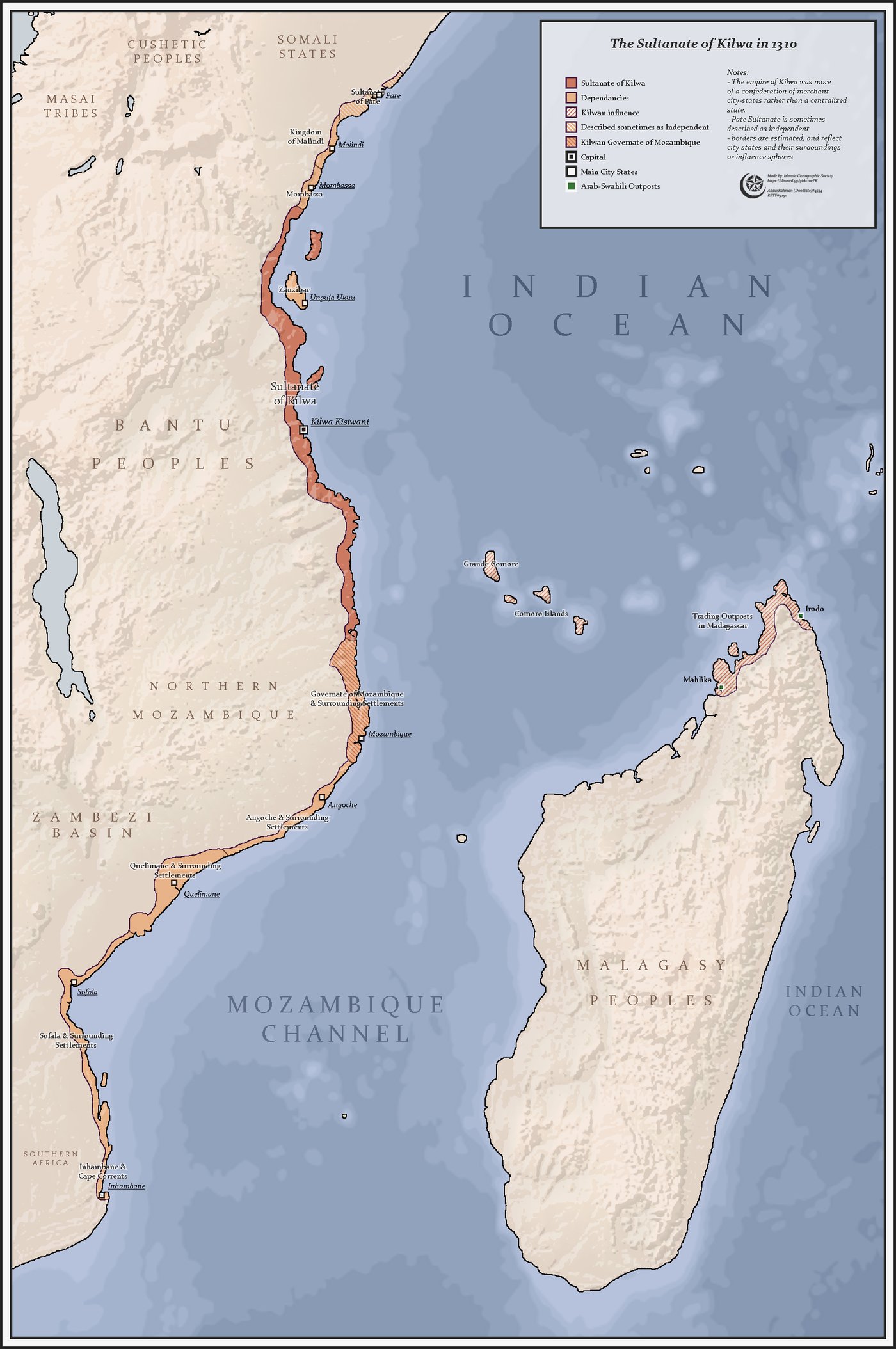
What made Kilwa rich in particular was gold. Far to the south, at a port called Sofala on the coast of what is now Mozambique, the gold of the African interior came down to the sea: metal mined and traded out of the highlands where, in the same centuries, the stone city of Great Zimbabwe was rising. Whoever controlled Sofala controlled the gold, and by the thirteenth century that was Kilwa. The sultans planted a governor there, taxed the trade, and sat back while the wealth of a continent’s heart flowed out through their harbour on its way to the wider ocean. Ivory went the same way, and mangrove poles, and, less comfortably to record, enslaved people taken from the mainland. Kilwa did not dig the gold or fell the ivory. It sat at the door and took its cut.
The prince who bought an island with cloth
Kilwa liked to tell a grand story about where it came from. It is written down in the Kilwa Chronicle, a history that survives in two versions (one in Arabic, one preserved by a Portuguese writer who had it read to him), and it goes like this. A prince of Shiraz, in Persia, one of the seven sons of a sultan by an Abyssinian slave woman, was pushed out of his inheritance by his brothers. He gathered his household into ships and sailed for Africa. Turned away from one port after another, he came at last to Kilwa, then held by a local ruler, and offered to buy the island. The price, the story says, was enough coloured cloth to ring the whole island round. The deal done, the seller had second thoughts and tried to wade back across the channel at low tide to take the place by force, but the tide came in, the water rose, and the Persians kept their island.
It is a good founding myth, and like most founding myths it is doing a job. Claiming a Persian prince for a grandfather made Kilwa’s rulers something more than local big men; it tied them to the prestige of the Islamic heartland, to Shiraz and its poets and its shahs. For a long time European scholars took the tale more or less straight, and imagined the Swahili towns as colonies planted by Arab and Persian settlers on a passive African shore. The stones say otherwise.
In the traditional telling, the Swahili cities were the work of incomers: Arab and Persian adventurers who arrived by sea, married into or displaced the locals, and built a civilisation of stone and Islam on a coast that had none. Kilwa’s own chronicle makes its dynasty the children of a Shirazi prince, and for centuries that was taken as history: a foreign gift, dressed in coral.
Excavation tells a different story. Beneath the coral mosques lie older layers of ordinary African fishing and farming villages, built of earth and thatch, that took up Islam and ocean trade gradually and grew wealthy from within. The Swahili were not colonists’ leftovers; they were a local culture that reached out to the ocean and pulled its riches ashore. The Shirazi legend is best read not as a boat that arrived but as a family tree back-dated for prestige: a real society claiming a glamorous ancestor it did not need.
The date the archaeology gives for a settlement at Kilwa is around the end of the tenth century, which fits the chronicle’s own timeline loosely enough. What it does not support is the picture of Persians arriving to build a city where none could have existed. The city was African. The trade, the faith and a flattering genealogy came over the water; the people who used them were already there.
Coral, coins and a palace on the cliff
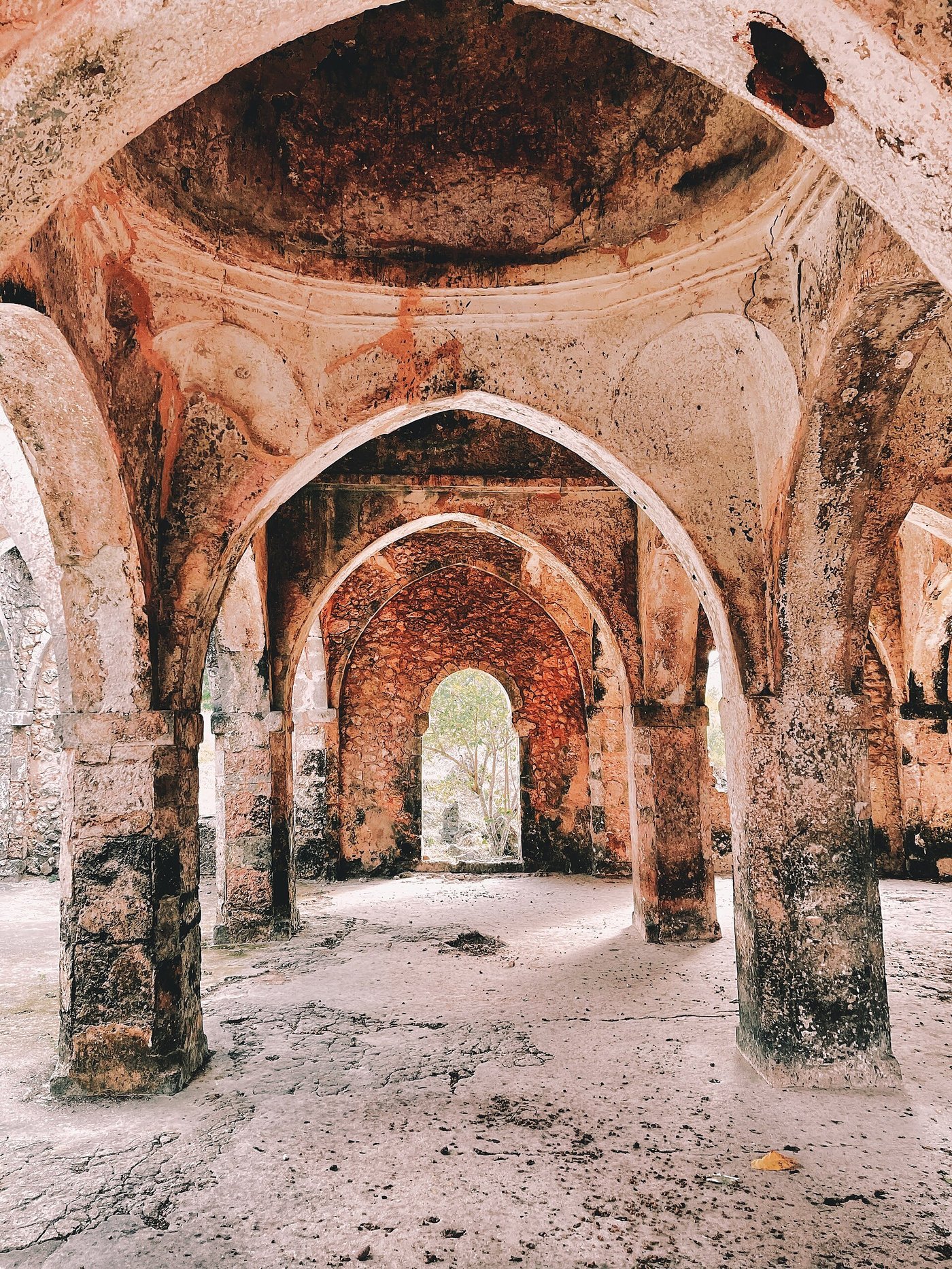
By the fourteenth century Kilwa was building on a scale nowhere else in the region matched. The favoured material was coral rag: blocks of fossil reef cut from the shallows, easy to shape when fresh and hard when dry, bound with lime made by burning more coral. Out of it the city raised the Great Mosque, begun perhaps in the eleventh century and enlarged again and again as the money came in. For a long stretch of the Middle Ages it was the largest mosque anywhere in sub-Saharan Africa. Its later builders roofed wide bays with domes and barrel vaults of coral, resting on pillars, in a style that owed something to the wider Islamic world and everything to local hands and local stone.
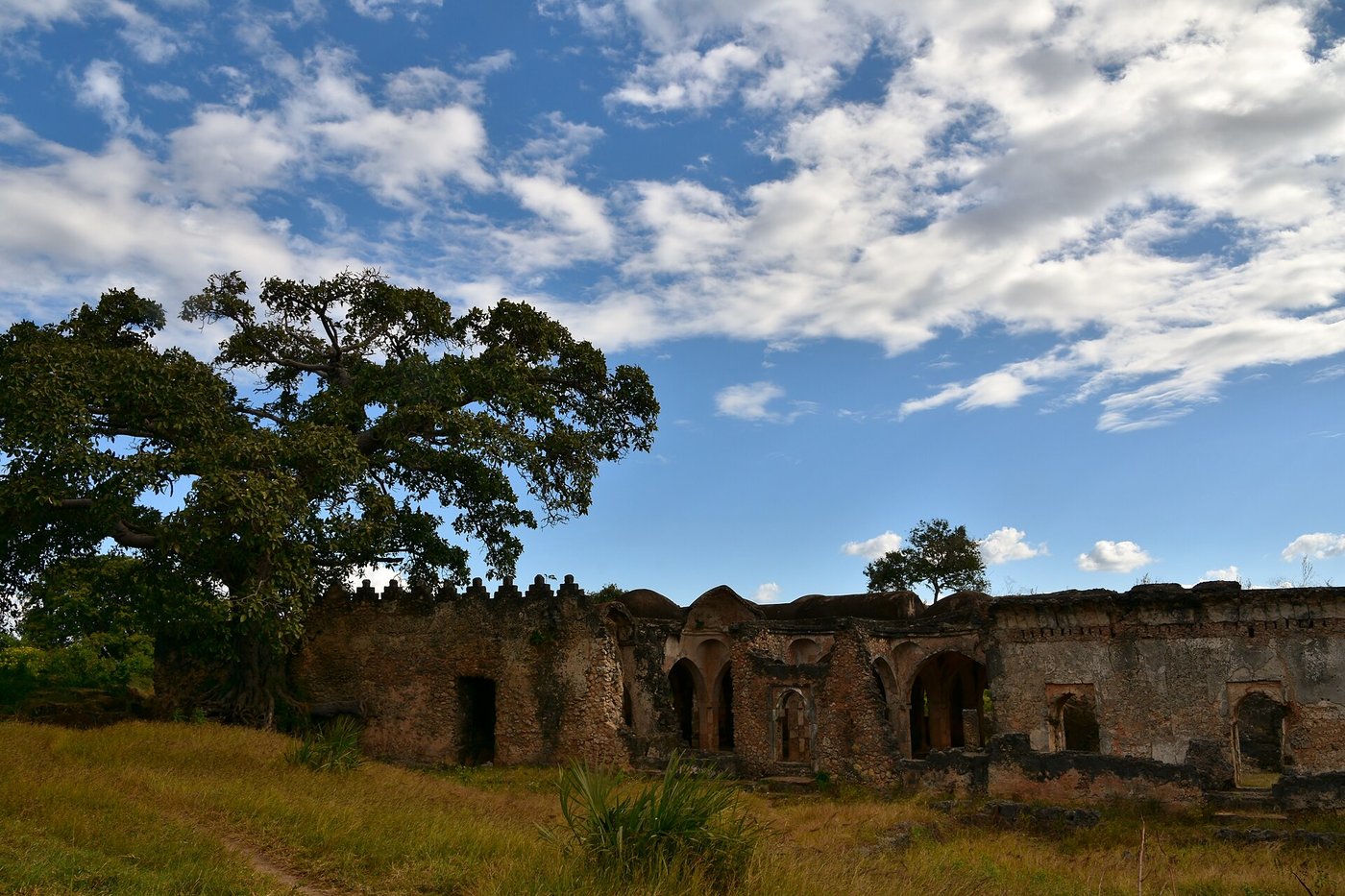
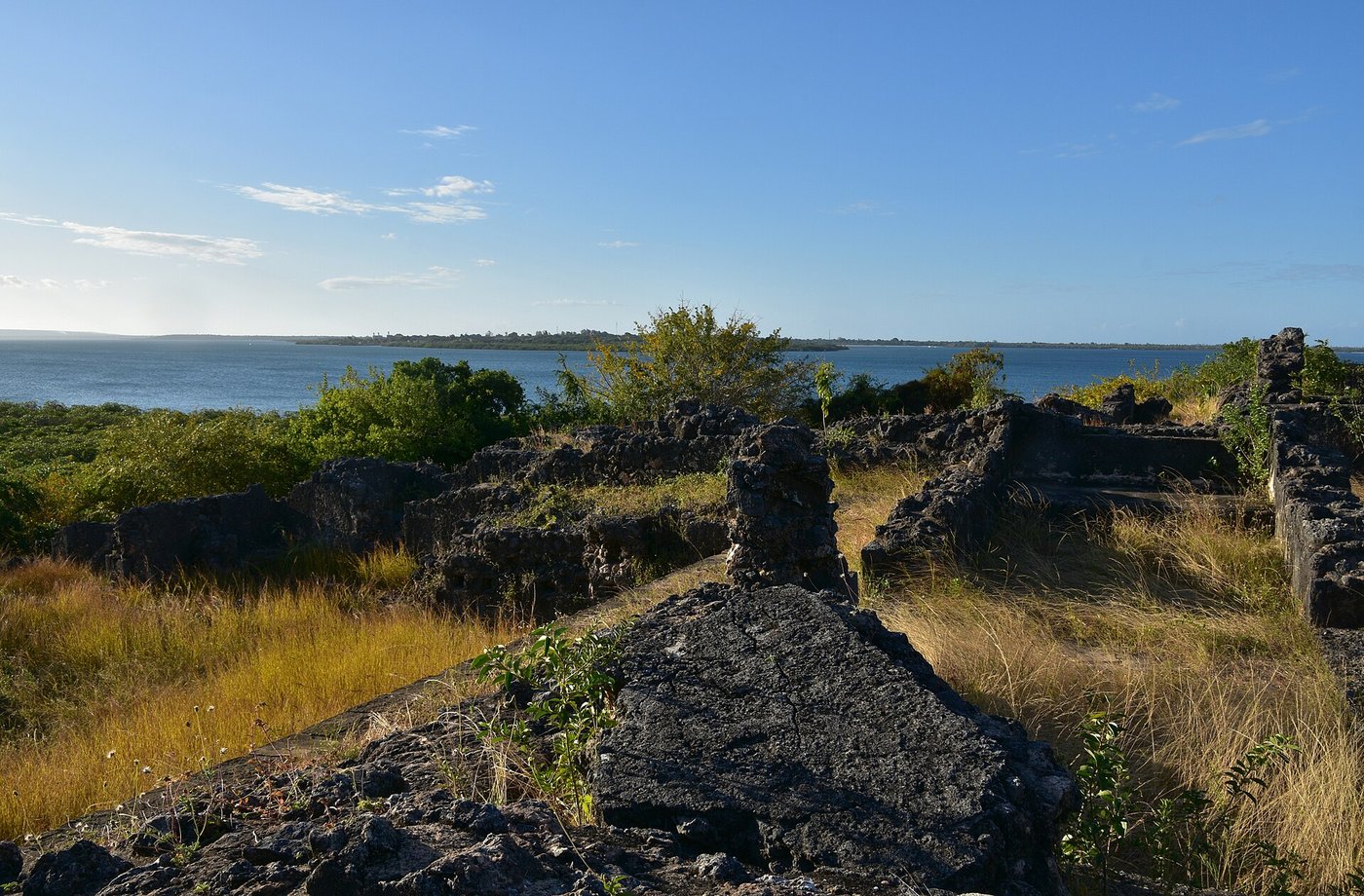
The most extravagant building was not the mosque but the palace. On the cliff at the northern edge of the island, looking out over the harbour approach, the sultans raised Husuni Kubwa, the great fort, though it was as much showroom and warehouse as fortress. It ran to something over a hundred rooms terraced down towards the water, with a large octagonal bathing pool, courtyards, an audience court, and a vast walled enclosure that seems to have been a store for goods waiting on the wind. It is usually credited to Sultan al-Hasan ibn Sulaiman, who ruled early in the fourteenth century, and it may have been the largest stone-built structure in sub-Saharan Africa before modern times. It was also, it seems, too ambitious: parts of it were never finished, and it was abandoned within a few generations, the sea breeze doing its slow work on the coral.
And Kilwa made money, literally. The sultans struck their own coins, mostly in copper, a few in gold, at a time when the use of coinage was rare almost everywhere south of the Sahara. It was one of the earliest mints in that whole vast region. The copper pieces were small, humble things, not gold to hoard but change to spend, and they turn up in their thousands in and around the city. They are the same kind of coin that ended up, five of them, in a tin in Australia.
Across most of medieval sub-Saharan Africa, wealth moved as gold dust, cloth, cattle and cowrie shells rather than struck coin. Kilwa was an exception. From at least the eleventh century its rulers issued copper coinage in quantity, each coin naming the sultan and a pious rhyme. Only one Kilwa ruler, al-Hasan ibn Sulaiman, is known to have struck gold, and just a handful of those survive. It is the copper (common, cheap, easily lost) that travelled, and that scattered along the trade routes as far as Great Zimbabwe, the ports of Arabia, and one improbable beach in the Australian north.
The traveller who could not stop praising it
In 1331 the greatest traveller of the age arrived. Ibn Battuta of Tangier, who spent his life crossing the Muslim world and writing down what he saw, sailed down the coast and stepped ashore at Kilwa. He called it one of the most beautiful and well-built towns in the world. He admired the layout, the mosque, the piety and the open-handedness of its sultan (the same al-Hasan ibn Sulaiman of the great palace), whom he watched give away much of what came into his hands. Some of that generosity, Ibn Battuta noted plainly, was funded by raids on the non-Muslim peoples of the mainland, whose goods and captives were carried back to the island. Kilwa’s beauty and Kilwa’s violence were the same coin, two faces of it.
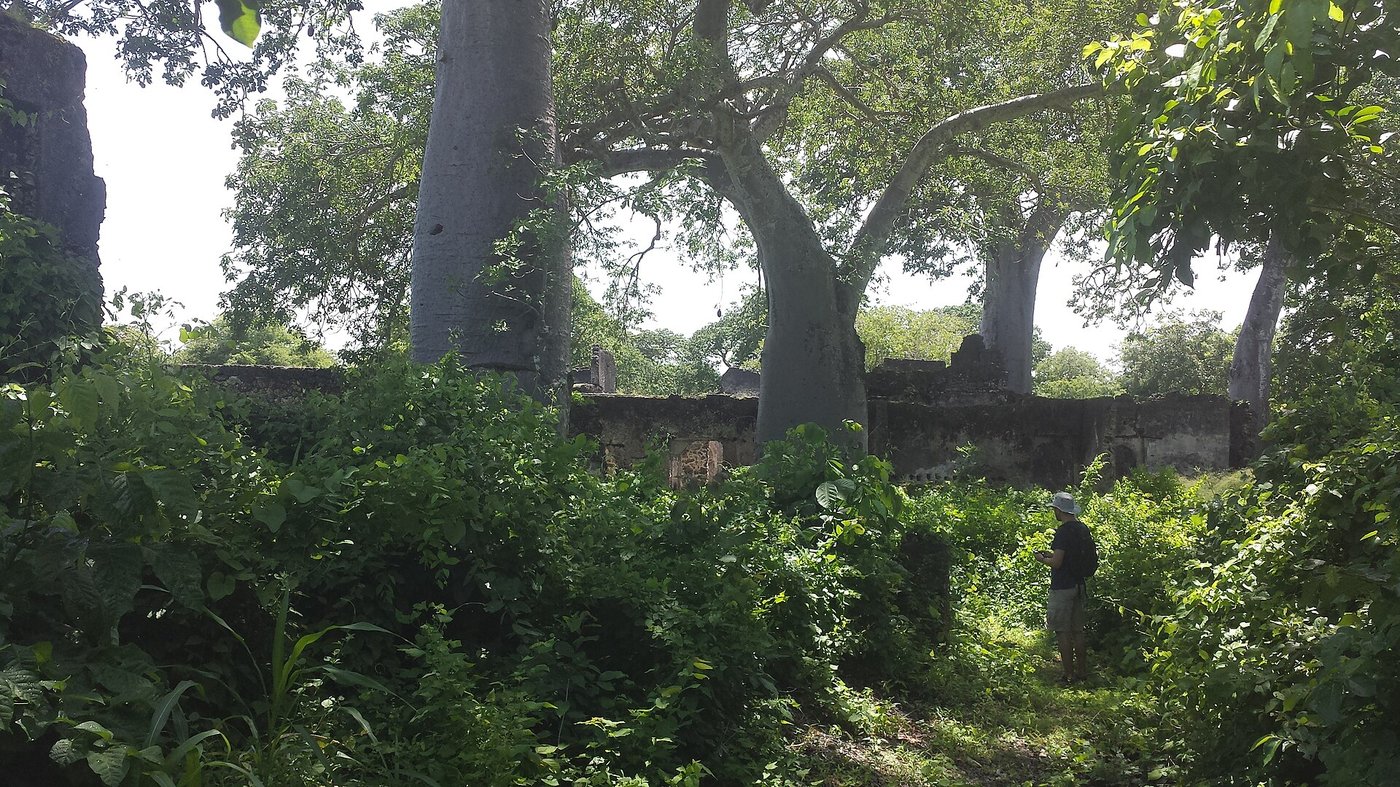
Kilwa was not a single city so much as the head of a family of them. Just across the water stood Songo Mnara, a smaller planned town of coral houses, mosques and tombs, laid out in the fourteenth and fifteenth centuries and today one of the best-preserved Swahili sites anywhere. Up and down the coast lay dozens more: Sofala to the south under Kilwa’s governor, and northward the ports that would later eclipse it. This was a whole civilisation of stone towns strung along the ocean’s edge, trading with half the world and answering, for a while, to Kilwa.
The fleet at the harbour mouth
What ended it came, as trouble so often did on that coast, from the sea. In 1498 Vasco da Gama rounded southern Africa and reached the Swahili ports, and the Portuguese understood at once what they were looking at: the wealth of the Indian Ocean, and a set of small rich cities with no answer to a broadside. On a later voyage da Gama forced Kilwa to promise tribute. When the tribute did not satisfy, the response was direct. In 1505 a fleet under Dom Francisco de Almeida sailed into the harbour, put men ashore, stormed the town, and sacked it. The Portuguese threw up a stone fort, the Gereza, to hold what they had taken.
Kilwa never came back from it. The gold trade was diverted, the Portuguese preferring to work through their own fort at Sofala and their base far to the north. The sultans became clients, then irrelevances. Later centuries brought new masters (Omani Arabs, a brief and grim revival under a French-fed slave trade in the eighteenth century, a last palace called the Makutani), but the great days were over. By the time European scholars came to measure the ruins, the domes of the Great Mosque had fallen in and the palace on the cliff was a shell full of sand.
How a Kilwa coin reaches Arnhem Land
Which brings us back to the beach. If Kilwa’s copper scattered along the ocean’s trade routes, how far could a coin travel? And could it reach a dune in northern Australia on its own?
The honest answer is that the coins probably did not come to Australia straight from Africa in some lost medieval crossing. Kilwa coins are found in many places precisely because they moved around the ocean for centuries after they were struck; a coin made in 1300 could still be rattling in a purse in 1700. The most likely story is that they arrived late and by accident. A ship (Portuguese, Arab, or from the Indonesian islands) carried them south as loose change, keepsakes or ballast, and they were lost on that coast, perhaps from a wreck, perhaps dropped by a visitor. From the seventeenth century onward, fishermen from Makassar in Sulawesi came to Arnhem Land every year for the sea cucumber, and Dutch and other European ships passed the same waters. Any of them could have carried an old coin. The four Dutch coins in the same tin point that way: a mixed handful of ocean money, gathered up and lost together, long after Kilwa itself was ruins.
Part of the trouble is that no one is quite sure where Isenberg’s coins came from. His hand-drawn map marked a spot, but the beach has moved in eighty years, and there is even doubt about which island he meant. In 2013 an expedition led by the anthropologist Ian McIntosh and the heritage consultant Mike Owen went back to the Wessels to try to relocate the find and search for more, without settling the question. Until a second coin turns up in a properly recorded dig, in a datable layer on a known beach, the how and the when stay open. What is not in doubt is the where they were made: a coral island off Tanzania, and nowhere else.
So the coins are not proof that Africans sailed to Australia. What they are is a small hard reminder of how large and how connected the old Indian Ocean world was: a world in which a coin struck on a little island off Tanzania could, by some chain of hands no one recorded, end up in the sand at the very bottom of the map. The mystery is not that the coin travelled. Coins were made to travel. The mystery is only the last few metres of its journey, from a ship’s deck to a dune, and those we may never recover.
What the island keeps
Kilwa Kisiwani is quiet now. A few hundred people live on the island among the ruins; fishing boats pull up on the beach below the old fort. The Great Mosque and the palace and Songo Mnara across the water were together made a World Heritage site in 1981, and for a decade they sat on the list of those in danger, the coral crumbling, the sea gnawing at the cliff under Husuni Kubwa. Conservators have shored up the worst of it. The domes still show the shape of the wealth that raised them.
It is easy to let a place like this shrink into its ending: the Portuguese fleet, the sack, the sand. But the coins argue against that. They were made by a city confident enough to put its rulers’ names in your hand every time you bought a fish, and careless enough, in its wealth, to let its small change roll away across an entire ocean. One of those coins ended up in a soldier’s tin on the far side of the world, waited thirty-five years in a drawer, and still would not fully explain itself. Kilwa was that kind of place. It touched more of the world than the world remembered, and it left the proof lying, green and unregarded, in the sand.
Read next: Mansa Musa: The Richest Man in History and the Hajj That Crashed a Currency.
Sources & further reading
- Neville Chittick, Kilwa: An Islamic Trading City on the East African Coast (British Institute in Eastern Africa) — the classic report on the excavations of the mosque and palace.
- Stephanie Wynne-Jones and Jeffrey Fleisher, work on Songo Mnara and the archaeology of Swahili urban life — on the local roots of the coastal towns.
- Mark Horton and John Middleton, The Swahili: The Social Landscape of a Mercantile Society — on Swahili identity, Islam and Indian Ocean trade.
- G. S. P. Freeman-Grenville, The Medieval History of the Coast of Tanganyika and his translation of the Kilwa Chronicle — on the founding legend and the sultans.
- Ian S. McIntosh, “Life and Death on the Wessel Islands: The Case of Australia’s Mysterious African Coins,” Australian Folklore — on the Isenberg find and the 2013 expedition.
- UNESCO World Heritage Centre, “Ruins of Kilwa Kisiwani and Ruins of Songo Mnara” (inscribed 1981) — nomination and conservation records.
Image credits (via Wikimedia Commons): the Great Mosque of Kilwa Kisiwani — Richard Mortel (CC BY 2.0); map of the reach of the Sultanate of Kilwa — AbdurRahman AbdulMoneim (CC BY-SA 4.0); interior of the Great Mosque — Halidtz (CC BY-SA 4.0); the ruins of Husuni Kubwa — Richard Mortel (CC BY 2.0); the ruins of Songo Mnara — Plouf250 (CC BY-SA 4.0).