In April 2026, days before Zimbabwe marked its independence, a small soapstone bird was carried out of a museum store in Cape Town and set on a table draped with a flag. The staff called it Chapungu. It was the last of eight carved birds taken from a ruined city in the 1890s, and it had spent about a hundred and forty years more than two thousand kilometres from the wall it once stood on. Around it were eight coffins holding human remains that had been dug up for study a century before. When the bird went north that week, it closed a story that began with a simple, ugly idea: that the people of southern Africa could not have built the thing the bird was taken from.
The city is Great Zimbabwe. It sits in the south of the modern country that took its name, on a saddle of high grassland near the town of Masvingo. It is the largest stone ruin in Africa below the Sahara, and for a long time it was the most argued-over. The strange part is what the argument was about. For most of a century, educated Europeans did not ask how the city had been built or when. They asked who could possibly have built it, and answered themselves before they had turned a single spade of earth. Anyone, they decided, but the Africans living all around it.
This is the story of a place, and of the lie that was wrapped around it: how the lie was made, how a government later tried to enforce it by law, and how the evidence, and the birds, finally came home.
A city that never hid
Great Zimbabwe was never lost in the way a jungle temple is lost. Its walls stood above the grass the whole time. Local people knew them, farmed around them, and kept stories about them. The word itself gives the game away. "Zimbabwe" comes from the Shona dzimba dza mabwe, houses of stone, or from dzimbahwe, the venerated house of a chief. The name is a plain description in the language of the people whose ancestors raised it.
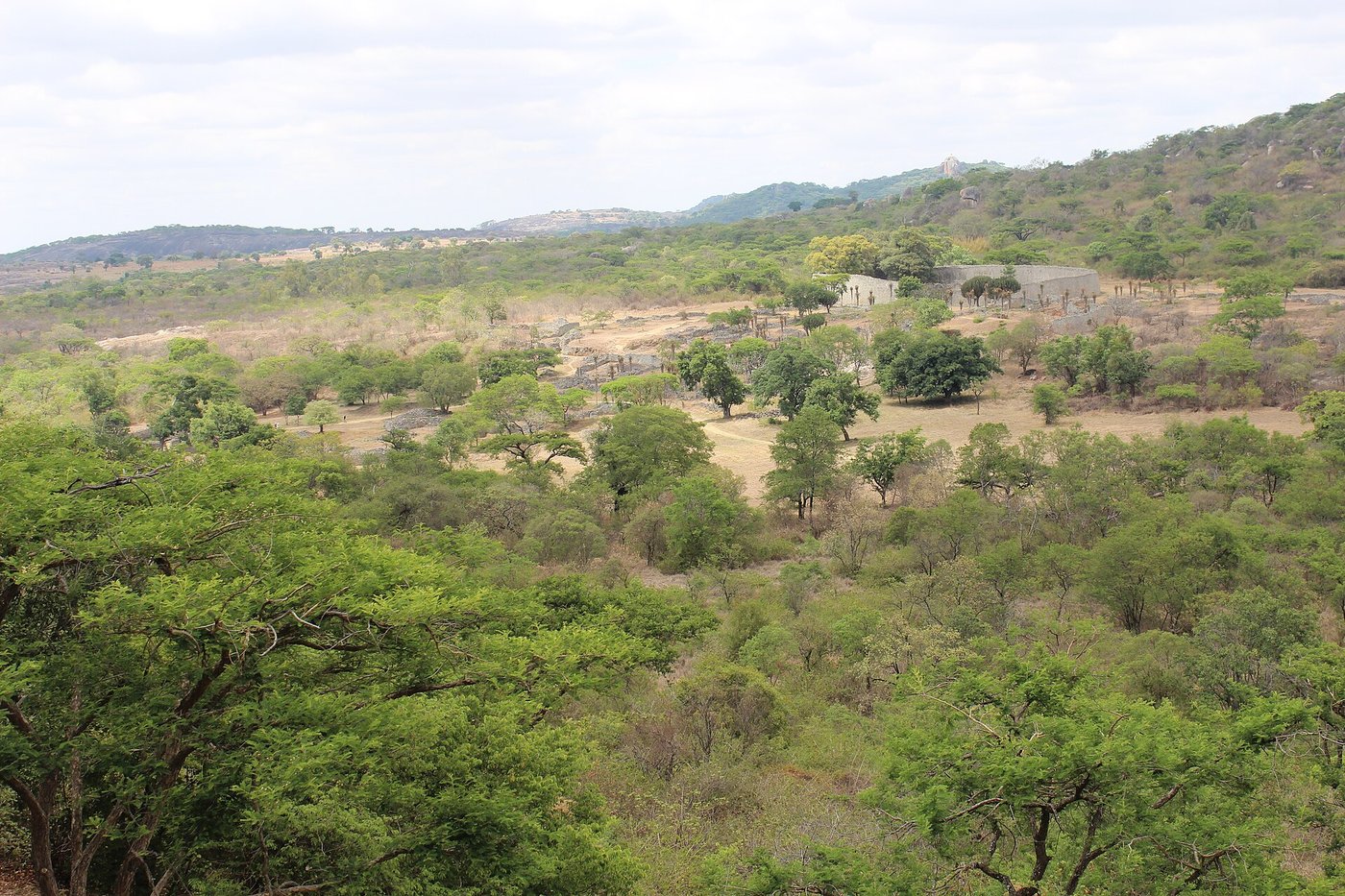
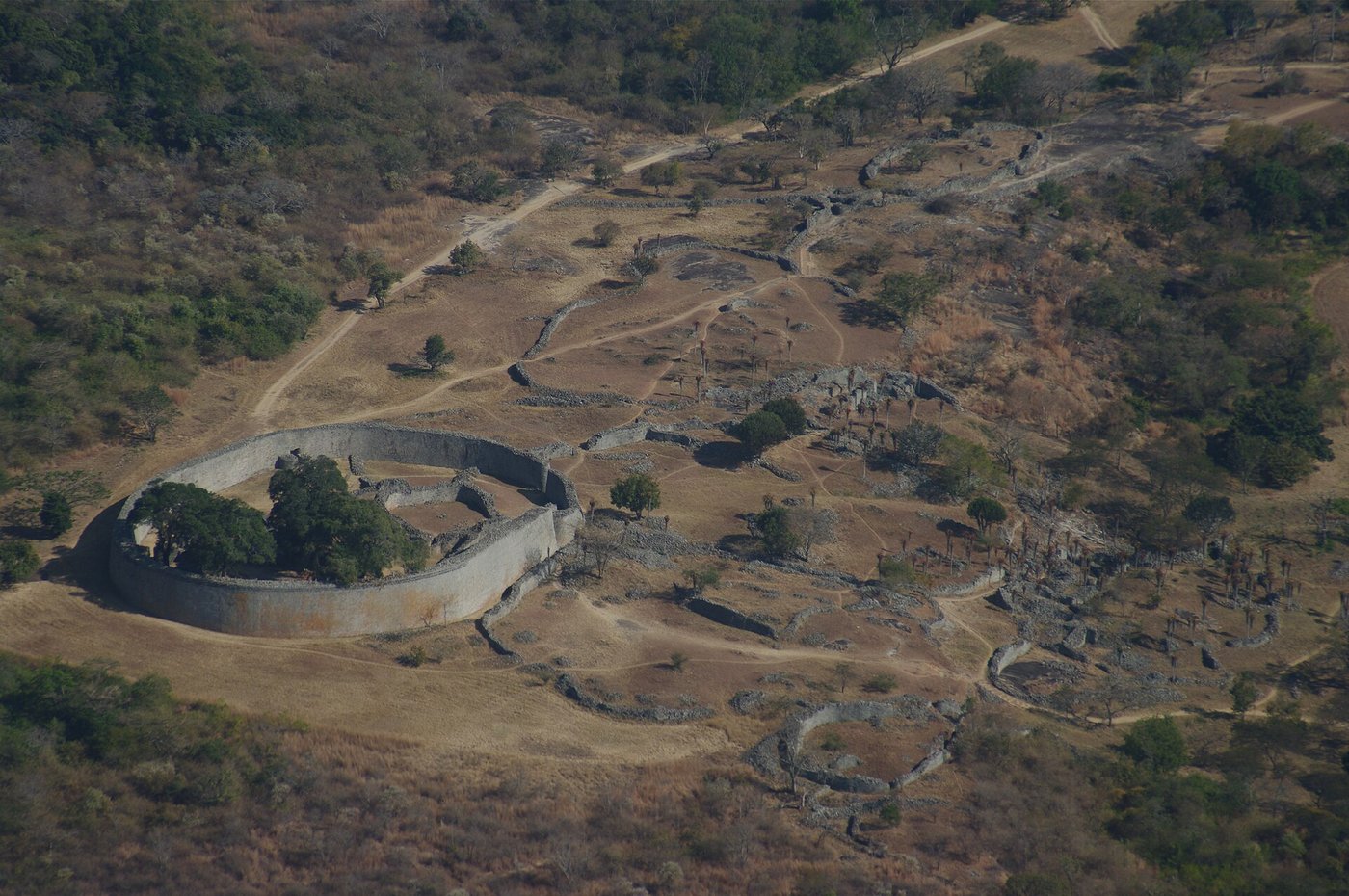
The site has three main parts. On a granite hill stands the oldest section, a maze of walls threaded between huge natural boulders, often called the Hill Complex. Below it, on the flat, sits the Great Enclosure, the piece everyone pictures: an oval ring of coursed stone with an outer wall that climbs close to ten metres and thickens to five metres at the base. It is the single largest ancient structure south of the Sahara. A scatter of smaller ruins fills the valley between and around them, the footings of the ordinary town.
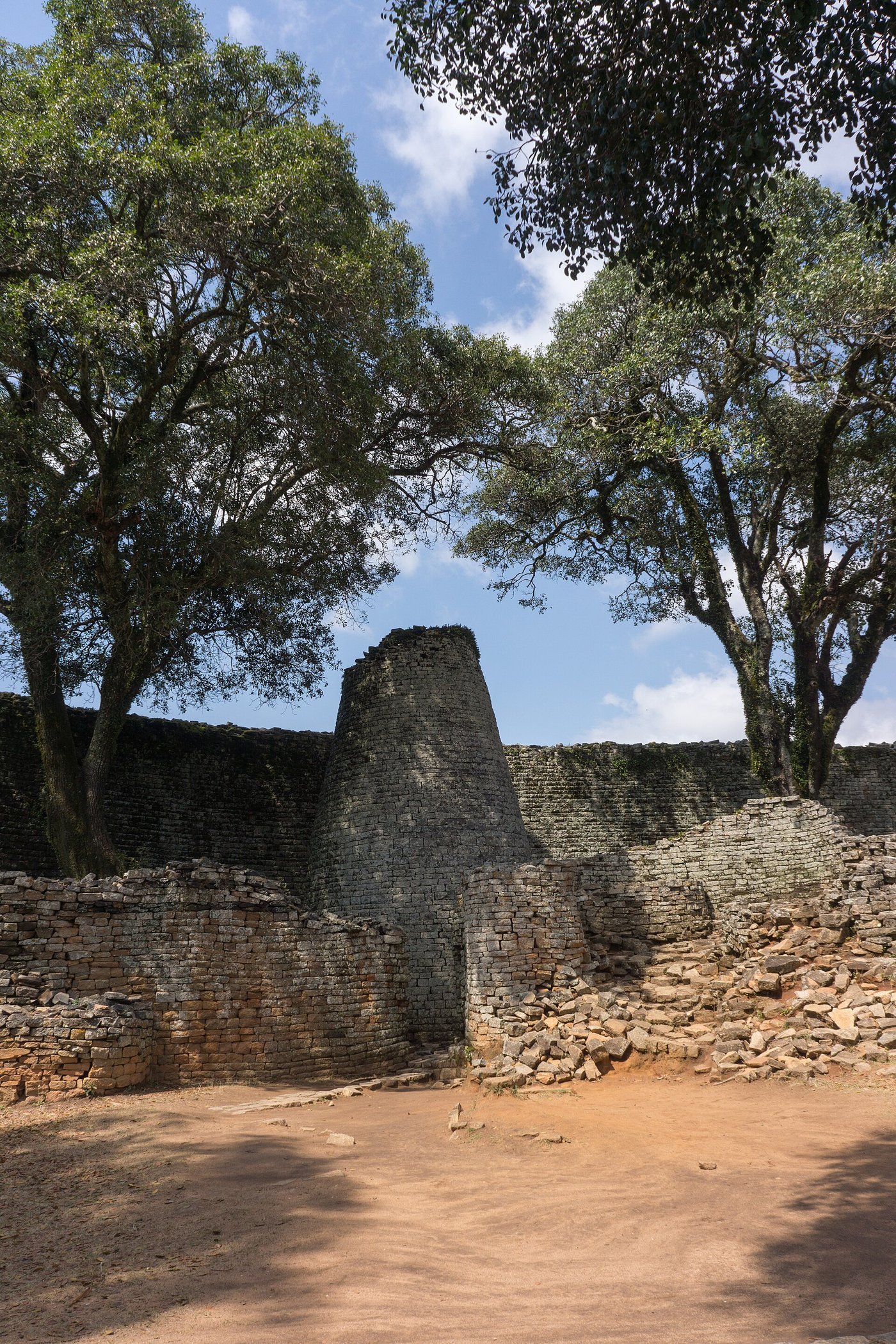
Inside the Great Enclosure stands its most talked-about feature, a solid cone of masonry about ten metres tall. It has no door, no chamber, no stair. It is simply a tower, and most scholars now read it as a giant version of a grain bin, a symbol of a full granary, and so of a ruler who kept his people fed. It says something about the city that its grandest object is a monument to a full harvest.
People lived here in real numbers. At its height in the fourteenth century the settlement spread across some seven hundred hectares and may have held around eighteen thousand people, with the ruling families in the stone enclosures and everyone else in clay-walled houses across the surrounding land. This was not a temple standing empty in the bush. It was a crowded capital.
What the coast sent inland
Great Zimbabwe grew rich because it sat in the right place. The plateau around it held gold, and beyond the gold lay cattle and ivory. To the east, down the rivers and across the low country, ran the ports of the Indian Ocean: Sofala, and beyond it the great Swahili trading town of Kilwa. Gold and ivory went down to the coast. The wider world came back up.
The proof is in the ground. Diggers at Great Zimbabwe have turned up glass beads by the thousand, fragments of Chinese porcelain, shards of Persian pottery with their bright glazes, worked glass from the Near East, and a coin struck at Kilwa in the fourteenth century. None of it was made anywhere near the plateau. All of it arrived because the city had something the ocean wanted, and traders were willing to carry luxuries a very long way to get it.
The undisturbed floors of Great Zimbabwe held Chinese porcelain, Persian glazed pottery, Near Eastern glass, tens of thousands of imported glass beads and a fourteenth-century coin minted at Kilwa on the Swahili coast. Every one of those objects tells the same story: a home-grown African state, rich enough in gold and ivory to pull the trade of the Indian Ocean up onto the plateau.
Here is the part the later story worked hard to hide. The imported goods do not show that foreigners built the city. They show the opposite. A community that could gather gold from the hills, drive it to the coast, and bring back Chinese porcelain was a community with its own reach and its own power. The beads and coins are the receipts of African merchants, not the calling cards of foreign masons.
Stone laid without a drop of mortar
Walk up to the wall and the first thing you notice is that nothing holds it together. There is no mortar, no cement, no clay filling the joins. The whole thing stands by weight and by fit: hundreds of thousands of stone blocks stacked so cleanly that the wall has held its shape for six centuries.
The builders had a gift from the local granite. When the region's bare granite domes heat in the sun and cool at night, the outer skin cracks and peels away in flat, even sheets. Those sheets break into slabs that are already close to brick-shaped. The masons gathered them, trimmed them, and laid them in level courses, the way a bricklayer works, tapering the great walls inward as they rose so the mass held itself steady.
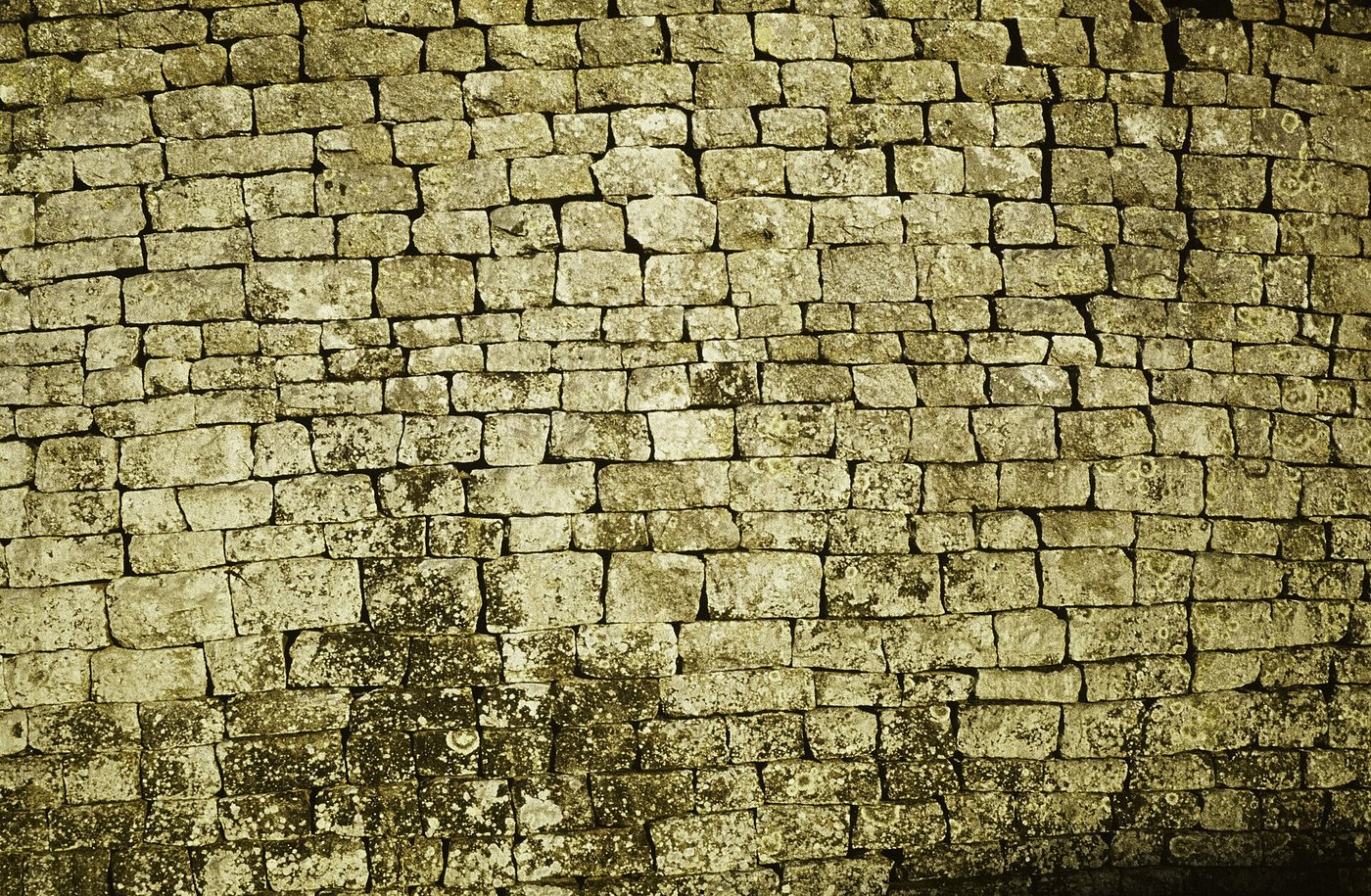
Great Zimbabwe's walls use no mortar at all. The masons exploited a local quirk, sun-cracked granite that flakes into flat, brick-like slabs, and laid it in careful courses, battering the thick walls inward for stability. It is patient, skilled, entirely local engineering, and it has stood for roughly six hundred years without a binding agent of any kind.
None of this needs a lost race to explain it. It needs granite, time, and people who knew their material. The technique is specific to this landscape, which is exactly why it appears here and at the many smaller stone-walled sites across the same plateau. The style was born on the ground it stands on.
The lie that came with the first visitors
The trouble started with a German named Karl Mauch. In 1871 he reached the ruins, guided there by local people and by a hunter who had seen them, and he decided almost at once that he had found something from the Bible. The walls, he thought, were the work of the Queen of Sheba; the site was Ophir, the land that sent gold to King Solomon. He cut a splinter from a wooden lintel, decided it smelled like cedar, and concluded it must be Lebanese cedar carried from Solomon's temple. It was local wood. The idea, though, was already loose.
Twenty years later the myth got a coat of respectability. In 1891 the antiquarian Theodore Bent came out to dig, backed by the Royal Geographical Society and by Cecil Rhodes, whose British South Africa Company had just seized the country and named it, after himself, Rhodesia. Bent found African pottery, African ironwork, African gold-working tools. Then he wrote a book, The Ruined Cities of Mashonaland, arguing that some ancient northern people (Phoenicians, or Arabians from the south of the peninsula) had raised the city, and that the local Africans had only wandered in later. The finds pointed one way; the conclusion marched off the other.
It is worth being clear about why this happened, because it was not an honest mistake that anyone could have made. Rhodes and the settlers around him were in the middle of taking the land. A city built by Africans, and recently, was an awkward neighbour to a story about bringing civilisation to an empty wilderness. A city built by a vanished white or Near Eastern race was convenient. It made the ruins a relic to be admired and the living Shona a people with no claim to greatness and no claim to the ground. The archaeology was bent to fit the conquest.
Myth: Great Zimbabwe was built by a lost civilisation from the north (Phoenicians, Arabians, or the Queen of Sheba's people) because Africans could not have raised stone walls on this scale.
Reality: every excavation that dug undisturbed ground found African pottery, ironwork and gold-working tools, and radiocarbon dates in the medieval centuries. The city was built by the ancestors of the Shona, between roughly the eleventh and fifteenth centuries. The "lost race" was never anything but a story the conquerors needed.
The curator who dug the evidence away
The most damage was done by a man trying to prove the myth. In 1902 Richard Nicklin Hall was put in charge of the ruins with orders to clear and tidy them. He believed foreigners had built the place, and he set out to find their traces. To do it, he dug out the accumulated deposits inside the enclosures (in places more than a metre of packed floors and rubbish and fallen stone) and threw them away, down to bare rock.
Think about what that means. The layers he shovelled off were the record. They held the pottery, the beads, the bones and the burnt grain that could have dated the city and named its builders, stacked in order like pages. Hall was hunting for a Phoenician layer that was never there, and to reach it he destroyed the African layers that were. When professional archaeologists arrived a few years later, some of the best evidence had already been carted off in barrows. Hall was eventually removed, but the harm stood.
Two excavations the settlers could not argue with
In 1905 the Royal Geographical Society sent out a trained field archaeologist, David Randall-MacIver, to do the job properly. He looked for ground Hall had not wrecked, dug it in careful layers, and recorded what came from where. He found no foreign city under the African one. The objects in the undisturbed deposits were the goods of a medieval African town, and nothing older or stranger lay beneath. He put it in print in a book with a deliberately flat title, Medieval Rhodesia. The message was in that first word: not ancient, not Phoenician. Medieval, and African.
The settlers did not want to hear it, so a generation later the question was tested again, harder. In 1929 Gertrude Caton-Thompson, one of the most exacting excavators of her age, came to Great Zimbabwe for the British Association. She chose untouched ground, including a drain sealed inside a wall, so that whatever she found had to belong to the people who built that wall and could not have washed in later. The datable objects were medieval imports. Her verdict was blunt: the ruins were African in origin and medieval in date, and the evidence for anything else did not exist. Two careful digs, a quarter of a century apart, had reached the same answer.
Randall-MacIver in 1906 and Caton-Thompson in 1929 both dug undisturbed ground, and both concluded the same thing: Great Zimbabwe was medieval and African. Later radiocarbon dating, first run at the site in the 1950s, confirmed the medieval range down to the century. The science was settled long before the politics allowed anyone to say so out loud.
A government that tried to un-name a city
By the second half of the twentieth century the facts were not in serious doubt among archaeologists. They were, however, a political problem for the white-minority government of Rhodesia, which declared its own independence from Britain in 1965 to hold on to power. A medieval African capital, sophisticated and self-made, contradicted the whole justification for that government. So it reached for the tools of the state.
Official guidebooks and museum displays were required to present the origin of Great Zimbabwe as an open question, when it was not one. Tourists were shown scenes of Africans bowing before the wise outsiders who had supposedly raised the walls. Civil servants whose job was to study the past were told, in effect, what conclusion they were allowed to reach. The senior state archaeologist Peter Garlake, who kept saying plainly that the city was African, found his position impossible and left the country around 1970. A regime was censoring the age of its own stones.
It did not hold. The African-origin case had the evidence, and a government cannot outvote a sealed drain full of medieval pottery forever. When the country won majority rule in 1980, the new nation did the most pointed thing it could. It took the name of the very city the old order had spent a century explaining away. Rhodesia, named for the man who funded the myth, became Zimbabwe, named in the language of the people who built the stones.
The birds fly home
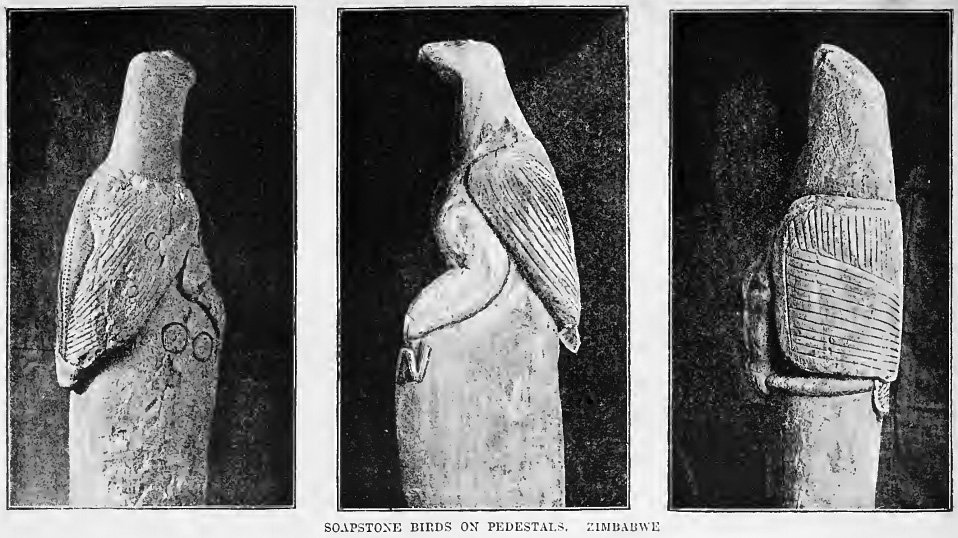
Which brings the story back to the birds. Eight of them were carved from soapstone and set on tall stone columns, each about a metre and a half high, most of them standing in the eastern part of the Hill Complex. They are not quite eagles and not quite people: upright birds with a few human touches, lips instead of a beak here, five-toed feet there. Nobody living can say for certain what they meant, though many link them to ancestors and to messengers between the living and the dead. They matter enough now that one of them stands on the national flag.
Within a few years of Bent's visit, almost all of them were prised loose and carried off. One was sold to Cecil Rhodes and ended up in his house at Groote Schuur in Cape Town. Others scattered into museums and private hands. One bird was even sawn in two: its upper part went one way, while the lower portion, the carved pedestal, passed to a German missionary and then to a museum in Berlin. During the Second World War the Soviet army carried that fragment off to the east, and only after the Cold War did it find its way back to Berlin, and then, at the turn of this century, home to Zimbabwe, where the two halves of the one bird were joined again.
The last to come back was Chapungu, the bird that had sat longest in Cape Town. In April 2026, with ancestral human remains that had also been taken for study, it was handed over and returned north, arriving just before Independence Day. The gap between the taking and the return is almost exactly the length of the lie itself: a hundred and forty years, from the decade the myth was manufactured to the week the last carving came home.
Stand today at the foot of the Great Enclosure and the argument looks faintly absurd. The wall is there. It is enormous, and beautifully made, and it was built by the people who lived beside it, using the stone under their feet, to run a kingdom that traded with China. It took soldiers, curators and finally a government to talk anyone out of believing that. The stones never needed the help. They only needed to be read honestly, and, at last, to have their birds back on the wall.
Read next: Kilwa Kisiwani: The African Coins Found on an Australian Beach and Tiwanaku: The Andean Temple a Satellite Found Under a Farmer's Field.
Sources & further reading
- David Randall-MacIver, Medieval Rhodesia (1906) — the first professional excavation to date the site to the medieval period and identify it as African.
- Gertrude Caton-Thompson, The Zimbabwe Culture: Ruins and Reactions (1931) — the meticulous 1929 dig that put the African-origin conclusion beyond reasonable dispute.
- Peter Garlake, Great Zimbabwe (1973) — a synthesis by the state archaeologist forced out for defending the evidence.
- Edward Matenga, The Soapstone Birds of Great Zimbabwe: Archaeological Heritage, Religion and Politics (2011) — on the carvings, their looting and their return.
- Innocent Pikirayi, The Zimbabwe Culture: Origins and Decline of Southern Zambezian States (2001) — on the rise, trade and fall of the city.
- Iziko Museums of South Africa and the Zimbabwean National Museums and Monuments — reporting on the 2026 return of the Chapungu bird and ancestral remains.
Image credits (via Wikimedia Commons): aerial view of Great Zimbabwe — Janice Bell (CC BY-SA 4.0); outer wall of the Great Enclosure — Todinirunganga (CC BY-SA 4.0); the Conical Tower — Fanny Schertzer (CC BY 3.0); dry-stone wall detail — Aart Rietveld / ASC Leiden (CC BY-SA 4.0); soapstone birds on pedestals — from J. Theodore Bent, 1892 (public domain).