In the summer of 2009, a small British and Ukrainian team dragged a magnetometer back and forth across a field near the village of Nebelivka, in the rolling farm country south of Kyiv. They were not digging. The instrument reads the faint magnetism of what lies below, and as the readings turned into a plan on a laptop screen, something enormous came up out of the soil. Not one buried house but hundreds, set out in vast concentric rings, a lattice of streets running in towards a wide empty middle. The plan covered nearly two and a half square kilometres. It was the outline of a settlement raised around 4000 BCE, and by the numbers it was one of the largest places anyone on Earth had built up to that time.
The people who made it left no writing, so they never told us what they called it. We call the whole world they belonged to by two village names stuck together (Cucuteni, in Romania, and Trypillia, in Ukraine), because that is where the first pots were dug up. For a long time the culture was filed away as a scattering of Copper Age farming villages, colourful pottery and little else. Then the magnetometers arrived, and the villages turned out to be cities. Cities that had no palaces, kept no kings, and, every few generations, burned themselves to the ground on purpose.
Two villages that named a lost world
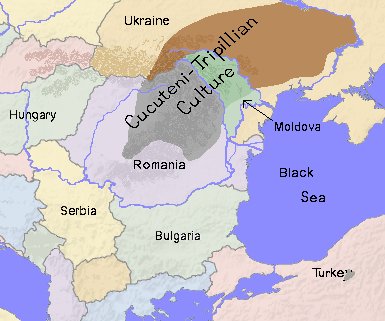
The story of the finding runs backwards, from small things to enormous ones. In 1884 a Romanian scholar, Teodor Burada, noticed painted potsherds turning up near the village of Cucuteni and began to dig. A decade later, working near Kyiv, a Czech-born archaeologist named Vikentiy Khvoyka uncovered the same kind of bright, swirling pottery at a place called Trypillia. On opposite sides of a closed imperial border, the two men had found halves of one thing. Only much later did anyone realise the Cucuteni pots of Romania and Moldova and the Trypillia pots of Ukraine belonged to a single culture that had spread across roughly 350,000 square kilometres, from the Carpathians to the Dnieper, and lasted some two thousand years.
For most of the twentieth century the picture stayed small. Archaeologists dug house by house, found ovens and painted jars and clay figurines, and reconstructed a settled farming people who grew wheat and barley and kept cattle. Then, in the 1960s and 70s, a Soviet topographer began studying aerial and military survey photographs of the Ukrainian countryside and saw patterns no plough had made: huge oval rings of dark marks, hundreds of metres across, showing where burnt houses lay under the fields. The sites were far bigger than anyone had guessed. When ground-based geophysics caught up, decades later, the true scale finally settled the argument. These were not overgrown villages. They were the biggest settlements of their age anywhere in the world.
Bigger than anything else then alive
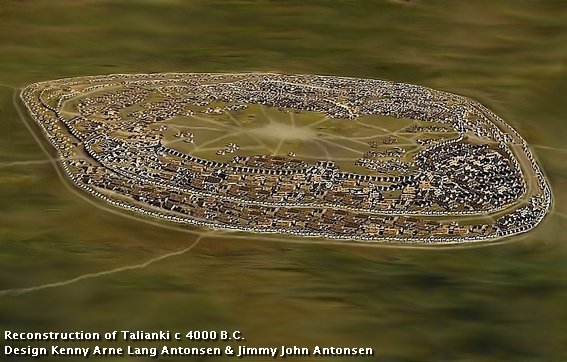
Numbers make the point better than adjectives. At the peak of the culture, between roughly 4100 and 3500 BCE, the largest Trypillia sites (Taljanky, Maidanetske, Nebelivka) sprawled over 250 to 320 hectares and held, on the higher estimates, ten to fifteen thousand people, packed into a couple of thousand houses. Nothing in Mesopotamia was yet that large. The great cities of Sumer, the ones the textbooks still hand the title "first cities," would not swell to comparable size for several centuries. If the measure of a city is simply how many people live crowded together in one built-up place, then the earliest cities on Earth stood not between the Tigris and the Euphrates but in the black-earth farmland northwest of the Black Sea.
The geophysical survey at Nebelivka mapped a settlement of around 238 hectares containing well over a thousand houses, laid out in a series of concentric circuits with radial streets and a large, almost empty central space. Scattered through the rings were more than a hundred larger buildings the excavators call assembly houses, and near the centre stood one giant structure roughly 60 by 20 metres (about 1,200 square metres of floor), among the largest roofed buildings known anywhere in prehistoric Europe.
What throws people is that this happened with a Copper Age toolkit. No bronze, no iron, no writing, no wheel-turned pots, no draught of large-scale slavery that we can see. The Trypillia builders raised the largest towns on the planet using stone, copper, timber and clay, and the labour of ordinary households. The scale was real; the machinery we assume you need to reach it was not there.
The shape of the plan
Seen from above, a Trypillia megasite is unmistakable and slightly hypnotic. The houses stand shoulder to shoulder in a ring, sometimes joined wall to wall into a near-continuous band. Inside that ring runs another, and another, so the settlement grows as a set of nested ovals. Streets radiate inward like the spokes of a wheel, and at the very heart of the plan sits a broad open space with almost nothing built on it: no temple, no citadel, no royal compound looming over the rest.

The layout hints at how the place was run, and the answer seems to be: from the bottom up. The rings are divided into neighbourhoods, each with its own larger building (the assembly houses) where a cluster of families could meet, hold rites, and settle whatever needed settling. There is no single seat of power at the centre because, as far as the archaeology shows, there was no single power. A town of thousands appears to have organised itself as a federation of quarters, each looking after its own, all sharing a plan nobody was compelled to follow.
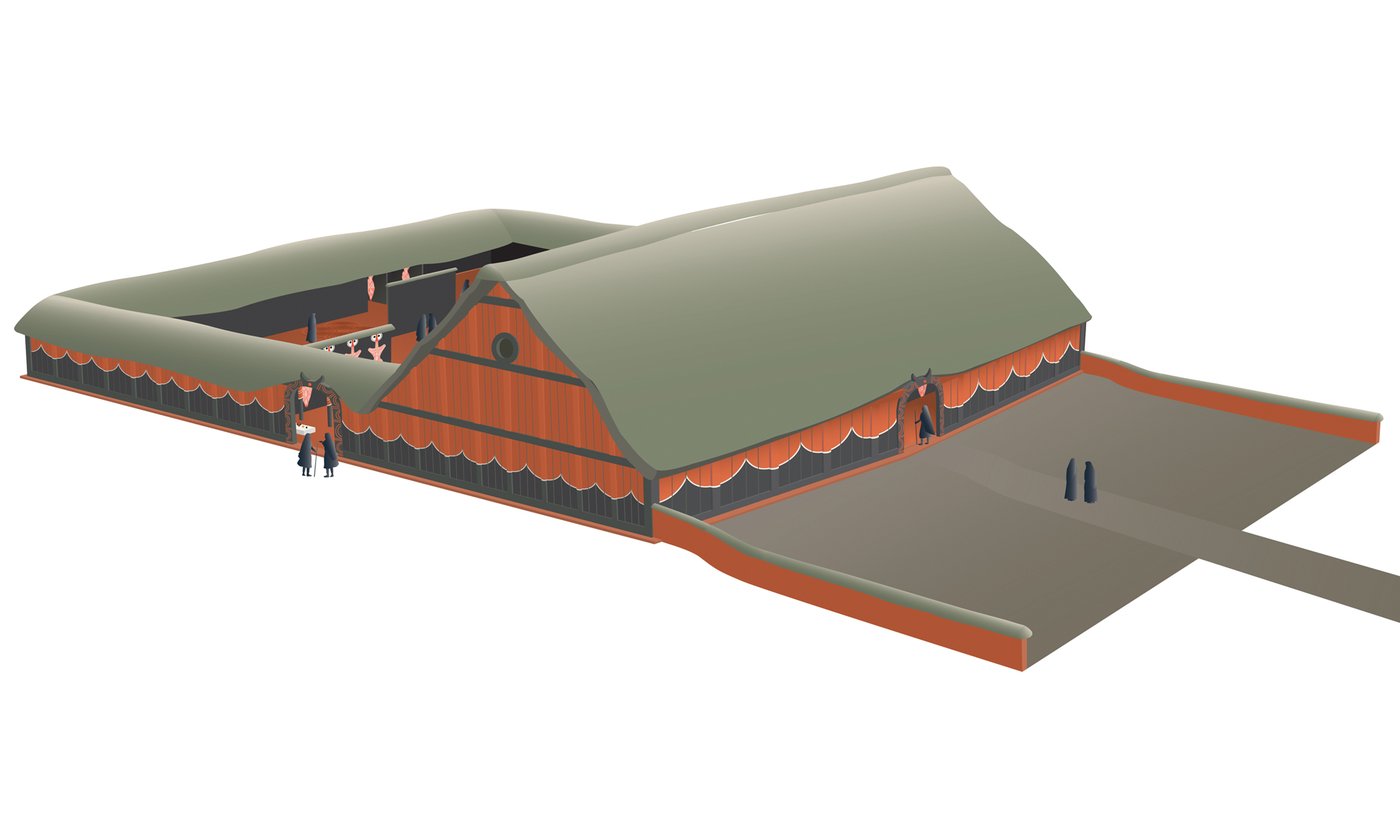
The houses themselves were substantial. Many were two storeys, built of timber posts packed with wattle and daub, floored with fired clay, and fitted inside with domed ovens, raised platforms, and grinding stones for turning grain into flour. Families lived above their stores and their work. A Trypillia town was not a cluster of huts around a great man's hall. It was thousands of near-identical family houses, each much like its neighbour, arranged with a planner's eye and no obvious boss.
Painted pots and the little clay women
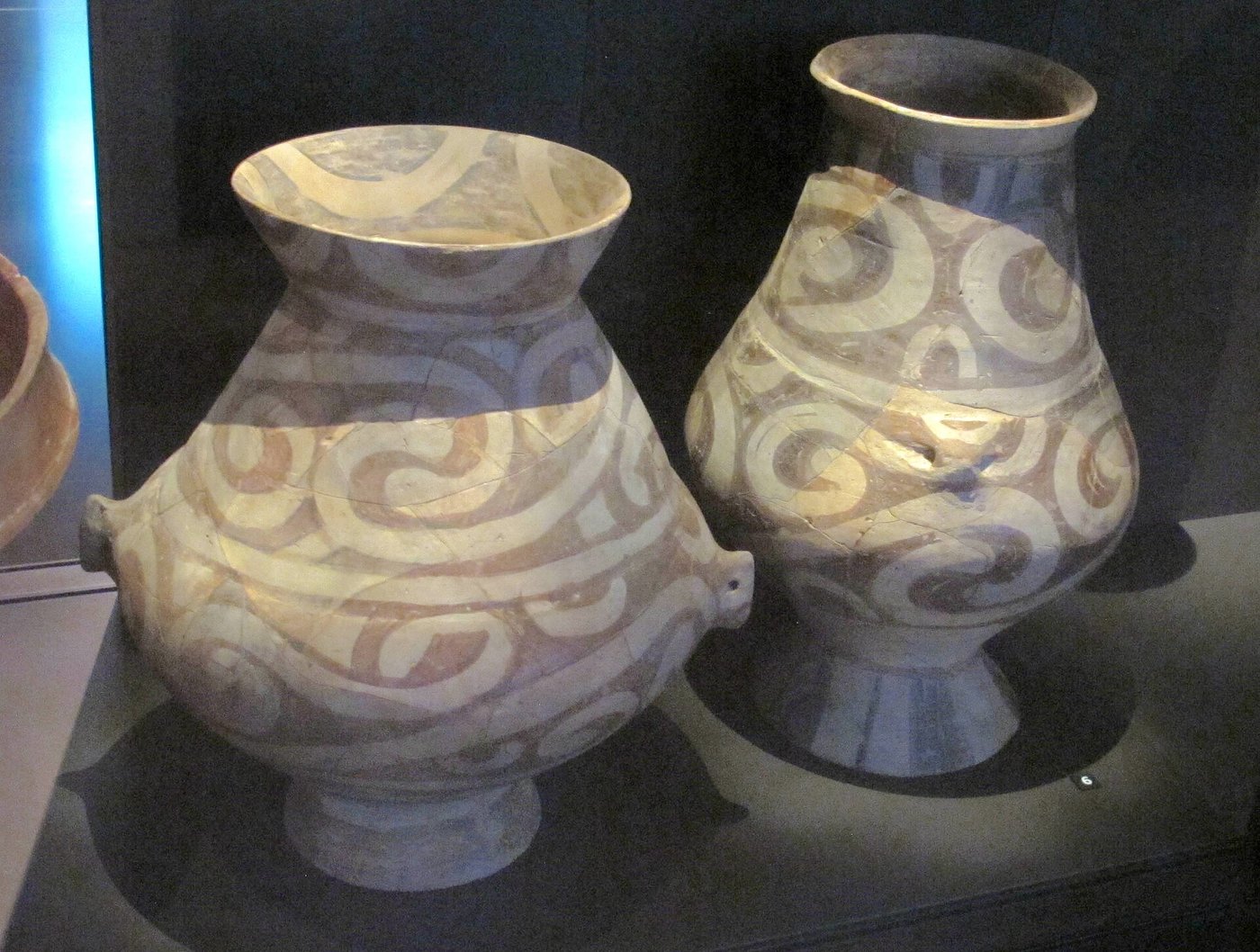
If the buildings tell you how these people lived, their pottery tells you how they saw the world. Trypillia ceramics are some of the most beautiful of the whole prehistoric age: tall storage jars, bowls and strange binocular-shaped vessels, painted in red, white and black with spirals, waves and running curves that seem to turn as you look at them. Their kilns reached one thousand degrees and more, hot enough for crisp, hard-fired ware. Among the finds is a small clay model of a potter's wheel, one of the oldest hints anywhere that the wheel was being turned, and other models of wheeled sledges that predate the wheeled carts of Mesopotamia by centuries.
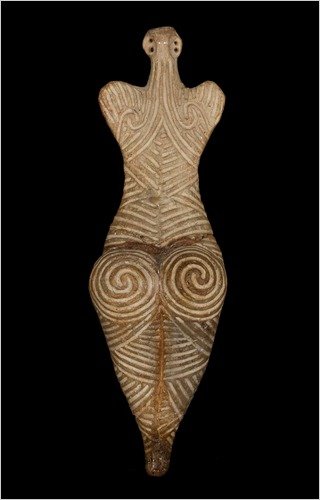
Then there are the figurines, thousands of them, mostly small clay women. Some are marked with incised lines that may stand for tattoos or woven cloth; many were found in and around the houses, a few set near ovens or under floors. Nobody can say for certain what they meant: household protectors, offerings, images of a goddess, tokens of a story now lost. They are a reminder of how much of this culture's inner life is simply gone. We have the pots and the plans and the burnt clay. The beliefs that gave them meaning went up with the smoke.
The town that set fire to itself
Here is the strangest thing of all. Across this whole world, from Romania to Ukraine, the houses were burnt: not a few of them by accident, but most of them, deliberately, again and again, over two thousand years. Dig a Trypillia house and you find its walls fired to a hard ceramic slag, floors baked, clay collapsed inward in a way that ordinary domestic fires never manage. Whole settlements show the same signature. Archaeologists gave the pattern a name: the burned house horizon.
For a long time you could argue it was misfortune: open hearths, timber and thatch, sparks, bad luck. Experiment killed that idea. When researchers built full-size wattle-and-daub houses and set them alight the ordinary way, the clay barely fired at all; less than one in a hundred parts of the daub turned to the hard, vitrified stuff found in the ground. To bake a whole house into ceramic, you have to want to. You have to pack it with extra fuel (brushwood, grain, more timber) and keep the heat up until the walls themselves cook. These houses did not catch fire. They were cremated.
To test how the burnt houses formed, teams have built experimental two-storey Trypillia houses from timber, wattle and daub and then torched them. An accidental blaze in such a house fires only a tiny fraction of the clay, nothing like the mass of hard, glassy rubble excavators actually dig up. Reproducing that rubble took deliberate stoking: fuel heaped inside and against the walls, the fire tended until the daub itself turned to ceramic. The archaeological pattern only makes sense as an act carried out on purpose, not a run of accidents.
Why do it? The favoured answer is that a house had a life of its own, and burning was its proper death. Sites often show a rhythm: a settlement stands for roughly sixty to eighty years (two or three generations) and is then put to the torch and rebuilt, sometimes on the same spot, sometimes on fresh ground nearby. Layer sits on layer; one Romanian site has thirteen. The fire may have closed off one generation's world and opened the next, a way of ending a house's story cleanly rather than letting it rot. Newer research even wonders whether hard experience played a part: a fire that fierce would sterilise a plague-ridden dwelling as surely as it consumed it. Ritual, hygiene, renewal: the reasons may not be separable. What is clear is the choice. These people repeatedly gathered everything they had built and gave it to the flames.
No palace, no king
Return, now, to the empty centre of the plan, because it is the deepest puzzle of all. Every early city we think we understand has a middle that shouts about power: a ziggurat, a palace, a temple mound, a chief's great house, a burial stuffed with gold. Trypillia has none of it. Excavate the megasites and you find no rich graves set apart from poor ones, no district of mansions, no storerooms hoarding the wealth of a ruling family. The houses are strikingly alike. A study of inequality across ancient settlements published in 2024 placed the Trypillia megasites among the most equal large communities known from the whole of prehistory.
That forces an uncomfortable question onto the table. How do thousands of people share one crowded, planned settlement (agree where the streets go, keep the peace, feed themselves, decide when to burn it all and start again) without a ruler to make them? The assembly houses are part of the answer: government by gathering, quarter by quarter, rather than by command. But it strains everything we tend to assume, which is that scale needs hierarchy, that once enough people live together someone must end up on top. For a while, in these towns, that seems not to have happened.
Whether to call these places "cities" at all is argued over. The scholars who mapped Nebelivka, Bisserka Gaydarska and John Chapman, make the case that they were: the earliest cities in the world, but a different kind, low-density, spread-out, grown from the bottom up rather than ruled from the top down. Sceptics answer that a true city needs permanent dense settlement, craft specialists and central institutions, and that the Trypillia sites may have been used only part of the year, or never held as many people at once as the raw hectares suggest. The disagreement is really about what the word "city" is allowed to mean.
The myth: cities began in Mesopotamia, and a city, by its nature, needs kings, temples and a ruling class to hold it together. Crowd enough people into one place and a hierarchy is bound to rise.
The reality: the Trypillia megasites reached the size of cities centuries before Sumer's did, and appear to have run without any of that apparatus: no palace, no king, no marked rich and poor. They may not fit every definition of a city, and the debate is real. But they show that thousands of people once lived together at urban scale, for generations, organised from the ground up rather than ruled from above. Whatever else it proves, it means large settled life did not have to begin with a boss.
How the great rings emptied
The megasites did not last. After about 3500 BCE the largest of them were abandoned, and over the following centuries the whole culture unwound; by around 3000 to 2950 BCE it was effectively gone. Why is a long-running argument with no single winner. A drying, cooling climate towards the end of the fourth millennium would have made the region's intensive farming harder, and there are signs of people scattering into smaller, more defensible spots: hilltops, caves, islands. At the same time, herders of the Yamnaya culture were pushing west out of the steppe, and the old idea, argued fiercely by Marija Gimbutas, was that they simply overran and destroyed the settled farmers.
The truth was probably messier and slower. For a time the two worlds seem to have overlapped and traded, and ancient DNA from late Trypillia burials shows steppe ancestry mixing in rather than a clean replacement. No single blow toppled these towns. Climate strained them, the vast experiment of living crammed together may have carried its own costs, and a new kind of mobile, cattle-driving society was rising all around. The rings were left to the grass, the last houses perhaps burnt in the old way with no one returning to rebuild, and the memory of the largest towns on Earth sank into the soil for five thousand years.
What the black earth is still holding
Most of it has never been dug. The megasites are mapped now, their rings and streets and empty hearts traced by instruments that never break the ground, but only slivers have been excavated. Under the wheat and sunflower fields of central Ukraine lie the plans of cities older than Uruk, their houses still packed with the fired clay of the last fire that took them. It is a strange inheritance to sit, largely untouched, beneath a countryside that in recent years has again known war, the sites themselves at risk from the fighting that has swept the region.
They leave a hard question behind, and it is not really about pottery or dates. It is about us. We tend to believe that living together in great numbers requires someone to rule, that crowds breed kings. For two thousand years, in the black earth north of the Black Sea, thousands of people seem to have proved otherwise, and then, every few generations, they gathered everything they owned inside their houses and burnt it, and began again. We can measure the rings and count the walls. We still cannot say, for certain, why they lit the match.
Read next: Poverty Point: The Colossal Mounds Nobody Was Ordered to Build and Varna: The World's Oldest Gold, Found by Accident in a Shoebox.
Sources & further reading
- Gaydarska, B. (ed.), Early Urbanism in Europe: The Trypillia Megasites of the Ukrainian Forest-Steppe — the main account of the Durham–Kyiv fieldwork at Nebelivka and the case for low-density cities.
- Chapman, J., Videiko, M., Gaydarska, B., et al., "The planning of the earliest European proto-towns: a new geophysical plan of the Trypillia mega-site of Nebelivka," Antiquity — the geophysical survey and site plan.
- Tringham, R., and Stevanović, M., on the "burned house horizon" — the argument, backed by experiment, that Trypillia and related houses were destroyed deliberately.
- Müller, J., Rassmann, K. & Videiko, M. (eds.), Trypillia Megasites and European Prehistory, 4100–3400 BCE — a detailed synthesis of scale, chronology and society.
- Gimbutas, M., The Civilization of the Goddess — the classic (and much-debated) reading of Old Europe and the steppe incursions.
- Recent comparative studies of wealth inequality in early settlements (2024) — placing the Trypillia megasites among the most egalitarian large communities in prehistory.
Image credits (via Wikimedia Commons): reconstruction of the Trypillian city of Taljanky — Kenny Arne Lang Antonsen (CC BY-SA 4.0); map of the culture's extent — Saukkomies (public domain); painted jars, Neues Museum — Ismoon (CC BY-SA 4.0); clay figurine — Ann Longmore-Etheridge (public domain); reconstruction of the Maidanetske outer wall — Kenny Arne Lang Antonsen (CC BY-SA 4.0); reconstruction of the Nebelivka mega-structure — C. Unwin (CC BY-SA 4.0).