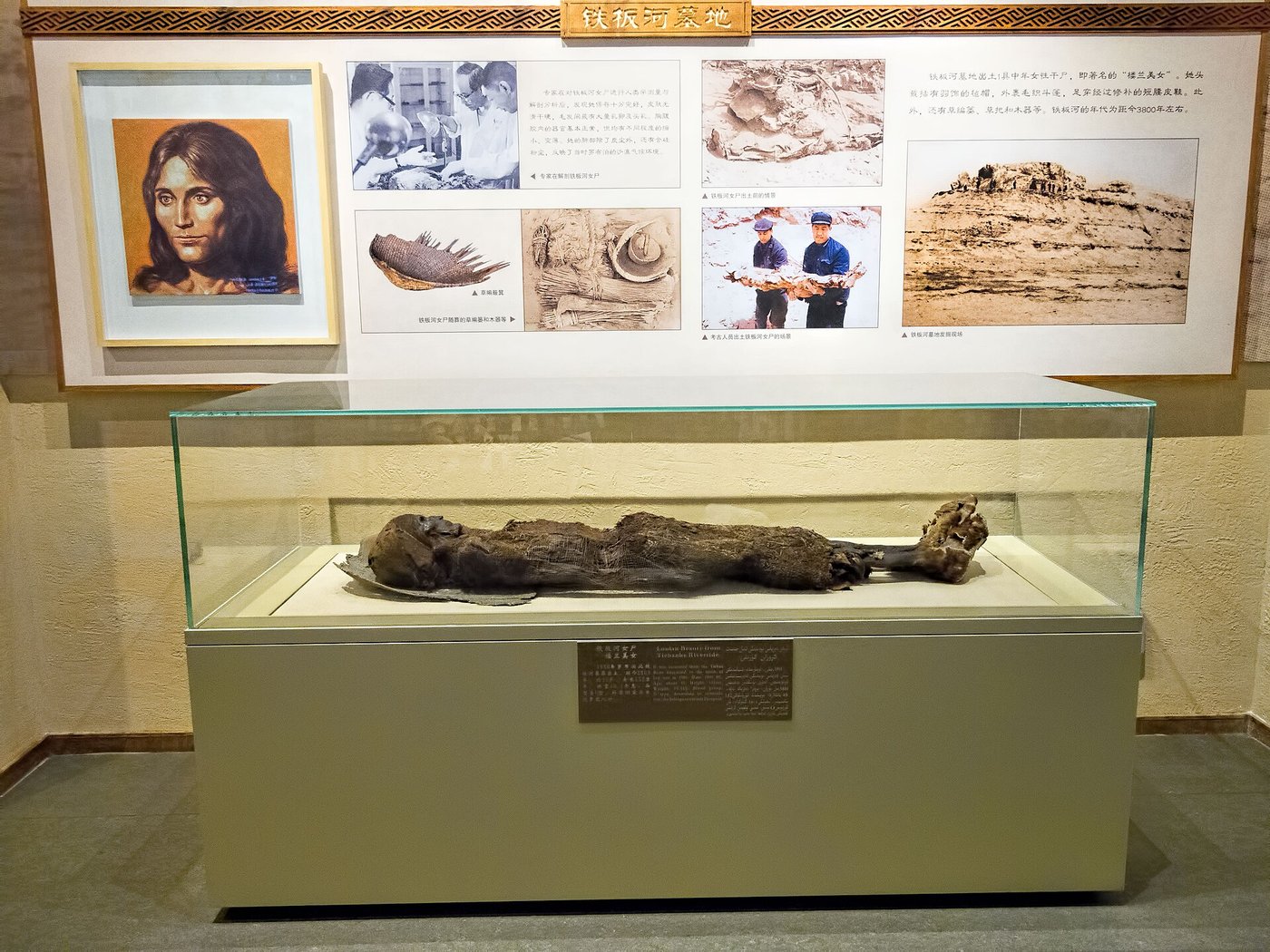
In the spring of 1980, a Chinese archaeological team working the dry bed of the Tiebanhe river, near the vanished lake of Lop Nur in the far west of China, brushed the sand away from a body and found a face looking back at them. She had been dead for around 3,800 years, yet her features were startlingly intact: high cheekbones, a long straight nose, brown hair still tucked under a felt cap, eyelashes resting on desiccated skin. The desert had not rotted her; it had kept her. The archaeologists called her the Beauty of Loulan, and almost at once she became the centre of an argument that would run for the next forty years: who was she, and how had someone who looked like this come to lie beneath a Chinese desert two thousand years before the Silk Road?
She was not alone. Over the following decades, hundreds of naturally preserved bodies were pulled from the sands of the Tarim Basin, the great bowl of desert that fills western Xinjiang between the Tian Shan mountains and the Tibetan Plateau. Some are older than her, some far younger. Together they are known as the Tarim mummies, and they are among the best-preserved ancient dead anywhere on Earth. For a long time they seemed to tell a clear and dramatic story about migration and the movement of peoples across Asia. Then, in 2021, a study of their DNA took that story apart.
How the desert keeps its dead
The Tarim Basin is one of the driest places on the planet. At its heart lies the Taklamakan, a desert whose name is often translated, with grim local humour, as something close to "go in and you won't come out." Rain almost never falls. The air pulls moisture out of everything. And the soil in places is heavy with salt, which kills the bacteria that would normally break a body down.
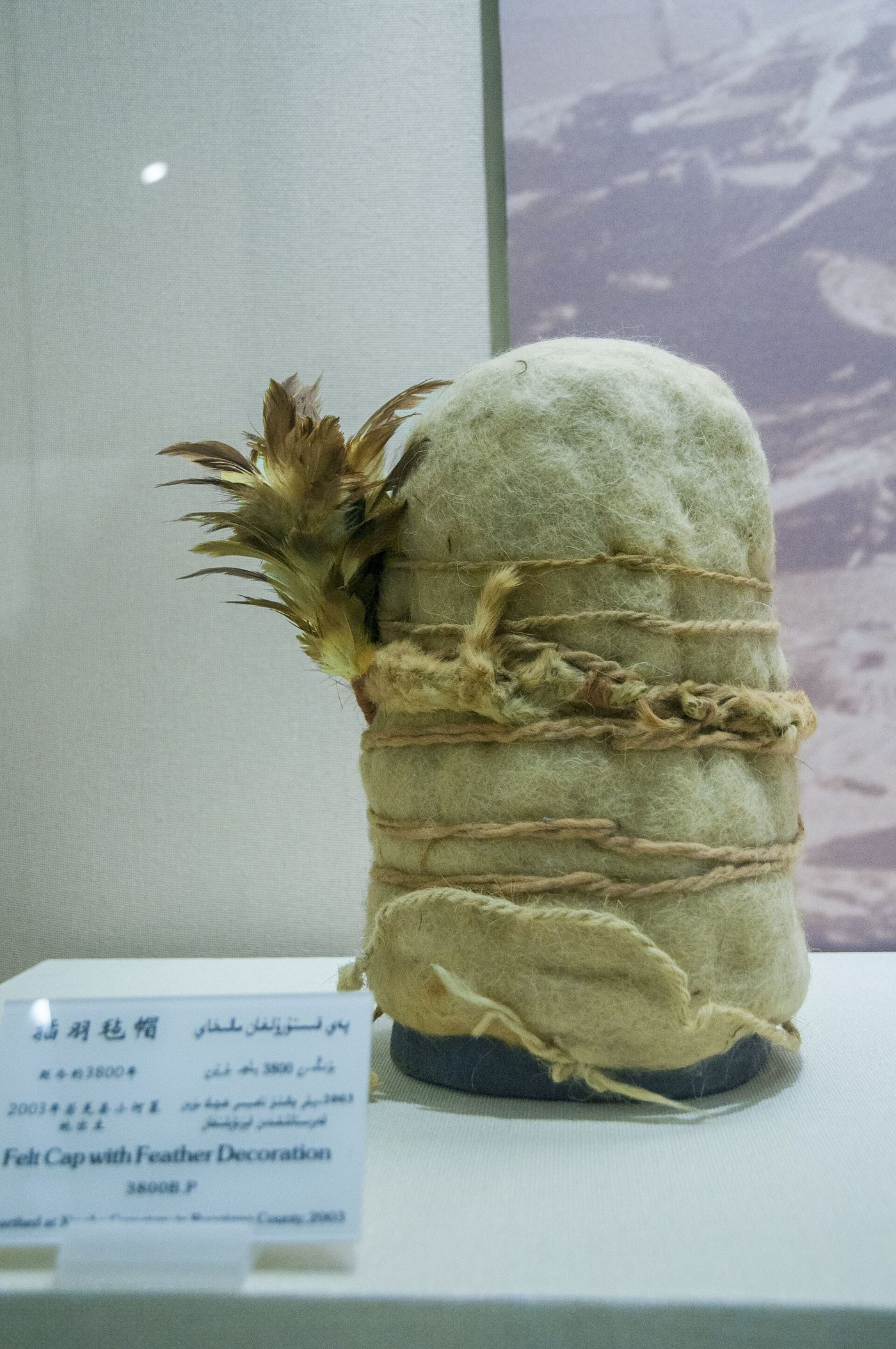
Those conditions add up to a natural embalming machine. Unlike the Egyptian dead, the Tarim bodies were not treated with resins or wrapped by priests. They were simply buried in the right ground, and the desert did the rest. Skin, hair, eyelashes, the felt of their hats, the weave of their clothes and even the food placed beside them survived across three or four thousand years. When you look at a Tarim mummy you are not looking at a shrivelled husk but at something close to a sleeping person, which is exactly why they unsettle people so much.
A gallery of the preserved
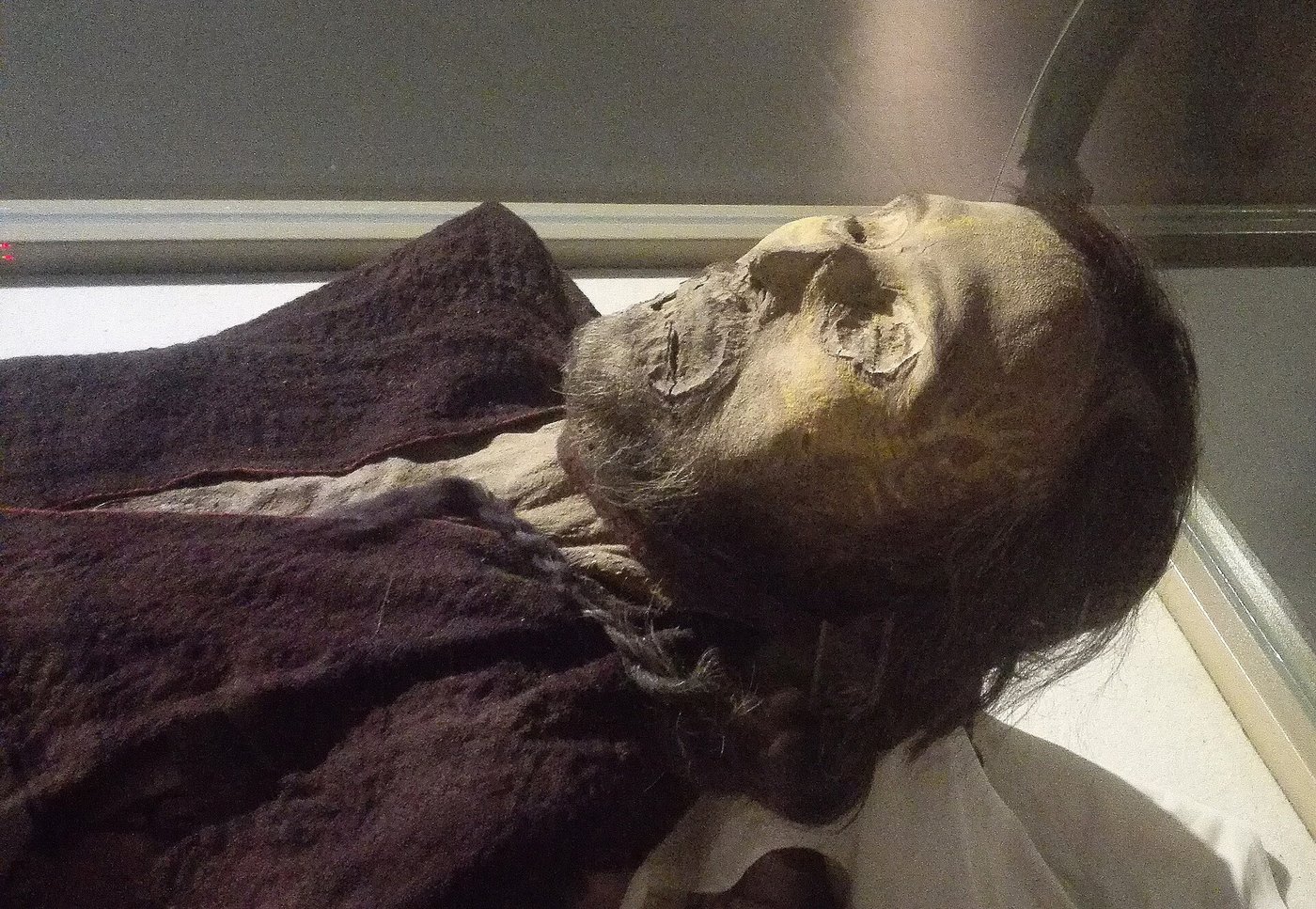
The most famous of the bodies have earned nicknames. The Beauty of Loulan is the oldest of the celebrities, dated to roughly 1800 BC. Younger by several centuries is the group from Cherchen, in the south of the basin, buried around 1000 BC. The best known of them, the Cherchen Man, was a tall figure, well over six feet, with reddish-brown hair, a trimmed beard and yellow spirals painted or tattooed on his face. He was laid to rest in a red woollen tunic and striped leggings, with felt boots and a pair of matching deerskin mittens.
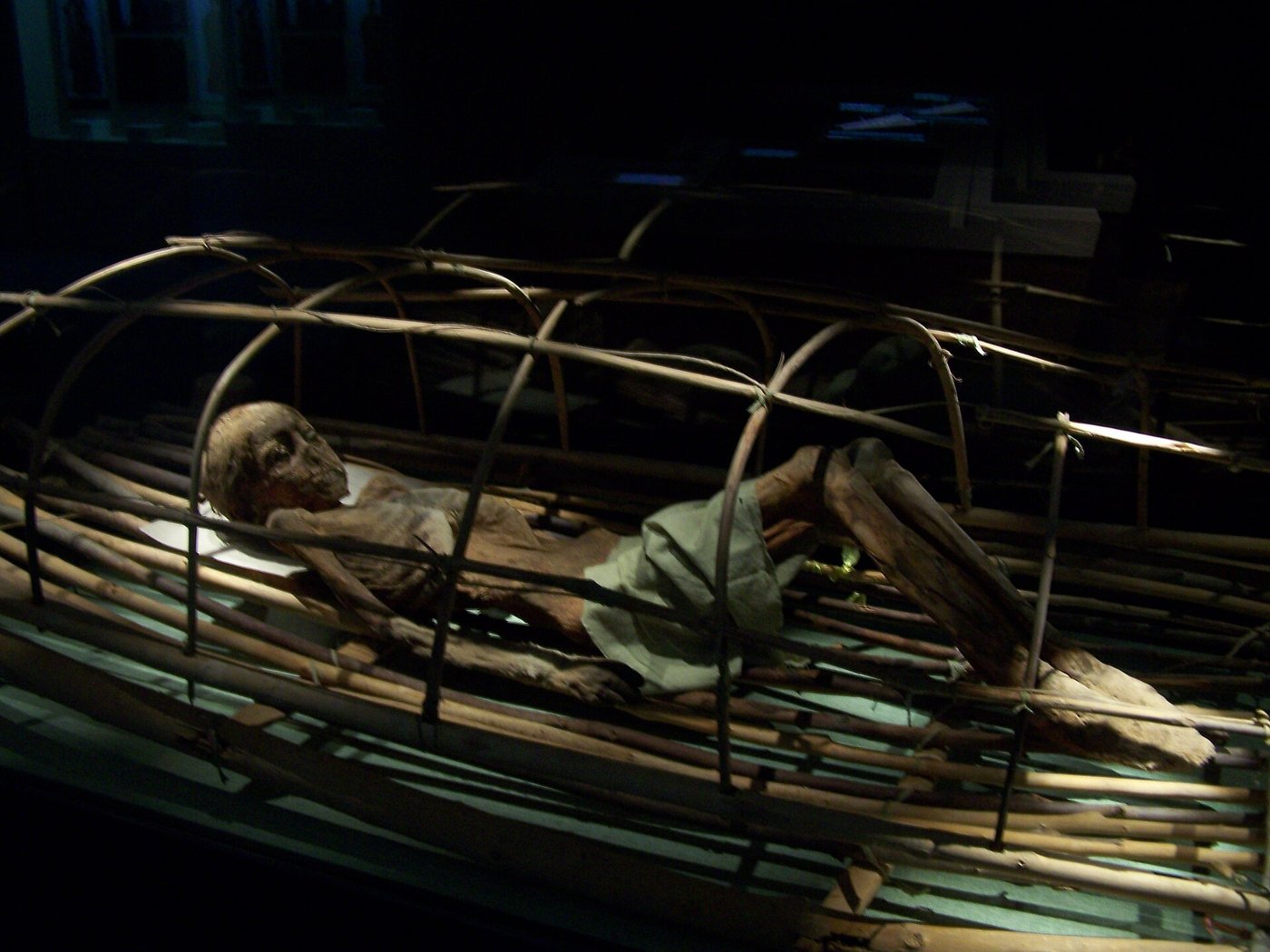
Beside him lay women and, heartbreakingly, an infant, wrapped in wool and blue-dyed cloth, with small blue stones placed over its eyes and a drinking horn and an ancient bottle made from a sheep's udder tucked in for the journey. Whoever buried that child took great care over it. Across the basin the graves are full of such details: bundles of a herb resembling ephedra, baskets of woven grass, wheat and millet, and, remarkably, lumps of the world's oldest preserved cheese, a soft kefir cheese draped over the necks and chests of some of the Xiaohe dead.
Around the necks of several mummies from the Xiaohe cemetery, scientists found clumps of a pale, crumbly substance that turned out to be cheese: kefir cheese, made by fermenting milk with a particular blend of bacteria and yeast. Dated to about 1615 BC, it is the oldest cheese ever discovered, and the microbes trapped inside it are still recognisable to dairy scientists today.
The city of oars in the sand
If one site captures the strangeness of the Tarim dead, it is Xiaohe, the "Small River" cemetery. A Swedish explorer, Folke Bergman, stumbled on it in 1934, guided by a local hunter, and then it was lost again to the desert for nearly seventy years until Chinese archaeologists relocated and excavated it in the early 2000s.
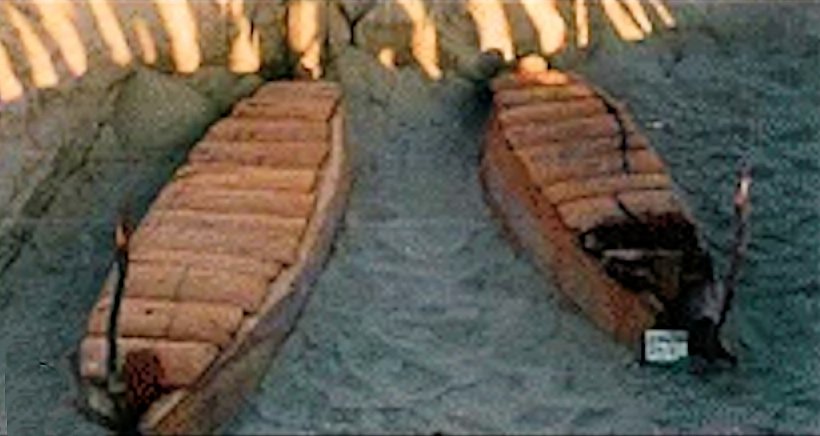
What they uncovered looks like nothing else in the ancient world. The cemetery is a great sandy mound bristling with wooden posts, hundreds of them, standing upright like a dead forest. Some are shaped and painted; the ones marking men's graves are carved like oars, while those over women's graves are tall and phallic. Beneath them the dead lie not in ordinary coffins but inside upturned boats, wooden hulls flipped over the body and wrapped in cowhide, which shrank as it dried and sealed each burial tight. There is no river anywhere near Xiaohe now, and there was none then. These desert people buried their dead in boats they never sailed, under a forest of oars that pointed at nothing but the sky.
The woollen puzzle
It was not only the faces of the mummies that made people think of somewhere far to the west. It was what they wore. The Tarim dead were dressed in fine woven wool, and some of the cloth is twill woven in checks and stripes, patterns that, to European eyes, looked uncannily like tartan or plaid. Textile specialists pointed out that this kind of weaving, and this way of herding sheep for coloured wool, had close cousins in Bronze Age Europe and the western steppe.
Add the tall stature, the fair and reddish hair, the felt hats that resembled those worn by later Central Asian herders, and a picture assembled itself almost too neatly. Here, surely, was proof of a great migration: people from somewhere around the Black Sea or the European steppe, speakers of an early Indo-European tongue, driving their flocks and their looms eastward until they reached the far edge of the Chinese world, long before any Chinese record mentions them. Many linked the mummies to the Tocharians, a people who much later left behind an Indo-European language written on manuscripts found in the same region.
"The Tarim Basin mummies have long been a focus of debate as to their origins... surprisingly, we found that they were a genetically isolated local population."— from the 2021 study of Tarim mummy genomes published in Nature
The DNA answer nobody predicted
The argument could not be settled by looking at faces or fabrics. It needed the one thing the mummies had carried inside them all along: their DNA. In October 2021 a large international team, led by researchers from Jilin University, the Max Planck Institute and Seoul National University, published in Nature the first genome-wide study of the oldest Tarim bodies: thirteen individuals from Xiaohe and nearby sites, dating to between roughly 2100 and 1700 BC.
The result overturned almost everyone's expectations. The Tarim founders were not migrants from the western steppe. They were not recent arrivals from Europe, Iran, or the Afanasievo herders of Siberia. Instead their ancestry traced overwhelmingly to a much older and more local source: a Pleistocene population that geneticists call the Ancient North Eurasians, hunter-gatherers who had roamed Ice Age Siberia and Central Asia more than ten thousand years earlier. By the Bronze Age this ancestry had all but disappeared, diluted everywhere else by later migrations, but in the isolated Tarim Basin it had survived almost pure. The mummies were, in genetic terms, a relic: the last strong echo of a vanished Ice Age people.
Isolated in blood, open to the world
Here is the twist that makes the Tarim mummies so interesting. Genetically they were among the most isolated people of their age: an inbred, closed population that had barely mixed with anyone for thousands of years. Yet their way of life was strikingly cosmopolitan. They herded cattle, sheep and goats. They grew wheat and millet, crops first domesticated far to the west and far to the east respectively. They made kefir cheese using techniques shared with herders across the steppe. Their culture drew on ideas from every direction, even though their bloodline drew on almost none.
That combination forces a rethink of a very old assumption: that when new tools, crops or fashions appear in the archaeological record, new people must have carried them in. The Tarim founders show that a community can adopt farming, dairying and weaving from its neighbours through trade, marriage at the margins, and simple contact, without being replaced or overrun. Culture can travel where genes do not. The tartan-like cloth was not a passport proving where these people were born. It was evidence that even the most isolated desert community was plugged into a web of shared knowledge stretching across the continent.
"The Tarim mummies were European or western migrants — Indo-European herders who trekked thousands of miles east, proving a great Bronze Age migration into China."
Their 2021 genomes show the opposite. The oldest Tarim people were a genetically isolated local population, direct descendants of Ice Age Ancient North Eurasians who had lived in the region for millennia. Their western-looking features and clothing reflect deep ancestry and cultural borrowing, not a recent journey from the west.
Why dead bodies became a live argument
Few archaeological finds have been so tangled up in modern politics. Xinjiang is the homeland of the Uyghurs, a Turkic-speaking, mostly Muslim people whose relationship with the Chinese state has grown increasingly fraught. When the mummies emerged looking nothing like the Han Chinese majority, some Uyghur activists embraced them as ancestors, proof, they argued, that the original inhabitants of this land were not Chinese at all. Others in the West used them to argue for early European contact with the East.
Beijing, understandably, was wary of dead bodies being turned into nationalist banners. For years access to the mummies and their DNA was tightly controlled, and some of the most famous specimens were kept out of public view. The 2021 genetic study, carried out with Chinese institutions, cut through much of the noise: the mummies were neither Han nor European incomers, but a distinct local population older than either category. In a strange way the science defused the argument by refusing to hand victory to anyone. The Tarim people were simply themselves: a population native to the basin, belonging to no modern nation's story.
If the founding Tarim population was so isolated, where did their language come from? And were they really the ancestors of the later Tocharians, whose Indo-European texts turn up in the same region? The genome study answered the question of ancestry but not of speech. Language and genes need not travel together, and a people can adopt a new tongue without changing their bloodline. Whether the boat-coffin builders of Xiaohe spoke an early form of Tocharian, some lost language of their own, or something else entirely remains, for now, beyond the reach of the evidence.
The child in the blue cloth
It is easy, with a find like this, to get lost in migration models and ancestry percentages and forget what is actually lying in the sand. These were people. The Cherchen Man was somebody's husband and father, dressed with obvious love for his burial. The infant with blue stones on its eyes was mourned by parents who gave it a milk bottle for a journey they must have imagined it taking. The Beauty of Loulan wore a wooden comb and a feather in her cap.
They lived at the far edge of the habitable world, in a place that gives nothing away easily, and they made it work for centuries: herding, weaving, farming irrigated patches of grain, burying their dead with care under a forest of painted posts. They had no idea that four thousand years later strangers would argue over the shape of their noses and the pattern of their cloth. They only knew the desert, the mountains that fed the rivers, and each other.
The lesson of the sleeping dead
The Tarim mummies are a warning against reading history from surfaces. For decades their faces and their tartans seemed to shout a simple answer, and the simple answer was wrong. The truth was stranger and quieter: an ancient, isolated people, holding on to a bloodline from the Ice Age while freely borrowing the tools of the wider world, buried in boats in a place with no water, forgotten so completely that no name for them survives.
They remind us that the movement of ideas is not the same as the movement of people, that isolation and connection can live side by side, and that the categories we reach for (European, Asian, migrant, native) often say more about us than about the dead we press them onto. The desert kept these people for four thousand years so that we could finally read them properly. It would be a shame to keep telling their story wrong.
Read next: Chinchorro: Made by Fishermen, Older Than the Pharaohs and Lapita: The Dotted Pottery Behind Prehistory's Fastest Migration.
Sources & further reading
- Zhang, F., Ning, C., Scott, A., Fu, Q., Wang, C.-C. et al., "The genomic origins of the Bronze Age Tarim Basin mummies," Nature, vol. 599 (2021).
- Mallory, J. P. and Mair, V. H., The Tarim Mummies: Ancient China and the Mystery of the Earliest Peoples from the West (Thames & Hudson, 2000).
- Barber, E. W., The Mummies of Ürümchi (W. W. Norton, 1999).
- Yang, Y. et al., "Proteomic evidence for kefir dairy in Early Bronze Age China," on the Xiaohe cheese finds, Journal of Archaeological Science (2014).
- Wang, W. et al., excavation reports on the Xiaohe (Small River) cemetery, Xinjiang Institute of Cultural Relics and Archaeology.
Image credits (via Wikimedia Commons): Cherchen Man mummy — Baomi (CC BY-SA 4.0); Xiaohe boat-coffins — Li et al. (CC BY-SA 4.0); Xiaohe felt hat — Scott Newman (CC BY-SA 2.0); Tarim boy mummy — Woudloper (CC BY-SA 4.0); Beauty of Loulan (featured) — Dan Lundberg (CC BY-SA 2.0).