Somewhere on the Jos Plateau in central Nigeria, in 1943, a clay head sat on top of a pole in a field of yams. It had a calm, heavy-lidded face and a neat coil of hair, and its job was to frighten birds. It was good at the job, by all accounts. It was also roughly two thousand years old, and it was about to rewrite the early history of an entire continent. A tin miner had turned it up, thought it a handsome thing, and put it to work. When word of it reached a young British officer in the town of Jos, the head came down off its pole and went into a museum, where it is still known by the name of the village nearby: the Jemaa Head.
That is roughly how the oldest sculpture in sub-Saharan Africa entered the record: not from a tomb opened by lamplight, but from farm furniture. It is a fitting beginning for the Nok, a people who left thousands of faces in the ground and not one word to tell us who they were. Everything we know about them we have had to read off the clay itself, and off the disturbed dirt around it. Much of that dirt was disturbed by people who were not looking for knowledge at all.
A face washed out of the tin
The Jos Plateau was mining country. Under its red soil ran seams of alluvial tin, and by the early twentieth century European companies were tearing the ground open to get at it, blasting the earth loose with high-pressure water hoses and washing the gravel for ore. The land gave up more than metal. Now and then a spray of water would expose a piece of fired clay (a foot, a torso, a head with holes for eyes), and the workers, having no reason to think it mattered, would toss it aside or take it home.
The first piece to be noticed came up in 1928, near the village of Nok itself. It was a small terracotta figure, and the manager of the mine, Colonel John Dent Young, was curious enough to have it and a few other fragments sent to the museum in Jos rather than let them vanish. For fifteen years that was more or less that. The pieces were odd, clearly old, clearly made by skilled hands, and completely without a home in anyone's history of the region. They sat and waited.
What they were waiting for was a man who would take them seriously. He arrived in Nigeria in 1939.
The man who bought a lost people piece by piece
Bernard Fagg came out as a junior administrative officer and was posted to the plateau, into the middle of the tin trade. He had a sharp eye for old things and a habit of asking questions, and when the scarecrow head reached him in 1943 he did the one thing that turns a curiosity into a discipline: he compared it to the 1928 find and saw the same hand at work. Same clay, same style, same strange treatment of the face. Two heads from two places, decades and miles apart, plainly belonged to one tradition. If there were two, there were more.
So Fagg went looking, and he asked the miners to look with him. He put out word across the tin fields that he wanted any lump of figured clay the hoses turned up, and he would pay for it. Pieces began to come in from everywhere: buried under a hockey pitch, jammed in a pile of mine gravel, standing on a rocky hilltop, dug from a stream bed. Over a few years, through purchase, persuasion and his own excavations, Fagg gathered close to two hundred terracottas. In 1952 a museum opened in Jos to hold them. He named the whole culture after the little village where the trail had started. The Nok had a name at last, if not a language.
Fagg's real achievement was not the collecting. It was recognising that a scatter of unrelated-looking fragments, pulled from mines across a wide stretch of country, were the wreckage of a single, sophisticated, and very old society, one that no written source, African, Arab or European, had ever mentioned.
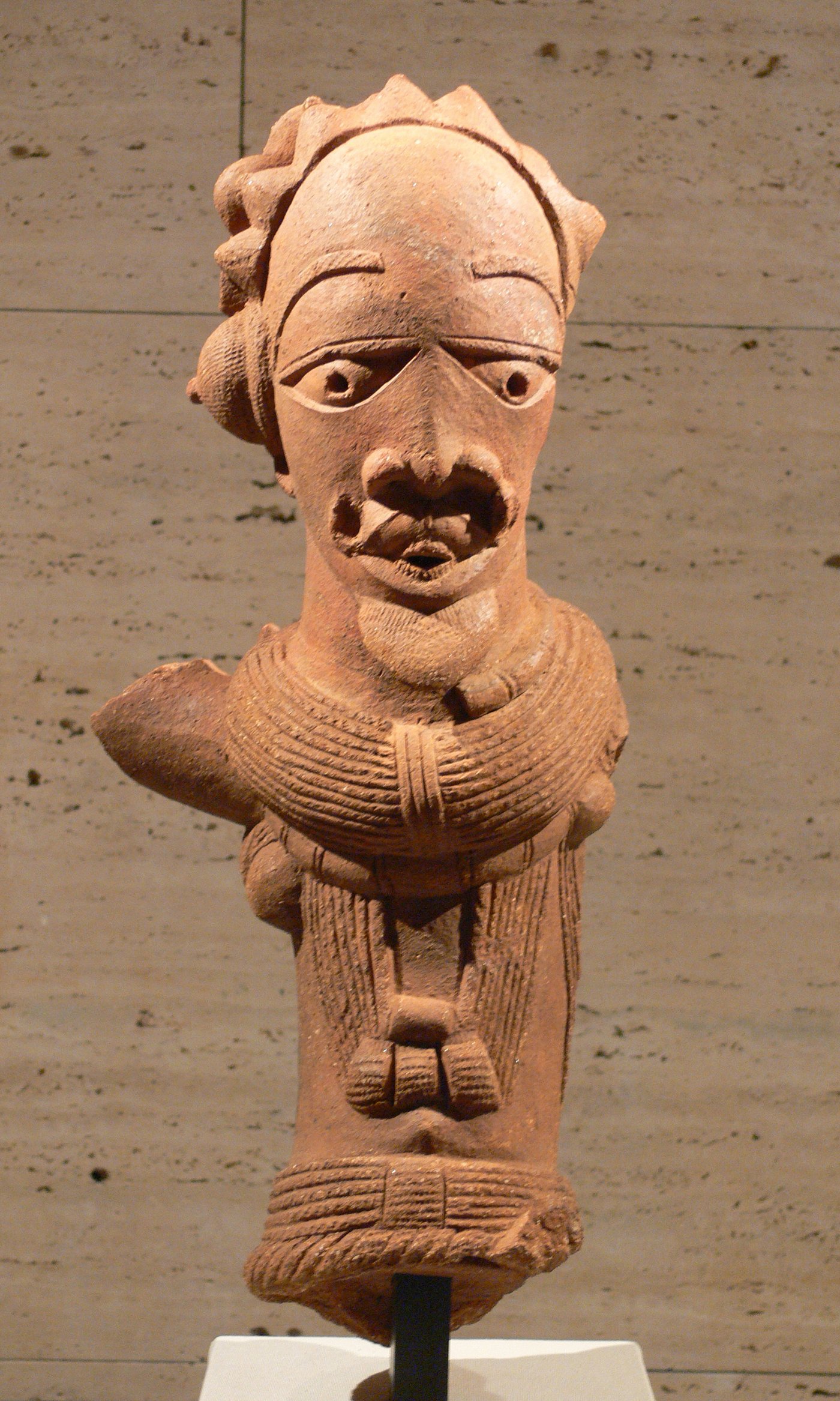
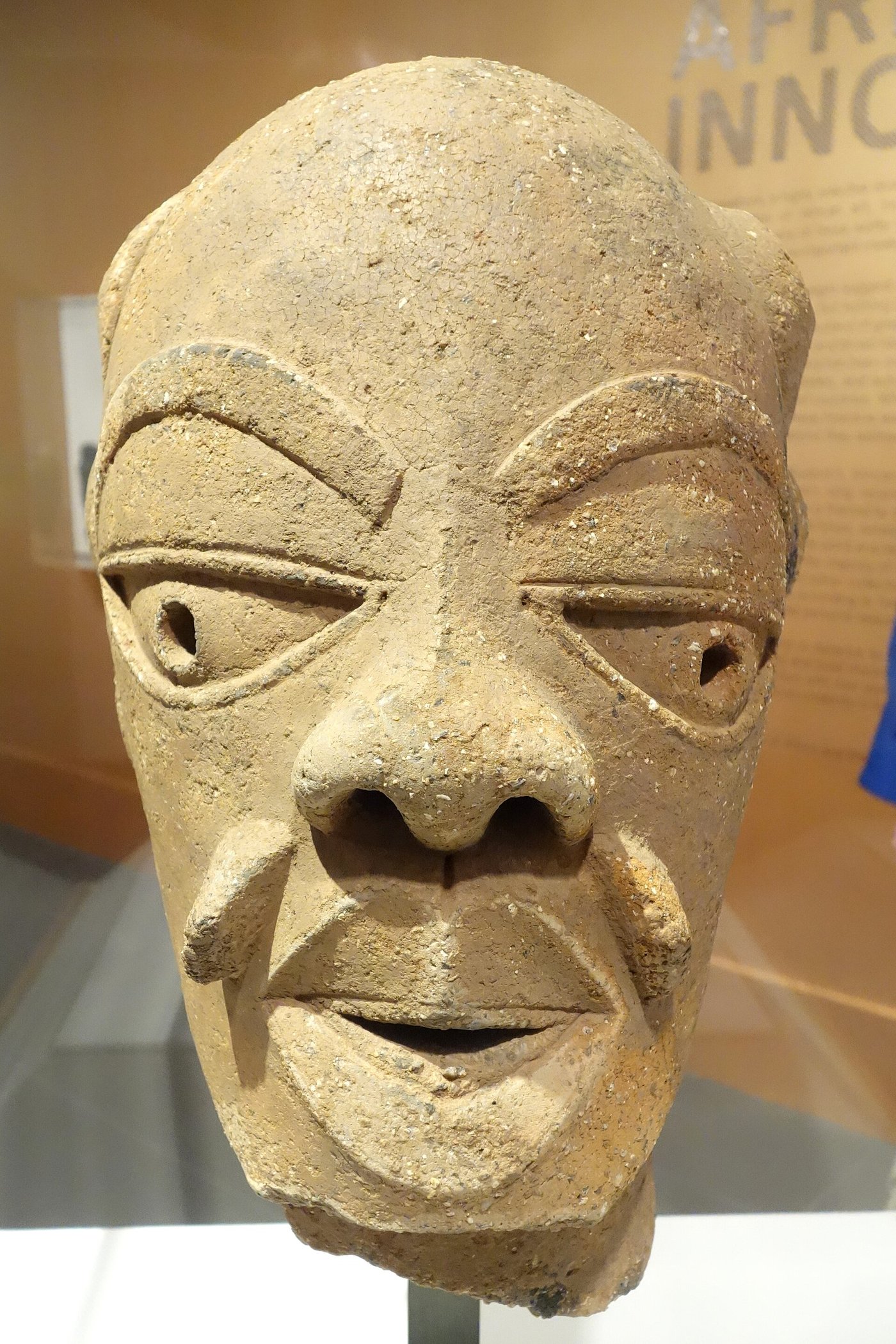
A Nok face is unmistakable because of its eyes: a triangle, or a segment of a circle, with the eyebrow above often echoing the same shape. The pupil is a drilled hole. So, usually, are the nostrils, the corners of the mouth, and the ear canals. Part of this is style. Part of it is engineering. A solid lump of clay that thick will trap air and moisture, and in the heat of firing that trapped air expands and blows the piece apart. The holes let the head breathe as it bakes. Beauty and physics arrived at the same design.
What a Nok figure is
Strip away the mystery and look at the objects as objects, and they are astonishing. The larger ones stand close to life-size. They are hollow, built up by hand from coils and slabs of a coarse, grog-tempered clay: no potter's wheel, no mould, just fingers and time. The clay across the whole Nok region is remarkably uniform, which hints at either shared sources or shared workshops.
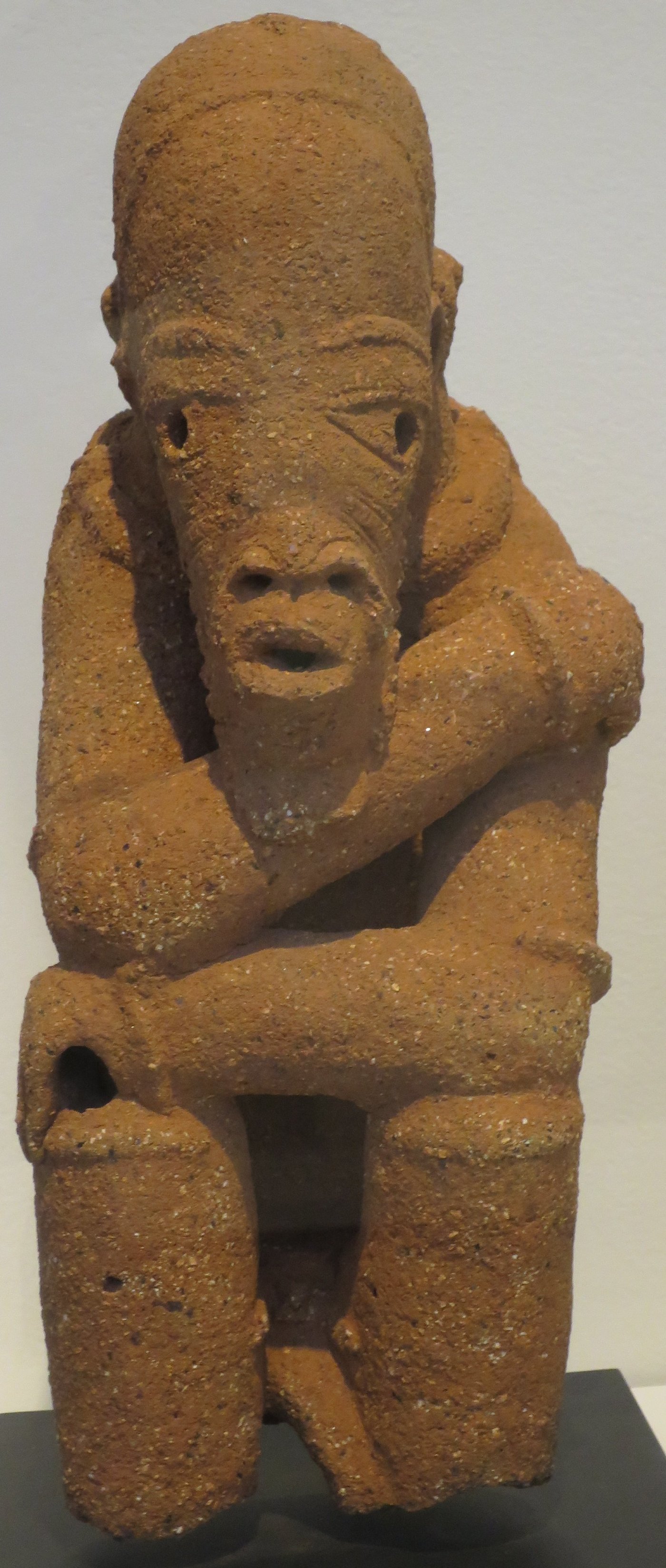
The people they show are dressed to impress. Figures wear tiered hairstyles gathered into buns and crests, strings of beads at the neck, wrist and ankle, pendants, and what look like batons or staffs of office. Many sit with their arms resting on drawn-up knees. Others kneel. The heads are large for the bodies, the way a child draws a person, with the face given all the attention.
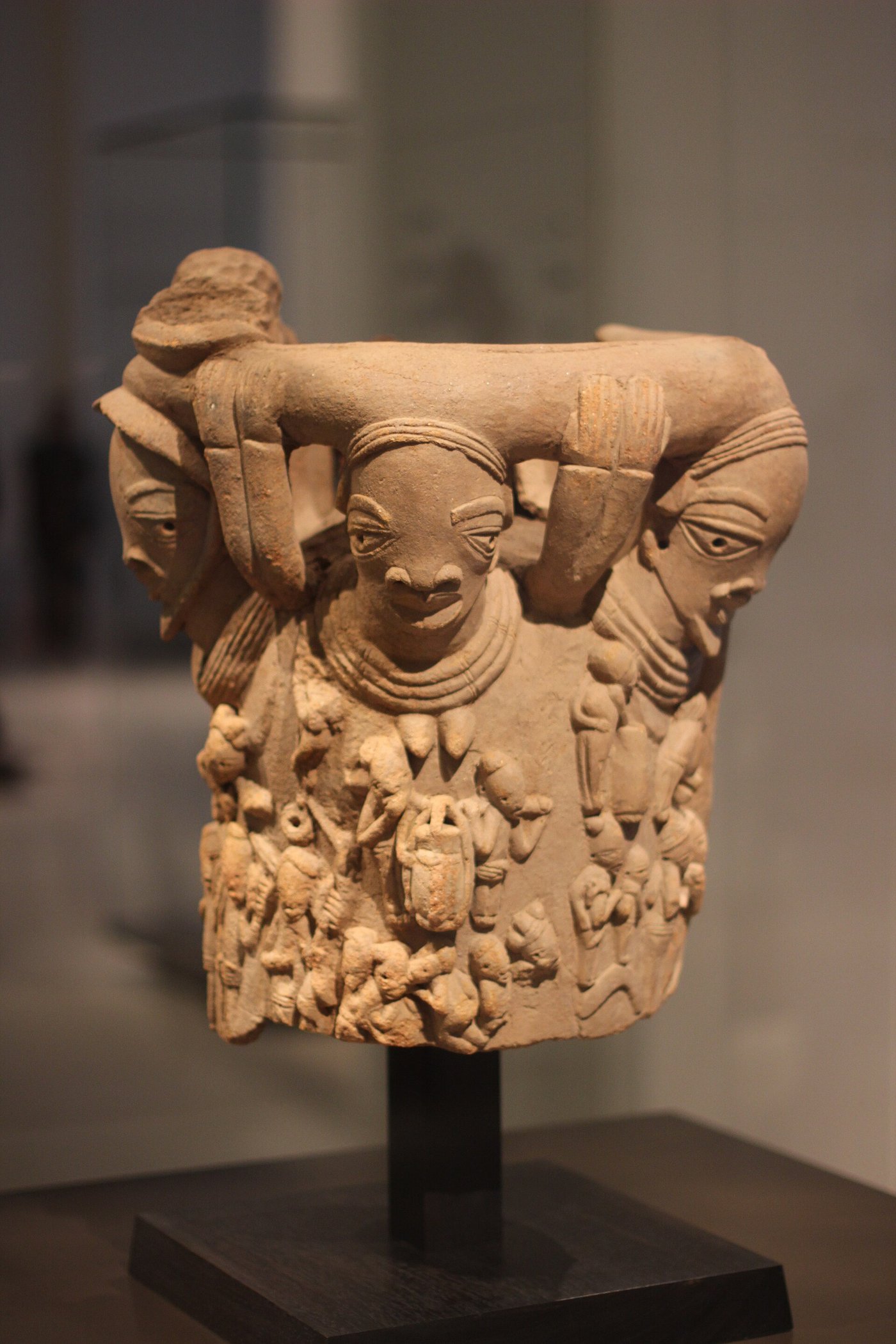
Some are stranger still. A handful of figures appear to show illness: swollen limbs that look like elephantiasis, drooping faces, growths. Whoever modelled them was not only making idealised nobles. They were paying close attention to real bodies, including bodies that had gone wrong. That care is one of the few direct windows we have into how these people saw the world: closely, and without flinching.
Iron, standing next to stone
The Nok did not only work clay. Fagg found their figurines turning up alongside the debris of ironworking, and in 1961 he reached a site at Taruga, some ninety miles from Nok, where the ground held no fewer than thirteen iron-smelting furnaces. Charcoal from Nok smelting sites has since been dated to the middle of the first millennium BC, which places these people among the earliest ironworkers anywhere in sub-Saharan Africa.
What makes it vivid is the overlap. Excavators kept finding iron tools lying only a short distance from polished stone axes of the older world. For a while the two technologies ran side by side, the new metal not yet cheap or plentiful enough to sweep the old stone out. You can stand at that seam in the Nok record and watch one age hand over to the next, slowly, with neither quite letting go.
The neat version: the Nok invented iron smelting in Africa, striking straight from stone to metal in one bold leap that the rest of the continent then copied.
What the evidence supports: the Nok were among Africa's earliest ironworkers, which is remarkable enough, but "first" is a claim the ground has not settled. Other early smelting evidence has been argued for elsewhere, the dates are contested, and whether iron was invented in the region or arrived from outside is still open. What Taruga shows for certain is a society smelting iron early and well, not a tidy origin myth for a whole continent.
The dates that will not sit still
Pinning the Nok in time has been a long argument with the science. The first radiocarbon results bracketed the culture roughly between 440 BC and AD 200. Thermoluminescence testing of the Jemaa Head, the old scarecrow, came back around 500 BC. Good enough, for decades, to call the Nok an Iron Age culture of the last few centuries BC.
Then the newer excavations pushed the beginning backwards. Careful dating of charcoal and plant matter from sealed layers now stretches the tradition back towards 900 BC, into the ninth century. The figures we admire may sit in the middle of a story that was already old when they were made. The lesson the Nok keep teaching is that a date is only as good as the dirt it came from, and for a century, most Nok pieces came from no recorded dirt at all.
The years the sites were mined for money
After Fagg, the science more or less stopped. For around forty years no one carried on his work in any serious way. But the world had learned what the objects were, and by the 1980s and 1990s a Nok terracotta was a valuable thing on the international art market, wanted by dealers and collectors in Europe and the United States. Where there is that kind of money, there are men with spades.
The looting was systematic. Organised gangs dug the known sites and hunted for new ones, smashing through the very layers that could have told archaeologists anything, and pulling out heads and figures to be smuggled and sold. Peter Breunig, the German archaeologist who later led the return to Nok, put it bluntly: no one had continued Fagg's work, so instead of scientific exploration the Nok became the victim of illegal digging and international dealers. A whole culture's context was shovelled out and thrown away so that its faces could sit, mute and unprovenanced, on drawing-room shelves.
There was a cruel twist in it. Scientific dating techniques, thermoluminescence chief among them, were used to reassure buyers that a piece was really ancient. The tool that should have served knowledge was turned to serve the trade, helping launder looted heads into saleable antiquities. The market only cooled after 2005, partly through tighter export controls and partly because it had flooded itself with so many convincing fakes that no buyer could be sure what they were paying for.
Nobody knows what a Nok figure was for, and the honest answer is a list of maybes. Fagg's early guess tied them to ironworking: charms to bless the furnace. Others read them as totems for good harvests, or as images of honoured ancestors. The most recent digging leans towards funerals: the figures seem to have been made, used, then deliberately broken and buried as part of elaborate mortuary rites, which is one reason so many survive as heads alone. Ritual, ancestor, grave good: the clay does not say, and each generation of scholars reads its own concerns into the silence.
Digging it back up, properly
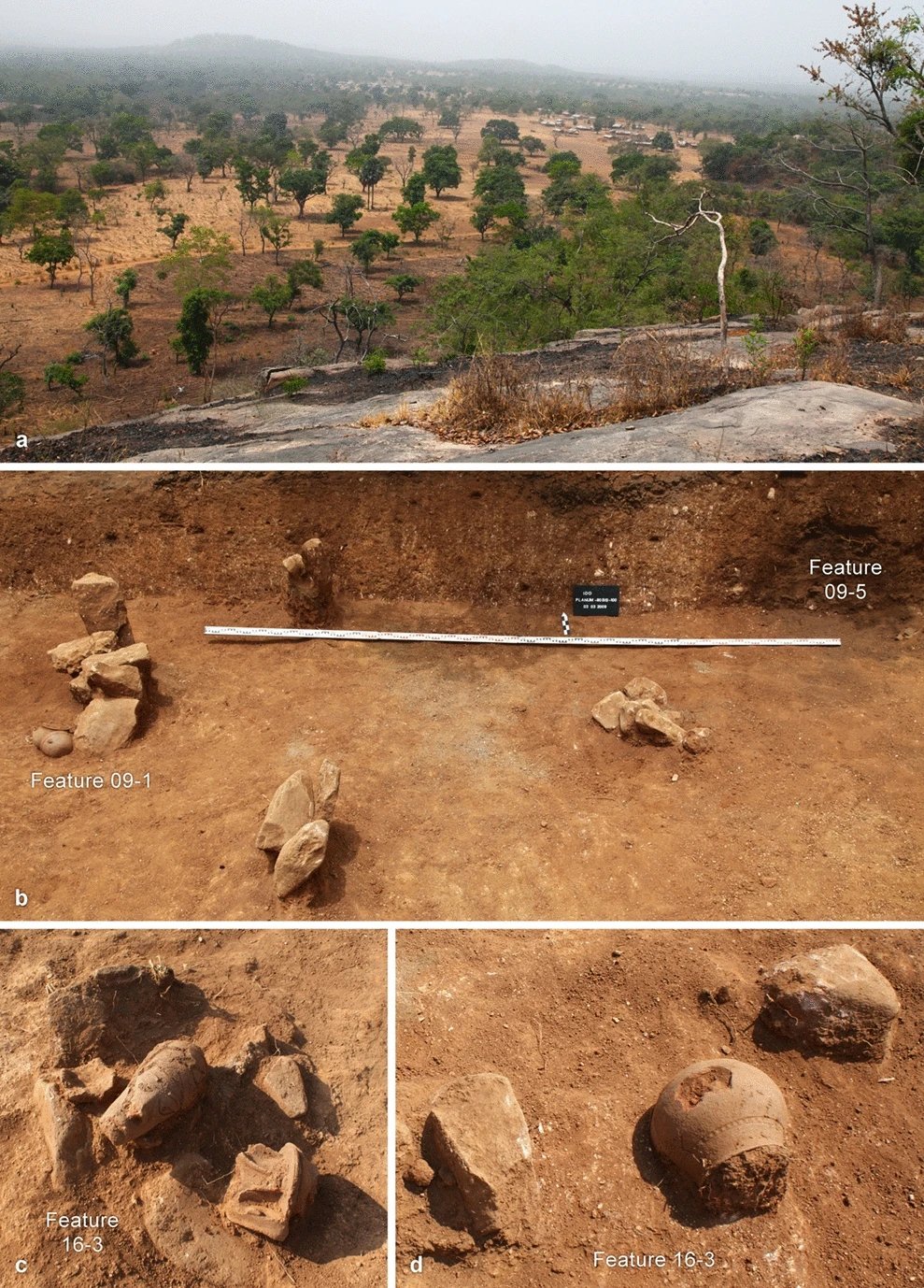
The redemption came from Frankfurt. From 2005, Breunig and his colleague Nicole Rupp led a long German–Nigerian project across some 150 square miles of central Nigeria, north of Abuja, doing what almost no one had done since Fagg: excavating Nok sites with method, recording every layer, dating everything they could. At one site they recovered around seventeen hundred terracotta fragments from a patch of ground no bigger than a tennis court.
The picture that came out of the controlled dirt was of a settled farming society, growing pearl millet, that could spare the labour and skill to sustain a specialised class of makers: potters and sculptors organised, perhaps, into something like guilds, which in turn implies a society with rank and structure. There is evidence of feasting, and of the figures being smashed and deposited in the same places over generations. The Nok were not simple villagers who happened to be good with clay. They were an organised people running an artistic tradition for the better part of a thousand years.
How it ended, and what came after
The tradition faded around AD 200, and the fading looks like a slow one rather than a catastrophe. The deposits of pottery and terracotta thin out and stop. Breunig has suggested a plain, modern-sounding culprit: the Nok may have worn out their own landscape, leaning too hard on the forest for the charcoal their iron furnaces devoured, until the ground could no longer carry them. A people undone, in part, by the very technology that made them remarkable.
They did not vanish without issue. The great later art of the Nigerian forest (the terracottas and then the famous bronzes of Ife, made more than a thousand years afterwards) has long tempted scholars to draw a line back to Nok. Some stylistic echoes are real; a firm chain of descent has never been proven. The link is a reasonable hunch, not a fact, and it deserves to be named as such.
What is certain is smaller and stranger. A farming people on a high African plateau, using iron before most of the world, spent a thousand years making faces (nobles in their finery, the sick with their swellings, the calm and the odd alike) and then stopped, leaving no name for themselves and no story we can read. We found them by accident, in the wash from a tin mine, and one of the first of them we ever really looked at had been standing in a field, keeping the birds off the yams. The Nok are still up there in the red soil, more of them than we will ever dig, watching with triangular eyes and saying nothing at all.
Read next: Igbo-Ukwu: The Bronzes Too Fine to Be as Old as They Are and Jiroft: The Civilisation Looters Reached Before the Archaeologists.
Sources & further reading
- Fagg, Bernard, Nok Terracottas (Ethnographica / National Museum, Lagos) — the foundational catalogue by the man who named the culture.
- Breunig, Peter (ed.), Nok: African Sculpture in Archaeological Context (Africa Magna Verlag) — the results of the Frankfurt excavations.
- Rupp, Nicole, Beck, C., Franke, G. and Breunig, P., papers on the chronology and settlement of the Nok Culture in Journal of African Archaeology and Azania.
- Roger Atwood, “The Nok of Nigeria,” Archaeology magazine feature on Fagg, the looting and the German–Nigerian project.
- National Museum, Jos, and the collections of the British Museum, the Louvre (Pavillon des Sessions) and the Kimbell Art Museum for the figures themselves.
Image credits (via Wikimedia Commons): Nok male figure, Kimbell Art Museum — User:FA2010 (Public domain); Nok head, Brooklyn Museum — Daderot (CC0); Nok figure, Musée du Louvre — Daehan (CC BY-SA 4.0); excavations at the Nok site of Ido — Louis Champion et al. (CC BY 4.0); kneeling Nok figure, Honolulu Museum of Art — Hiart (CC0).