One night in the spring of 1880, on the hard road that runs down from the Oxus towards Kabul, three merchants lost everything they were carrying. They had bought a bagful of ancient gold (little figures, bracelets, thin stamped plaques, coins) from villagers on the far bank of the river, and they were taking it south to sell. Robbers took it from them first. The merchants were left with nothing but the news of their own ruin, which they carried into a British camp because they had nowhere else to carry it. What happened next is the reason a great deal of Persian gold now sits in a glass case in London, and the reason nobody can tell you, for certain, the field it came out of.
The gold is called the Oxus Treasure, after the river the Greeks named the Oxus and the map now calls the Amu Darya. It is the finest surviving collection of gold and silver from the Achaemenid Persian empire, the empire of Cyrus and Darius and Xerxes that ran from the Aegean to the Indus between about 550 and 330 BC. Roughly a hundred and eighty worked objects survive, along with a scatter of coins that were probably swept in later. Every piece has a clear enough shape and style. What none of them has is a proper birth certificate. No archaeologist watched them come out of the ground. They arrived in the world already stolen, already sold, already halfway to being melted.
The officer who chased the gold back
The camp the merchants stumbled into belonged to Captain Francis Charles Burton, a British political officer working the country between Afghanistan and India in a tense year. The Second Anglo-Afghan War was still smouldering; a man in Burton's position spent his days managing tribes, roads and rumours. When the robbed merchants told him what had been taken, he did something a careful officer might not have. He went after it.
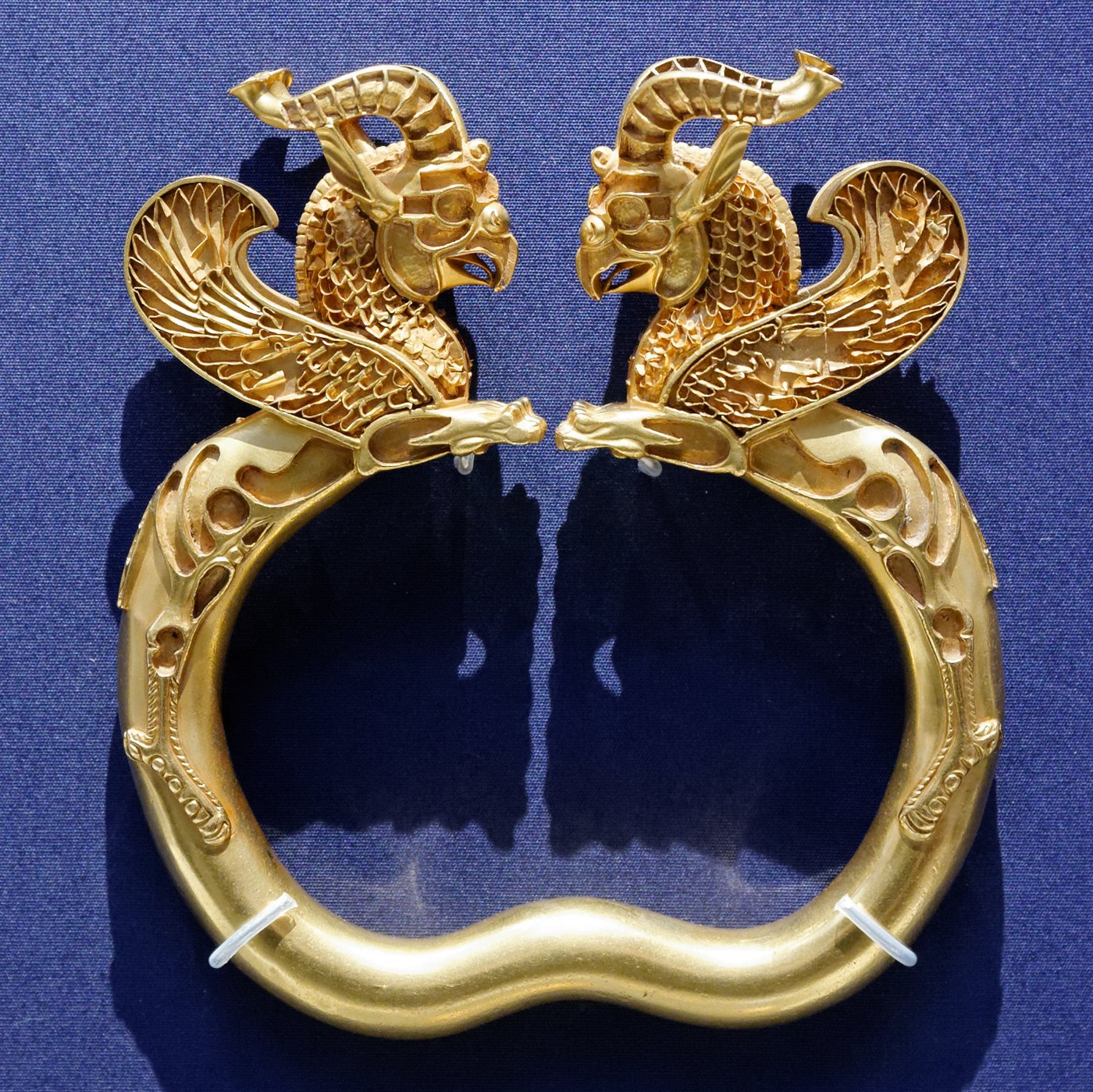
By the traditional account, told later by the men who bought the pieces, Burton tracked the thieves through the night and cornered them by lamplight in a cave, where they were already quarrelling over the spoil and cutting some of the larger objects apart to share them. He recovered most of the gold and handed it back. The grateful merchants let him keep, or sold him cheaply, one heavy gold armlet with a pair of griffins rearing at each end. That armlet is how the find entered the record at all: Burton showed it in India, scholars saw it, and word spread that a hoard of old Persian gold was loose in the bazaars of the north-west frontier.
It is a good story, and it may even be broadly true. It is also exactly the kind of story that hardens into fact because it is repeated by people who were not there. The one solid thing inside it is the armlet, which is real, and which still carries the small injuries of a rough life. Look closely and you can see it was once thick with inlay: turquoise, lapis, coloured glass packed into every cell of the design. All of that is gone, prised out somewhere along the way. The gold cage that held it survived because gold, on its own, was worth carrying.
The griffin armlets were not jewellery in our sense. Armlets exactly like them are shown on the great stone staircase at Persepolis, carried as tribute and worn by the men closest to the king. To own a pair was to wear rank on your arms. The Oxus pair are among the most complete Achaemenid examples left anywhere, which is why their stripped, empty sockets are studied as hard as the gold around them.
A river, a ferry, and a golden tiger
Where did it come from before the merchants bought it? Everyone agrees on the river and almost nothing else. The pieces surfaced among dealers who traced them back to the north bank of the Oxus, near an old crossing called Takht-i Kuwad, a ferry station in what is now southern Tajikistan. Close by stands a bigger site, Takht-i Sangin, where much later a temple would be dug out of the ground. Somewhere in that stretch of riverbank, in the late 1870s, local people had been turning up gold.
A Russian officer heard the tail end of it. In 1879 Major-General Nikolai Mayev, poking around the same reach of the Oxus, was told by villagers that treasure had come out of the ground there, and that among it had been a large golden tiger. All of it, they said, had already been sold to travelling Indian merchants. The golden tiger has never been seen since. It may have been melted the week it was found. It may be sitting unrecognised in a collection somewhere. It may never have existed in quite the form the story gives it. That is the flavour of the whole affair: a real find, remembered by people with no reason to write anything down, reaching us through two or three retellings in languages none of the finders spoke.
The gold left the riverbank in handfuls and made its way south, changing hands and changing shape. Dealers cut pieces up. Coins were added to the pile from who knows where. By the time serious buyers were looking at it in the towns of British India, the "treasure" was less a sealed hoard than a moving heap of Persian gold with a rough address and a violent recent history.
The man who bought a treasure by post
The person who saved the Oxus Treasure for study was not on the frontier at all. Augustus Wollaston Franks was a wealthy, tireless curator at the British Museum, a man who spent much of his own fortune buying things the museum would not or could not buy itself. Through the 1880s he acquired the Oxus pieces steadily, mostly through dealers and go-betweens, often sight unseen. He was not the only buyer. Alexander Cunningham, the head of the Archaeological Survey of India, had gathered a parcel of the same gold, and Franks bought his collection too and folded it in.
Buying gold this way, from this distance, was asking to be cheated, and Franks knew it. The frontier dealers had worked out that a rich Englishman would pay well above the melt value for anything authentically ancient, and they set about making sure there was plenty to sell. They produced copies. By one account they first offered Franks fakes, watched him decline them without fuss, and only then brought out the real objects, keeping the imitations to try on the next buyer. Franks bought the authentic pieces "at a small percentage over the gold value", which tells you both how sharp his eye was and how cheap great art can be when it is loose in the world and nobody official is watching.
When Franks died in 1897 he left the Oxus Treasure to the British Museum, where it has stayed. A few years later the curator Ormonde Maddock Dalton produced the catalogue that made it famous, The Treasure of the Oxus, first printed in 1905 and revised for decades after. Dalton did the careful, unglamorous work: measuring, describing, arguing about which pieces belonged and which had drifted in. He is the reason the collection is a subject and not just a pile.
Because no one recorded the find, scholars have never agreed on what actually belongs to it. Some objects are pure fifth-century Achaemenid work. Others look older, or foreign, or simply out of place, as though the dealers had bulked out an authentic hoard with unrelated gold to raise the price. The coins in particular span too many centuries to have been buried together. So "the Oxus Treasure" may be a real ancient deposit wearing a coat of later additions, and telling the two apart, object by object, is work that is still going on.
What the gold actually is
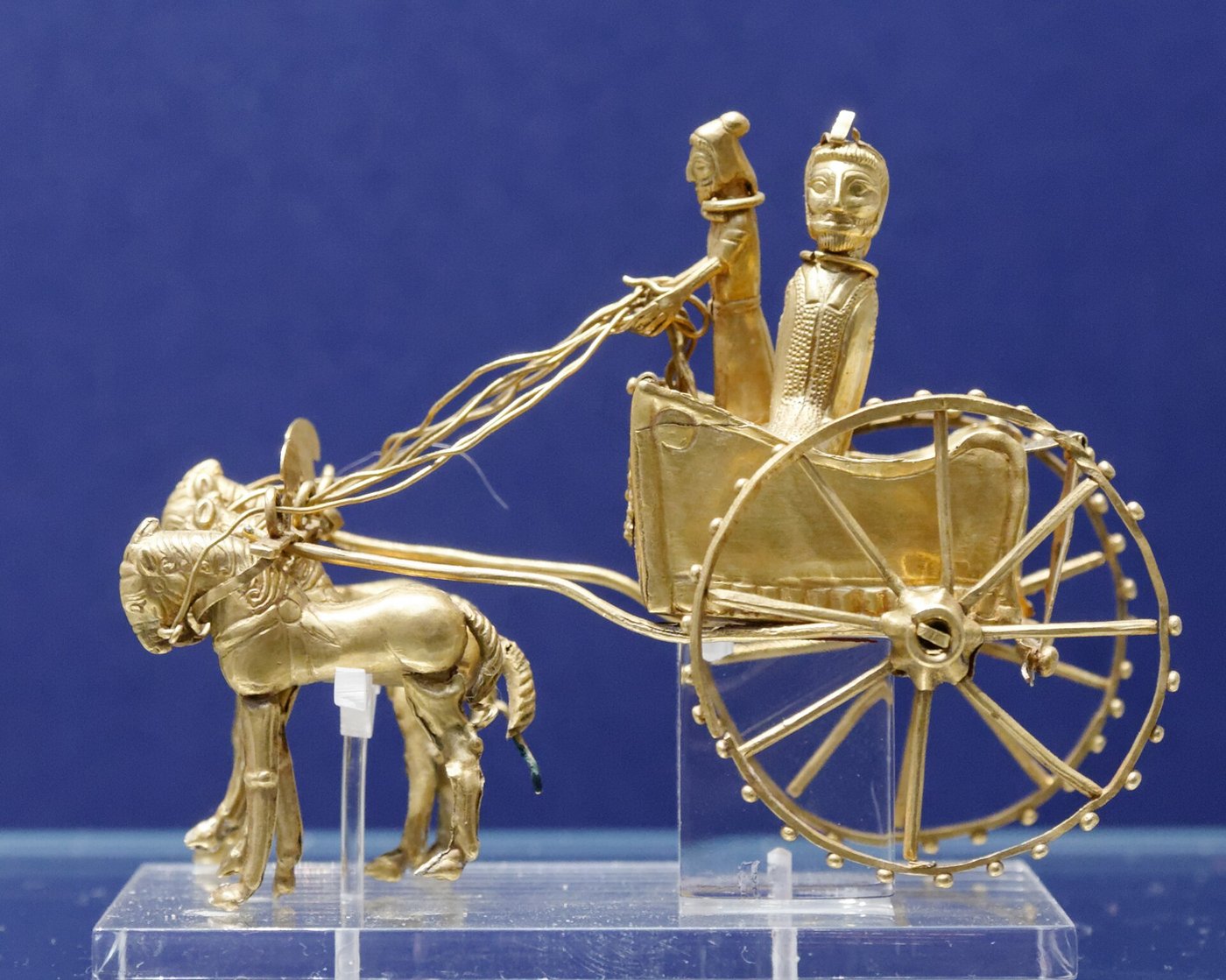
Set the history aside for a moment and look at the objects, because they are extraordinary. The single most famous piece is a model chariot, small enough to sit in your palm, pulled by four horses and carrying two figures. One of them wears the dress of the Medes, the northern people who ruled before the Persians and then served beside them. The front of the little car is stamped with the face of Bes, an Egyptian household god who had travelled the whole width of the empire to end up on a Persian toy. It is not a toy. It is a votive, a thing given to a god or a temple, made to stand for a real chariot and a real rider.
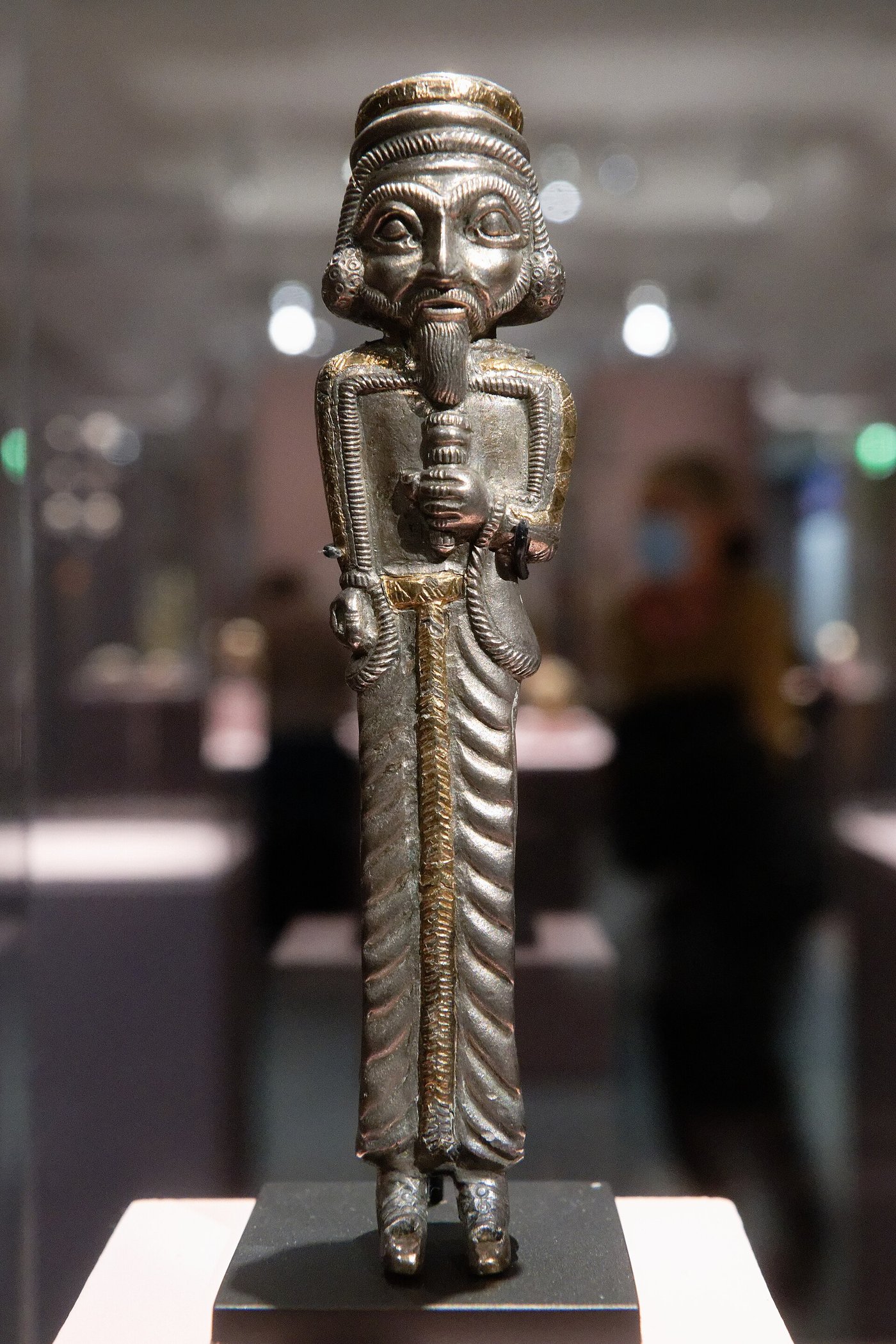
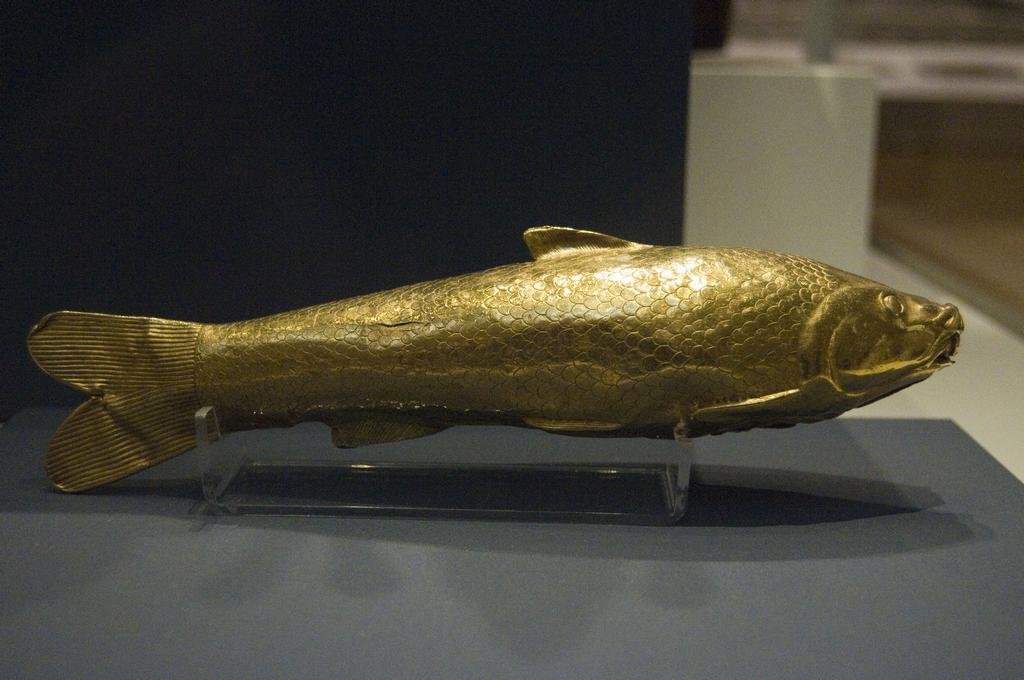
Then there is the fish. A hollow gold vessel shaped like a carp, about the length of a forearm, modelled so exactly that biologists have named the species: a barbel that still swims in the rivers of Central Asia. It would have held a liquid, poured out in some ceremony we can only guess at. Beside it are the griffin armlets, the scabbard for a short Persian sword worked with a lion hunt, finger rings, seals, and dozens of the little standing men, each holding a bundle of thin rods called a barsom, the sign of a worshipper at prayer in the Persian religion.
Most numerous of all are the plaques: thin sheets of gold, some no bigger than a playing card, stamped or scratched with the figure of a man standing in profile, again holding his barsom. There are dozens of them. They were the cheap offering, the candle you could afford, left at a shrine by people who wanted a god's attention and had a scrap of gold to spend on it. Taken together, the objects do not read like a king's strongroom. They read like the contents of a temple: the gifts of the rich and the poor, piled up over generations beside a river.
The story that stuck: the find was so murky, and the fakes so many, that the whole treasure is half fraudulent and too compromised to trust.
What the ground later showed: the doubt was fair at the time, but it did not survive the digging. When real Achaemenid tombs were opened under proper conditions, they held jewellery that matched the Oxus pieces closely. The core of the treasure is authentic. The problem was never the gold; it was the silence around how it was found.
The proof came out of Susa
For a long time a careful person could reasonably doubt the whole thing. The find had no witnessed context, the dealers had a factory of fakes, and much of the argument for authenticity came down to expert instinct. Then, in 1901, a French team led by Jacques de Morgan was digging at Susa, one of the Persian capitals, deep inside Iran. On the acropolis they opened an undisturbed Achaemenid tomb, watched every spadeful, and found gold and silver jewellery of exactly the kind the Oxus dealers had been selling twenty years before.
That made an enormous difference. Here were the same forms, the same techniques, the same taste, pulled from the ground by archaeologists who had recorded everything. The Susa tomb could not be a frontier forgery. If its jewellery was real Achaemenid work, then the Oxus pieces that matched it were real too. The find that had entered history through a night robbery was, at its heart, ancient. The instinct of men like Franks and Dalton had been right.
Later the riverbank itself began to talk. From the 1970s, Soviet and Tajik archaeologists dug at Takht-i Sangin, close to where the treasure was said to have surfaced, and uncovered a great temple: the sanctuary that some now call the Temple of the Oxus. It had received offerings for centuries, thousands of them, exactly the kind of place from which a hoard of votive gold might come. It does not prove that this temple is the source. It proves that a source of the right shape existed, in the right place, all along.
Not everyone is content. In 2003 the archaeologist Oscar White Muscarella, a lifelong critic of unprovenanced antiquities, argued that a find with no recorded context can never be fully trusted, and that some Oxus objects may yet be modern. Most scholars think the core is genuine, backed by Susa and Takht-i Sangin. But Muscarella's point is not really about this gold. It is about every beautiful thing that reaches a museum without anyone able to say where it came from.
What the river kept to itself
So the Oxus Treasure sits in London, catalogued, photographed, argued over, lent out in replica to a museum in Tajikistan under an agreement signed in 2013. You can stand in front of the chariot and the fish and the griffin armlets and see them as clearly as anyone ever has. And you still cannot answer the first question a child would ask, which is: where exactly did they come from, and who put them in the ground?
We do not know whose hands made the plaques, or which god the fish was poured out for, or whether the golden tiger was real. We do not know how much the dealers added, or how much they melted before anyone thought the pieces worth saving. The gold outlasted the empire that made it, then outlasted the temple, then outlasted the robbers and the merchants and the men who bought it by post. It came through all of that and kept its one secret: the plain fact of its own beginning, lost the moment the first villager dug it up and decided to sell.
Most treasures lose their gold and keep their story. This one did the opposite. It saved almost every ounce of metal and gave up nearly all of its history on the way. What survives is the gold itself, bright as the day it was buried, still standing for prayers we cannot hear, made by people whose names went into the river with everything else.
Read next: Tillya Tepe: The Bactrian Gold Everyone Thought the Wars Had Melted and Meroë: The Treasure Hunter Who Blew the Tops Off Forty Pyramids.
Sources & further reading
- Dalton, O. M., The Treasure of the Oxus, with Other Examples of Early Oriental Metal-work (British Museum), the founding catalogue.
- Curtis, J., The Oxus Treasure (British Museum Objects in Focus series).
- Curtis, J. & Tallis, N. (eds.), Forgotten Empire: The World of Ancient Persia, British Museum Press.
- Muscarella, O. W., writings on the provenance and authenticity of unexcavated Achaemenid metalwork (2003 and later).
- Litvinsky, B. A. & Pichikian, I. R., on the Temple of the Oxus at Takht-i Sangin.
- British Museum collection pages for the Oxus Treasure (chariot model, griffin armlets, fish vessel and votive plaques).
Image credits (via Wikimedia Commons): gold model chariot — Marie-Lan Nguyen (Public domain); griffin-headed armlet — Marie-Lan Nguyen (Public domain); gold figure holding a barsom — Marie-Lan Nguyen (Public domain); gold fish vessel — Nickmard Khoey (CC BY-SA 2.0); gold heads and ornaments — Paul Hudson (CC BY 2.0).