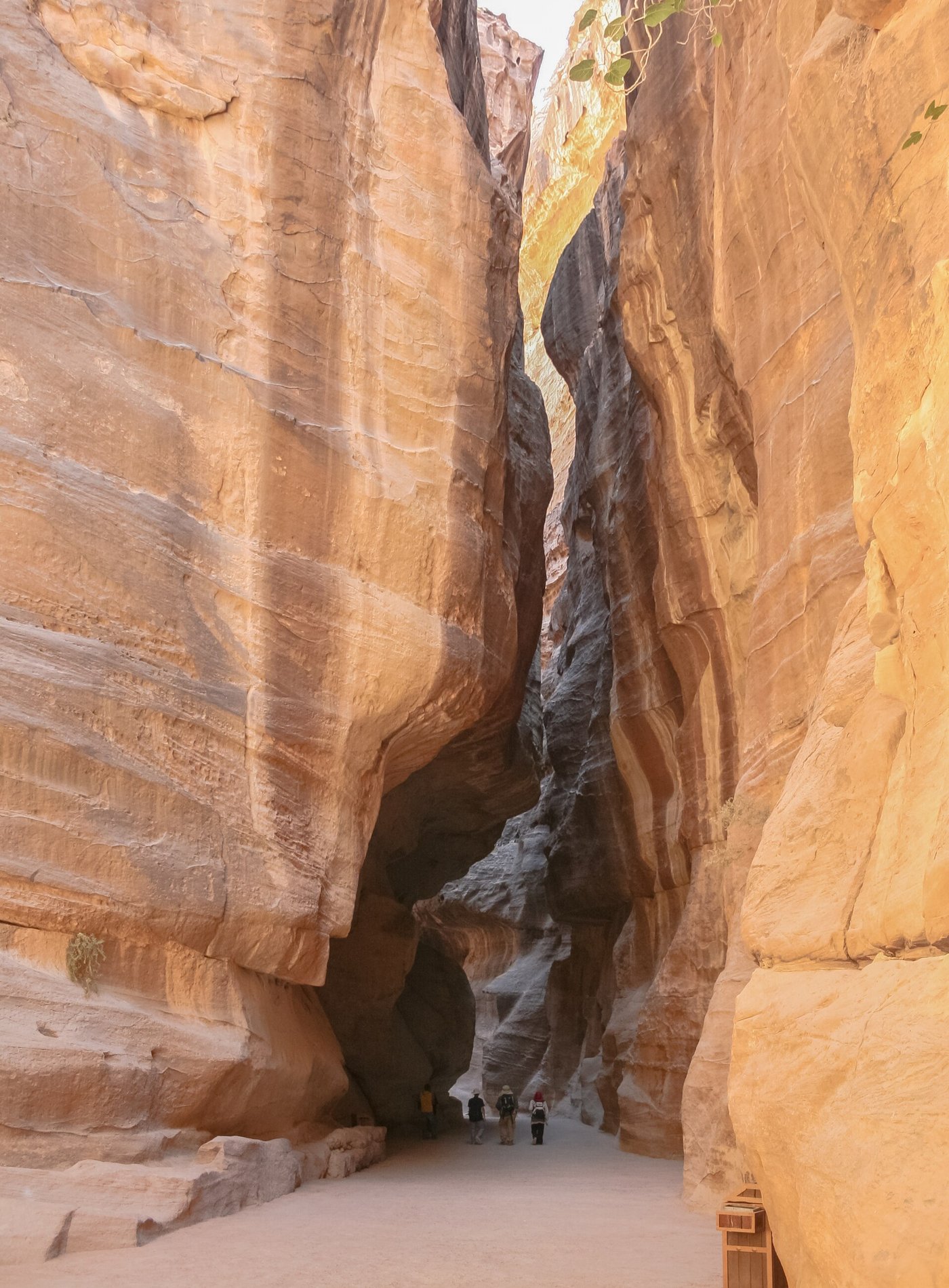
On an April afternoon in 1963, a group of French tourists filed into the Siq, the narrow gorge that is the only easy way into Petra. The walls of pink sandstone rise more than a hundred metres on either side, so close in places that two people can touch both at once. It had been raining somewhere up in the hills, out of sight. The visitors heard the sound before they understood it, a low roar coming down the canyon, and then the water arrived, a wall of it, funnelled by the rock into a single killing channel with nowhere to climb. Twenty-three people drowned in the space of a few minutes. What almost nobody in the party could have known, as the flood came for them, was that the Nabataeans who carved this city had faced exactly this danger two thousand years earlier, and had beaten it.
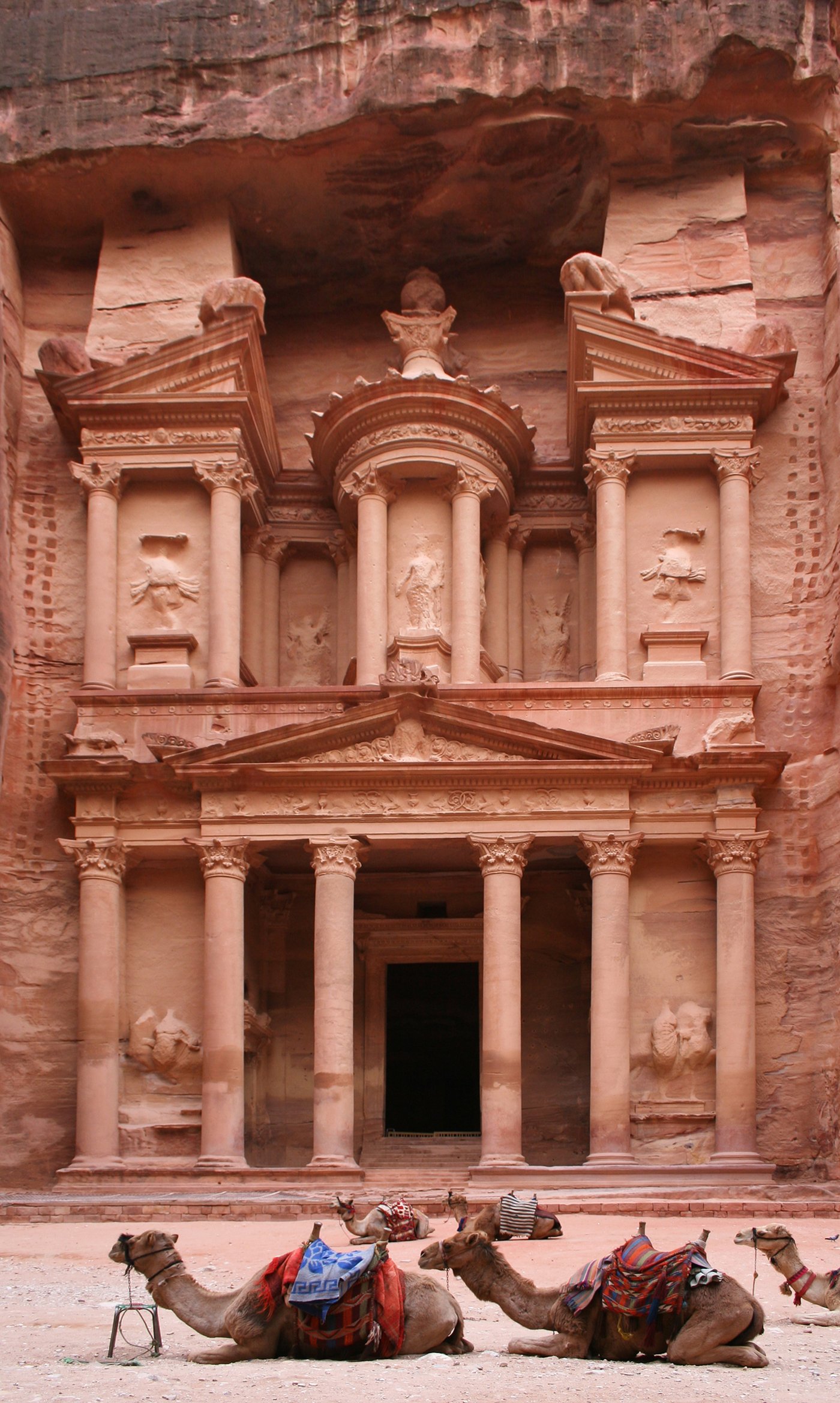
Petra is famous for the wrong reason. The photographs sell a tomb: Al-Khazneh, the so-called Treasury, its columns and urn cut straight into a cliff of rose and amber stone, glowing at the end of the Siq like the last frame of an adventure film. It is one of the most recognisable ruins on earth. But the tomb is the easy part. The real achievement at Petra is not carved on the surface where the cameras point. It is buried in the walls, under the floors, and out along the dry valleys around the city: a water system so good that it turned a place with no business supporting a town into the capital of a kingdom.
A city built where it should not have been
Start with the problem the Nabataeans set themselves. Petra sits in the mountains of southern Jordan, in country that gets perhaps 150 millimetres of rain in a good year and often much less. That is desert. Worse, the rain that does fall tends to come in short violent bursts in the winter months, exactly the kind of storm that had killed the tourists in the Siq. So the site offered its builders the two worst versions of a water problem at once: not enough of it for most of the year, and far too much of it, far too fast, for a few days each winter. A city here needed to catch and hold every drop it could, and to survive the floods that arrived with the rest.
The people who solved this were, to begin with, not city-builders at all. The Nabataeans started as nomads: Arab herders and traders moving through the deserts of northern Arabia. The Greek writer Diodorus Siculus, drawing on an earlier account, describes them in the fourth century BC as a people with a rule against sowing crops, planting trees, building houses or drinking wine, so that no enemy could ever force them to surrender by threatening a settled home. They lived light on purpose. And they knew, better than anyone, how to find water in a landscape that seemed to have none. Diodorus says they dug hidden cisterns in the desert, sealed and marked in ways only they understood, so that a Nabataean caravan could cross ground that would kill a pursuing army.
That desert skill was the seed of everything at Petra. When the Nabataeans grew rich enough to want a capital, they did not abandon the knowledge that had kept them alive on the move. They scaled it up.
What made them rich
The money came from smell. Frankincense and myrrh, the aromatic resins burned in temples and used in medicine and burial across the ancient world, grew in southern Arabia and the Horn of Africa, and almost nowhere else. Getting them north to the markets of the Mediterranean meant a long overland haul by camel, and Petra sat at a hinge of those routes, where the tracks up from Arabia met the roads to Gaza, Damascus and the sea. The Nabataeans took a cut of everything that passed. They guided the caravans, guarded them, watered them, taxed them. Over a couple of centuries they turned that toll into one of the wealthiest small states of the ancient Near East.
By the first century BC Petra was a proper city, with temples, a colonnaded street, a theatre cut into the hillside, and the carved tomb-fronts that still draw the crowds. At its height, sometime around the turn of the first century AD, perhaps twenty to thirty thousand people lived here. Every one of them needed to drink, in a canyon that rain visited for only a few weeks a year. The tombs are what survived; the waterworks are what made them possible.
The channels in the gorge wall
Walk into Petra today through the Siq and, if you know to look, you can read the system on the walls beside you. Cut into the rock along both sides of the gorge, about waist to shoulder height, run two water channels. On one side an open stone channel; on the other, a line of sockets and cut beds that once held a pipeline of fitted clay pipes. They ran the length of the Siq, more than a kilometre, on a careful, gentle gradient, and they carried fresh water into the heart of the city.
The source was a spring called Ain Musa (the Spring of Moses) a few kilometres east of Petra, near the modern town of Wadi Musa. Local tradition holds it is the rock Moses struck to bring forth water, which is a fine story for a spring that really never stops. The Nabataeans tapped it, and possibly other springs too, and led the water down towards the city along conduits that hugged the contours of the hills. By the time it reached the Siq, the flow was split between the open channel and the closed pipe and sent gliding into town.
The two-channel arrangement was not decoration. Running some of the supply through sealed clay pipe kept it clean and cut the loss to evaporation; the open channel could be inspected and cleared. And the pipes themselves were made with a subtlety that engineers only fully appreciated in modern times.
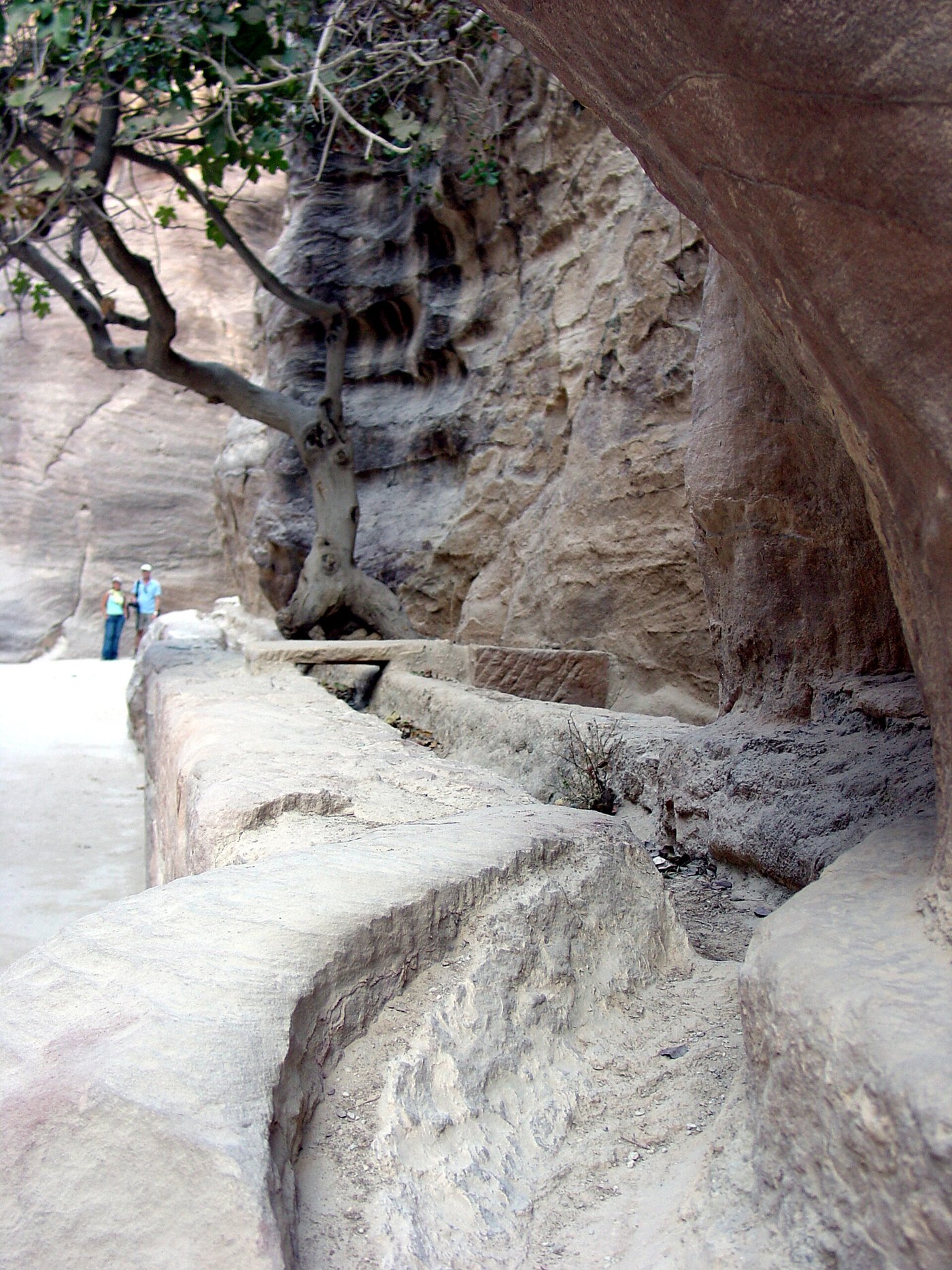
The American hydraulic engineer Charles Ortloff spent years reverse-engineering Petra's plumbing, and found choices no amateur would make. The clay pipes were sized so that, at the volumes the springs delivered, water ran through them only partly full rather than under full pressure. That sounds like a waste of a pipe. It is the opposite: a pipe running partly full carries water smoothly, without the surges and hammering that a fully pressurised line suffers when the flow changes. It also stopped the mineral-heavy spring water from clogging the pipe as fast. The Nabataeans had no equations for any of this. They had trial, error, and generations of watching water behave, and they arrived at the answer a textbook would give today.
Dams, cisterns and the art of catching a flood
Bringing spring water in was only half the design. The other half was surviving the winter storms, the same floods that would one day fill the Siq. The Nabataean answer was to treat the whole bowl of hills around Petra as a single machine for catching water, and to make sure that when the rain came, none of it ran through the city as a weapon.
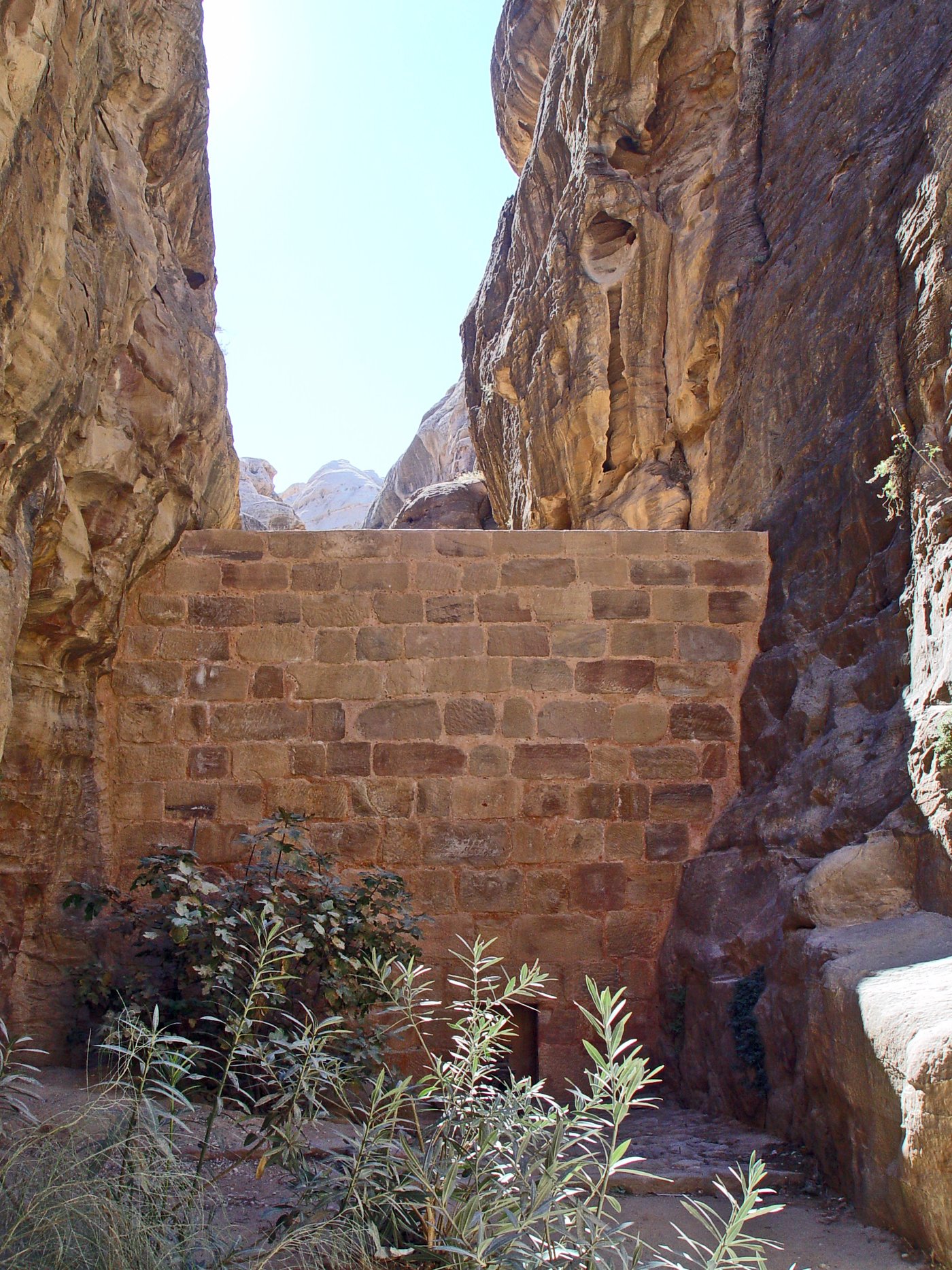
They built dams, scores of them, small and large, across the side valleys that fed into the Siq and the city. The most important sat at the very mouth of the Siq. Instead of letting the winter flood pour down the gorge, the Nabataeans dammed it and cut a tunnel through the solid rock to one side, diverting the water into an adjacent wadi and away from the town entirely. The gorge that killed the tourists in 1963 had, in Nabataean times, been sealed off from exactly that flood. Their dam and tunnel had simply been allowed to silt up and fail in the long centuries since.
The response to the 1963 disaster tells you how good the ancient design was: Jordanian engineers, working out how to make the Siq safe for visitors again, built a modern dam across its mouth and reopened the old Nabataean diversion tunnel to carry flood water away. The twentieth-century solution was to copy the first-century one.
What the dams did not divert, the Nabataeans stored. Cut and plastered cisterns are everywhere at Petra, hollowed into the rock beneath courtyards, tucked under floors, sunk into the hillsides. Channels led rooftop and street runoff into them; settling basins let the grit drop out before the water went into store. Estimates of the total storage run into the millions of litres. The point of all of it was to move water across time as well as space: to take the flood that fell in a few frantic winter weeks and dole it out through the long dry summer, so that a city in a desert could drink, bathe, water its gardens and fill its fountains in July as if the rain had never stopped.
A pipeline found in 2026
For all the study Petra has had, the system is still giving up new pieces. In 2026 a survey led by Niklas Jungmann, of the Humboldt University of Berlin, working along the Ain Braq aqueduct on the southern edge of the city, traced not one conduit but two, built in different phases using different technology, running through a stretch of hillside that earlier maps had left more or less blank.
The find that drew attention was a lead pipeline, around 116 metres of it, laid to carry water under pressure. Lead pipe of that length, out in the open landscape rather than inside a building, is rare in the eastern Mediterranean, and it shows the Nabataeans and their Roman-era successors reaching for a different tool when the ground demanded it. Where a gentle clay pipe running half-full suited a gentle gradient, a stretch of awkward terrain that needed water pushed uphill or across a dip called for a sealed, pressurised line, and they built one. In places the survey found the old conduit blocks with their mortar still hard, and fragments of the lead pipe still set inside.
The 2026 work on the Ain Braq aqueduct matters less for the single pipeline than for what two conduits, built in two phases, tell you: Petra's water network was not designed once and left alone. It was extended, patched, upgraded and re-engineered over centuries, with builders reaching for open channels, clay pipe or pressurised lead depending on what a particular slope required. The map of Petra's plumbing is still being drawn, and the southern edge of the city, long treated as marginal, turns out to have carried some of its most ambitious engineering.
The myth of the lost rose-red city
The popular image of Petra is a romance, and like most romances it gets the facts backwards. The story goes that Petra was a lost city, forgotten by the world, until a daring young Swiss explorer named Johann Ludwig Burckhardt talked his way in through the Siq in 1812, disguised as a Muslim pilgrim, and revealed its wonders to an astonished Europe. Soon after, an Oxford prize poem gave it the line everyone still quotes: “a rose-red city half as old as time.”
It is a lovely line and almost nothing about the legend around it is true.
Petra was a lost city, swallowed by the desert and unknown to the world, until a European explorer rediscovered it in 1812: a rose-red city half as old as time, waiting silent for someone to find it.
Petra was never lost to the people who lived beside it. The Bedouin of the region knew the ruins intimately and were living among them; Burckhardt got in by hiring a local guide who could walk him straight to the tombs. Petra was “lost” only to Western Europe, which is a very different thing. As for “half as old as time”, the poet John William Burgon, who wrote the line in 1845, had never been within a thousand miles of the place. Petra's grand monuments are roughly two thousand years old, not the primeval age the poem imagines. And the “Treasury” holds no treasure and never did: it is a tomb. The name comes from a Bedouin story that a pharaoh hid gold in the great stone urn above its door, which is why the urn is pocked with old bullet marks, from people who tried to shoot it open.
Strip the romance away and Petra becomes more impressive, not less. It was not a mysterious lost jewel. It was a working desert capital, run by clever people who had engineered a solution to the hardest problem their landscape could set. The tombs are beautiful. The water system is the reason anyone was ever alive to carve them.
What went wrong
If the Nabataeans were so good at this, why is Petra a ruin?
Nothing dramatic, in the end. Petra's decline was slow and had several causes, and running out of water was not really one of them. The first blow was political: in AD 106 Rome annexed the Nabataean kingdom and folded it into the empire as the province of Arabia. Petra kept its status for a while (the Romans admired the place and added to it), but the centre of gravity shifted. Trade routes moved. More and more of the eastern trade went by sea, up the Red Sea and through Egypt, rather than overland by camel through the desert tolls that had made Petra rich. The rival caravan city of Palmyra took a share of what was left. A city whose whole reason for being was to sit astride a land route began to matter less as the world took the water route instead.
Then the ground moved. A major earthquake in AD 363 wrecked buildings across the region and damaged Petra badly, and the maintenance that a water system like this demands (the constant clearing of channels, repairing of pipes, dredging of cisterns) became harder to sustain as the population and the money thinned out. A further great earthquake in 551 did more harm. The city was never entirely abandoned; a Christian community lived there in Byzantine times, adapting some tombs into churches, and Bedouin families lived among the ruins for centuries after. But the great days were over. The clever machine for catching water, left untended, silted up and fell quiet, until a flood in 1963 came down an ungoverned Siq and reminded everyone what the Nabataeans had been holding back.
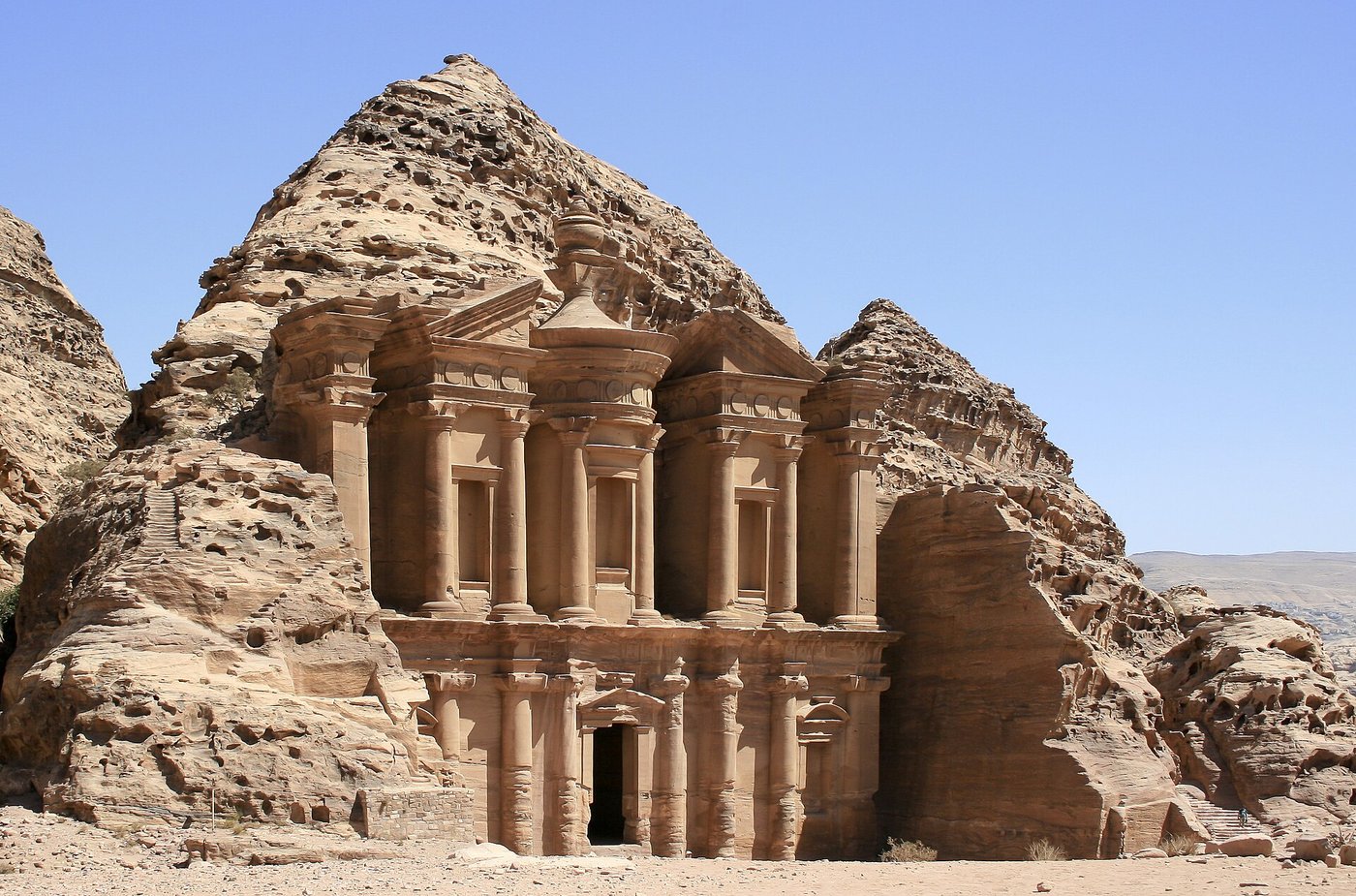
Nobody can put a firm figure on Petra's population, and the argument runs largely through the water system. Estimates cluster somewhere between twenty and thirty thousand at the peak, reasoned partly from how much water the springs, dams and cisterns could reliably deliver across a dry year. Push the number much higher and the supply, however clever, cannot obviously stretch to meet it; pitch it much lower and it is hard to explain the scale of the tombs, the theatre and the streets. The plumbing, in other words, has become a way of weighing the city, a reminder that at Petra the water was never a background detail. It set the size of everything.
The real monument
The tourists who died in the Siq in 1963 were killed by the one force the Nabataeans had most carefully tamed, at the exact spot they had tamed it, because their defences had been allowed to fail. There is something almost unbearable in that. The people who built this city understood the canyon better than the modern world that inherited it, and the proof was written into the walls the whole time, in two thin channels most visitors walk straight past on their way to photograph a tomb.
Petra is worth seeing for the carved facades; everyone is right about that. But the next time you meet the rose-red city in a photograph, look past the columns to the wall of the gorge, and imagine it wet: a clay pipe and an open channel carrying spring water into a desert, kept running by people who had learned, out on the sand, that the difference between a caravan and a corpse is knowing where the water is. They turned that knowledge into a capital. The tombs are the part they left for us to admire. The water is what let them build.
Read next: Marib Dam: The Wall That Fed Sheba Until the Repairs Stopped and Ubar: The 'Atlantis of the Sands' That Fell Into a Sinkhole.
Sources & further reading
- Charles R. Ortloff, “The water supply and distribution system of the Nabataean city of Petra (Jordan), 300 BC–AD 300,” Cambridge Archaeological Journal 15:1 (2005).
- Diodorus Siculus, Bibliotheca Historica, Book XIX (on the early Nabataeans and their hidden cisterns).
- “New study reveals advanced lead pipeline system in Petra's ancient aqueduct,” reporting on N. Jungmann's 2026 survey of the Ain Braq aqueduct (Humboldt University of Berlin).
- G. W. Bowersock, Roman Arabia (Harvard University Press, 1983).
- “Petra” and “Al-Khazneh,” UNESCO World Heritage Centre and British Museum collection notes.
Image credits (via Wikimedia Commons): the Siq — Diego Delso (CC BY-SA 3.0); water channel in the Siq — Michael Gunther (CC BY-SA 3.0); Petra dam — Etan J. Tal (CC BY 3.0); Ad Deir, the Monastery — Diego Delso (CC BY-SA 3.0). Featured image: Al-Khazneh, the Treasury — Graham Racher / MrPanyGoff (CC BY-SA 2.0).