On a stripped patch of west Norfolk clay in the summer of 2025, an archaeologist working ahead of a housing estate scraped back the soil and found a curl of green bronze coming up out of the ground. It was not a bracelet or a bowl. As the diggers followed it, the metal ran on and on: a long, narrow tube, bent, tipped at one end with the crumpled snout of an animal. They had opened a pit that Iron Age hands had filled two thousand years before, and lying in it, nearly whole, was one of the strangest instruments the ancient world ever built: a carnyx, the boar-headed war trumpet that Celtic armies once raised over their own heads and blew until the noise carried across a valley.
For most of the last two centuries the carnyx was a rumour. Roman writers described a terrible braying on Celtic battlefields. Celtic and Roman artists carved a tall, S-necked horn with a beast's gaping mouth onto cauldrons and coins and triumphal arches. But almost nothing survived in metal, and what did was a single broken head. People half-wondered whether the whole thing had been exaggerated, a bit of barbarian theatre blown up by frightened Romans, or an artist's flourish. Then the ground started giving carnyces back. First a pit in France. Now a field in England. And the instrument that was mostly a story turned out to be exactly as odd as the stories said.
A shape borrowed from the enemy's art
Before any complete carnyx came out of the earth, the way to know what one looked like was to study the people who had reason to remember it, often the people it had been pointed at. The horn shows up again and again in the art of the Iron Age and the world that conquered it. On Roman coins struck to mark victories in Gaul, a heap of captured weapons almost always includes that unmistakable long-necked trumpet with the animal bell. It is carved onto the triumphal arch at Orange in southern France, tossed among the spoils. It appears on the great cross-legged god plate of a Danish silver cauldron, and on other Celtic metalwork besides.
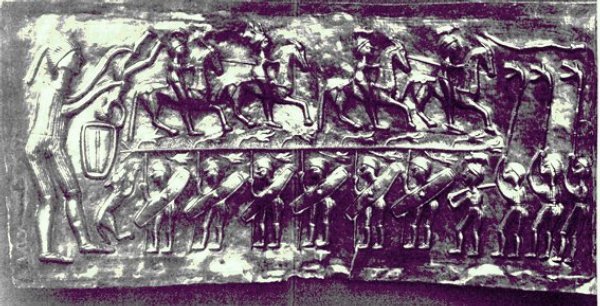
The clearest picture of all is on that cauldron, dug from a peat bog at Gundestrup in Jutland and now one of the treasures of the National Museum of Denmark. On one of its inner plates a line of warriors marches behind three musicians, and each of the three holds a carnyx bolt upright, the boar-head bell high above the crowd. It is a small scene, hammered into silver, but it settles the basic question. The instrument was meant to be played vertically, its voice thrown out over the tops of men's heads rather than forward like a modern bugle. What no carving could tell you was whether the thing had ever really worked, or how it sounded. For that you needed the metal itself.
How you build a scream
A carnyx is, at heart, a very long trumpet made to stand as tall as the man playing it: roughly a metre and three-quarters from mouthpiece to bell. The player took it in both hands, set the small mouthpiece to his lips at chest height, and the tube climbed straight up past his face before the whole thing turned forward at the top into the head of a beast, most often a wild boar. It was built from sheet bronze, worked and joined by hand, light enough to carry into a fight and hold aloft, which is no small feat of metalworking for a piece so long.
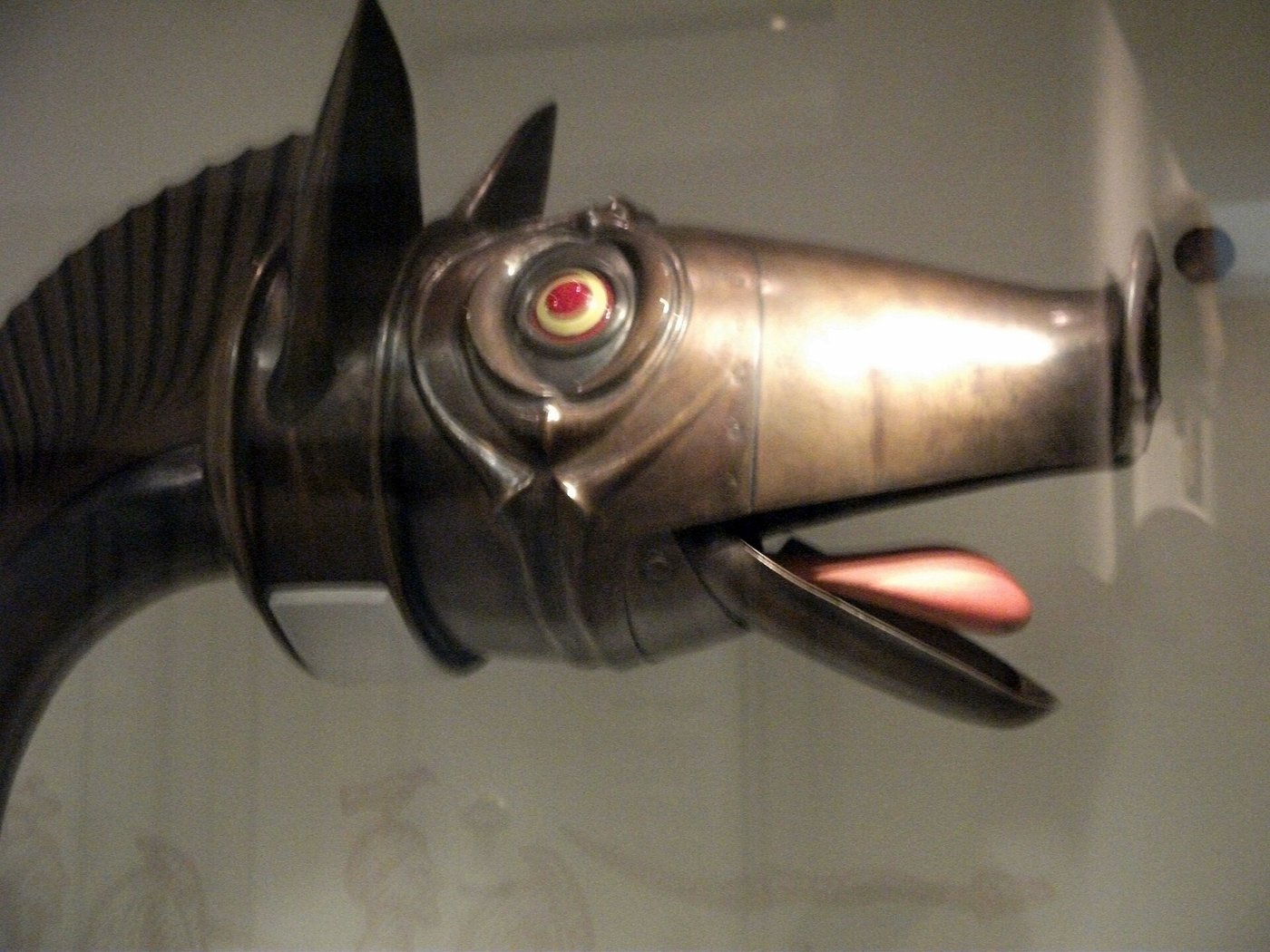
The clever part was the head. On the finest examples the boar's jaw was a separate hinged piece, so the lower jaw could swing, and the mouth held a thin sheet of bronze (a movable palate or tongue) hung on a little pivot inside the open mouth. When the instrument sounded, air and vibration set that loose tongue rattling, and the boar's jaw could clatter. The result was not the clean note of a modern horn. It was a raw, buzzing, ragged blare with a hard edge on it, thrown down out of a metal animal's throat two feet above the noise of the crowd. The design was doing two jobs at once: making a sound, and making a monster.
"There were innumerable horn-blowers and trumpeters, and, as the whole army was shouting its war-cries at the same time, there was such a tumult of sound that it seemed that not only the trumpets and the soldiers but all the country round had got a voice and caught up the cry."— Polybius, Histories, describing a Celtic army facing Rome at Telamon
The Greek historian Polybius watched a Celtic host draw up against a Roman army at Telamon in Italy and remembered, above everything, the sound of it: a wall of noise so total that the land itself seemed to be shouting. Diodorus Siculus, writing a century or two later, was blunter about the instrument behind the din: the Celts, he said, had trumpets "of a peculiar barbarian kind", blown to produce "a harsh sound which suits the tumult of war". Neither man was a fan. That is rather the point. The carnyx was built to be heard by people who did not want to hear it.
The head in the Banffshire bog
The first real carnyx to reach modern hands came up not from a battlefield but from a Scottish peat bog, and only in part. In 1816, at Leitchestown farm near Deskford in Banffshire, in the north-east of Scotland, someone cutting turf turned up a battered boar's head of bronze. The long tube was gone; what survived was the bell, the snarling head that had crowned it, laid down on its own in wet ground. The style of the work and later dating put it somewhere around AD 80 to 250, and there is little doubt about why it was there. It had been placed in the bog on purpose, an offering to whatever powers lived in the water, exactly as the Gundestrup cauldron had been sunk in its own Danish marsh.
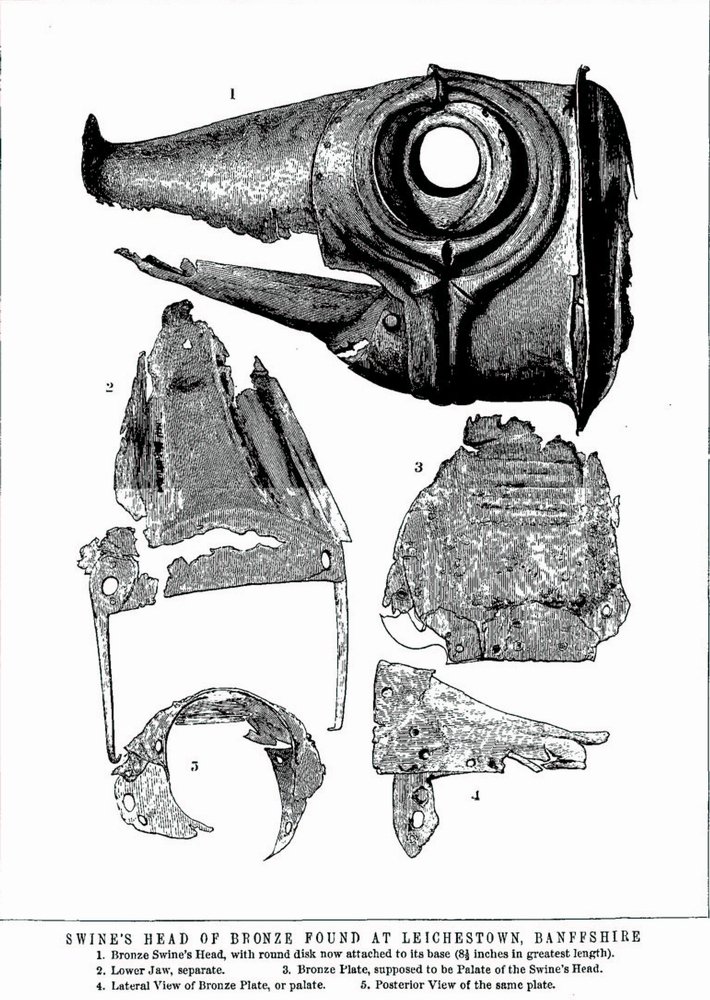
The Deskford head is worn and dented, its eyes empty, its ears broken, and it is still one of the great objects in the National Museum of Scotland. When it was found it had once held that hinged jaw and a movable wooden tongue; both were gone, but the sockets and fittings showed where they had been. For nearly two hundred years this single head, missing most of itself, was the best physical evidence anyone had that the carnyx was a real, working thing and not just a shape in a carving. It was enough to prove the instrument existed. It was not nearly enough to bring it back.
Seven in a pit at Tintignac
That took a field in central France. In 2004, at a Gallo-Roman sanctuary called Tintignac in the Corrèze, archaeologists opened a pit packed with more than five hundred fragments of broken bronze (armour, helmets, animal figures, weapons), and among the wreckage lay the pieces of seven carnyces. Seven. In one hole, an instrument known until then from a single ruined head suddenly multiplied into a whole broken chorus. Six of the seven ended in the usual wild boar. The seventh was something else: a long-eared, open-mouthed serpent or monster, a reminder that the boar was the favourite bell but not the only one.
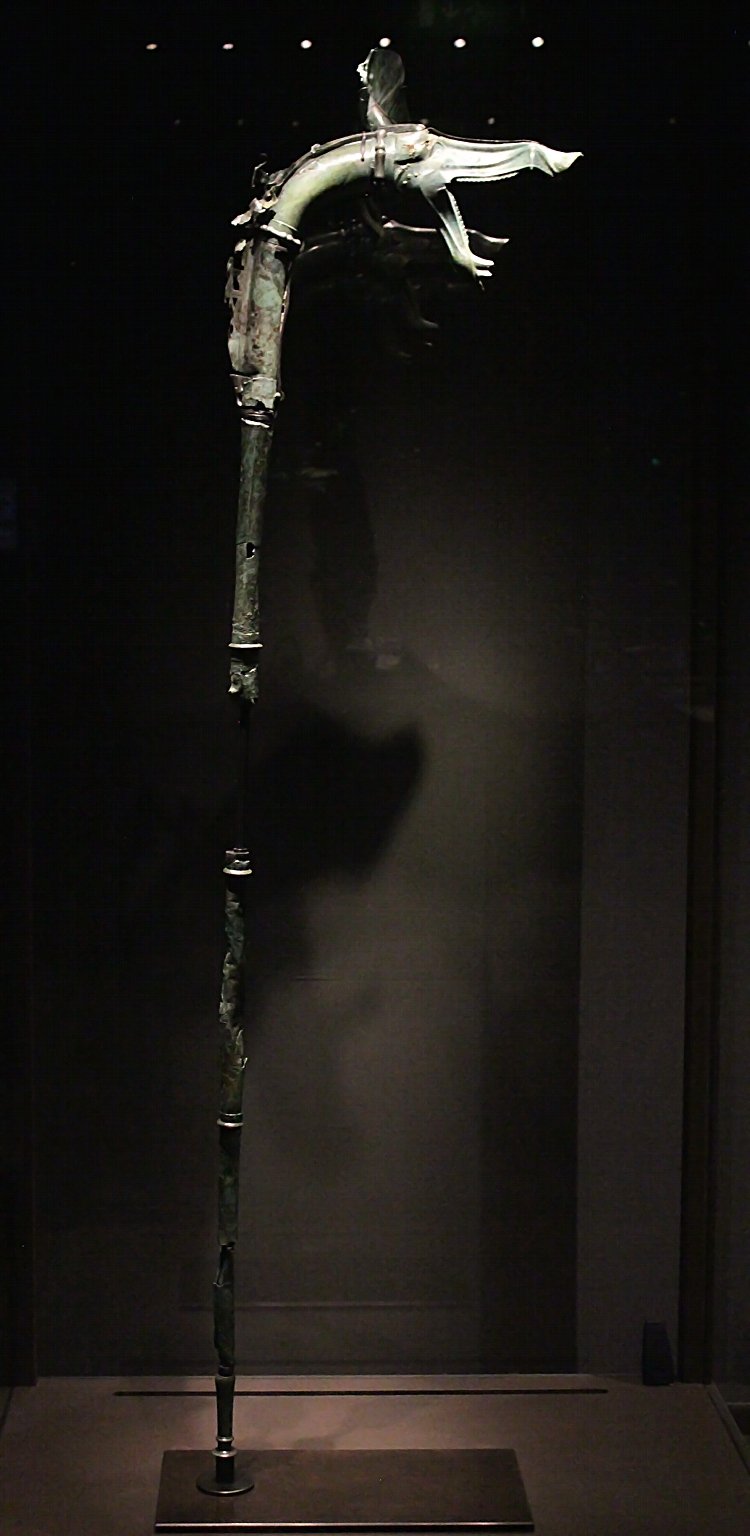
Like the Deskford head, the Tintignac horns had been deliberately taken apart and buried, most likely as a ritual deposit soon after Rome finished conquering Gaul: the sacred objects of a defeated people put out of use and given to the ground. But because so much of each instrument survived, the Tintignac find did what nothing before it could. It let people rebuild a carnyx from real ancient parts, from the true diameters and lengths and joints, rather than guessing from a picture. For the first time the whole instrument, tube and head and hinged jaw, stood up complete. And once you have a complete carnyx, you can do the thing everyone had wanted to do for two centuries. You can blow into it.
The story runs that the tall boar-horn was a bit of stagecraft: exaggerated by nervous Roman writers, stylised by artists, with nothing solid behind the pictures. A scary noise-maker that existed mostly in the imagination of the people it was used against.
The metal keeps arriving. The Deskford bog gave up a real boar's-head bell in 1816. The Tintignac pit gave up the pieces of seven whole instruments in 2004. And in 2025 a Norfolk field produced a carnyx nearly complete, one of only three known from Britain and among the most intact ever found anywhere. The carnyx was not invented by frightened Romans. It was a real, carefully engineered instrument that Iron Age smiths built, played, and then buried, and the ground has been handing it back, piece by piece, ever since.
Making it speak again
The work of giving the carnyx its voice back began before Tintignac, around the Deskford head, and it took years. Through the early 1990s a team including the silversmith John Creed studied the Scottish boar and built a working reconstruction, raising the long tube in bronze and fitting the hinged jaw and the loose tongue the way the original fittings suggested. In 1993 the trombonist John Kenny lifted the finished instrument, set the mouthpiece to his lips, and became, as far as anyone can say, the first person to sound a carnyx in something close to two thousand years.
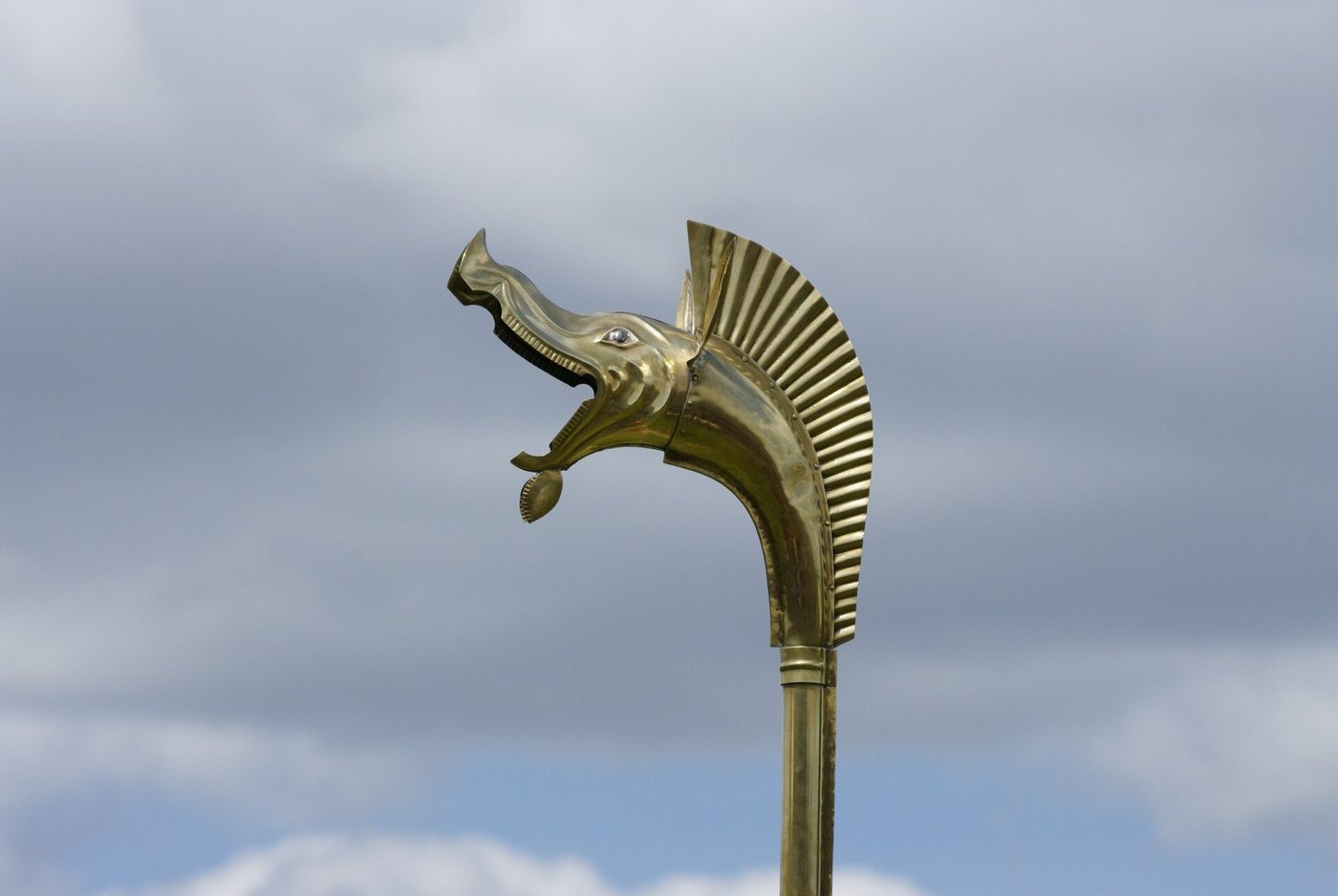
What came out surprised everyone. A player who knows the instrument can pull a wide range of sound from it: a deep, moaning drone at the bottom, and higher up a harsh, cutting bray that carries a very long way. Acoustic study of the rebuilt Tintignac horns found that their natural resonances did not line up in the neat harmonic ladder of a modern brass instrument; the closest match anyone could offer was an alto saxhorn, and even that only roughly. The Tintignac boars, with their wide open mouths, threw the sound straight forward and hit harder than the Deskford reconstruction did. These were not all one instrument. They were a family, tuned by hand, each with its own throat.
Hearing it, you understand the design at last. Stand a rank of these things up over an army, set the loose tongues rattling and the jaws clattering, add the war-cries and the clash of shields, and you have engineered a sound meant to arrive before the spears do, to reach the enemy's line while the men holding it are still out of reach, and start the fight in their heads. Polybius did not exaggerate. If anything, silver and bronze had been trying to warn us for centuries, and we simply could not hear them.
The trumpet in the Norfolk clay
Which brings the story back to that housing plot in west Norfolk. The dig was routine: the ordinary archaeology that the law requires before builders move in, carried out by a firm called Pre-Construct Archaeology. What they lifted out of the ground was anything but routine. Alongside the near-complete carnyx lay the broken parts of at least one more, five bronze shield bosses, and something never before seen in Britain: a boar's head beaten from sheet bronze that had once crowned a military standard, a flag-pole topped with the same fierce animal that snarled from the horns. The whole lot had been buried together, in the first century AD, deep in territory that had belonged to the Iceni.
That last detail is the one setting hearts racing. The Iceni were Boudicca's people, the tribe whose queen led the great revolt against Roman rule in AD 60 or 61, burned Colchester, London and St Albans, and came within sight of driving Rome out of Britain before she was crushed. A hoard of war-gear and screaming horns, put into the ground in Iceni country at just about that time, is the kind of find that invites a famous name. Whether Boudicca herself has anything to do with it is another matter, and no honest archaeologist will yet say so. What is certain is that the objects are extraordinary: the carnyx is one of only three ever found in Britain and among the most complete recovered anywhere in Europe. It was shown to the public for the first time on the BBC's Digging for Britain in January 2026, while conservators X-rayed and scanned it and a coroner weighed who now owns it under the treasure law.
What was the carnyx actually for? Some read it as battlefield signalling, a way to pass orders and rally lines through the din. Some see a weapon aimed at the mind: noise as terror, meant to break an enemy's courage before the blades met. And the boar bell, the bog offerings, the deliberate burials all point somewhere else again: to the sacred, the horn as a voice for the gods and the dead, given back to water and earth when its work was done. The likeliest answer is that these were never separate jobs. In a world where a war and a rite and a god were the same event, the instrument could be all three at once, which is exactly why it ended up in the ground rather than passed down.
What the boar was saying
It is worth asking why, of all creatures, the bell was so often a boar. To the peoples of Iron Age Europe the wild boar was the animal of war itself: fearless, tusked, willing to charge anything, a beast that would rather die than run. Warriors wore it on their helmets and shields and standards; here it was, again, at the top of the horn, mouth flung open as though the terrible sound were the animal's own roar. The man playing the carnyx was lending his breath to a bronze boar and letting it scream.
There is a temptation to file all this under crude psychology: savages banging on a big scary horn to frighten better-drilled Romans. The finds argue for something more considered. This was precision metalwork, tuned and hinged and balanced, made by craftsmen who understood sound, and it was treated as holy: not discarded when it broke but dismantled with care and laid in bogs and pits like the offering it was. A people who buried their trumpets in sacred water were not just trying to be loud. They believed the instrument carried something worth giving to the gods.
The sound in the ground
There is a strange symmetry to the whole history of the carnyx. It was an instrument built to be heard, to throw a sound as far as bronze and breath could carry it, over the heads of an army and across open country to an enemy who could not yet see who was coming. And again and again, its owners took that voice and pushed it down into silence: a boar's head into a Banffshire bog, seven horns into a French pit, a whole armoury of them into Norfolk clay. The loudest object of the Iron Age keeps being found in the quietest places.
We can play it now. Reconstructions stand in museums, and a handful of musicians can raise the tube, set the tongue rattling, and fill a hall with a sound no Roman had heard in two thousand years. But a concert hall is not a valley at dawn, and a curious audience is not a legionary watching a hillside fill with men and boar-headed horns. We have the instrument back. We have measured its throat and matched it, roughly, to a saxhorn. What we cannot quite recover is the thing Polybius could not forget: the moment the whole country seemed to find a voice, and start to shout. The bronze remembers the note. It has stopped short of telling us the fear.
Read next: Gundestrup Cauldron: Celtic Gods, Thracian Hands, Foreign Silver and Vix: The Celtic Grave That Held Antiquity's Largest Bronze Vessel.
Sources & further reading
- National Museum of Scotland, Edinburgh — the Deskford carnyx head and John Creed's playable reconstruction, with the museum's account of its discovery and dating.
- Musée d'archéologie de Naves and the Tintignac excavation reports (Christophe Maniquet and others) — the 2004 deposit of seven carnyces and their reconstruction.
- Polybius, Histories, Book II (the Battle of Telamon), and Diodorus Siculus, Library of History, Book V — the classical descriptions of Celtic war-trumpets.
- National Museum of Denmark — the Gundestrup cauldron and its plate showing carnyx players.
- Historic England and Norfolk Museums Service — statements on the west Norfolk Iron Age hoard, its near-complete carnyx and boar's-head standard, 2026.
- Digging for Britain, BBC Two, series shown January 2026 — first public presentation of the Norfolk carnyx.
Image credits (via Wikimedia Commons): Deskford carnyx reconstruction, National Museum of Scotland (featured) — Johnbod (CC BY-SA 3.0); Gundestrup cauldron plate with carnyx players — public domain; Deskford carnyx head — John Alexander Smith (public domain); Tintignac carnyces — Claude Valette (CC BY-SA 3.0); carnyx in performance — Elliott Sadourny (CC BY-SA 3.0).