One night in February 1987, in a poor village on the north coast of Peru, a grave robber named Ernil Bernal squeezed down a tunnel he had dug into the side of an old adobe mound. He had been digging for weeks. This time the shaft broke through into a sealed space, and the space gave up its contents all at once. Gold rained down on him in the dark (beads, bells, a rattle, sheets of worked metal) until he was buried to the chest in it. He and his brothers hauled out rice sacks of the stuff and split it by lamplight. Within days they had fallen out over the shares, someone talked, and the police came. In the confrontation that followed, Ernil Bernal was shot dead. What his tunnel had opened was the richest undisturbed royal grave ever found in the Americas.
The place was called Huaca Rajada, the split mound, a pair of crumbling mud-brick pyramids standing over the sugar-cane and the village of Sipán, near the town of Chiclayo. To anyone driving past, it looked like nothing: two brown hills melting slowly back into the plain. For more than a thousand years it had held the body of a man dressed head to foot in gold, and no one alive knew he was there.
That is the odd thing about the Lord of Sipán. He is now the most famous ancient ruler South America has ever produced, and the world learned his name only because thieves reached him first.
The mound the looters found first
The people who built Huaca Rajada were the Moche, sometimes called the Mochica. They lived along the desert coast of northern Peru for roughly seven centuries, from around AD 100 to 800, in a strip of green river valleys pinned between the Pacific and the Andes. They had no cities the size of Rome and no writing at all. What they had was water, moved by long canals onto land that gets almost no rain, and a genius for working metal and clay. They raised pyramids out of millions of mud bricks, and they buried their lords inside them.
By 1987 those mounds had been picked over by looters, huaqueros, for generations. Grave robbing on the north coast was not a rare crime but an informal industry, passed down in families, tolerated because the alternative was hunger. Most of what the huaqueros pulled out went straight onto the international market for pre-Columbian art, stripped of any record of where it came from. A gold bead in a private collection tells you nothing. A gold bead lying beside a body in a sealed chamber can tell you almost everything. That difference is the whole story of Sipán.
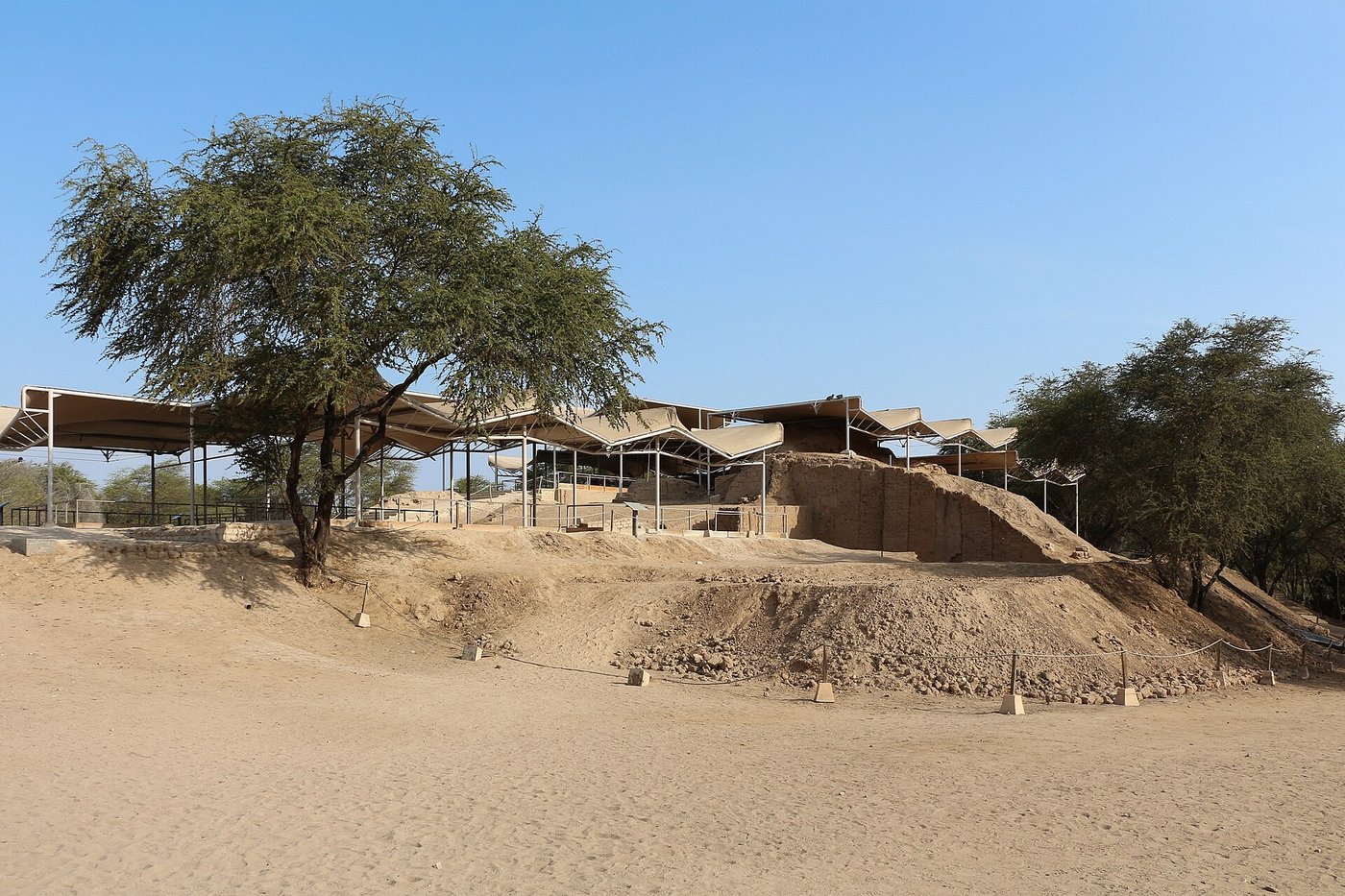
When the police confiscated sacks of gold from the Bernal house, they needed someone who could say what the pieces were. The someone was Walter Alva, then in his late thirties, director of the small Brüning Museum in nearby Lambayeque. Alva was pulled out of a sickbed to look at the haul. What he saw frightened him. These were not the usual trinkets. The workmanship was imperial, and the quantity meant a great tomb had been torn open. If he did nothing, the rest would be gone within the week.
A dig nobody wanted
Alva took over the mound with police protection and almost no money. The village hated him for it. The huaqueros of Sipán had seen the mound as their own bank, and here was a museum man with rifles closing it off. Shots were fired at the site in the early weeks. Alva and his small team lived on the huaca, guarded it around the clock, and dug in the heat with the whole neighbourhood wishing them gone.
The looters' tunnel had gutted one rich burial already. Alva could easily have recorded the damage, boxed the leftovers, and called it a rescue. Instead he kept scraping down through the platform, following the old Moche floors, convinced there was more. Months passed. Then, a few metres from the robbed chamber, his trowels found a rectangle of darker soil, the ghost of a mud-brick room the thieves had missed.
Inside it, first, were the traces of a wooden coffin: not a carved sarcophagus but a simple box of planks, long rotted, its corners marked by copper straps. Around and above it lay other people. And on the low roof of the chamber, folded into a niche looking down into the grave, sat a man.
The sentry with no feet
He is the detail that stops you. The man in the niche had been placed as a guard, a sentinel set to watch over the burial forever. His feet had been cut off. So had the feet of at least one of the men laid inside the chamber below.
This was not cruelty for its own sake, and it was not done to a living prisoner as torture. The men were already dead when they went into the grave, sacrificed to accompany their lord. The removal of the feet reads as something colder and more deliberate: a guard cannot desert his post if he has no feet to walk away on. The Moche wanted this watchman fixed in place for eternity, and they made sure of it. A thousand years later, when Alva lifted the soil off the niche, the footless sentry was still on duty above the king.
The chamber was crowded. Laid out around the central coffin were the bodies of three young women, dressed in ceremonial cloth, placed at the head and foot of the box. There were two men, thought to be warriors. There was a child of about nine or ten. There was a dog, not a sacrifice arranged in rows like the others, but set down almost like a companion, perhaps the lord's own. Two llamas had been added as offerings. It was a household folded whole into the earth, so that a man could arrive in the next world with everything and everyone a ruler needed.
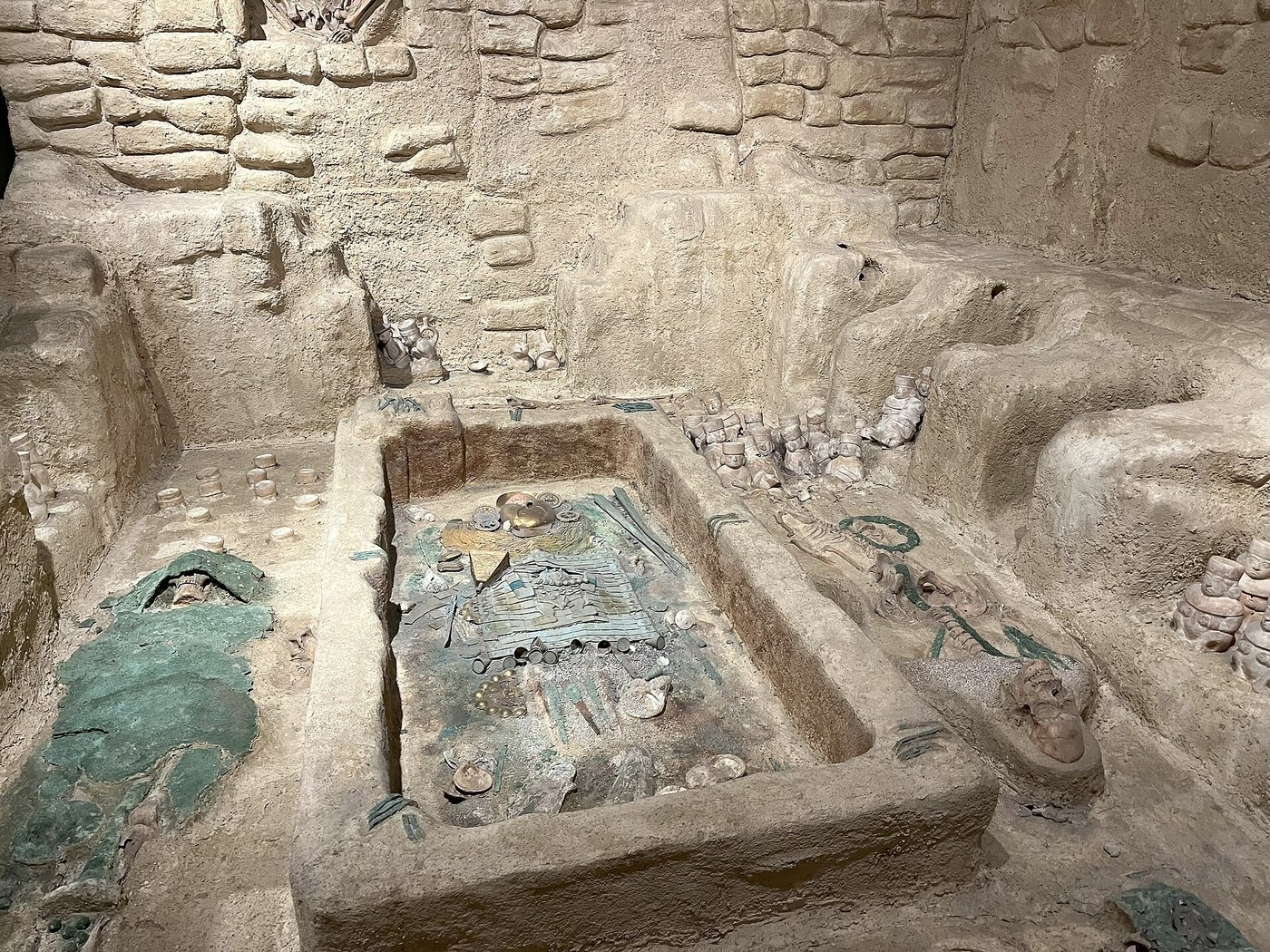
The single tomb of the Lord of Sipán held more than four hundred and fifty objects of gold, silver, gilded copper, turquoise and Spondylus shell, alongside the lord, three women, two men, a child, a dog and two llamas. Nothing like it had ever been excavated intact in the Americas. Everything earlier had come from robbed tombs, where the objects survived but the arrangement, the meaning, was gone.
Gold on the right, silver on the left
The lord himself had almost dissolved. A thousand years in damp coastal ground leaves little of a body but a brown stain and a scatter of bone. His regalia, though, had held its shape where it fell, and reading it was like reading a man laid out in metal.
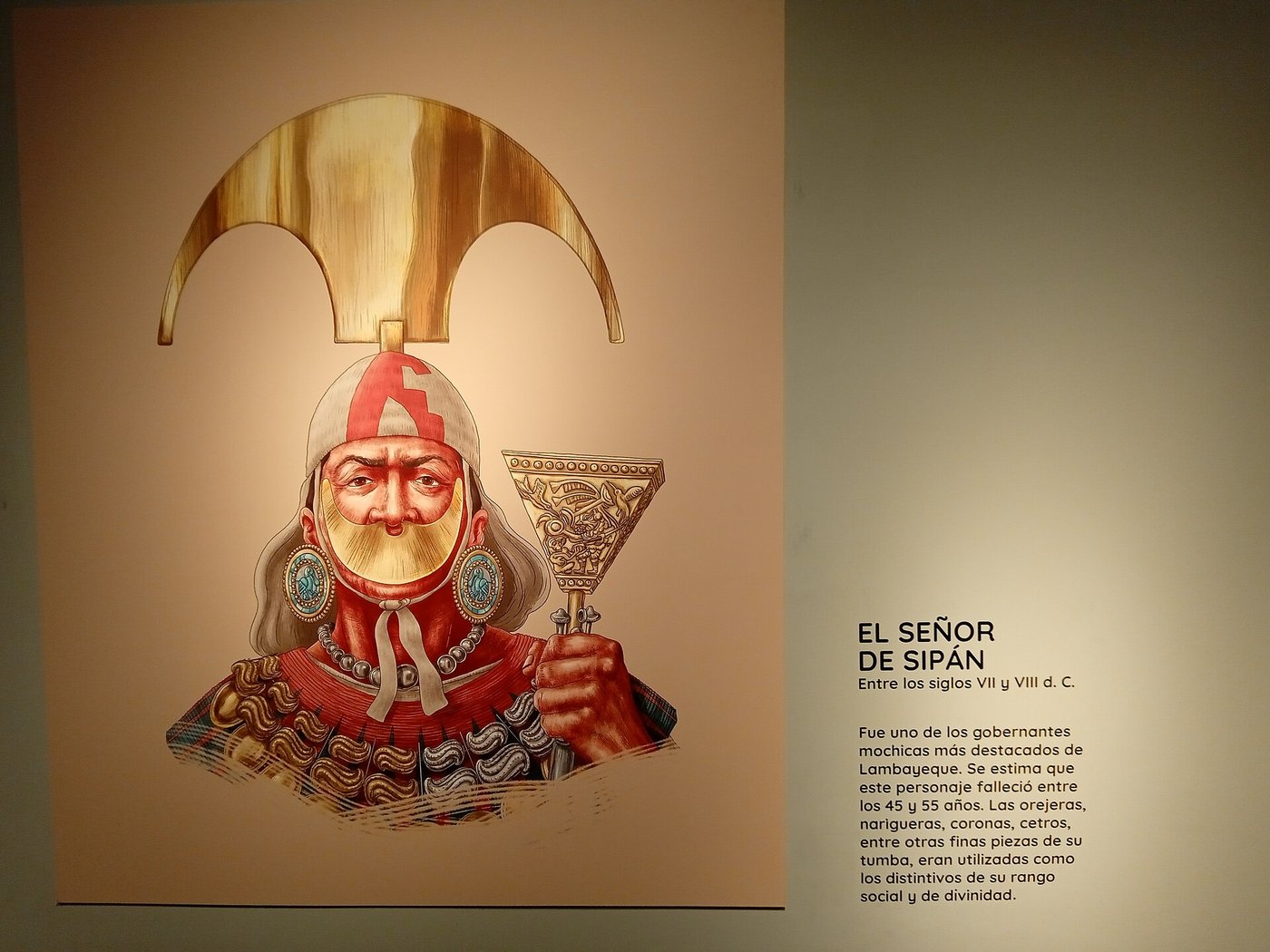
Over his face had been a covering of gold. His eyes, in death, were sheets of gold; his nose was gold. Great crescent ornaments of gold and of gilded copper framed his head. Across his chest lay collars of tiny shell beads in the thousands, blue-green and white and red, laid out in bands. At his ears were two of the finest objects the ancient Americas have left us: gold-and-turquoise discs, each set with a minute figure of a Moche warrior in full costume (a headdress, a necklace, a war club), every piece of it separately made and no larger than a thumbnail.
Then there was the necklace of peanuts. Ten large beads in the shape of peanuts in their shells hung at his neck, and the two sides did not match. The ten on the right were gold. The ten on the left were silver. To the Moche this pairing was not decoration but a statement about the order of the world: gold for the sun, the right hand, the male; silver for the moon, the left, the female. A ruler stood at the join of those halves and held them together. He wore the idea on his own body.
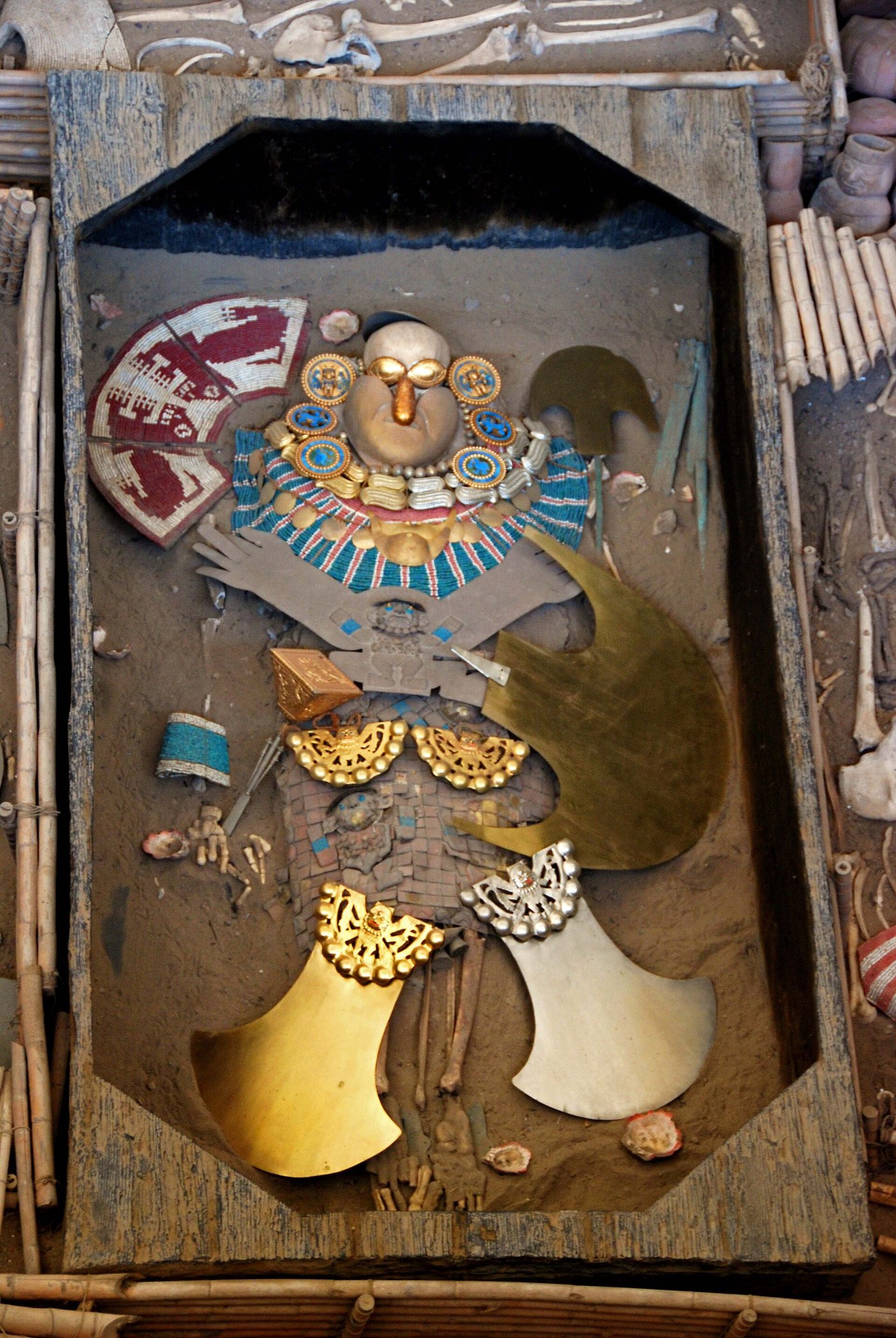
The peanut necklace is the neatest clue in the whole tomb. Peanuts grow underground and were tied to the earth and the dead; rendered at ten times life size in precious metal, split gold against silver, they turn a food crop into a diagram of the cosmos. A goldsmith who could shape a hollow silver peanut this cleanly was working at the very top of his craft, for a patron who wanted meaning in every bead.
A people who left no writing, and the pictures that spoke for them
Here is where Sipán stops being a treasure story and becomes something rarer. The Moche never wrote anything down. Everything we thought we knew about them before 1987 had to be read off their pottery, and they were among the greatest potters of the ancient world. Their finest vessels are painted in fine reddish line on cream, crowded with scenes: warriors, runners, hunts, and above all a ritual that scholars had puzzled over for decades.
In this scene (the researchers called it the Sacrifice Ceremony, or the Presentation Theme), prisoners are stripped and their throats are cut. Their blood is caught in a tall goblet. The goblet is carried to a central figure, the grandest in the picture, who receives it. That figure wears a crescent headdress, large crescent ornaments, a warrior's dress. He had been painted hundreds of times across hundreds of years of Moche pots, and most experts assumed he was a god, or a myth, a story the Moche told rather than a thing they did.
Then Alva lifted the Lord of Sipán out of the ground wearing exactly that costume. The crescent headdress. The great ornaments. The rattle, the war gear, the metal backflap that hung behind the figure in the paintings. Piece by piece, the regalia in the tomb matched the regalia on the pots. The man in the picture was not a god. He was a job, an office, and here was one of the men who had held it, buried in the uniform of it.
For most of the twentieth century the sacrifice scene painted across Moche pottery was read as religious fantasy: a legend about gods, not a record of anything real people did. And surely, some assumed, the pre-Columbian coast had nothing to set beside the great royal tombs of Egypt or China.
The tomb settled it. A real ruler was buried in the precise costume of the central figure in the ceremony, down to the rattle and the backflap, which means the scene on the pots recorded a rite performed by living lords: captives taken in battle, killed, their blood presented to a man dressed as this one was. Later digs found the priestess who appears beside him in the same paintings, buried in her own matching regalia at San José de Moro. The art was not imagining the Moche elite. It was portraying them. And the coast's rulers went to their graves as richly as any pharaoh.
The Old Lord below him
Sipán was not one grave but a dynasty stacked in a mound. As Alva's team went deeper and wider through the platform, they found more tombs: a priest buried with an owl headdress, other lords, over a dozen burials in all across the seasons of digging. The most startling lay beneath the first.
Under the Lord of Sipán, cut into an older level of the pyramid, was a burial the team called the Old Lord of Sipán. He was older by perhaps a century or more: an earlier ruler of the same line, laid down when the mound was young. His goods were stranger and, to some eyes, finer. Around his neck had been a necklace of gold beads in the form of spiders, and on the back of each spider, where the body should be, was a small human face. Spider and web, the trap and the caught, the drinker of blood: the imagery ran straight back to the same world of war and sacrifice, carried in gold across generations.
The stacking mattered as much as the gold. It showed that Huaca Rajada had been a royal burial place for a long time, that these were not one lucky king but a succession of them, and that the office painted on the pots had been filled again and again by real men whose bones Alva could now hold.
Putting a face on him
Who was he? The bones, though poor, gave up a little. He was a man, robust, and had died in middle age, somewhere around his late thirties to forties by most readings. He had eaten well; he had not done hard physical labour; his body carried the marks of a life of authority rather than toil. He died, as best the excavators could date the tomb, around AD 250, though estimates slide by a few decades either way and some place him a little later. He ruled one valley, or part of one, not an empire: a local lord whose power reached as far as the canals he controlled and the warriors he could put in the field.
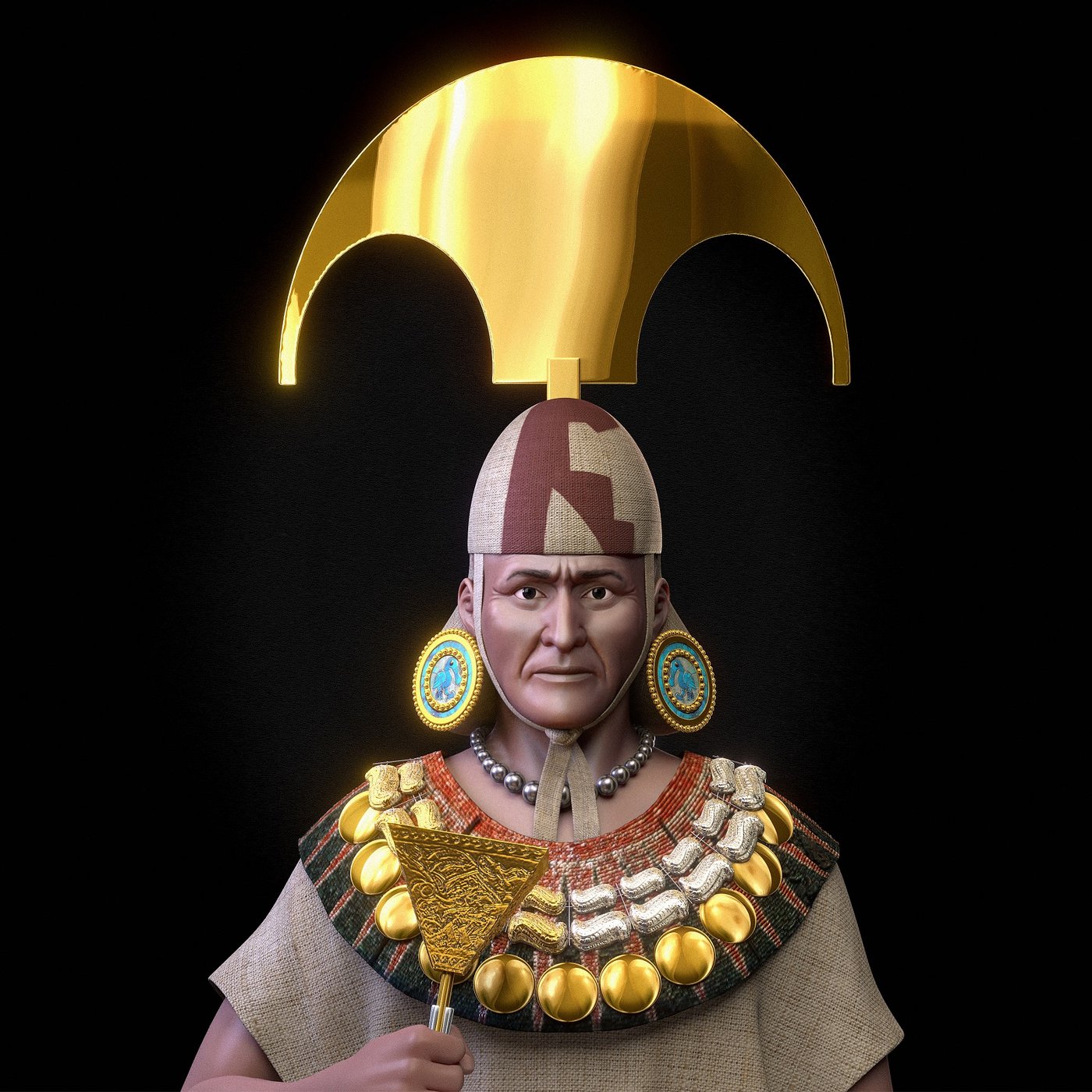
Decades after the dig, forensic artists took the shape of his skull and built his face back onto it, muscle by muscle, and set the crescent crown above it. The man who looks out is broad-featured and unsmiling, neither a god nor a myth, just a person who lived and gave orders and drank, perhaps, from that goblet. It is a strange gift from a robbed mound: a coast people who wrote nothing now have a face.
Plenty about Sipán stays open. The exact dates drift between roughly AD 100 for the Old Lord and the third century for the Lord himself, and specialists still debate how the Moche reckoned kingship: whether these were priests who ruled or rulers who performed as priests. And the looting never really stopped: pieces stripped from north-coast tombs still surface at auction, including a gold backflap of the Sipán type that took years of legal effort to bring home. Every object without a findspot is a page torn out before anyone could read it.
What the robbers nearly erased
The gold from Sipán now sits in a museum built for it: the Royal Tombs of Sipán, opened at Lambayeque in 2002, its red walls raised in the shape of a Moche pyramid so that the treasure came, in a sense, back into a mound. The ear ornaments, the peanuts, the gilded face, the spider necklace of the Old Lord: they are laid out in the dark there, close to where they were dug.
It is worth holding the two nights side by side. On the first, a robber crawled into the dark, took what he could carry, and would have sold a king's household in pieces to buyers who neither knew nor cared where it came from. On the second sort of night (the long run of them Alva and his team spent guarding the mound), the same ground was read instead of emptied, and a silent people got their voices back: their gods turned out to be men, their myths turned out to be rites, their kings turned out to have faces.
Ernil Bernal died for a sack of gold and is remembered, if at all, as the man who tunnelled in first. The lord he disturbed had been dead for seventeen centuries and is known around the world. The footless sentry is still there in the reconstruction, still watching over the coffin he was never meant to leave. He kept his post longer than anyone asked. In the end it was not the guard who let the outside world in. It was a man with a shovel and a rice sack, and then, close behind him, a man with a trowel who decided the rest was worth saving.
Read next: Chan Chan: The Mud City Where Dead Kings Sealed Their Own Palaces and The Great Death Pit of Ur: The Sacrifice CT Scans Rewrote.
Sources & further reading
- Walter Alva and Christopher B. Donnan, Royal Tombs of Sipán (Fowler Museum of Cultural History, UCLA) — the excavators' own full account of the tombs and their contents.
- Walter Alva, “The Moche of Ancient Peru: New Tomb of Royal Splendor,” National Geographic (1988–1990 reports on the Sipán excavations).
- Christopher B. Donnan, Moche Art and Iconography and later work on the Sacrifice Ceremony — how the tomb regalia matched the figures painted on Moche pottery.
- Sidney Kirkpatrick, Lords of Sipán: A Tale of Pre-Inca Tombs, Archaeology, and Crime — a narrative of the looting, the police case and the rescue dig.
- Museo Tumbas Reales de Sipán, Lambayeque — the museum built for the finds, on the regalia, the Old Lord and the later tombs.
- Luis Jaime Castillo and others on San José de Moro — the burials of the Moche priestess who appears alongside the warrior-priest in the ceremony scenes.
Image credits (via Wikimedia Commons): the Lord of Sipán in reconstructed regalia, Museo Tumbas Reales de Sipán (featured) — Alex Benites Abad (CC BY-SA 4.0); Huaca Rajada — Bernard Gagnon (CC BY-SA 3.0); reconstruction of the burial chamber — Vicpeters (CC BY 4.0); the regalia as excavated — Adrian Hernandez (CC BY-SA 4.0); forensic facial reconstruction — Cícero Moraes (CC BY-SA 4.0).