In the first weeks of 1864, a French lay brother named Eugène Eyraud stepped ashore on Rapa Nui (the island the outside world had taken to calling Easter Island) and began noticing something in the houses. Hanging in nearly every one was a piece of wood covered edge to edge in tiny carved figures: birds, fish, standing men, shapes he had no name for. He asked what they were. The islanders told him the boards held writing. Then they told him that no one alive could read it.
Eyraud had walked into the last hour of a mystery. Within a few years the boards would be gone from the island altogether (burned, buried, wrapped around fishing line, or carried off by collectors), and the people who might once have chanted them aloud would be dead or shipped away. What he saw is now called rongorongo, and more than a century and a half later it remains the only script of Oceania, and one of a bare handful of writing systems on Earth that has never been read. What has changed, and changed only very recently, is the question of where it came from. For a long time the safe answer was that the islanders copied the idea from Europeans. A radiocarbon lab has just made that answer much harder to hold.
A script in every house, and no one left to read it
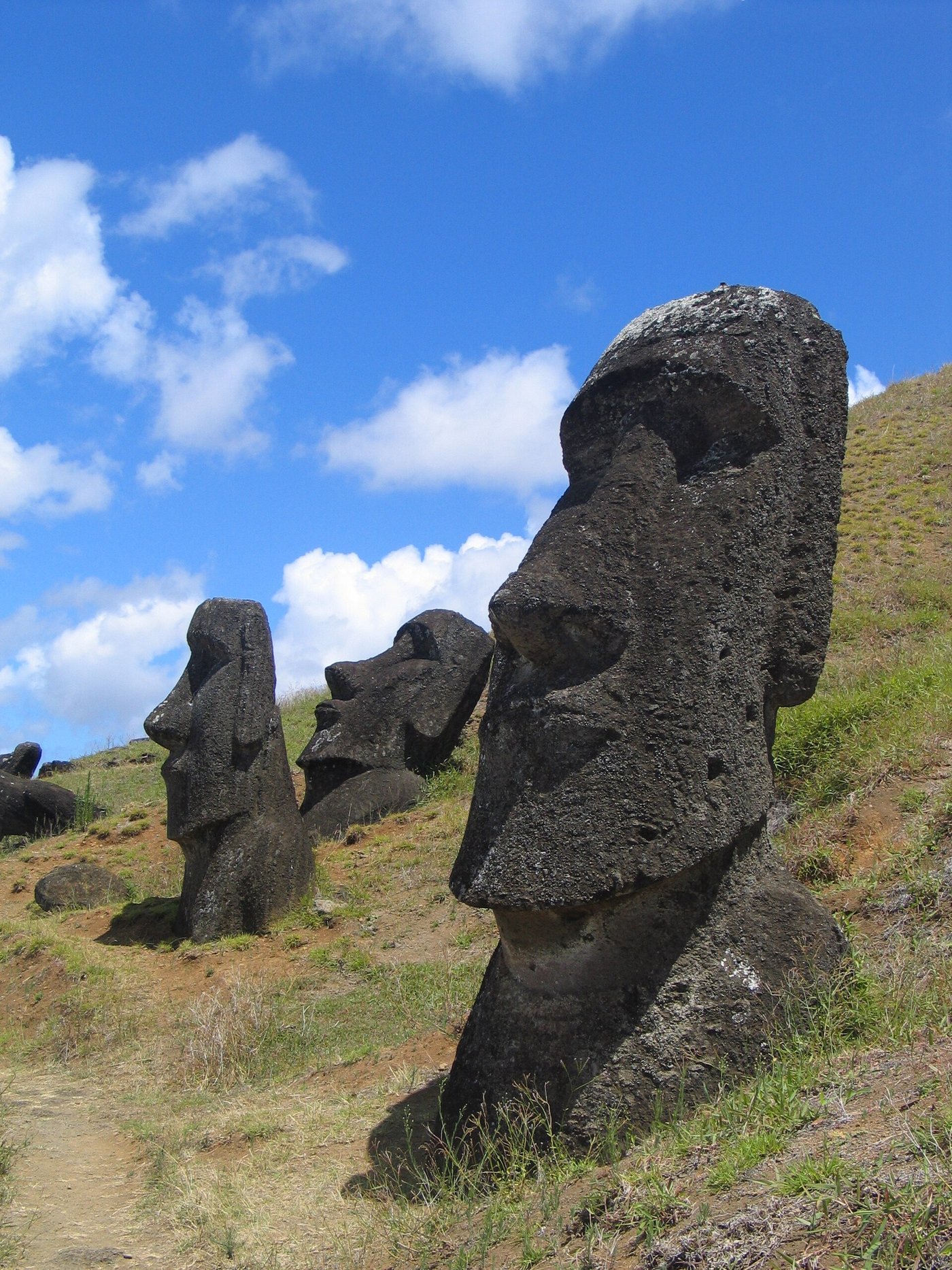
Rapa Nui is one of the loneliest inhabited places on the planet. It sits in the South Pacific, more than 3,500 kilometres off the coast of Chile, with the nearest inhabited island a five-day sail away. Polynesian voyagers reached it perhaps around 1200 AD and built, in near-total isolation, the society that raised the moai. The first European to see it was the Dutch captain Jacob Roggeveen, who arrived on Easter Sunday in 1722 and gave the island its European name. Spanish ships came in 1770, Captain Cook in 1774. Every one of those visits was brief.
Eyraud belonged to a Catholic order, the Congregation of the Sacred Hearts, and he had come to stay. His letters are the first outside account of the tablets, and they are precise about one thing: the boards were common, and their meaning was already lost. The islanders kept them, seemed to prize them, and could not tell him what the marks said. A generation earlier there may have been men who could. By 1864 there were none.
"In all the houses one finds wooden tablets or sticks covered with several sorts of hieroglyphic characters."— from Eyraud's report to his superiors, the earliest written notice of rongorongo
He was not believed at first, or not thought interested. Nobody around him could read the boards, and the wider Church had other concerns. It took the curiosity of a bishop, a few years later and an ocean away, before anyone treated the carvings as more than curiosities.
What the marks look like
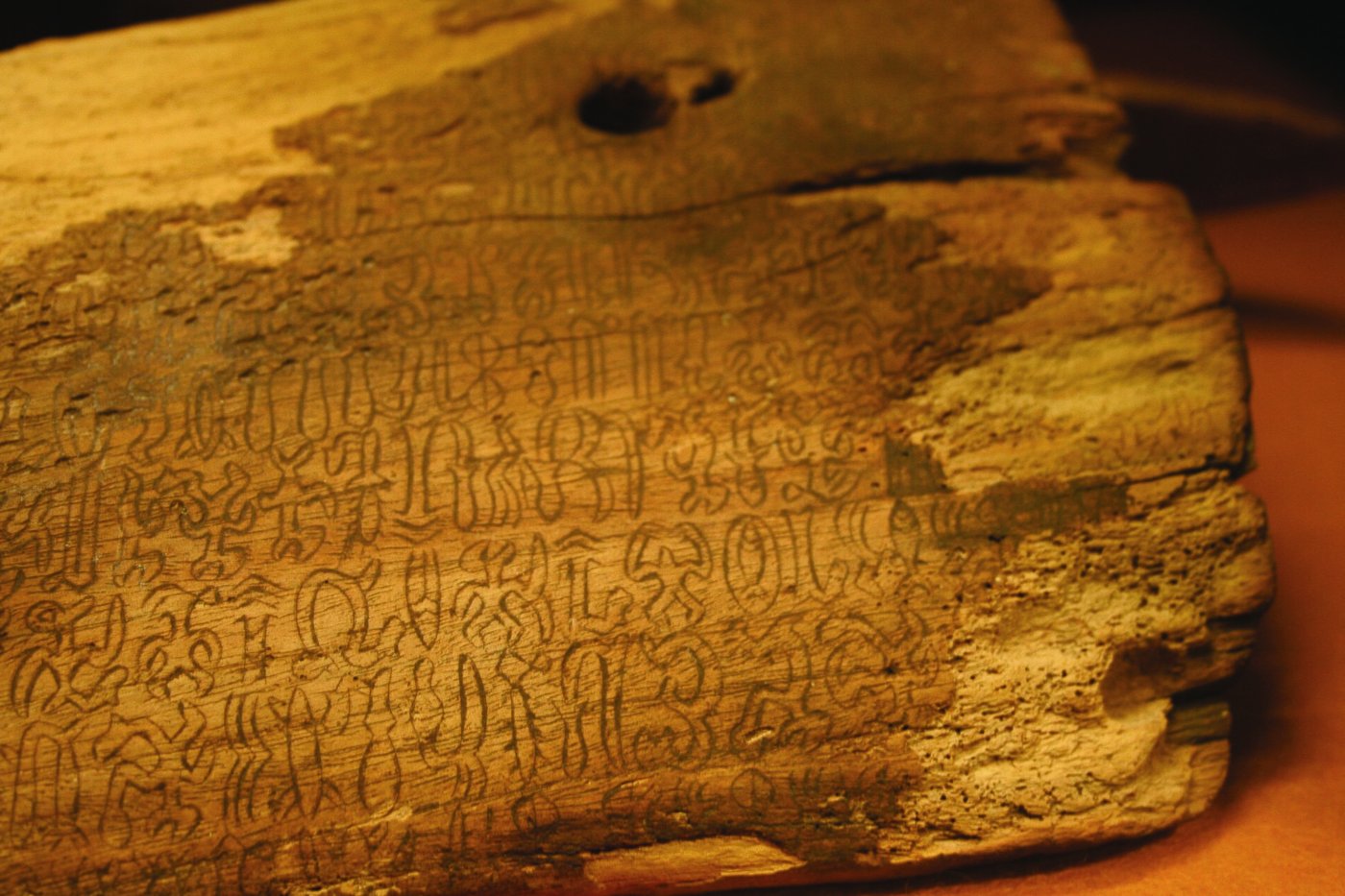
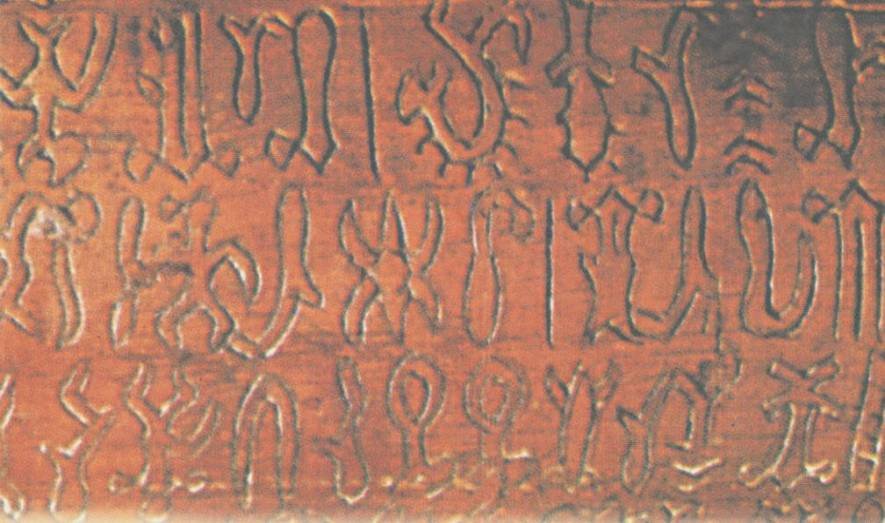
Rongorongo is written in rows of small, densely packed signs. There are human figures with raised arms, birds with hooked beaks, fish, plants, and a mass of geometric forms: crescents, chevrons, discs. Scholars have counted somewhere between 120 and 150 basic elements, which combine and fuse into a much larger set of compound signs, perhaps six or seven hundred in all. The carving was done with a sharp edge, often a flake of obsidian or a shark's tooth, cut into wood that had been rubbed smooth.
The strangest feature is the direction of reading. Rongorongo runs in what is called reverse boustrophedon. You start at the bottom-left corner and read along the line to the right. At the end of the line you do not return to the left as in English, and you do not simply carry on as in a snaking Greek inscription. Instead you turn the whole tablet 180 degrees and read the next line, which had been sitting upside down above the one you just finished. Every second line is inverted. To read a tablet through, you rotate it over and over in your hands, which means the carver had to plan the text upside down half the time he was cutting it.
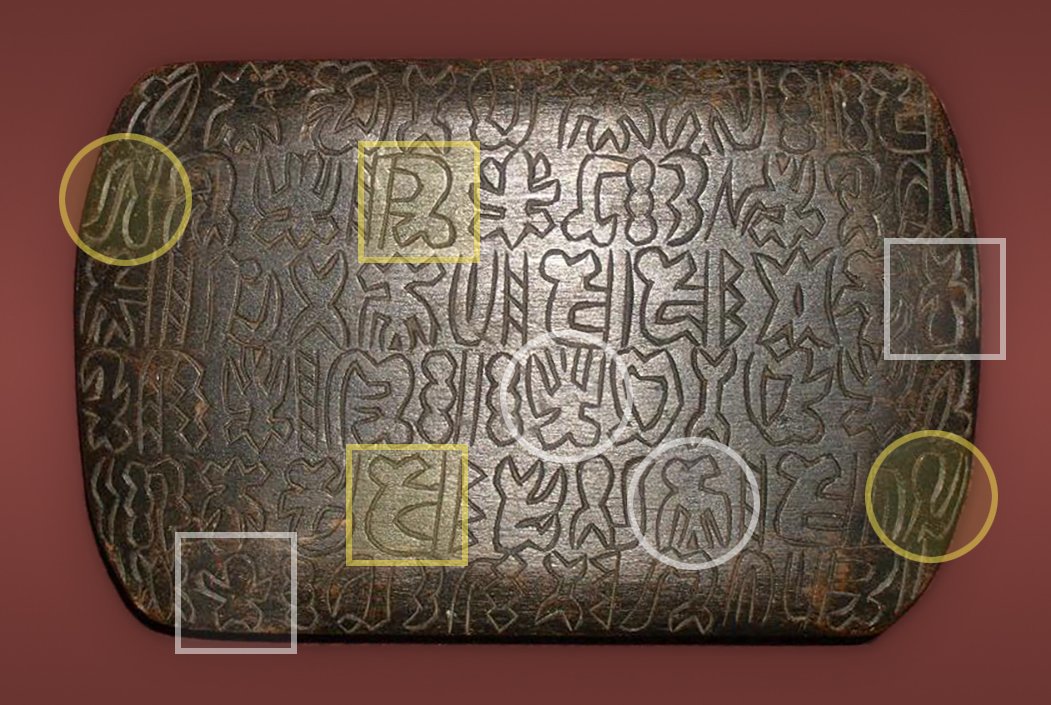
That single detail tells you something. Whoever devised the system had thought hard about it. This is not a few scratches; it is a worked-out convention, followed consistently across boards carved by different hands. Whether it records speech the way our alphabet does, sound by sound, or whether it is a memory aid, a set of cues for a chant already known by heart, is a question that sits at the centre of everything that follows.
The bishop who went looking for a reader
Around 1869 a tablet reached Tahiti as a kind of packing material: the island's missionaries had wound a length of braided human hair around a board covered in glyphs and sent it as a gift. It landed on the desk of Florentin-Étienne Jaussen, the Catholic bishop of Tahiti, known locally as Tepano. He unwrapped the cord, looked at the wood, and understood at once that the thing carrying the present mattered more than the present.
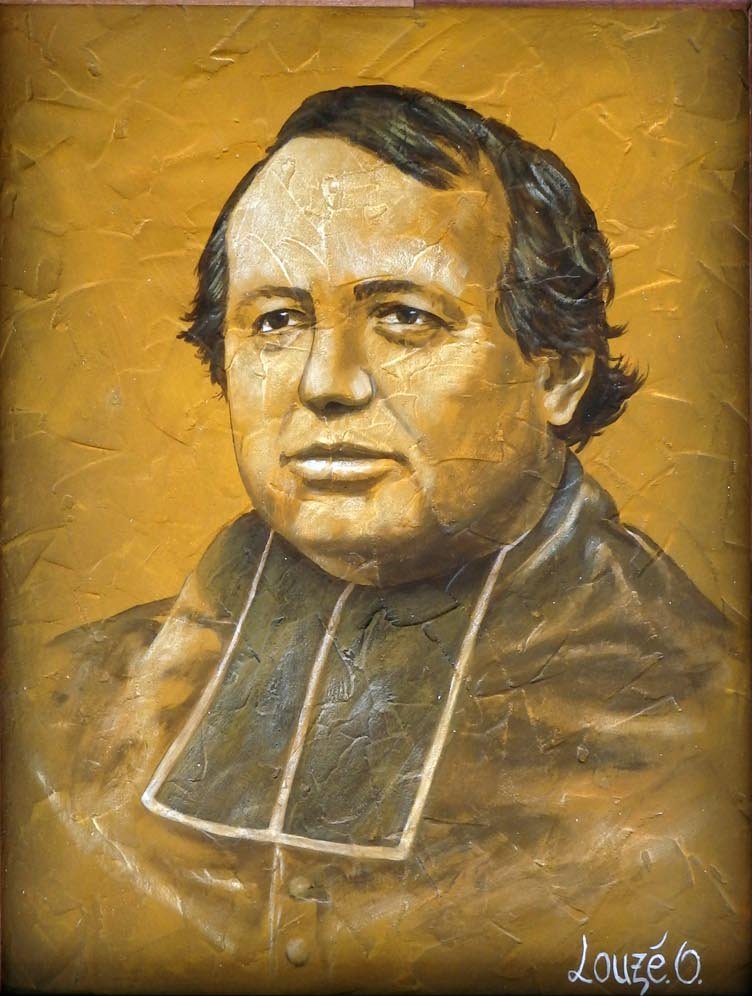
Jaussen set about collecting every tablet he could find and hunting for someone who could still read them. He was told of a Rapa Nui man named Metoro Tau'a Ure, then labouring on a plantation in the islands, who was said to know the signs. Jaussen sat him down with the boards and asked him to read. Metoro turned each tablet in the reverse-boustrophedon way, without being shown how, and began to chant. Line after line, he sang out names of birds and gods and stars.
It looked like a breakthrough. It was not. When later scholars compared Metoro's chants against the glyphs, the readings would not hold together. The same sign drew different words on different days; his verses did not match from one tablet to the next; much of what he sang seemed to be plain description of the pictures rather than any fixed text: "a bird," "the sun," "he stands." Metoro may have half-remembered a real tradition, or he may have been improvising to please a bishop who badly wanted a result. The record he left, the so-called Jaussen list of glyph meanings, has tempted and misled every generation of decoders since.
Twenty-something pieces of wood
Set against the scale of the puzzle, the surviving evidence is heartbreakingly small. Only about two dozen authentic inscribed objects are known to exist (the usual count runs to roughly twenty-five to twenty-seven), scattered across museums in Rome, Santiago, London, St Petersburg, Berlin, Vienna, Honolulu and Washington. Between them they carry perhaps fifteen thousand glyphs, which sounds like a great deal until you remember that reading an unknown script is a game of repetition, and fifteen thousand signs across two dozen short texts is very little to work with.
Every known rongorongo tablet now sits in a museum or private collection off Rapa Nui: in Europe, mainland Chile, the United States and Russia. The boards were cut from local toromiro wood, from Pacific rosewood, and in at least one case from a piece of European driftwood or a broken oar that had washed ashore. The island that made the script keeps none of it.
The pieces are not all flat tablets. One is a chief's staff, another a bird-shaped pectoral ornament called a reimiro, another a snuff box remade from a fragment of an older board. The grandest is the object known as the Santiago Staff, held in Chile: a wooden baton crowded with more than two thousand glyphs, the single longest rongorongo text in existence. Its lines are broken up by little vertical marks that may divide the text into sections, which has made it a favourite hunting ground for anyone claiming to have cracked the code.
The ships that carried off the readers
To understand why a living island lost the ability to read its own boards in a single generation, you have to look at what happened just before Eyraud arrived. In late 1862 and into 1863, Peruvian slave ships descended on Rapa Nui and other Pacific islands, seizing people to work the guano diggings and plantations of South America. On Rapa Nui the raids were catastrophic. Around a fifth of the population was taken in a matter of months, and the raiders deliberately targeted the powerful and the learned: the ariki, the chiefs, and the ritual specialists.
Those specialists were exactly the men most likely to know rongorongo. Reading the boards, if it was ever a widespread skill, seems to have belonged to a trained few: people who recited at ceremonies, kept genealogies, held the island's memory. When they were carried off, the knowledge went with them. International protest eventually forced Peru to return some captives, but disease had swept through them; the handful who reached home brought smallpox, and the epidemic tore through what remained. Within about fifteen years the island's population had fallen to roughly a hundred souls. A script that might have been read aloud by living people in 1861 had, by 1864, no one left to read it.
This is the cruel shape of the rongorongo problem. It is not an ancient script lost in deep time, worn from stone over millennia. It was alive, or nearly alive, within living memory of the modern age, and it went dark almost overnight, not because the writing failed but because the readers were stolen and killed.
The one passage that gave a little back
For all that, the boards have not stayed completely mute. The most determined early attempt came from a German ethnologist, Thomas Barthel, who in the 1950s photographed and catalogued the entire corpus and gave every glyph a number, a system still used today. His 1958 book laid the groundwork for everyone after him. Barthel believed one tablet in particular, the board called Mamari, carried a calendar.
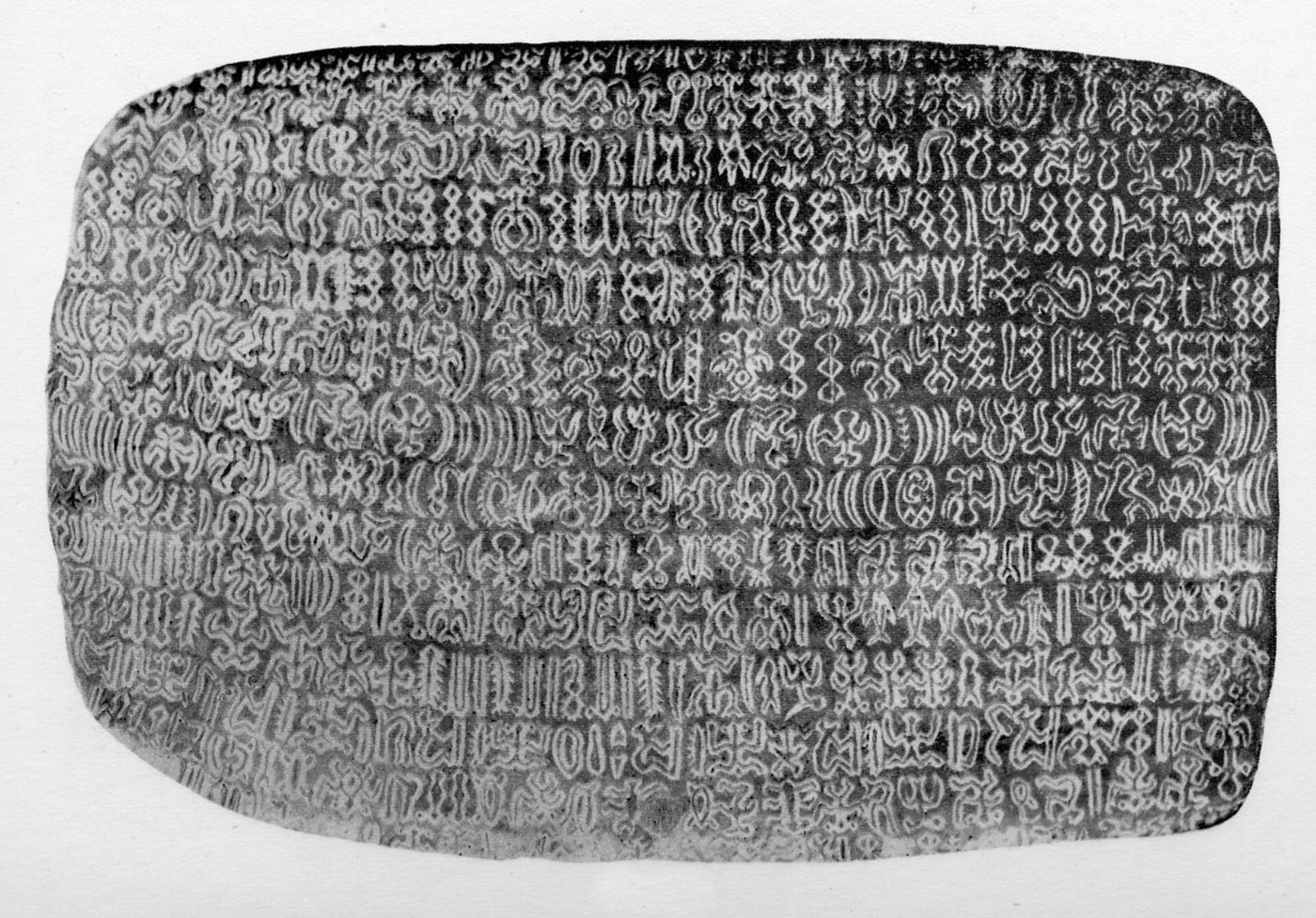
He was probably right, and later work sharpened the point. The linguist Jacques Guy studied a run of signs on Mamari and showed that it lines up, night by night, with the Rapa Nui lunar month recorded by ethnographers: a sequence of crescents and marked figures that tracks the moon through its phases, including a clever pair of signs that seem to signal the two nights when an extra day was inserted to keep the calendar true. It is the one stretch of rongorongo that most experts accept as understood. Not read word for word, but grasped: this part is about the moon.
Grander claims have come and gone. In the 1990s the linguist Steven Fischer announced that he had cracked the Santiago Staff, reading its repeating three-part structures as chants of creation: one thing coupling with another to produce a third, over and over. The reading is bold and, to most specialists, unconvincing; the pattern is real, but the meanings Fischer poured into it are not something the glyphs can be shown to carry. More recent statistical work, by scholars such as Konstantin Pozdniakov, has come at the corpus from the other direction, counting how often signs appear and in what combinations. That work hints the system may be smaller and more repetitive than a full writing script would be, which brings back the old, unresolved doubt about what rongorongo really is.
Copied from the Spanish, or invented from nothing?
Here is the question that the 1864 date always seemed to answer the safe way. If nobody could read the boards by the time outsiders arrived, and the oldest firm sighting of them is that late, might the script be young, younger even than European contact?
There is a specific version of this idea, and it is a good one. In 1770 a Spanish expedition formally annexed the island for the crown, and as part of the ceremony they had island chiefs make marks on a document of possession. Some scholars, including the great Rapa Nui ethnographer Alfred Métraux, suggested that watching Europeans set down meaning in rows of signs on paper could have sparked the whole idea. The islanders would not have copied the Spanish letters (rongorongo looks nothing like the Latin alphabet), but they might have grasped the concept of writing and then invented their own from scratch. On that view, the script is a clever local response to a single afternoon in 1770, and everything we have was carved in the ninety years between then and Eyraud.
The comfortable story: rongorongo was invented after islanders watched Spanish officers write on a deed of annexation. It would make the script a post-contact curiosity, barely a century old: ingenious, but sparked from outside.
The idea was always a guess, built on the late date of the first European sighting rather than on any evidence about the tablets themselves. It could never explain why the glyphs resemble no European writing at all. And in 2024 the wood of one tablet was dated to a time before any European is known to have set eyes on the island, which the 1770 story cannot easily survive.
The date in the wood
In 2024 a team of researchers based mainly in Italy published radiocarbon dates for four rongorongo tablets kept in Rome, in the care of the Congregation of the Sacred Hearts, the same order Eyraud had belonged to. Three of the four boards dated, as expected, to the nineteenth century. The fourth did not. Its wood returned a secure date in the fifteenth to early sixteenth century, around 1450 to 1500, well before 1722, and well before the Spanish ceremony of 1770.
The wood, in other words, was already old when the first European arrived. And this was not a piece of foreign driftwood that could have floated in from anywhere; the analysis pointed to a tree that grew on or near the island and died centuries before contact. If the glyphs were cut into that board when the wood was fresh, or anywhere near it, then rongorongo was being carved on Rapa Nui before any outsider came to show the islanders what writing was. That would make it one of the very few times in human history, alongside Mesopotamia, Egypt, China and Mesoamerica, that a people invented writing entirely on their own.
It is a spectacular possibility, and the researchers were careful not to oversell it. Radiocarbon dating tells you when a tree stopped growing, not when someone took a knife to the plank. An islander in 1850 could, in principle, have carved a much older piece of wood. But there is no reason to expect an eighteenth or nineteenth-century carver to reach for a four-hundred-year-old board, and the simplest reading of the date is the striking one: the tradition is older than the tourists.
Still unread, and now older than we thought
None of this brings us any closer to knowing what the boards actually say. The Mamari moon calendar aside, rongorongo remains unread, and it may stay that way. Two dozen texts is not enough for the kind of statistical attack that broke other lost scripts, and there is no bilingual key: no rongorongo Rosetta Stone with the same text in a language we know. The men who could have simply told us are two centuries dead, taken by the slave ships or the smallpox that followed.
What the new date does is change the stakes. For a long time it was easy to file rongorongo away as a late, minor, borrowed thing, a clever imitation dreamt up after contact and abandoned almost as fast. The wood in Rome argues for something larger and stranger: that on the most isolated inhabited island on Earth, a people looked at the world and decided, without a single example to copy, that thought could be pinned to wood in rows of birds and fish and standing men. If that is right, the boards Eyraud found hanging in the houses were not a curiosity. They were the surviving pages of an invention as fundamental as any our species has made, and we are still holding them upside down.
Read next: Lapita: The Dotted Pottery Behind Prehistory's Fastest Migration.
Sources & further reading
- Silvia Ferrara et al., "The invention of writing on Rapa Nui (Easter Island). New radiocarbon dates on the Rongorongo script," Scientific Reports 14 (2024) — the study that dated one tablet's wood to before European contact.
- Thomas Barthel, Grundlagen zur Entzifferung der Osterinselschrift (1958) — the foundational catalogue and numbering of the glyph corpus.
- Steven Roger Fischer, Rongorongo: The Easter Island Script — History, Traditions, Texts (Oxford University Press, 1997).
- Jacques B. M. Guy, papers on the lunar calendar sequence of the Mamari tablet, Journal de la Société des Océanistes (1990s).
- Jo Anne Van Tilburg and others on the 1862–63 Peruvian slave raids and the demographic collapse of Rapa Nui.
- Contemporary reporting in Nature and Popular Archaeology on the 2024 dating results and the independent-invention debate.
Image credits (via Wikimedia Commons): rongorongo tablet (featured) — christopherhu (CC BY 2.0); moai at Rano Raraku — Aurbina (public domain); rongorongo glyph detail — Penarc and Basile Morin (CC BY-SA 1.0); Bishop Tepano Jaussen — Louzé.O. (public domain); the Santiago Staff — unknown author (public domain); the Mamari tablet — from Stéphen Chauvet (1935), via Wikimedia Commons (CC BY-SA 3.0).