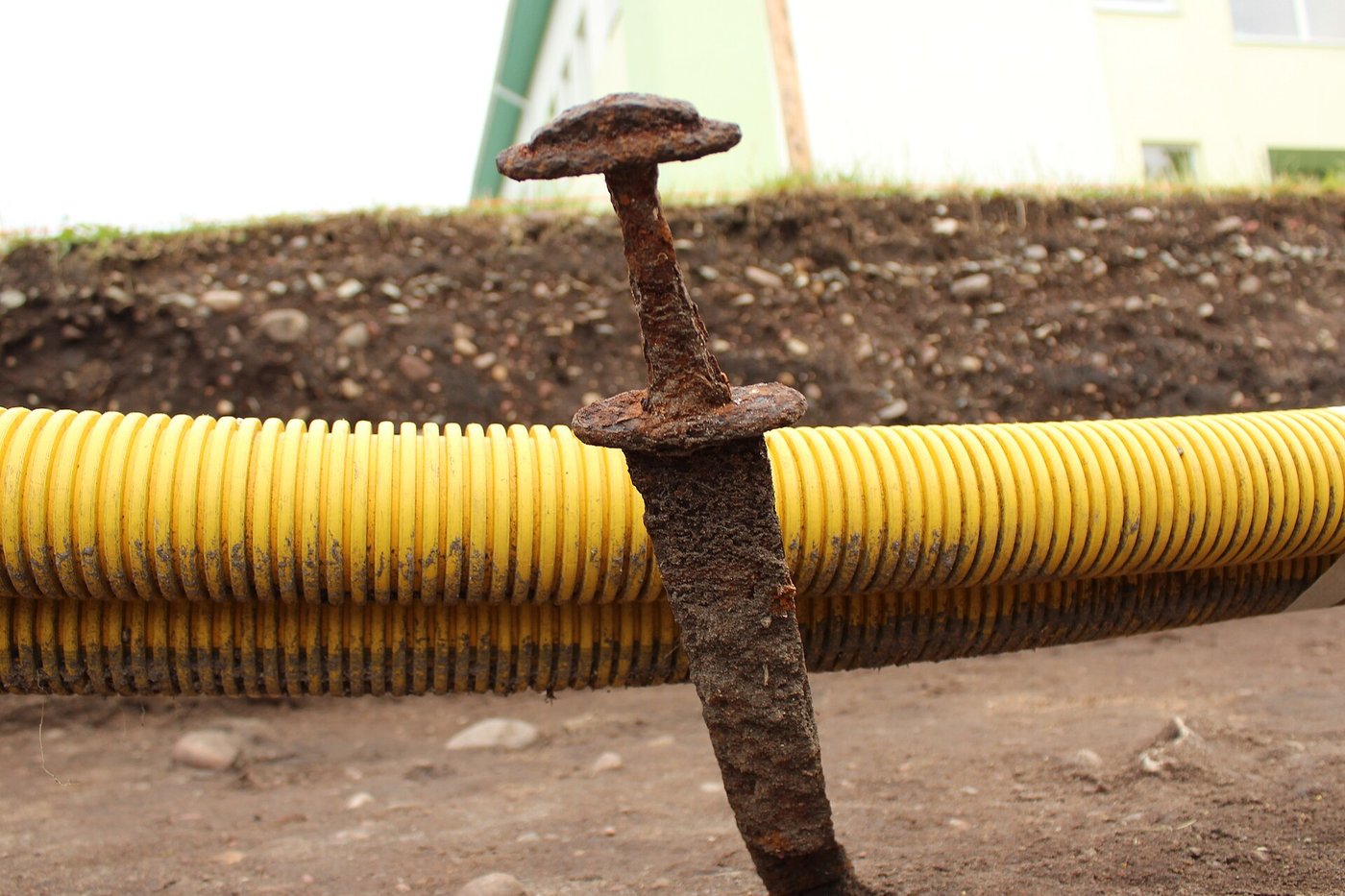
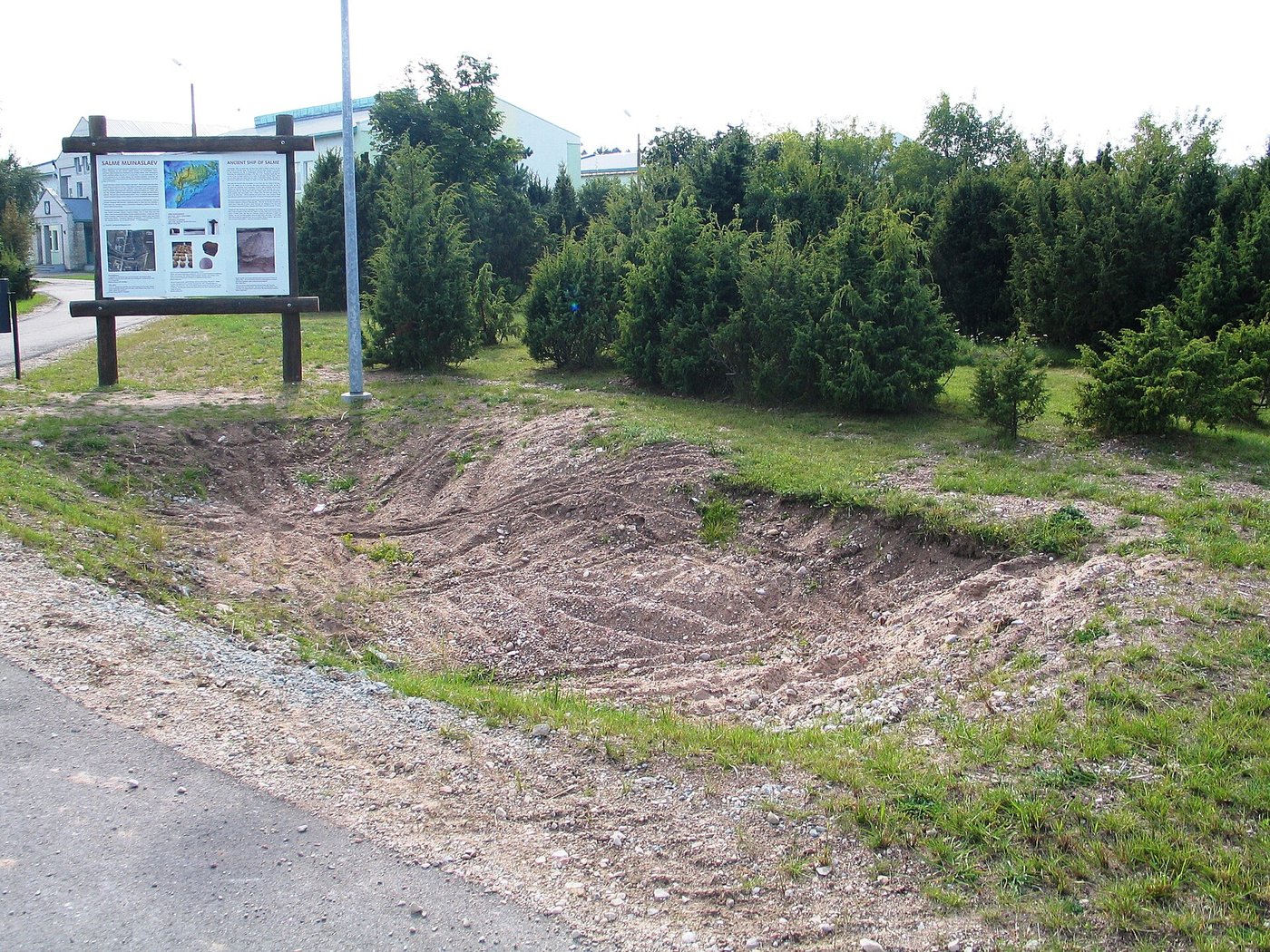
The machine that found them was digging a trench for an electric cable. In the autumn of 2008 a mechanical digger was cutting through a low sandy rise on the edge of Salme village, on the Estonian island of Saaremaa, when the driver noticed something odd in the spoil: rusted iron, scraps of bronze, and bone that was plainly not an animal’s. Work stopped. When archaeologists cleaned back the sand they found a decayed wooden boat laid into the ground, and inside it seven men, buried with their weapons. Two years later, a few metres away, a second and much larger boat came out of the same ridge, with thirty-four more men packed inside. Forty-one dead in all. Every one of them had died by violence, and every one of them had been carried here from across the sea.
What the trench had cut through was not a cemetery in any ordinary sense. It was the aftermath of a disaster: a war party that sailed out, met something worse than it expected, and never sailed home. The men who buried them did it in a hurry, but they did it with care, and they did it in a way that would not become common in the north for another hundred years. The Salme boats look, at first glance, exactly like Viking burials. Ships. Warriors. Swords and gaming pieces and slaughtered hawks. There is only one problem with that picture. When these men died, the Viking Age had not begun.
A grave that arrives too early
Ask most people when the Vikings started and, if they can name a year at all, they will name 793, the summer raiders came out of the sea and sacked the monastery of Lindisfarne off the coast of Northumbria. It is a tidy date, and historians have used it for generations as the opening bell of the Viking Age. The Salme boats were in the ground before that bell rang. Radiocarbon dates and the style of the objects put the burials at around 700 to 750, roughly two generations before Lindisfarne. Here were Scandinavians crossing open water in a sailing ship, raiding or campaigning far from home, dying in a foreign land and being buried in their boat: doing, in other words, all the things the Vikings are famous for, decades before the Vikings are supposed to exist.
That is why a rescue dig on a small Baltic island ended up in journals read all over the world. Salme did not just add two boats to the record. It moved a line that textbooks had drawn with confidence, and it forced a question that is still being argued: if the raiding and the seafaring and the ship burials were already happening in 700, what exactly began in 793? The honest answer is that 793 was the year the raids reached people who could write about them. What Salme shows is the same world, a little earlier, with no monk to take the minutes.
The two boats
The smaller boat, the one the digger struck first, was about eleven and a half metres long: a rowing vessel built for perhaps a dozen oars, clinker-built from thin overlapping planks held with short iron rivets. Its seven men had not been dropped in a heap. They were arranged, more or less, as if still at their stations, with weapons and belongings around them. It reads less like a mass grave than a crew laid to rest in the thing that had carried them.
The second boat was in a different class. It was longer, heavier, and, most importantly, built to carry a sail. Into it the survivors had stacked thirty-four bodies in layers, one above another, shields laid over the top like a lid. This was not carelessness. It was a great deal of digging and lifting done under pressure, on a hostile shore, by people who wanted their dead kept together and kept covered. Both boats were laid roughly north-east to south-west, an alignment that later Scandinavian burials also favour and that some link to the track of the Milky Way, the road the dead were thought to travel.
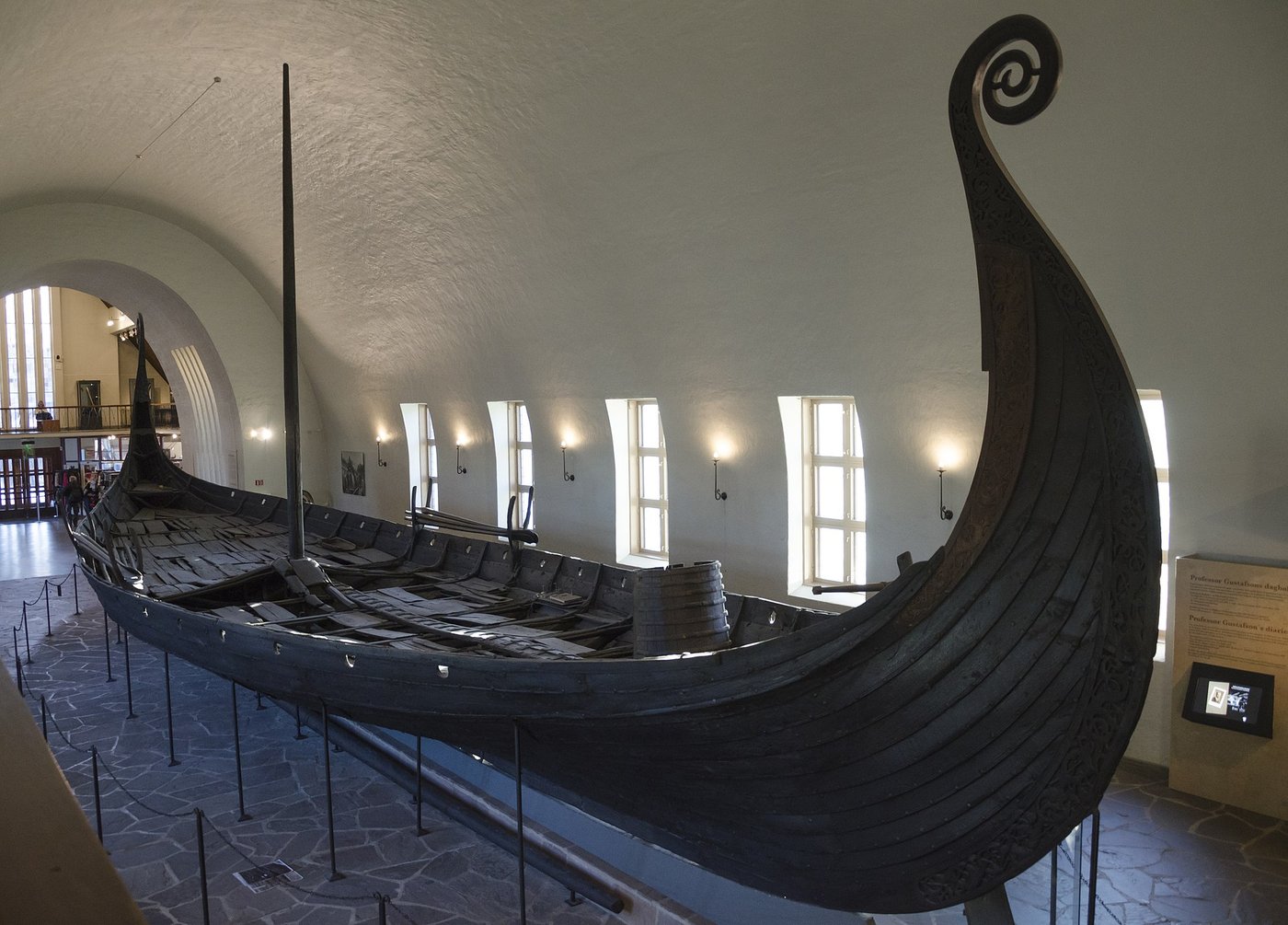
The larger boat matters for another reason. A ship that can carry a sail can cross the Baltic under wind power, and a crew that arrives under sail arrives faster, rested and ready to fight. Salme holds some of the earliest hard evidence for sailing ships in these waters, a full century before the famous Oseberg ship was built in Norway. The technology that would make the Viking raids possible was already in the water. The raids had simply not yet found their chroniclers.
What killed them
These men did not die of fever or old age. The bones carry the marks of a fight, and the marks are not subtle. One man’s upper arm had been chopped clean through in three separate places. Another had two blade wounds to the front of the skull, the kind a sword or an axe leaves when it comes down on someone facing his attacker. There are cuts, breaks and puncture wounds across the group. Several of the bodies were missing pieces the excavators never found (hands, feet), consistent with a hard, close fight rather than a tidy execution.
They were also, by the standards of their time, formidable. The men were tall and strongly built, most of them in their twenties and thirties, their teeth in good condition, their frames well fed. This was not a levy of farmers. It was a picked band of fighting men, the sort a lord would gather for something ambitious, equipped with weapons that ordinary people never owned. Whatever they came to Saaremaa to do, they came expecting to win it. They lost.
And then the story turns strange, because the people who did this, or the survivors on the losing side, did not leave the dead where they fell. Someone dragged two boats up onto the shore, dug them into the sand, and filled them with the fallen and their gear. You do not do that to an enemy. You do it to your own. The likeliest reading is that the war party itself buried its dead before whatever was left of it limped away, or that the whole affair ended in a truce grim enough to allow a proper funeral. Either way, the men who wielded the shovels knew exactly who these people were and treated them accordingly.
Reading the dead
For a long time that was where the story stopped: a battle, a burial, a mystery on a beach. Then the laboratories went to work, and the bones began to talk. Strontium locked into tooth enamel records the chemistry of the water and soil where a person grew up, and the Salme teeth did not match Saaremaa. They matched a landscape far to the north-west: the Lake Mälaren valley of east-central Sweden, the country around what is now Stockholm and the old royal centres of the Svear. These were Swedes, then, a long way from home.
Ancient DNA sharpened the picture into something almost unbearably human. Among the thirty-four men in the larger boat, four were full brothers, and they had been laid down side by side, touching, as though even in death they were not to be separated. A fifth man was a close relative, perhaps an uncle or a cousin. This was not a random muster of strangers. It was, in part, a family: brothers who set out together, fought together, and were buried together by whoever survived. Somewhere in the Mälaren valley a household lost four sons in a single afternoon and, most likely, never learned exactly where they lay.
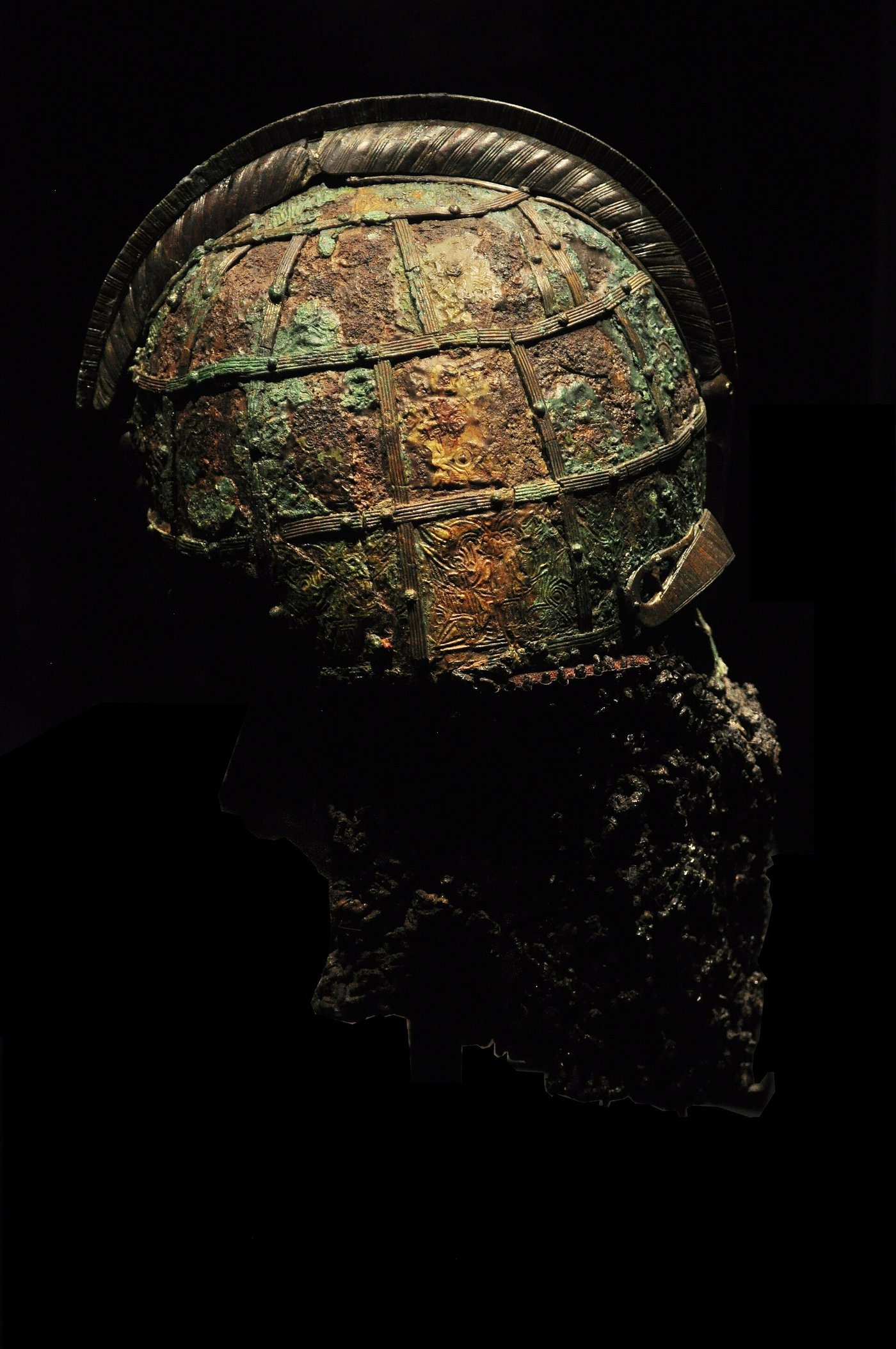
Seven fighters in the smaller rowing boat; thirty-four in the larger sailing ship, stacked in layers under a roof of shields. All male, most aged between twenty and forty. Their tooth chemistry points to the Lake Mälaren region of Sweden, and DNA shows four of them were brothers. Every skeleton examined carried wounds from edged weapons. Nobody here died quietly.
Bone dice and a king in the mouth
Warriors travelled with more than swords, and the Salme boats were full of the ordinary business of men far from home. There were combs and whetstones, knives and antler dice, joints of butchered meat packed as provisions or laid out for a farewell feast. There were hunting birds (goshawks and a sparrowhawk, their heads removed), killed to go into the ground with their owners. There were dogs, one of them cut in two. These were people who hunted, gambled and ate well, and who expected to go on doing so wherever the dead were bound.
The strangest find of all was the gaming pieces. Between the two boats there were hundreds of them, carved from whalebone, the counters for a board game the north called hnefatafl (“king’s table”), in which a single king piece tries to break out through a ring of attackers. Most of the Salme pieces are plain. A few are not. In each boat there was a special king: larger, finer, one wrapped in finely carved braid, the other topped with an iron tack. And in the mouth of one of the dead men the excavators found a king piece, deliberately placed there, on the tongue, like a coin for a ferryman.
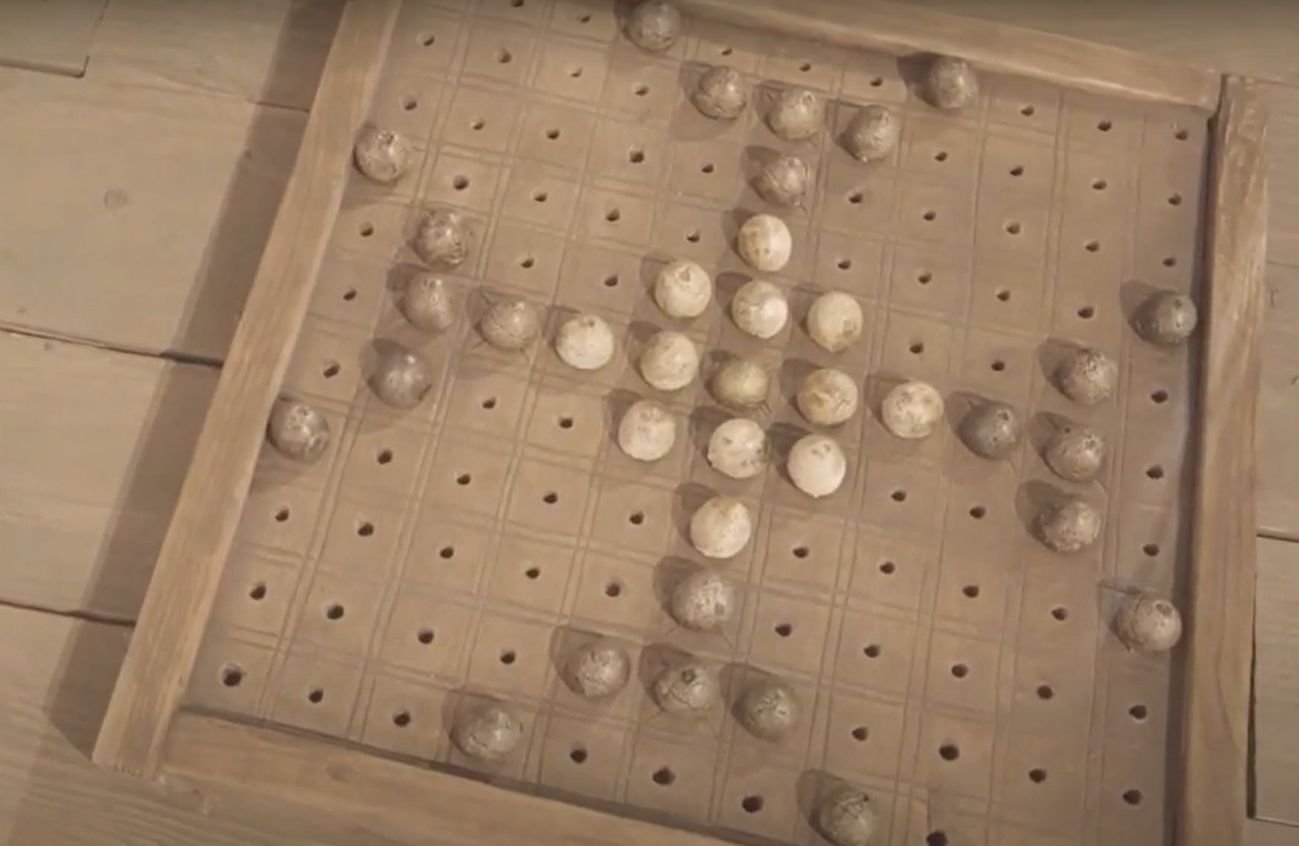
Nobody can say for certain what that king in the mouth meant. Perhaps it marked the man as a leader, the king on the board standing for the king of the band. Perhaps it was a private joke turned into a rite by grieving friends, or a wager settled in the only currency that mattered now. The gesture is precise, and it is personal, and it has survived thirteen centuries with its meaning sealed inside it. It is the single most human thing in the whole find: somebody, on that shore, took the time to place a small carved king on a dead friend’s tongue.
The problem with 793
Salme lands hardest on the neat timeline of the Viking Age. The raid on Lindisfarne in 793 was a shock to the Christian west precisely because it was written down: monks kept annals, and a raid on a monastery was an outrage worth recording. But the sea did not suddenly fill with Scandinavian ships that summer. The Salme men show the whole apparatus of Viking raiding (sailing ships, war-bands of related men, long crossings, violent deaths abroad, burial in boats) already running smoothly two generations earlier, in a corner of the Baltic where no annalist was watching.
The story goes that the Viking Age began with a bolt from the blue: raiders appearing off Lindisfarne in 793, launching three centuries of seaborne terror that had no real prelude.
793 is the date the raids reached people who kept written records, not the date they started. Salme shows Swedish war-bands crossing the Baltic in sailing ships and dying abroad around 700–750. The seafaring, the raiding and the ship burials were decades old before any monk wrote them down. The “beginning” of the Viking Age is really the beginning of the paper trail.
This does not mean the Vikings began at Salme either. It means the whole idea of a single starting line is a trick of the sources. The people of the Baltic and the North Sea had been trading, raiding and quarrelling by boat for a very long time. What changed around 800 was scale and reach and, above all, visibility: the raids grew big enough, and struck rich enough targets, to enter the written history of the peoples on the receiving end. Salme is a window into the age before that window opened.
A king out of a saga
There is a temptation, with a find like this, to reach for a name, and the north obligingly offers one. Centuries later, the Icelander Snorri Sturluson wrote down the Ynglinga saga, a legendary history of the early Swedish kings. In it, a king named Ingvar (Yngvar the Tall) leads a raiding expedition into the eastern Baltic and is killed in battle in Estonia, on an island the saga calls Øsel. Øsel is Saaremaa. The very island where the Salme boats came out of the ground is the island where a saga says a Swedish king died fighting.
The Ynglinga saga has King Ingvar of the Svear falling in battle on Saaremaa, the exact island, and roughly the right kind of event, as the Salme burials. It is a seductive match. But the saga was written down some five hundred years after the fact, mixes myth with memory, and names no year the archaeology can test. The find fits the tale in outline and cannot confirm a word of it. Most researchers treat the link as a tantalising possibility, not a caption.
It is a wonderful coincidence, and it may be more than a coincidence, and there is no way to prove it. Sagas are not court records; they were written half a millennium after the events they describe, by men weaving legend and politics and half-remembered fact into a story. A leader in the larger boat, possibly the man with the king piece on his tongue, was clearly somebody of rank. Whether he was Ingvar, or a lord the saga never named, or a chief whose name died with his brothers, the trench cannot say. The most it will allow is that a real disaster of about the right date, in about the right place, sits underneath a story the north told for centuries. Sometimes that is as close as the past will let you stand.
What the boats were doing there
So why did forty-one Swedish fighting men sail to a small Estonian island around the year 730 and get themselves killed? Nobody knows, and the honest historians say so. A raid gone wrong is the obvious guess: a war-band that came for plunder or tribute and ran into a defence it had underestimated. But the mix of goods complicates the picture. Alongside the weapons there were the gaming boards, the fine combs, the hawks, the sense of men equipped for status as much as for slaughter. Some have wondered whether this was less a raid than an embassy, or a marriage escort, or a show of force meant to overawe rather than to fight: a piece of high politics that turned, on a beach, into a massacre.
What is not in doubt is the ambition. To cross open water in numbers, in a sailing ship, with the sons of a leading family aboard, was not a casual outing. It was a venture with a purpose worth risking heirs for. Whatever that purpose was, it failed completely, and the failure was total enough that the survivors chose to bury the dead where they lay rather than carry them home. That decision, more than anything, tells you how badly the day had gone. You bring your dead home when you can. When you cannot, you dig them into a foreign shore and hope the ground keeps them.
The ground kept them
It did keep them, for about thirteen hundred years, until a cable trench opened the ridge and let the twenty-first century in. What came out was not a monument or a treasure hoard but something rarer: a moment, frozen. A bad day at the far edge of somebody’s world, with the losers laid out exactly as their friends left them, down to the game piece on a dead man’s tongue. The swords had been bent, some of them, before they went into the ground, killed like their owners so that nothing sharp went unfinished into the next world.
The men in the Salme boats never knew they would settle an argument in a discipline that did not yet exist, about an age that had not yet been named. They thought they were sailing somewhere and coming back. They did neither. But they left, in the sand of Saaremaa, the clearest surviving portrait we have of the world that made the Vikings: the seafarers before the word, the raiders before the record, the brothers who went out together under a sail and were carried, together, into the dark. When you next hear that the Viking Age began in 793, remember the trench at Salme, and the fact that it began, without anyone writing it down, a good deal earlier than that.
Read next: Varangian Guard: The Vikings Who Plundered a Dead Emperor’s Treasury.
Sources & further reading
- Jüri Peets et al., The Salme Ship Burials: Two Eighth-Century Mass Graves on Saaremaa Island, Estonia — the excavators’ own fieldwork report and catalogue of the boats and their contents.
- T. Douglas Price et al., “Human remains, context, and place of origin for the Salme, Estonia, boat burials,” Journal of Anthropological Archaeology (2020) — the strontium isotope study pointing to the Lake Mälaren region.
- Ashot Margaryan et al., “Population genomics of the Viking world,” Nature 585 (2020) — the ancient-DNA study that identified the four brothers among the Salme dead.
- Neil Price and others, The Viking Way and the exhibition The Vikings Begin (Gustavianum, Uppsala) — on the Vendel-era Swedish world the Salme crews came from.
- Snorri Sturluson, Ynglinga saga (in Heimskringla) — the medieval source for King Ingvar’s death in Estonia, to be read as legend rather than record.
Image credits (via Wikimedia Commons): a corroded Salme sword at the excavation (featured) — Rsaage (CC BY-SA 3.0); the Salme find-site and information board — Ave Maria Mõistlik (CC BY-SA 4.0); Vendel-era helmet from a boat grave at Valsgärde — Joe Mabel (CC BY-SA 4.0); hnefatafl gaming board and pieces, Truso reconstruction — Muzeum Archeologiczno-Historyczne w Elblágu (CC BY 3.0); the Oseberg ship, Museum of the Viking Age, Oslo — Petter Ulleland (CC BY-SA 4.0).