In the winter of 1794 a British officer named John Seely rode out from the plains of the Deccan to see a temple he had heard described in tones he did not quite believe. He climbed a ridge, looked down into a great pit cut from the living hillside, and found himself staring at a whole stone temple (towers, courtyards, life-sized elephants, galleries of gods) standing free at the bottom of it. What stopped him was not the size, though the size was astonishing. It was the slow realisation that nothing here had been built. No blocks had been carried up and set in place. The entire thing had been carved downward out of one unbroken cliff of rock, like a sculptor freeing a figure from a single piece of marble, only the figure was the size of a cathedral.
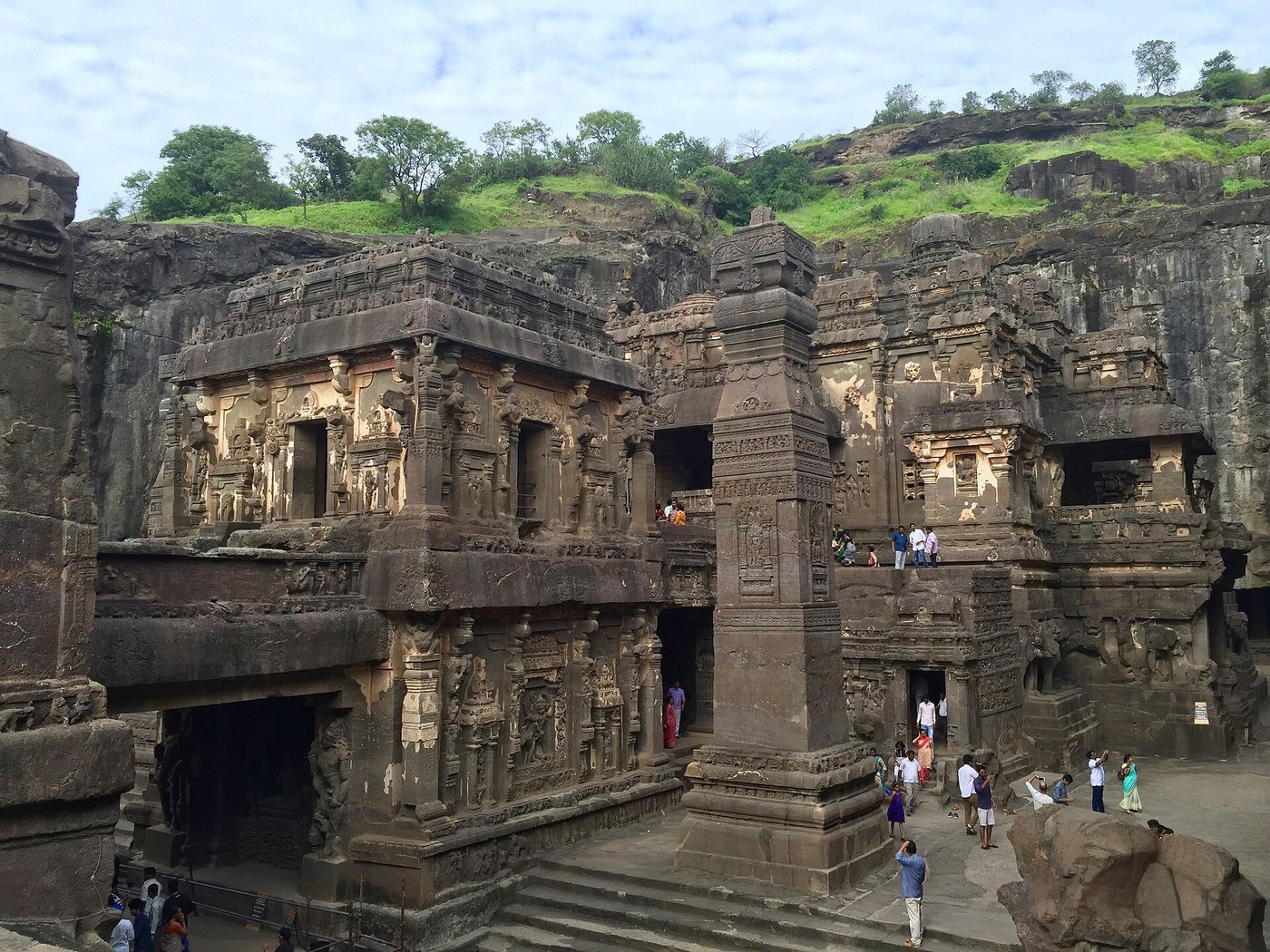
The temple is called Kailasa, and it sits in the long line of rock-cut caves at Ellora in the Indian state of Maharashtra, where it is catalogued, rather flatly, as Cave 16. The name is deliberate. Kailasa is the Himalayan mountain that Hindus hold to be the home of the god Shiva, a peak so sacred that no one is meant to climb it. In the eighth century a king decided to bring that mountain down to the Deccan: not to model it, not to suggest it, but to carve an entire image of Shiva's cosmic home out of a hillside of volcanic basalt. What his workers left behind is still, more than twelve hundred years later, one of the most staggering things human hands have ever made.
A temple that was dug, not built
Almost every large building in the world is made by addition. You gather materials (stone, brick, timber) and you stack them, join them, raise them course by course until a structure stands where there was empty air. Kailasa was made by subtraction. The workers started with a solid slope of rock and took away everything that was not temple.
They began at the top. Standing on the crest of the cliff, masons cut three deep trenches down into the hillside, isolating a huge block of stone roughly the size of a large ship. Then, working from the summit downward, they carved that block into shape: first the crowning tower, then the roof, then the upper storeys, and so on down to the courtyard floor. Because they always worked from above, they never needed scaffolding. Each finished level gave them a platform to reach the next. By the time they reached the ground they had released, from a single piece of the earth, a two-storey temple complex complete with a gateway, a pavilion, a hall of pillars, a sanctum, subsidiary shrines and a surrounding gallery, every part of it still physically joined to the bedrock beneath.
The scale of the removal is hard to hold in the mind. Estimates of the rock cut away and hauled off run into the hundreds of thousands of tonnes. The main temple rises around thirty metres from the courtyard floor, and the pit carved to free it is roughly eighty metres deep and fifty wide. There is no margin for error in work like this. A misplaced chisel does not cost you a stone that can be replaced; it wounds the one and only piece of rock the entire temple is being drawn out of. Everything had to be planned from the top down and got right the first time.
The king who ordered a mountain
The temple is generally credited to Krishna I, a ruler of the Rashtrakuta dynasty who reigned in the third quarter of the eighth century. The Rashtrakutas controlled much of the Deccan and were great patrons of art and religion, and Kailasa was their grandest statement in stone. A set of copper-plate inscriptions associated with the dynasty records the building of a temple so wonderful that, the text claims, even the gods who passed overhead in their celestial chariots stopped in astonishment, and the very architect who had made it could scarcely believe his own work.
That flourish of royal boasting hides an enormous practical effort. A project on this scale was not the work of a single reign or a single team. It needed quarrymen, master sculptors, engineers who understood how the basalt would fracture, labourers to carry away the spoil, and planners who could hold the finished shape in their heads while standing on top of a hill that, at the start, looked like nothing at all. The work is usually thought to have taken many years, perhaps spanning more than one generation of craftsmen, with different guilds and regional styles leaving their marks on different parts of the temple.
Kailasa was dedicated to Shiva, and everything about its design is meant to make the point that this is his mountain. The tower over the sanctum is shaped in the southern Indian style, its tiers climbing toward a crowning stone. Inside the innermost chamber sits the lingam, the abstract pillar that represents the god. Around it, carved into every available surface, is a whole world of divine figures, guardians, dancers, rivers-made-goddesses and scenes from the great epics: a mountain not of bare rock but of living myth.
Kailasa covers about twice the ground area of the Parthenon in Athens and stands considerably taller, yet unlike the Parthenon it contains no joints, no mortar and no separately quarried blocks at all. It is a single continuous piece of stone, shaped rather than assembled. There is no other monument of comparable size anywhere that was made in quite this way.
Elephants that hold up the world
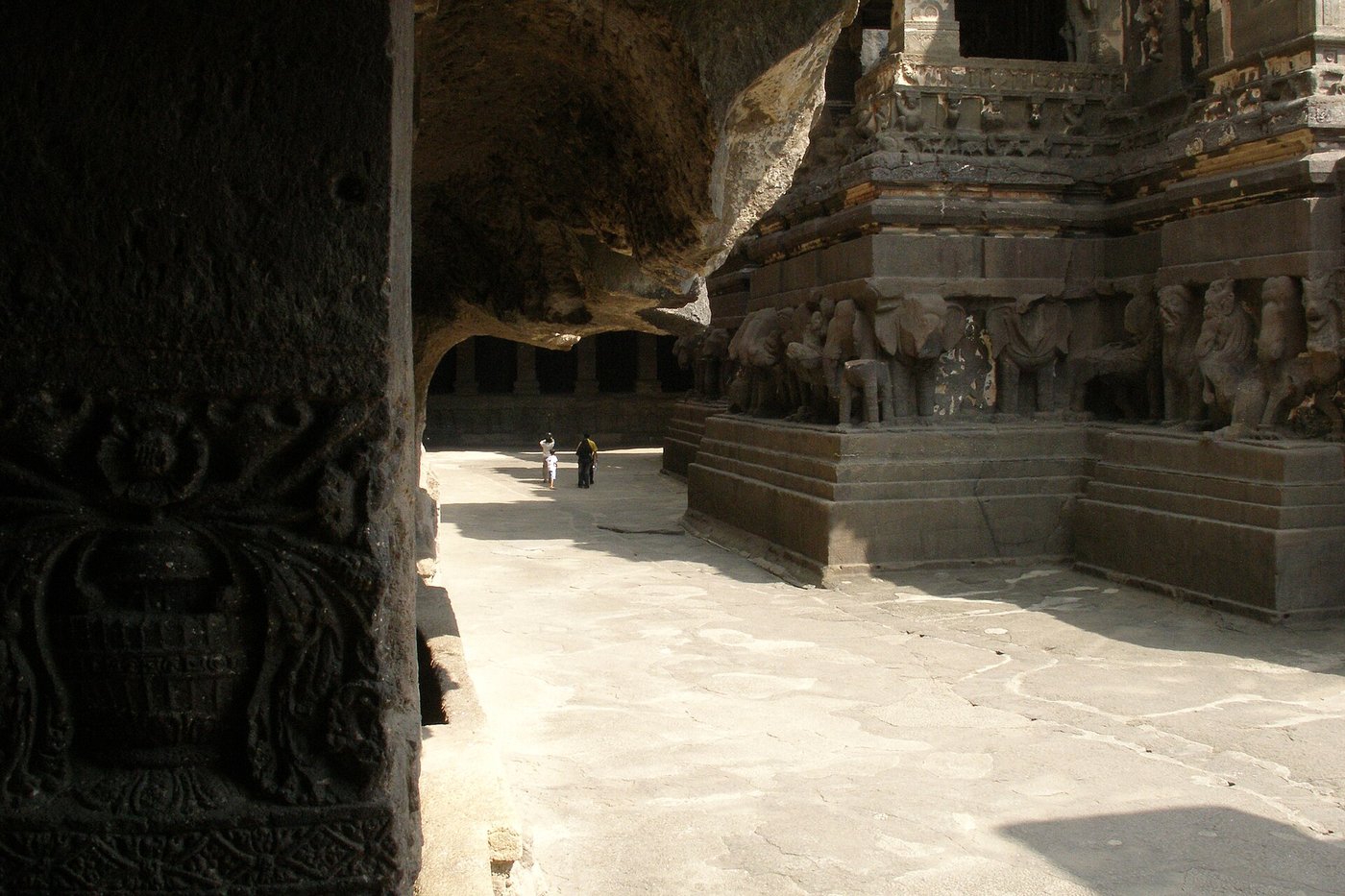
Walk down into the courtyard and the illusion the builders were chasing becomes clear. Around the base of the main shrine runs a band of carved elephants and mythical lions, worked so that they seem to be carrying the whole enormous mass of the temple on their backs. It is an old idea in Indian art, that the world rests on the shoulders of great beasts, and here it is made literal at a colossal scale. The temple appears to float above its animal supporters, as though the mountain itself were being lifted clear of the ground.
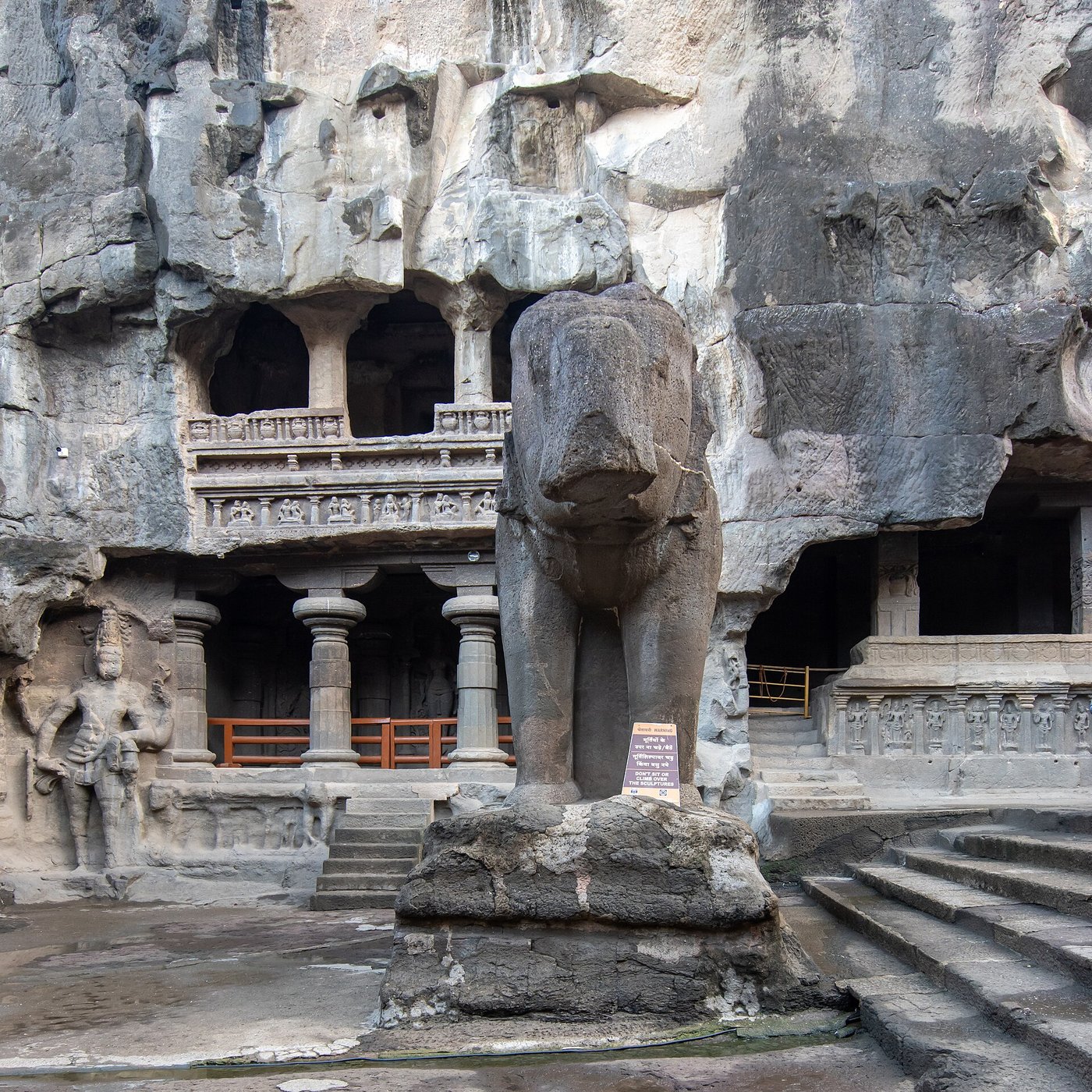
The elephants are life-sized and carved fully in the round, and time and iconoclasm have not been kind to all of them; many have lost trunks and tusks. But enough survive to feel the intention. Nearby stand two free-standing pillars and a stone image of Nandi, Shiva's bull, facing the sanctum as a worshipper would. Elsewhere in the courtyard a tall monolithic column and the remains of life-sized elephants complete a stage set built for gods rather than people.
Ravana beneath the mountain
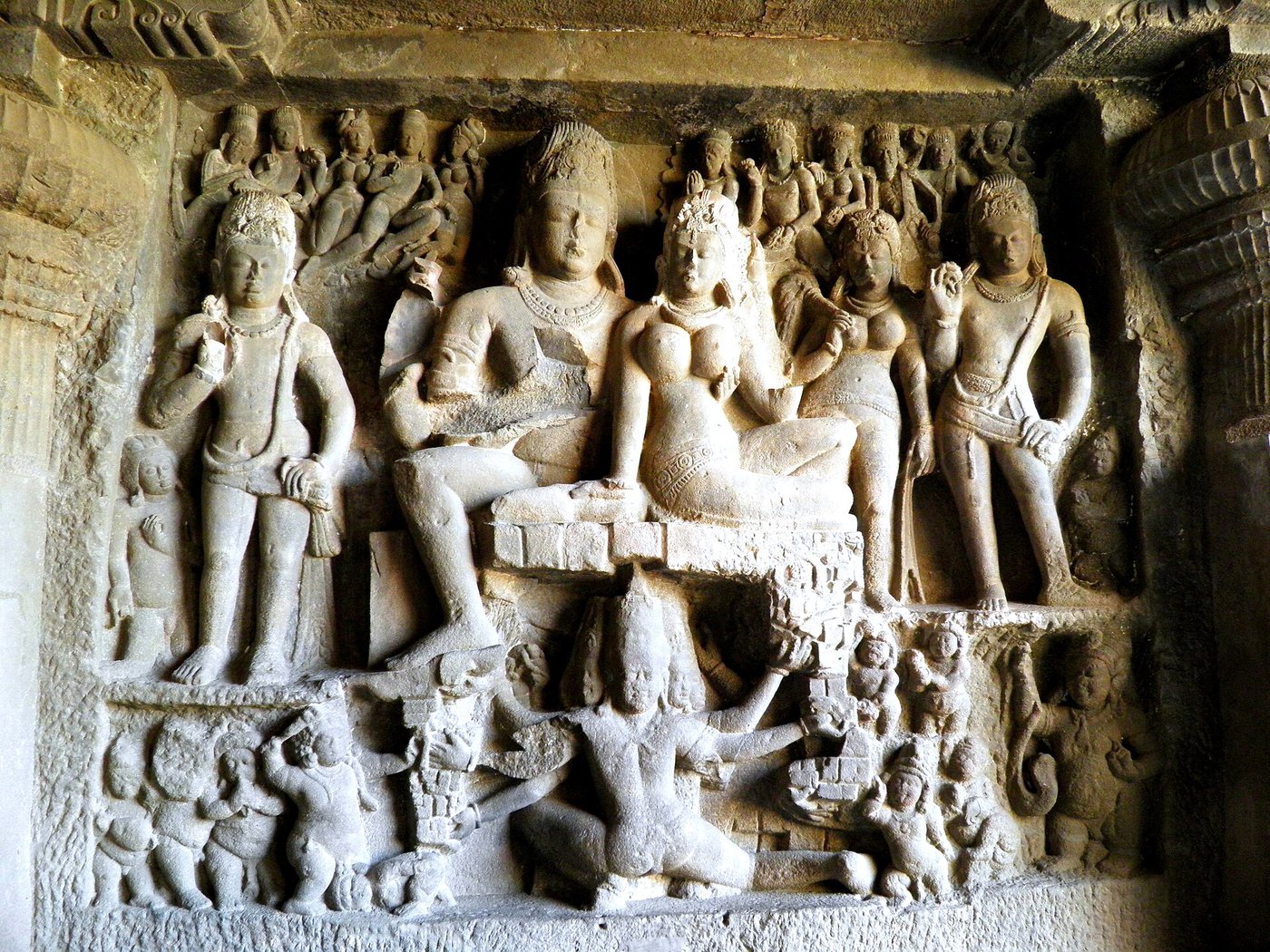
Of all the carvings at Kailasa, one is quoted more than any other, and it turns the temple's own name into a drama. On a panel set into the base of the shrine, the sculptors carved the moment from the Ramayana when the demon king Ravana, trapped for his arrogance beneath Mount Kailasa, sets his many arms against the underside of the mountain and tries to shake it loose.
The relief is a masterpiece of controlled tension. Ravana crouches in a rocky cavern below, his multiple arms fanning out as he heaves upward. Above him the mountain is shown as tiers of rock, with Shiva seated calmly at the summit beside his consort Parvati, who leans against him, a little alarmed. Shiva has only to press down with one toe to pin the mountain, and the demon, back in place. Attendants scatter; the whole scene trembles. What makes it extraordinary is that the sculptors have carved a shaking mountain into the base of a temple that is itself a carved mountain. The building depicts, on its own flank, a myth about the very thing it claims to be.
"Even the gods, moving in their chariots through the sky, halted in wonder, saying — this temple of Shiva could not have been made by human effort."— paraphrasing a Rashtrakuta copper-plate inscription praising the temple at Ellora
How did anyone do it?
Stand in the courtyard and the question presses in from every side: how? The honest answer is that the people who made Kailasa left us the temple but not their notebooks. There are no surviving plans, no work diaries, no record of how many people laboured or for how long. What we do have is the rock itself, and the marks of the tools on it.
Those marks tell a consistent story. The basalt of the Deccan is hard but workable, and it fractures along predictable lines when struck. The masons used iron chisels, points and hammers, and above all they used knowledge: an understanding, built up over centuries of rock-cutting at Ellora and other sites, of exactly how this stone behaves. Ellora is not one cave but dozens, Buddhist, Hindu and Jain, cut over roughly five hundred years. Kailasa was not a leap out of nowhere. It was the summit of a long tradition of excavating temples from cliffs, undertaken by communities of craftsmen who had been perfecting the technique for generations.
The top-down method was the key that made the impossible merely very difficult. By starting at the summit and working down, the carvers could rough out the mass, then refine the detail on each level while standing on solid rock, never needing to raise heavy material or build supports. The spoil, the vast tonnage of chipped and broken basalt, was carried out of the trenches and dumped, though where exactly it all went is itself a small mystery, since nothing like the expected mountain of debris survives nearby.
The myth of the lost technology
Precisely because Kailasa is so hard to imagine being made by hand, it has become a magnet for a certain kind of claim. Search for it online and you will quickly meet the idea that no ordinary people with hammers and chisels could have produced such a thing, and that it must be the work of a lost super-civilisation, or advanced machines, or visitors from elsewhere. The temple's perfection is offered as proof that the official story cannot be true.
"Kailasa is too precise and too vast to have been carved with simple hand tools. Ancient people could not have removed hundreds of thousands of tonnes of rock so cleanly. It must be the trace of some lost technology or outside help."
The temple sits inside a long, well-documented tradition of rock-cut architecture at Ellora and across India, with hundreds of other caves showing every intermediate stage of skill. Tool marks, unfinished sections and inscriptions all point to human quarrymen and sculptors working over years with iron tools and hard-won expertise. The "it's impossible" argument mistakes our own unfamiliarity with the craft for a limit on what past people could do.
The trouble with the lost-technology story is not that it is disrespectful of the truth so much as that it is disrespectful of the people who actually did the work. It takes one of the greatest feats of organised human skill ever attempted and hands the credit to imaginary aliens, precisely because the real achievement is so impressive. The tool marks on the walls of Kailasa are the fingerprints of named traditions and forgotten guilds. The proper response to them is not disbelief but a kind of awe at what disciplined, patient, ordinary human beings can accomplish when a whole society decides that something must be made.
A queen, an architect and a week
Alongside the sober history, Kailasa has gathered its own legend, and it is worth telling because it captures how later generations tried to make sense of the temple's speed and audacity. The story goes that a queen, usually said to be the wife of the king, made a vow that she would not eat, nor even drink, until she could see the top of the temple's tower complete. It was a pious vow and, given how temples were normally built, a nearly suicidal one, since a tower of that size would take years to raise from the ground up.
The king's architects despaired, all but one. A clever master builder, remembered in some versions as Kokasa, understood the trick that no one else had grasped: if you carve from the top down rather than build from the bottom up, the crowning tower is the first thing finished, not the last. He promised the anxious king that the queen would see the completed shikhara within a week. And by starting at the summit of the rock and cutting downward, so the tale runs, he kept his word. The story is almost certainly a later invention, but it preserves, in the shape of a folk tale, the single most important fact about how Kailasa was really made.
Paint, plaster and a lost brilliance
The Kailasa we visit today is bare grey-brown basalt, and it is easy to assume it always looked this austere. It did not. Traces of white plaster and pigment survive in sheltered corners, and they tell us the temple was once brightly finished. The rough rock was coated in a smooth layer of lime plaster to give the effect of pale, gleaming stone (an image of the snow-covered Himalayan Kailasa) and painted with figures and patterns in colour. Fragments of murals still cling to a few ceilings.
Picture it new: a mountain-temple standing white and shining at the bottom of its great pit, its galleries alive with painted gods, its elephants and lions crisp and unbroken, incense and chant rising from the sanctum. What survives is the skeleton of something that was, in its day, a riot of colour and devotion. The dignified monochrome ruin we admire is a shadow of the original, and knowing that changes how you see it: not a solemn grey miracle, but a once-blazing act of worship weathered down to its bones.
How long did Kailasa actually take, and how many hands? Popular accounts often repeat a tidy figure of eighteen years, but there is no ancient source that fixes the number, and scholars are cautious. The temple shows several styles and phases, which suggests work stretching across more than one reign and the involvement of different regional workshops. Some carving may have continued long after the main structure was freed. The truth is that we do not know precisely, and confident single figures (for the years, the workers, or the tonnes removed) are best treated as informed guesses rather than established fact.
Still pulling people up the ridge
Kailasa was recognised as part of the Ellora UNESCO World Heritage Site in 1983, and today it draws visitors from across the world, many of whom arrive knowing nothing of the Rashtrakutas and leave unable to stop thinking about the place. Its pull is not only religious or art-historical. It is something more basic. The temple is a physical argument about ambition: proof that a society with hand tools and deep knowledge could set itself a task that looks, on paper, insane, and simply finish it.
We live in an age that measures achievement in speed and machinery, and Kailasa resists that measure. It was made slowly, by people who would never see it completed, using nothing more advanced than iron, stone and accumulated skill. It asks a question that does not date: what could be made if a community agreed that something was worth the whole weight of its effort, and then gave that effort, year after year, without the expectation of finishing in a single lifetime?
There is a reason John Seely stood on that ridge in 1794 and struggled to accept what he was seeing, and a reason travellers still fall quiet at the top of the pit today. Kailasa does not merely represent Shiva's mountain. It performs the impossible thing at its own heart: a mountain carved from a mountain, a temple that was never built, standing where a hillside used to be because a great many forgotten people decided, twelve centuries ago, that it should.
Read next: Aksum: The 520-Tonne Stele That Fell as It Was Raised and My Son Sanctuary: The Road for the Gods Buried for Centuries.
Sources & further reading
- Dhavalikar, M. K., Ellora, Monumental Legacy series, Oxford University Press (2003).
- Owen, Lisa N., Carving Devotion in the Jain Caves at Ellora, Brill (2012) — for context on the wider Ellora complex.
- Archaeological Survey of India, site documentation for the Ellora Caves (Cave 16, Kailasa).
- UNESCO World Heritage Centre, "Ellora Caves" inscription and description (1983).
- Seely, John B., The Wonders of Elora (1824) — an early European account of the temple.
Image credits (via Wikimedia Commons): Kailasa temple overview — Ms Sarah Welch (CC BY-SA 4.0); aerial of Kailasa Temple — Vyacheslav Argenberg (CC BY 4.0); monolithic elephant — Rohit Sharma (CC BY-SA 4.0); Ravana shaking Kailasa relief — Vasukrishnan57 (CC BY-SA 4.0); Sri Naga serpent sculpture — Pratheepps (CC BY-SA 3.0).