When the emperor Michael the Fourth died in a monastery by the sea in December 1041, worn out by illness at barely thirty, a small group of very large men did something that should have got them hanged. They walked into the palace, went to the rooms where the imperial gold was kept, and helped themselves to as much as each man could gather up and carry in his arms. Nobody stopped them. Nobody wanted to. This was not a robbery but a right, old and understood, and the men taking the gold were the last people in Constantinople anyone would try to argue with. They were the emperor’s own bodyguard, and most of them had been born a very long way north of the Bosphorus, in places where the sea froze and men prayed to Odin.
They were the Varangian Guard, and for more than two centuries they stood between the ruler of the richest city in Christendom and everyone who wanted him dead. They were Swedes and Norwegians and Danes to begin with, later Englishmen driven out of their own country, and a scatter of Rus and Icelanders in between. Byzantine writers, who had a Greek word for almost everything, mostly just called them the axe-bearers. They were foreign, they were enormous by the standards of the day, they drank too much, and they were completely, ferociously loyal: not to Byzantium, not to the Orthodox faith, but to the man who paid them. That loyalty had a strange edge to it, and the run on the treasury was part of the bargain. To understand why an emperor would let a crowd of drunken northerners loot his gold, you have to go back to a winter when an emperor had almost nothing left to lose.
Six thousand men, sent down a river
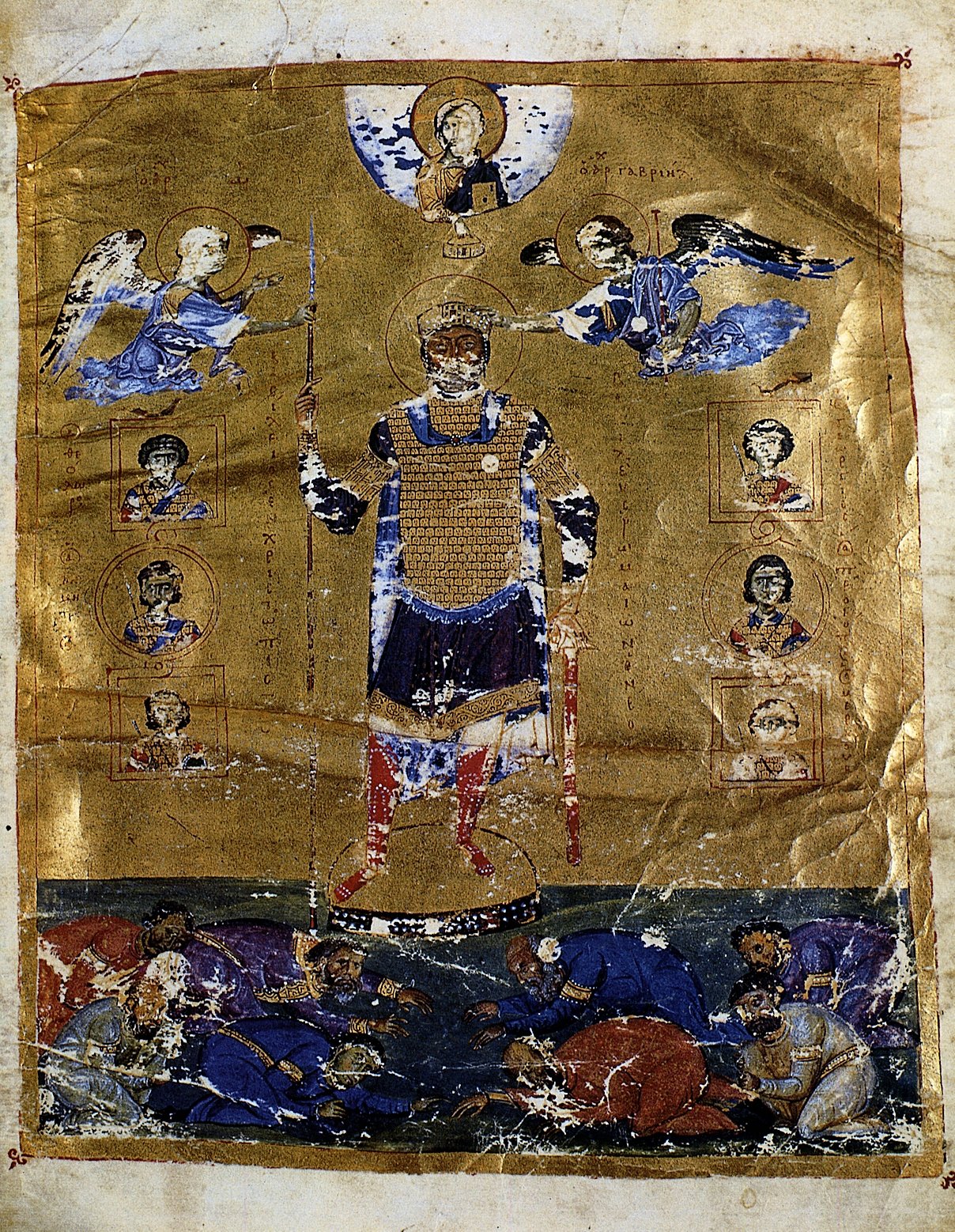
In 987 the emperor Basil the Second was in serious trouble. He was young, he had already lost a battle badly to the Bulgarians, and now the most powerful general in the empire, Bardas Phokas, had declared himself emperor and marched on the capital with much of the eastern army behind him. Basil held Constantinople and not a great deal else. The city walls were the best in the world, but walls do not win back an empire, and the troops he could trust were few. He needed soldiers who owed nothing to any Byzantine faction, and he needed them fast.
He found them in the north. A few years earlier a prince named Vladimir ruled the Rus from Kiev, a river people descended from Swedish traders and raiders who had settled among the Slavs. Vladimir had a surplus of exactly what Basil lacked: hard, professional fighting men, the kind who came south down the great rivers looking for silver and a war. A deal was struck, and it was an astonishing one. Vladimir would send six thousand warriors. In return Basil would give him something no emperor had ever given a foreign ruler: his own sister, the princess Anna, born in the purple, in marriage. The price of the bride was that Vladimir had to be baptised, and so he was. The arrival of the six thousand and the conversion of the Rus were two halves of the same bargain, and between them they changed the religion of what would one day be Russia.
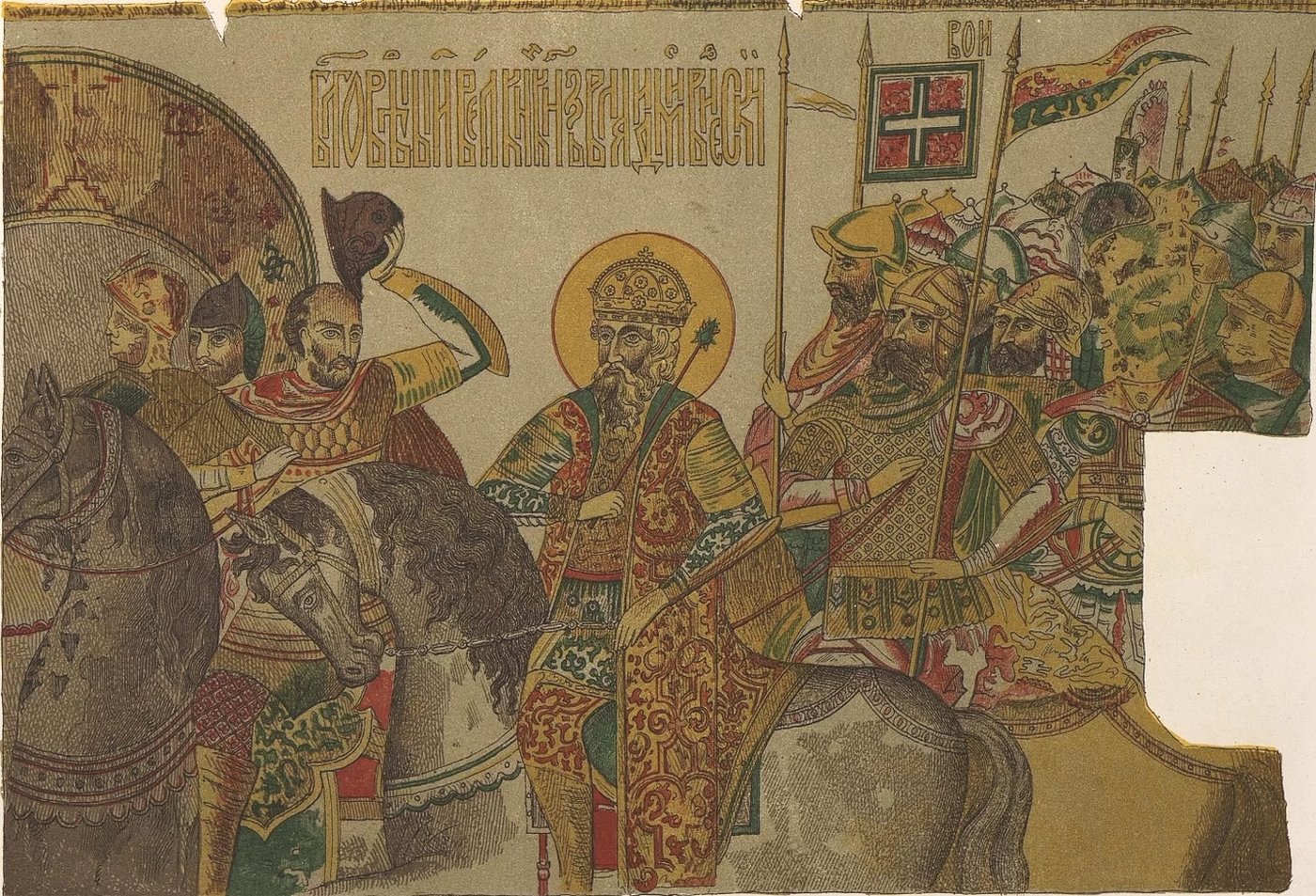
The men came down the rivers and across the Black Sea, and in the spring they went to work. Basil landed them by night near the enemy camp at Chrysopolis, across the water from the city, and they fell on Phokas’s troops in the dark and cut them apart. A little later, at Abydos, they met the main rebel army. Bardas Phokas rode out to challenge the young emperor in person and dropped dead from his horse in the middle of the field, felled by a stroke or a seizure before a blow was struck. The revolt collapsed. Basil had his throne back, and he had learned a lesson he never forgot: the northerners fought like nothing else in his army, and, better still, they had no cousins in the Senate, no estates to protect, no reason to plot. He kept them. The six thousand became a standing corps, and the corps became an institution.
Axe on the shoulder
Picture one of them on duty. He stood a head taller than the courtiers around him. He wore his own mail and a helmet, and over the plain war-gear the emperor dressed his guard in silk and gold thread for ceremony, so that a man who had grown up in a turf house on a cold fjord now shone like a saint on a wall. Across one shoulder he carried the weapon that gave the guard its Greek nickname: a long axe, the haft as tall as a man, the head a broad single blade of heavy iron. In a hall it sat on the shoulder. On a battlefield it came down through helmet and collarbone in a single stroke, and there was very little armour of the eleventh century that could stop it.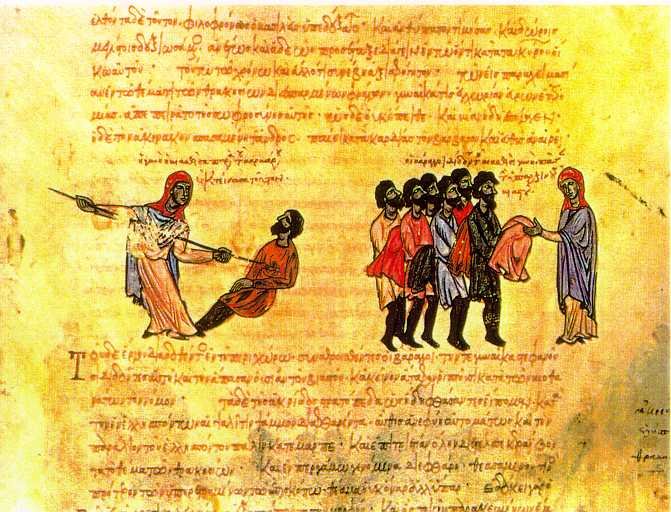
The court historian Michael Psellos, who watched them at close quarters, described their standard arms as the shield and the rhomphaia, a heavy single-edged sword, alongside the axe. They were shock troops and doormen at once. In the palace they lined the throne room and slept across the emperor’s door. In the field they were held back until the fighting turned, then sent in to break whatever needed breaking. Anna Komnene, an emperor’s daughter who wrote a history of her father’s reign, called them men who regarded loyalty to the emperors as a family tradition, a thing handed down, almost a religion of its own.
The Varangians swung great double-headed battleaxes, a blade on each side of the haft, the better to cut both ways in the press of a fight.
Almost every surviving picture and every real axe head from the period tells a different story. The guardsman’s weapon was the long-hafted broadaxe, sometimes called the Dane axe, with a single wide cutting edge and a plain poll on the other side. The double-bladed axe belongs to the nineteenth-century imagination and to costume drama, not to the eleventh century. A second edge would have made the weapon heavier, worse balanced and more likely to cut its own wielder; nobody who fought for a living wanted one. The Byzantine artists who actually saw the guard drew a single broad blade every time.
Why an emperor wanted strangers at his door
It seems backwards. The most powerful man in the Christian world guarded his own body with foreigners who could barely speak Greek, who worshipped, at first, the wrong gods, and who had arrived as hired swords. But that was the idea, and it was a cold, clever piece of thinking. A Byzantine emperor’s worst enemies were rarely at the frontier. They were in the palace: an ambitious general, a slighted brother, a eunuch minister with a plan and a knife. A guard drawn from the local aristocracy was a guard full of men with their own loyalties, their own families, their own reasons to look the other way on the night of a coup.
The Varangians had none of that. They had no land in the empire, no relatives in the factions, no stake in who wore the crown so long as somebody did and the somebody paid. An emperor could stand among them and know that not one of them was quietly working for his rival, because none of them cared about the rivalry at all. They cared about their wages, their honour and each other. It made them the one part of the court that could not be turned, and every emperor for two hundred years understood that this single fact was worth more than any number of native regiments.
The night the treasury opened
The pay was good and it was strange. A Varangian drew a regular wage in gold, better than most soldiers in the empire could dream of, and on campaign he took a share of the plunder on top. But the custom that fixed the guard in the northern memory, the one the Norse called polutasvarf, only came due when an emperor died. On that night, and that night alone, the guard had the right to go through the imperial apartments and the treasury and take what they could carry. It was not looting in the ordinary sense. It was a recognised perquisite, a bonus paid by a dead man to the living who had failed, through no fault of their own, to keep him alive for ever.
The saga tradition says the guardsmen were allowed to walk once through the palace treasure and keep whatever their two hands could gather. A single Byzantine gold coin, the histamenon, weighed about four and a half grams, so a strong man carrying an armful of coin and plate might come away with several years’ wages in one walk. Multiply that across a career, add the regular gold pay and a share of every campaign’s spoil, and you can see why a poor man from a rocky Norwegian valley would sail three thousand miles for the chance. Men who survived their years in the guard went home rich enough to buy land, keep followers and settle old scores. The gold that flowed north out of Constantinople has been dug up in Swedish fields as coins and hoards a thousand years later.
That single custom did more than reward the guard. It was the recruiting engine of the whole enterprise. A young man in Uppland or Trondheim heard that his neighbour’s son had come back from the great city dressed in silk, with a purse of foreign gold and stories of an emperor who ruled the world. He did not need a recruiting sergeant. He needed a ship. For as long as the gold kept coming home, the north kept sending its best fighters south to earn it, and the guard renewed itself generation after generation without Byzantium having to lift a finger.
The Norwegian who came for the gold and left a king
The most famous Varangian of all arrived around 1034, a giant of a young man in exile and in a hurry. His name was Harald Sigurdsson, and he was the half-brother of a Norwegian king, Olaf, who had been killed in battle in 1030 while Harald, then fifteen, fought at his side and was carried wounded from the field. Harald fled east, first to the court of Yaroslav in the land of the Rus, and then down to Constantinople, where a strong man with a sword could always find work. He joined the guard and, over roughly a decade, became its most celebrated captain.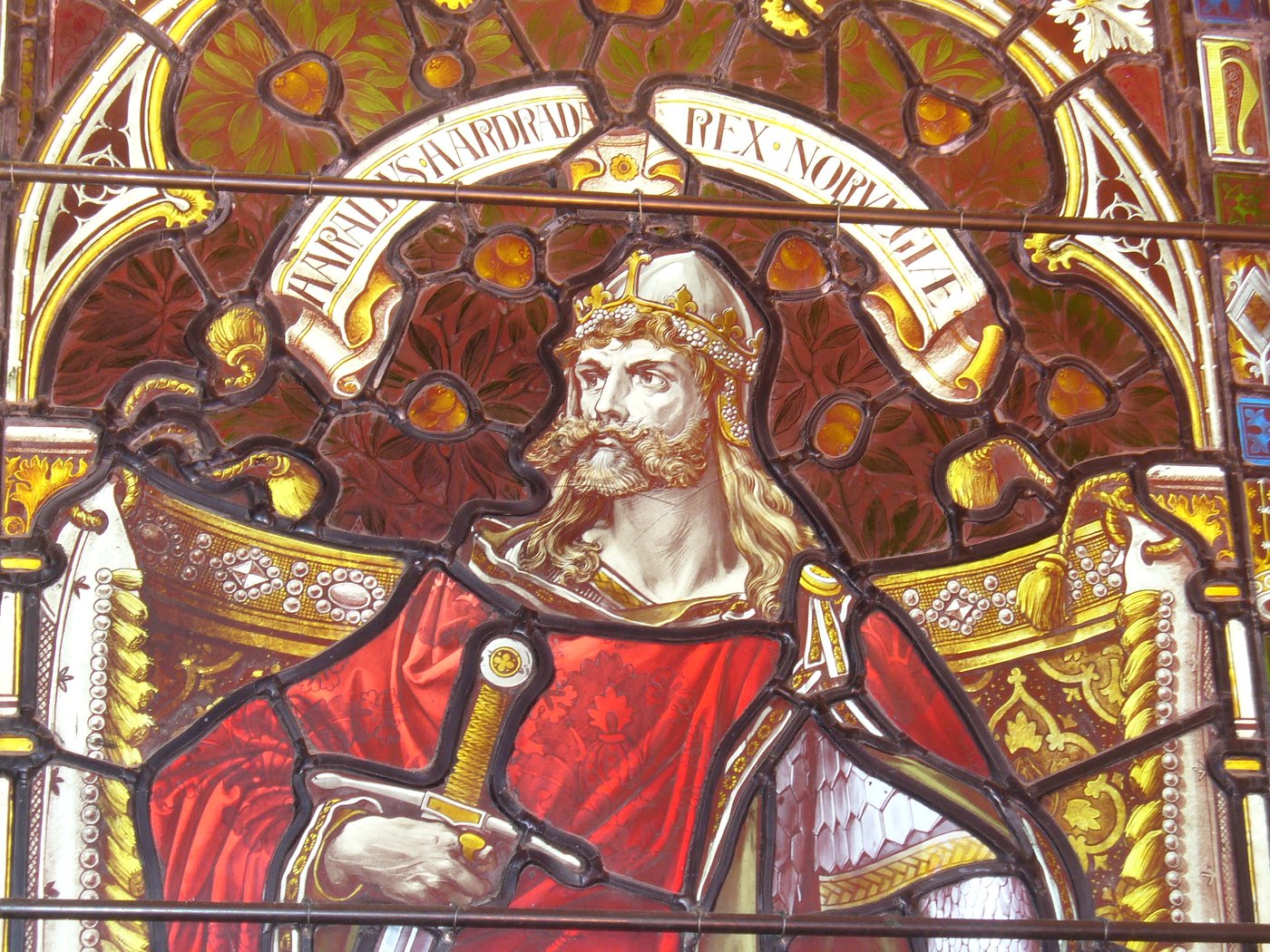
The sagas, written down in Iceland long after, follow him around the Mediterranean and beyond. He fought in Sicily under the Byzantine general George Maniakes, storming towns the Greeks had not held in generations. He put down a great rising in Bulgaria, a campaign that earned him, in the northern telling, the grim nickname the Bulgar-burner. He may have gone as far as the Holy Land with the army. And when emperors died, Harald was there for the old privilege: the saga of his life states plainly that he took part in the plundering of the palace three times over, in keeping with the law of the Varangians that granted them the run of the emperor’s treasure whenever a ruler passed away. He did not spend it. He sent the bulk of his fortune north for safekeeping to Yaroslav in the land of the Rus, building the war-chest of a man who meant to go home and take a crown.
His leaving was murky. By the early 1040s Harald had fallen out with the palace. The sagas talk of a quarrel over withheld plunder and of the empress Zoe herself turning against him, and of a spell in prison from which he broke out during the chaos when the young emperor Michael the Fifth was overthrown. In the northern version Harald settled that account brutally, taking part in the blinding of the fallen emperor before he slipped away. He escaped up the Bosphorus, so the story goes, having his men heave his galley over the great iron chain that closed the harbour. Then he sailed home, married Yaroslav’s daughter with his Byzantine gold, and made himself king of Norway. History knows him best by the name he earned later: Harald Hardrada, Harald the hard-ruler. He died in England in 1066 at Stamford Bridge, cut down while trying to take a third kingdom, and his fall is often marked as the last day of the Viking age. The man who ended it had learned his trade in the emperor’s bodyguard.
Halfdan cuts his name in the gallery
Most of the guardsmen left no mark on history at all. They served, they drank, they died in some field in Anatolia or Italy, and their names went with them. But a few reached up, in an idle or a bored moment, and scratched themselves into the most famous building in the city, and the scratches are still there.
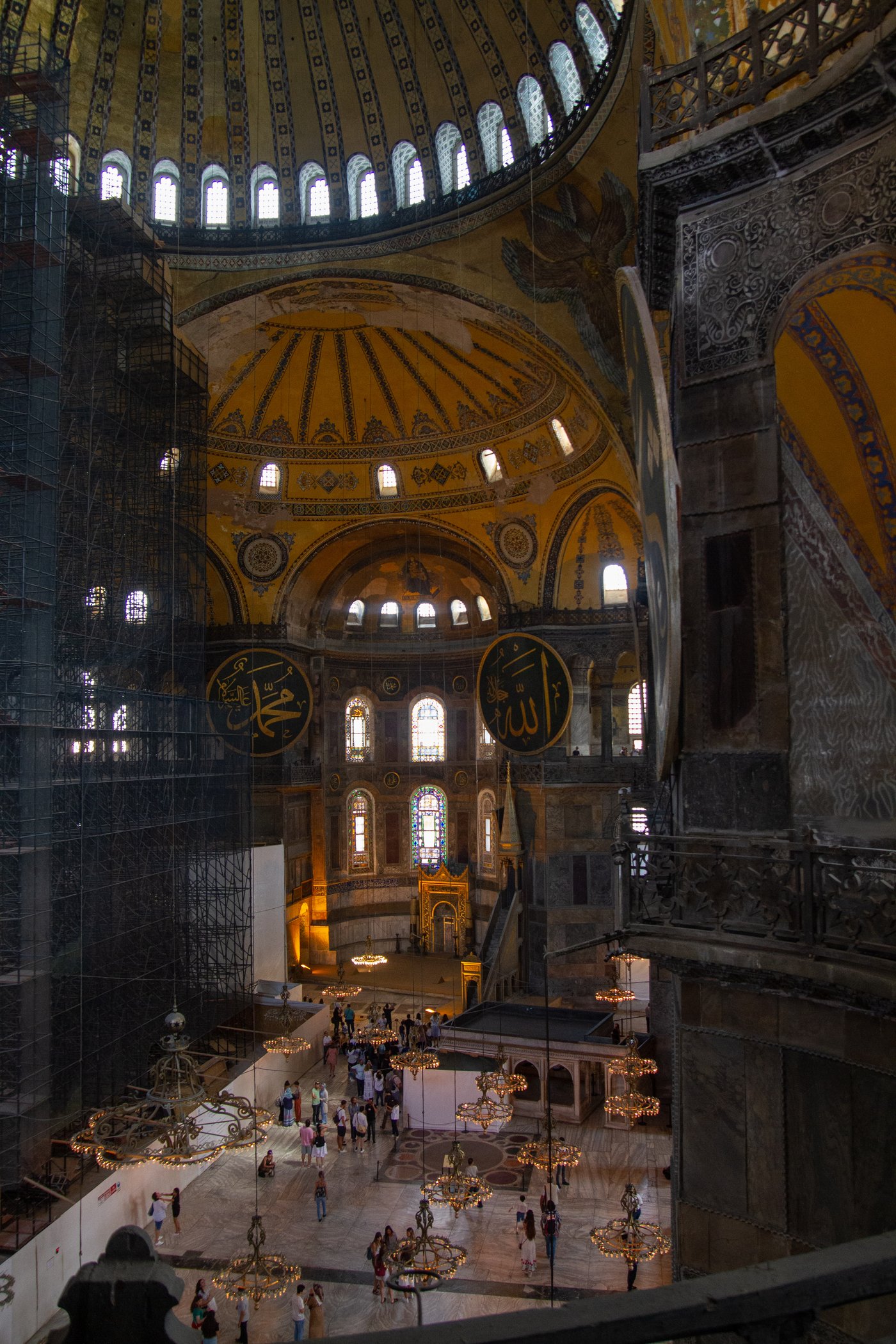
High in the southern gallery of Hagia Sophia, on a marble parapet where a guardsman might have leaned through a long liturgy, someone once cut a line of runes. It was noticed properly only in 1964, and much of it has worn to nothing, but the end of a name survives clearly enough: it reads, in the Norse alphabet, the last letters of Halfdan. Runologists think the full inscription once ran to the commonest formula in the whole runic world (so-and-so carved these runes): the graffiti of a man announcing, in a foreign church a world away from home, that he had been there. A second inscription, a name that reads as Ari, turned up in the same gallery in 1975. They are small, private things, easy to walk past. They are also, quite possibly, the only words any individual guardsman left behind in his own hand.
The Halfdan inscription sits on a parapet in the upper south gallery of Hagia Sophia and measures roughly twenty-three centimetres. It was first published by the Swedish runologist Elisabeth Svärdström in 1970, a few years after a guide spotted it. Only the ending of the name can still be read with confidence; the rest was already gone by the time anyone was looking. What makes it move people is not what it says but who said it and where. A man from the far north stood in the greatest church in the Christian world, in the service of an emperor whose language he could barely follow, and did the oldest human thing there is: he wrote down his name so that he would not be forgotten. He very nearly was.
Loyal to the last, and not always to the same man
Their loyalty was real, but it was loyalty to the office rather than always to the occupant. When an emperor was strong the guard was his wall. When an emperor was doomed, the guard could be the instrument of his fall, and it usually landed on the winning side because the winning side was the side that would still be paying it tomorrow. In 1042 the people of Constantinople rose against Michael the Fifth, the same emperor whose blinding Harald’s saga claims a share in, and the man who had thought his foreign axemen made him untouchable found that even they would not stand between a hated ruler and the whole city.
On the battlefield their record was harder and simpler. At Manzikert in 1071, the catastrophe in eastern Anatolia where the emperor Romanos was defeated and captured by the Seljuk Turks, the Varangians are remembered fighting around the imperial standard to the end, dying where they stood rather than break. It was the truer picture of the guard: a body of men who might read the politics of a coup shrewdly inside the palace, but who, once the line was drawn on open ground and the emperor was among them, simply did not run.
When the guard learned English
In 1066, the same year Harald Hardrada died in the north, a duke from Normandy won a battle near Hastings and took England. The men on the losing side, the Anglo-Saxon warrior class, the thegns and house-carls who had served the old English kings, found their country handed to foreigners and their lands parcelled out to strangers. Thousands of them would not live under it. They took ship, and a great many of them ended up doing the only thing they knew how to do, for the one ruler still rich enough to want them: the emperor in Constantinople.
Within a generation the Varangian Guard had changed its accent. The Scandinavian stream thinned as the kingdoms of the north settled into Christian monarchies with less appetite for sending men abroad, and the English stream swelled to take its place. By the twelfth century a Byzantine could reasonably think of the axe-bearers as Englishmen. There is even a strange half-legend, carried in a couple of later sources, of a band of these exiles sailing on past Constantinople to found a colony on the northern shore of the Black Sea, a place some called New England, where the beaten English of 1066 might start again out of reach of the Normans. Whether it was ever a real settlement or only a story the exiles told each other, it says something true about who these men were: people without a country, selling the one thing they had left.
The long ebb
Nothing lasts, and the guard aged with the empire it protected. In 1081, at Dyrrachion on the Adriatic coast, a Varangian force made largely of those English exiles charged the Norman army of Robert Guiscard, broke it, chased it too far, and was surrounded and slaughtered almost to a man. It was a disaster with a bitter symmetry: Englishmen destroyed by Normans a second time, a thousand miles from the first. The corps was rebuilt, but the golden age was over. The northern rivers no longer ran with willing recruits the way they had, and the empire that paid the wages was shrinking.
By the time the armies of the Fourth Crusade turned on Constantinople in 1203 and 1204 (Western Christians besieging the Christian city they had promised to help), the Varangians were still on the walls, still swinging the long axes, defending the capital against men not so very different from themselves. When the city fell to the crusaders in April 1204 the guard fell with its purpose. Emperors of the shrunken states that followed kept a body called by the old name for another two hundred years, but it dwindled into a ceremonial thing, a memory in silk, and the last clear mention of it flickers out in the early fifteenth century. The empire itself outlived the real guard by only a few decades, until the Ottomans took the walls for good in 1453.
What is left is oddly small and oddly durable. Not a monument, not a tomb, not a treasure; the gold went home to the north and into the ground centuries ago. What is left is a name scratched in a gallery by a man called Halfdan, high up in a building that has been a church, a mosque, a museum and a mosque again, and has outlasted the emperors, the guard and the empire alike. He wanted to be remembered. Nine hundred years later, standing in the crowd below his railing, you can still read the end of his name.
Read next: The Viking Age: More Farmers and Traders Than Raiders and The Fall of Constantinople, 1453: Cannon Against a Thousand-Year Wall.
Sources & further reading
- Sigfus Blondal (trans. and rev. Benedikt Benedikz), The Varangians of Byzantium (Cambridge University Press, 1978) — the standard scholarly account in English.
- Michael Psellos, Chronographia (eleventh century) — an eyewitness at court who describes the guard’s arms and service.
- Anna Komnene, The Alexiad (twelfth century) — on the guard’s loyalty and the disaster at Dyrrachion.
- Snorri Sturluson, Heimskringla, “King Harald’s Saga” (thirteenth century) — the Norse tradition of Harald Hardrada’s Byzantine years and of polutasvarf.
- Elisabeth Svärdström, publication of the Hagia Sophia runic inscription (1970); and “Runic inscriptions in Hagia Sophia” for the Halfdan and Ari finds.
- “Varangian Guard,” World History Encyclopedia, and recent surveys of Byzantine–Norse contact for the founding under Basil II.
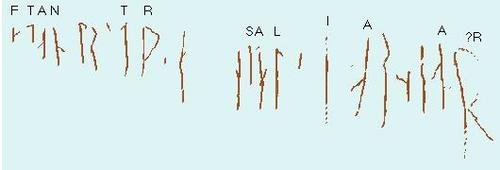
Image credits (via Wikimedia Commons): Emperor Basil II, frontispiece of his Psalter (Biblioteca Marciana, MS gr. 17) — unknown medieval artist (public domain); the Varangian Guard, Madrid Skylitzes — John Skylitzes / unknown (public domain); Vladimir of Kiev and his druzhina — V. Prokhorov (public domain); interior of Hagia Sophia — Maksym Kozlenko (CC BY-SA 4.0); the Halfdan runic inscription — unknown photographer (public domain); Harald Hardrada window, Kirkwall Cathedral — Colin Smith (CC BY-SA 2.0). Featured image: Basil II in imperial armour — unknown medieval artist (public domain).