In the winter of 2004 a researcher in Tehran did something nobody had thought to try with a small grey cup that had sat in a museum store for thirty years. He set photographs of its five painted panels side by side, in order, and let his eye travel along the row. A wild goat crouched, gathered itself, sprang, stretched up for the leaves of a tree, and came down again. Painted on clay somewhere around five thousand years ago, the animal moved. The cup had come out of a grave in a place with no ancient name we can read, a place the modern world simply calls the Burnt City.
That is the thing about Shahr-e Sukhteh. It sits at the far eastern edge of Iran, in a corner of desert most people could not find on a map, and it keeps producing objects that ought not to exist yet. Not treasure exactly; there is no golden mask here, no famous king. What the city hands over instead is a run of quiet, unsettling firsts: the earliest animation anyone has found, an artificial eye that a woman actually wore, a skull opened by a surgeon and healed, a board game with its rules half-recoverable. All of it made on the wrong side of the ancient world, a thousand kilometres from the cities of Mesopotamia that are supposed to have invented civilisation for everyone else. And nobody can tell you what its builders called it, or why, after a thousand good years, they walked away and let it go to dust.
Where the Helmand ran out
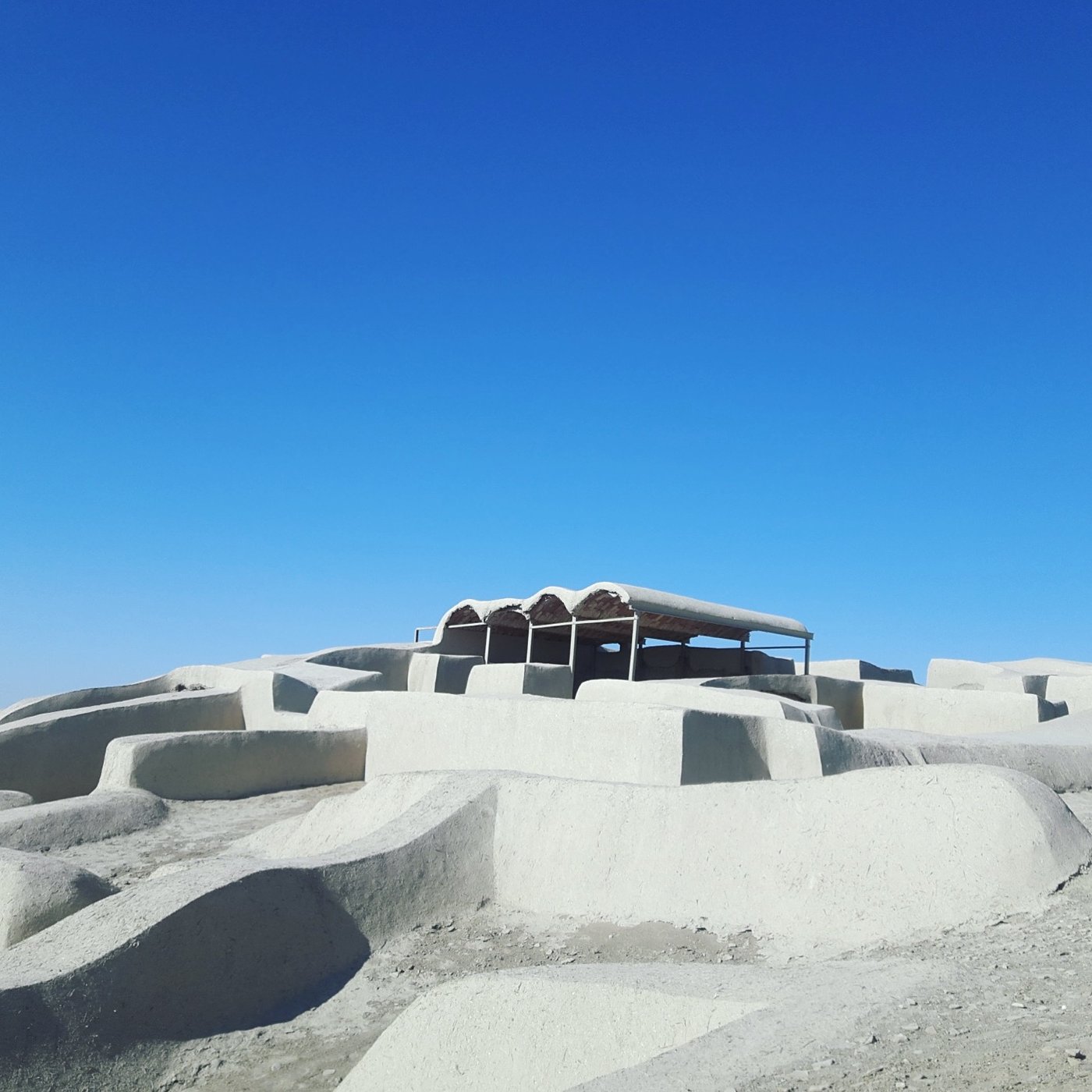
Start with the ground, because the ground explains both the city and its ending. Shahr-e Sukhteh lies in Sistan, in the province of Sistan and Baluchistan, on the flat between the towns of Zabol and Zahedan. Today it is one of the hottest, driest, most wind-scoured places in Iran; the local wind has a name and a season, and it strips the mounds a little thinner every year. Five thousand years ago it was not like that. The Helmand river, running down out of the mountains of Afghanistan, spread here into a shifting network of channels and shallow lakes, the Hamun, before losing itself in the sand. Where the water reached, the land was green enough to feed a town. The city grew up on that edge, in the exact place where a great river gives out.
It was big. At its height, around 2500 BC, the built-up area covered something like eighty hectares, and the whole site with its edges runs closer to two hundred. For its day that made it one of the largest settlements on earth: a real city, with districts given over to houses, to workshops, to the dead. The oldest layers go back to about 3550 BC and the last ones peter out around 2300 BC, so people lived here, on and off, for the better part of thirteen centuries. The British explorer Aurel Stein noted the mounds early in the twentieth century. But the site only gave up its secrets after 1967, when an Italian team under the archaeologist Maurizio Tosi began to dig, followed from the late 1990s by Iranian archaeologists led by Seyyed Mansur Sajjadi, who are still at it.
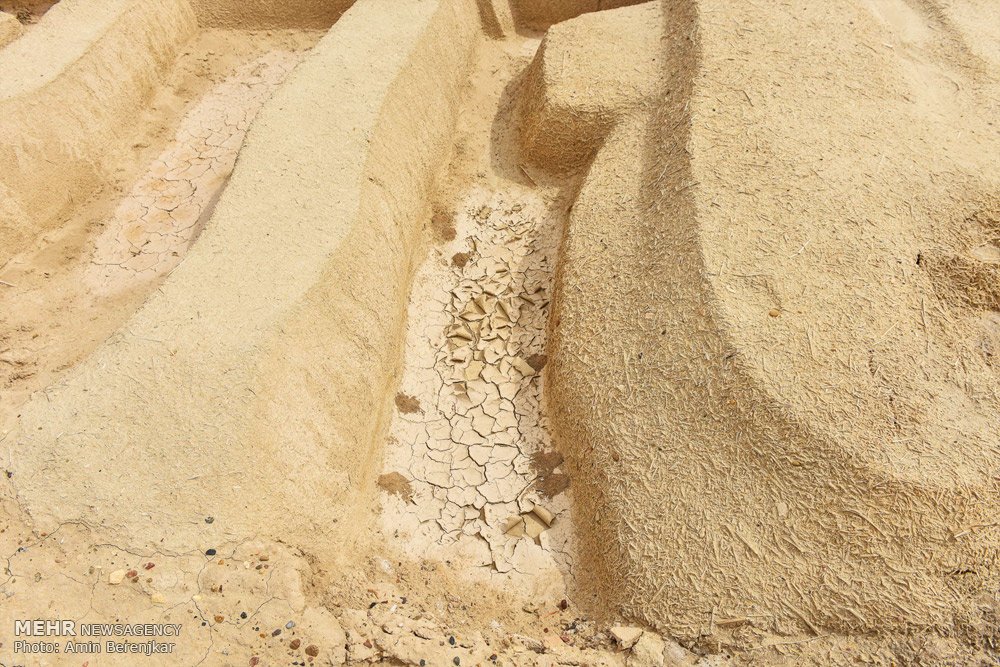
The name is a warning in itself. Shahr-e Sukhteh just means “Burnt City” in Persian, and it is modern: a description, not a memory. The people who dug the first trenches found thick layers of ash and charred roof-beams and called the place what it looked like. We do not know what the inhabitants said when they meant home. They left no readable writing of their own beyond a scatter of clay tokens and stamp seals, so the city speaks to us only through its things. It turns out to have a great deal to say.
Five frames on a cup
The goblet is small, about ten centimetres tall, the sort of thing you could close your hand around. Round its outside a painter laid five images of a goat, one after another, each with the legs and neck caught in a slightly different attitude. Line the images up and play them in sequence and the goat performs a single smooth action: it leaps up towards a tree and reaches the leaves. The city's excavators pulled the cup out of a grave in the 1970s. What took another thirty years was for someone to notice that the five pictures were not five goats. They were one goat, five times, in motion.
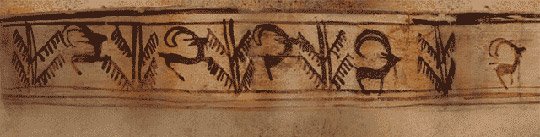
It is a strange object to hold in the mind. The painter understood something that would not be written down as a principle for another five thousand years: that a series of still images, each a small step on from the last, will read as movement if you take them in the right order. Whether the potter meant it as a toy, a charm, a bit of visual wit, or simply liked the pattern, we cannot know. But the sequence is deliberate. The goat's front legs fold and unfold; the body rises; the head lifts to the branch. That is not a decorative border repeating a motif. That is a drawing of time.
The animation runs on just five painted panels: not a strip of dozens of cells like a film, but the smallest number of frames you can get an action out of. Each shows the same wild goat, a Persian bezoar ibex, at a further point in a single spring towards a tree. Reading them in order gives you crouch, launch, reach, and land. It is the fewest pictures that will still carry the illusion of movement, which is either a happy accident or a very good eye. Nothing older that clearly sets out to show one thing moving has yet been found anywhere.
The claim that gets attached to it, “the world's first cartoon”, is worth handling with care, because it is both true and misleading at once.
Shahr-e Sukhteh gave us the world's first animation: a five-thousand-year-old cartoon of a leaping goat, the direct ancestor of everything from the flip-book to the cinema.
Nobody in the Burnt City could make the goat move the way we do; there was no way to flick the panels past the eye fast enough to fuse them. The animation lives in the sequence, and in the viewer turning the cup, not in any machine. Calling it “the first animation” is a modern reading of an ancient object; the potter left no note saying that is what it was for. What is fair to say is stronger and simpler: it is the earliest surviving image we know of that sets out to show a single figure moving through stages of one action. The idea underneath cinema is here. The projector is five thousand years late.
The woman with the golden eye
In another grave the diggers found a tall woman, unusually tall at about one metre eighty-two, laid out with an object still resting in the socket of her left eye. It was a shallow hemisphere a little over two and a half centimetres across, made of a light bitumen paste and covered with a thin layer of gold worked into fine lines that ran out from the centre like the rays of a sun, standing in for the iris. Two small holes had been drilled at the sides. Through them ran a gold thread, fine as hair, that had held the eye in place against the lids.
The detail that stops you is not the craftsmanship. It is what the socket showed. Under the microscope the bone around the eye carried the faint imprint of the gold thread, pressed in over time. That mark can only form on a living face. She had not been fitted with the eye for burial; she had worn it, for years, while alive: a woman between about twenty-five and thirty, walking around the Burnt City some time around 2900 BC with a golden eye that must have caught the light every time she turned her head. People would have known her by it from across a courtyard.
The case that she wore it in life does not rest on a guess. It rests on the eye-socket itself, which preserved the pressure line left by the gold thread and traces consistent with an abscess that can form where such a prosthesis rubs living tissue. Dead bone does not bruise or react. Those marks put the golden eye on her face while her heart was still going, which makes it, on the current evidence, the earliest artificial eye known to have been worn by a person, rather than added after death.
A hole cut in a living skull
The graves keep raising the same quiet question: how much did these people know that we assume no one knew yet? Among the thousands of burials in the great cemetery (and there are thousands, tens of thousands by some counts, spread across a quarter of the site), the diggers found a young skull with a piece cut cleanly out of it. This is trepanation, the deliberate opening of the skull, one of the oldest operations there is. What matters is the edge of the hole. The bone around it had begun to grow back, smooth and rounded. The patient, a girl in her early teens, did not die on whatever passed for the table. She lived on, for weeks at least, with a healing wound in her head, in a town on the edge of a desert, five thousand years ago.
We do not know why it was done: to relieve pressure after an injury, to treat a swelling, for reasons that made sense inside a world of belief we cannot enter. But it was done with enough skill and care that a child survived it. Set that beside the golden eye and a picture starts to form of a place that thought hard about the human body, and was willing to intervene in it.
Twenty squares and four dice
Not everything the city left behind is so grave. In one burial the excavators found a board game, laid in beside the dead as if for the journey. The board is a rectangle of dark artwood carved so that a coiled serpent winds across its surface, its body divided into twenty squares. With it came the equipment of play: small pieces in two colours to move around the snake, and dice to move them by. It belongs to a family of games archaeologists call the Game of Twenty Squares, cousins of it turn up from the royal graves of Ur to Egypt, but the Sistan version is its own thing, and one of the oldest and most complete ever lifted from the ground.
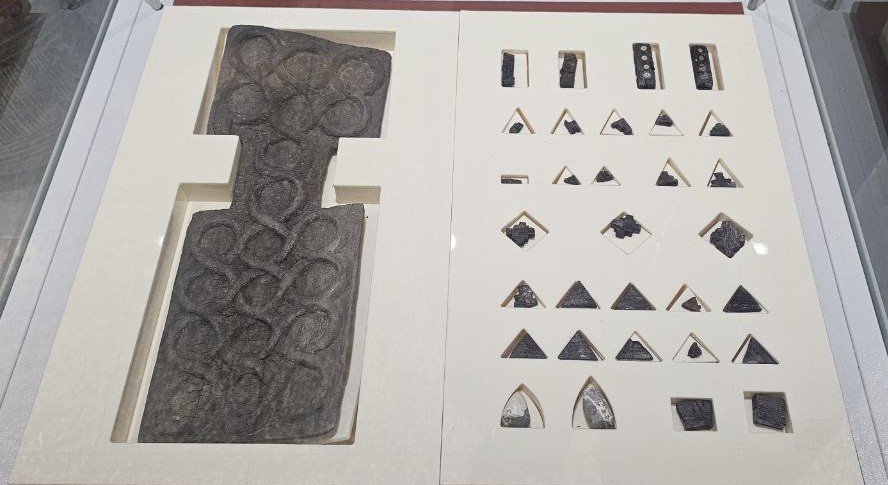
It is an easy object to love, because it needs no translation. A board, counters, dice, two players and the roll of luck against the shape of a plan: the machinery of a game has barely changed. Somebody in the Burnt City sat across from somebody else and played, and lost, and wanted to go again. That the board was buried with its owner suggests the game mattered enough to send along into the dark, which tells you something warmer about the place than any wall or wall-painting could.
What a city on the edge could make
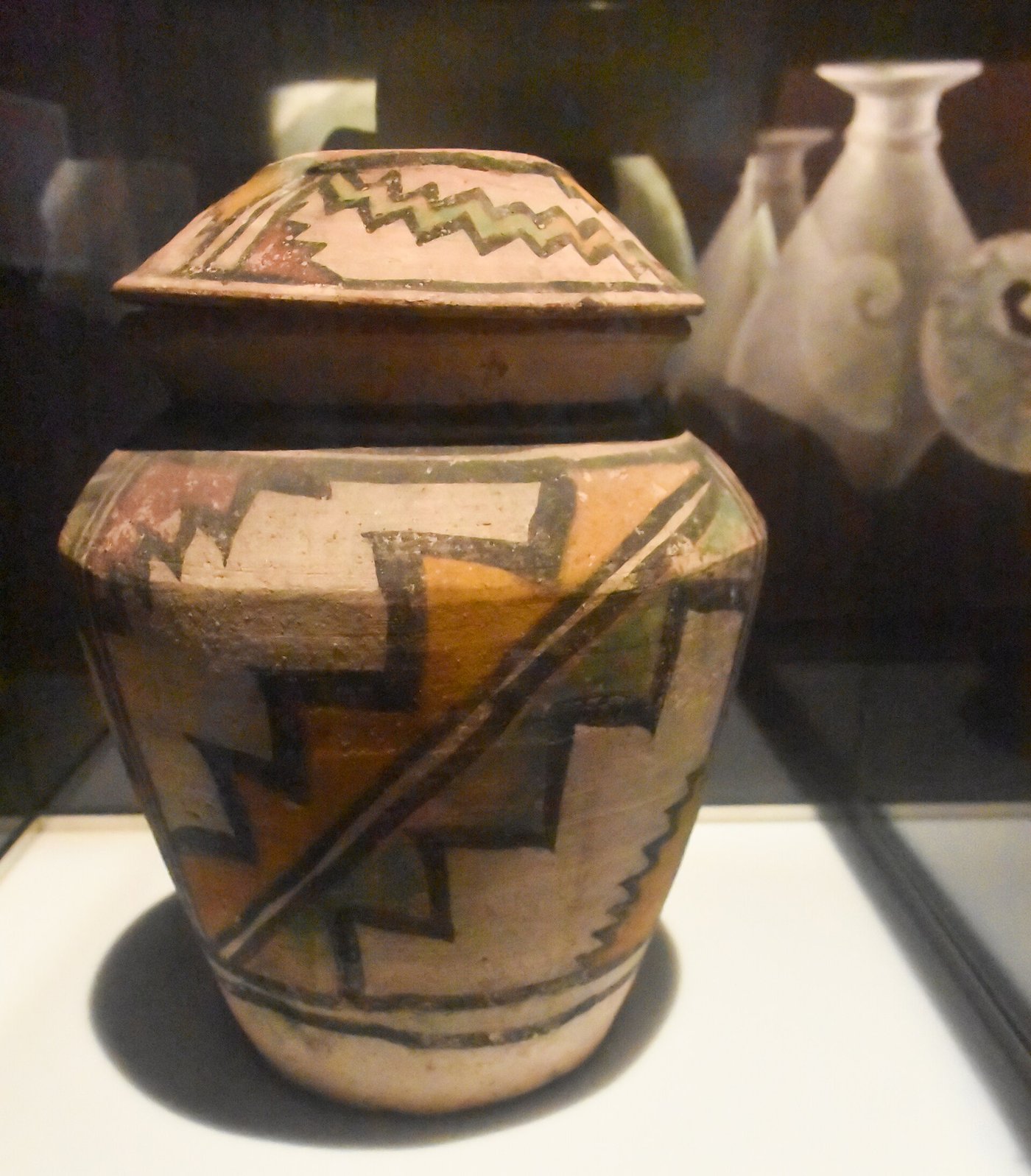
None of this was the work of a poor town scraping by. Shahr-e Sukhteh was a workshop city, and a rich one, because it sat astride the roads that carried the most valued stone of the age. Lapis lazuli, the deep blue stone that Sumerian and Egyptian royalty craved, came out of the mountains of Badakhshan in north-eastern Afghanistan. The rough blocks travelled west, and a great many of them passed through here to be cut, shaped and traded on. Turquoise moved the same way. The city's craftsmen worked stone, made beads by the tens of thousands, wove textiles, turned out standardised pottery in real quantity. Under the floors of one building the diggers found the debris of an industry, not a household.
And this is what makes archaeologists lean back and think. For all its wealth, the city shows very little sign of the things we take as the price of civilisation. Weapons are rare in the graves. There is no obvious palace looming over the houses, no fortress wall built for war, no royal tomb heaped with the loot of the many for one. The burials, rich and poor, are not separated by the gulf you see in Mesopotamia or Egypt at the same date. Women were buried with wealth and, it seems, with standing; some evidence points to households organised around them. This looks less like a kingdom held down by a king than a large, busy, trading community that ran itself, and ran itself well enough to last for centuries.
The old story of the Bronze Age has civilisation radiating outward from Mesopotamia: the Sumerians invent the city, and everyone downstream copies it. Shahr-e Sukhteh sits awkwardly in that story. It traded with Mesopotamia, the Indus cities and the cultures of Central Asia, and borrowed from all of them, but its distinctive pottery, its craft economy, its flatter society and its own firsts suggest a place that grew on its own terms, one node in a web of early cities rather than a copy of a single centre. Some scholars read it as evidence of a home-grown eastern Iranian civilisation. Others see a crossroads that simply absorbed its neighbours. What is no longer easy to argue is that the good ideas of the ancient world all began in one river valley and spread from there.
Why a city with everything walks away
So a large, wealthy, inventive city stands for more than a thousand years on the edge of a desert, and then it ends. The burning that gave the place its name happened more than once; there are separate scorched layers, and after the earlier fires the city was simply rebuilt on top of the ash. Fire alone did not finish it. Something slower did.
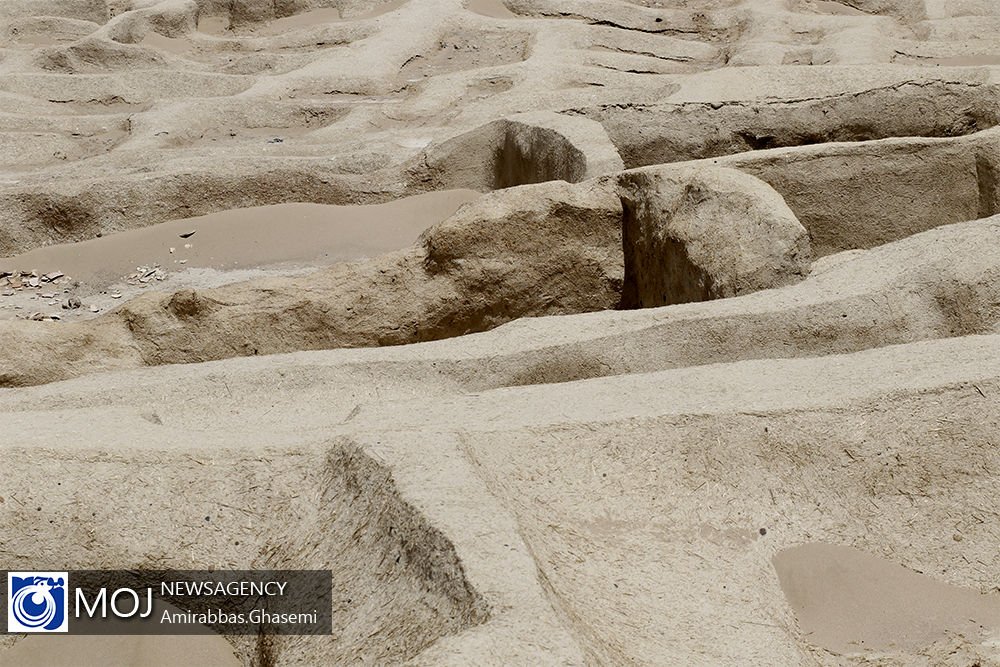
The likeliest culprit is the thing that made the city possible in the first place: the water. The Helmand does not run in a fixed bed across the flat of Sistan; over centuries it wanders, and the lakes it feeds swell and shrink with it. If the river shifted its main channel away from the city, or the climate turned drier and the Hamun pulled back, the green edge that fed eighty hectares of townspeople would have moved off and left them stranded on a plain going back to sand. That fits the record. By around 2300 BC the great city is finished as a great city, with only a thin, poor reoccupation flickering on afterwards. There is no sign of a conquering army, no mass grave of the slaughtered. It looks less like a city destroyed than a city that dried up and was abandoned, family by family walking off after the water that had walked off first.
What the desert kept
The cruelty and the gift of the place are the same fact. The dryness that killed the city is exactly what preserved it. In that salt-laden ground, cloth survives, and wood, and the paint on a cup, and the pressure-mark of a thread on a woman's eye-socket, and the healed rim of a hole in a child's skull: the soft, perishable evidence that rots to nothing almost everywhere else. Shahr-e Sukhteh is generous with the small human things and silent on the large ones. It will show you a goat in mid-leap and a game someone loved enough to be buried with. It will not tell you the city's name, or the woman's, or what the surgeon was trying to save, or the morning the last household decided there was no reason to stay.
That is the strange balance the Burnt City leaves you holding. We know the reach of a goat and the fineness of a gold thread, and we do not know the word these people used for the river that both made them and left. The desert kept the leap and lost the language. You come away able to picture a life here in extraordinary close-up, and unable to say what any of them called it.
Read next: Jiroft: The Civilisation Looters Reached Before the Archaeologists and Dilmun: The Land Sumer Called Deathless, and Its 11,774 Tombs.
Sources & further reading
- Maurizio Tosi (ed.), Prehistoric Sistan (Istituto Italiano per il Medio ed Estremo Oriente, Rome), the foundational reports on the Italian excavations.
- Seyyed Mansur Sajjadi and the Iranian Centre for Archaeological Research, excavation reports on Shahr-i Sokhta, 1997 onward.
- “An ancient artificial eye from the Burnt City,” reporting on the ocular prosthesis found in grave 6705 and the analysis by Lorenzo Costantini and colleagues.
- UNESCO World Heritage Centre, “Shahr-i Sokhta” (inscribed 2014), site description and nomination file.
- National Museum of Iran, catalogue notes on the animated goblet and the twenty-square board game from Shahr-e Sukhteh.
Image credits (via Wikimedia Commons): the site of Shahr-e Sukhteh — Saeeddanaie69 (CC BY-SA 4.0); the ruins — Amin Berenjkar (CC BY 4.0); the animated goblet — uncredited (Public domain); the board game — Cyrussis (CC BY-SA 4.0); painted pottery — Dorieo (CC BY-SA 4.0); excavated foundations — Amirabbas Ghasemi (CC BY 4.0).