In the summer of 2025, on a wooded plateau about seventy kilometres north-west of Rome, a team of archaeologists cleared away the last of the soil from a stone slab and realised what they were looking at. The door of the chamber behind it was still in place. Every other tomb in the necropolis at San Giuliano (more than six hundred of them, cut into the soft volcanic rock over centuries) had been emptied by robbers, some of them as early as the Roman occupation in the third century BC. This one had not. When the team finally opened it, they found four people lying on carved stone beds where they had been placed roughly 2,600 years earlier, surrounded by more than a hundred objects that nobody had touched since the day the door was shut: seventy-four ceramic pots, iron weapons, bronze ornaments, and a pair of small silver spools that had once held someone's hair in place.
The people in that chamber were Etruscans. Most of us have heard the name and very little else. They are the civilisation that sits in the blind spot of European history: older than Rome, richer than Rome for a long stretch of its early life, and the source of a surprising amount of what we think of as Roman. Then they stopped existing, not through a single catastrophe but through a slow absorption so complete that within a few generations almost nobody could read their writing. What is left of them is mostly what they buried.
Twelve cities and no country
The Etruscans called themselves the Rasna. The Greeks called them Tyrrhenoi, which is why the sea off Italy's west coast is still the Tyrrhenian. The Romans called them Etrusci or Tusci, which is why the region is called Tuscany. Their heartland ran roughly from the Arno in the north to the Tiber in the south, taking in modern Tuscany, western Umbria and northern Lazio, and at their height in the sixth century BC their influence reached from the Po valley down into Campania.
They were never a country in the way we would understand it. Etruria was a league of independent cities (traditionally twelve, though the list shifts depending on which ancient writer you follow), each with its own ruler, its own coinage, its own army and its own quarrels. Veii, Caere, Tarquinia, Vulci, Volsinii, Chiusi, Perugia, Arezzo, Cortona, Populonia, Volterra, Vetulonia. They met once a year at a sanctuary near Volsinii for a religious festival and, presumably, for politics. What they did not do reliably was fight as one. That turned out to matter a great deal.
For roughly three centuries, from about 700 to 400 BC, these cities were the wealthiest and most technologically advanced communities in the western Mediterranean north of the Greek colonies. They mined and worked metal on an industrial scale, ran fleets that Greek writers complained about as piratical, drained marshland with rock-cut tunnels that still function, and laid out towns on a grid long before Rome did. When early Rome was a cluster of huts on hills above a swamp, Etruscan cities had paved streets and stone temples.
Cities of the dead
Almost everything we know about them comes from their cemeteries, and this creates a strange distortion. Etruscan houses were built of timber and mud brick and have almost entirely rotted away. Their tombs were cut into rock and built to last. So we know a great deal about how Etruscans wanted to be remembered and comparatively little about how they lived from day to day.
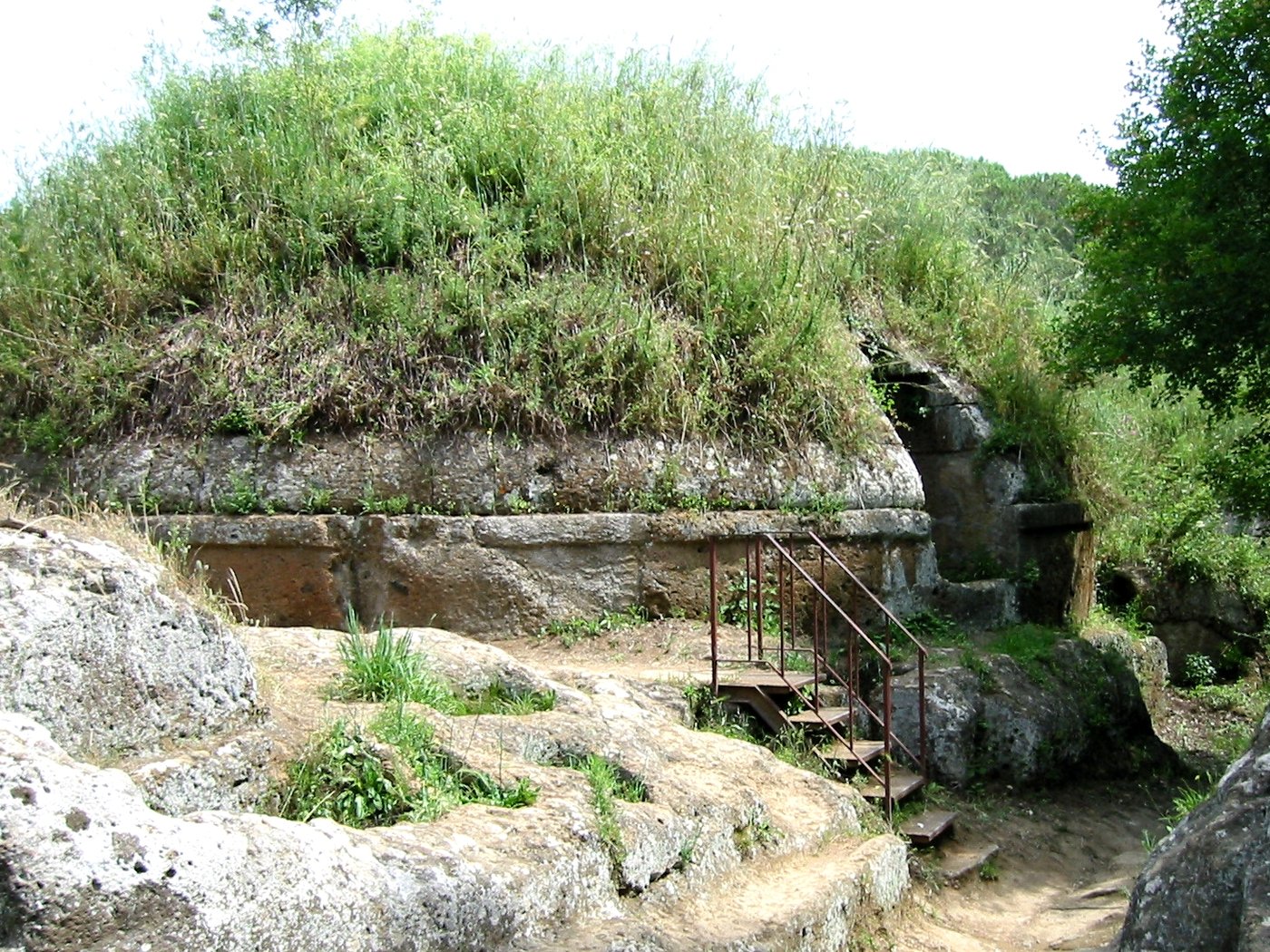
The scale of these cemeteries is difficult to convey. At Cerveteri (ancient Caere) the Banditaccia necropolis covers around four hundred hectares and contains thousands of tombs laid out along streets, with the earlier ones covered by circular earth mounds up to forty metres across. Walking through it feels less like visiting a graveyard than visiting a suburb. That is roughly the intention. The chambers inside were carved to imitate houses: sloping ceilings cut to look like timber roof beams, doorways with lintels, benches shaped like furniture, and in one famous example at Cerveteri, walls carved with stucco reliefs of household objects (rope, jugs, knives, a folding stool, even a pet).
The alphabet you are reading passed through Etruscan hands. The Etruscans borrowed a version of the Greek alphabet from the colony at Cumae around 700 BC, adapted it to their own sounds, and passed it on to their Latin-speaking neighbours. Several letter shapes we use today reflect Etruscan choices rather than Greek ones, including the fact that Latin, and therefore English, uses the letter C where Greek used a hard G sound.
Where the Etruscans came from
This question has been argued over for 2,500 years, and for most of that time the argument has been between two ancient Greek writers. Herodotus, in the fifth century BC, reported that the Etruscans were migrants from Lydia in Anatolia, driven west by famine and led by a prince named Tyrrhenus. Dionysius of Halicarnassus, writing four centuries later in Rome, disagreed flatly: he thought they were native to Italy, pointing out that they shared no language, no gods and no customs with the Lydians.
The Lydian story had a long life. It appealed to nineteenth-century scholars who found the Etruscans exotic and wanted an eastern explanation for their art. It appealed even more to anyone who noticed that the Etruscan language was not Indo-European (not related to Latin, Greek, Celtic or Sanskrit), which made it look like an intruder in Italy.
Genetics has now largely settled it. A study published in 2021 in Science Advances analysed DNA from eighty-two individuals buried in central Italy between roughly 800 BC and AD 1000. The Iron Age Etruscans turned out to be genetically almost indistinguishable from their Latin-speaking neighbours, sharing the same steppe-derived ancestry that arrived in Italy during the Bronze Age. There was no signal of a recent migration from Anatolia. Archaeology points the same way: Etruscan culture emerges without a break from the earlier Villanovan culture of the same region, the burial practices shifting gradually rather than being replaced.
"The Etruscans were mysterious outsiders who sailed to Italy from Anatolia, bringing an alien language and eastern customs with them."
Ancient DNA shows Iron Age Etruscans were locals, genetically the same population as the Latins next door. Their unusual language is better explained as a survivor: a tongue already spoken in the region before Indo-European languages spread across Europe, which happened to hold on in Etruria long after it had been replaced everywhere else.
The banquet, and the women who scandalised the Greeks
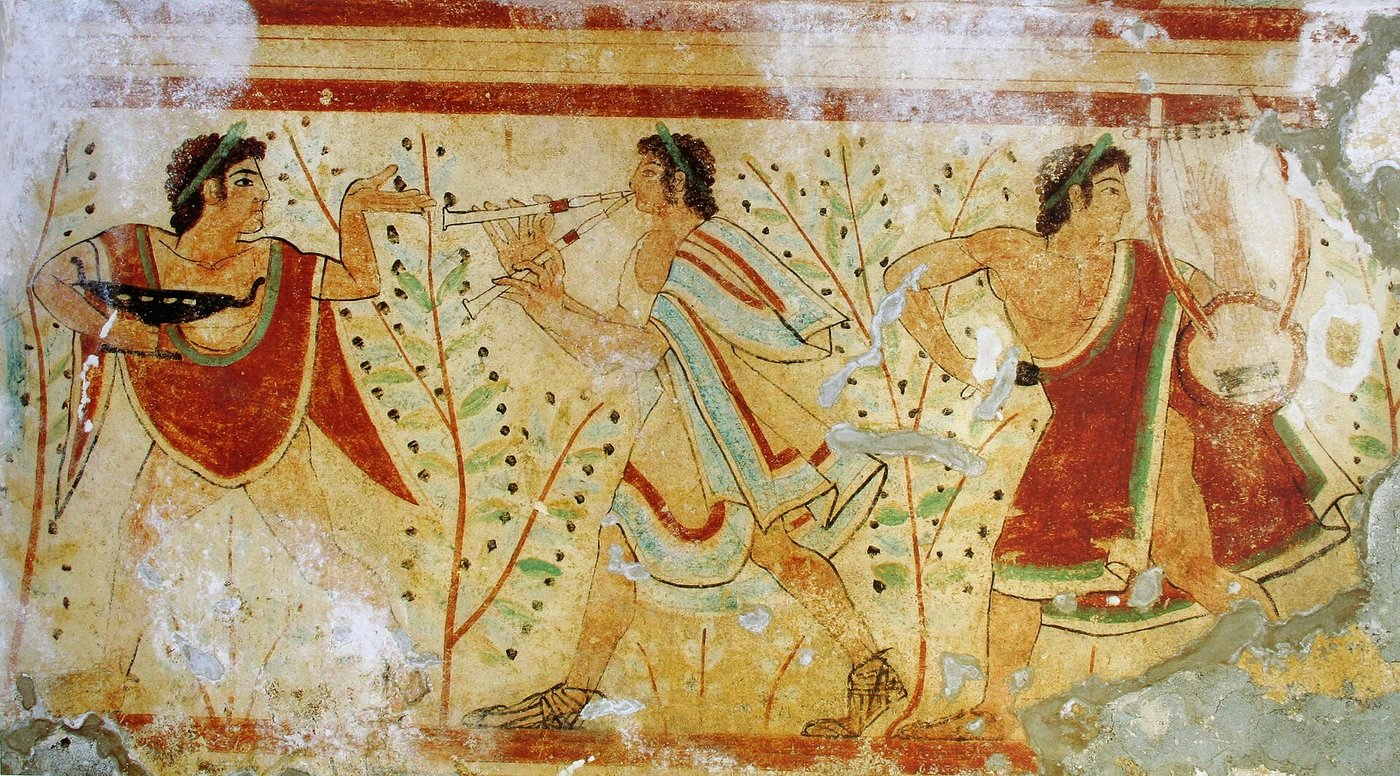
The painted tombs of Tarquinia are the closest thing we have to a window into Etruscan social life. Roughly two hundred of them carry frescoes, and the subject is nearly always the same: a banquet. Couples recline on couches. Servants carry jugs. Musicians play the double pipe and the lyre. Dancers move through stylised trees. Everyone is eating, drinking and, quite visibly, enjoying it.
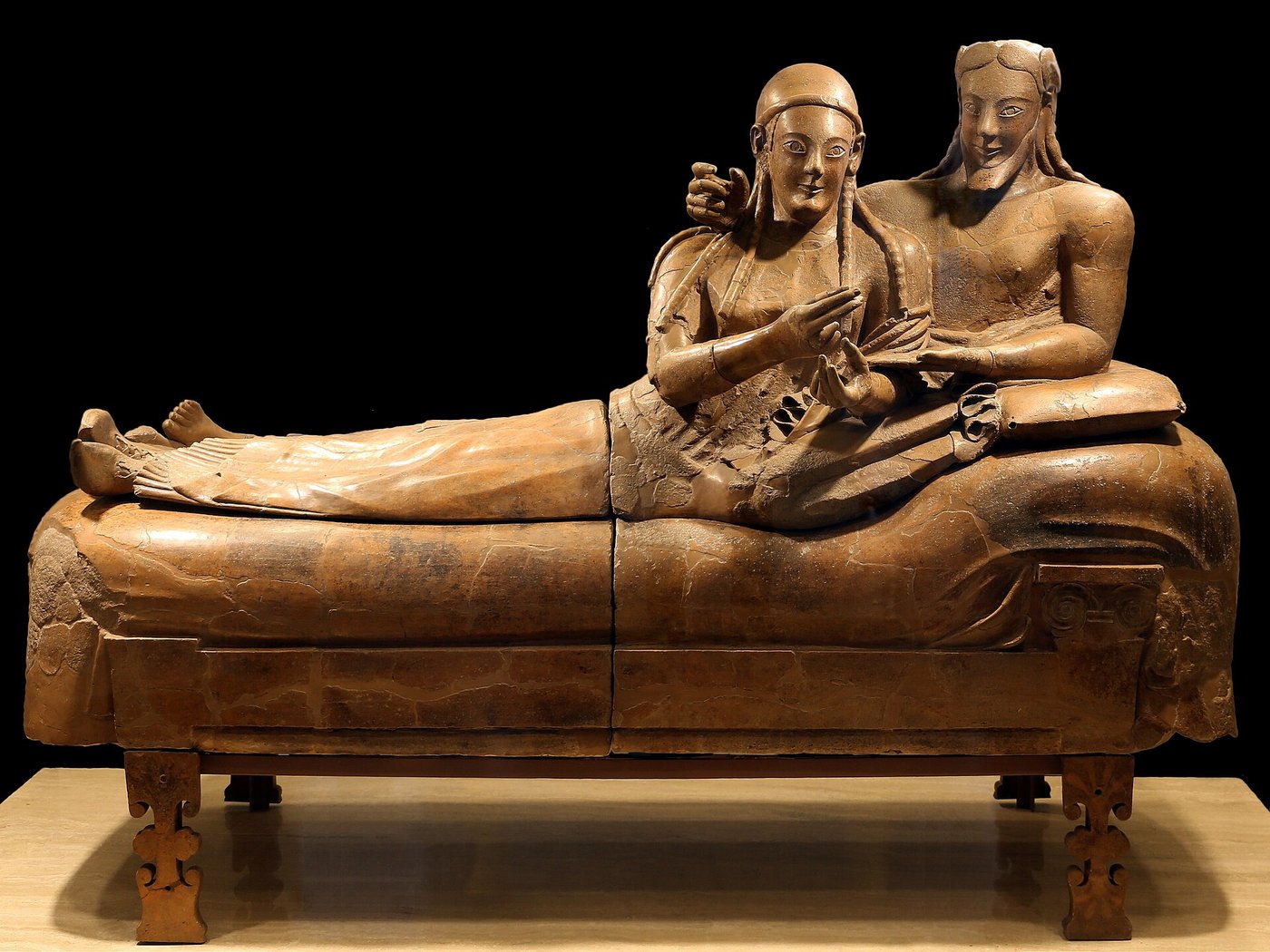
What struck Greek and Roman observers was not the party but who was at it. Etruscan women reclined at banquets alongside men, in public, as equals. In Greece, respectable women did not attend symposia at all; the women present were entertainers or courtesans. Etruscan women owned property, appear in inscriptions with their own family names as well as their husbands', and are shown on tomb paintings and sarcophagi with a physical closeness to their husbands that Greek and Roman art almost never permits. The Sarcophagus of the Spouses, made at Cerveteri around 520 BC, shows a man and a woman lying together on a couch, her hand raised as if in the middle of speaking, his arm around her shoulders. It is a portrait of a marriage, not a monument to a man.
Greek writers found this shocking and said so at length. The historian Theopompus, writing in the fourth century BC, produced a description of Etruscan morals so lurid that scholars have spent centuries debating how much of it is observation and how much is propaganda aimed at a commercial rival. The likely answer is that he saw women behaving with a freedom he did not recognise and reached for the worst explanation available.
"Sharing wives is an established Etruscan custom... they dine not with their own husbands, but with any men who happen to be present."— Theopompus of Chios, 4th century BC, preserved in Athenaeus, Deipnosophistae XII
Metal, ships and the wealth beneath the hills
Etruscan prosperity had a straightforward physical basis: they were sitting on the best metal deposits in Italy. The Colline Metallifere of Tuscany and the island of Elba held copper, tin, silver and enormous quantities of iron. Populonia, on the coast opposite Elba, became a smelting town on such a scale that the slag heaps around it were still worth reprocessing during the twentieth century.
That metal bought everything else. Etruscan ships carried it out and brought Greek pottery, Phoenician glass, Egyptian faience and Baltic amber back in. So much fine Athenian painted pottery was traded into Etruria that a large share of the Greek vases in the world's museums was in fact dug out of Etruscan tombs. One odd consequence is that our knowledge of Greek vase painting depends heavily on Etruscan burial habits.
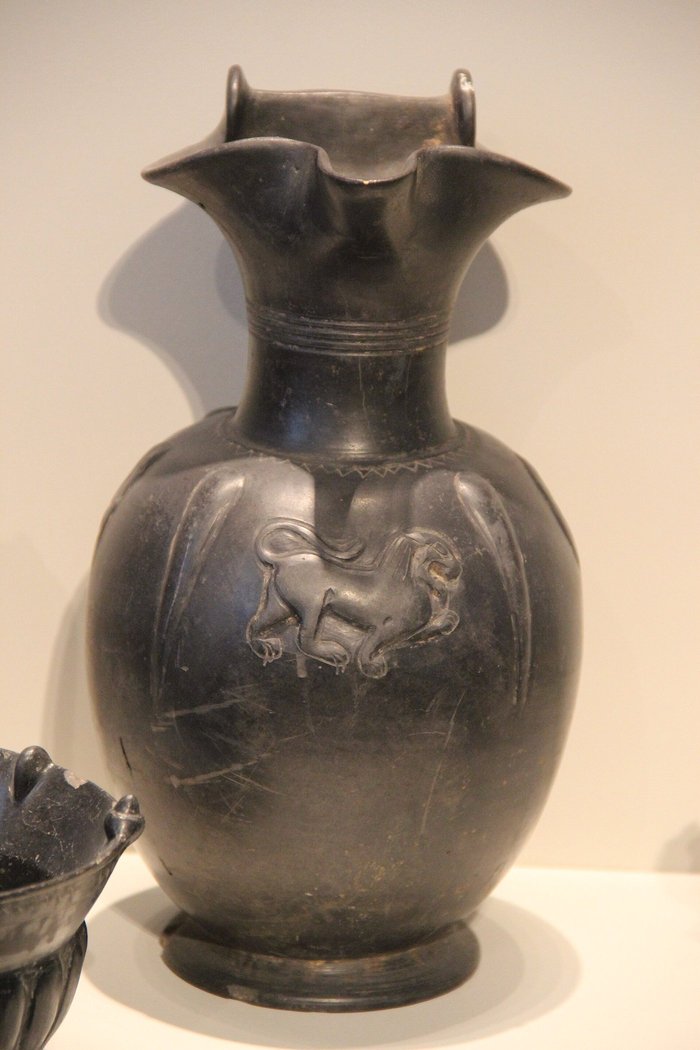
They made their own distinctive ware too. Bucchero is a glossy black pottery, fired in a low-oxygen kiln so that the clay turns dark all the way through, then burnished until it shines like metal, which was rather the point, since the shapes copy expensive bronze vessels. The earliest bucchero is astonishingly thin-walled, some of it barely a few millimetres thick. A bucchero cup and a small Greek oil flask were among the objects found in the second sealed tomb at San Giuliano, opened in 2026 a few feet from the first.
A language nobody can properly read
This is what frustrates everyone. We can read Etruscan. The alphabet is Greek-derived and was deciphered long ago; anyone who learns the letter forms can sound out an inscription aloud. What we largely cannot do is understand it.
The problem is that Etruscan has no living relatives. With Latin or Sanskrit, an unfamiliar word can be cracked by comparing it to cousins in other Indo-European languages. Etruscan offers no such help. Its only known relatives are two poorly attested tongues, Rhaetic in the Alps and Lemnian on a Greek island, which are themselves barely understood. So scholars have had to work outwards from context, and the context is almost entirely funerary. We have roughly 13,000 Etruscan inscriptions, and the overwhelming majority are short tomb labels: a name, a father's name, a mother's name, an age at death, an office held. We know the words for son, daughter, wife, year, and a long list of magistracies. We are much shakier on verbs, and on anything anyone actually said.
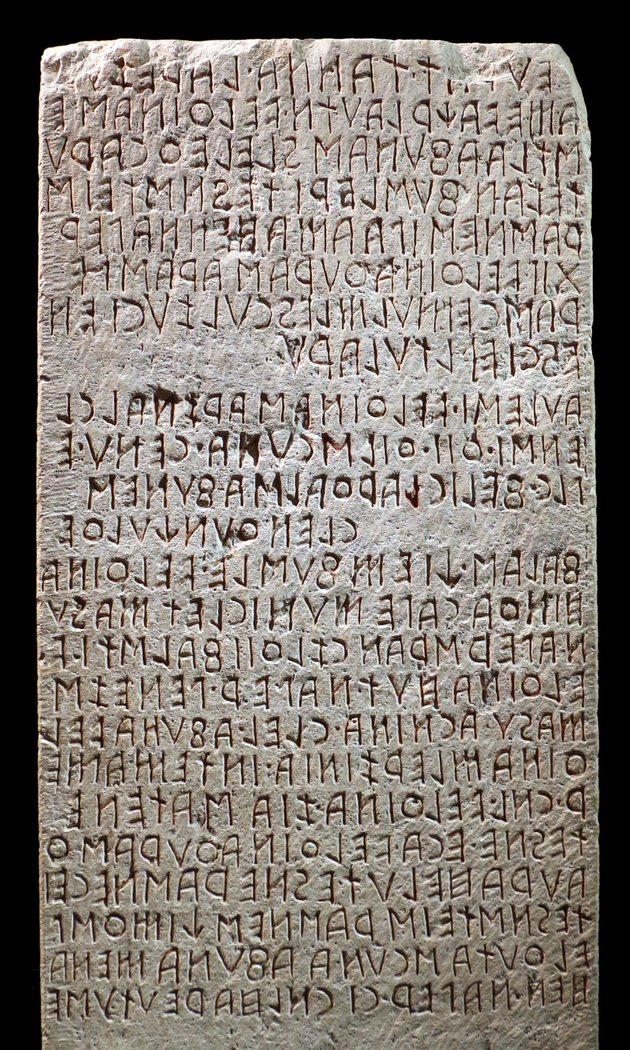
Two finds have done most of the heavy lifting. In 1964, three gold tablets were excavated at the port sanctuary of Pyrgi, two in Etruscan and one in Phoenician, recording a dedication by a ruler of Caere. They are not a perfect translation of each other, but they gave scholars a rare bilingual foothold. The other is the strangest object in the field: the Liber Linteus, a linen ritual calendar of some 1,200 words, which survived because an Egyptian mummy in Croatia turned out to be wrapped in it. Beyond those, the longest single Etruscan text is the Cippus Perusinus, a stone boundary marker from Perugia with 46 lines recording what appears to be a land agreement between two families. It is the closest thing we have to an Etruscan legal document.
What Rome took
Rome's own historians were oddly candid about this. Three of the seven legendary kings of Rome were Etruscan (Tarquinius Priscus, Servius Tullius and Tarquinius Superbus), and Roman tradition credited the Tarquins with building the city's first great drain, the Cloaca Maxima, and the temple of Jupiter on the Capitoline. An Etruscan account preserved in a painting from the François Tomb at Vulci tells a rather different version of the same period, in which a figure called Macstrna, generally identified with Servius Tullius, arrives in Rome as a warlord with his own war band.
The borrowings run deep and are mostly invisible now because Rome kept them so thoroughly. The toga began as the Etruscan tebenna. The fasces (the bundle of rods around an axe carried before Roman magistrates, and later the emblem that gave fascism its name) turns up as an actual iron object in a seventh-century tomb at Vetulonia, centuries before Rome used it. Roman numerals are Etruscan in origin. So is the atrium house, the arch used structurally on a large scale, and much of the machinery of Roman religion.
That last one is worth pausing on. Roman state religion ran on divination, and the specialists who read the will of the gods in the livers of sacrificed animals, the haruspices, were an explicitly Etruscan profession that the Romans imported wholesale and never replaced. A bronze model of a sheep's liver found near Piacenza, divided into forty regions each inscribed with a god's name, was a training tool for exactly this. Even at the height of the empire, when a lightning strike needed interpreting, the Senate sent for Etruscans.
How much did Rome owe Etruria? One school sees early Rome as effectively an Etruscan city for a century: ruled by Etruscan kings, laid out on Etruscan lines, culturally a junior partner. Another argues that Rome was always Latin, and that shared features reflect a common central-Italian culture in which ideas moved in every direction, not a one-way transfer. The archaeology of sixth-century Rome shows a city built with Etruscan techniques and craftsmen, which supports the first view; the language, the core institutions and the burial customs stayed stubbornly Latin, which supports the second.
How a civilisation disappears
The end came in pieces, and it took three centuries. The first blow was naval: in 474 BC a combined Greek fleet from Syracuse and Cumae destroyed Etruscan sea power in a battle off Cumae, closing the southern trade routes. Then came Rome. In 396 BC, after a siege that Roman tradition stretched into a ten-year epic to echo Troy, Veii fell. It was the nearest Etruscan city, barely sixteen kilometres from Rome, and one of the largest. Its population was sold into slavery and its territory annexed. City after city followed over the next century, some conquered, some signing treaties that made them Roman allies.
The final stage was not violent at all, which is why it worked. After the Social War of 91–88 BC, the Italian allies were granted full Roman citizenship. Etruscans became Romans by law. Their aristocracy had already been marrying into Roman families for generations; now their sons went into the Senate, their business went through Roman courts, and their children learned Latin because that was the language of everything worth doing. Within two or three generations, Etruscan had stopped being spoken. The last dated inscription is from around the first century AD.
The emperor Claudius saw it happening and tried to intervene. He married an Etruscan noblewoman, Plautia Urgulanilla, learned the language, and wrote a history of the Etruscans in twenty volumes, the Tyrrhenika, which he reportedly had read aloud annually in a museum he founded for the purpose. Not a single line of it survives. Had it come down to us, we would probably be able to read Etruscan today. It is the single most painful loss in the whole subject.
Why a sealed room matters
Which brings us back to San Giuliano. It is easy to see why an untouched chamber causes such excitement, and it is not really about the objects themselves. Museums are full of Etruscan pots and bronzes. What they are almost never full of is context.
Looting does more than steal things. It destroys relationships: which pot stood next to which body, which weapon lay at whose feet, whether the silver hair spools belonged to the woman on the left or the right. Those relationships are the evidence. They tell you about status, gender, family structure and belief in a way that an isolated vase behind glass never can. At San Giuliano the excavators found textile fibres still clinging to a bronze cloak pin, which means someone can now say something about Etruscan cloth. The four bodies, provisionally read as two male–female pairs, are going for isotopic and genetic analysis, which will say where they grew up and whether they were related. Almost none of the six hundred other tombs on that plateau can answer a single one of those questions.
There is a wider point here about how history gets lost. The Etruscans were not destroyed by a volcano or a plague or a sack. They were absorbed, and then they were edited. The people who wrote the surviving accounts of them were Romans and Greeks who had beaten them commercially and militarily, and who described them accordingly: decadent, obsessed with omens, morally suspect, faintly ridiculous. The Etruscans' own version (their histories, their poetry, their religious books, Claudius's twenty volumes) is gone. What survives is what they put in the ground and forgot to explain, which is why a single door that nobody managed to force open is worth a decade of digging elsewhere.
Read next: Vix: The Celtic Grave That Held Antiquity's Largest Bronze Vessel and The Sea Peoples: How Bronze Age Refugees Became History's Villains.
Sources & further reading
- Posth, C. et al., "The origin and legacy of the Etruscans through a 2000-year archeogenomic time transect," Science Advances, vol. 7, no. 39 (2021).
- Baylor University, "Rare Intact Etruscan Tomb in Italy Discovered by International Baylor-led Archaeological Research Team," Baylor Media and Public Relations (2025) — reporting on the San Giuliano Archaeological Research Project directed by Davide Zori.
- Haynes, S., Etruscan Civilization: A Cultural History, J. Paul Getty Museum (2000).
- Barker, G. and Rasmussen, T., The Etruscans, Blackwell (1998).
- Wallace, R., Zikh Rasna: A Manual of the Etruscan Language and Inscriptions, Beech Stave Press (2008).
Image credits (via Wikimedia Commons): Sarcophagus of the Spouses, Villa Giulia — Sailko (CC BY-SA 4.0); Banditaccia necropolis tumulus, Cerveteri — AlMare (public domain); musicians from the Tomb of the Leopards, Tarquinia — unknown author (public domain); Etruscan bucchero jug — Gary Todd (CC0); Cippus Perusinus — Sailko (CC BY-SA 4.0).