In the last week of March 1974, in a village called Xiyang east of Xi’an, a group of farmers went looking for water. The spring had been dry and the fields were cracking, so six men from the Yang clan started sinking a well in a stretch of scrub near the foot of a low hill. About four metres down, one of them, a man named Yang Zhifa, drove his spade into something that was not soil and not rock. He brought up a piece of hard baked clay shaped like a human head. The men were unnerved. Some thought it was an old kiln god and wanted to leave it. Instead they kept digging, and turned up shards of a body, bronze arrowheads green with age, and fragments of brick. They had not found water. They had opened the roof of a pit that held an entire army, standing in the dark exactly where it had been left for more than two thousand years.
What lay under the field was the guard of the First Emperor of China, Qin Shi Huang, who unified the warring states in 221 BCE and died eleven years later. Nobody had known the army was there. It appears in no map and, oddly, in no history: the great chronicler who described the emperor’s tomb in detail never mentions the thousands of clay soldiers buried a mile and a half from it. Fifty years of digging since have turned the site into one of the largest archaeological projects on Earth, and it keeps producing surprises. The strangest is not that the faces all look different. It is how they were made to look different.
The farmers were not treasure hunters. They were digging for irrigation water in a bad drought, and they kept going for days, hauling up broken figures and bronze without knowing what they were. Word reached a local official, then an archaeologist, Zhao Kangmin, who began piecing the fragments back together. Test trenches soon showed the pit ran on and on. The single hole meant to save a harvest had clipped the corner of a buried formation of roughly six thousand life-size soldiers, and it was only the first of several pits.
Ranks in the dark
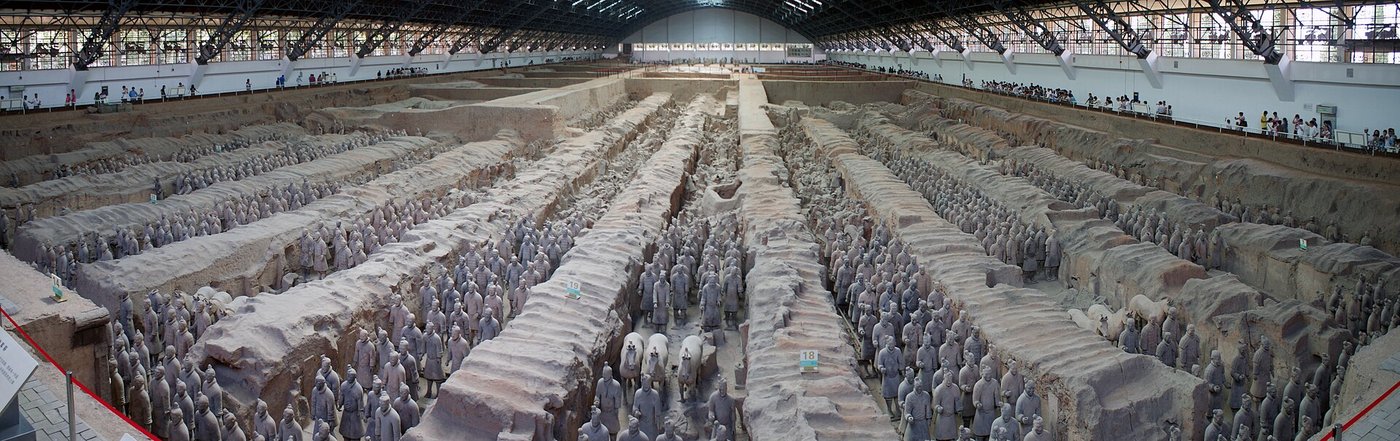
The soldiers stand in long parallel corridors dug into the loess, floored with brick and once roofed with timber and matting before the earth was heaped back over them. Archaeologists number the main pits one to four. Pit 1 is the giant: a rectangular hall the size of a football field and more, holding the massed infantry in their marching columns, perhaps six thousand figures in all, with the front ranks unarmoured and the men behind in plated tunics. Pit 2 is smaller and far more interesting to a soldier: a mixed force of kneeling and standing crossbowmen, cavalry with their horses, and war chariots, the combined arms of a real Qin battle line. Pit 3 is tiny by comparison and holds no fighting formation at all: a cluster of high-ranking figures around a chariot, which everyone reads as the command post. Pit 4 was found empty, a hole that was dug and never filled: work interrupted, perhaps, when the dynasty fell.
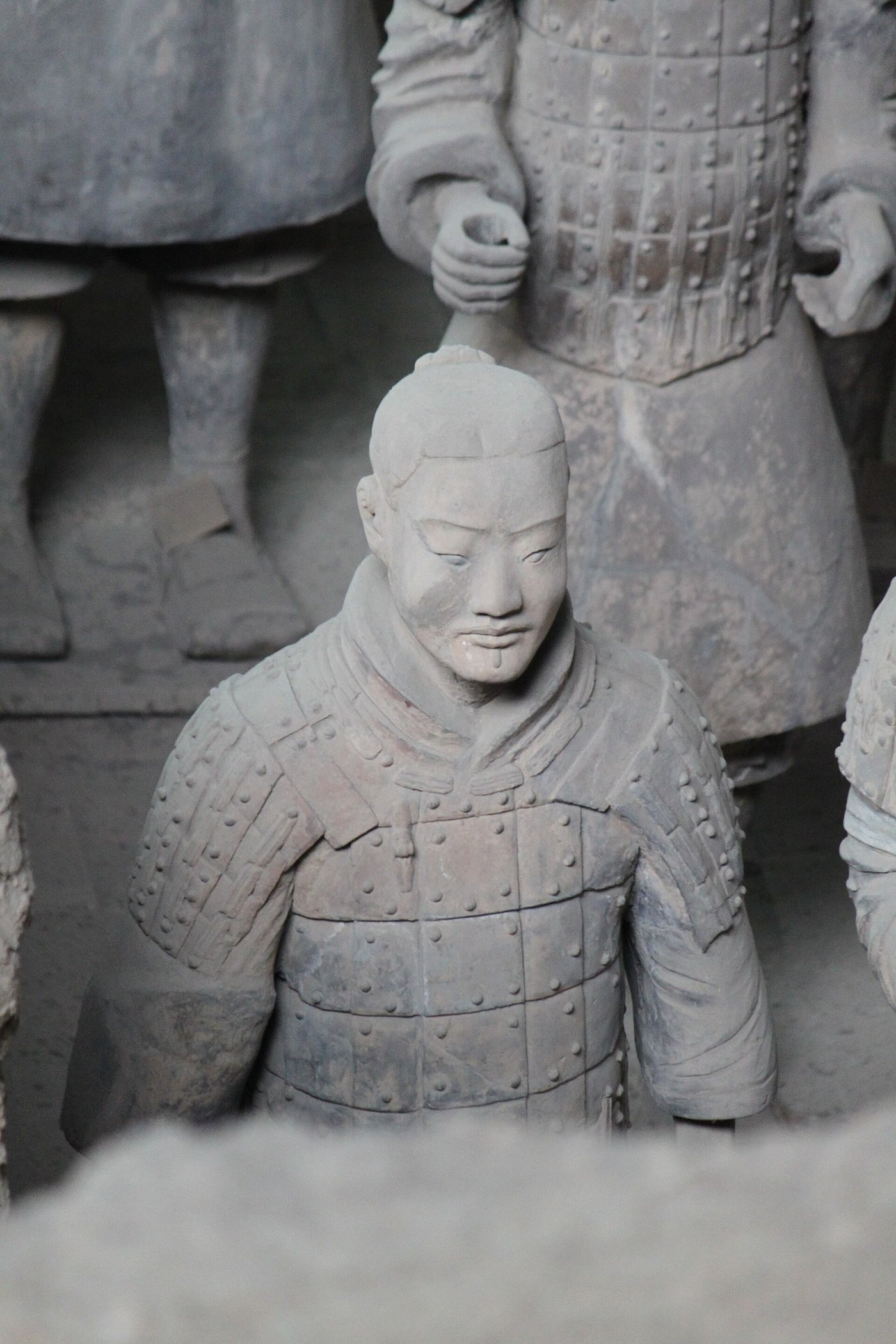
Count everything the pits are thought to contain and the numbers stop feeling human: something like 8,000 soldiers, more than 130 chariots, around 520 chariot horses and 150 cavalry mounts, most still buried and unexcavated. Each figure stands between about 1.7 and two metres tall, the officers deliberately made taller than the men. They were never meant to be seen. This was a full-sized army sealed underground to serve a dead king in whatever came next: a substitute, some argue, for the far older and bloodier practice of burying living retainers with a ruler.
And here is the thing that stops visitors in the aisles above Pit 1: no two of the faces are the same. Broad faces and narrow ones, thin lips and full, high cheekbones, jug ears, the beginnings of a paunch under the armour of an older man. You stand over eight thousand strangers. It looks, at first, like the most patient piece of portrait sculpture in the ancient world.
The army that came off a production line
It is not. Look closer at the bodies and the illusion starts to come apart in a much more interesting way. The legs of the standing soldiers are solid clay pillars, and they repeat. The torsos come in a small number of basic types. The arms were made separately and fitted on. Hands were turned out in a handful of standard shapes, left open or curled to hold a shaft. What looks like eight thousand individual sculptures is really a vast set of standard parts, made in bulk and combined.
The art historian Lothar Ledderose gave this its clearest description: the Terracotta Army is a masterpiece of the module. A workshop did not carve a soldier. It produced legs, torsos, arms, hands and heads as separate components, in moulds and standard patterns, then assembled them like a kit. Even the heads, which carry all the apparent individuality, began as castings from a limited set of moulds; scholars have argued for around eight basic face templates. The trick is what happened next. Once a head was pulled from its mould and joined to a body, a craftsman worked it over by hand: pinching on ears, adding a moustache or a beard, cutting the lines of the brow, building up a topknot or a flat cap, shaping the individual set of the mouth. A limited number of parts, finished by hand in endless small variations, produces the impression of a crowd of individuals. It is the same logic that would later stamp out bronze vessels and printed characters by the thousand. The Qin workshops simply did it at life size, in clay, for an audience of no one.
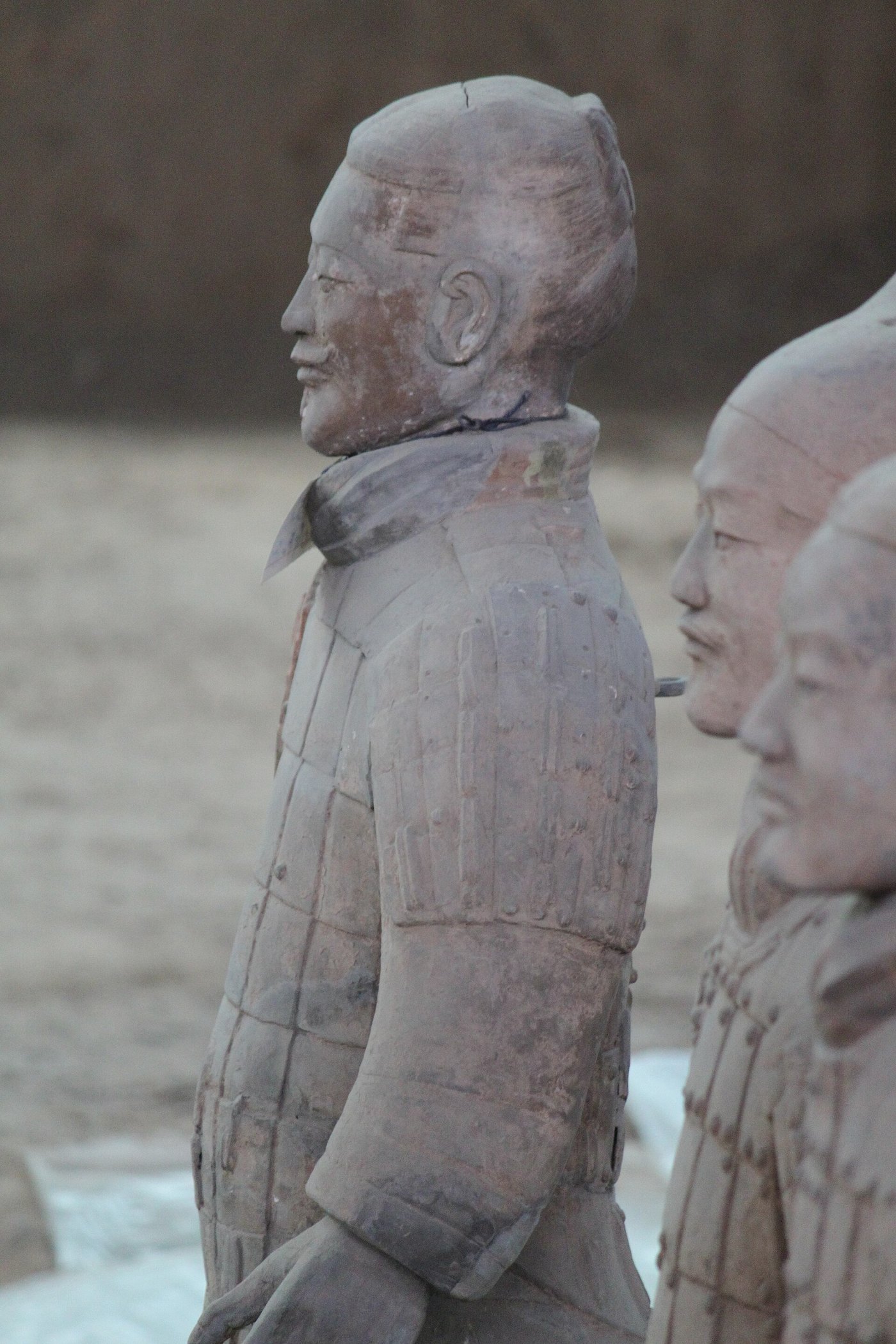
The workshops even signed their work, after a fashion. Inscribed on many figures, often hidden under an arm or inside a robe, are small stamped or incised marks: the names of foremen, and in some cases of state factories and their overseers. More than eighty individual names of master craftsmen have been read off the army. This was quality control by accountability, a Qin habit known from the law codes, where the maker’s name on a product meant the maker answered for its faults. An army of clay was run like a state arsenal, because that is more or less what it was.
“Each warrior is a portrait of a real soldier in the emperor’s army, modelled from life, which is why every face is unique.”
The faces are individualised, but they are not portraits. Bodies and heads were built from a small stock of standard, mould-made parts and then customised by hand. There is no evidence that eight thousand named guardsmen sat for eight thousand sittings. The uniqueness is a finishing technique laid over industrial mass production, which, if anything, is the more remarkable achievement.
They were never grey
The colour of the Terracotta Army, in every photograph you have ever seen, is a lie of preservation. The soldiers we look at are the bare grey and brown of fired clay. The soldiers the Qin buried were painted from head to foot in loud, saturated colour: red and green tunics, blue and purple trousers, lilac and pink and white, black hair and boots, faces given a flesh tone with dark eyes and hair picked out. Among the pigments is one that has become famous in its own right: a synthetic barium copper silicate known as Han purple, a colour the Qin and Han workshops manufactured through a difficult, high-temperature process, with no natural mineral source. These were not muted earth tones. A freshly finished rank would have been almost gaudy.
So why is it gone? The paint sits on a ground layer of East Asian lacquer, the sap of the lacquer tree, brushed onto the fired figure in one or two thin coats. That lacquer survived two millennia underground because the pit stayed at a stable, high humidity. The moment a figure is dug out into the dry air of Shaanxi, the lacquer begins to lose water, shrink and curl, and as it lifts, it takes the colour with it. In the early excavations, painted surfaces flaked and fell within a few minutes of exposure, and were lost before anyone could save them. The grey army is, in part, an accident of chemistry: we are looking at the undercoat because the topcoat could not survive being seen.
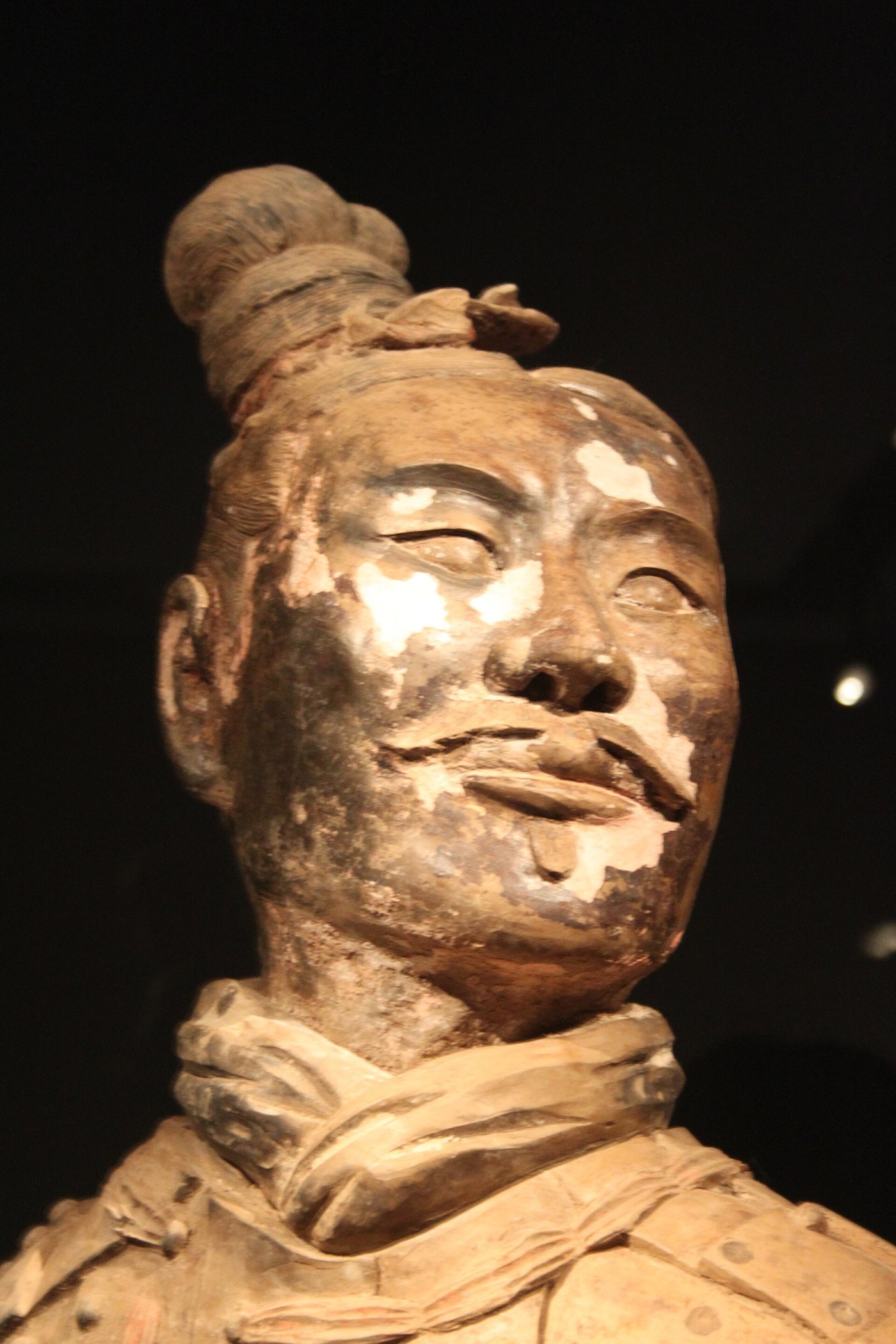
The fix, worked out over years by Chinese and German conservators, is unglamorous and effective. As a painted figure emerges it is kept damp, sprayed with agents that hold moisture and then stiffen the lacquer so it grips the clay again, and wrapped to control how fast it dries. It is slow, careful, expensive work, and it is one reason the digging is deliberately patient. There is no rush to haul the whole army into the light when the light itself is what destroys the colour.
Forty thousand blades
Buried with the clay soldiers was a real arsenal. The pits have yielded on the order of 40,000 bronze weapons: arrowheads by the tens of thousands, along with crossbow triggers, spears, halberds, dagger-axes and swords. These are not models. They are working weapons, and the metalwork is exact. The bronze crossbow triggers, delicate mechanisms of interlocking parts, are made to such consistent measurements that pieces from different triggers can be swapped: interchangeable parts, in the third century BCE, turned out to a tolerance that would not look out of place in a much later factory. The arrowheads were cast in standard patterns from moulds; the whole production ran on the same modular thinking as the men who were to fire them.
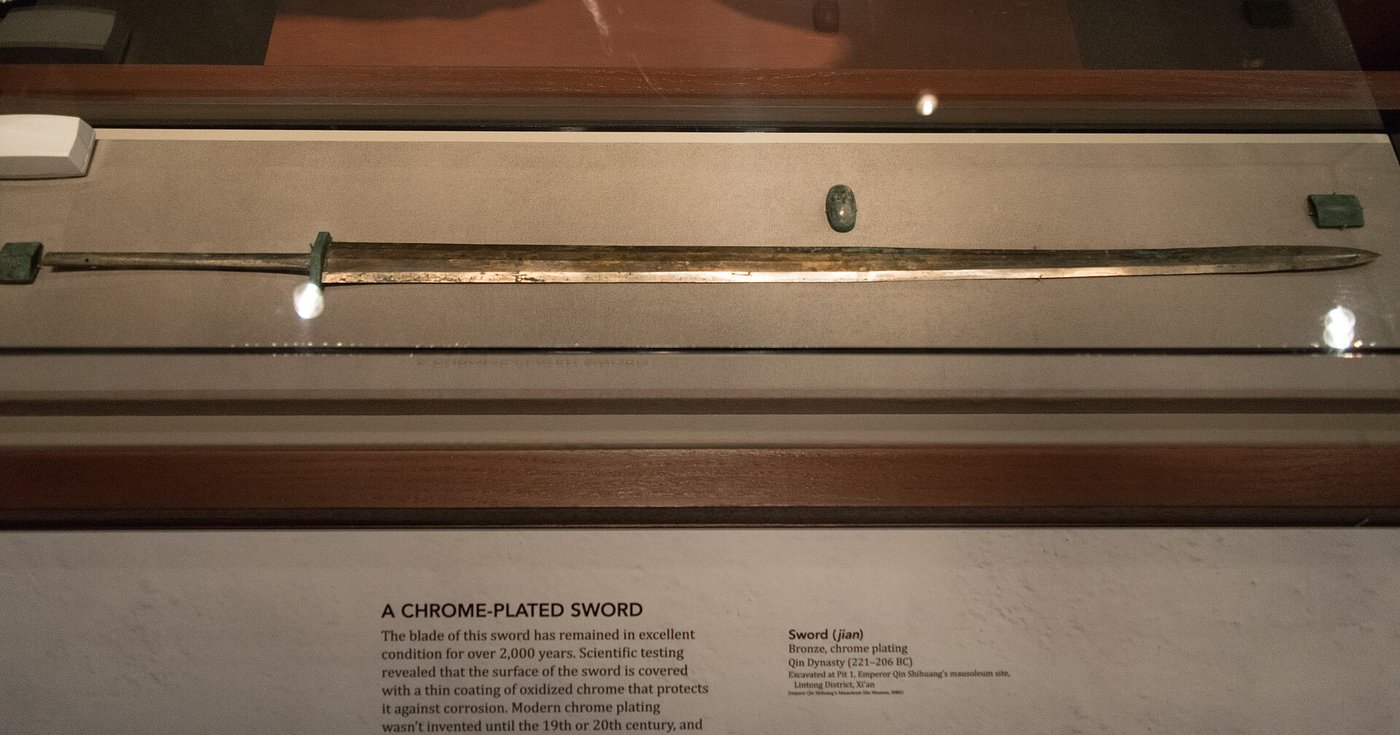
Some of the blades came out of the ground still bright and sharp, which produced one of the site’s most repeated claims: that the Qin had chromium-plated their weapons to stop them rusting, an anti-corrosion technique the modern world did not patent until the twentieth century. Traces of chromium really are present on the metal, so the story had a hook to hang on. But when a team tested hundreds of weapons in 2019, the tidy version fell apart.
“The Qin deliberately chrome-plated their bronze weapons two thousand years before anyone else, which is why the blades never rusted.”
Chromium turned up on only a minority of the weapons examined, and it clustered exactly where the metal had lain against lacquered wood or bamboo: scabbards, shafts and bindings. The lacquer is rich in chromium; the “plating” is contamination that leached onto the bronze after burial, not an ancient surface treatment. The real reason many blades stayed sound is more mundane: a tin-rich bronze alloy resting in the fine, mildly alkaline soil of the pits.
The mountain no one will open
The army is only the outer guard. Rise out of the pits, look west across the fields, and you see a broad, flat-topped hill green with trees. That is not a natural hill. It is the burial mound of Qin Shi Huang himself, raised over a tomb that has never been opened. Around it, decades of survey have mapped a walled funerary city several kilometres across, dotted with hundreds of smaller pits holding bronze waterbirds, stone armour, acrobats, officials and stabled horses: a whole court and country modelled underground. The clay soldiers guard its eastern approach. The centre, the tomb chamber itself, is still sealed.
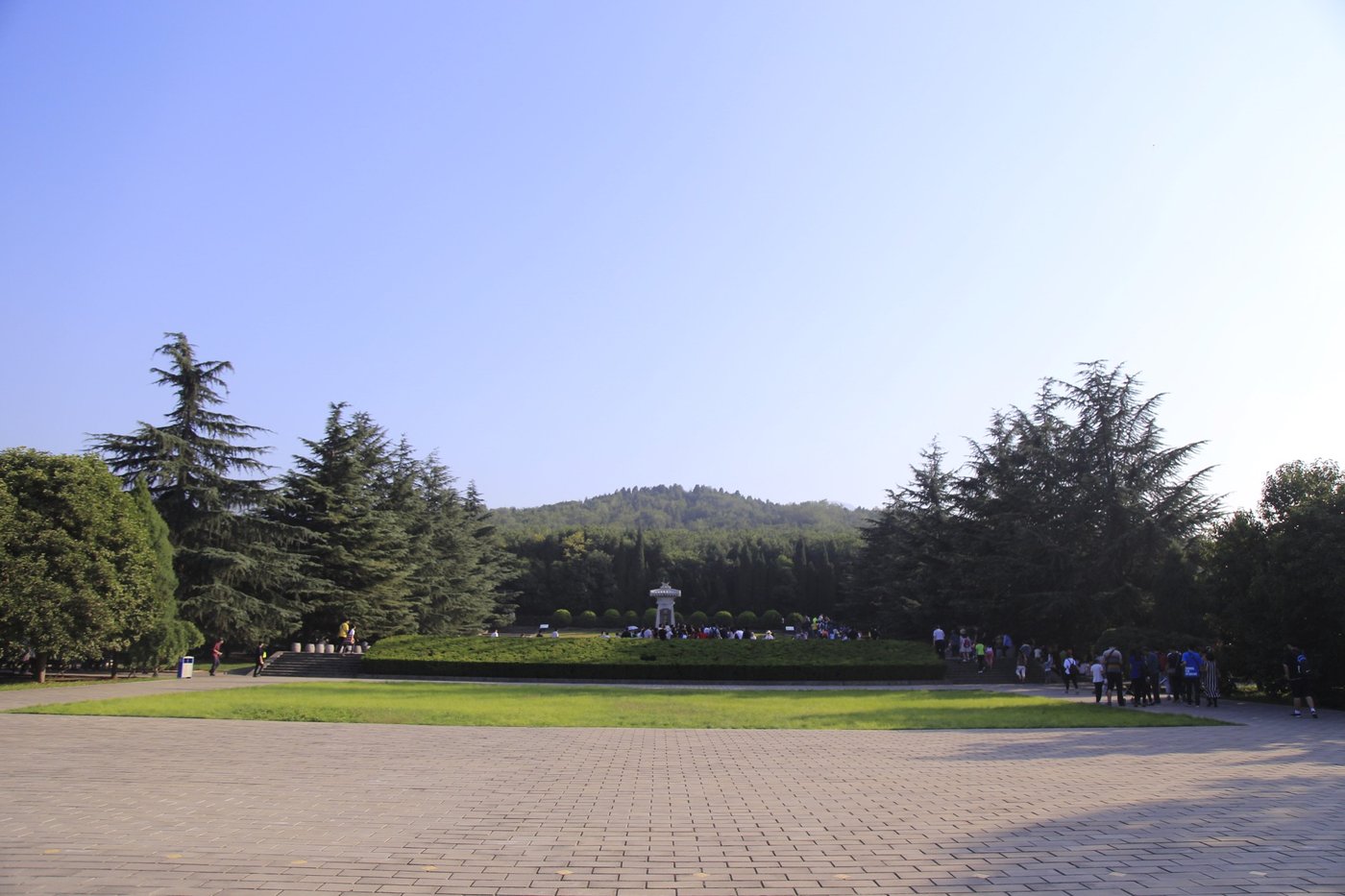
We do have a description of what is supposed to be inside. Sima Qian, writing about a century after the emperor died, records that the tomb was built by hundreds of thousands of conscripts, its ceiling set with the heavenly bodies, its floor laid out as a map of the empire, with the hundred rivers of China, the Yangtze and the Yellow River and the sea, reproduced in flowing mercury, kept moving by some hidden mechanism. For a long time this read like court legend. Then surveyors ran soil tests over the mound and found mercury: concentrations far above the local background, and, tellingly, distributed unevenly in a pattern that some read as echoing the geography of China. The rivers of quicksilver may be real. That single fact changes the character of the whole problem.
The case against digging is not superstition. A sealed chamber that has held its atmosphere for over two thousand years would almost certainly destroy its own contents on contact with air; the painted army already showed how fast that can happen. Add a possible reservoir of toxic mercury vapour, an unexcavated structure no one fully understands, and the plain fact that archaeology is destruction, and the argument for waiting becomes strong. The official position in China is to leave the tomb closed until the science exists to open it without ruining it. It may stay shut for another generation, or longer.
The general in the dark
Fifty years on, the site is nowhere near finished giving up its ranks. The digging in Pit 2 (the mixed formation with the cavalry and crossbows) has run for years and still turns up figures with their colour clinging on, protected now the moment they are found. In the last couple of years the excavators there reached something they had waited decades for: a senior commander, a general, marked out by his elaborate headgear, his layered armour tied with ribbon knots, and his hands folded in front of him in the posture of rank. Only around a dozen such high-ranking figures have ever been found across the whole army. Each one is a small event, because in a force of eight thousand the officers are rare, and rarity is how the Qin sculptors signalled who mattered.
What keeps the Terracotta Army interesting is not that it is old or vast, though it is both. It is that it refuses to be one simple thing. It looks like portraiture and turns out to be mass production. It looks grey and was once violently coloured. Its weapons carry a modern-sounding secret that dissolves under a proper test. And its emperor still lies a mile away under a mercury-veined hill that the best archaeologists in the world have decided, for now, they are not ready to disturb. The farmers who were only looking for water opened a door into all of that, and most of what is on the other side is still standing in the dark, waiting.
Read next: Daisen Kofun: Japan's Largest Tomb, Sealed Even to Its Archaeologists and Sanxingdui: The Bronze Masks With Eyes on Stalks.
Sources & further reading
- Lothar Ledderose, Ten Thousand Things: Module and Mass Production in Chinese Art (Princeton University Press, 2000), the chapter on the terracotta army and modular manufacture.
- Museum of the Terracotta Army / Emperor Qinshihuang’s Mausoleum Site Museum, Lintong, Xi’an — excavation reports on Pits 1, 2 and 3 and the ongoing Pit 2 work.
- M. Martinón-Torres and colleagues, “Surface chromium on Terracotta Army bronze weapons is neither an ancient anti-rust treatment nor the reason for their good preservation,” Scientific Reports (2019).
- P. Quinn and colleagues, geochemical study of the manufacture and supply chain of the terracotta figures, Archaeometry (2021).
- Sima Qian, Records of the Grand Historian (Shiji), the account of the First Emperor’s tomb, its mercury rivers and its construction.
- Reports on soil-mercury surveys of the Qin Shi Huang mausoleum mound, on the anomalous mercury readings above the burial chamber.
Image credits (via Wikimedia Commons): Pit 1 of the Terracotta Army — Walter-Wilhelm (CC BY 2.0); standing infantryman, warrior heads in profile, and the painted archer’s head — Gary Lee Todd (CC0); bronze sword from Pit 1 — “Difference engine” (CC BY-SA 4.0); the burial mound of Qin Shi Huang — Legolas1024 (CC BY-SA 4.0).