In the summer of 1986, two men digging clay for a brick kiln outside the town of Guanghan, in the west of Sichuan, put a spade through the lid of something they were not looking for. Under the paddy soil lay a pit packed with broken jade, charred elephant tusk and green bronze, with dozens of faces staring up out of the ground. The workers had been making bricks. What they had opened was a hole that a lost people had filled, on purpose, more than three thousand years before, with the smashed and burned bodies of their gods.
The place is called Sanxingdui, the "three star mounds", after three low rises that once stood on the plain beside a small river. For most of the twentieth century it was a footnote: a scatter of jade turned up by a farmer, a name known to a handful of Chinese archaeologists. Then the brickyard pits were emptied, and a civilisation nobody had a name for walked out of the earth. It made things no other Bronze Age culture in China made. It left no writing to explain any of it. And at some point its people took their most precious objects, broke them, set them alight, and buried them where they were never meant to be found again.
A farmer, a well, and a slab of jade
The first clue surfaced in 1929. A farmer named Yan Daocheng was clearing a ditch beside his house near Guanghan when his hoe struck a cache of polished jade discs and blades, buried in a neat pile. The stones were beautiful and clearly old, and they drifted onto the antiquities market, where they caught the eye of collectors and, eventually, of scholars. A local museum and a visiting archaeologist ran small digs in the following years. They found enough to know that something ancient sat under these fields, but not enough to say what.
War, revolution and decades of other priorities pushed the site down the list. Work picked up again in the 1950s and 1960s, then in earnest from the 1980s, and a picture slowly formed. Sanxingdui was not a village or a shrine. It was a city: a walled one, covering more than three square kilometres, with rammed-earth ramparts, house floors, workshops and a river running past. In its day, around 1600 to 1100 BC, it was one of the largest settlements anywhere in East Asia. The three "star mounds" that gave the site its name turned out to be the eroded stumps of one of those great earthen walls.
This was already a problem for the textbooks. The old story of early China put civilisation on the Yellow River, in the north, among the Shang kings whose oracle bones and bronze cauldrons defined what a Chinese Bronze Age was supposed to look like. Sichuan, tucked behind mountains to the south-west, was meant to be a backwater on the edge of that world. Sanxingdui said otherwise. Here was a wealthy, organised, city-building society, contemporary with the Shang, that owed the north its bronze-casting know-how and almost nothing else.
Two pits under the brickworks
Everything changed in 1986. That summer, the brickyard workers hit the first pit; a rescue excavation was thrown together, and within weeks a second pit came to light a few metres away. What came out of the two holes did not fit anything in the Chinese record, or any other.
The pits were crammed. There were hundreds of objects: bronze heads with sharp cheekbones and blank, staring eyes; bronze masks far too large for any human face; jade blades and discs; gold; and a tangle of elephant tusks, more than sixty of them, laid over the top like a final covering. Almost everything had been damaged before it went in. Bronzes were bent and broken. Many pieces bore scorch marks. The tusks were charred. Whoever filled these pits had not been hiding treasure in a hurry. They had staged something, breaking and burning the objects first, then packing them down in careful layers and sealing the earth over the top.
And the objects themselves were like nothing else. The Shang up north cast magnificent ritual vessels, but they did not make giant human figures, and they did not make masks. Sanxingdui made both, at a scale and in a style that had no parallel and no obvious ancestor. The people who dug the pits in 1986 were looking at the art of a culture that had, until that morning, been completely unknown.
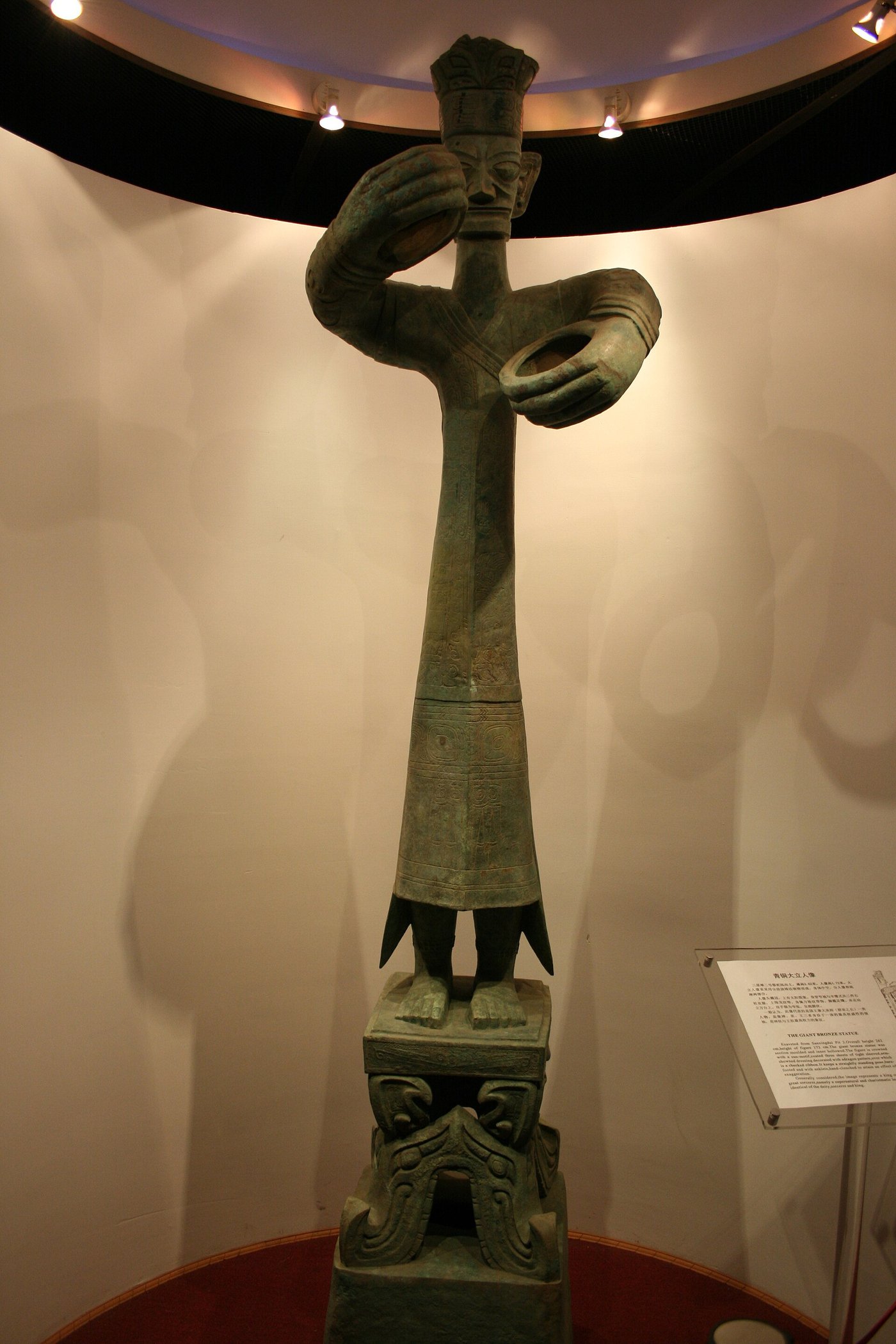
The strangest single object was a man. A bronze figure, cast standing barefoot on a decorated pedestal, stares out over the heads of everyone who comes to see him. He is more than two and a half metres tall counting his base, robed in patterned bronze, and his hands are the oddest thing about him: vast, ringed, curled into circles far too big for the arms, held one above the other as if once gripping a shaft or a tusk that has long since gone. Nobody knows who he is meant to be. A king, a priest, a god, the offering itself. He is the tallest surviving bronze figure of a human being from anywhere in the ancient world.
Faces that are not Chinese faces
Line up the bronze heads from Sanxingdui and the first thing you notice is that they do not look like the people who made the Shang bronzes, or like any real face at all. The jaws are square and heavy. The noses are straight blades. The eyes are almond-shaped and pushed to slits or held wide, the eyebrows drawn up in high arcs. Many of the heads have flat-cut necks, meant to be slotted onto bodies of wood or some other material that rotted away. Several once wore gold: thin foil, beaten and glued over the bronze so the face gleamed.
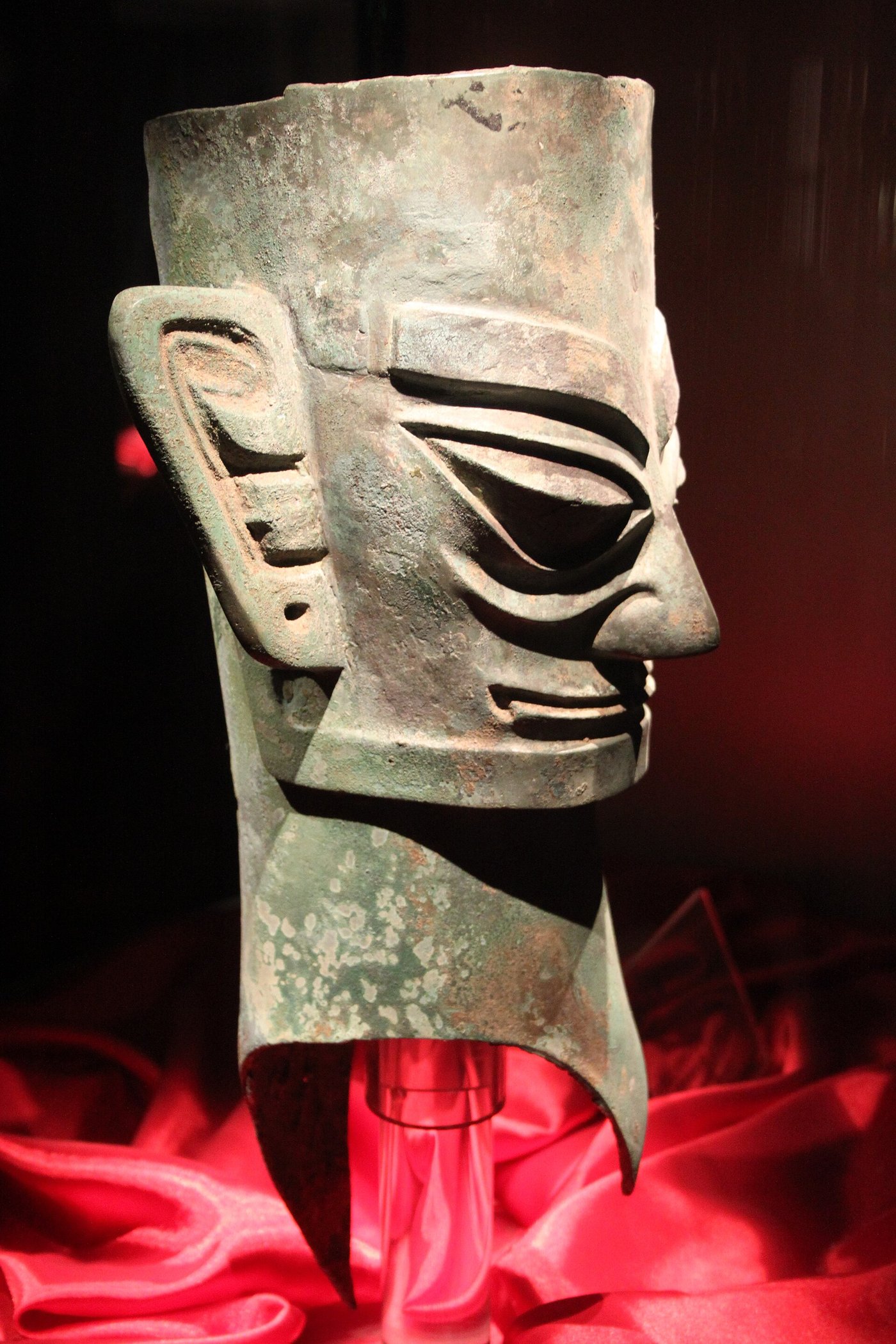
These are not portraits. They are a type: the same otherworldly face repeated, with small changes, across dozens of heads and masks. That repetition matters. It tells you the look was deliberate, a chosen way of showing something more than human, rather than an attempt to record real people. The Sanxingdui bronzeworkers had the skill to cast anything they wanted. What they wanted, again and again, was this face: severe, symmetrical, and staring.
Then there are the eyes.
Eyes on stalks
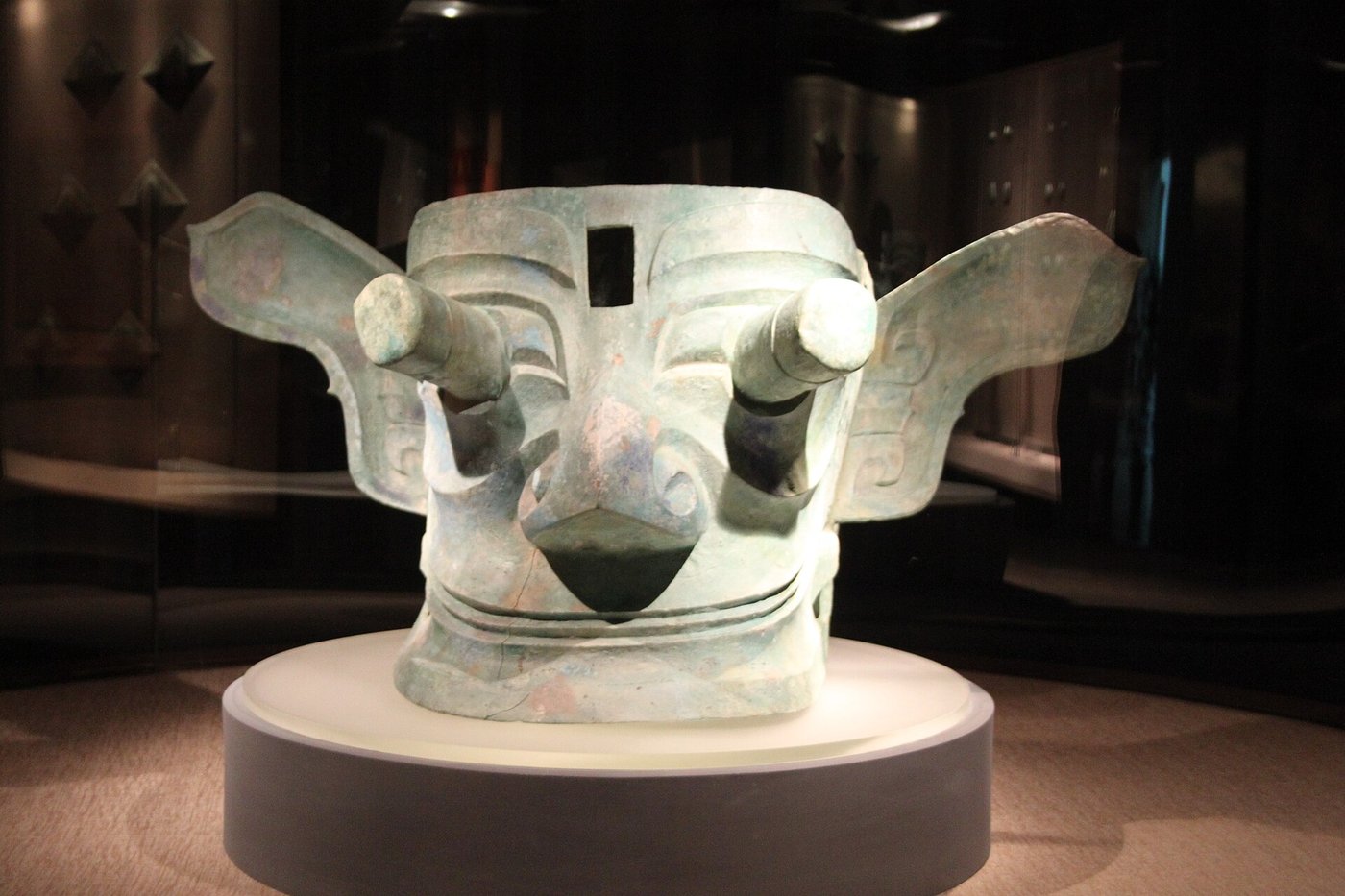
The most famous object from Sanxingdui is a mask so wide it looks like it belongs to a beast rather than a person. It measures well over a metre across, with ears that flare out sideways like wings, and from each eye socket a cylinder of bronze pushes straight forward, several centimetres clear of the face, ending in a blunt disc. The eyes are on stalks. They project out into the air like the eyes of a crab or a snail, or like something reaching to see further than a human head ever could.
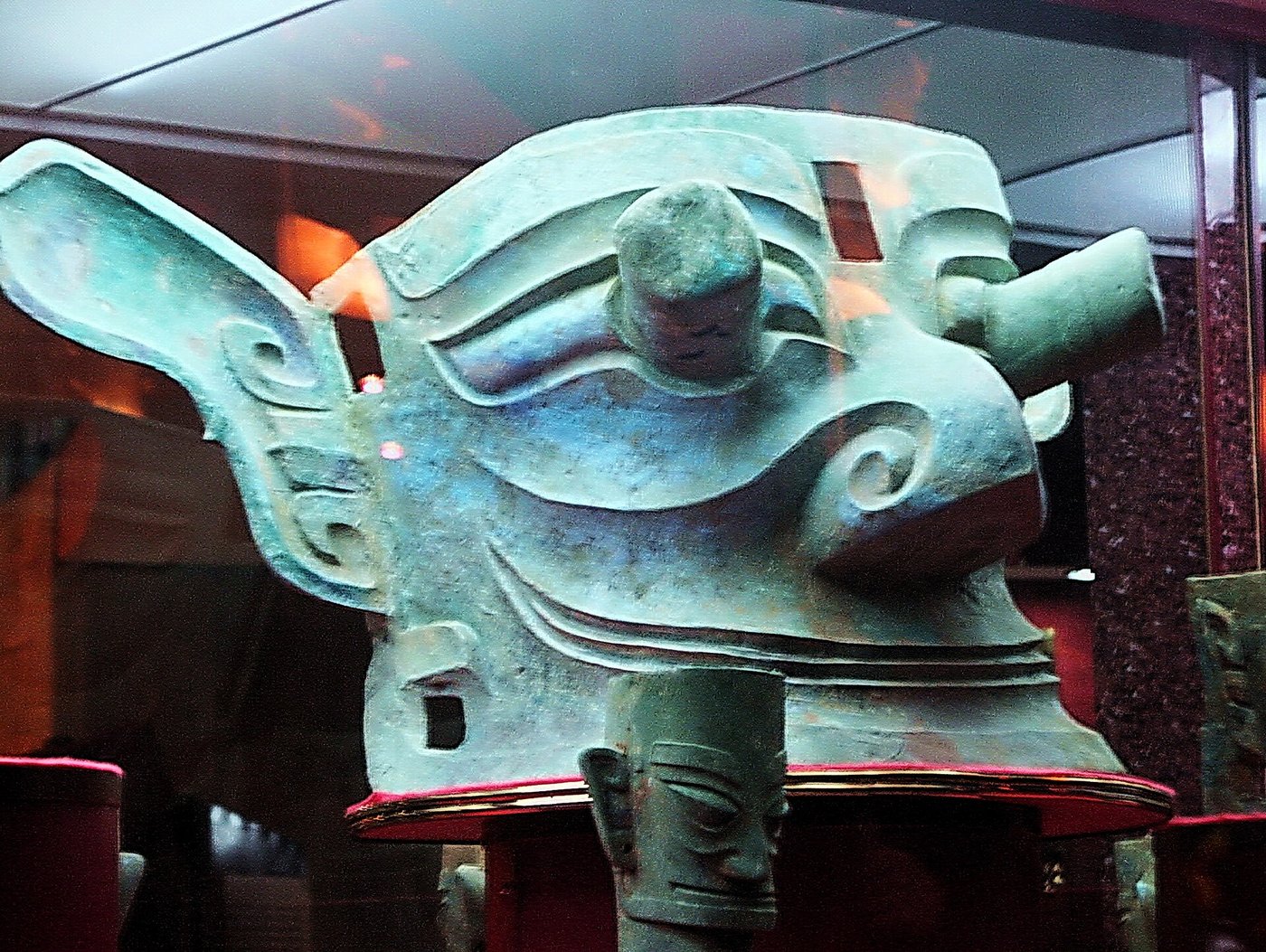
Why would anyone cast a face like this? For once there is a thread to pull, and it runs into a very old book. A fourth-century text called the Chronicles of Huayang, written long after Sanxingdui was gone, gathered up the half-legends of the Shu, the old name for this corner of Sichuan. It records that the first king of Shu was a figure named Cancong, and it says something peculiar about him: that his eyes were zongmu, protruding, standing out from his head. For centuries that line read like a fairy-tale detail. Then the brickyard pits gave up a bronze mask with its pupils on stalks, and a scrap of myth suddenly seemed to be describing an object someone had actually made.
"There was a lord of Shu named Cancong. His eyes stood out from his head. He was the first to call himself king."— paraphrased from the Chronicles of Huayang (Huayang Guozhi), compiled by Chang Qu, 4th century AD
It would be neat to say the mask is a portrait of Cancong, and some do. But the honest position is smaller and stranger. The mask and the legend both point at the same idea: that seeing, in this culture, was charged with power, and that a ruler or a god was imagined as something whose gaze pushed out into the world. Whether the myth remembered the mask, or the mask and the myth both grew from an older belief, cannot be untangled now. What survives is the fact that a people obsessed with sight built a face whose eyes could not blink and could not be met.
The strange faces, the story goes, look nothing like ancient China, so they must record contact with beings from somewhere else: the eyes on stalks are alien eyes, the culture dropped from the sky and vanished back into it.
Nothing about the bronzes needs an outside world to explain them. The casting technique came from the Shang north; the ritual vessels found in the same pits are recognisably Chinese in form; the lead and copper in the metal have been traced to real mines. The faces are strange because they are religious images, not people: the same deliberate, repeated mask of a god, made by skilled local workshops for local ceremonies. Mystery is not the same as visitors from space. The Shu were a homegrown people who imagined their gods with eyes that reached.
Gold, silk and a tree of birds
For more than thirty years the two 1986 pits were the whole of it. Then, in 2019 and 2020, archaeologists probing the ground between and around them found six more (pits three to eight), and this time they excavated with everything modern science could bring. Teams worked inside climate-controlled glass enclosures, in protective suits, lifting objects into on-site laboratories. What came up deepened the picture and, in places, sharpened the mystery.
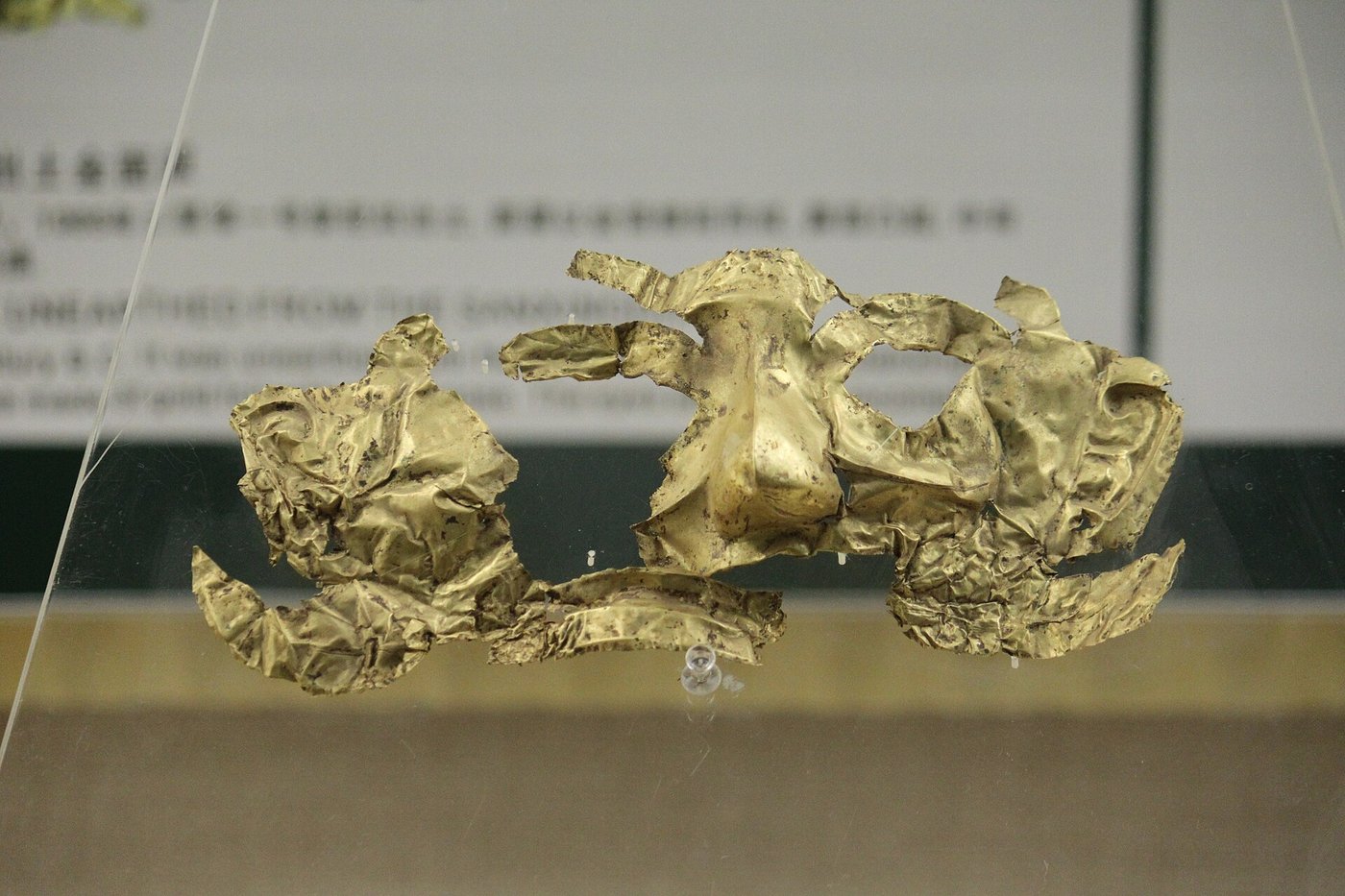
There was gold. A mask of thin beaten gold, about 280 grams of it and better than four-fifths pure, crushed into a lump that conservators slowly unfolded into a face: a covering that had once been fitted over a bronze head. There was more gold foil, gold leaf, a gold-clad staff from the earlier digs whose engraved fish and birds may be the closest thing the Shu had to writing, and may be nothing of the kind. There were traces of silk, teased out of the ash on some of the bronzes: the people of Sanxingdui wrapped their offerings in cloth before they burned them. And there were, again, the tusks: well over a hundred elephant tusks across the pits, from animals that once lived in a warmer, wetter Sichuan.
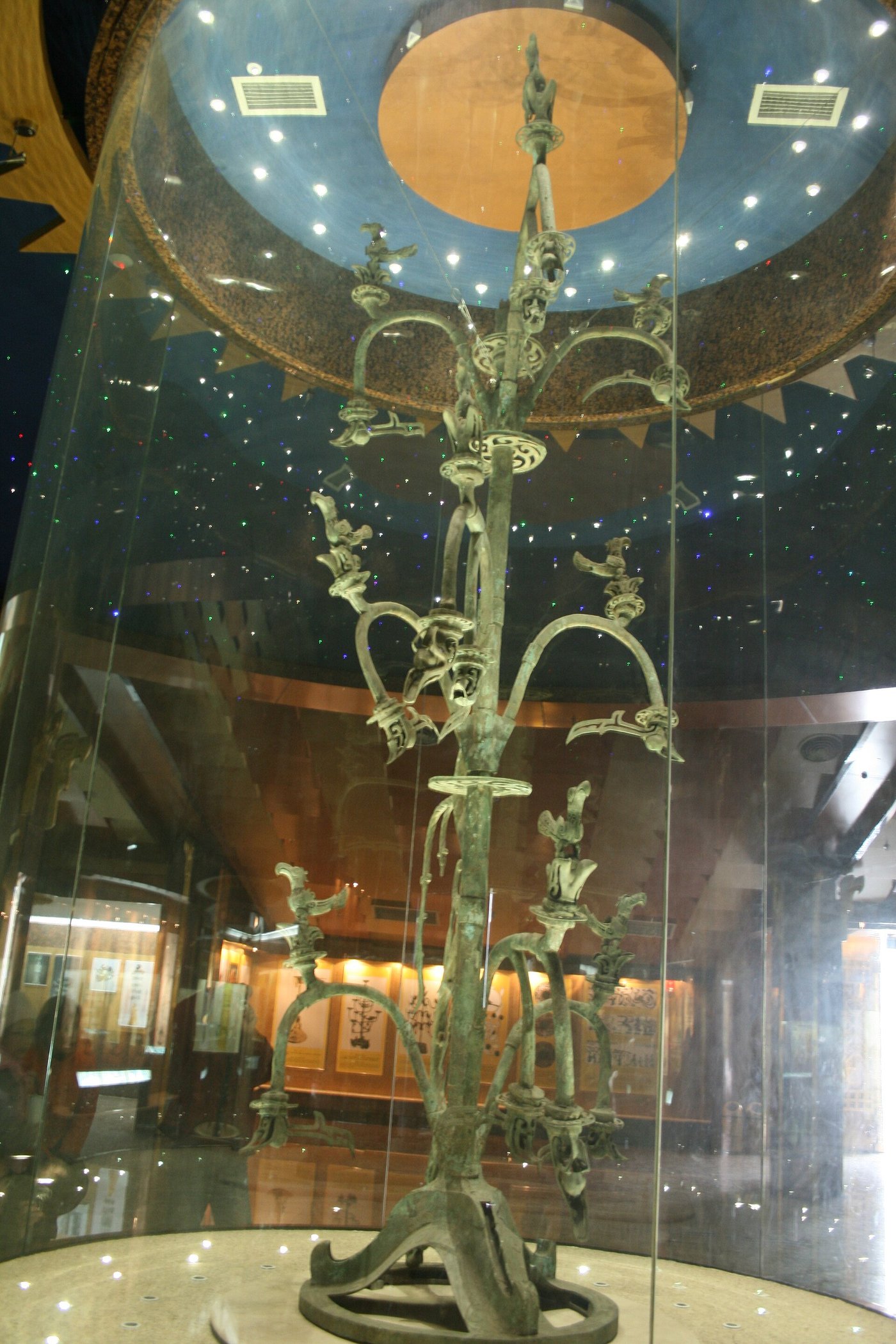
Rising above all of it stood the bronze trees. The best preserved is close to four metres tall, cast in sections, its trunk splitting into three tiers of branches. On the branches perch birds, nine of them, and a dragon runs down one side of the trunk as if pouring towards the ground. Trees like this turn up in later Chinese myth: a cosmic tree on which sun-birds roost, waiting to cross the sky one at a time. To find that idea already standing, in bronze, in a Bronze Age pit in Sichuan, is to watch a myth being caught much earlier than anyone expected. The Shu were not on the edge of Chinese thought. In some of it, they may have been ahead.
Who broke the gods, and why
Every road through Sanxingdui leads back to the pits, and to the hardest question the site asks: why does a rich, functioning city take its greatest treasures (the giant figure, the masks, the trees, the gold, a herd's worth of ivory), smash them, burn them, and bury them in the ground?
The damage was not casual. Objects were broken in ways that took effort. Many were heated in a great fire before burial; the ash sits through the layers, and studies of the burned ivory and the reddened, magnetically altered soil show real heat, not a passing blaze. The pieces were then arranged and packed down, not thrown. And they were never dug back up. Whatever this was, it was meant to be permanent.
The old suspicion was disaster: an enemy sacking the city, or a flood driving the people out, the pits a panic-burial of holy things. Newer work has undercut the panic. The most striking evidence came from the newest excavations: a piece of one bronze found in pit three fits, exactly, onto a piece of another bronze in pit eight. Fragments of the same object had been divided between separate pits, metres apart. You do not split a statue between two graves by accident in a flood. The pits were filled together, in one planned event, by people who broke the objects as part of the act.
If the pits were a single deliberate rite, what was being marked? One reading is religious housekeeping on a grand scale: a periodic sacrifice in which the sacred objects were "sent on" to the gods by fire and burial, exactly as offerings were meant to be consumed. Another reads politics into it: a change of rulers, or the abandonment of the city, in which the old regime's gods were ritually killed so they could not be inherited. The radiocarbon dates now cluster the burial in the late Shang period, around 1200 to 1050 BC, but a firm date for the ceremony is not the same as a reason for it, and the reason is still missing.
A city that moved, not a people who vanished
Popular retellings like to end Sanxingdui with a disappearance: a brilliant culture that flared and was gone, swallowed by the earth. The archaeology tells a quieter story. Not long after the pits were sealed, the great city was abandoned, but its people, its metalwork and its gods reappear about forty kilometres away, at a site called Jinsha, on the edge of modern Chengdu. Jinsha has the same gold, the same sun-and-bird motifs, the same taste for masks and ivory. The famous "Golden Sun Bird" of Jinsha, four birds circling a blazing sun, is now a symbol of Chinese cultural heritage. The Shu did not fall out of the sky and vanish. They picked up and moved down the plain, and carried their strange art with them for centuries more.
What they never did, at Sanxingdui or at Jinsha, was write. This is the silence at the centre of the whole story. The Shang up north kept records on bone and bronze; we can read their kings' names and worries. The Shu left thousands of objects and not one securely readable line. We do not know what they called themselves, what they called their gods, what words they said over the fire before they buried it. Every name in this account, Cancong and even Shu itself, comes from outsiders writing centuries later, in a language that was not the one spoken in that city.
What the bronze keeps
Stand in front of the great mask now, in the museum built beside the old mounds, and the eyes still do the thing they were made to do. They look past you. Three thousand years of dirt and fire and reburial, a chance blow from a brickmaker's spade, decades of careful lifting, and the face gives nothing away. We have measured the metal and traced the mines and dated the ash. We have matched a scrap of legend to a mask and watched a myth stand up in bronze. And we still cannot say the one thing we most want to know: what the people who cast these faces believed they were looking at, and why, one day, they decided their gods should go into the ground and never come out.
That is the rare gift of Sanxingdui. Most of the ancient world that survives is the side of it that talked: the inscriptions, the king-lists, the laws. Here is a great civilisation that left only its hands, and made us guess at its mind. The eyes on the mask were built to see further than a person can. What they saw, they are still not saying.
Read next: Shimao: The Stone City in China That Was Not Supposed to Exist and Silla Gold Crowns: The Korean Regalia Too Fragile to Wear.
Sources & further reading
- Sanxingdui Museum, Guanghan, Sichuan — permanent collection and site displays of the bronze figure, masks, trees and gold from Pits 1–8.
- Jay Xu and others, Ancient Sichuan: Treasures from a Lost Civilization (Seattle Art Museum / Princeton University Press) — the standard English catalogue of the Sanxingdui and related Shu bronzes.
- Chang Qu, Chronicles of Huayang (Huayang Guozhi), 4th century AD — the early record of the legendary Shu kings, including Cancong of the protruding eyes.
- Reports on the 2019–2022 excavation of Pits 3–8, including the cross-pit bronze joins and radiocarbon dating to the late Shang period, in Archaeology magazine and the Chinese excavation bulletins.
- Smithsonian Magazine and CNN Style, coverage of the "Faces of Sanxingdui" finds and the 2021 gold-mask and silk discoveries.
- Studies of ritual burning at the sacrificial pits (burned ivory, ash layers and magnetic soil properties), npj Heritage Science and related journals, 2023–2026.
Image credits (via Wikimedia Commons): great bronze mask with protruding eyes (featured) — Gary Todd (CC0); bronze standing figure — Gary Todd (CC0); row of bronze heads — Gary Todd (CC0); protruding-eye mask, front view — lienyuan lee (CC BY 3.0); gold mask — Gary Todd (CC0); bronze sacred tree — Gary Todd (CC0).