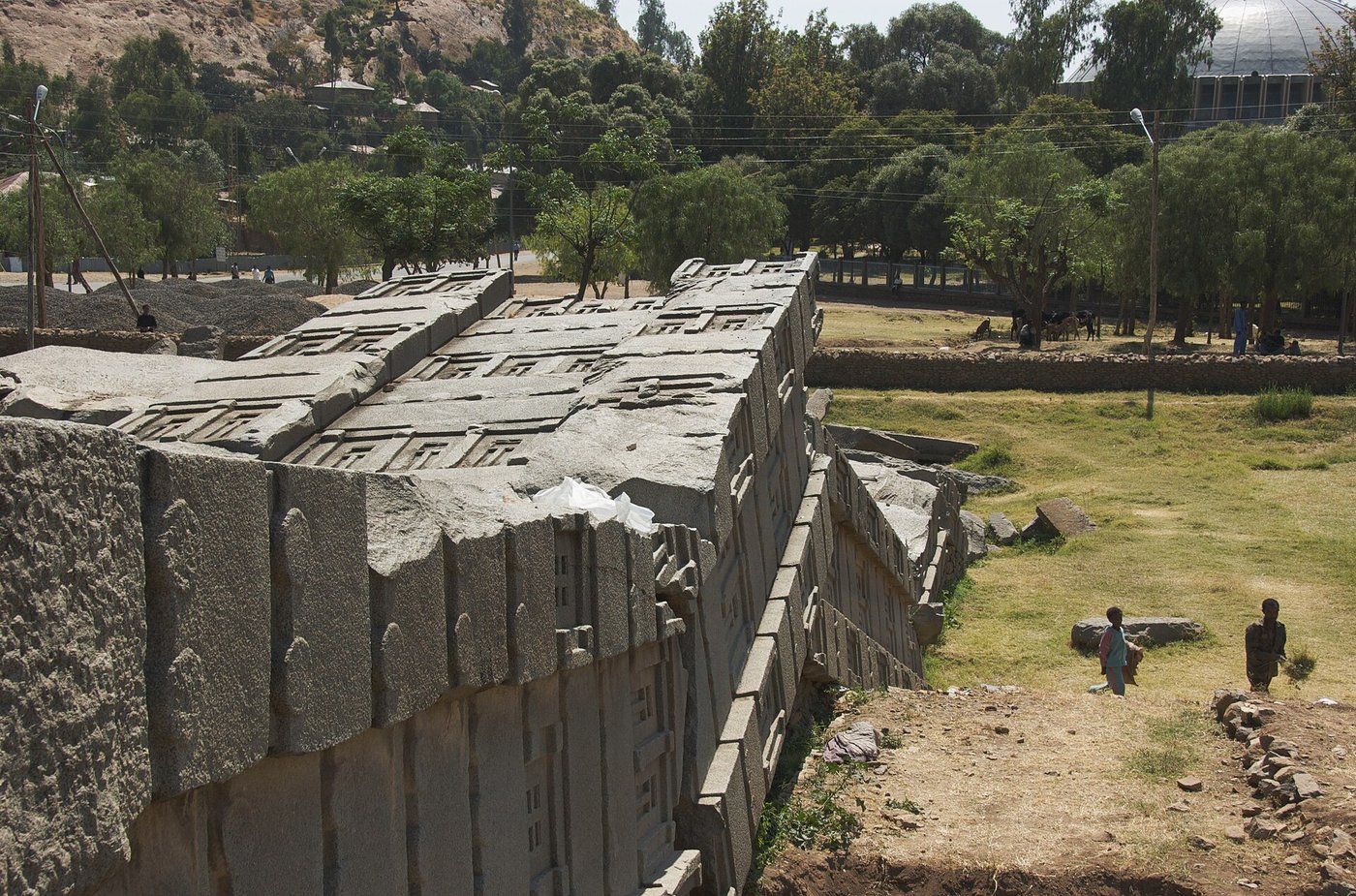
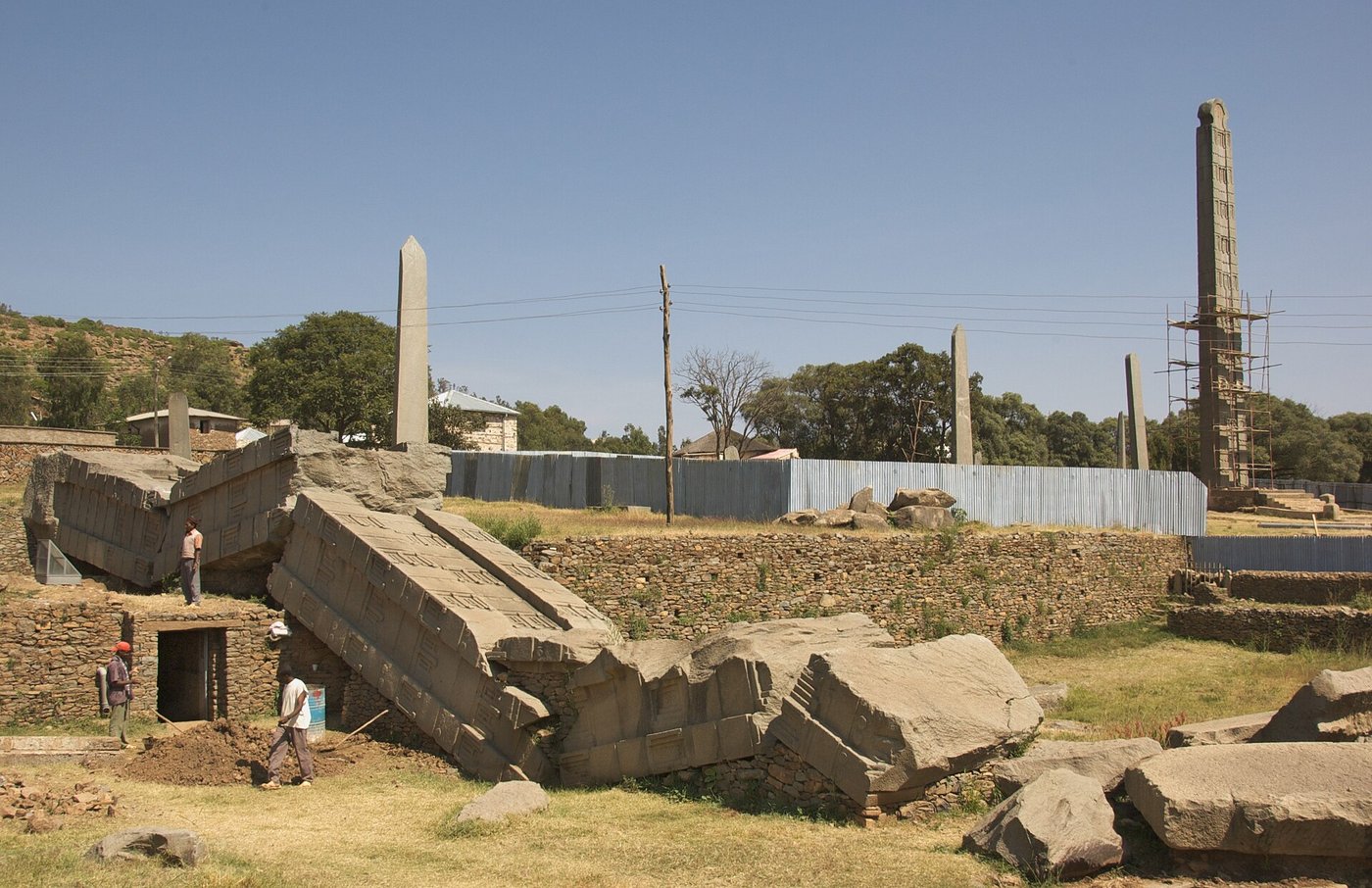
Some time in the fourth century, on a terrace above the town of Aksum in the highlands of northern Ethiopia, the largest single stone that human beings had ever tried to stand upright began to move. It had been quarried, carved and hauled into place over months, perhaps years. It weighed something close to 520 tonnes and stood as tall as a modern eleven-storey block. For a moment it must have risen against the sky. Then it came down, and it has been lying where it fell, broken into great sections, ever since.
The stone is known plainly as the Great Stele. It is not a natural rock or a rough pillar. It was cut to look like a building: a slender tower carved on every face with rows of false storeys, false windows, and a false door at the base complete with a stone lock and knocker. Whoever ordered it wanted a house for the dead that reached higher than any real house in the kingdom. They very nearly got it. Instead they got the most ambitious failure in the history of monumental stone.
Around the fallen giant stand its smaller brothers, and one of them still points at the sky after 1,700 years. To understand how a single African kingdom came to attempt something no one else has matched, and why the attempt broke apart in front of its own engineers, you have to look at the power that stood behind the stone.
A power the size of Rome had to notice
In the third century, a Persian prophet named Mani tried to explain the shape of the world to his followers. There were, he wrote, four great kingdoms: Rome in the west, Persia at the centre, China in the far east, and Aksum in the south. Three of those names have never left the school textbook. The fourth vanished from most of them entirely.
Aksum sat on the inland edge of a trade route that mattered enormously. Ships crossed the Red Sea and the Indian Ocean carrying ivory, gold, incense, and animals bound for the arenas of the Mediterranean, and much of that traffic passed through the Aksumite port of Adulis on its way to and from the interior. The kings who controlled that flow grew rich enough to build a stone capital, field armies that crossed the sea into Arabia, and mint their own money.
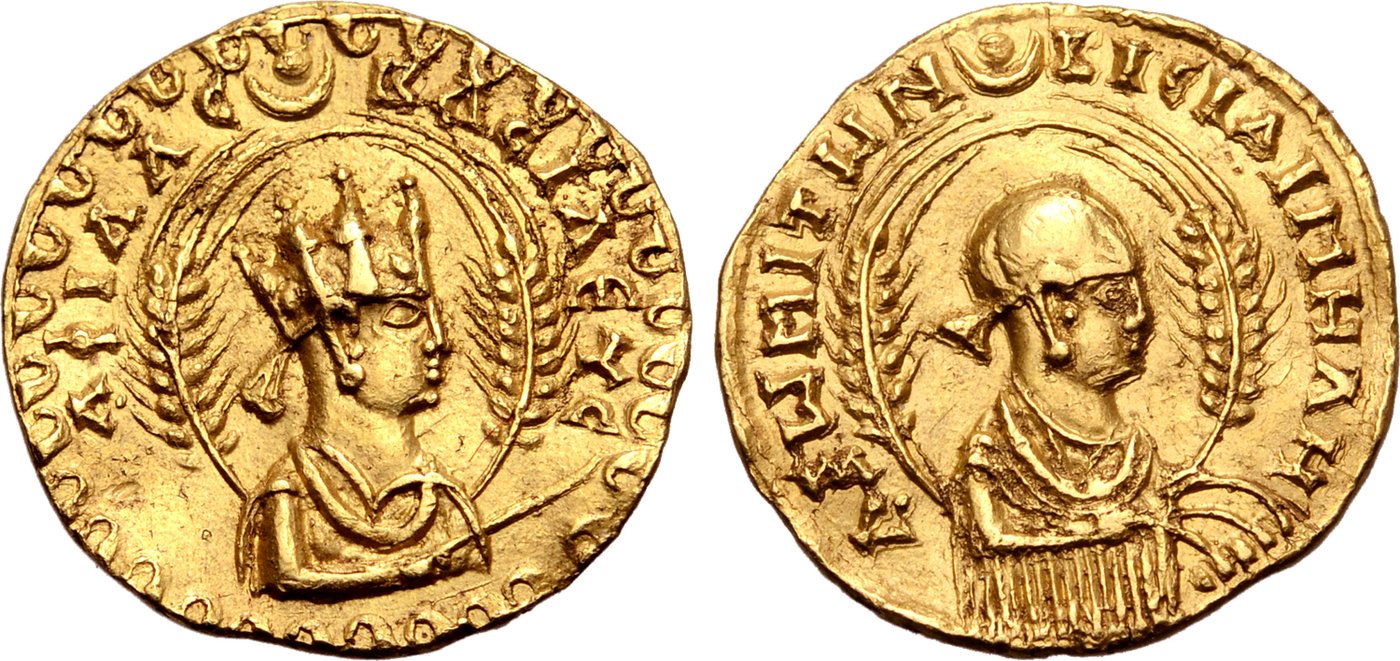
That last point is easy to skip past and worth stopping on. Around the 270s, under a king named Endubis, Aksum began striking coins in gold, silver and bronze. It was the first state in sub-Saharan Africa to do so, and almost the only power of its day outside Rome and Persia to put gold coinage into circulation. Aksumite coins have turned up as far away as southern India and the coast of the Levant. The gold pieces carried Greek lettering, because Greek was the language of the merchants the kings wanted to reach. These were not trinkets. They were a statement that Aksum expected to be dealt with as an equal.
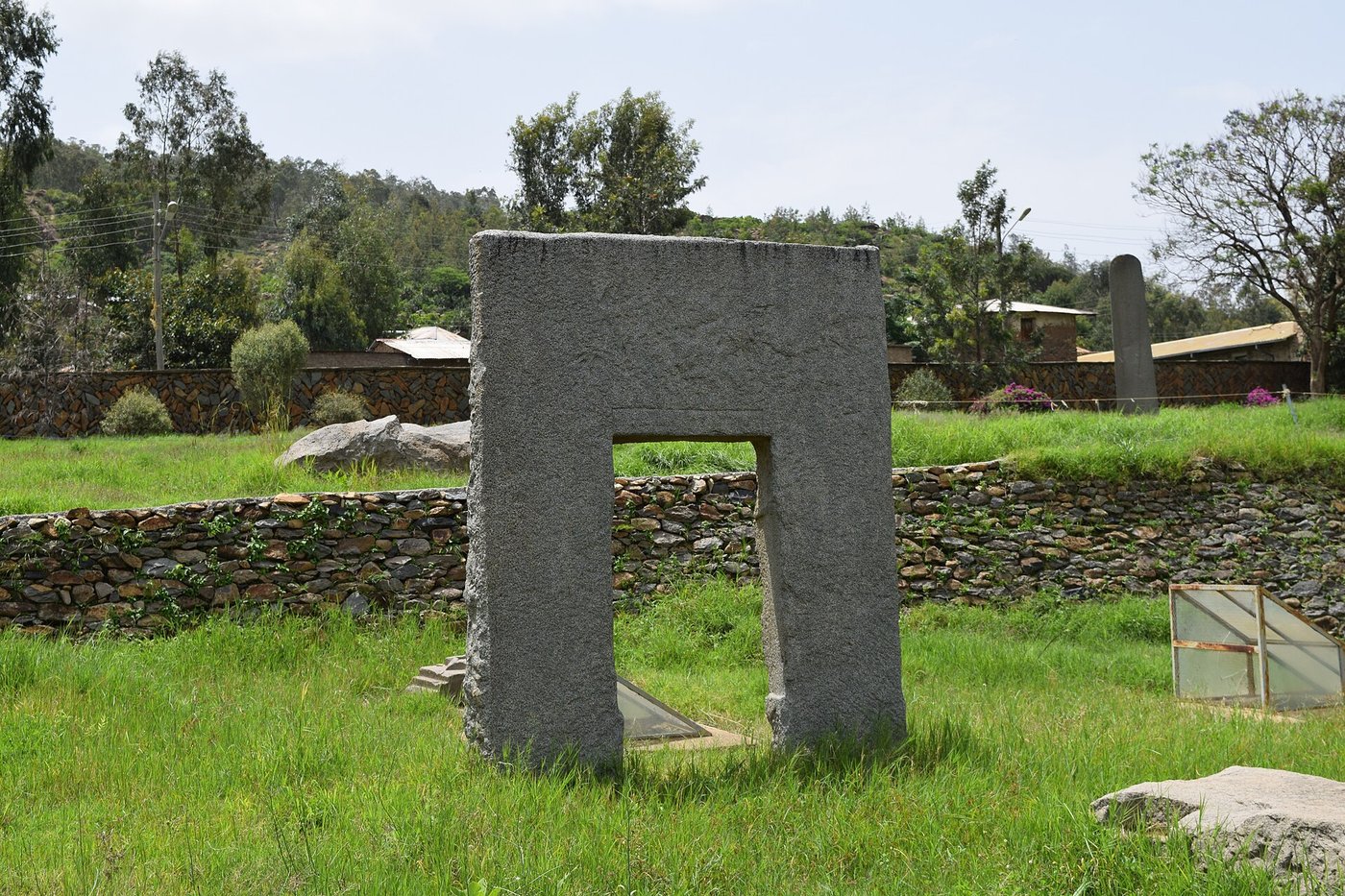
The great Aksumite stelae are not built up from blocks. Each is a single piece of stone, quarried whole and then carved to imitate the timber-and-stone tower houses the Aksumite elite actually lived in. The carving copies the real architecture down to the details: the projecting ends of floor beams, rendered as rows of round knobs the local guides call “monkey heads”; recessed window frames; and, at ground level, a false door carved with a lock, a bolt and a ring handle. The tallest of them stack nine or more of these fake floors on top of one another. Nobody could ever have gone inside. The point was the illusion: a house for a dead king, taller than any living one.
The town that carved its kings in stone
The Aksumites did not write long histories about themselves, and no royal chronicle survives to tell us who lay beneath the Great Stele or why. What survives is the stone. In a field on the northern edge of the town, more than a hundred stelae were raised over the centuries, most of them small and plain. Six were giants, carved as storeyed towers. Those six almost certainly marked the graves of kings.
Underneath the stelae field, archaeologists have found what the markers were pointing to: large built tombs, cut and lined with dressed stone, reached by stairways and sealed chambers. One is known as the Tomb of the Brick Arches, another as the Mausoleum, its long stone gallery running under the earth beside the fallen giant. The stelae were the visible half of a machine for remembering the dead. The buried half was just as carefully made.
Getting the stone in the first place meant going to the hills. The stelae were cut from a hard grey rock (a granite-like stone geologists call nepheline syenite) at a quarry on the slopes of Gobo Dura, several kilometres west of the town. You can still see there the marks of the work: part-cut blocks, and at least one enormous stele left lying unfinished in the quarry, abandoned before it was ever freed from the bedrock. Whatever went wrong with the Great Stele, it was not the first time the Aksumites had bitten off more stone than they could move.
How do you stand up 520 tonnes?
Here is the problem the Aksumite engineers set themselves. Take a slab of stone longer than a tennis court and heavier than a fully loaded jumbo jet. Move it several kilometres from the quarry to the town, downhill and across a valley, without breaking it. Then tip it from flat on the ground to bolt upright, drop its foot into a prepared socket, and trust that it will stay there.
No Aksumite left instructions, so the how has to be reconstructed from the stones and the ground around them. The base of each large stele sat in a socket cut into a massive stone platform, and the biggest were braced from behind by heavy retaining slabs. To raise one, the likeliest method was a long earthen ramp and an army of people hauling on ropes, using levers and packing to lift the head of the stele degree by degree until its own weight carried it past the tipping point and it dropped into the socket. Some accounts add elephants to the workforce, which Aksum certainly had. The physics is not mysterious. The margin for error is what kills you.
For the smaller stelae, and even for the 21-metre shaft that still stands, the method worked. Ezana's Stele, named for the king who ruled when Aksum turned to Christianity, went up and stayed up, and it is the tallest ancient monolith anywhere that has never fallen. It leans very slightly now, held straight in modern times with quiet engineering, but it has kept its feet for some 1,700 years. That is the proof that the Aksumites knew how to do this. The Great Stele is the proof that there is a size at which knowing how is not enough.
Scholars broadly agree the Great Stele collapsed, but not on when. One reading is that it stood for a while and then came down, brought low by an earth tremor (Aksum sits in a seismically active zone) or by the slow settling of the ground beneath 520 tonnes. The other, favoured by several archaeologists who have dug the site, is grimmer: that it never really stood at all, that it toppled during the raising itself and smashed the stone structure it fell across on the way down. On this reading the largest monument the kingdom ever attempted was a catastrophe on the day of its unveiling, watched by the same crowd that had gathered to see it rise. The broken sections lying across the buried gallery are the only witnesses, and they do not quite settle the argument.
The kingdom that changed its gods
Around the year 340, something visible happened to the money. The coins of King Ezana, struck early in his reign, carry a disc and a crescent, the emblems of the old gods of Aksum. The coins struck later in the same reign drop the disc and crescent and put a cross in their place. It is one of the clearest moments of religious change anywhere in the ancient world, recorded not in a chronicle but in small change passing from hand to hand.
The story attached to the change is that of a shipwrecked young Christian named Frumentius, taken to the Aksumite court, who rose to influence and helped bring the new faith to the king. Aksum became one of the first states on earth to make Christianity official, earlier than most of Europe, and by its own reckoning a direct descendant of that first conversion in an unbroken line. The Ethiopian church still traces itself to Frumentius, whom it calls Abba Salama, the Father of Peace.
The timing matters for the stelae. The giant carved towers belong to the old religion: grave markers for kings who were not yet Christian. Once the cross replaced the crescent, the kings stopped raising them. The custom of the storeyed monoliths had a beginning and an end, and the end came with the change of faith. The Great Stele may well have been one of the very last attempted, an old idea pushed to a scale that the old methods could not carry, right at the moment the whole tradition was about to be abandoned.
Two popular stories crowd out the real one. The romantic version ties the stelae to the Queen of Sheba, whom Ethiopian tradition places at Aksum, and to the Ark of the Covenant, said to rest in a guarded chapel in the town to this day. The lazier version, sold in television specials, says no ancient African people could have raised such stones at all, and reaches for lost civilisations or visitors from the sky to explain them.
The stelae are datable, and they are late: third and fourth century, the work of the historical Aksumite kings, not a bronze-age queen. The people who raised them left their fingerprints all over the site: the quarry with its tool marks and abandoned blocks, the socketed platforms, the royal inscriptions in Ge'ez, Greek and Sabaean that name real rulers and their campaigns. There is no gap in the evidence for a mystery to hide in. The achievement is entirely, provably human, and entirely Aksumite. That is what is remarkable: not that someone else did it, but that they did.
Slow decline, then silence
Aksum did not fall in a single dramatic collapse. It faded. By the seventh century the rise of Islam had redrawn the map of the Red Sea, and the trade routes that had made the kingdom rich shifted away from its ports. Aksum minted its last coins in the early eighth century and then stopped, a quiet, telling end for a power that had once announced itself in gold. There is evidence, too, of exhausted soil and a drying climate around the old capital, the kind of slow squeeze that empties a great town without a battle.
The centre of Ethiopian power moved south and inland, and Aksum shrank to a holy town rather than a capital. But it never emptied and it never forgot. The church of Our Lady Mary of Zion kept its place at the heart of the community, kings continued to be crowned there for centuries, and the stelae stood over the fields, some upright, the greatest one down. When European travellers began arriving in the sixteenth century, they found the monuments already ancient and already wrapped in legend.
The Portuguese priest Francisco Álvares reached Aksum in 1520 and left one of the first outside descriptions of the stelae. He marvelled at one tall shaft standing “above the others”, worked all over as if it were a great tower with false windows and a carved door at its foot, and noted a second, still larger, lying broken on the ground beside it. Four and a half centuries before archaeologists put numbers to the stones, a visiting chaplain had already recorded the two facts that still define the site: one giant standing, and a greater giant fallen.
The stone that went to Rome, and came home
The Great Stele stayed where it fell. Its most famous neighbour did not. Standing between the fallen giant and Ezana's shaft was a third great stele, about 24 metres tall and 160 tonnes, carved with the same false storeys. In 1937, during the Italian occupation of Ethiopia, soldiers acting on Mussolini's orders cut it into pieces and carted it away, five truckloads over two months, down to the coast and by ship to Italy. It was set up in Rome near the Circus Maximus, in front of the ministry that governed Italy's African colonies, and there it stood as a war trophy for the best part of seventy years.
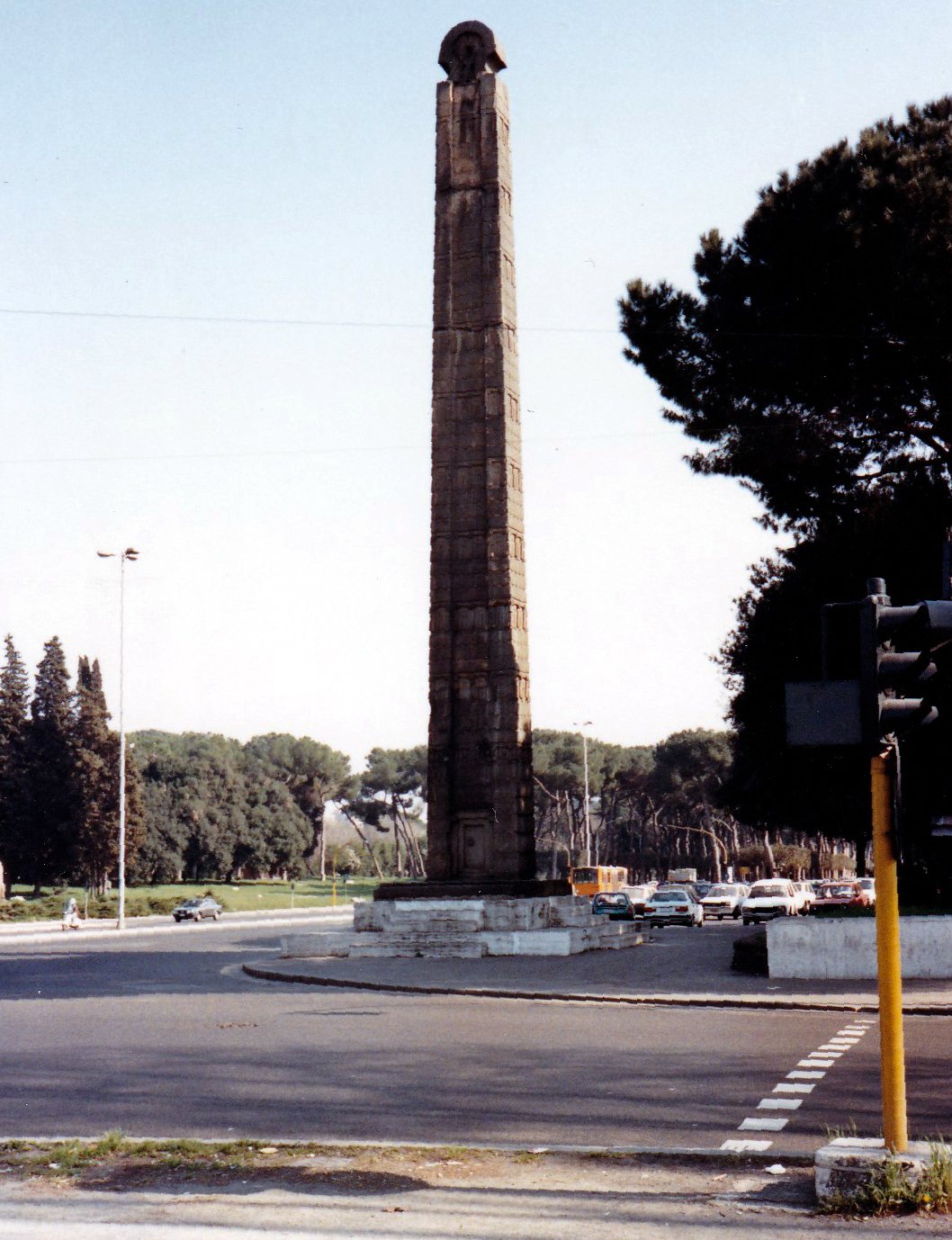
Italy agreed to give it back in a 1947 peace treaty. Then nothing happened for decades. The stone was too big, the excuses too easy, and one Italian government after another let the matter slide while Ethiopia kept asking. It took a lightning strike that damaged the stele in 2002 to finally force the issue.
The return, when it came, was an engineering feat in its own right. In 2005 the obelisk was cut back into three sections and flown to Ethiopia aboard an Antonov An-124, one of the largest cargo aircraft in the world, which had to use a specially strengthened runway to land its cargo near Aksum. The pieces arrived that April. In 2008 the stele was raised again on its old ground, straightened and reinforced with modern engineering so that this time it would stay up. A stone taken as proof of conquest had become, on its way home, proof of the opposite.
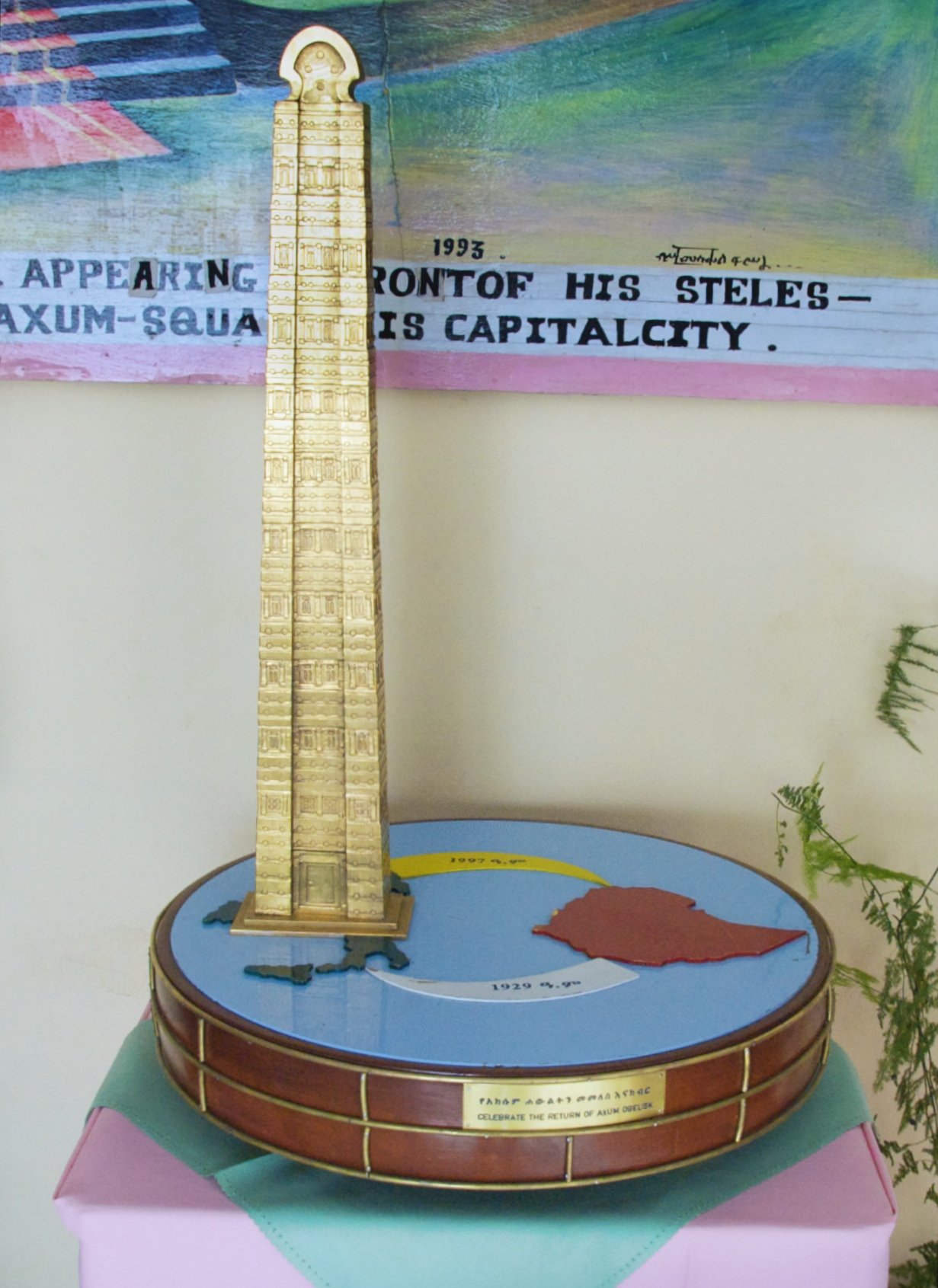
Three stones, and the whole of Aksum
Stand today in the northern field and you can read the whole arc of Aksum in three stones. One shaft still points at the sky, the tradition at its confident best. One stone stands again after a long exile, dragged out of the country as a trophy and hauled back by an aircraft that did not exist when it was carved. And between them lies the Great Stele, the reach that exceeded the grasp, 520 tonnes of ambition that came down the moment it went up.
It is easy to treat the Great Stele as a monument to failure, and in the narrow sense it is one. But there is another way to see it. A society only attempts a thing like this when it is sure of itself: sure of its wealth, its labour, its skill, its place among the powers of the earth. The kingdom that carved a 520-tonne house for a dead king, and nearly stood it up, was not a footnote to somebody else's history. It was one of the four kingdoms a prophet used to describe the world. The stone did not stay standing. The proof of what Aksum was does not depend on whether it did.
Read next: The Kailasa Temple of Ellora: The Mountain Carved Into a Temple and Marib Dam: The Wall That Fed Sheba Until the Repairs Stopped.
Sources & further reading
- Stuart Munro-Hay, Aksum: An African Civilisation of Late Antiquity (Edinburgh University Press, 1991).
- David W. Phillipson, Foundations of an African Civilisation: Aksum and the Northern Horn, 1000 BC–AD 1300 (James Currey, 2012).
- David W. Phillipson (ed.), Archaeology at Aksum, Ethiopia, 1993–7 (British Institute in Eastern Africa, 2000).
- Francisco Álvares, The Prester John of the Indies (account of 1520; Hakluyt Society edition, 1961).
- UNESCO World Heritage Centre, “Aksum” inscription file and the Aksum Obelisk reinstallation project reports (2005–2008).
- Contemporary coverage of the obelisk's return and re-erection, 2005–2008.
Image credits (via Wikimedia Commons): standing Great Obelisk (Ezana’s Stele) — A. Davey (CC BY 2.0); the northern stelae field — A. Davey (CC BY 2.0); the fallen Great Stele — Allamiro (CC BY-SA 4.0); Aksumite coinage — the British Museum (CC0); the obelisk standing in Rome — G41rn8 (CC BY-SA 4.0); celebrating the obelisk’s return to Aksum — A. Davey (CC BY 2.0).