On the morning of 24 July 2026, two men paid the entrance fee at a small museum in Châtillon-sur-Seine, in northern Burgundy, and walked in among the other visitors. They went to a display case, broke it open, lifted out a collar of twisted gold as old as the Parthenon, and walked back out through the front door. By the time anyone understood what had happened, the most famous object in the town was gone. The gold had belonged, two and a half thousand years earlier, to a woman buried a few miles away under a low mound of earth, and it was only the second most remarkable thing found in her grave.
The place is Vix, a village on the upper Seine where the river is still small enough to wade. In January 1953 an archaeologist opened a burial there and found something that did not fit any of the rules. A Celtic grave, in Iron Age Gaul, hundreds of miles from the Mediterranean, held a Greek bronze wine bowl taller than the woman it was buried with: the largest metal vessel to come down to us from the whole of classical antiquity. Nobody has ever fully explained how it got there. What follows is the story of that bowl, the woman it was left for, and the argument about who she was that has run for seventy years and is not finished yet.
A mound at the foot of the hill
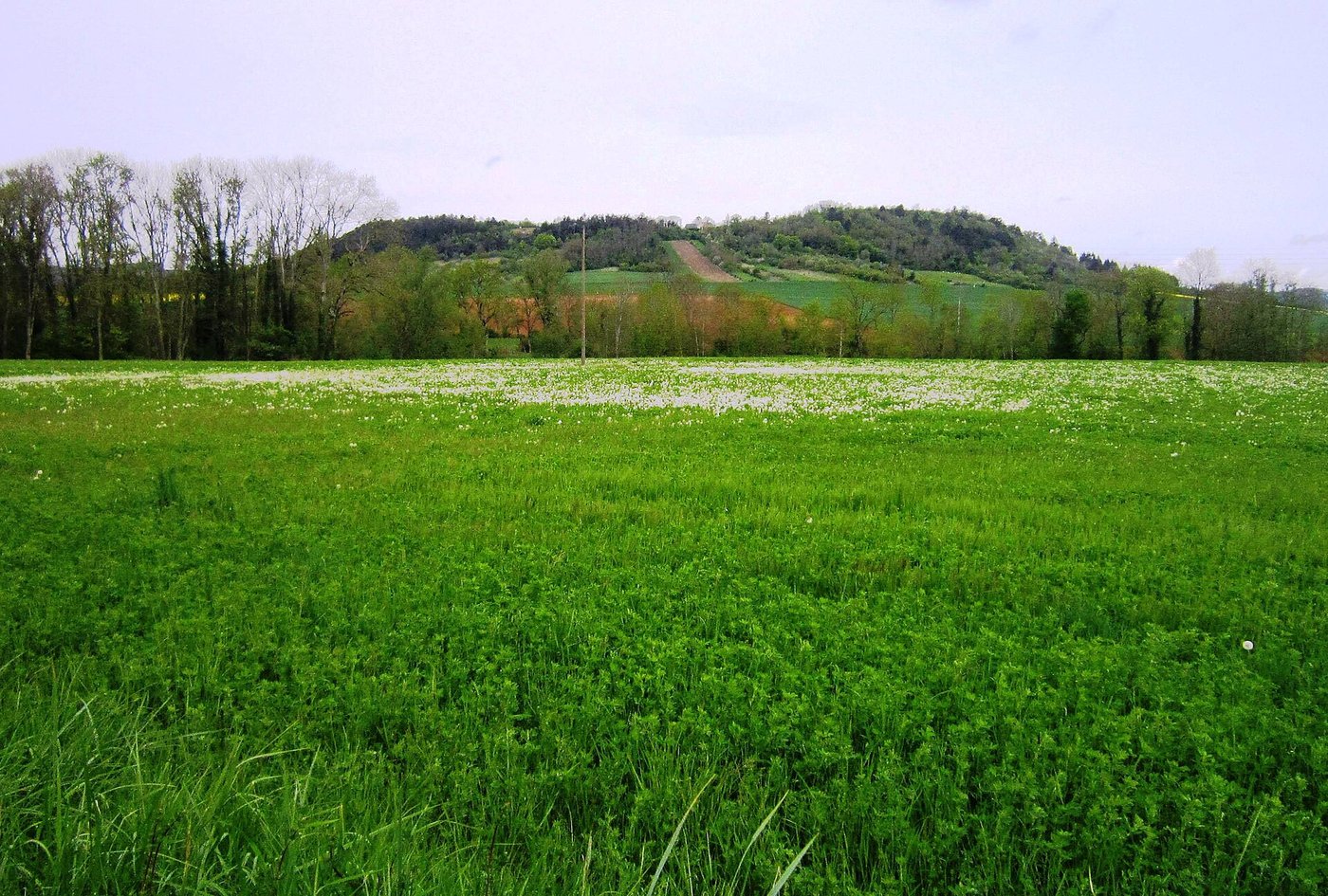
Above the village rises Mont Lassois, a flat-topped hill that does not look like much until you learn what sat on it. In the sixth century BCE this was one of the great strongholds of western Europe: a fortified town on the trade road that carried tin, amber and wine between the Mediterranean and the north. Greeks living at Massalia, the colony that would become Marseille, sent their goods up the Rhône and the Saône; somewhere near here the river route gave way to the land route, and whoever controlled the crossing grew rich on it. The hill has yielded thousands of fragments of imported Greek pottery and, more recently, the postholes of a vast timber hall, thirty-five metres long, standing where a ruler could watch the road.
The burial mound lay on the plain below, close to the river. It had been ploughed almost flat over the centuries, and for a long time no one guessed what was under it. Then, in the bitter cold of early 1953, the local schoolteacher and amateur digger Maurice Moisson, working with the archaeologist René Joffroy, cut into the mound and struck the edge of a stone-lined chamber. What they uncovered over the following weeks had never been robbed. That single fact (an intact elite grave from this period is almost unheard of) is why Vix matters. Everything was where the mourners had left it.
Inside the chamber was a wooden cart, its four wheels lifted off and stood against the wall so the body could be laid out on the box. On and around the woman lay her jewels. In the corner, dwarfing all of it, stood the bronze.
The bowl that should not have been there
Measure it and the numbers still sound wrong for something made by hand around 530 BCE. The krater at Vix stands 1.64 metres tall: well over five feet, taller than the woman buried beside it. It weighs a little over 208 kilograms. Filled to the brim it would hold 1,100 litres of liquid, enough to drown a room full of drinkers. No larger metal vessel survives from Greek or Roman antiquity, and nothing close to it has been found since. It is not a scaled-up version of an ordinary object. It is an object that seems to have been made once, at the outer limit of what a workshop could physically do, and then carried to the last place you would expect to find it.
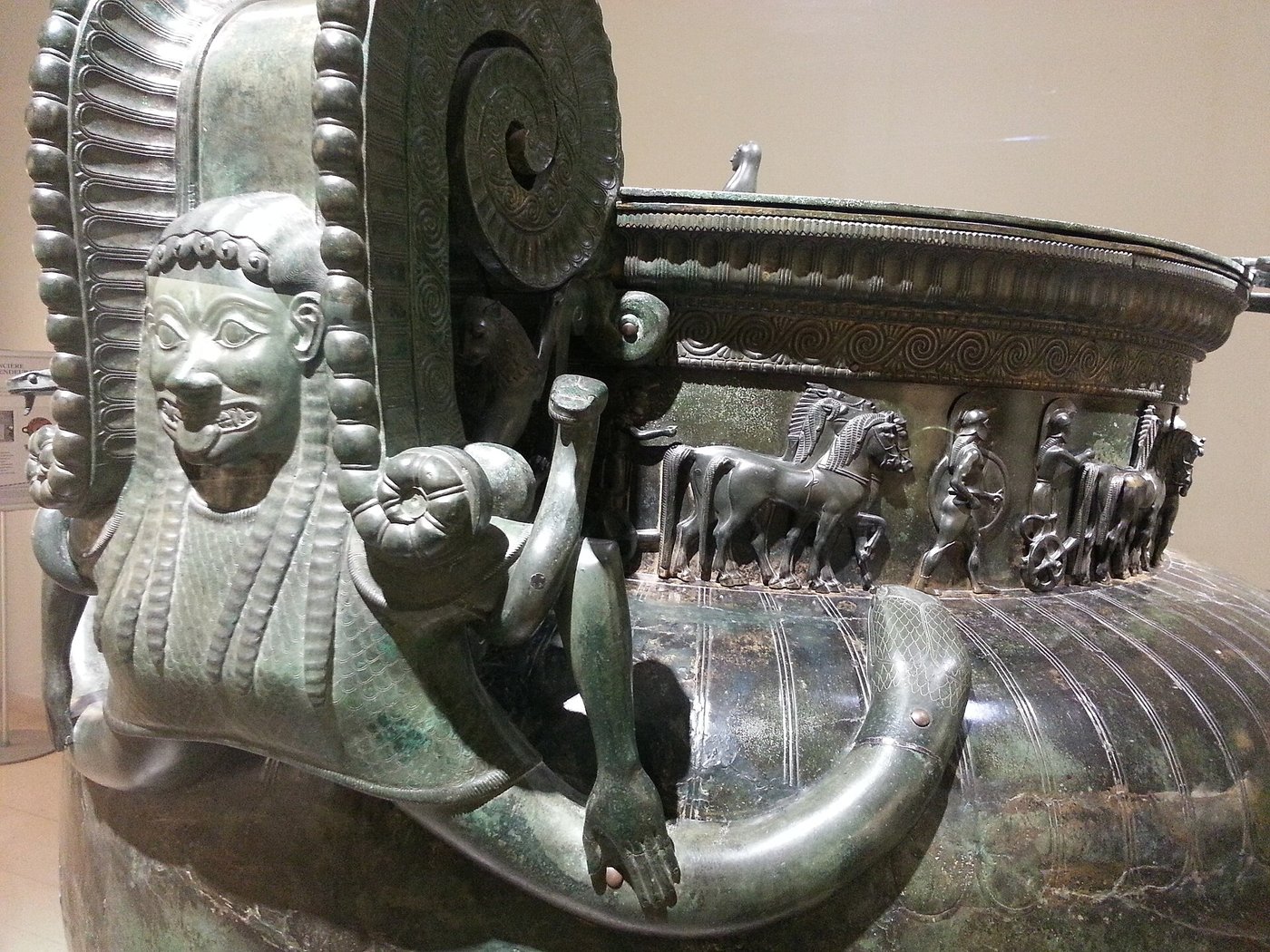
A krater, in the Greek world, was the bowl in which wine was mixed with water before a feast. To drink wine neat was thought barbaric; the mixing bowl sat at the centre of the table and the centre of the ritual. Most kraters are the size you can lift and carry. This one is furniture. Its body was raised by hammering from sheets of bronze so thin (barely a millimetre in places) that the whole enormous shape weighs less than you would guess, the metalworker's skill hidden inside the impossible size. Around its neck runs a band of figures. At its shoulders sit three handles, each one a coil of bronze crowned by the face of a Gorgon, tongue out, fangs bared, staring down anyone who came near the wine.
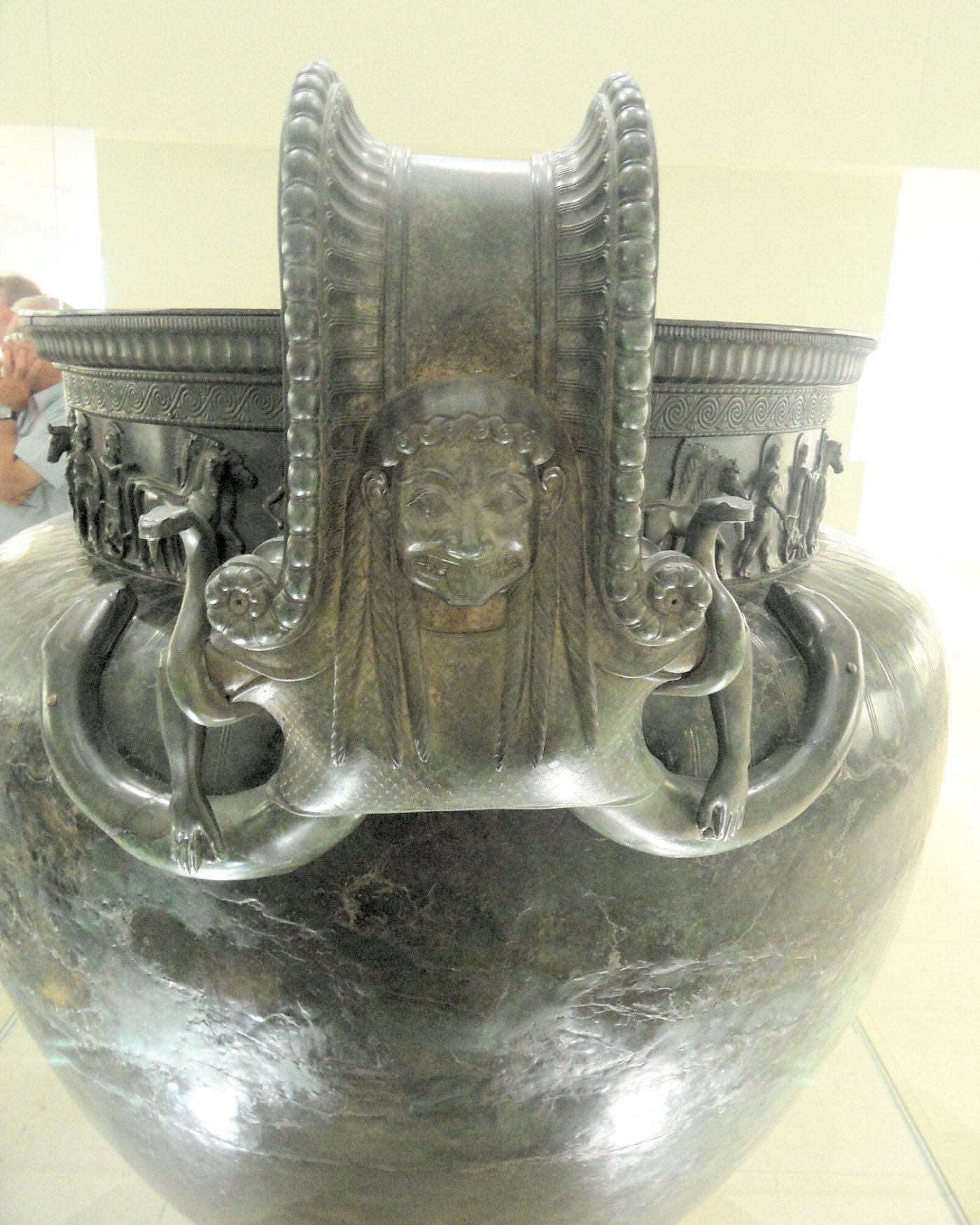
A bowl this size could not travel finished; it would have crumpled on the first bad road. So it did not travel finished. The krater was built to come apart: the body, the foot, the three heavy handles, the wide flat lid, seven or more separate pieces in all. On the rim and the parts that had to line up, the maker scratched small Greek letters, the ancient equivalent of the numbers stamped on flat-pack furniture: this handle goes here, that bracket there. The bowl was cast and beaten somewhere in the Greek world, dismantled, packed, hauled overland and up rivers for the better part of a thousand miles, and then reassembled by someone who could read the marks. The letters are still there. They are a set of instructions, cut in the sixth century BCE, for putting the thing back together at the other end of Europe.
A parade around the rim
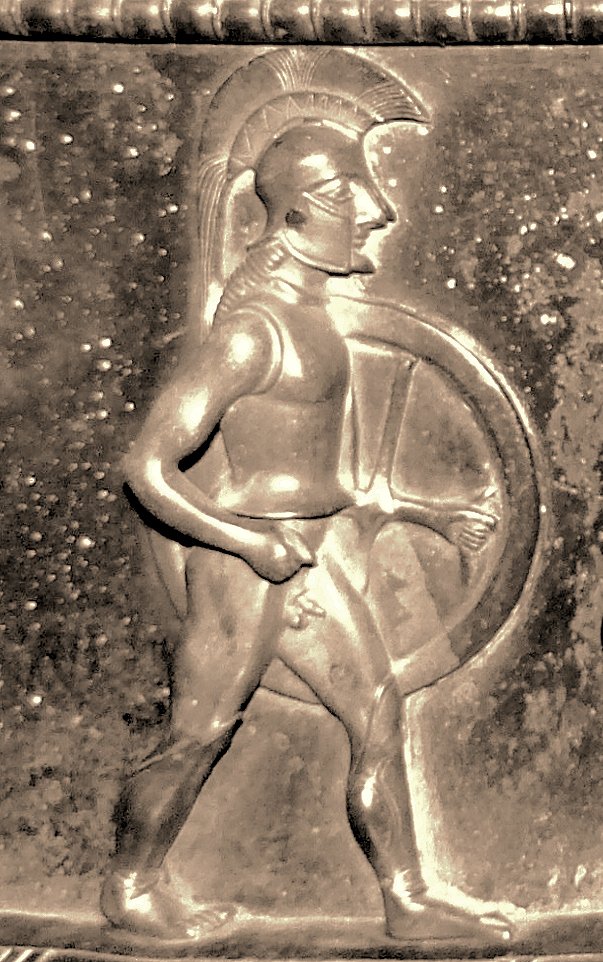
The band of figures around the neck rewards a close look. It shows a procession of hoplites (Greek foot soldiers in helmets and greaves, shields on their arms, spears in hand) walking beside four-horse chariots, each with its driver. Every figure was made separately and fixed in place, and the horses' legs overlap so the eye reads them as a crowd moving off to war or to a funeral games. It is Greek to the bone, the kind of scene painted on Greek vases of the same years. Whoever ended up owning it in Gaul was looking at a picture of a world they had never seen.
Over the mouth of the bowl sat a lid, a shallow bronze dish weighing on its own more than a heavy suitcase, and on top of that stood a small statuette of a woman in a pleated robe, one hand raised. She is often read as a servant or a goddess presiding over the wine. She is also, by chance or design, a tiny female figure standing guard over a vessel that would be buried with a woman. Where exactly the krater was made is still argued. Some point to Laconia, the region around Sparta, whose bronzeworkers had the reputation and the skill; others to the wealthy Greek cities of southern Italy, Sybaris or Tarentum, closer to the trade routes that ran north. There is no maker's signature, only the quality, which is the highest.
The woman on the wagon
Strip away the bronze and the grave is still extraordinary. The woman lay on the body of a dismantled four-wheeled wagon: a vehicle, not a bier, a real cart taken apart for the tomb. She had died somewhere between thirty and forty, and stood around 1.6 metres tall. She was not dressed plainly. There were bronze anklets and bracelets, some of stone and one strung with amber, brooches of bronze and iron, beads of amber and stone, and a shallow silver bowl. Set out with her were the tools of the feast: an Etruscan bronze wine jug, cups from Etruria and from Athens, basins of bronze. She was buried as someone who hosted, or presided over, the drinking.
And at her head lay the gold. A band of twisted, rope-like gold, 480 grams of it, twenty-four carats, finished at each end with a flat plaque resting on a lion's paw, and on each plaque a tiny winged horse. It is one of the finest pieces of ancient goldwork found anywhere in Europe, and it is the object that was stolen in 2026. For decades scholars have argued about how it was worn: looped at the throat like a torc, in the Celtic manner, or set across the brow like a diadem. The little horses give a clue, and they point away from Gaul entirely.
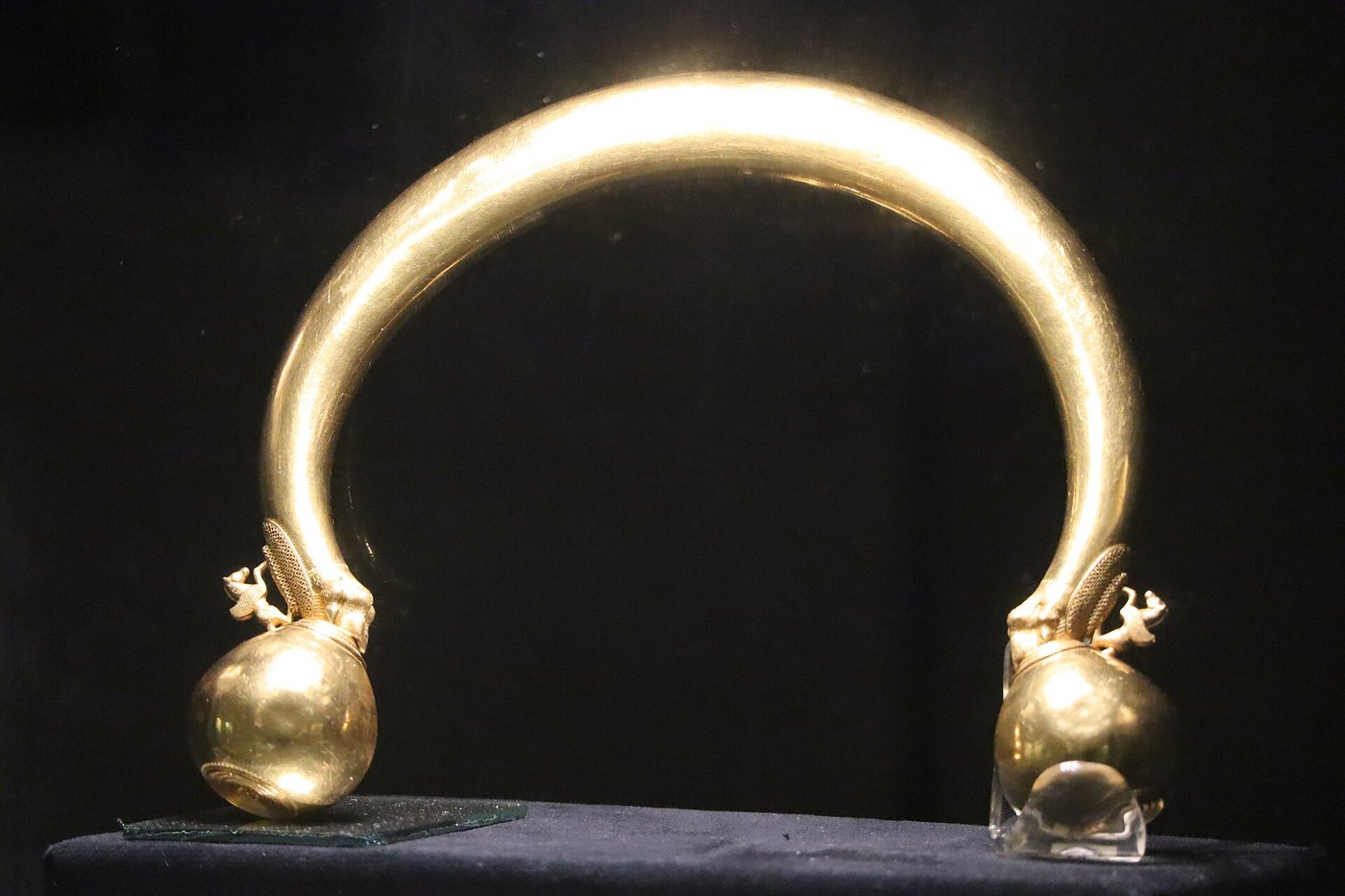
Look closely at the winged horses at the ends of the band. They are not the light, nervous animals of Greek art. They are thick-necked and heavy-maned, closer to the horses that gallop across the goldwork of the steppe peoples far to the east. That has led some to think the ornament was not made locally at all, but came out of a workshop where Greek and steppe styles met, perhaps one of the Greek trading colonies on the north coast of the Black Sea, where craftsmen worked gold for Scythian customers. If that is right, then the woman of Vix was buried in gold that had travelled almost as far as her bronze, from the opposite corner of the ancient world. Two of her greatest treasures came from two different foreign horizons, and met only in her grave.
Why a Celtic hilltop wanted a Greek wine bowl
None of this was loot, and none of it was accident. The imported drinking gear at Vix is the clearest sign of a system that ran for generations. The chiefs on hills like Mont Lassois controlled something the Mediterranean cities wanted: the routes north to tin, and the raw metals, salt, furs and slaves that came down them. In exchange the Greeks and Etruscans sent wine and the equipment for drinking it in style: jugs, cups, strainers, and, at the very top of the scale, kraters. A great mixing bowl was not just a container. It was a statement that the person who owned it could host the kind of feast a Greek aristocrat would recognise, and could reach across a continent to furnish it.
The krater at Vix is that logic taken to its limit. You do not order a bowl of 1,100 litres because you need to mix that much wine. You acquire it because no one else has one, because the sheer scale of it announces a reach and a wealth that ordinary imports cannot. It may have been a diplomatic gift, a gesture from a Greek city to a ruler whose goodwill kept the trade road open. It may have been bought outright. Either way it was a Mediterranean object doing a Celtic job: turning wealth into status, and status into the right to rule.
What the woman herself was, in the society that buried her, has no settled answer. The wagon, the gold and the greatest bronze in the known world say power without a doubt, but power of which kind? Some read her as a ruler in her own right, a queen at the head of the Mont Lassois community. Others see a priestess, the human centre of a cult of feasting and the sacred drink, the living counterpart of the small figure on the krater's lid. Still others argue that the grave marks not a person but a role: whoever held a certain office at Vix was buried like this, and this time the office was held by a woman. The goods tell us she mattered enormously. They do not tell us whether she gave orders, blessed the wine, or both.
The trouble with calling her a princess
She is known to the world as the Lady of Vix, or, more often, the Princess of Vix. Both titles were pinned on her by modern people, and both carry more than they should. When the grave was first found, the very richness of it caused a problem for the men studying it. In the 1950s the buried leaders of this world were assumed to be male; a grave this grand ought to hold a warrior or a chief. The bones said otherwise, and rather than accept a powerful woman, some proposed that the body might be a man in woman's dress, a priest of some kind. The jewellery, the reasoning went, could not simply mean what it looked like it meant.
Careful study of the skeleton settled the biology. The remains are those of a woman. Her skull carries a few features that read as slightly heavy or "androgynous," which is exactly the sort of ambiguity that let the earlier guesses run, but the overall verdict, argued most fully in a study published in 2002, is female. What the long detour reveals is less about Vix than about the people digging it up. Faced with wealth, they expected a man; faced with a woman, they reached for an explanation that would let the wealth stay masculine. The grave had to be talked out of what it plainly showed.
The myth: the Princess of Vix was a Celtic king's daughter, a young royal whose family's rank explains the gold and the great bronze bowl heaped into her grave.
The reality: "princess" is a modern label with no evidence behind it. We do not know her name, her family, or her exact place in Vix society, and there is no sign she was young; she was a grown woman of thirty to forty. She may have been a ruler, a religious leader, or the holder of an office that outlived any one person. The word "princess" makes her, without anyone noticing, a decorative dependant of some more important man. Everything actually in the ground says she was the important one.
The empty case
For seventy years the treasures of Vix sat in the museum at Châtillon-sur-Seine, a few miles from the mound. The krater, too big and too fragile to move without great care, became the centre of the collection; the gold lay in its case nearby. Generations of visitors came to see the bowl that should not exist and the gold of the woman who owned it. It was, for a small Burgundian town, the thing that put it on the map.
Then came the theft. The museum had been targeted before (an attempt in the winter of 2025, another only days earlier in July 2026), and on the 24th the thieves succeeded, walking in as paying visitors and out with the gold. A suspect in his twenties was arrested within days, but a piece of worked gold is easy to melt and hard to trace, and at the time of writing the ornament itself had not been recovered. If it was melted down, then 480 grams of metal that survived twenty-five centuries in the ground, two world wars and a hundred generations of ploughing were destroyed in a single summer morning for the price of the gold by weight.
The krater is still there. It is too large to carry out through a door, and in that clumsiness lies its safety: the same size that made it a marvel makes it almost impossible to steal. There is something fitting in that. The woman of Vix was buried with two treasures from opposite ends of the known world, and the one that endures is not the delicate gold but the vast, awkward bronze, the object nobody could quite believe reached her, and nobody can quietly take away. It has now outlasted the empire that made it, the people who buried it, the scholars who argued over its owner, and, perhaps, the very gold it once shared a grave with. It was built to be seen and never moved. Two and a half thousand years on, it still cannot be.
Read next: Gundestrup Cauldron: Celtic Gods, Thracian Hands, Foreign Silver.
Sources & further reading
- Joffroy, René, Le Trésor de Vix — the excavator's own account of the discovery and the contents of the grave.
- Rolley, Claude (ed.), La tombe princière de Vix — the full scholarly publication of the burial, the krater and the goldwork.
- Knüsel, Christopher J., "More Circe than Cassandra: The Princess of Vix in Ritualised Social Context," European Journal of Archaeology (2002) — the osteological reassessment and the case against the "man in disguise" reading.
- Arnold, Bettina, "The Deposed Princess of Vix: The Need for an Engendered European Prehistory" — on how modern assumptions shaped the interpretation of the grave.
- Chaume, Bruno, and others, on the excavations at Mont Lassois and the great hall — reports on the settlement that the Vix burial belonged to.
- Musée du Pays Châtillonnais / Trésor de Vix — the museum's own account of the collection and, from 2026, the theft of the gold torc.
Image credits (via Wikimedia Commons): the Vix krater — WikiRigaou (CC BY-SA 4.0); the krater's Gorgon handle — User:Ivory (public domain); the hoplite-and-chariot frieze — Oblomov2 (CC0); the gold torc of Vix — GO69 (CC BY-SA 4.0); Mont Lassois — Claude Piard (CC BY-SA 4.0).