Before dawn on 21 April 1526, a sleepless Turco-Mongol adventurer named Zahir ud-Din Muhammad Babur stood behind a barricade of seven hundred bullock carts lashed together with rawhide ropes on the plain outside the small town of Panipat, north of Delhi. He had been camped there for eight days, staring across at a Sultan's army several times the size of his own, wondering whether the enemy would ever attack at all. That morning, they finally did. Within a few hours the Delhi Sultanate that had ruled northern India for three centuries was finished, its Sultan lay dead under a pile of his own soldiers, and a new empire, one that would eventually stretch from Kabul to the Bay of Bengal and last for more than three hundred years, had been born in the space of a single battle. Five centuries on, historians still call the collision of that morning the moment gunpowder rewrote the map of India.
The First Battle of Panipat is one of those rare hinge-points where a single day's fighting changed the course of a subcontinent. It ended the Delhi Sultanate and installed the Mughal dynasty that would rule, in one form or another, until the British formally abolished it in 1858. And yet the battle itself was won not by overwhelming numbers (Babur's army was outnumbered by anywhere from three to five to one) but by a combination of field fortification, disciplined manoeuvre and, decisively, artillery that most of India's armies had never faced before. It is a story of an exile with almost nothing left to lose, a Sultan whose own nobles had begged an invader to remove him, and eight tense days of waiting that ended in an hour and a half of slaughter.
A prince who had already lost everything once
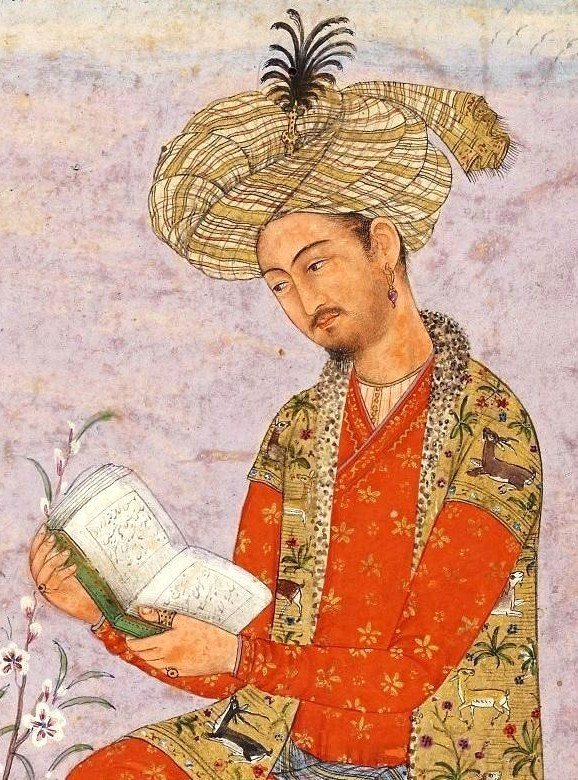
Babur did not arrive in India as a conquering emperor with a grand plan. He arrived as a survivor. Born in 1483 in the Fergana Valley, in what is now Uzbekistan, he was descended twice over from history's most feared conquerors: from Timur (Tamerlane) on his father's side, and from Genghis Khan through his mother's line. That pedigree should have guaranteed him a throne. Instead, it guaranteed him a childhood of war. He inherited the small kingdom of Fergana at the age of twelve, seized the fabled city of Samarkand not once but twice, and lost it both times to rival Timurid and Uzbek claimants. By his mid-twenties, the great cities of Central Asia that were his birthright were closed to him for good.
What Babur did next says everything about him. Rather than dying a minor pretender in the mountains, he turned south, seized the city of Kabul in 1504, and built himself a new base almost from nothing. For two decades Kabul was his consolation prize, a mountain kingdom he ruled capably while never quite giving up on something grander. He raided across the Khyber Pass into the Punjab several times in the 1510s and early 1520s, testing the Delhi Sultanate's defences and growing increasingly convinced that Hindustan's wealth was there for the taking by whoever brought superior firepower and discipline. What he was missing was an invitation, and an excuse. In 1526, both arrived from an unexpected direction: Delhi itself.
The Sultan whose own men wanted him gone
By the 1520s the Delhi Sultanate, then ruled by the Lodi dynasty, was rotting from within. Sultan Ibrahim Lodi had inherited the throne in 1517 and set about a project of centralising royal power that any medieval Afghan nobleman would have recognised as a direct threat: stripping the great Lodi and Afghan chieftains of their traditional autonomy, executing or imprisoning rivals, and ruling, in the words of contemporaries, with a harshness that alienated the very aristocracy his dynasty depended on. Ibrahim was not a fool or a weakling (he could field a formidable army), but he had made himself deeply unpopular with the men who commanded his armies and governed his provinces.
Two of those disaffected men changed history. Daulat Khan Lodi, the powerful governor of the Punjab, and Alam Khan, Ibrahim's own estranged uncle who nursed his own claim to the throne, independently reached the same conclusion: the only way to be rid of Ibrahim was to bring in outside muscle. Both sent envoys across the mountains to Kabul, inviting Babur to invade India and depose the Sultan. It was, in effect, an open door held by the Sultanate's own senior officials. Babur, who had been probing at that door for years, did not need to be asked twice.
Babur's invasion of India was, on paper, a rescue mission gone rogue. He initially marched south in response to real invitations from Ibrahim Lodi's own governor of the Punjab and the Sultan's disgruntled uncle, both hoping Babur would help remove Ibrahim and then withdraw, leaving one of them in charge. Babur took their invitation, took their help, and then simply kept Hindustan for himself. Daulat Khan Lodi ended his days stripped of power under the very invader he had summoned.
The march south, and a battlefield chosen with care
Babur crossed the Indus in late 1525 with a force historians estimate at somewhere between twelve and twenty thousand men: a mixed army of Central Asian and Afghan cavalry, matchlock-armed infantry, and, most importantly, a corps of Ottoman-trained gunners under two named specialists, Ustad Ali Quli and Mustafa Rumi, who had brought Ottoman cannon-founding and gun-carriage techniques east with them. Against him, Ibrahim Lodi mobilised an army that Babur's own memoirs, and most chroniclers since, put at anywhere from forty to a hundred thousand men, backed by close to a thousand war elephants. Those beasts had terrified and trampled armies across South Asia for two thousand years, and no army north of the Himalayas had ever needed to fight them.
The two forces converged near the town of Panipat, on the open plain that has hosted three separate decisive battles across Indian history precisely because it offered flat, unobstructed ground for large armies to manoeuvre, which is exactly why Babur did not want to fight there on Ibrahim's terms. Heavily outnumbered, he needed the terrain to work for him rather than against him, and he found the answer in an ordinary Delhi town.
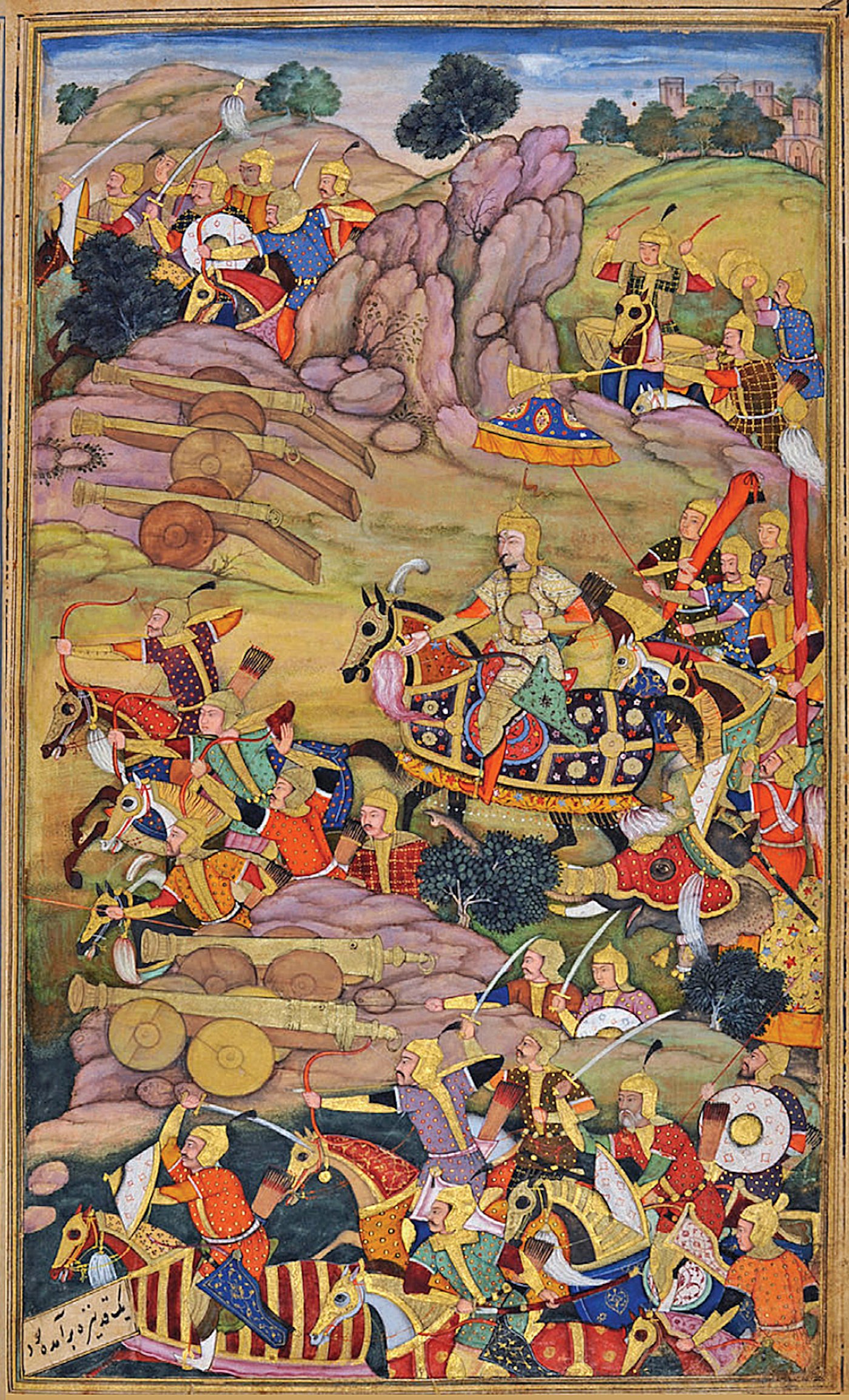
Babur anchored his right flank on Panipat's houses and the cover they offered, and secured his left with ditches and felled trees, so that Ibrahim's far larger army could not simply flow around his flanks. Across his own front he lashed together some seven hundred bullock carts (a war-cart barrier the Ottomans called araba) with gaps just wide enough for horsemen to sortie through, and behind the carts he positioned his artillery, protected by wheeled wooden mantelets so the guns could be angled and moved without exposing the gunners. It was, in essence, a mobile fortress built in a matter of days on open ground, something no army in India had ever had to fight through before.
Eight days of nerves
Then came the waiting. Babur reached Panipat around 12 April 1526 and dug in; Ibrahim's army arrived soon after and simply sat opposite him. For eight days neither side attacked in force. Babur, by his own admission in his memoirs, grew anxious that Ibrahim would simply starve him out or wait for reinforcements, and he tried repeatedly to provoke a response, sending a strong raiding party against the Sultan's camp by night in the hope of drawing his army into a premature, disorganised attack. The raid caused some confusion but did not bring on the general battle Babur wanted. Ibrahim, for his part, seems to have been in no hurry, confident that the sheer weight of his numbers made the outcome a formality whenever he chose to move.
"I never saw such a well-arranged force as Sultan Ibrahim's army; indeed compared with mine, it was as a hundred to twelve or thirteen thousand men. But God had given his troops no unity of purpose, no discipline; each captain had his own opinion, each man his own way of fighting."— paraphrased from the Baburnama, Babur's memoir of the campaign
Babur used the standing days well, reinforcing his defences and refining a tactic borrowed from steppe warfare called the tulughma: dividing his cavalry into a fixed centre and flanking wings, each wing further split into forward and rear detachments, so the flanks could swing wide once battle was joined and turn a frontal fight into an envelopment. It was a manoeuvre built for a smaller, faster force facing a larger, slower one.
The morning of 21 April
On the ninth day, Ibrahim finally advanced his whole army at first light, apparently intending simply to overwhelm Babur's position by weight of numbers before it could be reinforced. It was, in hindsight, exactly the mistake Babur had spent eight days hoping for. Ibrahim's vast front, packed with cavalry, infantry and war elephants, surged forward into ground it had not scouted, crowded by its own numbers, and slammed into a barricade of chained carts it had no experience of fighting through.
Behind that barricade, Ustad Ali Quli's gunners opened fire. The cannon and matchlocks of Babur's centre tore into the leading ranks of Ibrahim's army at close range, and, by nearly every account of the battle, the noise and smoke of gunfire panicked Ibrahim's war elephants, sending some of the huge animals careening backward through their own advancing ranks, trampling the soldiers behind them and turning the Sultanate's proudest weapon into a source of chaos in its own army. As the Sultan's front stalled and clogged against the carts, Babur's flanking wings executed the tulughma, swinging wide around both sides of the packed, immobile mass and closing in from the rear and flanks. Ibrahim's enormous army had no room left to manoeuvre and no space to retreat.
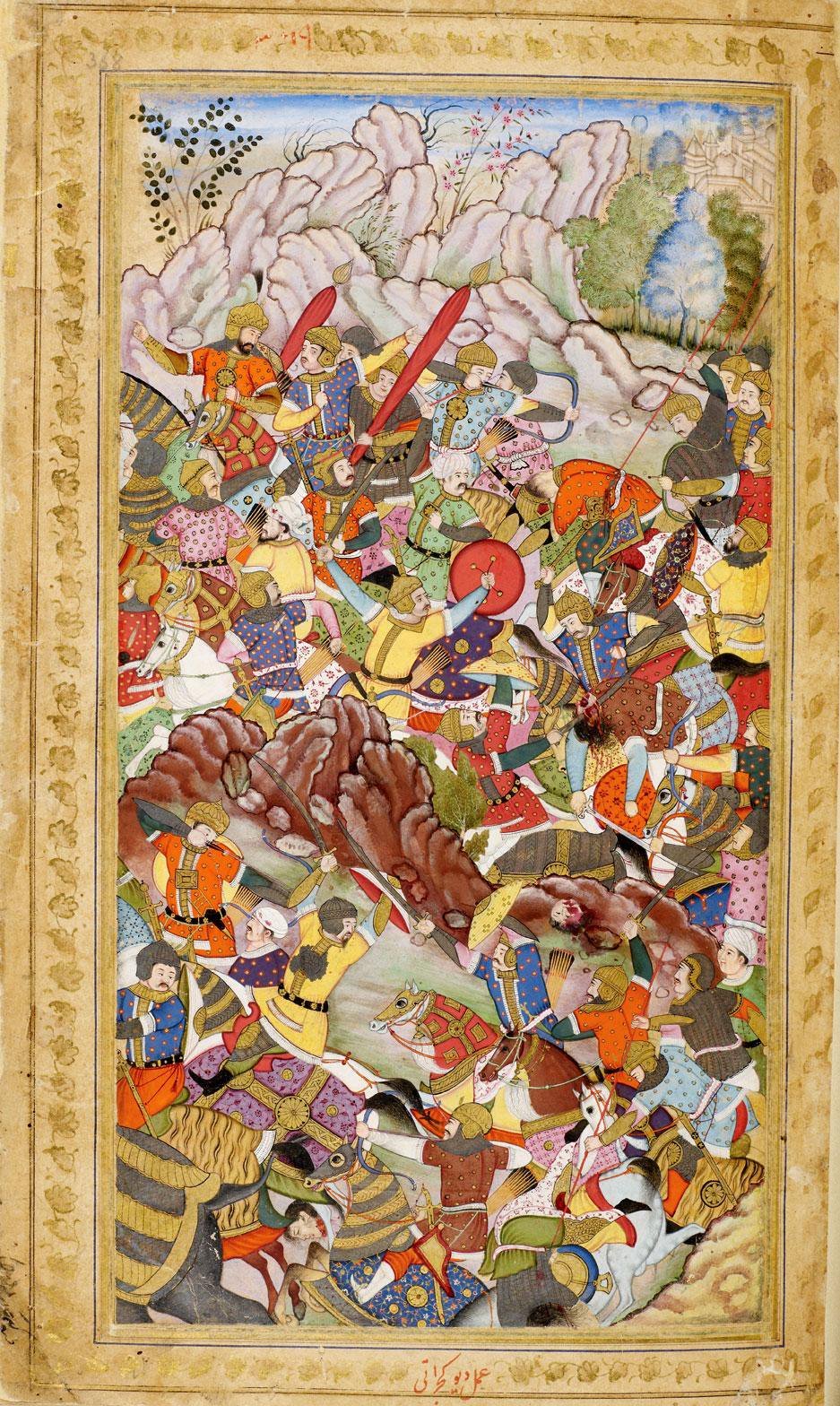
The fighting was over by around mid-morning, perhaps two or three hours after it began, remarkably brief for a battle that changed the fate of a subcontinent. Ibrahim Lodi himself was killed in the crush, cut down, according to tradition, still fighting near the centre of his broken army; roughly fifteen to twenty thousand of his men are said to have died with him, many trampled or crushed as their own numbers turned against them in the chaos. Babur's casualties were a fraction of that. A Sultanate that had ruled from Delhi for over three hundred years ended, for practical purposes, in a single morning.
"Babur won purely because he had guns and Ibrahim Lodi didn't."
Gunpowder mattered, but it was not a magic wand. Babur's twenty-odd cannon and handful of hundred matchlockmen could not, by themselves, have killed tens of thousands of men in a few hours; most of the carnage came from close-quarters cavalry fighting, trampling elephants and the tulughma envelopment. What the guns and the cart barrier actually did was psychological and tactical: they stopped Ibrahim's initial charge dead, funnelled his huge army into a jam it could not escape, and bought time for Babur's flanking manoeuvre to close the trap. The Delhi Sultanate also had its own gunpowder weapons by this period and had used artillery before; the real gap was less about possessing the technology than about the combined-arms discipline, foreign expertise and battlefield engineering to use it decisively. Babur won an infantry-and-cavalry battle that artillery made possible, not an artillery battle by itself.
From battlefield to throne
Babur wasted no time turning victory into rule. Within days he sent his son Humayun ahead to secure Agra, then the Sultanate's treasury city, and rode into Delhi himself soon after, where Friday prayers were read in his name, the traditional public declaration of a new sovereign in Islamic India. The captured Lodi treasury at Agra was, by every account, staggering, and Babur famously distributed much of it among his commanders and even sent gifts back to relatives and holy men in Central Asia, a generosity that later earned him the nickname "Qalandar," the wandering dervish, for his seeming indifference to hoarding wealth he had just won.
Babur did not, in fact, have an easy or guaranteed hold on his prize. Rajput and Afghan resistance continued for years, most seriously at the Battle of Khanwa in 1527 against the formidable Rajput confederacy led by Rana Sanga, another close-run fight Babur won through the same combination of carts, cannon and disciplined cavalry. Panipat opened the door; it took several more years of hard campaigning before the new dynasty's grip on northern India was secure. But Panipat was the door itself, and without it none of what followed would have happened at all.
Historians still argue over how much credit Panipat deserves as a turning point versus a symptom of a collapse already underway. One school emphasises Babur's real military innovation (the araba-and-artillery system, the tulughma, disciplined command) as the decisive factor that let a small force beat one many times its size. Another school points out that the Delhi Sultanate had been fracturing for decades before 1526, riven by exactly the noble disaffection that handed Babur his invitation in the first place, and argues that almost any sufficiently organised outside force could have exploited that rot. The truth probably sits between the two: Babur needed both the opportunity created by Lodi misrule and the tactical edge of Ottoman-style gunpowder warfare. Either alone might not have been enough; together, they ended a three-hundred-year-old Sultanate in a single morning.
Why the empire, not just the battle, mattered
What makes the First Battle of Panipat more than a footnote of medieval military history is what grew out of it. Babur himself ruled his new conquest for barely four more years before dying in 1530, and openly worried, in his memoir, whether the whole project would collapse the moment he was gone. He found Hindustan's climate, food and customs alien and said so with startling candour for a man who had just won it. But the dynasty he founded did not collapse. His son Humayun lost the throne to an Afghan rival for a decade and then reclaimed it; his grandson Akbar built the fragile conquest into one of the wealthiest, most sophisticated empires on earth. The Mughal Empire that grew from Babur's eight anxious days at Panipat went on to produce the Taj Mahal, the Red Fort, and a flowering of Indo-Persian art, architecture and governance that later empires, including, eventually, the British, inherited and adapted. It lasted, in name if increasingly not in power, until 1857.
Panipat's ground kept its grim significance. The same plain hosted two more decisive battles in the centuries that followed: in 1556, when Akbar's forces secured Mughal rule against a resurgent challenger, and in 1761, when an Afghan army shattered the Maratha Confederacy in one of the bloodiest single days in pre-modern Indian warfare. Three empires effectively rose or fell on that one stretch of flat Haryana farmland, a coincidence of geography that has made "Panipat" a byword in Indian historical memory for the battle that decides everything.
Five hundred years on
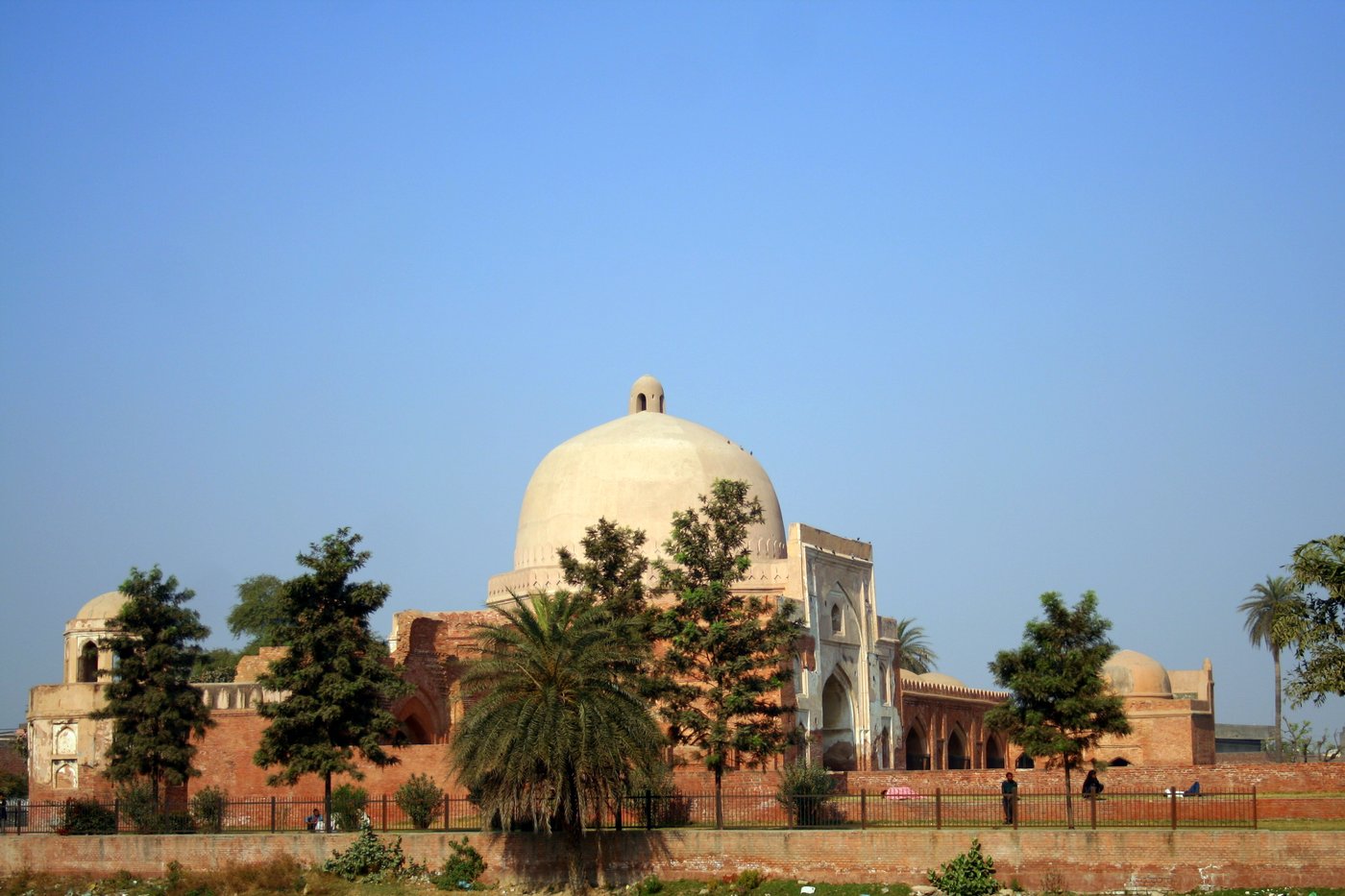
2026 marks five centuries since that April morning, and the anniversary lands at an interesting moment for how the battle is remembered. Modern popular retellings sometimes flatten it into a clean story of superior Western-style technology triumphing over a hidebound Sultanate, or, conversely, into an equally clean story of a rapacious foreign invader stealing a kingdom that belonged to someone else. Both versions are too simple. What actually happened at Panipat was messier and more human: a self-made exile with nothing left to lose, invited in by the very court he would go on to conquer, who staked everything on eight days of nerve, a barricade of ordinary farm carts, and a handful of foreign gunners. He won a subcontinent almost by accident, then spent the rest of his short life wondering if he could keep it. Five hundred years later, the mosque he built to mark the victory still stands in Panipat, largely unvisited, while the empire it announced remains one of the most consequential in world history.
Image credits (via Wikimedia Commons): the Battle of Panipat, artist unknown, Mughal-era ("Painters of Babur"), public domain; idealised portrait of Babur, probably by Aqa Riza, British Museum, public domain; "The First Battle of Panipat" by Deo Gujarati, public domain; Kabuli Bagh mosque, Panipat — Ramesh Lalwani, CC BY-SA 3.0.
Read next: Rani Lakshmibai: The Legend and Truth of the Queen of Jhansi and The Koh-i-Noor: How One Diamond Passed Through Five Empires.
Sources & further reading
- Wheeler M. Thackston (trans.), The Baburnama: Memoirs of Babur, Prince and Emperor — the primary first-hand account of the campaign and battle.
- Satish Chandra, Medieval India: From Sultanat to the Mughals — standard scholarly overview of the Lodi collapse and Mughal founding.
- Iqtidar Alam Khan, Gunpowder and Firearms: Warfare in Medieval India — on the tulughma, araba and the real role of artillery at Panipat.
- William Dalrymple, "The Great Mughal," essays on Babur and the founding of the dynasty.
- Encyclopaedia Britannica, "First Battle of Panipat (1526)"; Britannica, "Babur."