High in the mountains of Svaneti, in the far north-west of Georgia, a herder will still now and then peg a sheepskin flat to the bed of a fast stream, weight it with stones, and walk away. He leaves it for weeks. When he hauls it out the wet wool is stiff with grit, and threaded through the grit (if he has read the river well) are flecks of gold, each too small to notice on its own but bright enough together to be worth the wait. In the summer of 2014 a team of Georgian geologists went into those same valleys to test an old idea, and they came back with wet fleeces and real gold in the fibres. They had gone looking for a myth. They found a method.
The myth is the oldest adventure story Europe kept. A hero sails to the end of the known world for a fleece of gold, wins a sorceress, and comes home changed. We call it Jason and the Argonauts, and for a long time it was filed where such stories go: with the flying rams and sleepless dragons, next to the other things that never happened. Then people started reading the small print. Ancient geographers had left an odd, matter-of-fact note in the margins of the legend: out east, they said, in the land the Greeks called Colchis, people really did catch gold in sheepskins. The fleece was not a metaphor. It was a tool.
A ram that could fly
Start with the story as the Greeks told it, because the shape of it matters. In Boeotia a king took a second wife, and the new queen wanted her stepchildren gone. As the boy Phrixus and his sister Helle were about to be sacrificed, a ram with a golden fleece (a gift of the gods, winged in most tellings, born of Poseidon in some) swept down and carried them off across the sky. Helle lost her grip somewhere over the strait between Europe and Asia and fell; the Greeks named the water for her, the Hellespont, the sea of Helle. Phrixus held on.
He came down at the eastern edge of the Black Sea, in Colchis, and there he did a hard thing: he sacrificed the ram that had saved him and gave its golden fleece to the local king, Aeetes, a son of the sun god Helios. Aeetes hung the fleece on an oak in a grove sacred to Ares and set a serpent that never slept to guard it. That is where it waited.
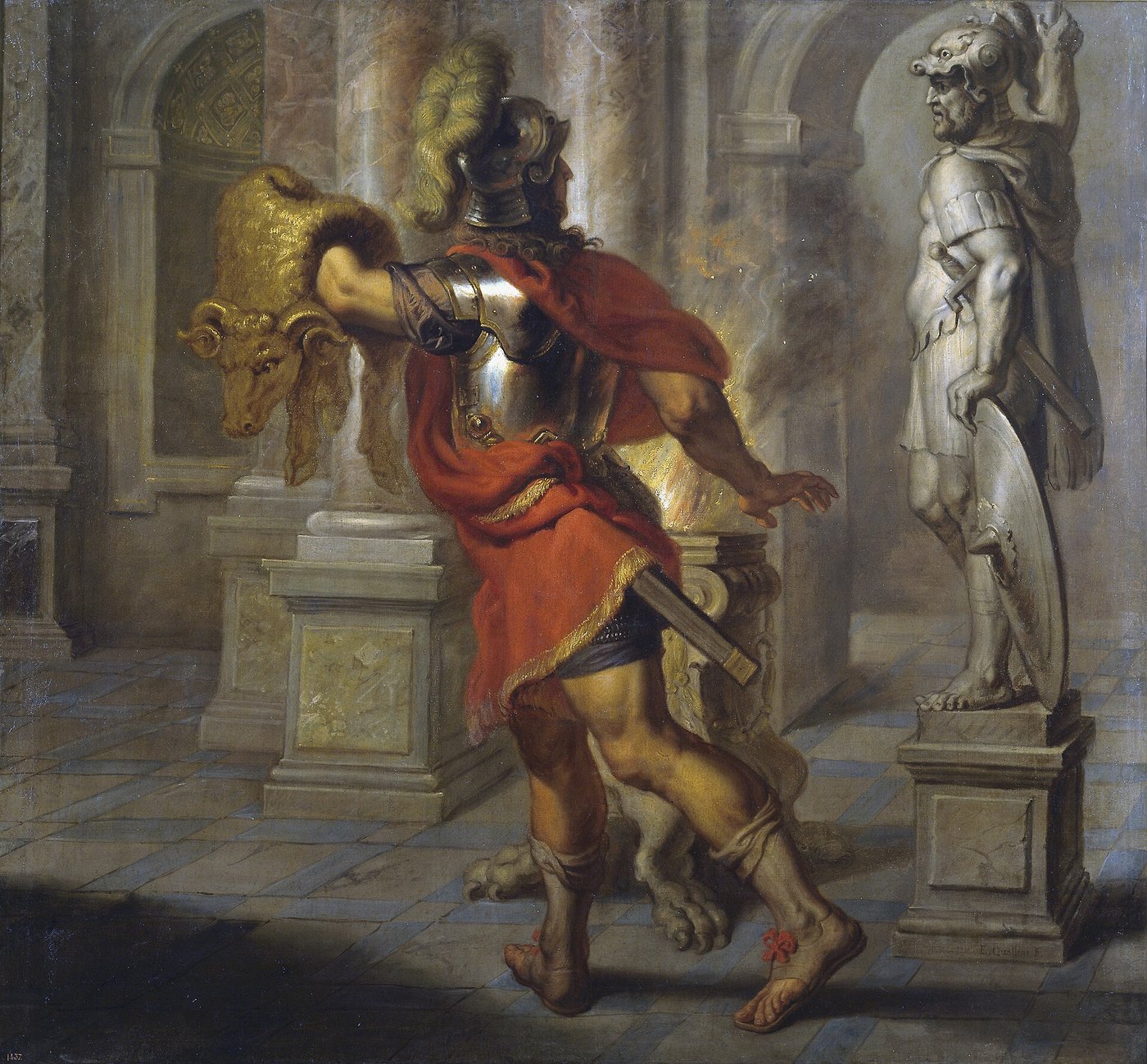
A generation later the quest begins. Far to the west, in Iolcus in Thessaly, a young man named Jason turns up to claim a throne his uncle Pelias has taken. Pelias, unwilling to say no outright, sets an errand he assumes is a death sentence: bring back the fleece from Colchis. Jason builds a ship, the Argo, gathers a crew of the age's greatest names (Heracles, Orpheus, the twins Castor and Pollux) and rows east into the unknown. At the far end he finds not only the fleece but Aeetes's daughter, Medea, a princess and a sorceress who falls for him, drugs the serpent, and hands him the prize. They flee together. What follows (the betrayals, the murders, the long unravelling of Jason and Medea) is another story, and a bleaker one. The fleece itself simply drops out of the tale once it is won, its work done.
For most of the last two thousand years that was the whole of it: a good yarn about a magic sheep's hide. The interesting question is not whether a ram ever flew. It is why the treasure at the end of the earth was a fleece at all: not a crown, not a jewel, not a sword, but a piece of wool.
The kingdom at the edge of the map
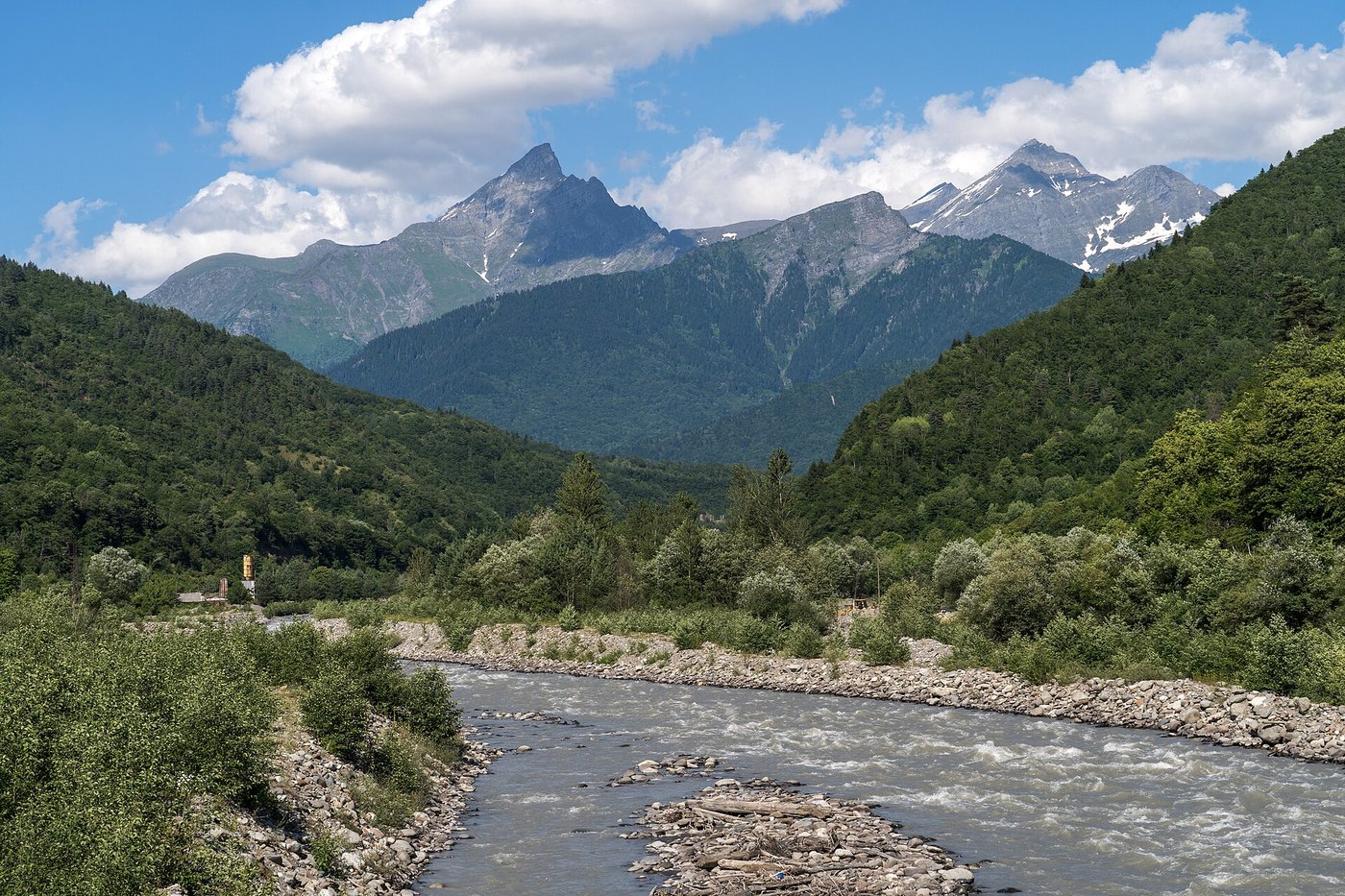
Colchis was a real place, and the Greeks knew it. It lay along the eastern shore of the Black Sea, across the lowland where the Rioni river (the ancient Phasis) comes down off the Greater Caucasus and spreads into a warm, wet, malarial plain. To a sailor from the Aegean it was the last stop before the map ran out: the sunrise coast, the country under the mountains where the giants and the sun's own children were said to live. Calling Aeetes a son of Helios was a way of saying he ruled where the day began.
It was also, and this is what got lost, rich in gold. The rivers running off the Caucasus carry fine placer gold, ground out of veins in the high rock and washed down in the spring floods as invisible dust. A land like that does not need a myth to explain its wealth. It needs a way to gather it, and the people of Colchis had one.
The clearest ancient note comes from the geographer Strabo, writing around the turn of the first century. Describing Colchis and the tribes of the Caucasus, he sets down almost in passing that in their country “the winter torrents bring down gold, and the barbarians obtain it by means of perforated troughs and fleecy skins, and this is the origin of the myth of the golden fleece.” He does not present it as a discovery or a puzzle. He states it as a plain fact he expects his readers to accept, the myth explained in a single sentence, and then he moves on to the next tribe.
Strabo was not alone. Later the historian Appian of Alexandria described the rivers of the Caucasus carrying down an unseen “gold sand,” which the locals caught by sinking thick, shaggy sheepskins into the water and lifting them out heavy with metal. Appian went a step further than Strabo. To his mind the real object of the whole voyage had been the technique itself: the Argonauts had rowed east not for a magic hide but for the know-how of turning a river into a mine.
How to catch gold in a river
The method works because of a single stubborn fact: gold is heavy. A flake of it is nearly twenty times denser than water and far denser than the sand and silt it travels with. Drop the lot into moving water and the light stuff stays in suspension and drifts on, while the gold, given any chance to settle, sinks first and stays down. Every gold pan in history is a way of using that difference. So is a fleece.
Lay a sheepskin, wool up, on the bed of a stream that carries gold, and the fleece becomes a trap built for exactly this. The dense metal flakes drop out of the current and lodge among the crimped fibres; the greasy natural lanolin in unwashed wool helps the finest particles cling; the lighter grit washes over and away. Leave it long enough and the fleece grows heavy with a season's worth of catch. Then you lift it, dry it, and beat the gold loose over a cloth, or, if the flakes are fine and the wool is matted with them, you simply burn the skin and pick the melted gold from the ashes. Either way you end with a handful of metal and, before you burn it, a fleece that quite literally shines.
A fleece is not just an improvised bowl. Its structure makes it better than most simple gear at holding on to the smallest, most easily-lost particles: the “flour gold” that a careless pan flushes straight out. The crimp of the fibres and the tack of the lanolin catch dust that water alone would carry off, which is why placer miners kept using wool, hide and other fleece-like mats long after the Bronze Age, from the Caucasus to the goldfields of the nineteenth century. The Colchians had found, by trial, a very good piece of engineering.
None of this is guesswork any more. The 2014 fieldwork, led by the Georgian geologist Avtandil Okrostsvaridze and later written up in a scientific journal, went to the mountain rivers of Svaneti and Racha, the upper reaches of the Colchian drainage, and did the experiment. They confirmed gold in the sediment, tested sheepskins in the current, and recovered visible metal from the wool. The old herders' trick was not folklore dressed up after the fact. It caught gold in front of the scientists, in the same valleys, from the same rivers, in the way Strabo had described eighteen centuries before.
The goldsmiths of Vani
If Colchis was catching river gold on this scale, you would expect the wealth to show up in the ground. It does. The place to see it is Vani, a hill in the Imereti region of western Georgia, above the plain and near the old trade routes, where a Colchian town rose and fell between roughly the eighth and the first centuries BC.
Vani was dug at first in scattered bursts (the earliest finds were reported in 1851), but the serious work began in 1966 under the archaeologist Otar Lordkipanidze, who ran the excavation for the rest of his life and carried on being felt after his death in 2002, when his colleague Darejan Kacharava took the site forward. What they uncovered was not a poor frontier settlement. It was a sanctuary town rich enough to bury its dead like kings.
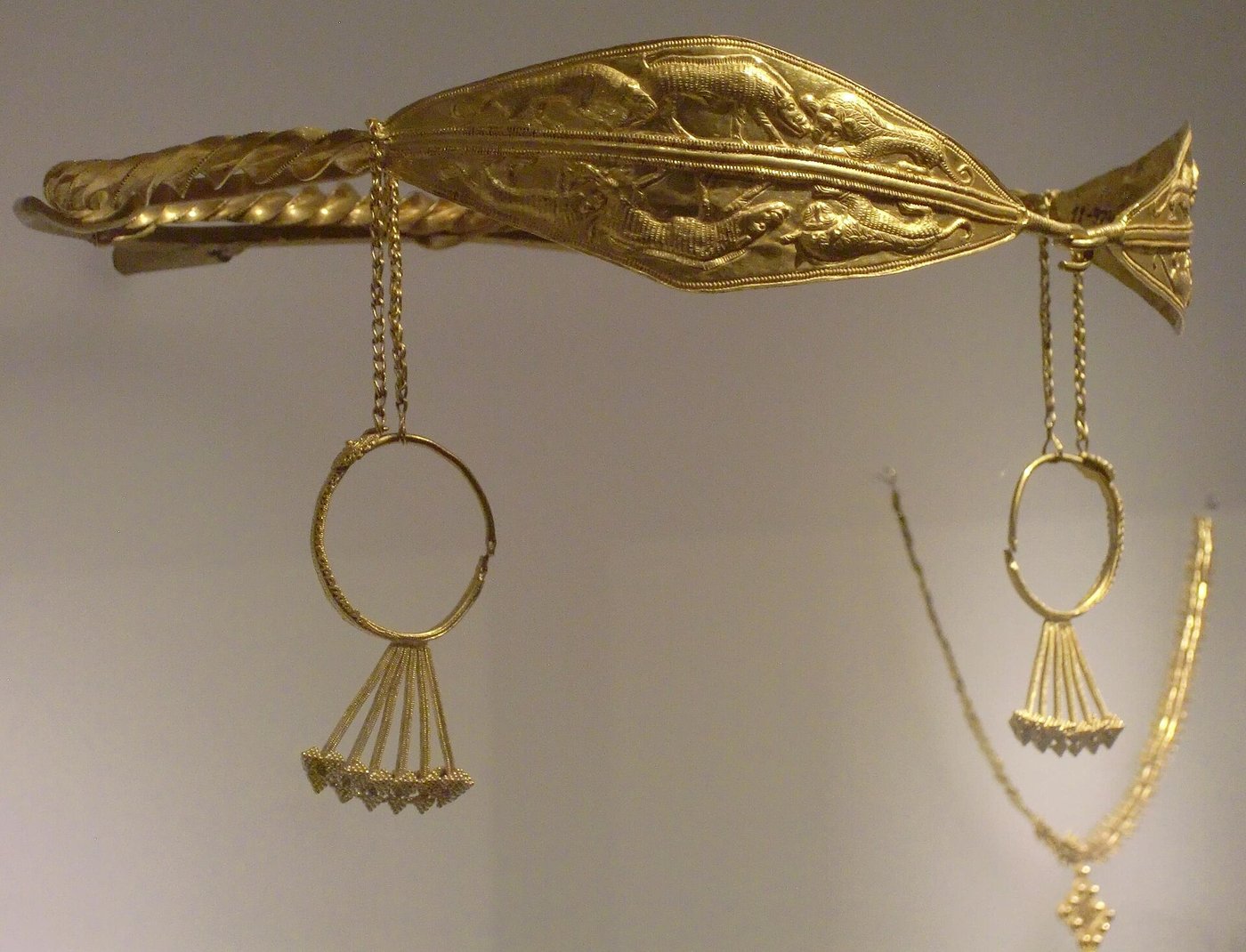
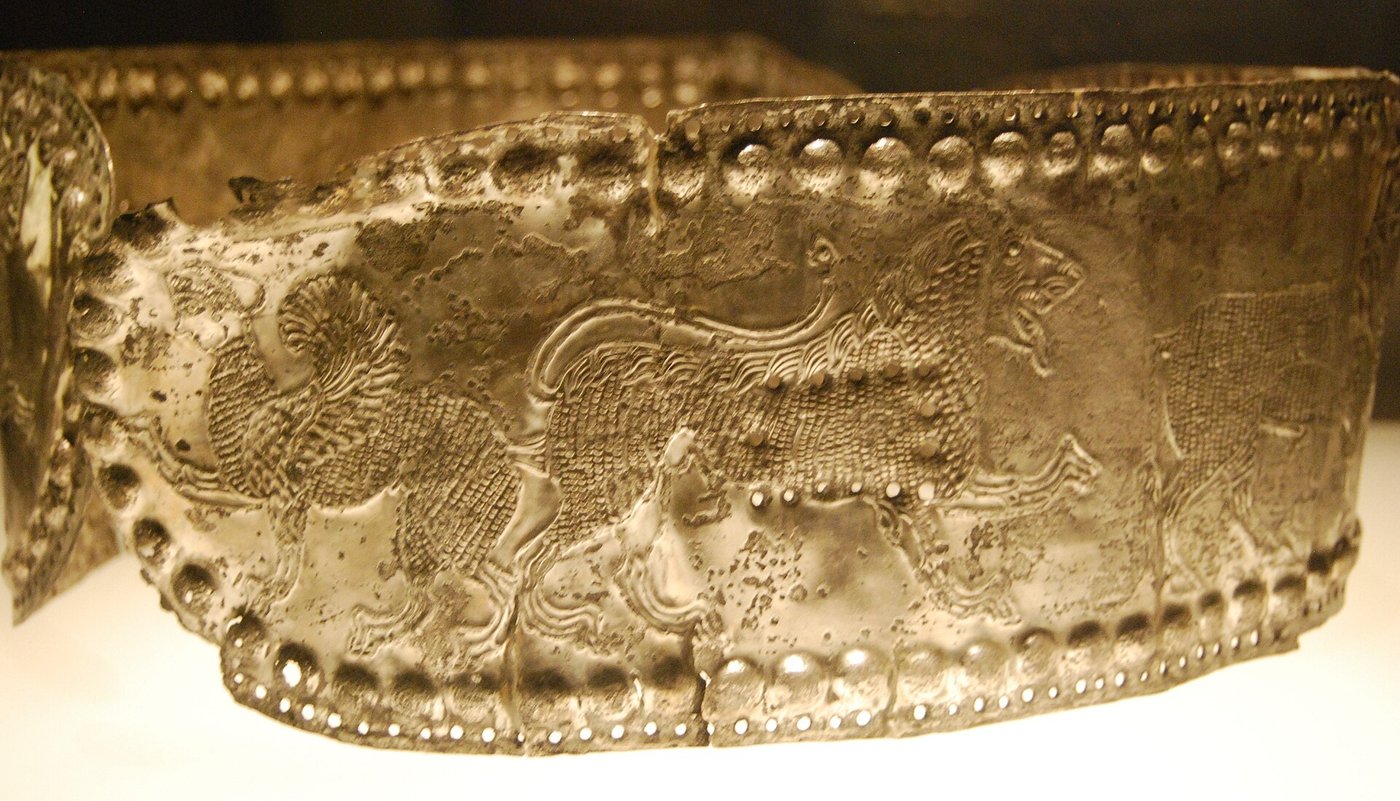
The graves of the fifth and fourth centuries BC are the ones that stop you. Bodies were laid out under shrouds sewn thick with hundreds of tiny gold beads, wearing gold diadems worked with rows of animals (lions, boars, horsemen), and hung with necklaces, earrings and headdresses of a delicacy that took the excavators by surprise. One necklace carries a string of little gold tortoises. The metalwork is fine enough that scholars talk about Colchian goldsmiths developing techniques early, before comparable skill shows up further west in Europe. This was a culture that had gold to spare and the confidence to spend it on the dead.
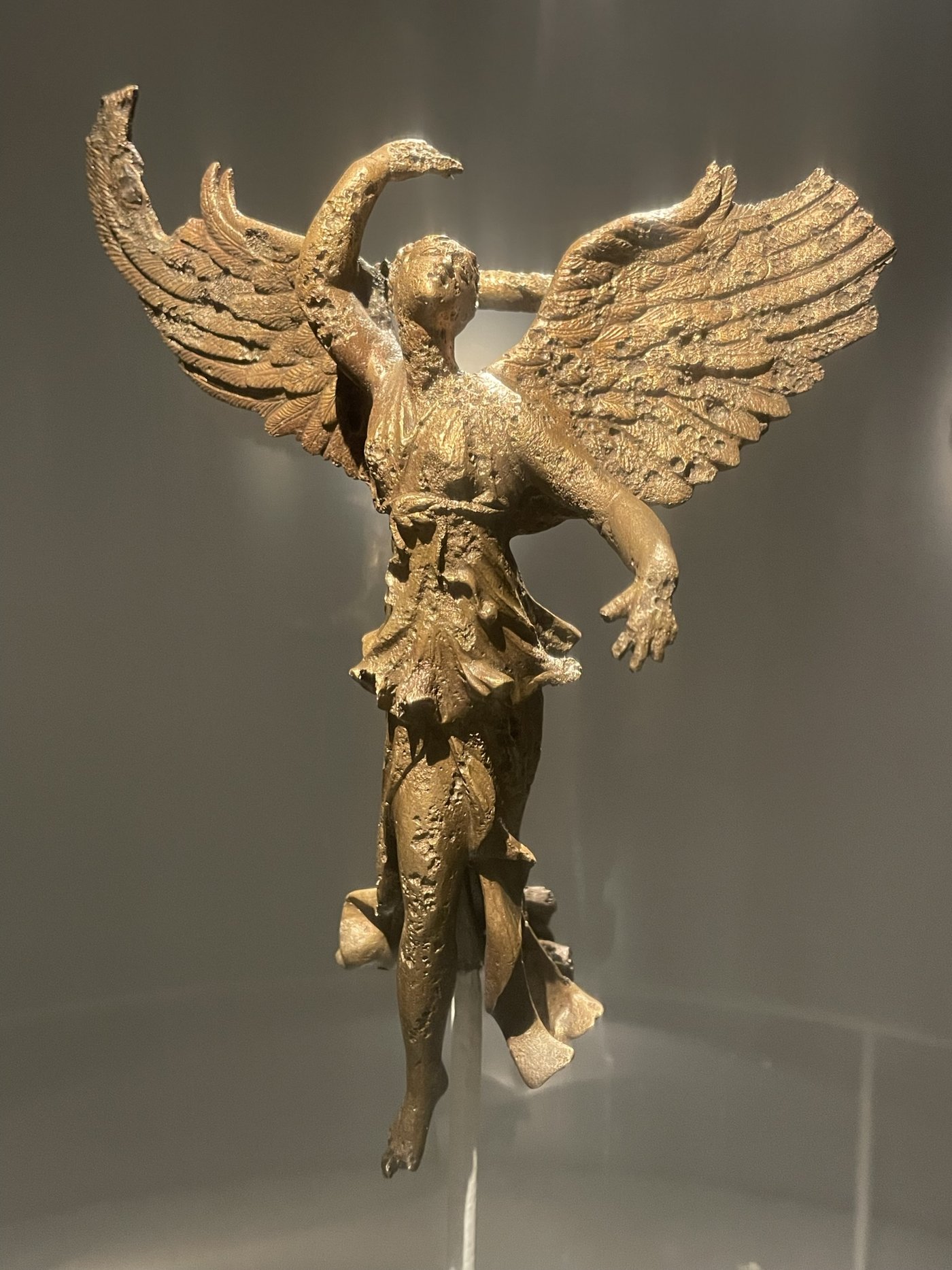
The burials carry a darker signature too. In the richest graves the nobles did not go into the ground alone: the remains of servants, and in some cases horses, were buried with them, a retainer sacrifice with parallels among the Scythian peoples of the steppe to the north. Vani was a place of processions and offerings, of bronze statues and temple architecture in its later phases, and of a wealth that had to come from somewhere. The rivers are the obvious answer.
The fleece, put back together
Set the two halves side by side and the myth stops looking like an invention and starts looking like a memory. There was a real kingdom at the edge of the Greek world, on a coast famous for the sunrise and infamous for its distance. That kingdom sat on rivers full of gold. Its people gathered the gold in sheepskins and grew rich enough to sew their graves shut with it. And a fleece heavy with gold, hung up to dry, is a thing that really glitters.
The myth: the Golden Fleece was the hide of a magical flying ram, a unique wonder-object hung in a sacred grove and guarded by a dragon, pure fantasy with nothing real behind it.
The likelier truth: the fleece was a working gold-catching tool, and the “treasure” it stood for was a whole gold-rich kingdom on the Caucasus rivers. Greek storytellers, hearing of a distant land where you pulled gold from the water in a sheepskin, did what storytellers do: they turned an industrial trick into a single miraculous object and sent a hero to steal it. The wonder was real; it had just been the method, not the magic.
That does not mean Jason existed, or that a ship called the Argo ever tied up on the Phasis. The voyage may fold together several older memories: of trade in the metals of the Black Sea, of the first Greek ventures into a sea they found frightening, of a coast they knew held wealth they could not quite reach. Historians still argue over how much history hides inside the poem, and the honest answer is that we cannot draw a straight line from a fleece in a stream to a named hero on a named deck. What we can say is narrower and stranger: the specific, peculiar detail at the heart of the story, that the prize was a fleece and that it was made of gold, matches a real practice in a real place better than any invented emblem has a right to.
What still runs in the water
The gold has not stopped coming down. The Caucasus is still shedding it into the rivers, grain by grain, the way it did when Colchis was a name that frightened sailors, and in the high villages a few people still know how to catch it in a fleece. When those geologists lifted a dripping sheepskin out of a Svaneti stream and saw the fibres flecked with metal, they were repeating an experiment that Strabo could have watched, and that some Colchian by the Phasis had worked out long before anyone thought to write it down.
The best old myths tend to have a hard little seed of fact buried at the centre, and this is one of the clearest. The dragon is invention. The flying ram is invention. But the shining fleece, the gold in the wool, the far country where the rivers ran rich: those were true, and a version of them is true still. Somewhere in Georgia tonight there is a sheepskin under running water, doing what it has always done, waiting to be lifted out heavy and bright.
Read next: Varna: The World's Oldest Gold, Found by Accident in a Shoebox and Gonur Depe: The Lost Capital That Brewed the Drink of the Gods.
Sources & further reading
- Strabo, Geography (Book 11) — the geographer's brief, decisive note that Colchians caught river gold in perforated troughs and fleecy skins, “the origin of the myth of the golden fleece.”
- Appian, Mithridatic Wars — the Caucasus rivers' invisible “gold sand” and the sheepskins sunk to catch it.
- Okrostsvaridze, A., Gagnidze, N. & Akimidze, K., “A modern field investigation of the mythical ‘gold sands’ of the ancient Colchis Kingdom and ‘Golden Fleece’ phenomena,” Quaternary International — the fieldwork that recovered gold from sheepskins in Svaneti.
- Lordkipanidze, O., Phasis: The River and City in Colchis — the excavator of Vani on the archaeology and setting of ancient Colchis.
- Kacharava, D. & Kvirkvelia, G., Wine, Worship and Sacrifice: The Golden Graves of Ancient Vani — catalogue of the Vani gold and burials (Getty Villa / Institute for the Study of the Ancient World).
- Apollonius of Rhodes, Argonautica — the fullest surviving telling of Jason, Medea and the voyage to the fleece.
Image credits (via Wikimedia Commons): Vani boar diadem — Jonathan Cardy (CC BY-SA 3.0); Jason with the Golden Fleece (1630) — Erasmus Quellinus II (public domain); the Rioni river near Oni — Alexkom000 (CC BY 4.0); Colchis gold display — Gill M L (CC BY-SA 2.0); Vani archaeological site and museum — Carole Raddato (CC BY-SA 2.0).