In 2009, in a quiet room at the University of Pennsylvania Museum in Philadelphia, a skull that had lain in a drawer for eighty years was slid into a medical CT scanner. It had come out of the ground at Ur, in southern Iraq, in the 1920s, and for most of a century the story attached to it was a gentle one: a young woman had walked down into a royal grave in her best gold, drunk something from a little cup, lain down in a tidy row with dozens of others, and slipped away. The scan told a different story. Near the back of the skull was a neat hole the size of a large coin, driven inward, made while the bone was still living. Whoever this woman was, she had not fallen asleep. Someone had hit her very hard with a pointed weapon.
The grave she came from is one of the strangest things ever dug out of the ancient world. Between about 2600 and 2450 BCE, in a corner of the Sumerian city of Ur, a handful of the dead were buried not only with gold and music and jewelled headdresses, but with rows of other human beings (servants, soldiers, musicians, women in silver hair ribbons) laid out around them in the same pit. Nobody had seen anything quite like it before, and nobody has explained it fully since. What follows is the story of that cemetery, of the queen at the centre of it, and of how a few careful scans took apart the beautiful lie we had been told about how its victims died.
The trench Woolley waited years to open
Ur today is a low spread of mud-brick ruins and a restored ziggurat on the flat land west of the Euphrates. In the 1920s it was one of the richest digs on earth. The excavation was run jointly by the British Museum and the Penn Museum, and the man in charge was Leonard Woolley, a sharp, showmanlike archaeologist who understood, better than most of his colleagues, that a dig was also a story you told to the people paying for it.
Woolley knew early on that there was a cemetery on the edge of the old city. He also knew his workmen were not ready for it. When his diggers first struck gold in the soil, he deliberately stopped and moved them elsewhere, and did not come back to the graves in earnest for years, until he trusted his team to lift a bead necklace without turning it to loose beads and mud. It was a rare act of patience, and it paid. Over twelve seasons, from 1922 to 1934, he cleared roughly two thousand graves.
Most were ordinary: a body in a reed mat or a plain coffin, a few pots, a personal seal. But sixteen of them were something else. These were built tombs (stone or brick chambers at the bottom of deep shafts, reached by a sloping ramp), and they were crammed with a kind of wealth that had no parallel anywhere in the world of their time. Woolley called them the royal tombs. The label has been argued over ever since, but the sheer richness is not in doubt.
The queen who named no husband
The tomb that made Woolley famous was catalogued, without romance, as PG 800. Almost every other rich grave at Ur had been robbed in antiquity, sometimes within a generation of the funeral, the thieves tunnelling straight for the gold. PG 800 had not. It came up whole.
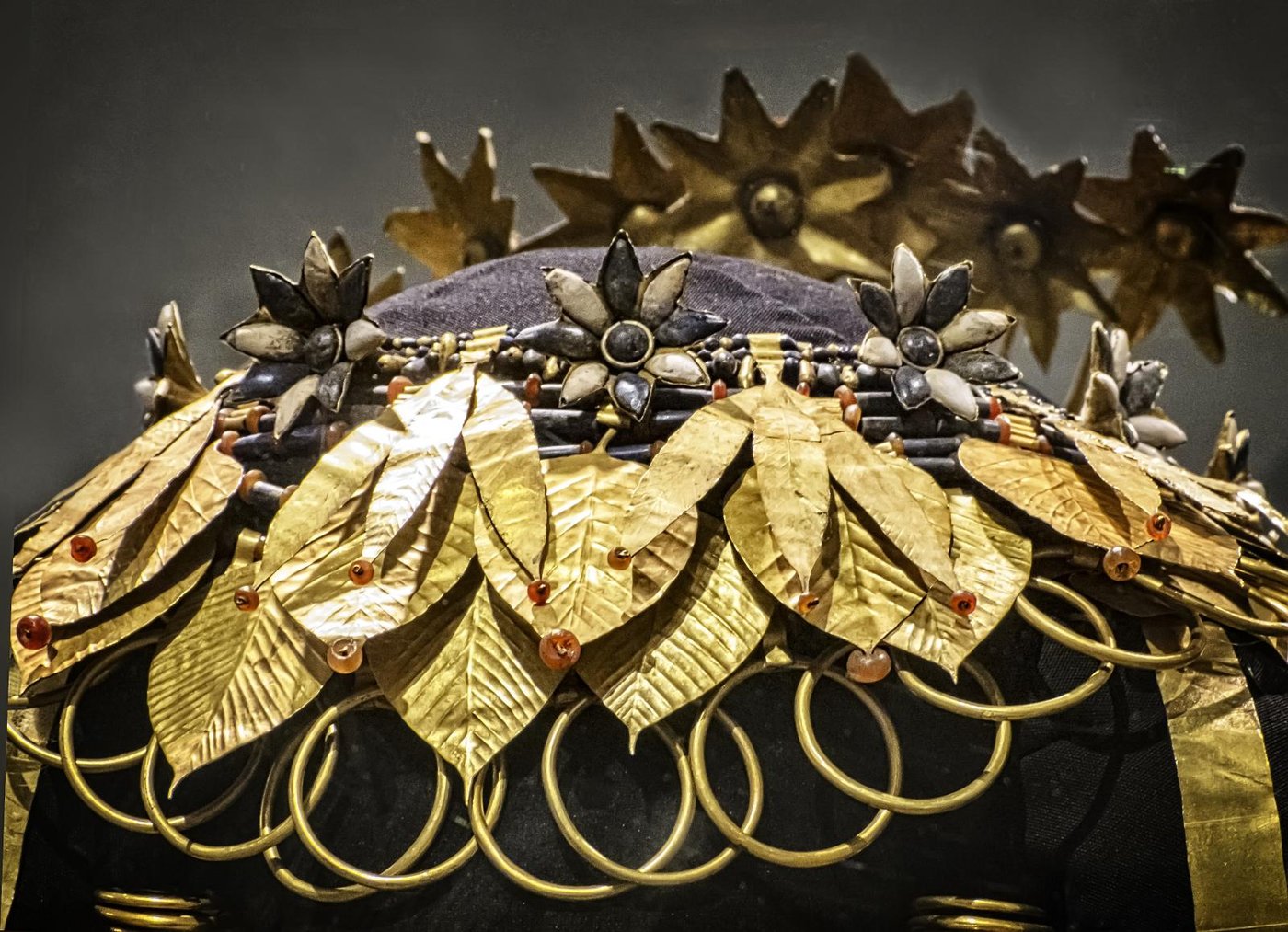
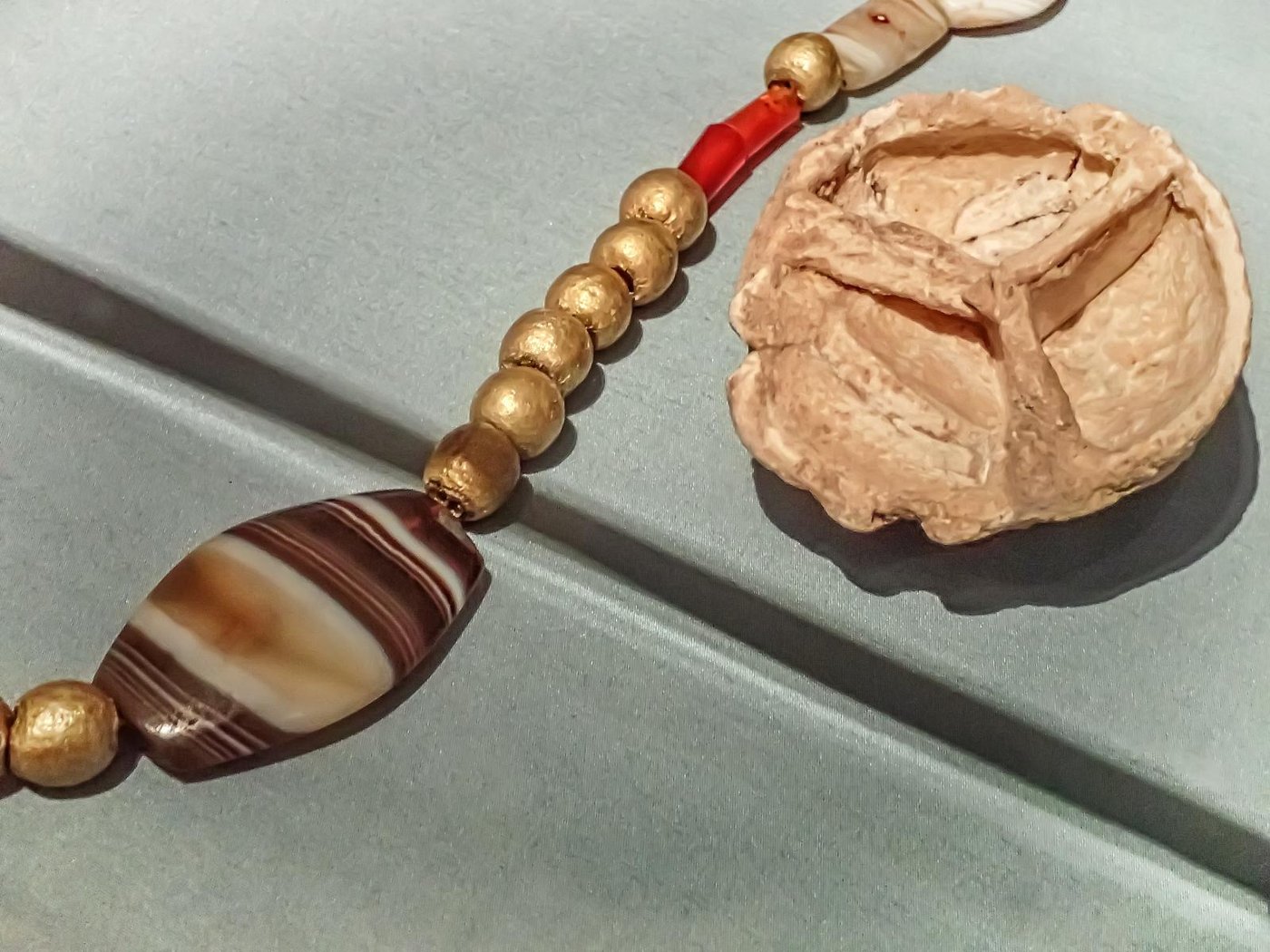
At the centre lay a woman. On and around her was a quantity of gold that is hard to picture from a list: a great headdress of gold ribbon, gold willow and poplar leaves and gold flowers, worn over a wig-like pad of hair, with a tall comb of gold rosettes rising behind; long earrings like folded gold moons; a cape of beads in gold, lapis lazuli and carnelian that ran from her shoulders to her waist; rings on her fingers and a garter of beads at her knee. Beside her head was a cylinder seal cut with her name.
The seal is where it gets interesting. It reads, in the earliest scholars' rendering, Pu-abi (a name once misread as "Shubad"), and gives her a title, nin or eresh, a Sumerian word that covers both "queen" and "lady" and "priestess." What the seal does not do is tie her to a man. Almost every royal woman we know from the ancient Near East is introduced as somebody's wife or somebody's daughter. Puabi is introduced as herself. That single silence has led some scholars to think she held power in her own right, not as a king's consort but as a ruler or a high priestess of the moon god whose city this was. We do not know. Her bones, later examined, were those of a woman around forty, a little under five feet tall. The name on the seal is almost the only certain thing about her.
For decades the queen of Ur was known as Shubad, the reading Woolley's team first gave her seal. That was the Sumerian guess at the signs. As the understanding of the script improved, scholars realised the name was written in Akkadian, a Semitic language, and should be read Pu-abi, perhaps "word of the father." It is a small correction with a large implication: the woman in the most Sumerian of graves may not have been Sumerian at all, but part of the mixed, many-tongued world that southern Iraq already was five thousand years ago.
Gold, and a goat in a bush
The objects from the cemetery are the reason its treasures sit today in three of the world's great museums. They are worth pausing on, because they are the yardstick against which everything else at Ur is measured.
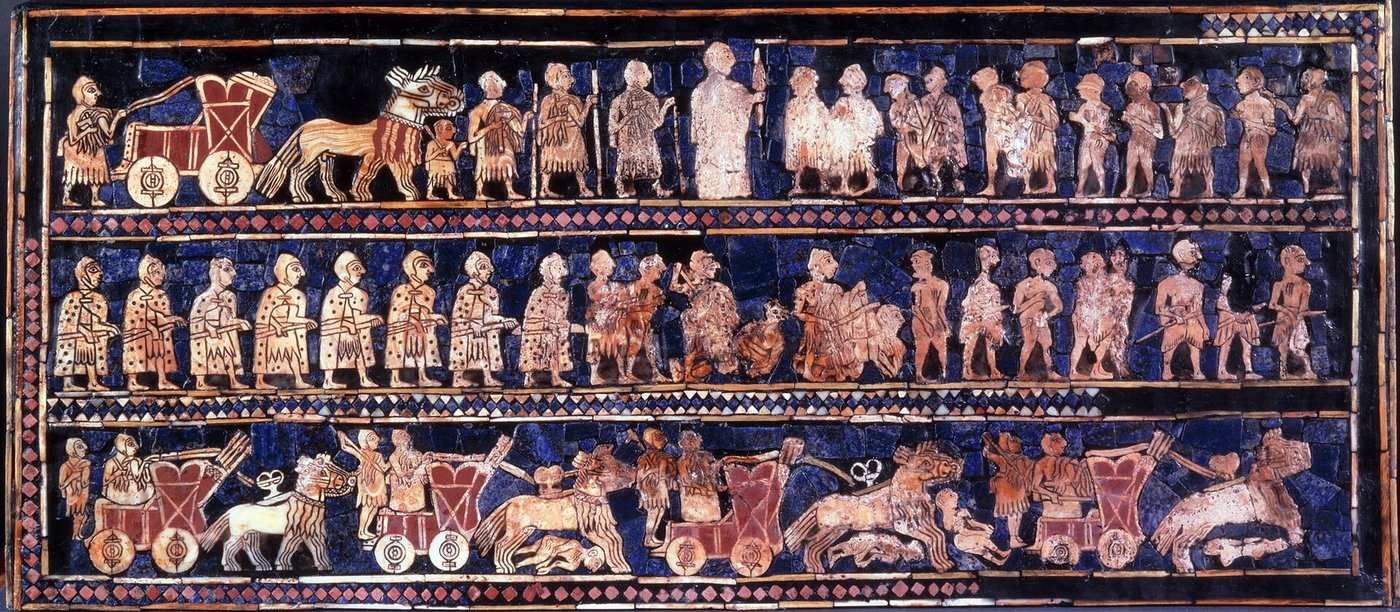
There is the Standard of Ur, a hollow box the length of a forearm, its two long sides worked in tiny pieces of shell, red limestone and deep blue lapis: on one face an army marching, chariots rolling over the fallen, prisoners led naked to a king; on the other a feast, with men carrying goods and animals up toward seated drinkers while a singer performs. Nobody is sure what it was (a standard carried on a pole, the sound-box of an instrument, a chest), so it keeps the neutral name Woolley gave it.
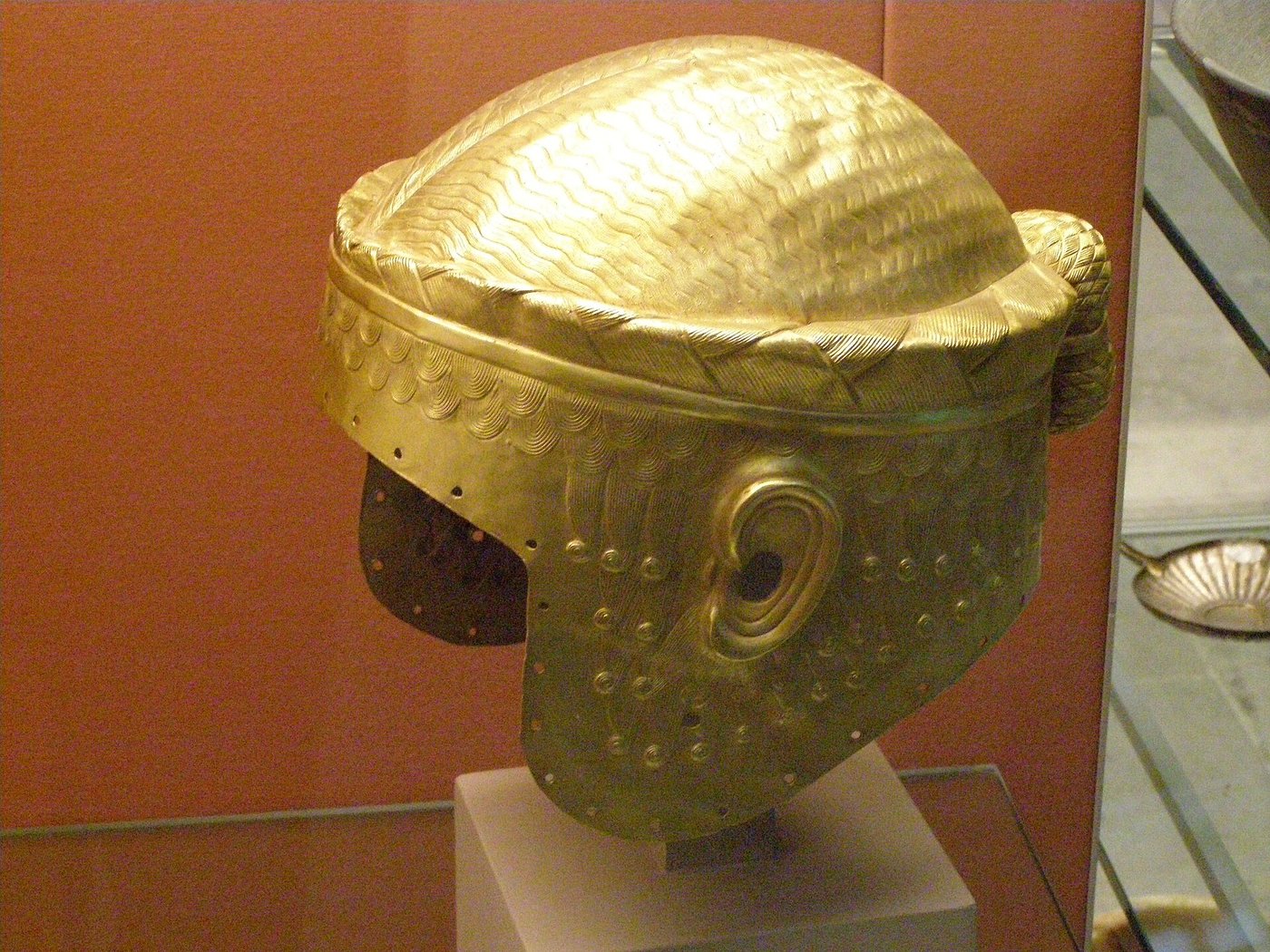
There are the lyres, their wooden frames long rotted but their fittings intact, each fronted by the head of a bull in gold and lapis, the beard a cascade of blue stone. There is the gold helmet of a man named Meskalamdug, beaten to look like a wig, every curl and the knot of hair at the back hammered into the metal: a piece so fine that the copy standing in for it in London still stops people in their tracks.
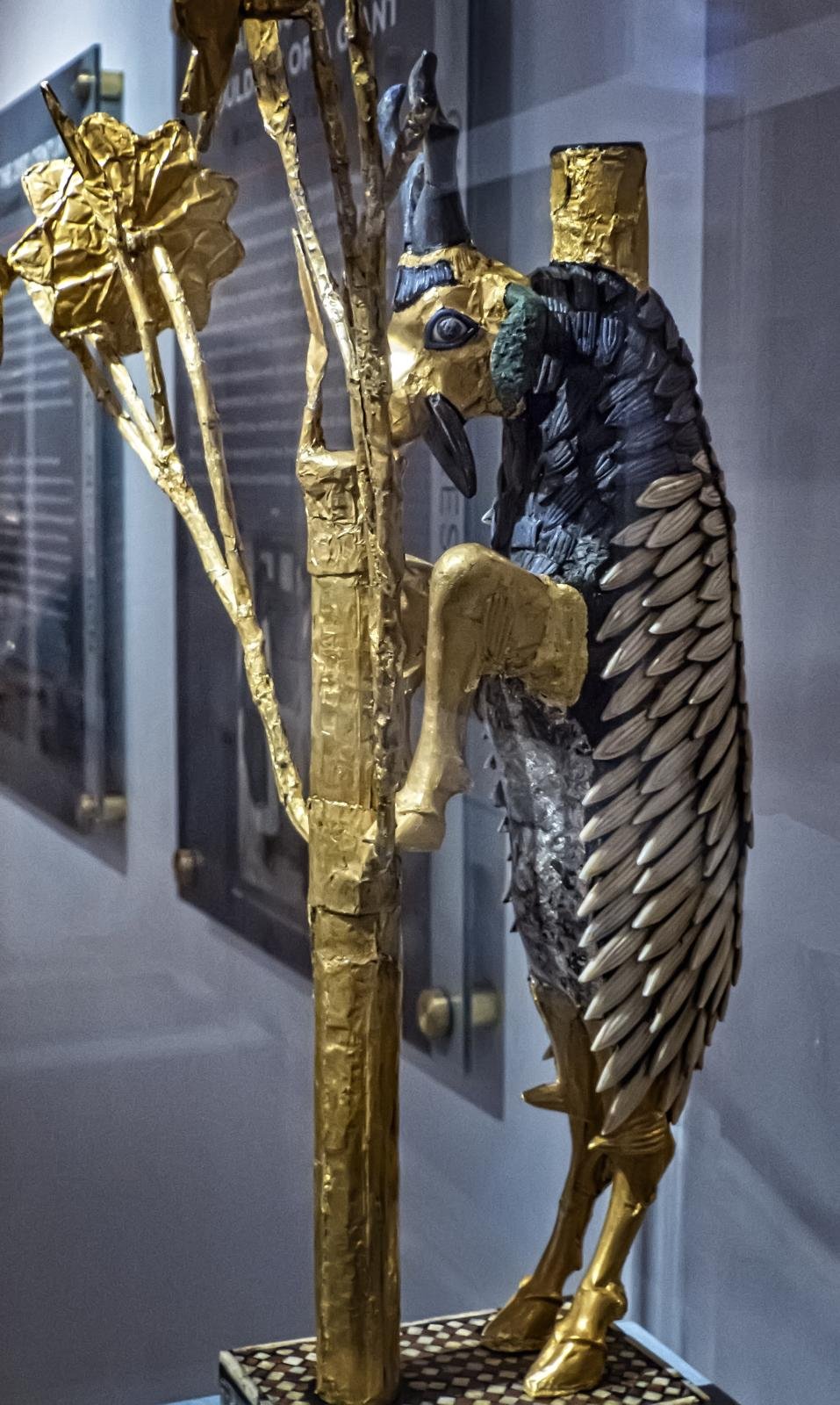
And there is the pair of figures Woolley could not resist naming after the Bible. Each shows a he-goat rearing up against a flowering tree, its front hooves caught in the branches, worked in gold, silver, shell and lapis over a wooden core. He called them the Ram in a Thicket, after the ram God sends to Abraham in place of his son. They are not rams and there is no thicket, but the name stuck, and the two of them (one now in London, one in Philadelphia) remain among the most reproduced objects from the ancient Near East.
The pit
All of that is prelude. The thing that makes Ur unlike any other cemetery is what lay in the shafts alongside the principal dead.
In the grandest tombs, the person in the chamber was not buried alone. Down in the open shaft outside the chamber, and sometimes packed in with the body, lay other people: many of them. One pit, which Woolley catalogued as PG 1237, he simply called the Great Death Pit. In it were seventy-four bodies. Six were men, laid near the entrance with copper helmets and spears, as if set to guard the way in. The other sixty-eight were women. They were arranged in careful rows across the floor of the pit, most in headdresses of gold or silver, many wearing the same leaves and ribbons as the queen, only plainer. Against one wall sat the remains of lyre-players, the bones of their hands still resting where the instruments had been. There were oxen, too, and the wagons they had drawn down the ramp.
It was orderly. That was the detail everyone fixed on. There was no sign of a struggle, no bodies flung about, no scattering of the delicate headdresses that the smallest panic would have disturbed. Each of the women seemed to have lain down, or been laid down, in her place. And beside a number of them was a small cup.
The little cups did more than anything else to shape the story of Ur. To Woolley they were the answer to an obvious question: how do you get dozens of people to lie down in rows and die without a fight? His reading was simple and humane: each attendant carried a cup, drank from it a drug or poison once they had taken their place, and fell asleep. It is a tidy solution, and it fits the tidy pit. It is also, we now think, almost certainly wrong.
The story Woolley told
Woolley was too good a writer to leave the scene as a plan of dots on a page. In his popular books he reconstructed the funeral as a procession. The court of Ur, he wrote, walked down into the grave alive and in their finery: soldiers, grooms leading the animals, women in red wool and gold, musicians still playing. Each went to an appointed place. Someone handed round the cups. The music played on as the drug took hold, and when the last player had slumped over her lyre, a few remaining hands killed the oxen, tidied the bodies, and filled the shaft with earth.
It is a magnificent piece of writing, and it did its job: for three generations, "the death pits of Ur" have meant loyal servants drifting off to sleep to follow their queen. The picture is calm, almost consoling. It turns a mass killing into a devotional act. And when the bones themselves were finally looked at with modern eyes, it fell apart.
The myth: the attendants of Ur walked willingly into the grave, drank poison from little cups, and lay down to sleep, a peaceful, self-chosen death in service of their ruler.
The reality: at least some of them were killed by a heavy blow to the head, and their bodies were then heated and treated to slow decay before being arranged in the rows we find. The orderliness is real, but it was staged after death, not achieved by a quiet drink. What the mourners did to the living, and what they did to the corpses afterwards, were two separate and deliberate acts.
What the scanner found
In 2009 a team led by the archaeologist Aubrey Baadsgaard, working with the Penn Museum, went back to the human remains that Woolley had kept, among them two well-preserved skulls, one from a male "soldier" and one from a female attendant. Instead of the naked eye, they used a CT scanner, which sees through bone and shows how and when a fracture happened.
Both skulls carried the same kind of injury: a hole punched into the head by a narrow, heavy, pointed object, something like a battle-axe or a pike, swung hard. The cracks radiated outward in the pattern that only living bone makes. These were not injuries from the weight of the collapsing earth, and they were not old damage from the dig. They happened at the moment of death, and they were delivered from behind or the side, the way you would strike someone who was kneeling and facing away.
There was more. On some of the remains the team found signs that the bodies had been heated (gently cooked) and traces of mercury, which comes from cinnabar, a red mineral used in the ancient world to slow the rotting of flesh. That only makes sense if there was a gap between death and burial: the corpses were treated to keep them presentable, then carried down and set in position. The famous tidiness of the pit was not the peace of people falling asleep together. It was the work of embalmers arranging the dead.
The cups, then, were probably real but not the whole answer. A drug may still have been handed round (to sedate, to make people compliant, to blunt the fear), but it was not what killed them. What killed them was a weapon, and a person holding it.
The blow to the skull tells us how the attendants died. It does not tell us whether they wanted to. A person can go to their death half-drugged and unresisting and still have chosen it, out of belief or duty or the certainty that a servant's afterlife lay with their lord. Equally, the sedative and the sudden strike from behind read a great deal like a way of killing people who might otherwise have run. We cannot get inside the heads of the dead of Ur. The forensics closed one question, how, and left the harder one, whether these were martyrs or victims, exactly as open as before.
The woman who may have owned the pit
There is one more twist in the Great Death Pit. Among its sixty-eight women, one (recorded as Body 61) was buried more richly than the rest, in a headdress close to the quality of a queen's, set slightly apart. The grander tombs at Ur each had a clear principal in the chamber; the Great Death Pit did not, or its chamber had been robbed away. Some scholars now suspect that Body 61 was that principal: not an attendant at all, but the person the whole pit was arranged around, buried in the open with her court because whatever chamber she rated never survived. If so, then the most spectacular mass grave at Ur is built around a woman whose name we will never know, distinguished from the servants who died with her by a few extra ornaments and a little more space.
What became of them
Under the rules of the day, the finds were split three ways. Some went to the British Museum in London, some to Philadelphia, and a share stayed in Baghdad, in what became the Iraq Museum. That division is why you can see a bull's-head lyre in one country and its near twin in another, and why one Ram in a Thicket faces the London traffic while the other stands in Pennsylvania.
The gold has since lived through more history than the people who made it. Objects from Ur were among the treasures scattered when the Iraq Museum was looted in 2003, in the chaos after the invasion; some of the cemetery's finest pieces had been moved to a bank vault for safekeeping and survived, others passed through years of uncertainty. Puabi's own skull and bones, meanwhile, ended up far from her grave, in the collections of the Natural History Museum in London, where they wait, like the woman from the scanner, to be asked new questions by machines their owners could never have imagined.
That is the odd afterlife of the dead of Ur. The queen was buried to be served for ever by the people around her. Five thousand years on it is those nameless people (the guard with the hole in his skull, Body 61 in her borrowed grandeur, the players with their hands where the music used to be) who have the most to tell us, and who are only now, one scan at a time, beginning to be heard over the story we told about them.
Read next: Lord of Sipán: The Guard Buried With His Feet Cut Off and Vix: The Celtic Grave That Held Antiquity's Largest Bronze Vessel.
Sources & further reading
- Woolley, C. Leonard, Ur of the Chaldees and the official Ur Excavations reports — the excavator's own accounts of the cemetery and its royal tombs.
- Baadsgaard, Aubrey, Janet Monge, Samantha Cox and Richard L. Zettler, "Human sacrifice and intentional corpse preservation in the Royal Cemetery of Ur," Antiquity 85 (2011) — the CT-scan study and the case for violent death and corpse treatment.
- Zettler, Richard L., and Lee Horne (eds.), Treasures from the Royal Tombs of Ur (Penn Museum) — a full catalogue of the objects and their contexts.
- Pollock, Susan, "The Royal Cemetery of Ur: Ritual, Tradition and the Creation of Subjects" — on how to read the graves as social and political acts.
- Penn Museum and British Museum online collections — object records, images and the reading of Puabi's seal.
Image credits (via Wikimedia Commons): Queen Puabi's gold headdress — Mary Harrsch (CC BY 2.0); the 'War' panel of the Standard of Ur — unknown author (public domain); the Ram in a Thicket — Mary Harrsch (CC BY 2.0); the gold helmet of Meskalamdug (British Museum electrotype) — Akieboy (CC BY-SA 2.0); necklace and cosmetics case from the Royal Cemetery of Ur — Mary Harrsch (CC BY 2.0).