Woolpit is a small village in Suffolk, halfway between Bury St Edmunds and Stowmarket, where the land lies flat and the fields run wide to the horizon. Nothing about it today would draw a stranger’s eye. Yet something happened here, probably in the 1140s or 1150s, that was considered so remarkable it was written down twice within fifty years, and neither writer could explain it. Two children walked out of a ditch at harvest time. They did not speak English. They would eat nothing but raw beans. And their skin, both chroniclers agreed, was green.
The story is eight hundred years old, and it refuses to go away. It has been claimed by folklorists as a fairy tale, by ufologists as an alien encounter, and by historians as a misunderstood social tragedy. None of these explanations quite accounts for all the details. What we have are two independent medieval accounts, written by serious men who believed they were recording fact, and a puzzle whose edges do not cleanly fit any single frame.
The wolf pits and the children
The village name itself carries a clue to the landscape. Woolpit derives from the Old English wulf-pytt, a pit dug to trap wolves. In the twelfth century these ditches still marked the edges of the village fields. It was beside one of these pits, during harvest, that local reapers found the children.
They were a boy and a girl, apparently brother and sister. They were crying and confused. Their clothes were made of an unfamiliar material. They spoke a language no one present could understand. And their skin had a distinctly greenish tinge: not painted on, not a trick of light, but present across their bodies. The reapers brought them to the village, where the local landowner, Sir Richard de Calne, took them into his household.
At first the children refused all food. They were wasting and seemed certain to die. Then someone brought in freshly cut bean plants, stalks and all, and the children seized on them. They tore open the stalks looking for the beans inside. When shown how to open the pods properly they ate ravenously. For weeks, beans were all they would touch.
Gradually they were introduced to other food and began to eat bread. As their diet changed, the green colour faded from their skin. The boy, who had always been the weaker of the two, sickened and died not long after both children were baptised. The girl survived. She grew up, learned English, and eventually married a man from King’s Lynn, or so the story goes. She was said to be “rather loose and wanton in her conduct,” which may simply mean she did not behave as a twelfth-century chronicler thought proper.
Two writers, one story
What makes this tale unusual among medieval curiosities is its documentation. Two chroniclers recorded it independently, and their accounts agree on the key facts while differing in small details, exactly what you would expect of authentic testimony gathered from different sources.
The first was Ralph of Coggeshall, abbot of a Cistercian monastery in Essex about twenty-six miles south of Woolpit. He wrote in his Chronicon Anglicanum around 1220, claiming that he heard the story directly from Sir Richard de Calne himself. The second was William of Newburgh, a canon at an Augustinian priory in Yorkshire, who included the account in his Historia Rerum Anglicarum in the 1190s. William was a careful historian (he is remembered for attacking Geoffrey of Monmouth’s fanciful History of the Kings of Britain as dishonest fabrication), and he clearly found the Woolpit story troubling. He included it precisely because he could not dismiss it. “I was so overwhelmed by the weight of so many and such competent witnesses,” he wrote, that he felt compelled to record it even though he could not explain it.
William was not a credulous writer. His Historia opens with a sustained attack on Geoffrey of Monmouth for inventing British history wholesale. He applied the same scepticism to the green children, and concluded that the witnesses were too numerous and too reliable to ignore. He recorded it as an observed event he could not account for, not as a wonder he wished to celebrate.
Both writers agreed on the green skin, the unknown language, the refusal of all food except beans, the boy’s death, and the girl’s survival and eventual marriage. Ralph adds the detail about Richard de Calne; William provides the girl’s later testimony about where she claimed to have come from.
The girl’s own account
Once she learned English, the surviving girl was asked where she and her brother had come from. Her answer only deepened the mystery. She said they came from a land where there was no sun, where the light was perpetual twilight, like the glow just after sunset. She called it the Land of St Martin. She said that everything there was green.
She and her brother had been following their father’s flocks when they heard a loud sound, like the bells of Bury St Edmunds, she said. They followed the sound into a cavern and walked for a long time in darkness. When they emerged they were in a field near Woolpit, blinded and stunned by the brightness of the sun, which they had never seen before. The heat and the strange light terrified them. They tried to find the entrance to the cave again but could not. That was when the reapers found them.
This testimony has been interpreted in wildly different ways. To folklorists it echoes the motif of fairy children emerging from underground. To literal-minded researchers it suggests the children came through one of the flint mines or ancient earthworks that riddle the Suffolk chalk. To Paul Harris, a local writer who investigated the story in the 1990s, it sounded like two frightened children trying to describe a real journey underground that they did not fully understand themselves.
The Flemish orphan theory
The most widely accepted modern explanation was put forward in various forms across the twentieth century. It goes like this: the children were Flemish.
In the 1100s, England had a substantial population of Flemish immigrants: weavers, farmers, and labourers who had crossed the Channel in waves over several decades. They were not always welcome. During the civil war of King Stephen’s reign (1135–1154), Flemish settlers in eastern England were persecuted. There were massacres. In 1173, after the Battle of Fornham St Genevieve, fought barely eight miles from Woolpit, Flemish mercenaries were killed in large numbers by local forces.
The theory suggests that the green children were orphans of one of these persecutions. Lost, starving, perhaps from the village of Fornham St Martin (which could be the “Land of St Martin” the girl described), they wandered through underground mine workings or covered passages until they emerged near Woolpit. Their language was Flemish, unintelligible to English-speaking villagers. Their green skin was the result of severe malnutrition, a condition called chlorosis, or “green sickness,” in which iron-deficient blood gives the skin a greenish pallor.
The theory is elegant. It accounts for the language barrier, the malnutrition, the specific mention of beans (a survival food for the desperately poor), and the geographical reference to St Martin. It places the event in a documented historical context of persecution and displacement. And it explains why the green colour faded as the children were properly fed.
But it does not account for everything. The underground journey remains unexplained; there are no known mine workings connecting Fornham to Woolpit. The “land of perpetual twilight” is harder to square with a village eight miles away, even for a confused child. And the girl never said, once she learned English, “Oh, I was Flemish”, or if she did, neither chronicler recorded it. The theory fits most of the facts. It does not fit all of them.
The arsenic and the uncle
A stranger theory, local to Suffolk, merges the green children with the old English tale of the Babes in the Wood. In this version, the children were heirs to an estate whose guardian, a wicked uncle, tried to poison them with arsenic to claim their inheritance. Arsenic poisoning can produce a greenish discolouration of the skin. The children survived the poisoning, were abandoned in Wayland Wood (about fifteen miles from Woolpit), wandered lost and sick until they were found, and were too traumatised to speak.
This theory was championed by the writer Derek Brewer in the 1990s and draws on a local folk tradition that had already linked the two stories. It has a certain dramatic neatness. But it requires the children to have lost the ability to speak English entirely (rather than simply being too shocked to use it), and it does not explain why beans were the only food they would accept, or why, once she recovered, the girl described a land of perpetual green twilight rather than, say, a house in Norfolk.
What the story is not
It is worth saying plainly what serious historians do not consider this to be. It is not an alien encounter. The extraterrestrial theory, popular since the 1960s, requires ignoring everything about the twelfth-century context and treating the story as though it happened in a vacuum. It is not a fairy tale invented by the chroniclers. William of Newburgh’s whole reputation rests on his hostility to invented history; he would not have included a campfire story in a work dedicated to factual accuracy. And it is almost certainly not a hoax by Richard de Calne, a minor landowner with nothing to gain from a fabrication that neither chronicler treats as reflecting well on anyone involved.
What it appears to be is a real event (two real children appeared in a real village) filtered through the understanding available to twelfth-century observers who lacked the vocabulary to describe what they were seeing. The green skin was real but unexplained. The language was real but unrecognised. The children’s distress was real. Everything else is interpretation.
The girl said she and her brother walked through a cavern for a long time before emerging near Woolpit. Suffolk sits on chalk, and flint mines exist in the region: Grimes Graves, a Neolithic flint mine complex, lies thirty miles north. But no passage connecting any settlement to Woolpit has ever been discovered. Either the passage collapsed, or the girl’s account was confused, or there was never a literal tunnel and the journey was something else entirely: a metaphor, a misunderstanding, or a memory distorted by trauma.
Woolpit remembers
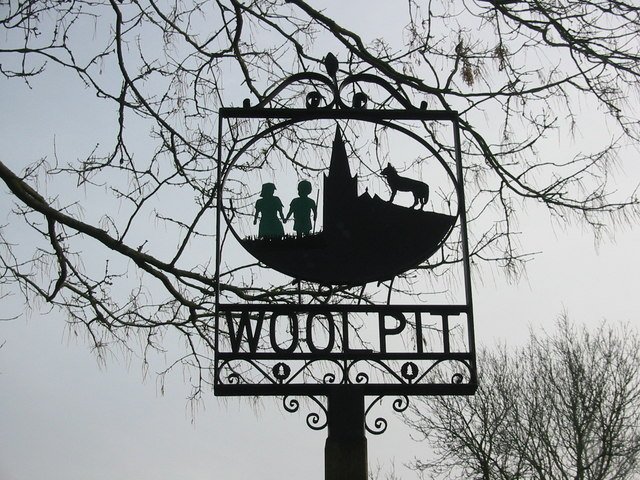
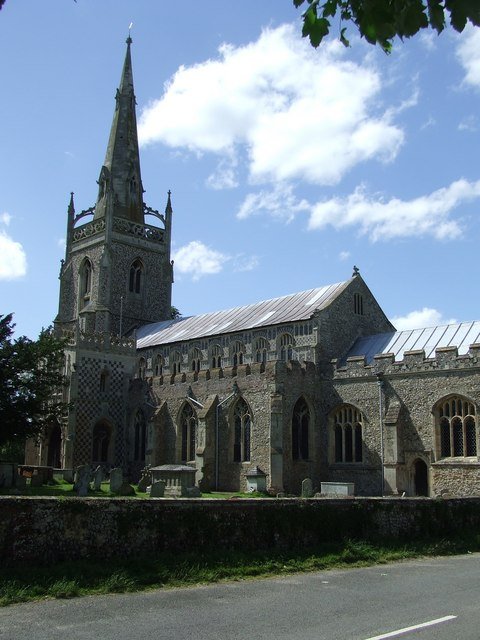
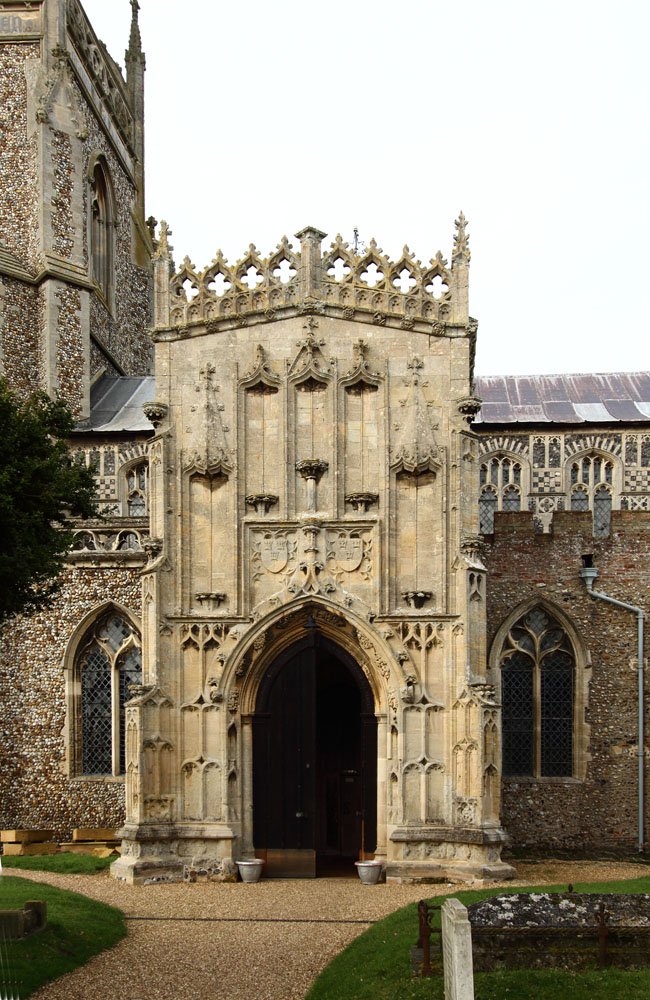
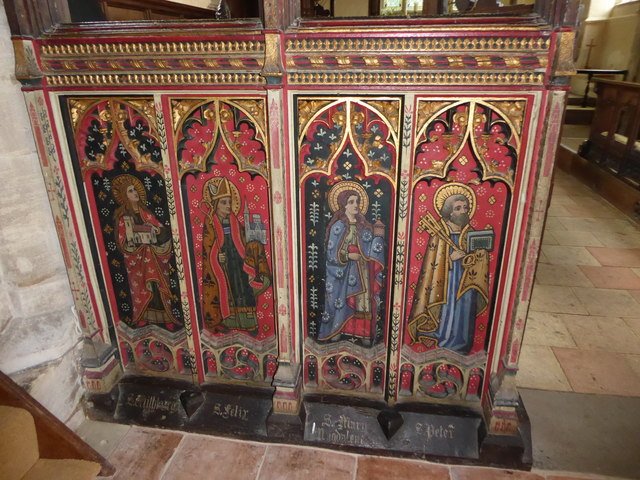
The village has not forgotten its strangest moment. The village sign, erected in 1977, depicts the two green children alongside the wolf that gives the village its name. St Mary’s Church still stands at the village centre, its magnificent fifteenth-century porch a reminder of the prosperity that medieval Woolpit enjoyed under the patronage of the Abbey of Bury St Edmunds. The church almost certainly stands on the site of the twelfth-century building that was here when the children were found.
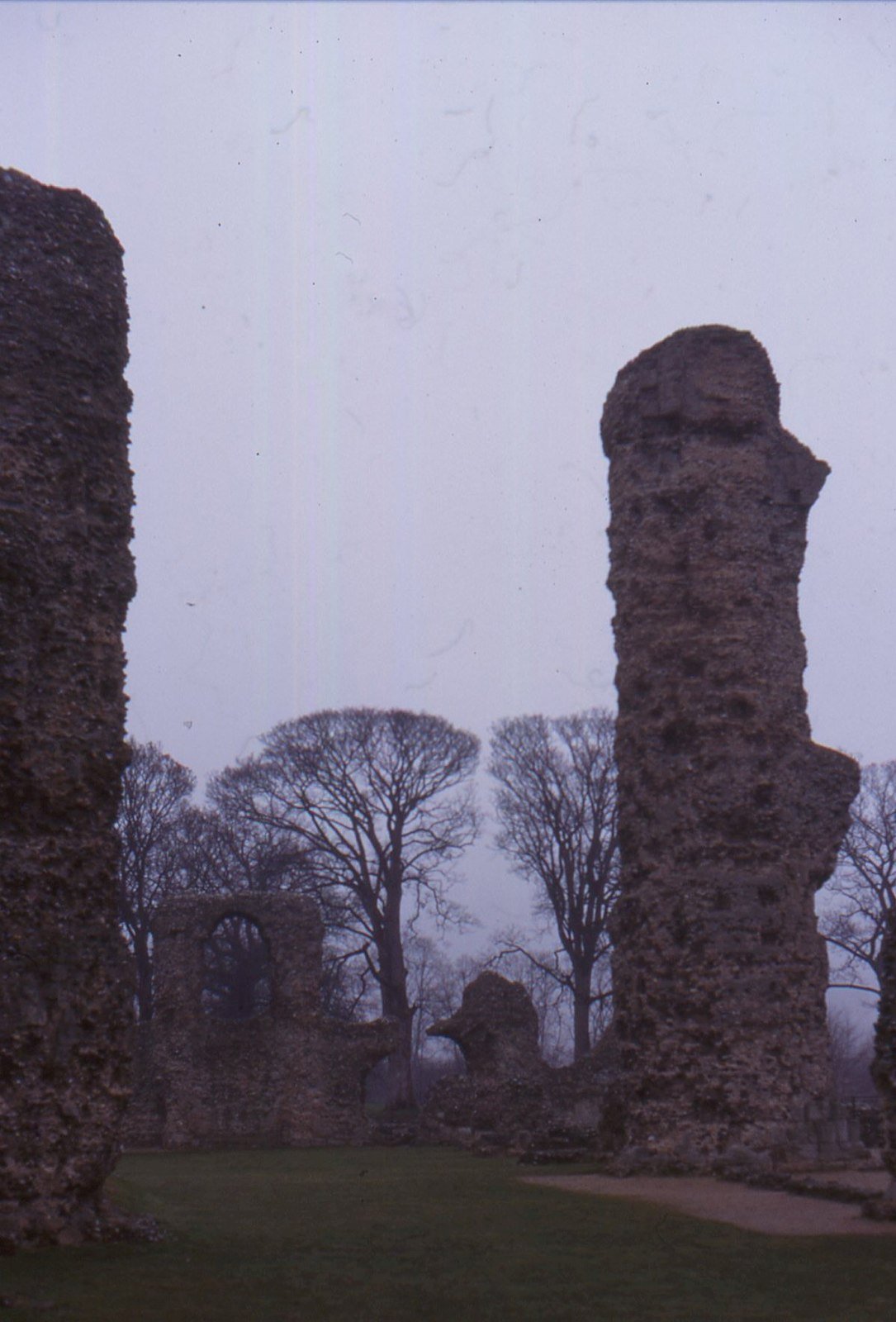
The Abbey of Bury St Edmunds, whose bells the girl said she heard, is now a ruin, but the ruins are massive, and in the twelfth century the abbey was one of the richest and most powerful religious houses in England. Its bells would have been audible for miles across the flat Suffolk landscape. That a child from a nearby village could hear them and follow the sound is entirely plausible.
And that may be the truest thing about this story: not the green skin or the twilight land or the cavern, but the bells. Somewhere in eastern England, probably in the 1140s or 1150s, two lost children heard bells ringing across flat country. They followed the sound. They ended up somewhere they did not belong, speaking a language no one understood, too hungry and too frightened to do anything but cry. One died. The other grew up, married, and presumably told her children a story about where she had been before, a story that already, by the time the monks wrote it down, had become something stranger and larger than two lost children in a ditch.
Eight centuries later we still cannot quite explain them. The green children of Woolpit remain what they were to William of Newburgh: a thing that happened, attested by credible witnesses, that does not fit neatly into any category we possess.
Read next: Princes in the Tower: The Bones No One Is Allowed to Test and Joan of Arc: The Peasant Girl Who Crowned a King.
Sources & further reading
- William of Newburgh, Historia Rerum Anglicarum, Book I, Chapter 27 (c. 1198)
- Ralph of Coggeshall, Chronicon Anglicanum (c. 1220)
- Paul Harris, “The Green Children of Woolpit,” Fortean Studies, Vol. 4 (1998)
- John Clark, “The Green Children of Woolpit” in A Companion to the Fairy Tale, eds. Davidson and Chaudhri (2003)
- Derek Brewer, “The Colour Green” in A Companion to the Gawain-Poet, eds. Brewer and Gibson (1997)
Image credits (via Wikimedia Commons): Green children on the Woolpit village sign — Rod Bacon (CC BY-SA 2.0); St Mary’s Church, Woolpit — Keith Evans (CC BY-SA 2.0); south porch of St Mary’s — John Salmon (CC BY-SA 2.0); interior of St Mary’s — Basher Eyre (CC BY-SA 2.0); ruins of Bury St Edmunds Abbey — Christopher Hilton (CC BY-SA 2.0).