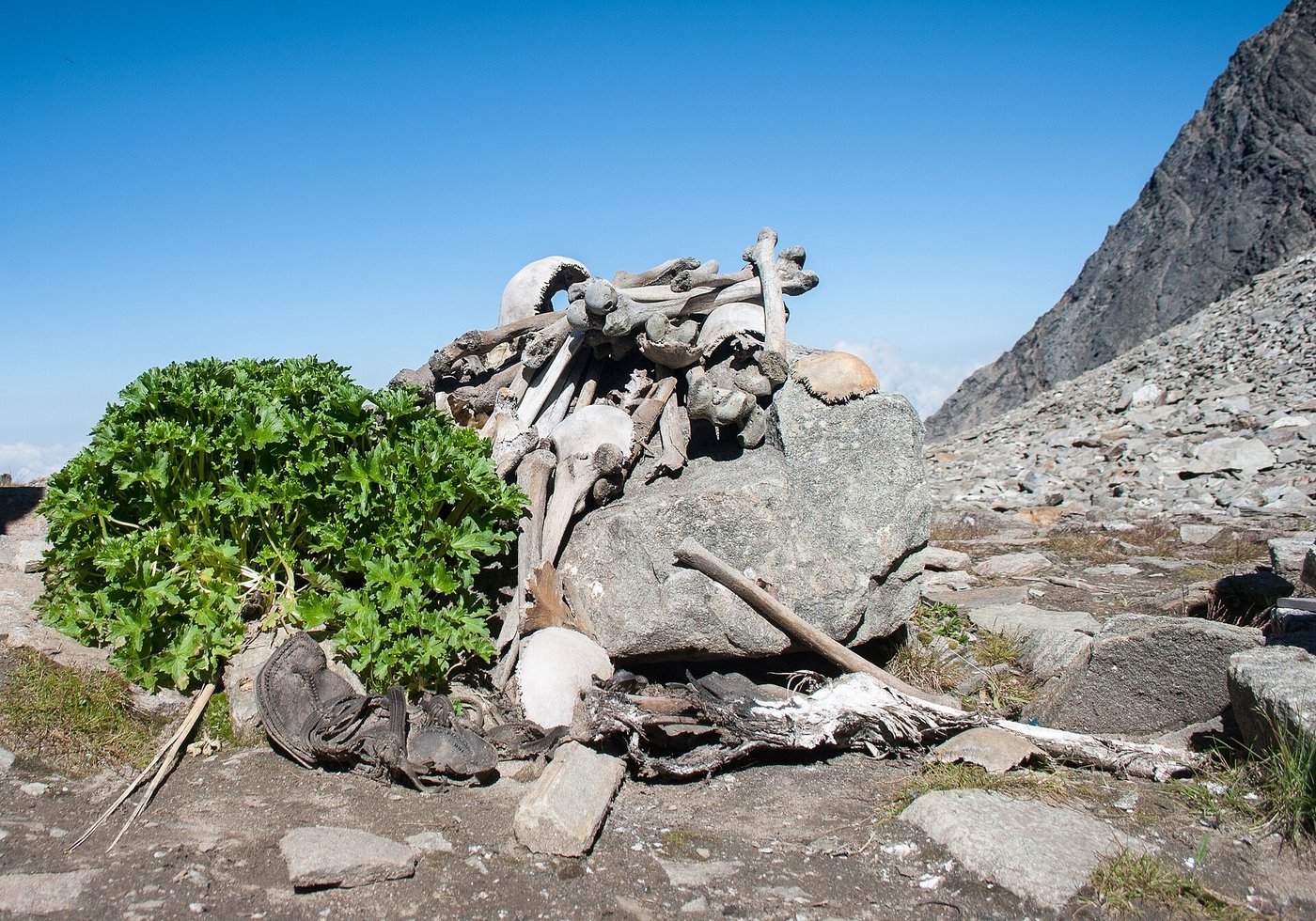
In September 1942, a British forest ranger named H. K. Madhwal was patrolling a barren, wind-scoured bowl in the Himalayas of what is now Uttarakhand when he came across something that stopped him cold. Scattered across the shingle around a small, half-frozen lake at over 5,000 metres were bones: hundreds of them. Skulls lay half-submerged in the shallows, staring up through water so clear that in some seasons you could count every rib on the skeletons resting on the bottom. There was no village nearby, no road, no reason for anyone to be this high on the flank of the mountain. Madhwal reported his find, and for decades afterwards, no one could agree on who these people were, when they had died, or why several hundred human beings had perished together in one of the most isolated, oxygen-starved places on Earth.
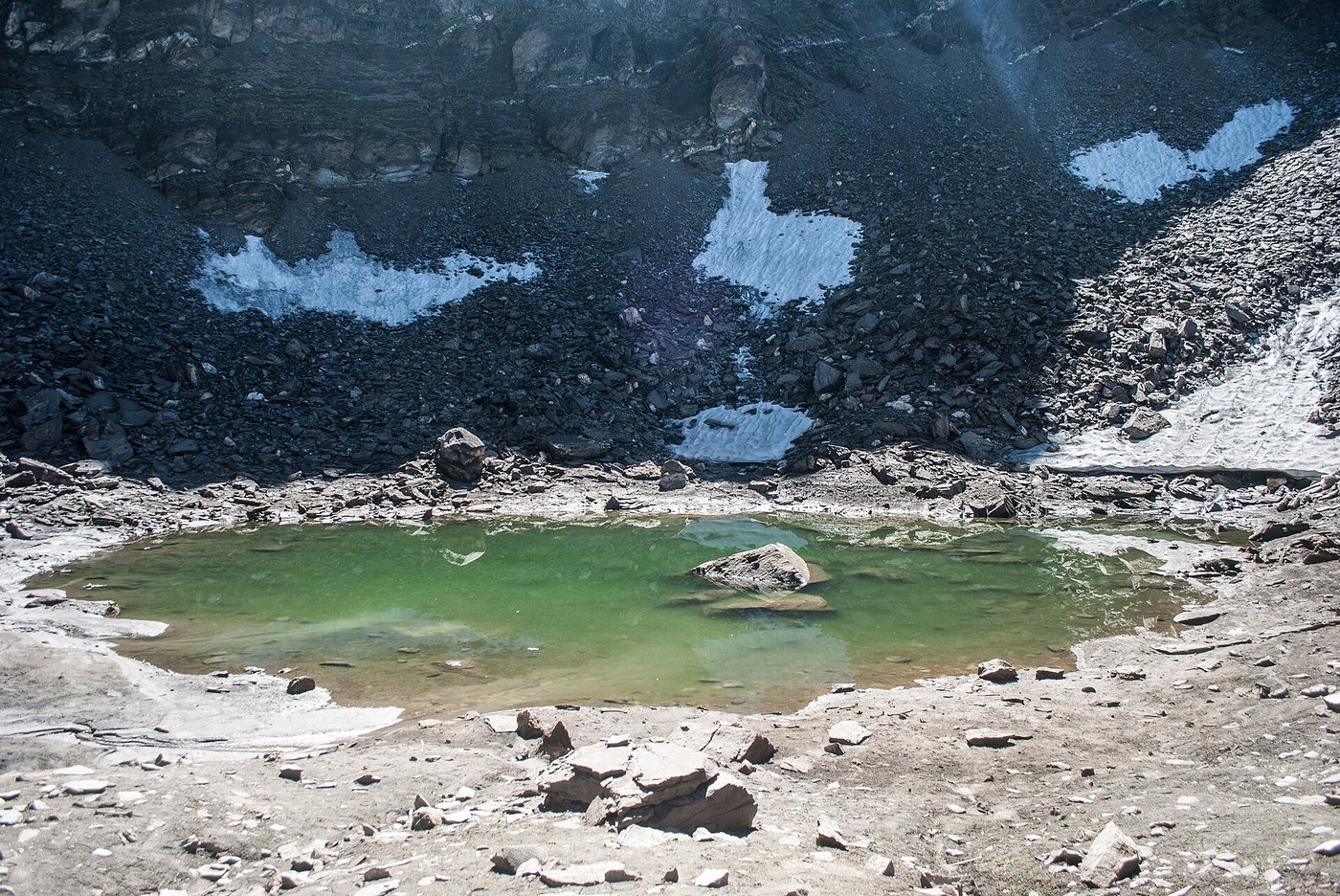
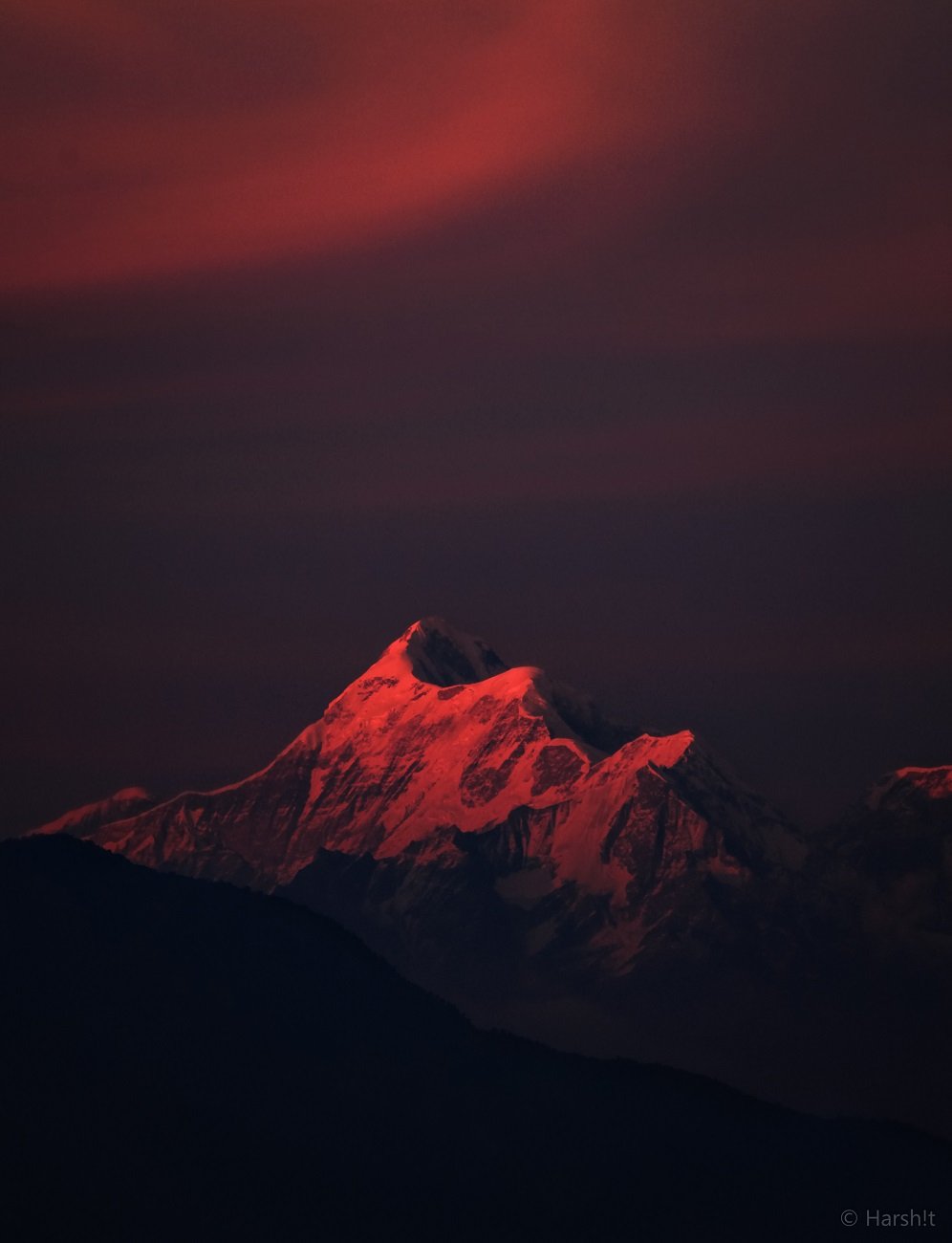
The lake is called Roopkund, and today it is nicknamed, with grim accuracy, Skeleton Lake. It sits in a small glacial depression on the slopes of Trisul, one of the great peaks of the Garhwal Himalaya, on a route still walked each year by trekkers and, once every twelve years, by an enormous Hindu pilgrimage. For most of its existence Roopkund has been little more than a curiosity, a strange, remote deposit of the dead that occasionally washed a few more bones into view when the ice melted. Then, in the twenty-first century, forensic scientists and geneticists arrived with tools nobody in 1942 could have imagined, and the lake's secrets turned out to be stranger, and far older, than anyone had guessed.
A lake that keeps its dead in view
Roopkund is not a large body of water. It is barely forty metres across, shallow enough in places to wade, and locked in ice for the better part of the year. What makes it extraordinary is what the melt reveals. Each summer, as the surface thaws and the snowbanks around its rim retreat a little, more skeletal remains become visible: femurs and skulls pressed into the frozen shingle, some still bearing tufts of hair, scraps of leather footwear, bamboo walking staves, iron spearheads, and rings. The cold, dry, oxygen-poor conditions at this altitude are remarkably good at preservation: flesh, hair, and nails have survived on some remains for centuries, mummified rather than decomposed.
Estimates of how many people are represented at the site have varied wildly over the years, from a conservative 300 to as many as 600 or 800 individuals, depending on how the scattered and fragmentary remains are counted. Whatever the true figure, it is clearly not a handful of unlucky travellers. This was a mass death, or, as later research would reveal, several mass deaths, separated not by days but by centuries.
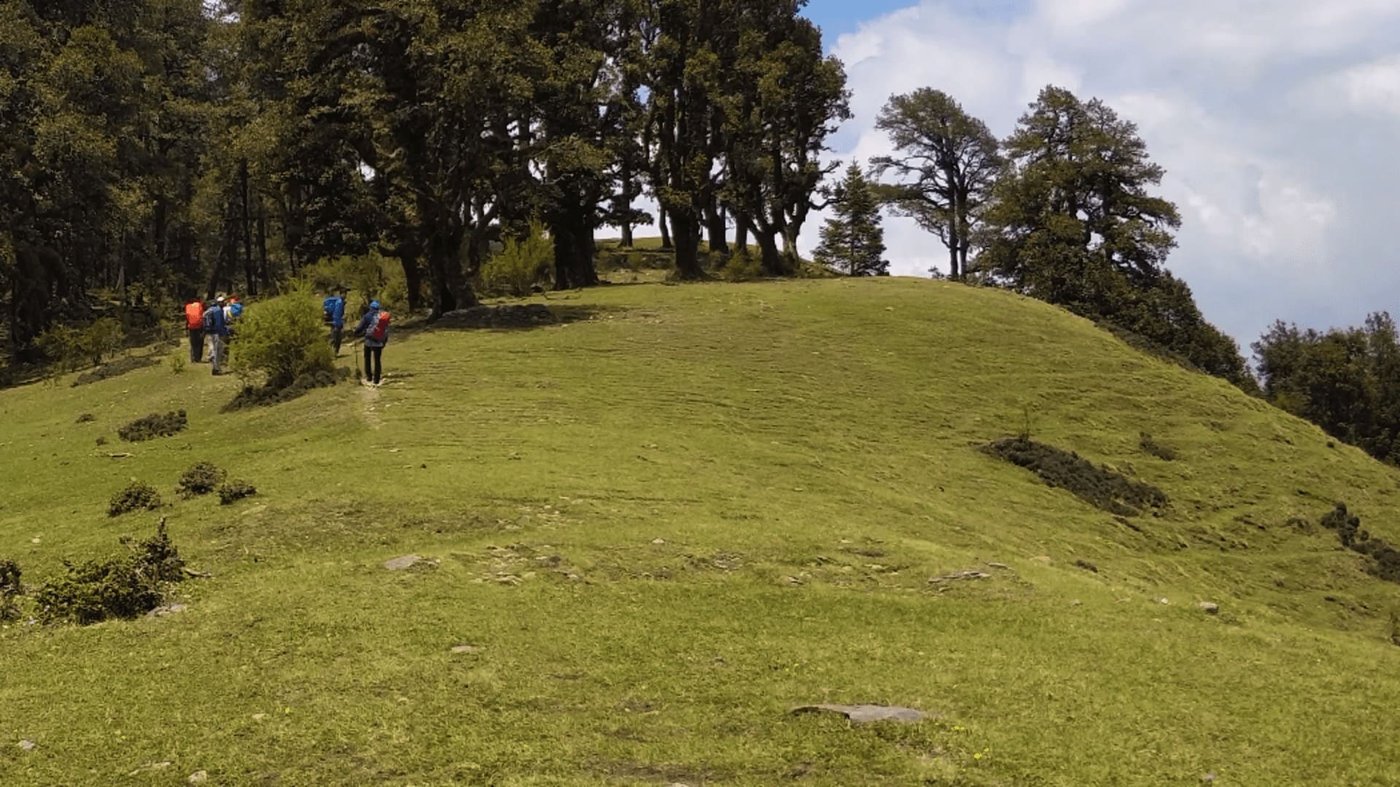
Roopkund sits directly on the route of the Nanda Devi Raj Jat, one of the longest and most arduous pilgrimages in the Hindu world. Held once every twelve years, it draws thousands of pilgrims on a three-week, roughly 280-kilometre trek through the Garhwal Himalaya, culminating near the peak of Trisul, within sight of the lake of bones.
The first theories: soldiers, traders, an epidemic
Long before anyone could test a single bone, Roopkund's location did a lot of the storytelling. When the discovery became more widely known in the 1950s, India was living in the shadow of the Second World War, and one of the first theories to circulate was that the skeletons belonged to Japanese soldiers who had died attempting a secret incursion into India through the high passes. The British colonial government is even said to have sent a team to investigate this possibility, worried about a hidden military disaster on Indian soil.
That theory collapsed almost immediately once anyone looked closely. The remains showed none of the equipment a mid-twentieth-century army would carry, and radiocarbon testing eventually dated them to periods centuries before the Second World War. Other early explanations followed the same pattern of being plausible on the surface and wrong underneath: a lost caravan of traders overtaken by a storm, victims of a cholera or plague epidemic who had wandered up the mountain to die away from their villages, even a defeated army that had attempted the pass and been annihilated by the terrain. None of these accounts could explain the sheer number of bodies, their location in such a specific and inhospitable spot, or the strange, repeated damage visible on many of the skulls.
The hailstorm theory
The breakthrough came in 2004, when a joint Indian and European research expedition carried out the first systematic forensic study of the remains. Anthropologists examined hundreds of skulls and found something consistent and strange: many bore blunt-force fractures on the crown and back of the head, the kind of injury caused by a single hard, rounded object striking from almost directly above. These were not the slashing or piercing trauma of weapons, and not injuries consistent with a fall or an avalanche. There were no wounds to the arms or upper body that would suggest people fighting off an attacker, and no evidence of blades.
The researchers' conclusion was as vivid as it was plausible: the group had been caught in the open by a sudden, extraordinarily violent hailstorm, pelted by ice stones large enough and hard enough to fracture skulls, potentially cricket-ball-sized, an established hazard in the Himalayan pre-monsoon and monsoon season. Trapped in the bowl-shaped terrain around Roopkund with no shelter for kilometres in any direction, and with routes back down the mountain blocked or impassable, the group had nowhere to run. They died more or less where they stood, and their bodies, along with their belongings, were gradually drawn into the small lake and frozen into the landscape.
"The nature of the wounds... suggest that all the individuals died in a single catastrophic event, and that the wounds were caused not by weapons but by blows from a rounded object, essentially the size and shape of a cricket ball."— summarising findings from the 2004 forensic expedition, published in the archaeological literature on Roopkund
Local folklore had, in a way, been circling this explanation for generations. Villagers in the region tell a story about the goddess Nanda Devi (the mountain deity for whom Trisul's neighbouring peak is named), who was enraged when a king and his retinue defiled her sacred territory during a celebratory pilgrimage, dancing and singing where they should have shown reverence. In her fury, the goddess summoned a storm of hail "hard as iron" and struck the offending party dead on the mountainside. It is, quite literally, a myth that describes a hailstorm killing pilgrims at exactly this location, centuries before any scientist proposed the same mechanism.
"An entire lost army, or a doomed group of foreign invaders, perished trying to cross the Himalayas and their bones simply piled up at Roopkund."
Forensic and genetic evidence now points to a mixed group of pilgrims and travellers, not soldiers, caught by localised but ferocious hailstorms, and this happened as at least two separate events centuries apart, not one single doomed expedition.
The DNA that rewrote the story
For a while, the hailstorm explanation seemed to close the case. Then, in 2019, a team led by geneticists at Harvard Medical School and the David Reich lab, working with Indian and international collaborators, published the results of a genome-wide ancient DNA analysis of 38 skeletons from the lake, by far the most rigorous scientific study Roopkund had ever received. What they found fractured the entire timeline into pieces.
The skeletons, it turned out, did not represent one group who died in one storm. They came from at least three genetically distinct populations, and they were not even contemporaries. Twenty-three of the individuals had ancestry consistent with present-day South Asian populations, and radiocarbon dating placed their deaths at around 800 CE, with evidence suggesting even this group died in more than one event, possibly a generation or more apart. Fourteen individuals, however, had ancestry closely matching populations of the eastern Mediterranean, similar to people living today in Crete and the Greek islands, and their remains dated to roughly 1800 CE, nearly a thousand years after the first group. One further individual showed Southeast Asian-related ancestry.
None of the tested individuals, across either group, were closely related to one another (no parent-child or sibling pairs), suggesting these were not intact family units but larger travelling parties. Isotopic analysis of the bones added another layer: the South Asian-ancestry group and the Mediterranean-ancestry group had eaten measurably different diets in the years before death, consistent with people who had grown up in very different regions and only converged on this one remote Himalayan lake, centuries apart, to die in strikingly similar ways.
The genetics settled the question of who died at Roopkund far more precisely than anyone expected, but it deepened, rather than solved, the question of why. The research team behind the 2019 study was candid about this in their published conclusions, noting they could explain the genetic origins of the skeletons but not what had drawn a group with eastern Mediterranean ancestry to a remote Himalayan pass around 1800 CE, a period with no known European pilgrimage or documented expedition to the site. Historians have proposed traders, itinerant pilgrims travelling unusual routes, or a group whose journey simply went unrecorded, but as of now, no theory has been confirmed.
Two catastrophes, one lake
Piecing together the current best understanding of Roopkund means holding two separate tragedies in mind at once. Around the ninth century CE, a group of South Asian travellers (plausibly pilgrims, given the region's long history of devotional journeys toward Nanda Devi's sacred peaks, or possibly a mixed party of pilgrims, porters, and local guides) were caught in the open by a violent hailstorm near the lake and killed, their bodies and belongings gradually settling into the ice and scree over the following months and years. This aligns closely with the original 2004 forensic hypothesis and with the region's own oral tradition about the goddess's wrath.
Then, roughly a millennium later, in the eighteenth or early nineteenth century, an entirely separate group, including individuals with recent ancestry from the eastern Mediterranean, arrived at the same remote spot and also died there, seemingly under broadly similar violent circumstances, their remains coming to rest alongside bones that had already been resting in the ice for eight hundred years. The lake, in other words, is not the site of a single disaster. It is a site that has claimed lives at least twice, across a gap of time longer than the entire history of many nations, joined only by geography and, perhaps, by weather that has always made this particular high mountain bowl a death trap for anyone caught without shelter.
Every early theory was reasonable, and wrong
It would be easy to file Roopkund away as a solved mystery: hailstorms, twice, case closed. But its value lies less in the specific answer than in what the investigation demonstrates about the limits of intuition when reading the past. Every early theory about Roopkund was constructed from a reasonable premise (soldiers make sense near a border, traders make sense on a route, an epidemic makes sense for a mass death), and every one of them was wrong, or at best only partially right, because the human eye reflexively looks for a single, tidy narrative. It took physical anthropology to identify the trauma, and it took ancient DNA, a technology that did not exist when Madhwal first stumbled on the site in 1942, to reveal that "the Roopkund skeletons" were never one story at all, but two, separated by a thousand years and pressed by coincidence into the same square metres of ice.
That is the broader lesson ancient DNA has brought to archaeology generally over the past decade: it has repeatedly shown that migration, mixing, and movement across the ancient and medieval world were more extensive and more surprising than written records alone ever suggested. Roopkund's eastern Mediterranean travellers, whoever they were and whatever brought them to a remote Himalayan pass centuries before any documented European expedition to the region, are a quiet reminder that people have always moved further, and connected more improbably, than the surviving paperwork implies. The lake kept their secret for two hundred years. It may be keeping others still.
Image credits (via Wikimedia Commons): skeletal remains at Roopkund — Schwiki (CC BY-SA 4.0); Roopkund lake — Schwiki (CC BY-SA 4.0); trekkers on the Roopkund route — Daniel Romanson (CC0); Trisul peak at dusk — Harshit SR (CC BY-SA 4.0); Himalayan ridgeline near Roopkund — Daniel Romanson (CC0).
Read next: The Dyatlov Pass Incident: Nine Hikers, One Frozen Mountain and Tollense: How One Arm Bone Uncovered Europe's Oldest Battle.
Sources & further reading
- Éadaoin Harney et al., "Ancient DNA from the skeletons of Roopkund Lake reveals Mediterranean migrants in India," Nature Communications (2019).
- William Sax, Mountain Goddess: Gender and Politics in a Himalayan Pilgrimage — background on the Nanda Devi Raj Jat and regional folklore.
- Forensic and anthropological survey findings from the 2004 National Geographic-affiliated expedition to Roopkund, on skull trauma consistent with hailstone impact.
- Max Planck Institute of Geoanthropology, research summary on the Roopkund biomolecular and isotopic analyses.
- Archaeological Survey of India and Uttarakhand tourism department records on the Roopkund trekking route and site history.