Nine metres inside the hill, past two turns that kill the last of the daylight, the air goes cold and the sound of the river drops to a hum in the stone. This is where the tour of the New Temple used to end, in a narrow stone room that had been bricked shut for more than two thousand years. When John Rick’s team broke into it in 2017 they found it dry, empty of bodies, and full of small things left on purpose: shells, pigment, a scatter of bone. Among the bone were slender tubes cut from the wing of a bird. For eight years no one could say for certain what they had held. Then, in the spring of 2025, a laboratory did, and it settled an argument that had run for a hundred years about what people came into this darkness to do.
The place is Chavín de Huántar, a stone complex high in the Peruvian Andes that is older than the Inca by more than two thousand years. It is not a lost city. There was no great population here, no market, no crush of houses. What stood at Chavín was a machine built out of rock and water and darkness, and the machine had one purpose: to take an ordinary person and, for a few hours, unmake them.
Where two rivers meet
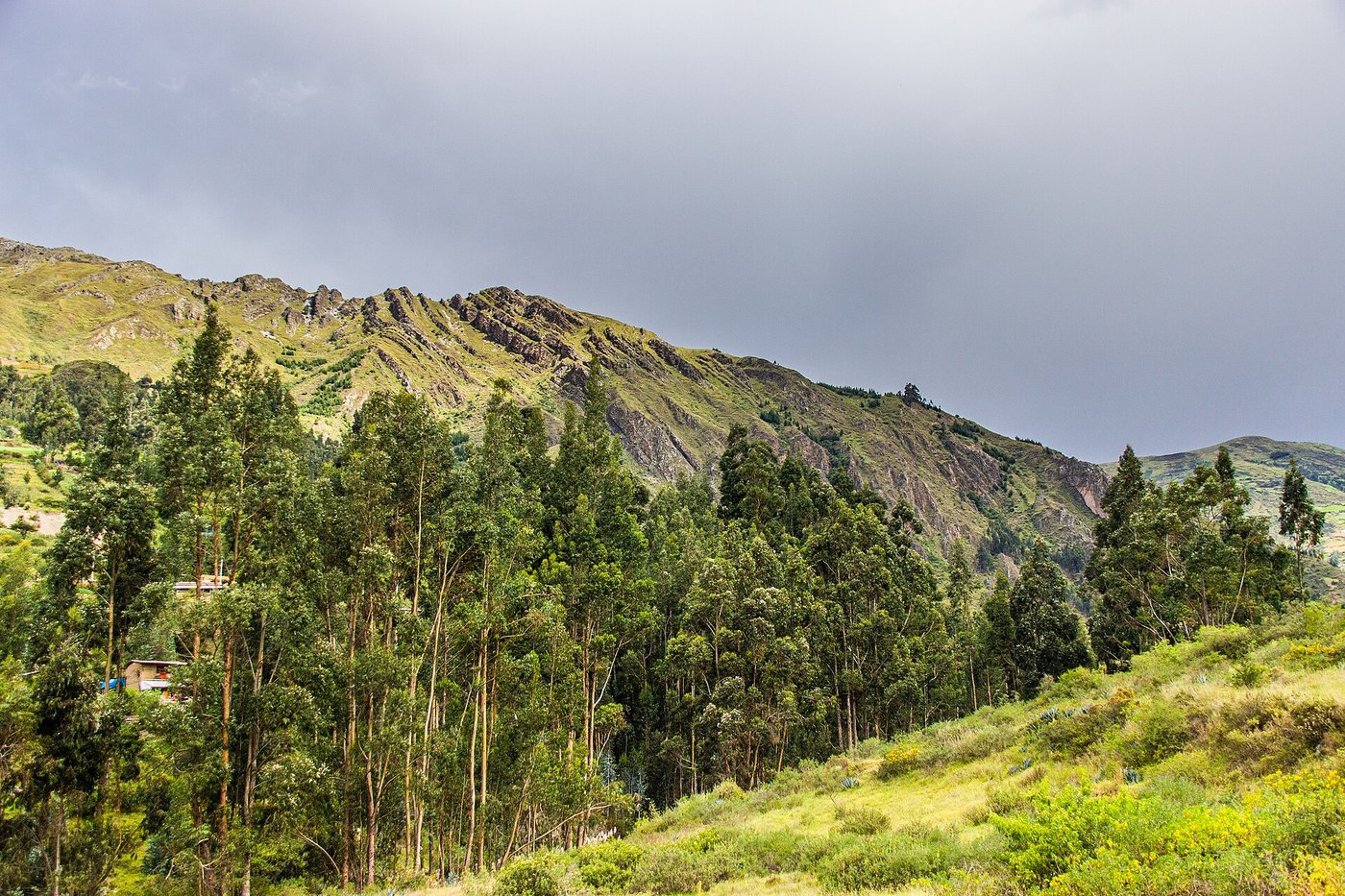
Chavín sits at 3,180 metres, in the Ancash highlands about 430 kilometres north of Lima, on a shelf of ground where the Mosna river takes in a smaller stream called the Wacheqsa. Mountains stand close on every side. To reach it in the first millennium BCE you walked, for days, up valleys that funnelled travellers toward this one point. That was not luck. The builders chose a spot where the paths of a wide region gathered, and then they gave the walkers something to gather around.
The dates are old enough to be hard to hold in the head. Building began before 1200 BCE. Most of the great stonework was finished by about 750 BCE. The site kept its pull for centuries after that, then faded as a religious centre somewhere before 400 BCE. Set against the more famous ruins of Peru, this is deep time: Chavín was already ancient and half-forgotten when the Inca began to build Cusco.
When the Peruvian scholar Julio César Tello first climbed up here in 1919, he understood at once that he was standing at a beginning. Tello, the son of a Quechua-speaking family from the mountains, spent much of his life arguing that the roots of Andean civilisation lay in the highlands rather than on the coast, and that Chavín was close to the taproot. He called it, in a phrase that stuck, the mother culture of Peru. Later archaeologists have softened that claim, but the instinct behind it has held up. Whatever Chavín was, a great deal of what came after in the Andes carried its fingerprints.
A building that plays tricks
From the outside the site reads as a set of flat-topped stone platforms around open courts. The earliest, the Old Temple, wraps in a U around a sunken circular plaza. Later builders bolted on a larger block, the New Temple, and added a grand rectangular court. Face on, it can look almost plain: terraced walls, staircases of white granite and black limestone, a monumental gateway. The trick is not on the outside.
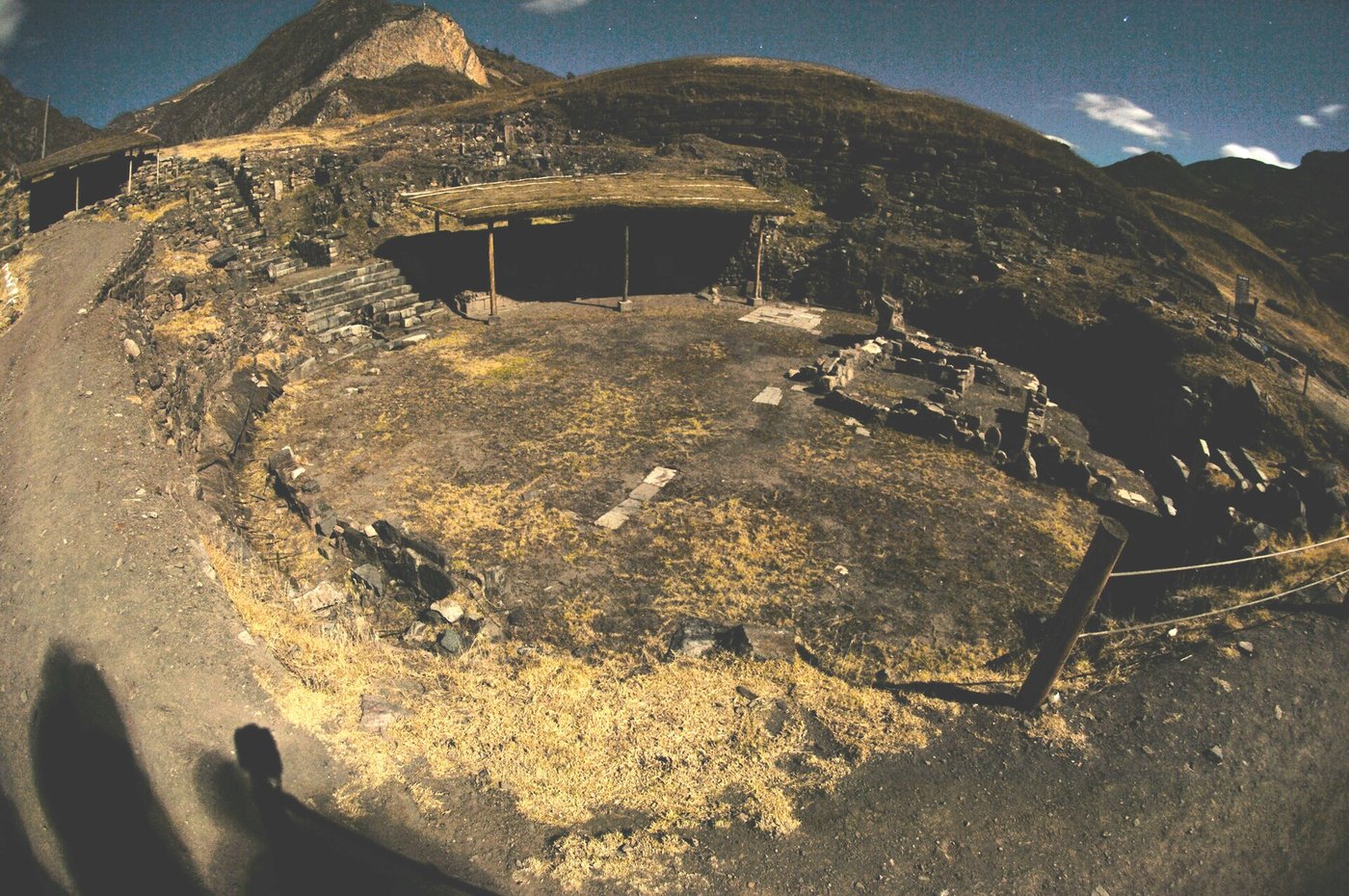
Cut into the solid mass of the platforms is a warren of narrow passages, the galleries. They run on several levels, cramped, unlit, roofed with heavy stone beams, linked by stairs and blind turns and doorways that a grown adult has to stoop through. More than thirty of these passages have now been mapped, and new ones keep appearing. Threaded among them is a second network, of water channels, that carried the Wacheqsa under and through the building. On certain days, opened at the right point, that water would have filled the galleries with a roar you could feel in your chest.
Nothing about this was accidental. A person led inside lost the sun, lost their sense of direction, lost the ordinary reckoning of where the walls were and how far the sound was coming from. The building was designed to strip away the props a mind leans on. And then, when the mind was already unmoored, it was shown a god.
The knife in the dark
At the very centre of the Old Temple, where the galleries fold in on themselves, stands a single shaft of white granite four and a half metres tall. It is wedged from floor to ceiling in a cross-shaped chamber so tight that you cannot step back far enough to see the whole of it. Archaeologists call it the Lanzón, from the Spanish for lance, because of its long blade-like shape. It has never been moved. It is very likely the oldest thing at Chavín still standing exactly where its makers set it.
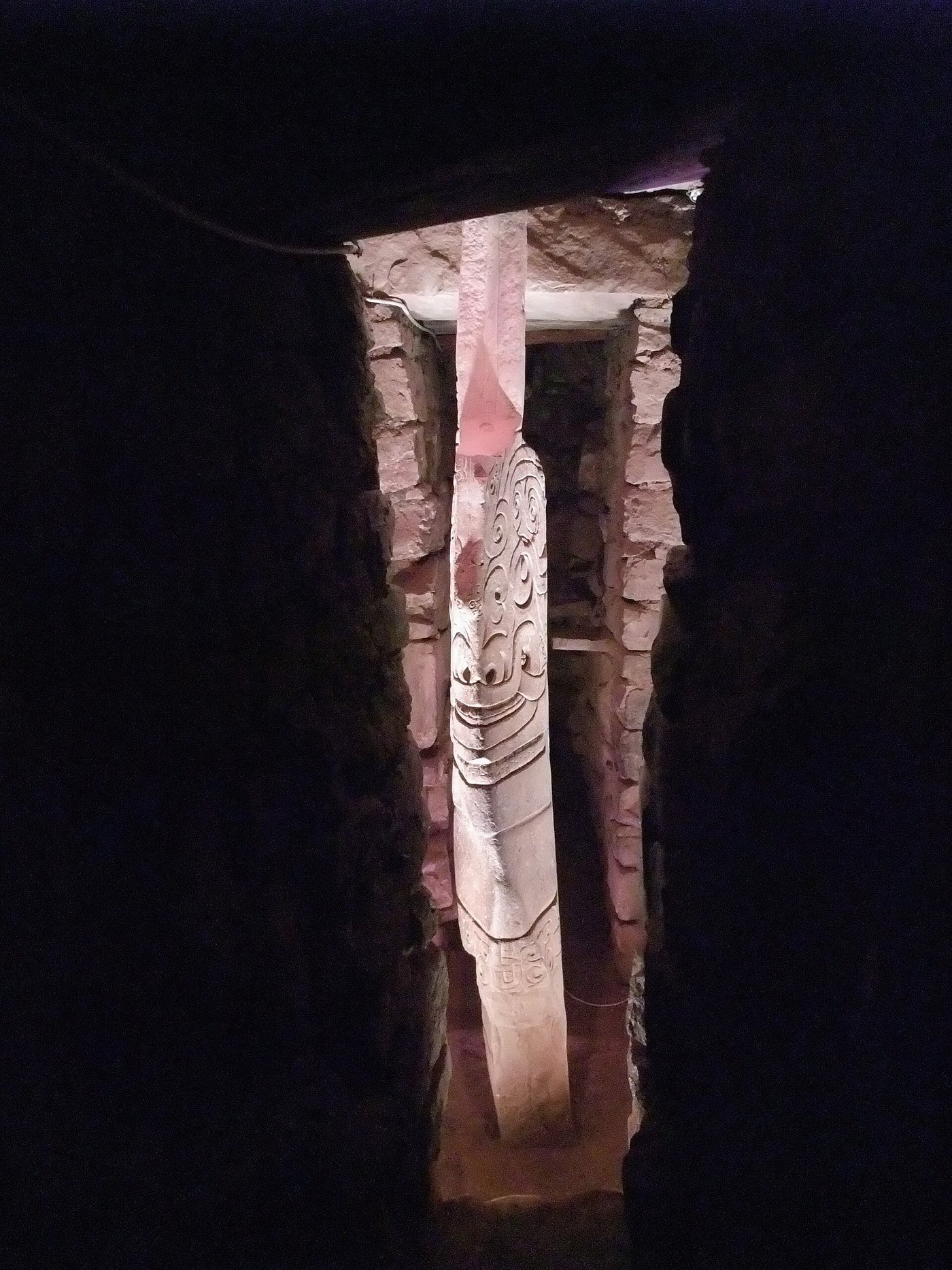
Carved into the stone is a standing figure, part human and part cat. Its mouth is a feline snarl with two long fangs curling upward. Its hair and eyebrows are snakes. One hand points to the sky, the other to the ground, joining the world above to the world below. The whole thing is fitted into the smallest, darkest, most hidden room in the complex, the destination at the end of the maze.
There is one more detail that turns a statue into a piece of theatre. A narrow channel runs up through the top of the Lanzón and out into the gallery above it. Someone standing in that upper passage, unseen by the person kneeling below, could speak or pour water down the shaft, and the sound would seem to come out of the god’s own head. Chavín, many think, was an oracle. People came from far away to put questions to the stone, and the stone answered.
The faces that change
Set into the outer walls, high up, were rows of stone heads the size of a person’s torso, each held in place by a stone peg driven into the masonry behind it. Most have fallen; one still sits in its original socket, and the rest are gathered in the site museum. They are called cabezas clavas, tenon heads, and lined up in order they tell a story.
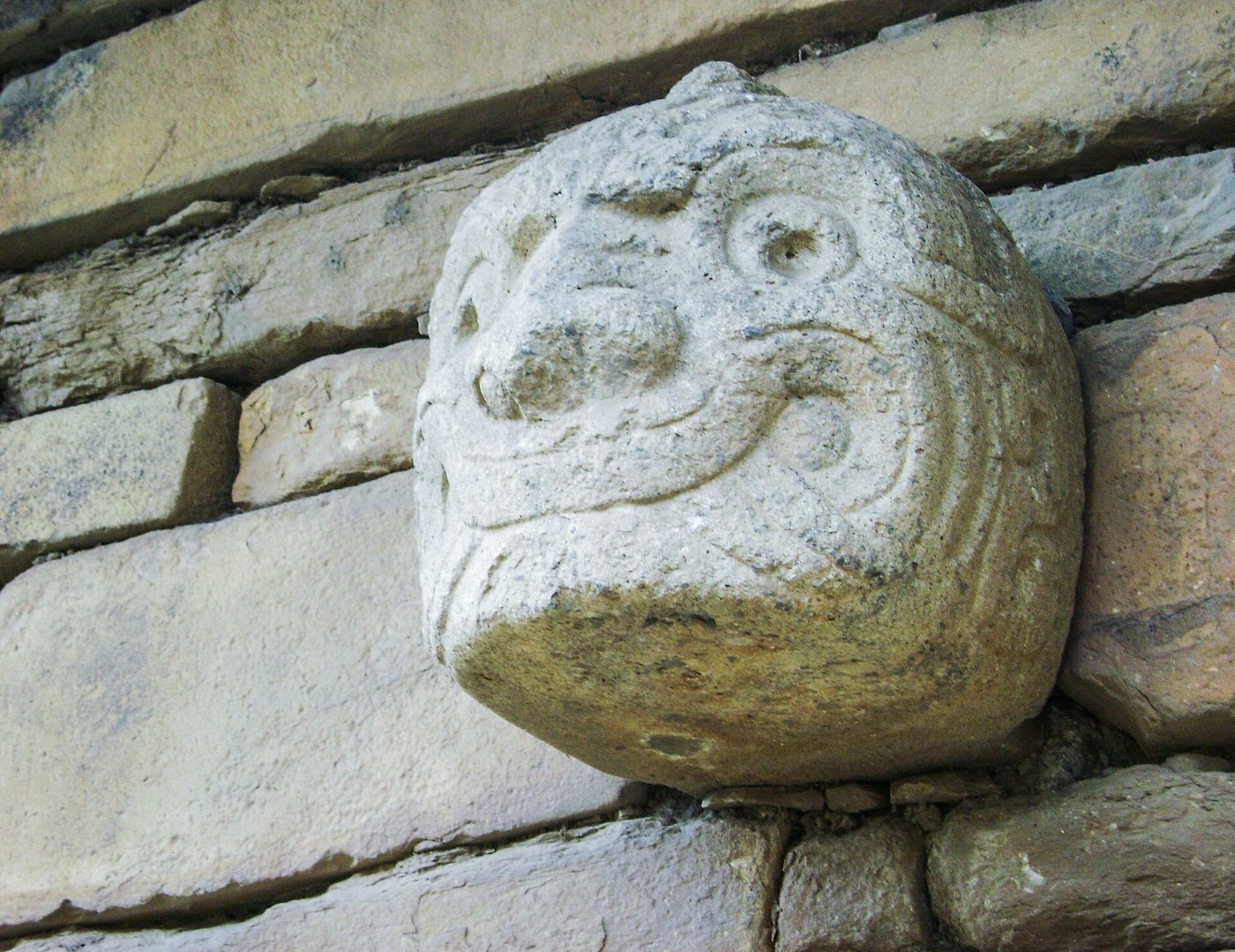
At one end of the sequence the faces are human. Then, head by head, they begin to change. The nose broadens and lifts. The eyes bulge. The mouth pulls back off the teeth. Fangs come in. From the nostrils of the later heads run heavy carved lines, and there is now a plain reason to think those lines are mucus, because the drug taken here made the nose stream. Read from human to beast, the heads show a man turning into a snarling animal. Read the other way, they show the animal a man had to pass through to reach the god. Either way, the wall was a warning and a promise about what happened inside.
The sound of the shells
In 2001 a team digging in one of the galleries came on a cache of twenty large seashells, each one a conch of the species Strombus galeatus, brought up from the warm sea off Ecuador more than eight hundred kilometres away. The tip of each shell had been cut off and ground into a mouthpiece. They were trumpets. In the Andes they are called pututus, and these ones still play. Blown, they give a hoarse, carrying blare somewhere between a horn and a human cry. The gallery where they were found is now known as the Gallery of the Conch Shells.
An acoustic scientist named Miriam Kolar spent years testing what those trumpets did inside Chavín’s stone passages. Her finding was that the building and the instruments were made for each other. The galleries bend and smear sound so that a listener cannot tell where a note is coming from; a pututu blown around a corner seems to speak from the walls, or from above, or from inside your own skull. Small ducts cut through the stone carry sound from one space to another. The architecture was, among other things, an instrument: a device for making noise behave in ways a person had never heard and could not explain.
Chavín has almost no signs of war. No walls built for defence, no ranks of weapons, no burned layers from a sacking. That has made it a favourite exhibit for anyone arguing that the first Andean societies grew through shared belief rather than force. But the drug tubes, the restricted rooms and the private galleries point the other way, toward a small group who controlled the visions and, through them, the people who came for them. Was Chavín a gentle pilgrimage that anyone could join, or an early machine for making some people obey others? The stones do not vote, and archaeologists are still divided over which story the same evidence tells.
What the sealed room gave up
Which brings the story back to the bone tubes in the dark. For most of the twentieth century, the idea that Chavín’s rituals involved mind-altering drugs was an educated guess, and everyone knew it was a guess. The evidence was in the art: the streaming noses on the tenon heads, the bulging eyes, the figures on the plaza slabs holding stalks of San Pedro cactus, whose flesh contains mescaline. It looked like drug imagery. But looking like something is not the same as proving it, and for a hundred years no one had found the drugs themselves in a room where they were used.
It is easy to assume the drug question was answered decades back. The snarling, streaming faces and the cactus-bearing figures are so obviously about altered states that generations of visitors have been told, plainly, that Chavín was a place of visionary ritual. The pictures seemed to say it out loud.
Art can show what a culture imagined, not what it actually did. Until very recently there was no direct chemical evidence: no residue of a psychoactive plant in an authentic ritual object from the site. That gap closed only in May 2025, when a study in the Proceedings of the National Academy of Sciences reported that residues on the bird-bone tubes contained real traces of the drugs. The century-old reading of the carvings turned out to be right, but it had been an interpretation, not a fact, for a very long time.
The team, led by researchers including the archaeologist Daniel Contreras of the University of Florida working with John Rick’s long project at the site, took twenty-three objects from the sealed galleries and put the smallest ones under the microscope and through chemical analysis. Six of the tubes, cut from bird bones, carried what they were looking for.
The residues held two things. One was vilca, a snuff made from the roasted seeds of an Anadenanthera tree, which contains compounds closely related to DMT and hits hard and fast when it is blown into the nose. The other was wild tobacco, far stronger than the tobacco grown today. The tubes were inhalers. Someone loaded a pinch of prepared snuff, put the bone to a nostril, and breathed the powder deep, which is exactly the kind of use that leaves a nose streaming, as the carved faces on the walls had shown all along.
The detail that matters most is not the drug but the setting. These were not open feasts. The tubes came from small, closed, hard-to-reach rooms that only a handful of people could enter at once. Beer, by contrast, the Andes shared in the open by the barrelful. The snuff at Chavín was private. It was taken in the dark, at the end of the maze, by a chosen few, under the eye of whoever ran the place. A drug that could be handed out or withheld is a drug that can be used to sort people: to mark who belongs to the inner rooms and who waits in the plaza. The visions were real. So was the door that most people could not walk through.
The god who travelled
Chavín’s reach went far beyond its own valley, and it went without armies. Over the centuries either side of 500 BCE, a shared style of art spread across much of what is now Peru, from the coast to the highlands. Its signatures are unmistakable: fanged mouths, staring eyes, hair that turns into snakes, birds of prey and caimans folded into human bodies. Archaeologists call this spread the Chavín horizon, and much of it seems to trace back to the images cut into the stones at Chavín de Huántar.
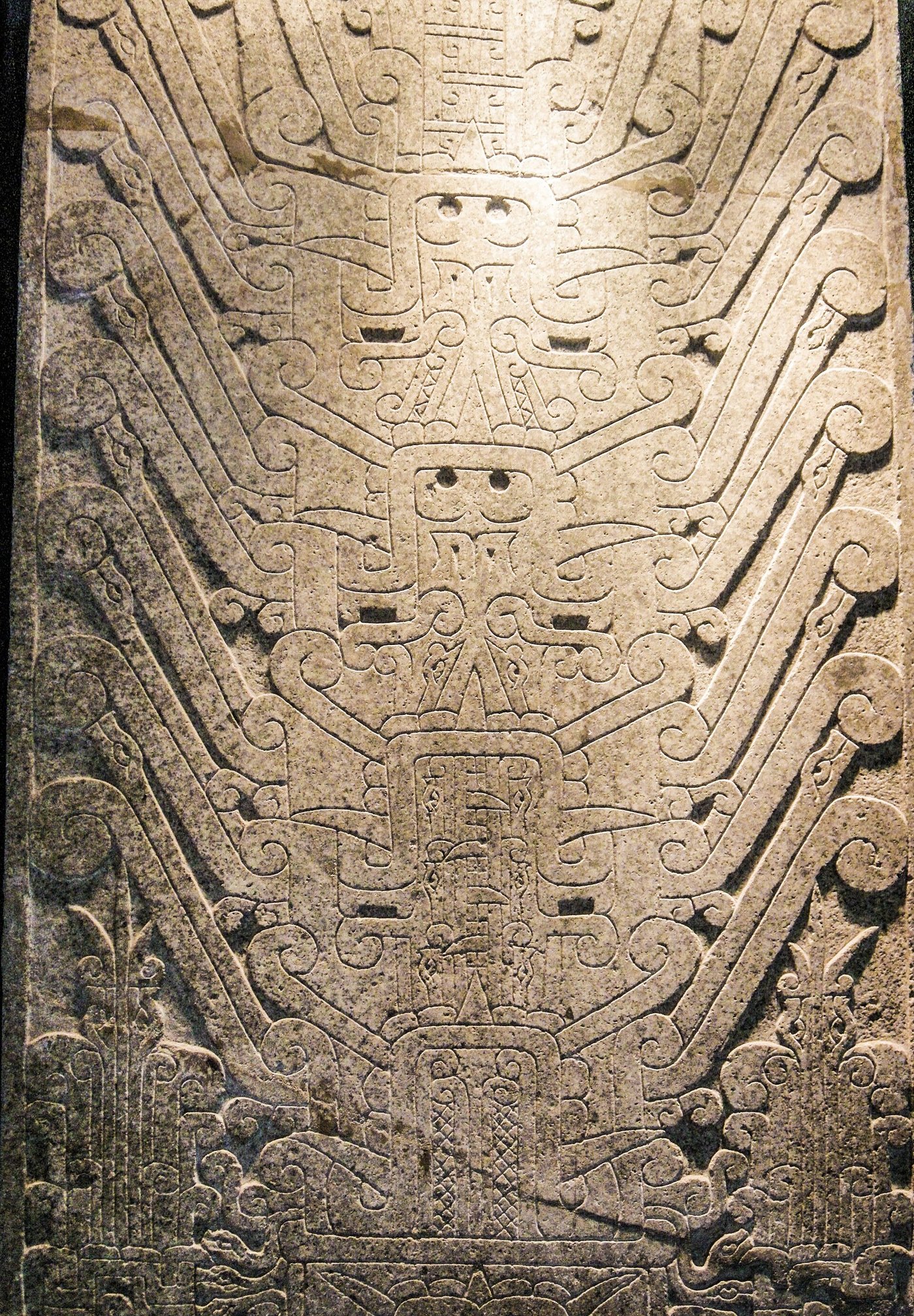
Two carvings show how clever that art could be. The Raimondi Stela, a slab of granite almost two metres tall, holds a standing deity with a staff in each hand: the Staff God who would echo through Andean religion for the next fifteen hundred years. Look at it one way and you see a face gazing out. Turn it upside down and the same lines become a column of snarling mouths. It is a single image with two readings, and switching between them is the sort of thing a mind full of vilca might do on its own. The Tello Obelisk, another famous stone, wraps a pair of cayman gods in a dense tangle of plants and animals that scholars are still unpicking.
How the style spread is still argued. It was probably not one religion with one leader. More likely, pilgrims came to Chavín, took part in whatever happened in the galleries, and carried the images and ideas home, where local craftsmen copied and changed them. The god travelled in people’s memories, not on the point of a spear.
The lights go out
Sometime after 500 BCE the pull of Chavín weakened. The great ceremonies wound down, the galleries fell quiet, and by around 400 BCE the place had lost its role as the centre that drew a region in. People still lived nearby, and later cultures reused the ground, but the machine had stopped. No single disaster explains it. Perhaps the network of belief that fed it frayed; perhaps rival centres rose; perhaps the trick simply wore thin once enough people had walked the maze and knew where the voices came from.
What is left is the building itself, and it still works on the people who visit. You can walk the galleries today with an electric torch, knowing the whole design, and the dark still presses in and the turns still fool you. Somewhere above your head is a channel cut so a hidden voice could fall from the mouth of a stone god. Somewhere in a museum case are the bird-bone tubes that a few people once lifted to their faces in these rooms, and the powder they breathed, identified at last after three thousand years. The visions are gone. The apparatus that made them, stone and water and carefully managed fear, is still standing, and it has never quite given up all of what it knows.
Read next: Tiwanaku: The Andean Temple a Satellite Found Under a Farmer's Field and Caral: A City as Old as the Pyramids, With No Sign of War.
Sources & further reading
- Daniel A. Contreras et al., “Pre-Hispanic ritual use of psychoactive plants at Chavín de Huántar, Peru,” Proceedings of the National Academy of Sciences (2025) — the study that found vilca and tobacco residue in the bone tubes.
- John W. Rick, “The Evolution of Authority and Power at Chavín de Huántar, Peru,” Archeological Papers of the American Anthropological Association — the excavator’s argument about ritual, secrecy and control.
- Miriam A. Kolar, Archaeological Psychoacoustics at Chavín de Huántar, Perú (Stanford, 2013) — the study of the pututu trumpets and the galleries as instruments.
- Richard L. Burger, Chavín and the Origins of Andean Civilization (Thames & Hudson) — the standard overview of the site, its art and its horizon.
- UNESCO World Heritage Centre, “Chavín (Archaeological Site),” inscribed 1985 — the official description and the case for its importance.
Image credits (via Wikimedia Commons): temple platforms and staircase (featured) — Apollo (CC BY 2.0); sunken circular plaza — CyArk (CC BY-SA 3.0); the Lanzón — Frenchguy (CC BY-SA 3.0); tenon head in situ — Dtarazona (CC BY-SA 4.0); Raimondi Stela — Ariadnayteseo (CC BY-SA 3.0).