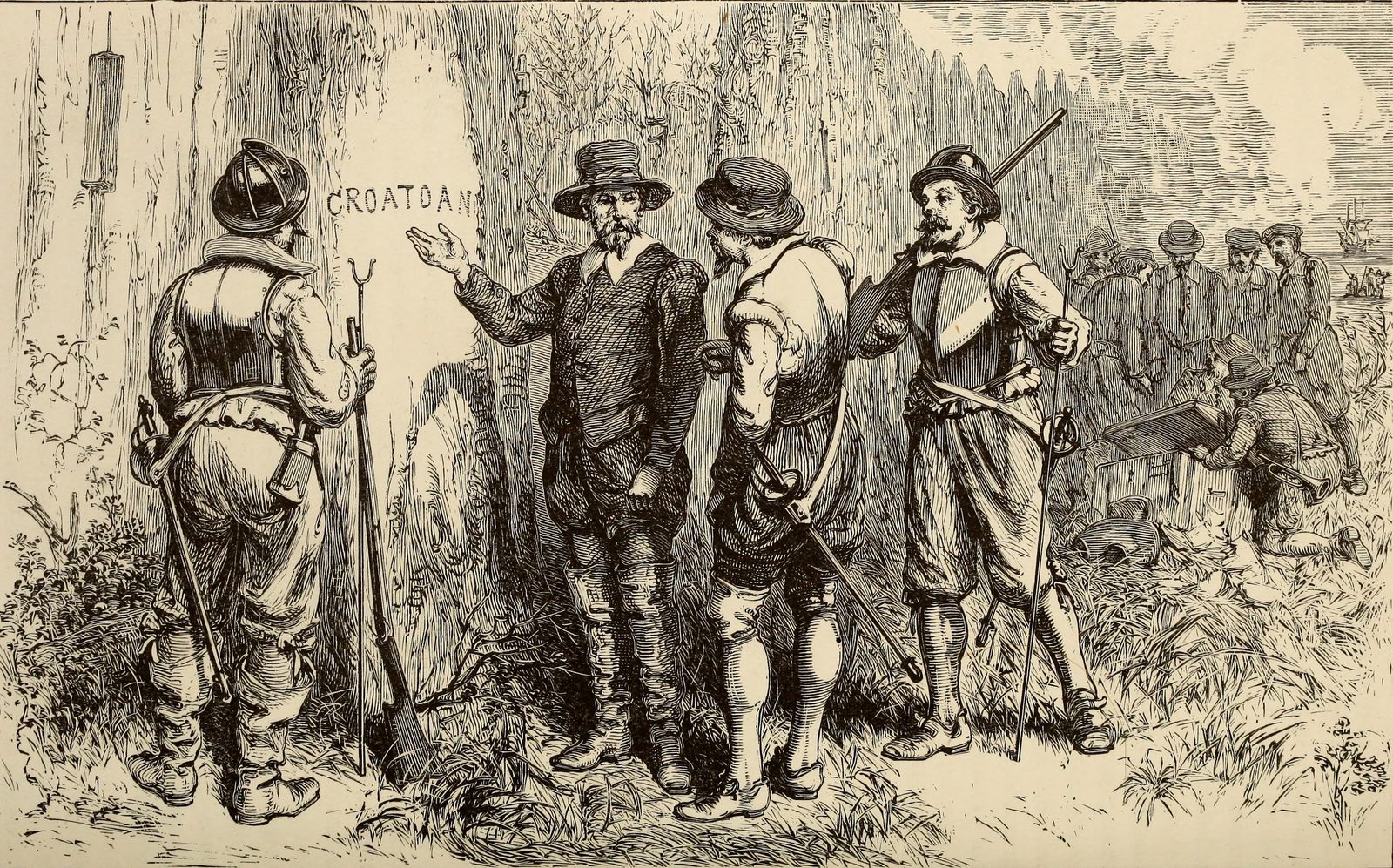
In August 1590, an English sailor named John White finally made it back to the little colony he had left on Roanoke Island, off the coast of what is now North Carolina. He had been gone three agonising years, delayed by war with Spain. Among the colonists he'd left behind were his daughter and his granddaughter, Virginia Dare, the first English child born in the Americas. White came ashore expecting a reunion. Instead he found silence. The houses were gone, dismantled. The settlement was deserted. There were no bodies, no signs of battle, no graves. Just over a hundred people had vanished without a trace. The only clue was a single word, carved into a wooden post: CROATOAN.
More than four centuries later, we still don't know for certain what happened to them. The Lost Colony of Roanoke is the oldest unsolved mystery in American colonial history, and, unusually for a famous mystery, the most likely answer has been hiding in plain sight the whole time.
A colony that was doomed from the start
England came late to the colonisation of the Americas, and Roanoke was its first serious attempt. Backed by Sir Walter Raleigh, the venture was meant to plant an English foothold in the "New World" (and, conveniently, give privateers a base to raid Spanish treasure ships). An earlier military expedition to Roanoke in 1585 had already gone badly, souring relations with the local Native peoples before the civilian colonists even arrived.
So when John White led roughly 115 men, women and children to Roanoke in 1587 to establish a permanent settlement, they were walking into a situation that was already hostile, under-supplied, and poorly planned. Within weeks it was clear they didn't have enough provisions to survive. The colonists persuaded White, their governor, to sail back to England for help. He didn't want to leave his family, but he was the obvious choice. He expected to be gone a few months.
The three-year delay
White's timing could hardly have been worse. He arrived back in England just as the country was bracing for invasion: 1588 was the year of the Spanish Armada. Queen Elizabeth I needed every available ship for the war with Spain, and a relief voyage to a tiny colony across the Atlantic was not a priority. White was stranded, frantic, and powerless, watching the months stretch into years while his family waited an ocean away.
It wasn't until 1590, three years after he'd left, that White finally secured passage back to Roanoke. He landed on the island on, of all days, his granddaughter Virginia's third birthday. And the place was empty.
The colonists and John White had agreed on a code before he left: if they had to leave Roanoke, they would carve their destination into a post or tree - and if they left under attack or duress, they would add a Maltese cross. White found the word CROATOAN carved cleanly, with no cross. By the colonists' own pre-arranged signal, that strongly implied they had moved on purpose, not been driven out in violence. The single most chilling clue may actually have been a message of reassurance.
The clue: CROATOAN
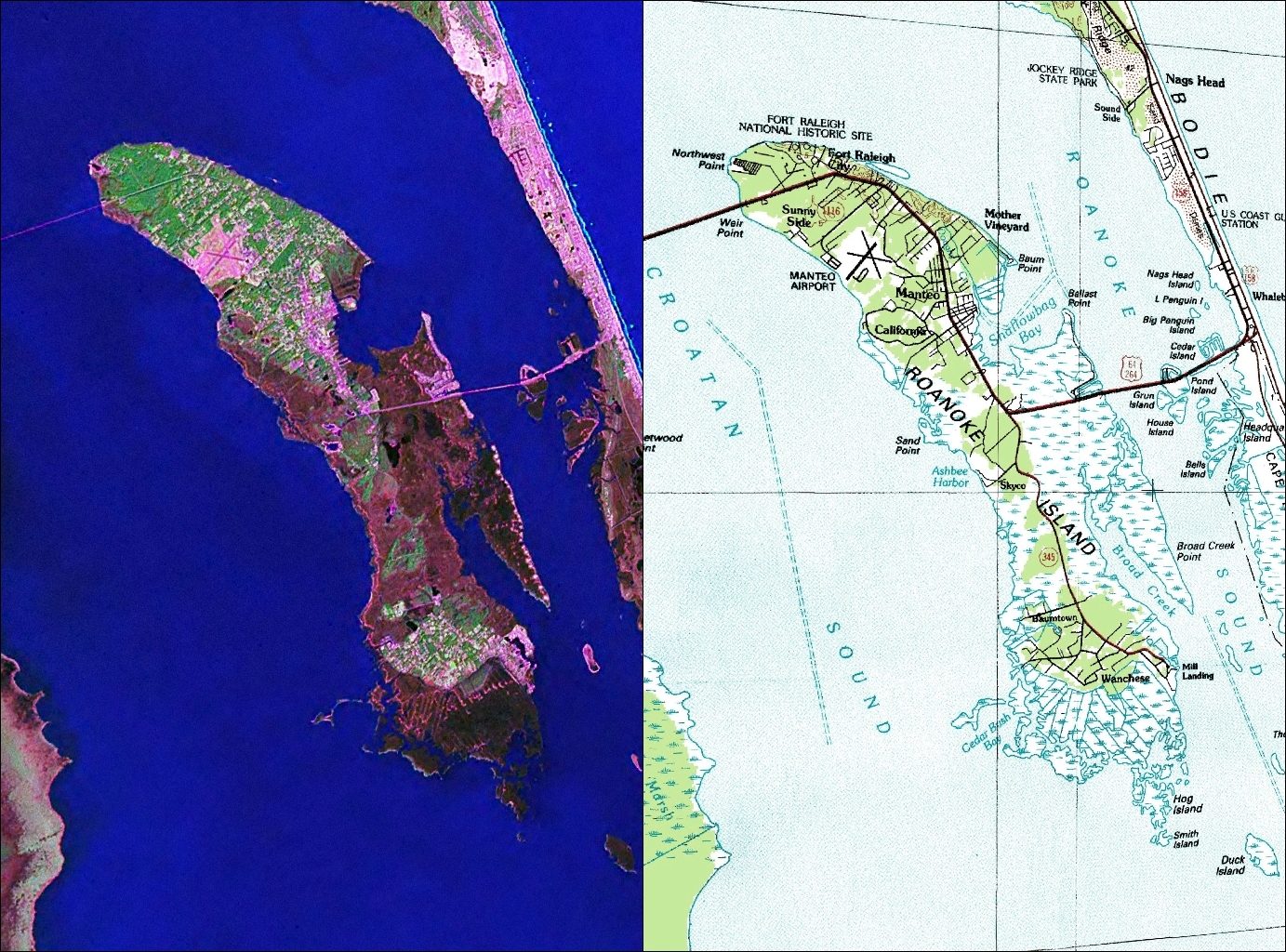
That carved word was not gibberish. "Croatoan" was the name of a nearby island (today's Hatteras Island) and of the Native people who lived there. The Croatoan were a group with whom the English had been on relatively friendly terms, and the island was the home of Manteo, a Croatoan man who had travelled to England and acted as the colonists' ally and interpreter.
In other words, the colonists appear to have left a clear forwarding address. The most natural reading is that, running out of food and out of hope that White would return, they abandoned the failing Roanoke settlement and went to live with the friendly Croatoan people, or moved inland to join other Native communities. It is not really a "vanishing" so much as a relocation that nobody was around to document.
Heartbreakingly, White never got to find out. A fierce storm was rising, his sailors refused to risk the dangerous waters around Hatteras, and the expedition was forced to turn back to England almost immediately. White, old and broke, never returned to the Americas. He died never knowing what had become of his daughter and granddaughter.
So what really happened?
The leading theory - that the colonists assimilated into nearby Native communities like the Croatoan - is supported by the carved word and by later reports of grey-eyed, English-speaking, or European-featured people among coastal tribes. But historians argue over the details and the alternatives: did the whole group go to Croatoan, or split up? Were some killed, enslaved, or scattered by drought and conflict? Tree-ring studies show the colony arrived during one of the worst droughts in 800 years, which would have made survival brutal for colonists and Natives alike. The "assimilation" answer is the most plausible - but proving exactly who went where, and what befell them, has so far defeated everyone.
Modern archaeology has chipped away at the mystery without fully cracking it. Digs on Hatteras Island (Croatoan) have turned up European artefacts (a signet ring, fragments of slate, gun parts, bits of pottery) mixed in with Native material, hinting at exactly the kind of blending you'd expect if colonists had joined that community. Another project, "Site X" on the mainland, has found English pottery suggesting at least some colonists may have moved inland. The picture emerging isn't a single dramatic fate but, most likely, a dispersal: small groups of desperate people surviving the only way they could, by ceasing to be a separate "English colony" at all.
Why the "vanishing" myth survives
"The Roanoke colonists vanished into thin air, with no clue and no explanation - a genuinely supernatural disappearance."
They left a clue: the word CROATOAN, carved without the agreed distress signal, pointing to a known friendly island and people. The likeliest answer - that the starving colonists abandoned a doomed settlement and were absorbed into Native communities - is mundane, even sensible. The "eerie vanishing" version persists because John White was forced to turn back before he could follow the clue, so the story was left permanently unfinished.
It's worth being honest about why Roanoke became legend. A storm, a war, and a frightened ship's crew stopped the one man who could have solved it from sailing ten miles further. The colonists almost certainly did not evaporate; they made a hard, rational choice and walked off the page of recorded history. But because no European followed them, the trail went cold, and a relocation hardened over the centuries into a ghost story.
"One of the chief trees or posts at the right side of the entrance had the bark taken off, and five feet from the ground in fair capital letters was graven CROATOAN, without any cross or sign of distress."— John White's own account of returning to Roanoke, 1590
The first lost colony
Roanoke matters as more than a campfire mystery. It was England's first attempt at a permanent American colony, and its failure shaped what came next: when the Virginia Company tried again two decades later, the lessons of Roanoke (supply, planning, location) hung over the founding of Jamestown in 1607, the settlement that finally stuck.
But the human heart of the story is John White, a father and grandfather who sailed home for help and was kept away by history's bad timing, returning to find a single carved word where his family had been. We remember Roanoke as a puzzle. For the man who left those people behind, it was the question he carried, unanswered, to his grave, and one that, four centuries on, we are still trying to answer for him.
The disaster before the disaster
The 1587 colonists were not the first English people to try Roanoke, and the failure of the earlier attempt helped doom them. In 1585, an expedition of soldiers under Ralph Lane had established a fort on the same island. It was a military outpost, not a family settlement, and it went badly. The English depended on the local Native peoples for food but treated them with suspicion and force; relations collapsed into violence, culminating in the killing of a local chief, Wingina. When supplies ran short and tempers frayed, that first garrison abandoned Roanoke and sailed home with a passing fleet in 1586.
So when John White's families arrived in 1587, they were settling among Native communities who had every reason to distrust and resent the English after the previous group's behaviour. The colonists inherited a poisoned relationship they hadn't created. That was one more reason their position was precarious from the very first day, and one more reason that "they went to live with the Croatoan" is plausible but complicated: some neighbours were friendly, others very much were not.
Virginia Dare: a baby who became a legend
Among the missing colonists was a child who has taken on a strange afterlife: Virginia Dare, John White's granddaughter and the first English child born on American soil, in August 1587. She was barely a week old when her grandfather sailed for England, and just three when he returned to find everyone gone.
Because her fate is completely unknown, Virginia Dare became a blank screen onto which later generations projected all sorts of meanings: a symbol of innocence lost, the subject of poems and folklore, even local legends in which she grows up among Native peoples or is transformed into a white doe. The historical reality is that we know almost nothing about her beyond her birth. But the emotional power of the story (a newborn, the very first of her kind, vanishing into the unknown) is a big part of why Roanoke grips people centuries later. It's not an abstract "lost colony"; it's a baby whose story simply stops.
The other theories
While assimilation into the Croatoan or other Native communities is the leading explanation, it's not the only one historians have entertained, and the alternatives are worth airing. One is a Spanish attack: Spain controlled Florida and viewed English colonies as illegal incursions to be wiped out. The Spanish actively searched for the Roanoke settlement, but their own records suggest they never found it, which makes a Spanish massacre unlikely (they'd have boasted of it).
Another possibility is disaster at sea: perhaps the colonists tried to sail back to England in their small pinnace and were lost in the Atlantic. A grimmer theory holds that some were killed by a hostile Native group rather than welcomed by a friendly one. The region's politics were complex, and not every community was as well-disposed as the Croatoan. It's entirely possible the truth is a combination: the group split, with some going to Croatoan, some moving inland, and some meeting bad ends along the way. After more than four hundred years, the most honest verdict is that Roanoke is probably not one mystery with one solution, but the scattered, unrecorded fates of a hundred desperate people, most of whom likely survived by disappearing into a new world, which is exactly why the paper trail ends. The absence of bodies, of graves, of any sign of slaughter is, in the end, the most hopeful detail of all. It suggests these people didn't die so much as walk off the edge of the records we happen to keep.
Hoaxes, forgeries, and false trails
A mystery this famous inevitably attracts fraud, and Roanoke has had a spectacular example. In the 1930s, a series of inscribed stones, the so-called "Dare Stones", began surfacing, purporting to be messages carved by Eleanor Dare (Virginia's mother) chronicling the colonists' fate after they left Roanoke. The first seemed tantalisingly plausible; then dozens more conveniently appeared, and the whole affair unravelled as a likely hoax, an embarrassing cautionary tale about wishful thinking and the money to be made from a good mystery. They're now mostly regarded as forgeries, though a few researchers still argue about the very first stone.
The Dare Stones matter because they show how powerfully Roanoke pulls at people: the urge to finish the story is so strong that it has repeatedly produced fakes, folklore, and overreaching theories. Real archaeology, by contrast, advances slowly and cautiously: a few European artefacts in a Native context here, some English pottery at an inland site there. No single dramatic "answer," just patient accumulation of small clues, all of which point gently toward the same undramatic conclusion: that the colonists survived by integrating with the people already living on that coast.
A clue still walking around today
Perhaps the most poignant evidence isn't buried at all. It's in the living. For centuries there have been reports and traditions among certain Native and mixed communities of the Carolinas, including groups connected to Hatteras (Croatoan) and the people later known as the Lumbee, of European ancestry, English surnames matching colonist names, and oral histories of long-ago newcomers who joined them. None of this is conclusive proof, and the questions of identity involved are complex and sensitive. But it fits the most likely scenario remarkably well: that the "Lost Colony" was never lost at all, only absorbed, its descendants continuing, for generation after generation, among the very people their ancestors came to live with. If that's true, then the great vanishing is really a story of survival in disguise, hiding in family trees rather than in the ground.
Image: the coastal landscape of Roanoke Island, North Carolina (via Wikimedia Commons).
Read next: Franklin Expedition: The Ships Found by Believing the Inuit and Mary Celeste: A Sound Ship, Six Months of Food, and No One Aboard.
Sources & further reading
- James Horn, A Kingdom Strange: The Brief and Tragic History of the Lost Colony of Roanoke (2010).
- Andrew Lawler, The Secret Token: Myth, Obsession, and the Search for the Lost Colony of Roanoke (2018).
- John White's narratives of the Roanoke voyages (primary source, reprinted in many collections).
- Research from the Croatoan Archaeological Society and the First Colony Foundation ("Site X"); tree-ring drought studies published in Science.