A warship is the last thing on the water that should be afraid of a breeze. On the afternoon of 10 August 1628 the people of Stockholm crowded the quays and the rocks to watch their newest one leave. The Vasa was the most expensive, most heavily gunned, most gorgeously carved ship Sweden had ever built, and this was only her first short hop down the harbour to pick up the rest of her crew. She loosed a salute. A gust came off the land. She leaned, stood herself up, leaned again, and this time she kept going. In the time it takes to read this paragraph the pride of the Swedish navy was on the bottom of her own harbour, her masts still standing clear of the water, and perhaps thirty people were drowning inside her.
She had sailed for about thirteen hundred metres. Not thirteen hundred miles, not out into a winter gale off some hostile coast, but thirteen hundred metres, on a summer day, in front of a home crowd, in water so sheltered you could throw a stone across parts of it. No enemy touched her. No reef, no rock, no fire. The mightiest ship in the Baltic was undone by an ordinary puff of wind, and the whole city saw it happen. The question of how that was possible has been asked for four hundred years, and the ship herself has spent the last sixty of them answering it, plank by salvaged plank.
A ship built to be looked at
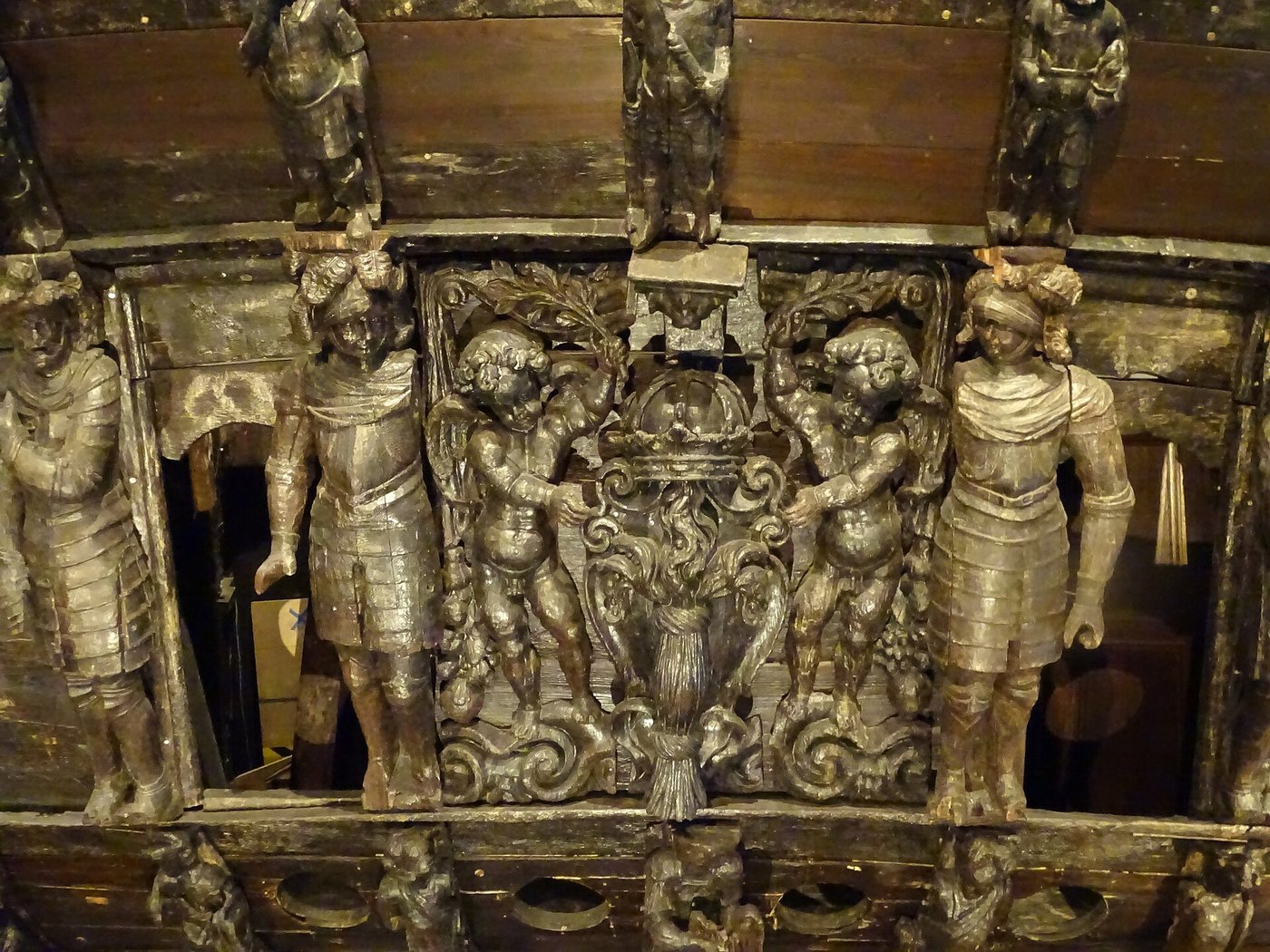
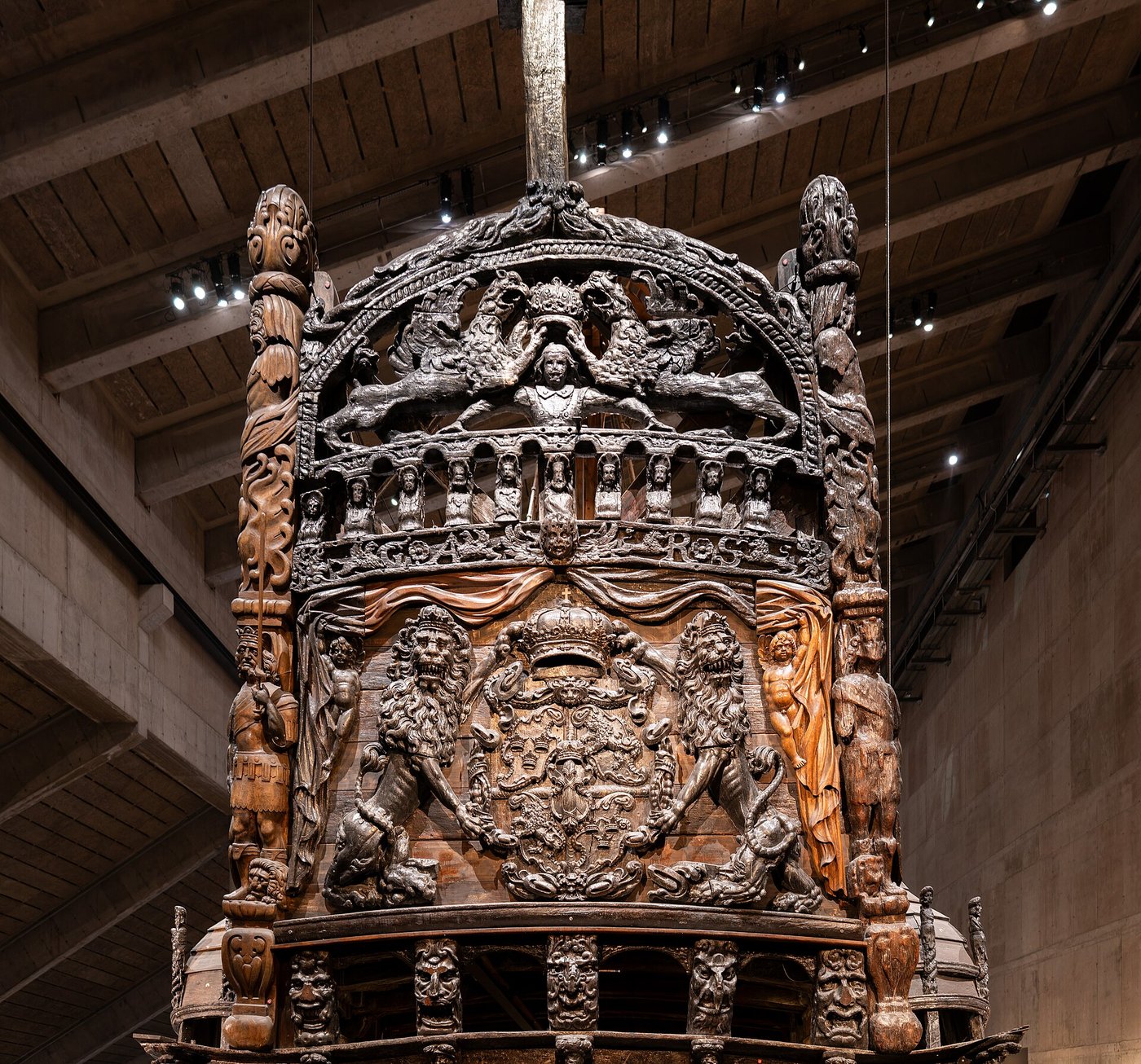
Start with what the crowd came to see, because the Vasa was designed first of all to be seen. Her stern climbed out of the water like the front of a small cathedral, packed with hundreds of carved figures: lions, sea gods, Roman emperors, biblical kings, cherubs, mermaids, a whole crowd of painted and gilded wood shouting a single idea, which was that the man who owned this ship was not to be trifled with. Much of it was brightly coloured, some of it covered in gold leaf. From a boat alongside she would have blazed.
None of this was decoration for its own sake. A great warship in the seventeenth century was a floating billboard for the state that paid for it. The carvings told anyone who could read them (and plenty who could not) that Sweden had arrived as a power, that its young king was heir to the heroes and the emperors, that resistance was a poor idea. The Vasa was propaganda you could fire cannon from. The trouble is that sculpture weighs something, and all of hers hung high up, at the ends and along the sides, exactly where a ship can least afford to carry extra weight.
Below the artwork sat the real argument: the guns. The Vasa was pierced for two full decks of them, one above the other, most of them heavy bronze twenty-four pounders throwing a shot the weight of a small child. Two closed gun decks, one on top of the other, was an unusual and fashionable thing in 1628, and it was why she was built. It also meant a second row of heavy metal, and a second row of open ports, set higher up the hull than was wise. Everything that made the Vasa magnificent made her top-heavy. The two facts were the same fact.
The king who could not wait
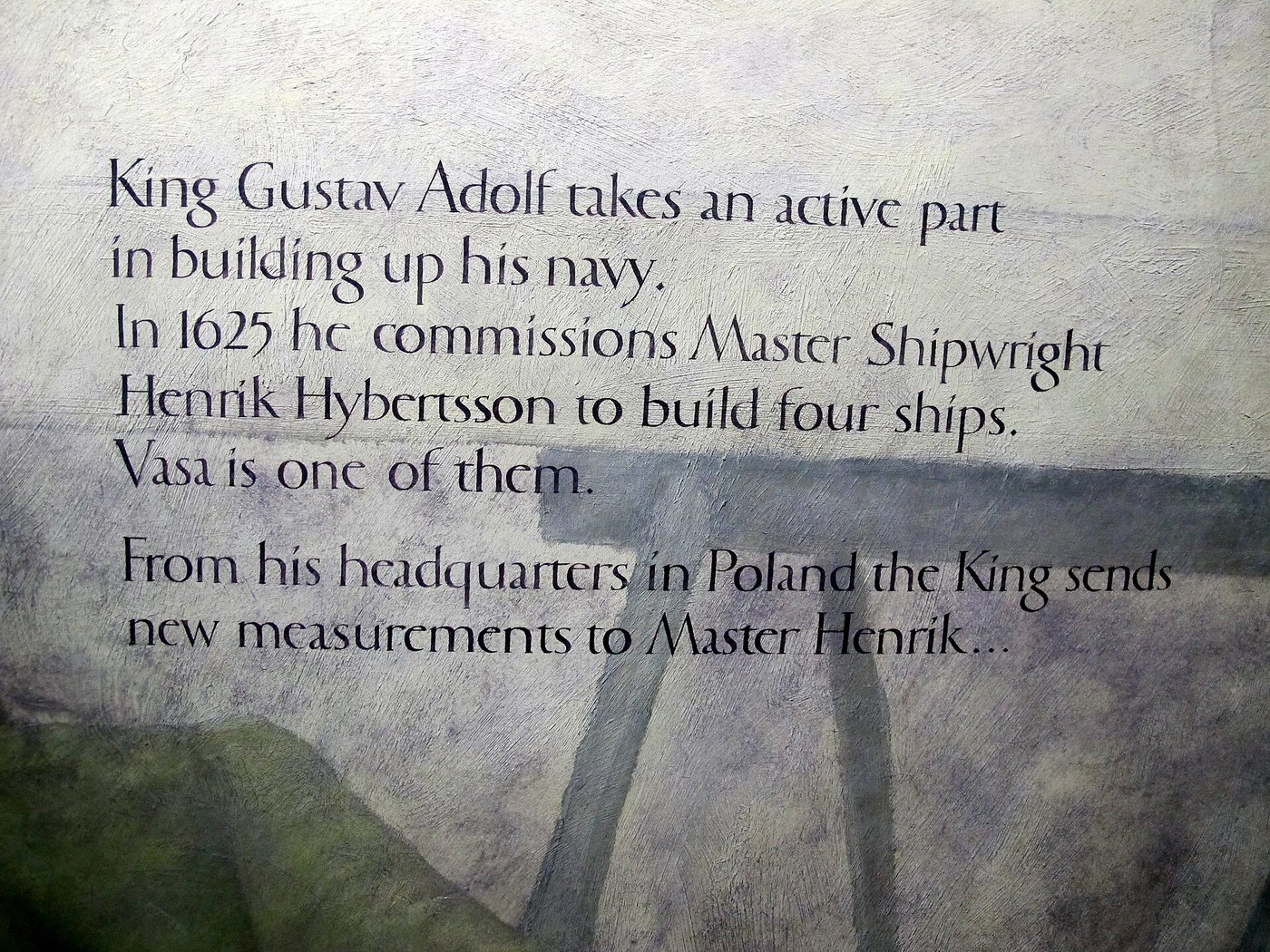
The man behind the ship was Gustavus Adolphus, king of Sweden, and in 1628 he was a king in a hurry. He was fighting Poland, he could see the great religious war in Germany drawing him in, and he had decided that Sweden’s future would be settled at sea as much as on land. In 1625 he ordered a batch of new ships from a Dutch master shipwright working in Stockholm, Henrik Hybertsson, an experienced builder who had made good vessels before. The Vasa was to be the showpiece.
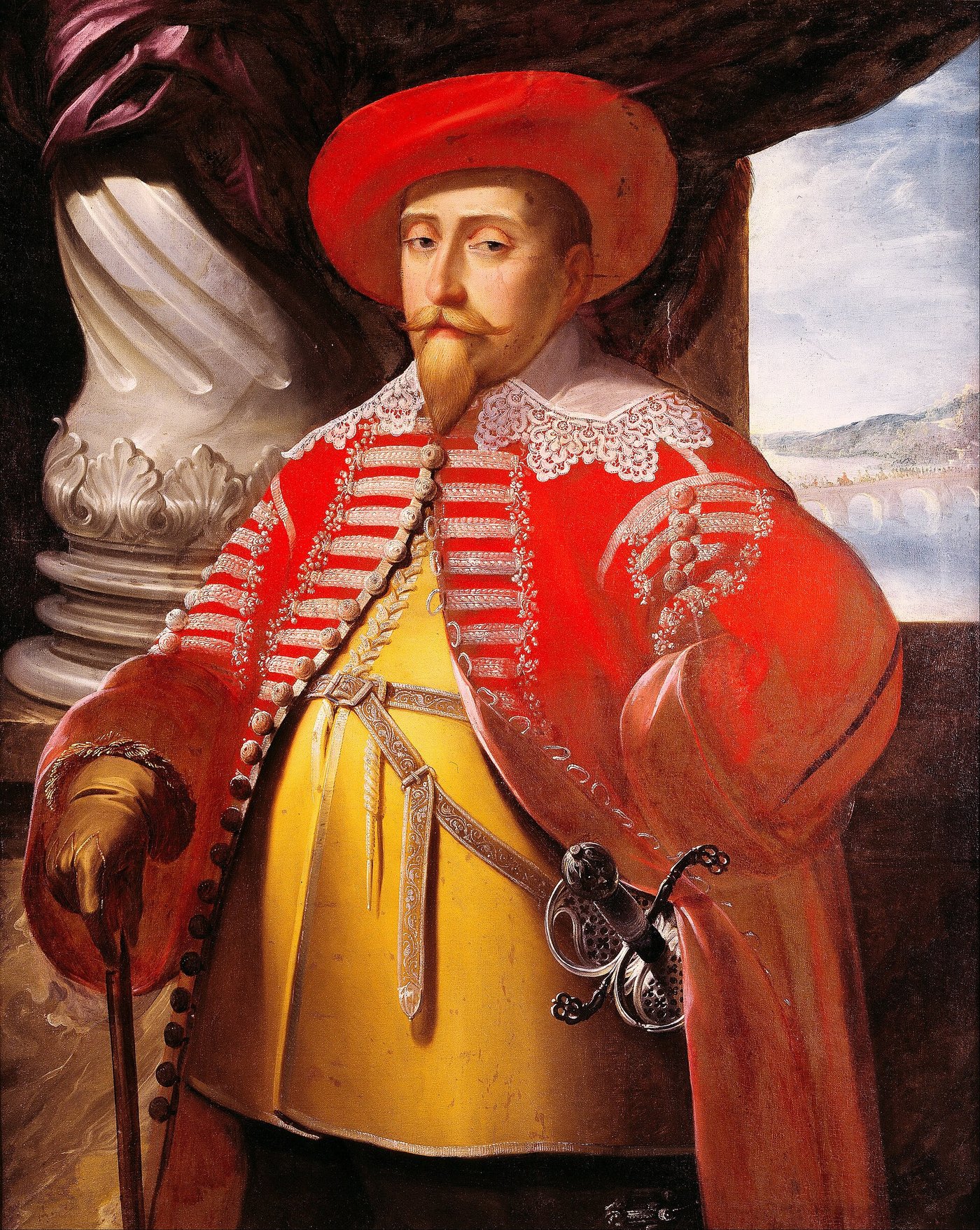
Two things then went wrong, long before launch day. The first was the king himself. He was away campaigning for most of the build, and he governed the project by letter, pushing for the ship to be longer, better armed, ready sooner. Somewhere in the correspondence the design seems to have been stretched and loaded beyond what was first drawn. When your employer is an anointed king with an army, you do not send back a letter explaining that his ship will float badly. You build what you are told and you hope.
The second thing was a death. Henrik Hybertsson fell ill during the work and died in 1627, a year before the Vasa sailed, leaving his assistant Hein Jakobsson to finish a ship whose master was gone. Nobody alive had built exactly this shape before, because nobody had built exactly this shape at all. There was no completed sister ship to measure her against, no proven template. The one man who carried the whole design in his head took a good part of it into the grave with him.
Two gun decks and no way to know
Here is the thing modern eyes find hardest to believe: in 1628 there was no way to calculate, in advance, whether a ship would float upright. The mathematics of stability (the sums that tell you where a hull’s centre of gravity sits and how hard it will fight to stand back up when shoved) had not been worked out yet. Ships were built by eye, by experience, by rule of thumb passed from master to apprentice. A good shipwright knew the proportions that had worked before and copied them. Push past what had worked before, as the Vasa did, and you were in the dark with everyone else.
The Vasa was too narrow and too tall for the weight she carried up high. To hold her down, the builders packed her bottom with stone ballast, roughly a hundred and twenty tonnes of it. It was not enough, and, worse, there was no room to add more. Pile in extra stone to steady her and you pushed the lower gun ports down towards the water; leave the ports safely clear and you had too little ballast to keep her from rolling. The ship was caught between two needs that could not both be met, and no one had the tools to see it before she was in the water.
There was sloppiness in the timber too. When she was studied after salvage, the hull turned out to be slightly lopsided, with more wood built into the port side than the starboard. Among the tools recovered were rulers marked in two different measurement systems, Swedish feet and Amsterdam feet, a hint that different teams had worked to different measures on the same hull. None of this alone would sink a ship. On a vessel already balanced on a knife edge, small errors did not stay small.
The afternoon they ran across the deck
The frightening part is that they knew. Before the Vasa ever set out, someone tested her, and the test failed, and she sailed anyway.
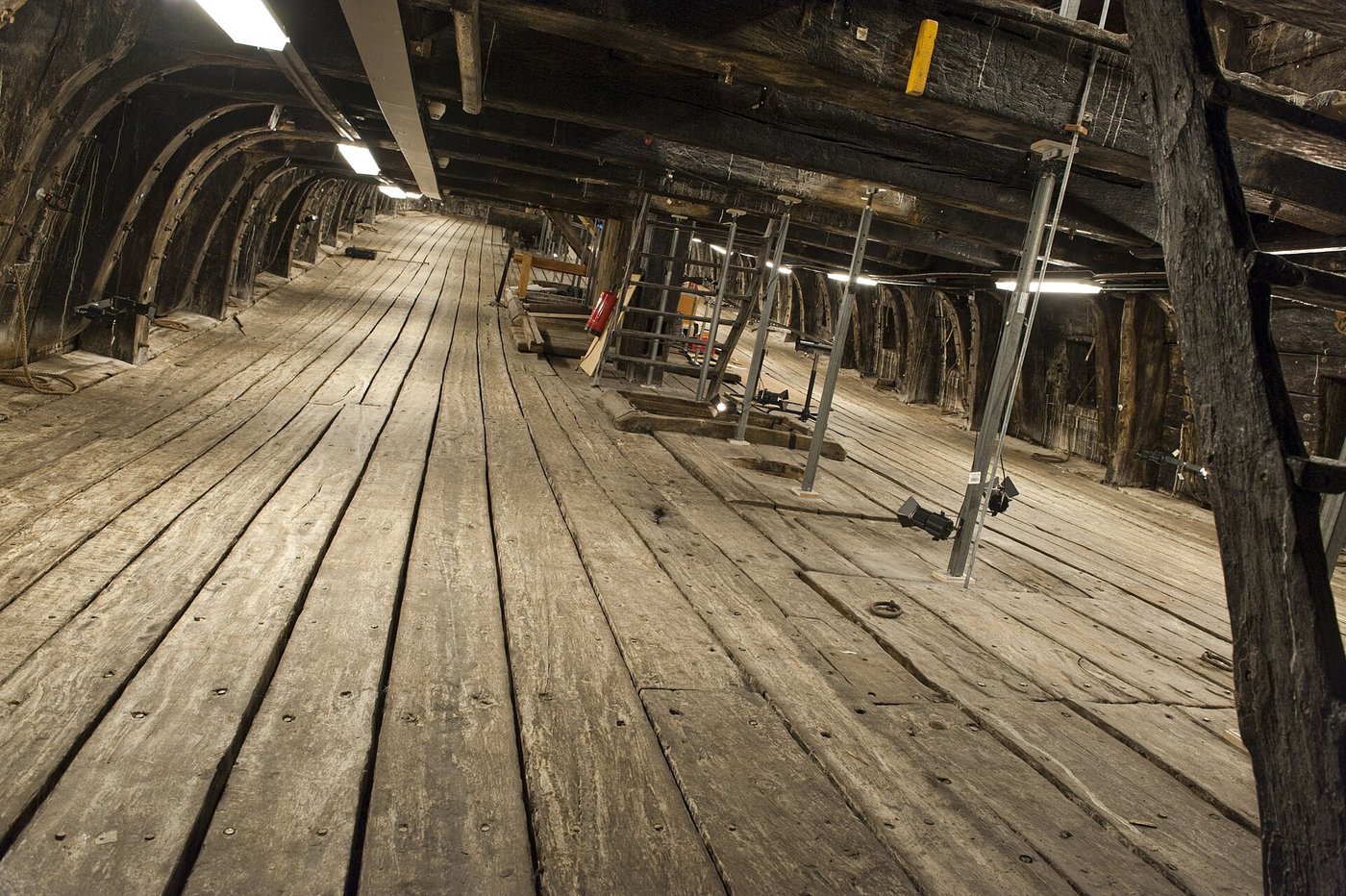
The trial was a simple one, the kind used at the time. Thirty men were sent running from one side of the deck to the other and back, all together, to see how the ship rolled. On a sound vessel the hull rocks and settles. The Vasa rocked further with each run and settled less. After three crossings the officer watching, Vice-Admiral Klas Fleming, ordered them to stop; if the men had kept running, she would have rolled her ports under right there at the dock. Fleming is said to have remarked that he wished the king were at home, which was as close as a careful officer could come to saying that this ship should not sail.
The heeling test was witnessed, remembered, and repeated under oath after the sinking. Thirty men ran the deck; three runs were enough to alarm a vice-admiral into halting it. Everyone present understood what they had seen. But the king was abroad and waiting, the ship was already late, and no one in that yard was willing to be the man who told Gustavus Adolphus his flagship was unfit. The Vasa sailed on a fault that had been demonstrated, out loud, to the navy’s own officers.
So the deeper cause of the wreck was not really wood or ballast. It was that a demonstrated, visible flaw ran straight into a chain of command that had no safe place to put bad news. The men who could have stopped her had every reason to stay quiet and no authority that outranked an impatient king. She was launched by the same force that had built her too tall in the first place.
The trial that blamed the wind
Sweden did what states do after a disaster: it held an inquiry. Within days the survivors, the officers and the builders were hauled in front of a council to explain how a brand-new warship had drowned herself in the harbour. The captain, Söfring Hansson, was questioned hard, partly on the suspicion that the crew had been drunk or the guns left loose to roll. He swore the cannon had been properly lashed. Witness after witness agreed the ship had simply heeled in the gust, taken water through her open lower ports, and gone down.
That left the design, and here the inquiry ran into a wall. The shipwrights pointed out, correctly, that the Vasa had been built to dimensions the king himself had approved. The proportions came from the crown. To find the builders guilty was to find the king’s own orders guilty, and no seventeenth-century council was going to write that down. So the hearing turned in a slow circle and stopped. No one was punished. No one was named. The loss was filed, in effect, under the will of God and the strength of the wind.
The story that stuck: the Vasa was sunk by one man’s vanity, a king who demanded too many guns and too much gilt and would not be told no.
What the evidence shows: the king’s meddling made a bad hull worse, but the deeper cause was that nobody on earth in 1628 could calculate whether a ship would stand up before they built it. The Vasa was pushed past the edge of what experience could judge, by men who had no instrument to measure the edge. Vanity lit the fuse; ignorance of the science laid it.
Three hundred years in the dark
The guns, at least, did not stay lost for long. Bronze cannon were worth a fortune, and within a few decades salvagers went after them. In the 1660s a diver named Hans Albrecht von Treileben worked the wreck using a primitive diving bell (a weighted, open-bottomed dome that trapped a bubble of air), sending men down into the freezing black water for a minute or two at a time to wrestle the guns loose by feel. It was astonishing work for the age, and it stripped most of the bronze off the ship. After that the Vasa slipped out of memory. Her masts rotted away at the waterline, the harbour traffic passed over her, and the exact spot where she lay was forgotten.
What saved the hull was the sea she sank in. The Baltic is only faintly salty, far too fresh for the shipworm, Teredo navalis, the little mollusc that riddles and eats wooden wrecks to nothing in warmer, saltier waters within a few decades. In the cold, dark, brackish, low-oxygen mud of Stockholm harbour, the Vasa’s oak simply sat there, soaking and blackening but holding its shape, for three centuries. In almost any other harbour in Europe there would have been nothing left to find.
The man who found her was not a professional archaeologist but a fuel engineer and amateur naval historian named Anders Franzén, who had grown obsessed with the lost warships of the Swedish navy. Reasoning that the Baltic might have kept them, he spent years dragging the harbour with a home-made coring tool: a heavy sampling device on a line, dropped to punch into whatever lay on the bottom and bring up a plug of it. In the summer of 1956 his corer came up with a plug of black oak. Divers went down and put their hands on the wall of a ship. The Vasa had been under the traffic the whole time.
Lifting a ship that meant to stay down
Getting her up was a five-year gamble. The plan was to pass steel cables under the hull and lift her in stages between a pair of salvage pontoons, walking her from deep water into shallow. To thread those cables, navy divers had to tunnel six passages clean through the packed clay beneath the ship, working blind in near-total darkness, lying in the mud under thousands of tonnes of waterlogged oak that could have settled and crushed them at any moment. It is still remembered as some of the most dangerous diving work ever attempted in Sweden, and remarkably no one was killed doing it.
Through 1959 and 1960 they lifted her in a series of short heaves, moving her step by step into shallower water, then sealed her gun ports and patched every hole so she could be pumped dry. On 24 April 1961 the final lift brought the Vasa’s deck back into the daylight for the first time in three hundred and thirty-three years. Pumps roared, the black hull rose streaming out of the harbour, and she floated again on her own bottom, more or less intact. Divers then spent months recovering the thousands of loose pieces that had fallen away over the centuries (carvings, planks, the whole scattered stern) to be fitted back on later, like a shipwright’s jigsaw the size of a building.
Saved, and then dissolving
A waterlogged wooden ship cannot simply be left to dry. Pull the water out of oak that has been soaking for three centuries and the cells collapse; the wood shrinks, cracks and warps into scrap. So for seventeen years the Vasa was sprayed, day and night, with polyethylene glycol, a waxy chemical that seeps into the timber and replaces the water molecule for molecule, holding the wood’s shape as it slowly dries. It worked. The ship kept her form, and in 1990 she was given her own museum, built around her, where millions of people have walked beneath her hull.
Then, around the year 2000, staff noticed pale, sour-smelling stains blooming on her timbers. The diagnosis was worse than damp. During those centuries on a polluted seabed, sulphur from the harbour had soaked deep into the wood: something close to two tonnes of it. In the warm, airy museum that sulphur was slowly turning to sulphuric acid, helped along by iron from the ship’s old bolts and from the new ones added during salvage. By some estimates the Vasa holds enough sulphur to make several thousand kilograms of acid, and it is eating her from the inside out.
Chemists put the sulphur locked in the Vasa’s timbers at up to roughly five thousand kilograms of sulphuric acid’s worth, forming slowly wherever moisture and iron meet the wood. There is no way to simply remove it. Instead the museum fights a permanent holding action: air kept at a steady humidity, hundreds of corroding iron bolts being swapped out for stainless steel, salt deposits monitored year on year, and a new internal support cradle designed to carry a hull that is slowly sagging under its own weight. The ship was raised once. Keeping her raised is a task with no end date.
She came up with her dead, too. In and around the hull the salvagers found the remains of at least fifteen people who went down with her, and the small ordinary things that drowned alongside them: shoes and a hat, a wooden spoon, coins, a hunting flask, a backgammon set, even a pat of butter still in its keg. From the bones, researchers later built up faces and rough life stories (a man in his thirties with old healed injuries, a woman named in the records only by guesswork) and gave them working names. The ship that killed them handed them back, four centuries on, better preserved than most of the people who came to gawp at her.
The Vasa drowned the people she was built to protect, on a calm day, a few hundred metres from shore, in front of the crowd that had come to cheer her. She has been dying ever since, only far more slowly now, held upright by chemists where ballast failed her. She was never beaten by an enemy fleet or a winter storm. She was beaten by a sum nobody had learned to do yet, and she has been sitting in Stockholm for four hundred years, black and vast and impossibly complete, waiting for anyone who thinks a splendid enough thing is exempt from the arithmetic underneath it.
Read next: Mary Celeste: A Sound Ship, Six Months of Food, and No One Aboard and The Mentor: The Shipwreck That Sank the Parthenon Marbles in 1802.
Sources & further reading
- Hocker, F., Vasa: A Swedish Warship (Medstroms), by the Vasa Museum’s director of research.
- Sandström, M. et al., ‘Deterioration of the seventeenth-century warship Vasa by internal formation of sulphuric acid’, Nature 415 (2002).
- Franzén, A., The Warship Vasa: Deep Diving and Marine Archaeology in Stockholm, on the search and salvage.
- Soop, H., The Power and the Glory: The Sculptures of the Warship Vasa, on the carvings and their meaning.
- Vasa Museum (Vasamuseet), Stockholm — collection and conservation pages on the ship, her sinking and her ongoing preservation.
Image credits (via Wikimedia Commons): the Vasa in the Vasa Museum, Stockholm — Ad Meskens (CC BY-SA 4.0); the carved stern — Jules Verne Times Two (CC BY-SA 4.0); King Gustavus Adolphus — Matthaeus Merian the Elder (public domain); the lower gun deck — Anneli Karlsson / Vasamuseet (CC BY-SA 4.0); the ship today — Murat Özsoy (CC BY-SA 4.0).