For as long as anyone in the fields near Caracollo could remember, the low rise above the maize was just a hill. People walked over it, grazed llamas on it, and never gave it a second thought. Then in the middle of 2025 a Bolivian-born archaeologist named José Capriles put satellite pictures of that hill on a screen, flew a drone over it, and stitched the photographs into a three-dimensional model. Under the scrub was the outline of a temple: fifteen walled rooms set around an open court, a hundred and forty-five metres across, its long axis lined up with the rising sun at the equinox. It sat two hundred and fifteen kilometres from the ruins of Tiwanaku, far outside the ground that everyone thought had already been mapped. The farmers had been walking across the edge of an empire without knowing it was there.
That is the strange thing about Tiwanaku. It is one of the most looked-at ancient sites in South America, a place travellers have sketched and argued over for four hundred years, and it keeps turning out to be bigger, and less understood, than the people staring at it believed. The temple near Caracollo, which the team called Palaspata, was announced in the journal Antiquity in June 2025. It was not dug out of the jungle. It was hiding in plain sight, on farmland, a short drive from a main road.
To see why that matters, you have to go back to the ruins themselves, on the cold plain south of Lake Titicaca, and to the long habit of getting them wrong.
A ruin that was never really lost
Tiwanaku sits at nearly three thousand nine hundred metres, on the high, treeless plateau the Spanish called the altiplano. The air is thin, the nights bite, and the horizon is flat except for the ruins and the mountains behind them. Unlike a buried city, Tiwanaku never disappeared. Its great stones stood above the grass the whole time, which is exactly what made them a target.
The Inca knew the place. When their empire spread south in the fifteenth century they took the ruins as sacred ground and folded them into their own origin story, saying the creator god had made the sun, the moon and the first people here at the start of the world. But the Inca did not build Tiwanaku, and they knew they had not. By the time they arrived the city had already been dead for four hundred years. They were tourists at a ruin too, telling stories about who might have raised it.
When the Spanish chronicler Pedro Cieza de León rode through around 1549, he wrote down what the local people told him: that the stones had been set up in a single night, or by a race of men who lived before the sun existed. He measured some of the blocks, admitted he could not imagine how they had been moved, and moved on. From the very first written account, Tiwanaku came wrapped in the idea that ordinary people could not have made it, and that it needed a miracle, or a vanished super-race, to explain.
That idea did real damage. Over the centuries the site was quarried like a stone yard. Villagers took blocks for the church at the modern town of Tiahuanaco. In the nineteenth century, railway builders laying track from La Paz to the lake helped themselves to cut stone, and treasure hunters dynamited some of the finest masonry to see whether gold was hidden inside. A good part of what Cieza had marvelled at was blown apart or carted off before anyone thought to protect it. The wonder and the wrecking came from the same belief: that the place was not quite human.
The man who aged it by fifteen thousand years
No one did more to fix that belief in print than Arthur Posnansky. An Austrian-born engineer who settled in Bolivia, Posnansky spent decades measuring Tiwanaku and became, in his own mind, its owner and defender. He was a real presence at the site and saved parts of it from further looting. He was also convinced it was the oldest civilisation on earth.
His method sounds scientific and is not. Posnansky assumed the great enclosure had been built as an astronomical instrument, lined up with the sun. Then he measured how far its alignment had drifted from where the sun actually rises today, and blamed the gap on the slow wobble of the earth's axis over thousands of years. Run the wobble backwards far enough to close the gap, he said, and you land on a founding date of around fifteen thousand years ago. He published it in a book with the confident title Tihuanacu: The Cradle of American Man.
The maths only works if the builders had aimed at the sun with perfect accuracy and the walls had never shifted, and neither is true. But the number was too good to die. It was picked up by people who wanted Tiwanaku to be older than history, and from there it slid into the world of lost continents and ancient astronauts, where it still circulates today.
The real dates are less dramatic and far better grounded. Radiocarbon has been sampled at Tiwanaku for decades, and in the 2020s researchers ran more than a hundred of those dates through a single statistical model to pin down the sequence. The picture that comes out is clear. The monumental heart of the city went up from roughly the late sixth century after Christ. The great building phase ran through the seventh and into the eighth. The city thrived to about the year one thousand, then emptied. Tiwanaku is a creation of the first millennium of our era, not of the last ice age. It is old, but it is the age of a medieval city, not of the mammoth hunters.
Standing stones and a sunken court
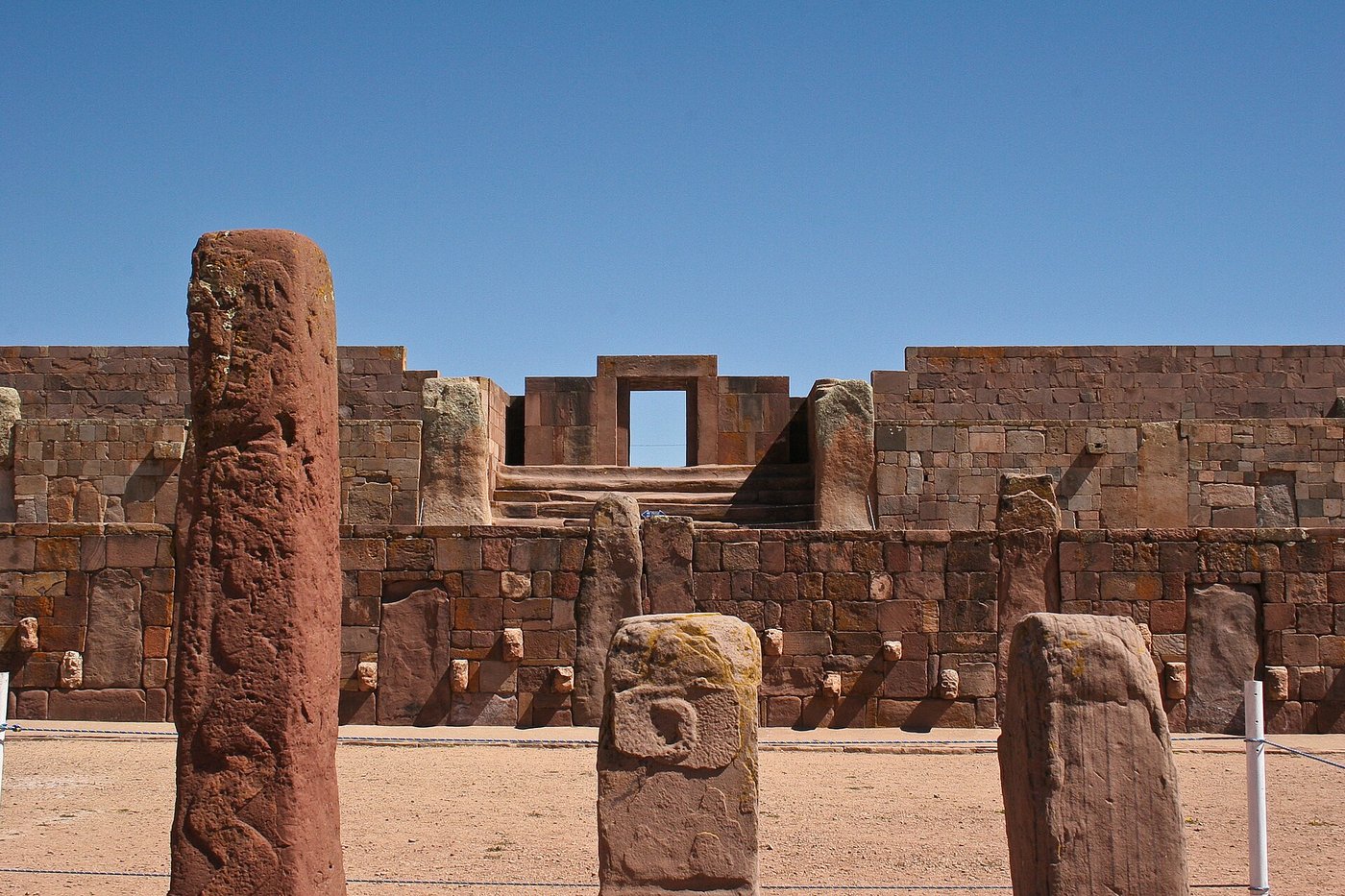
Strip away the bad dating and what remains is impressive enough on its own terms. The core of Tiwanaku is a set of platforms and enclosures built from stone hauled across the plain and worked to a fine finish. The largest, the Kalasasaya, is a raised court the size of several football pitches, its edge marked by tall upright pillars set at intervals like teeth in a jaw (the name means roughly "standing stones" in Aymara, the language later spoken across this ground).
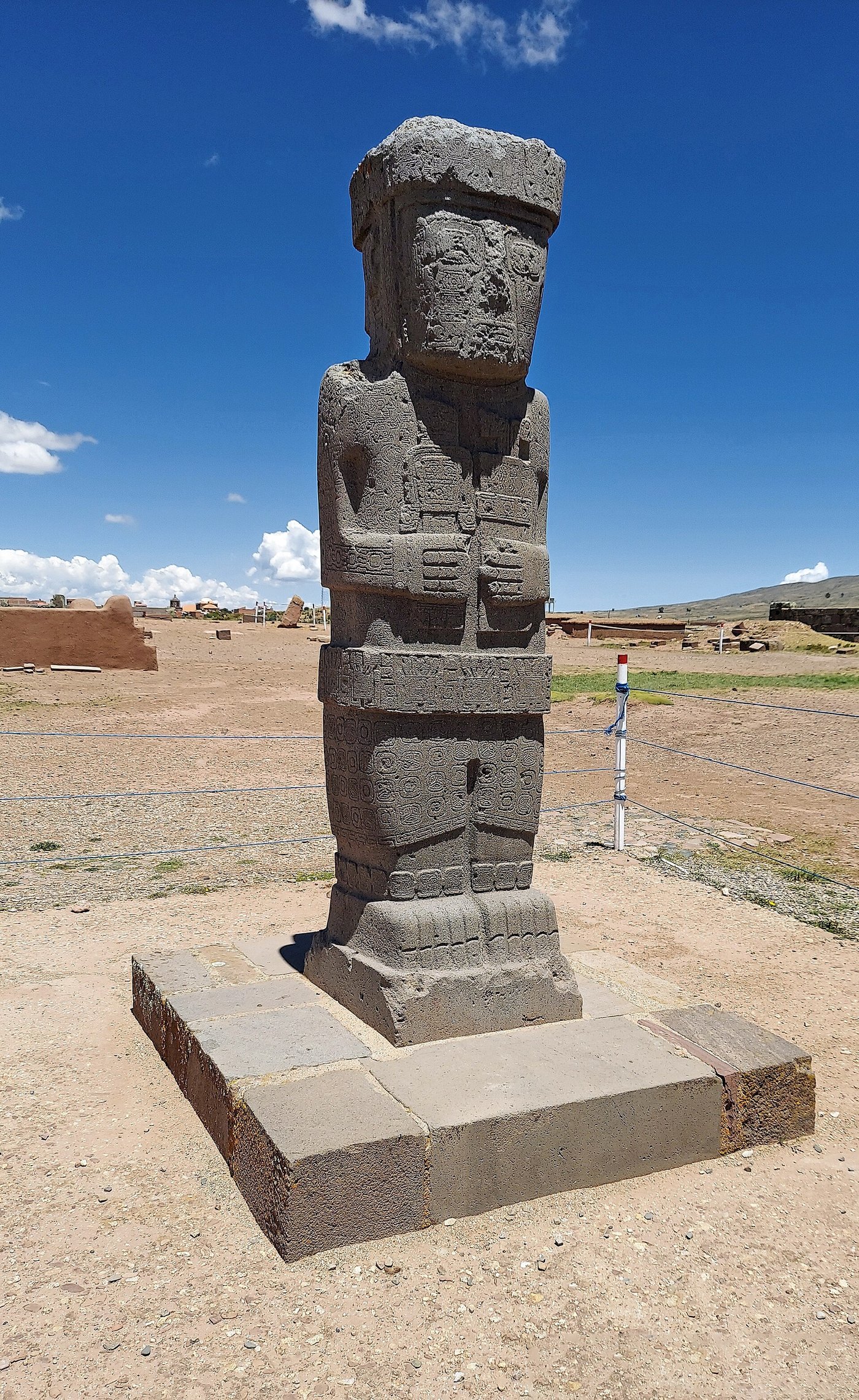
Inside the Kalasasaya stands the Ponce Monolith, a squared human figure about three metres tall, carved from a single block. He holds a beaker in one hand and a small tablet in the other: a cup for maize beer and a board for the snuff that Andean priests took to see visions. His whole surface is covered in tiny incised figures, so densely that from a distance he looks tattooed. He is not a portrait. He is a diagram of belief, a god or a lord wearing the entire cosmos on his skin.
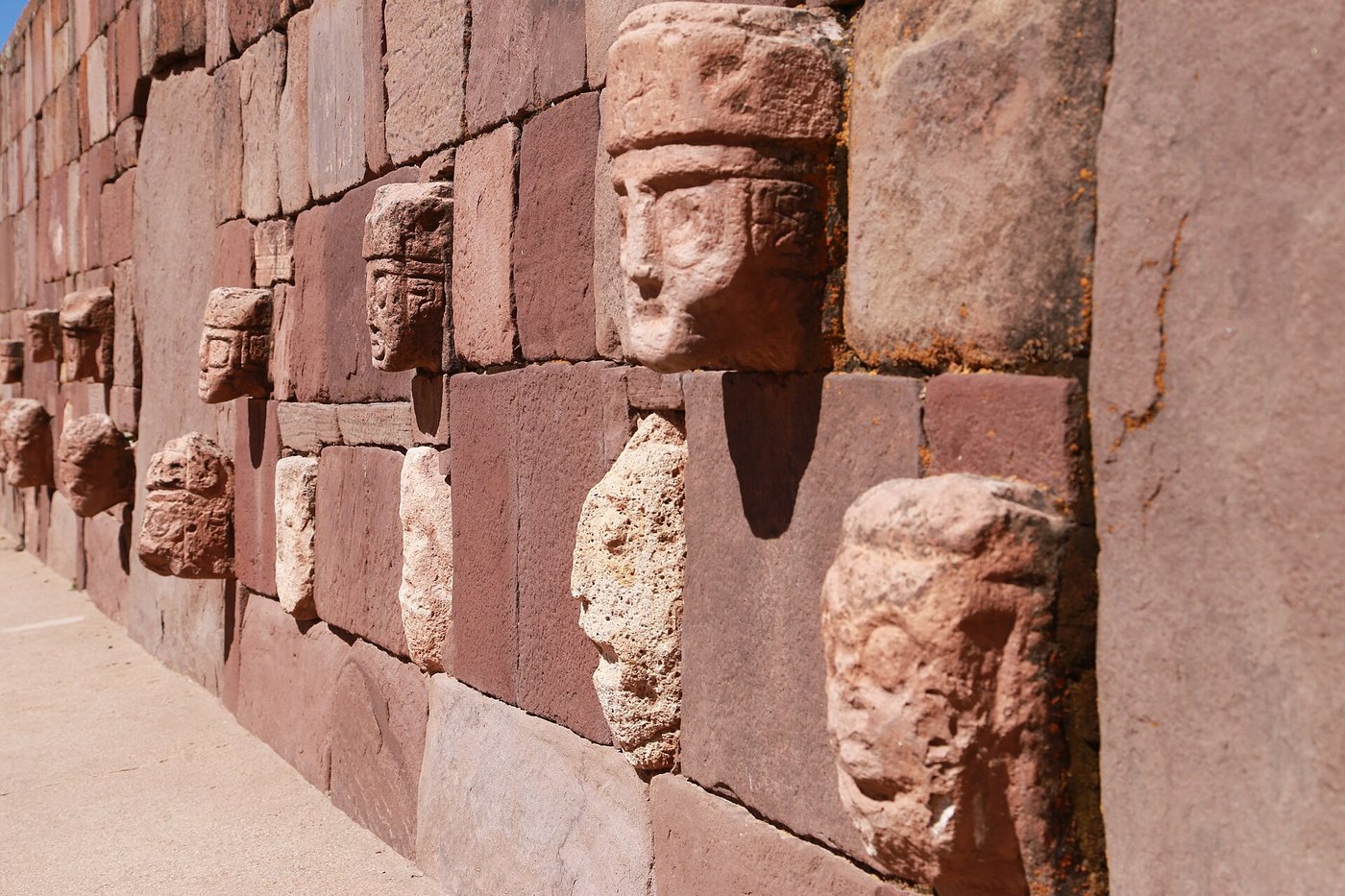
He has a bigger brother. The Bennett Monolith is more than seven metres tall, the largest stone statue in the Andes, and its life since being unearthed is a small history of the country. For much of the twentieth century it stood in an open plaza in La Paz, weathering under city rain and traffic, before being returned to Tiwanaku in 2002. A short walk away is the semi-subterranean temple, a sunken court sunk below ground level whose walls are set with scores of carved stone heads. There are more than a hundred and seventy of them, and no two share a face. Whatever they were (captured enemies, honoured ancestors, a portrait of every people the city pulled into its orbit), they turn the little court into a room full of silent, staring witnesses.
The gate and the figure with the staff
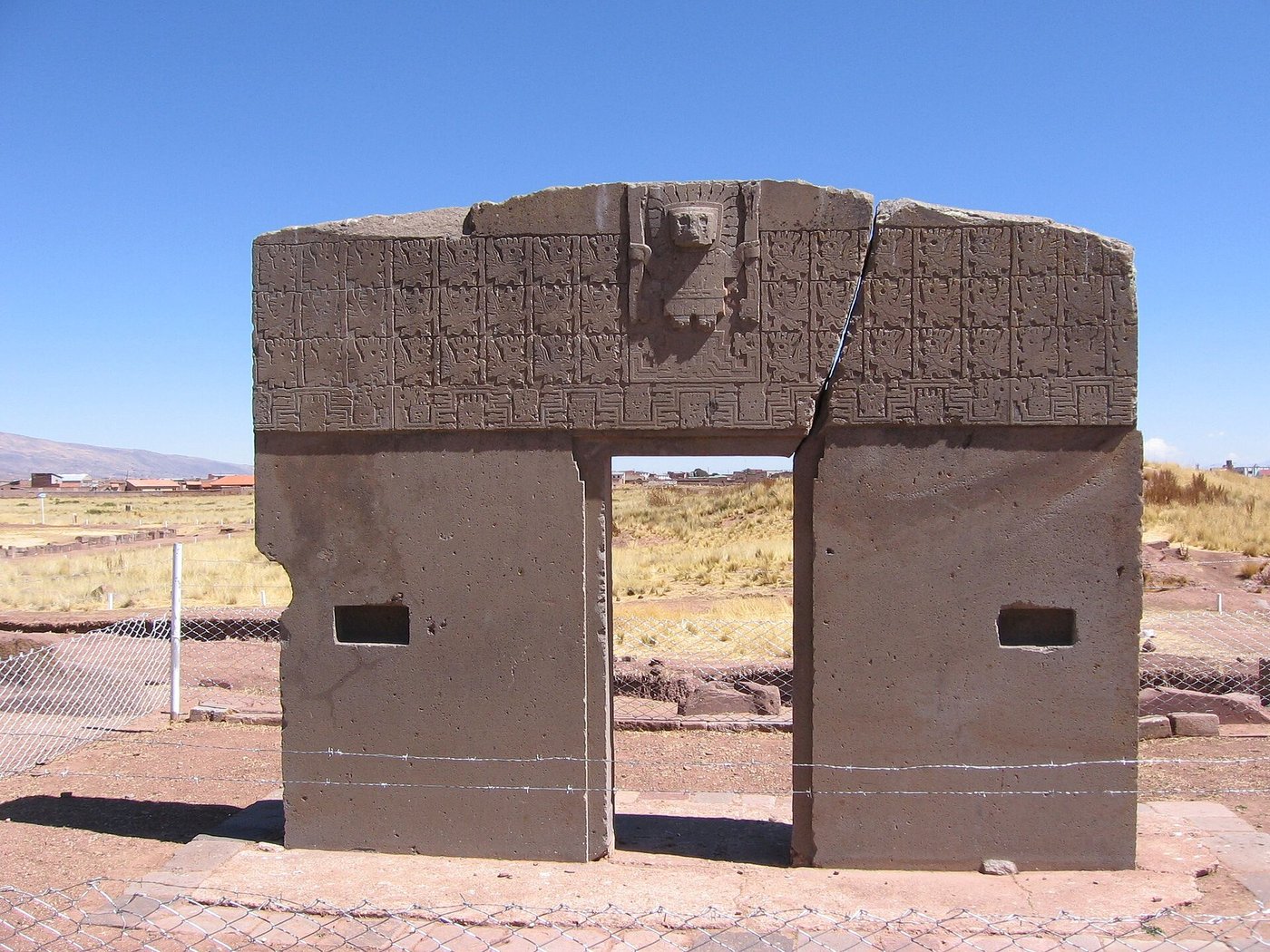
The single most famous object at Tiwanaku is the Gate of the Sun. It is cut from one block of grey andesite, weighs something close to ten tonnes, and stands now at a corner of the Kalasasaya, cracked across the top where it fell and was raised again. Across the lintel runs a carved frieze, and at its centre is a figure who has become the emblem of the whole culture.
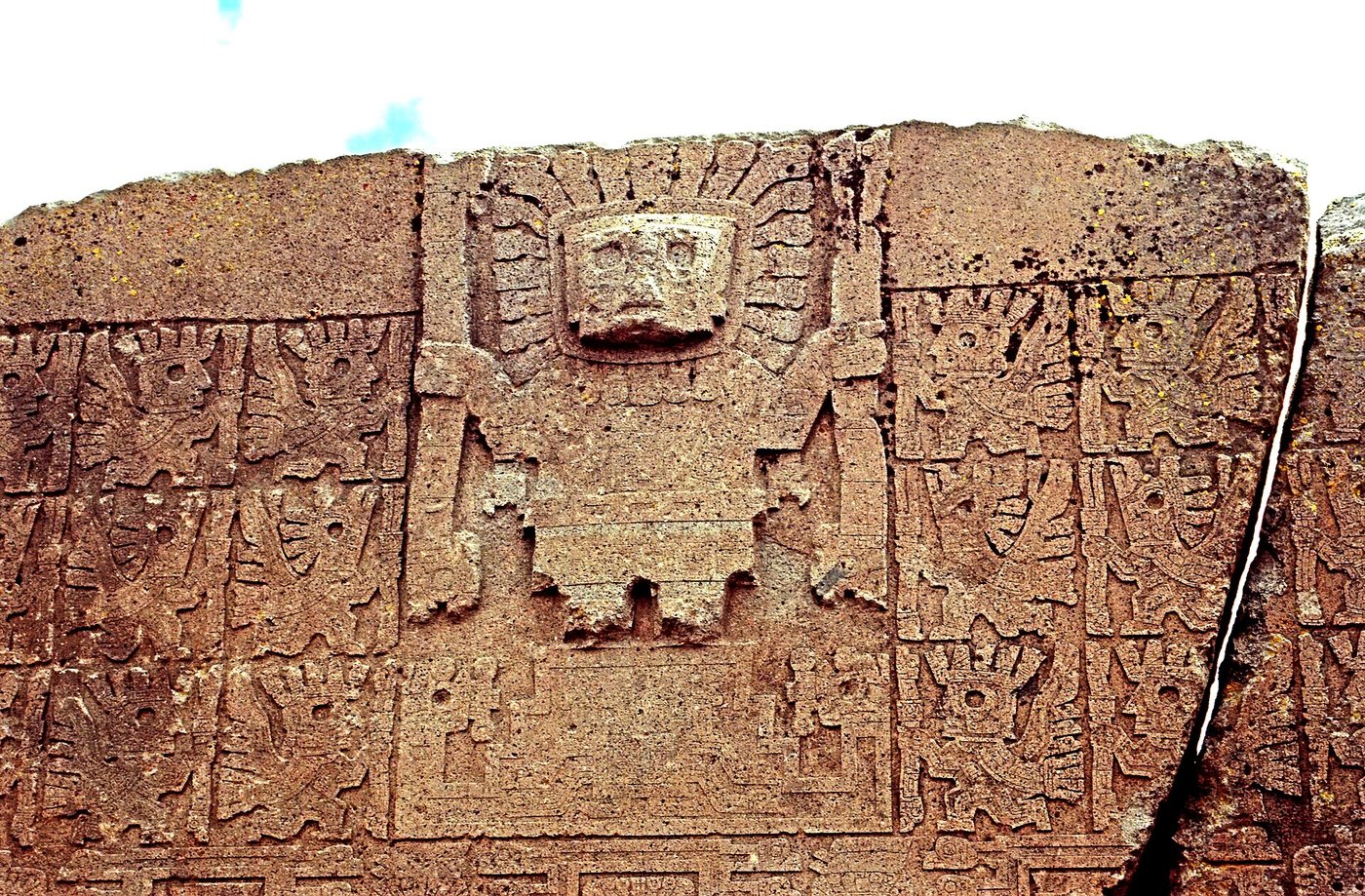
He stands facing forward, a staff gripped in each hand, his head ringed with rays that end in circles and the heads of pumas. Scholars call him the Staff God, and he is old: versions of the same front-facing, staff-holding figure turn up across the Andes for more than a thousand years, from earlier temples to the later Wari state to the textiles of the coast. At Tiwanaku he is flanked by forty-eight smaller winged figures, running in rows, every one of them turned to face him. Some have bird heads, some human faces, and there are exactly enough of them, arranged just so, that people have spent a century trying to read the whole thing as a calendar. Maybe it is. Maybe the rows count something. No one has proved it, and the honest answer is that we do not know what the gate was meant to say, only that it was meant to be read.
The stones that started the alien talk
If one part of Tiwanaku feeds the wild theories more than any other, it is Pumapunku. It is a separate platform mound at the edge of the site, and it is a field of broken precision. The blocks here are not rough megaliths. They are cut with flat faces, sharp interior corners, and lines so straight they look machined, some shaped into a repeating H, as if stamped from a mould, so that block locked into block. Stand among them and it is easy to see why people reach for lasers and spacecraft.
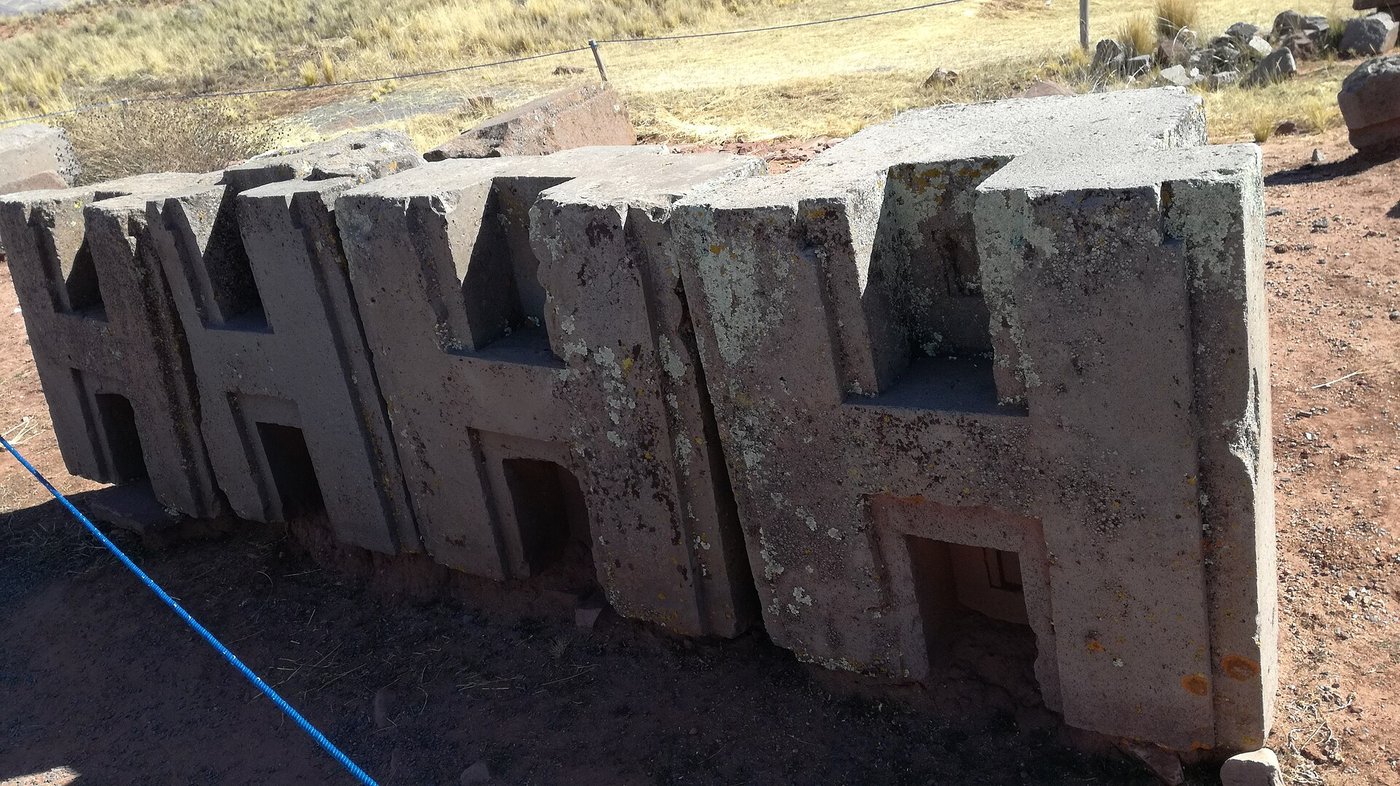
The cuts are too clean, the angles too true, the H-blocks too identical: no one working with stone tools could have made them, so the builders must have had machines, lost technology, or help from somewhere else.
Nothing at Pumapunku is beyond patient, skilled masons. The blocks were shaped by pecking away at the stone with harder hammerstones and grinding the faces flat with sand and water: slow, but exact. The reason the shapes repeat is that the builders worked to a module, a set of standard forms cut again and again so pieces would fit, the same trick that lets modern parts be swapped. The precision is a sign of good organisation and long practice, not of a machine. What it really tells you is that a state stood behind the work, feeding and directing the crews for years.
There is a detail at Pumapunku that the mystery-hunters usually skip, and it is more interesting than any of their answers. Some of the stones were locked together with metal. The builders carved matching notches across a joint in the shape of a capital I, then poured molten metal into the gap so that it set as a cramp holding the two blocks. When the metal was analysed, it turned out to be a deliberate alloy of copper with arsenic and nickel, and at least some of it seems to have been melted and poured on the spot. That is not the work of a people who needed rescuing by aliens. It is metallurgy, planning and confidence.
To bind the heaviest stones, Tiwanaku's masons cut I-shaped sockets across the joins and filled them with molten metal that hardened into cramps. Analysis showed a worked copper alloy carrying arsenic and nickel, and portable furnaces at the site suggest the metal was melted and poured in place. It is one of the earliest uses of the technique known anywhere in the Americas.
Beer, llamas and the fields that fed a state
None of this (the temples, the crews, the poured metal) is possible without food, and the altiplano is a hard place to farm. It is high, cold, and prone to frost that can kill a crop overnight. The people of Tiwanaku beat that problem with an idea so good it has been copied back into the present. They built raised fields: long planting beds of piled earth, separated by shallow water channels. The water soaked heat through the day and gave it back at night, wrapping the crops in a thin blanket of warmer air when frost came down. Fed by the beds, potatoes and the hardy grain quinoa could grow where bare ground would fail.
Spread across the plain around the lake, those fields could feed a real city. Estimates of how many people lived in Tiwanaku at its height run into the tens of thousands, with more scattered through the countryside working the beds and herding llama and alpaca. In the 1980s, archaeologists helped local farmers rebuild some of the ancient raised fields as an experiment, and the yields came back, proof that the old design worked, and had simply been forgotten.
The Spanish chronicler recorded the local memory of the ruins: that the great stones had been raised in a single night, and that the work belonged to a people who lived before the sun rose in the sky. He confessed he could not see how the blocks had been moved at all. It is the oldest written account of Tiwanaku, and already, four centuries ago, it framed the place as the work of someone other than ordinary human beings.
What held the whole thing together was not an army so much as a table. Tiwanaku ran on feasting. Great quantities of chicha, the mildly alcoholic beer brewed from maize, were drunk from keru cups, the same flared beaker the Ponce Monolith is holding. Hosting a feast, filling the cups, tying distant lords into cycles of drink and obligation: that was how the centre held the edges. And maize does not grow well up on the cold plateau. It comes from lower, warmer valleys, days away to the east around Cochabamba. So the beer at the heart of the highland capital depended on grain grown somewhere else and carried in, which is exactly why a temple at a crossroads two hundred kilometres out, on the road toward those valleys, makes sudden sense. Tiwanaku was never only the ruins on the plain. It was a web, and it reached.
It reached a long way. Tiwanaku pottery, tombs and colonists turn up hundreds of kilometres off: in the Moquegua valley of what is now Peru, in the oases of the Atacama in northern Chile. This was not an empire of conquest in the Roman style, with legions and provinces. It looks more like a spread of shared belief and shared goods, of colonists and caravans and pilgrims drawn to the temples, held together by trade, religion and beer rather than by the sword.
When the water changed its mind
Then, around the year one thousand, it came apart. The building stopped. The raised fields, which had fed the plain for centuries, fell out of use. People drifted away from the great centre until the temples stood among fields worked by far fewer hands. There was no single sack, no burning end that the record remembers. Tiwanaku did not fall so much as drain away.
The best explanation points at the sky. Cores drilled from Andean ice and lake beds record a long, deep drought settling over the altiplano in these centuries. The raised-field system was clever but it depended on water in the channels and a stable lake; a drawn-out dry spell would have pulled the water table down and left the beds useless. A farming method that had been the state's great strength became its weakness. When the fields could no longer carry the crowds, the reason to stay near the temples went with them.
Whether drought alone did it, or whether it only cracked a society already strained from inside, is still argued. What is clear is that the collapse was slow and left the stones standing. The people did not vanish. Their descendants, the Aymara, were still on that ground when the Inca came, and are there now. What ended was the state, and the knowledge of who exactly had built the gate and why. Within a few generations even the neighbours were saying it had all been raised in one night, before the sun.
The temple that was still out there
Which brings us back to the hill near Caracollo. For most of the last century the story of Tiwanaku was told from its centre: the platforms, the gate, the monoliths, all crowded onto one famous patch of the plain. Palaspata pulls the frame wide. A temple that size, that far out, aligned to the same sun and stocked with the same keru cups and with maize traces from the eastern valleys, is proof that the reach shown by the scattered pottery was real and was organised. The state built a house for its rituals right at the junction where the highland, the herding country and the maize valleys met. It put the temple where the trade was.
What should sit with you is not only what the temple says about the past. It is how it was found. No excavation, no lucky landslide, just satellite images, a drone, and someone willing to look hard at a hill that thousands of people had walked over without a glance. If a temple that big could stay invisible on open farmland until 2025, in one of the most studied ancient landscapes on the continent, then the map of Tiwanaku is not finished. There are almost certainly more of these places out there, under the maize and the scrub, waiting for the next person to look at an ordinary hill and see the straight lines under it.
The old habit was to make Tiwanaku stranger than it was: older than the ice age, too perfect for human hands, raised in a night by men who lived before the sun. The truth is stranger in a better way. Real people, on the coldest high plain in the Andes, warmed their fields with water, poured metal into stone, brewed beer to bind an empire, and built temples so exact that later generations could only explain them with miracles. And a thousand years on, we are still finding the ones they left behind.
Read next: Chavín de Huántar: The Bone Tubes Sealed in the Dark for 2,500 Years and Great Zimbabwe: The City Colonists Refused to Believe Africans Built.
Sources & further reading
- José M. Capriles et al., "Gateway to the east: the Palaspata temple and the south-eastern expansion of the Tiwanaku state," Antiquity 99 (2025) — the report of the Palaspata discovery, its plan, dating and setting.
- John Wayne Janusek, Ancient Tiwanaku (Cambridge University Press) — a full account of the city, its monuments, farming and society.
- Alan L. Kolata, The Tiwanaku: Portrait of an Andean Civilization — on raised-field agriculture, the state, and the drought-driven collapse.
- Heather Lechtman, on the copper-alloy cramps of Pumapunku and Andean metallurgy — the metal-poured-into-stone technique.
- Jean-Pierre Protzen and Stella Nair, on how the fine stonework of Tiwanaku and Pumapunku was actually cut and fitted — the answer to the "too precise" claim.
- Pedro Cieza de León, Crónica del Perú (c. 1553) — the earliest European description of the ruins and the local traditions about them.
Image credits (via Wikimedia Commons): the Gate of the Sun, Tiwanaku (featured) — Bgabel (public domain); the semi-subterranean temple heads — François Bianco (CC BY-SA 2.0); the Kalasasaya enclosure — Danielle Pereira (CC BY 2.0); the Ponce Monolith — P. Hughes (CC BY 4.0); detail of the Gate of the Sun — Dennis G. Jarvis (CC BY-SA 2.0); cut blocks at Pumapunku — Benjamin Burga (CC BY-SA 4.0).