On 22 June 1941, an American historian named Paul Kosok stood in the Peruvian desert at the end of a long, hot day of surveying strange lines scratched into the ground. As the sun dropped towards the horizon, its last light ran straight down one of the lines and out across the plain, and Kosok realised he was standing at the foot of a marker aimed squarely at the winter solstice sunset. "The largest astronomy book in the world," he is supposed to have said. He was almost certainly wrong about that. But standing on the Nazca pampa that evening, watching a line drawn a thousand years before Christ point at the turning of the year, he had stumbled onto one of the great puzzles of the ancient world.
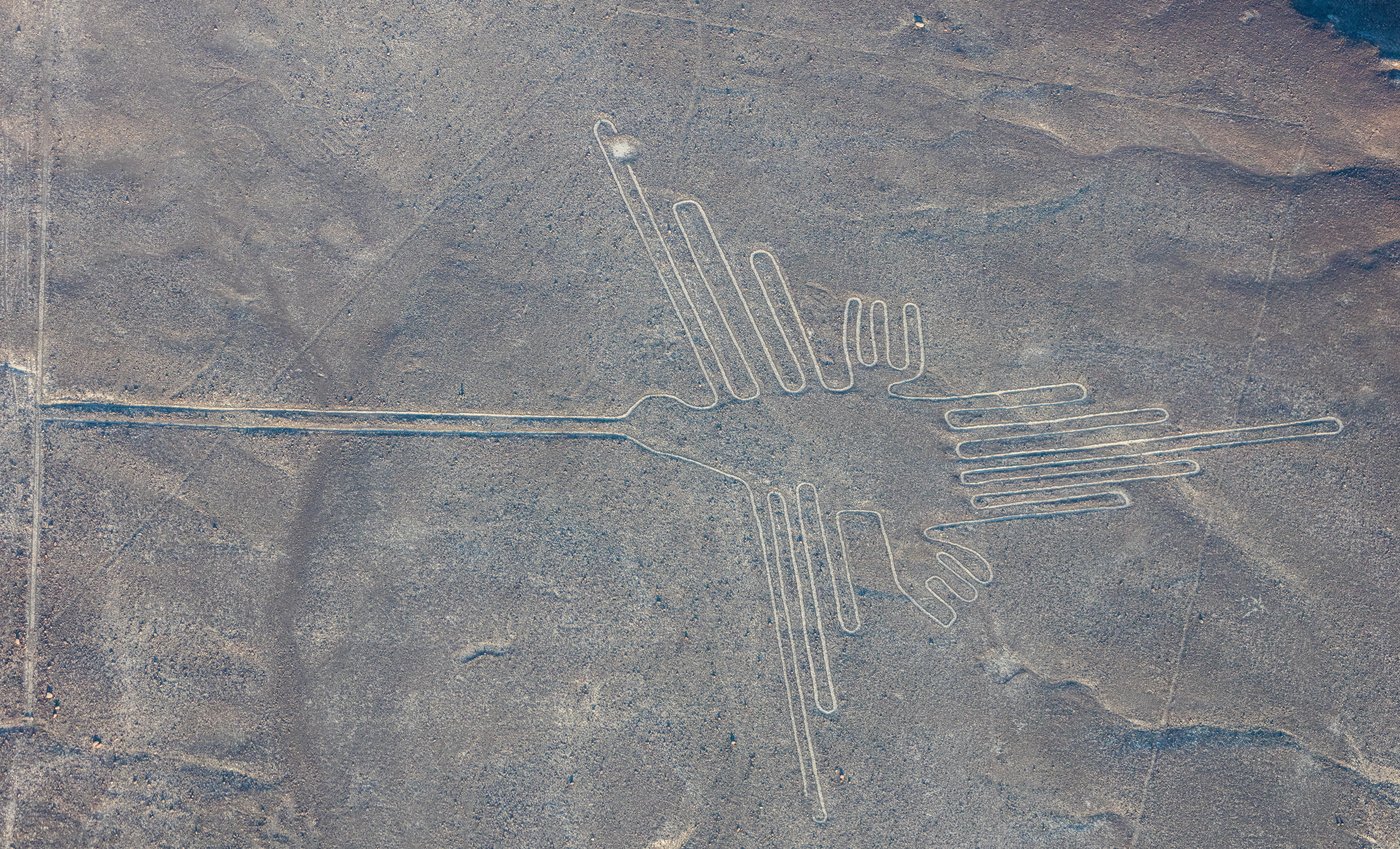
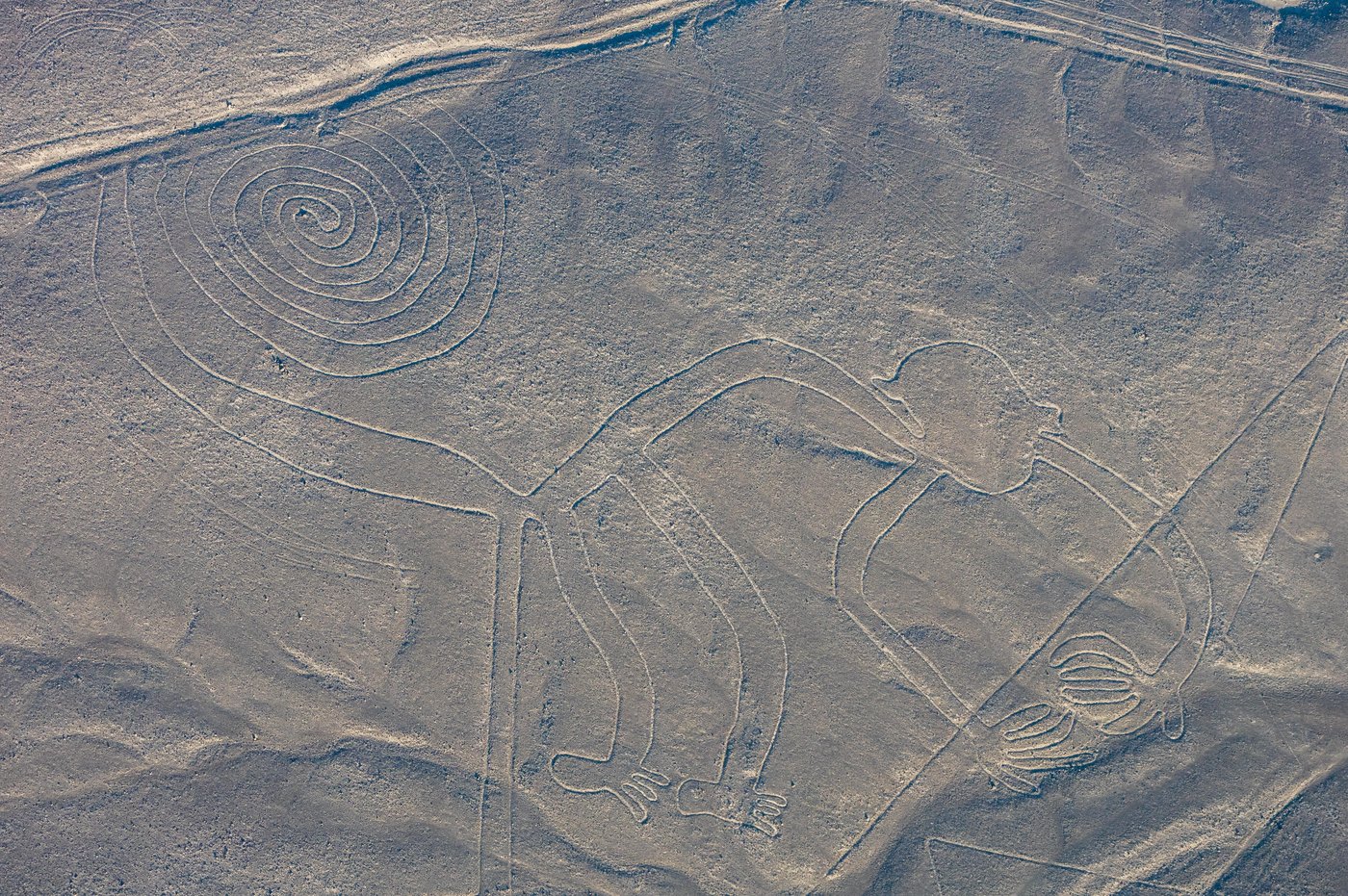
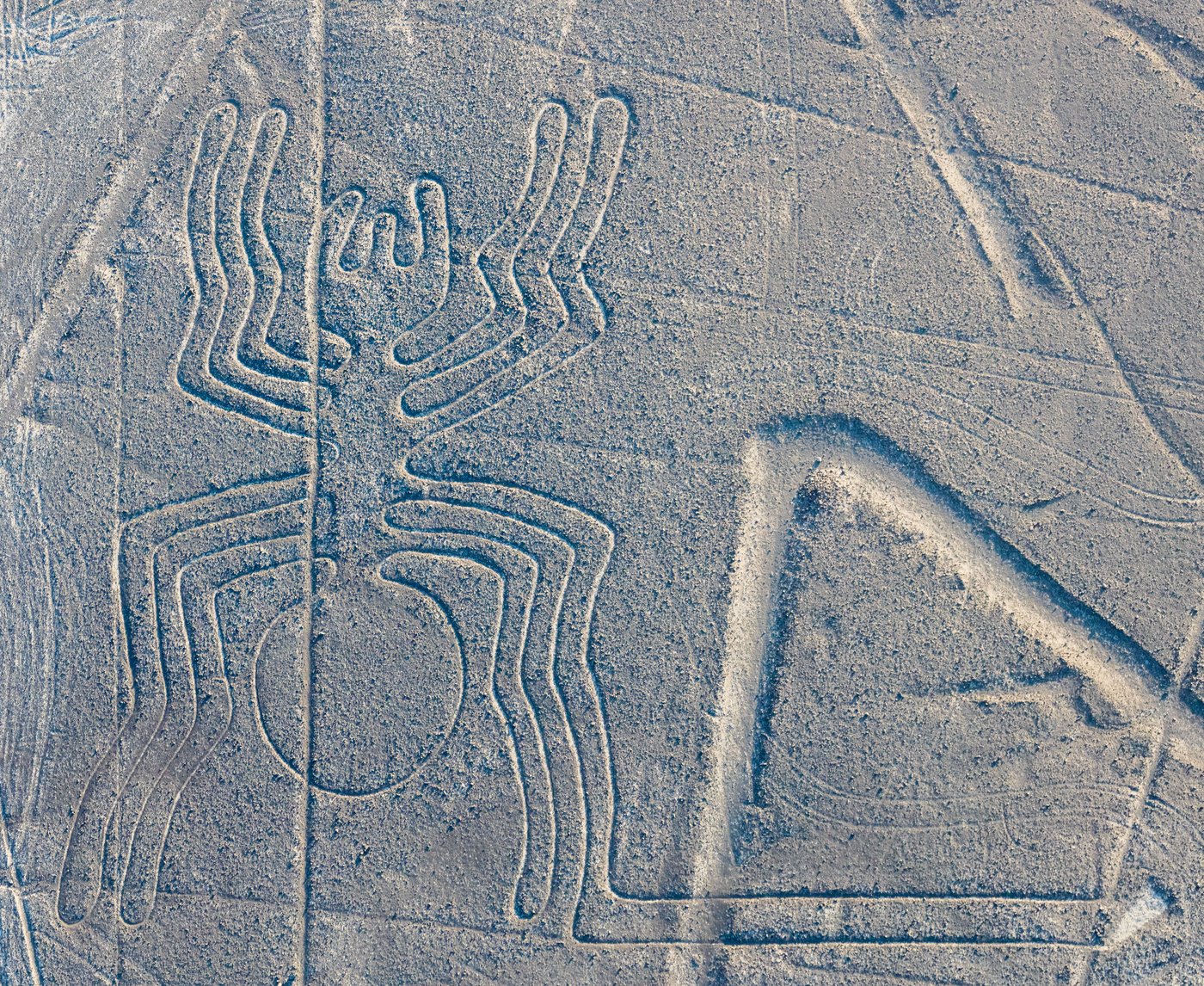
Scratched into a high, dry plateau in southern Peru are hundreds of enormous drawings. Some are simple: dead-straight lines that run for miles, or great trapezoids cleared of stone like landing strips. Others are pictures: a hummingbird, a monkey, a spider, a pelican, a many-armed figure that looks, from the air, like something out of a dream. They are so big that for centuries nobody realised what they were. You can walk across a Nazca figure without ever seeing it, because the only place the picture makes sense is the sky. And that simple fact, that these images seem built for an eye that no ancient person could ever have had, has fed a hundred years of wonder, bad theories, and, most recently, a wave of new discoveries driven by artificial intelligence.
A desert that never forgets
The Nazca Lines lie on a stretch of the Peruvian coastal desert between the towns of Nazca and Palpa, about 400 kilometres south of Lima. It is one of the driest places on Earth. Rain here is measured in minutes per year, the wind is light and steady, and the ground is covered in a layer of reddish stones darkened by centuries of sun and a thin film of iron oxide, what geologists call desert varnish.
That surface is what makes it all possible. To make a line, all you had to do was rake away the dark top stones and pile them at the edges, exposing the pale yellow-grey clay underneath. The contrast between the dark border and the light channel is what you see from above. Because it almost never rains and the wind barely stirs, those shallow scrapes have survived for anywhere between 1,500 and 2,500 years. In a wetter place they would have washed away in a single season. The Nazca desert is a page that refuses to be wiped clean.
The people who made them were the Nazca culture, who lived along these river valleys from roughly 100 BC to AD 800, farming in a punishingly dry land, building underground aqueducts that still work today, and producing some of the finest painted pottery in the ancient Americas. Some of the very oldest figures, in the neighbouring Palpa valleys, were made even earlier by the Paracas culture that came before them. These were not primitive people baffled by the sky. They were skilled engineers of water and clay.
How you draw something you cannot see
The first question everyone asks is the obvious one: how did people who never left the ground make pictures that only work from the air? It sounds like it needs a clever answer. It does not.
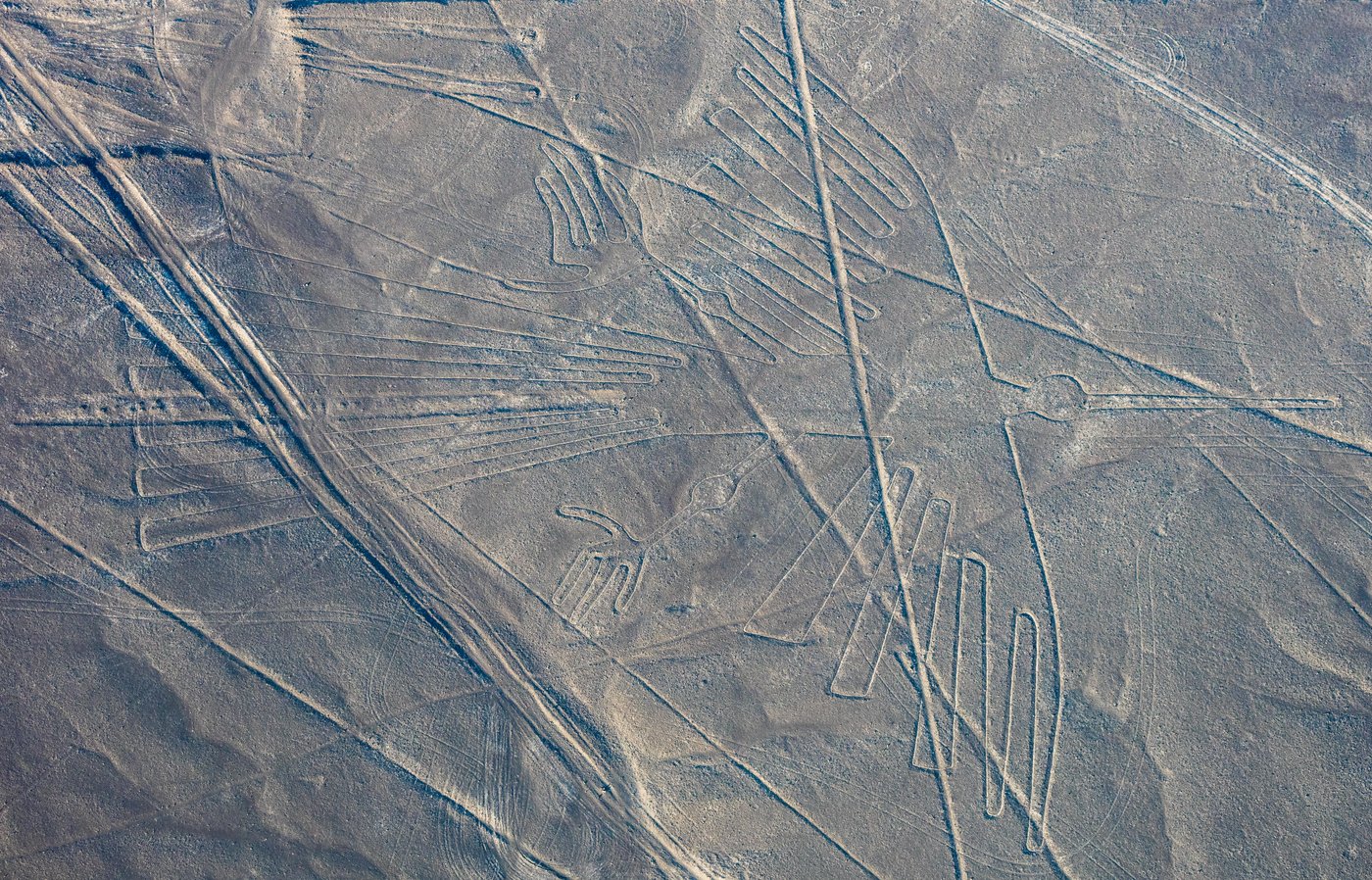
The figures are large but the method is simple, and archaeologists have proved it by copying it. You start with a small drawing. You lay out the big version using wooden stakes and lengths of cord. Several stakes have been found at the ends of lines, and radiocarbon dating of the wood helped fix the ages. To make a smooth curve, you swing a cord from a central peg like a giant compass. To keep a straight line running true across miles of desert, you sight from one stake to the next, the same way a surveyor does. The Nazca even seem to have worked from scaled-up grids. In the 1980s a researcher named Joe Nickell reproduced a full-size Nazca condor in a field using only wooden stakes, string and simple sightlines, with a small team and a few days' work. It matched the original closely enough to settle the "impossible" question for good.
What is striking is the discipline. The big animal figures are almost all drawn as a single unbroken line that loops around to form the whole creature and returns to where it began, never crossing itself. You could walk the entire outline of the monkey or the hummingbird as one continuous path. That has led many to suspect the finished figures were meant to be walked, not just seen, and that the making and the treading of the line was the purpose.
The straightest Nazca lines run for several kilometres while deviating by only a couple of metres from true, an accuracy of a few parts in a thousand, achieved with nothing more than sighting stakes and cord. Some lines cross dry riverbeds and climb low hills without ever visibly bending, holding their aim across terrain their makers could not see the far end of.
The woman who spent a lifetime on her knees
No one is more tied to the lines than Maria Reiche, a German-born mathematician who arrived in Peru in the 1930s and gave the rest of her life to the desert. For decades she measured, mapped and swept the figures clean with a broom, often working alone, living in a tiny room near the pampa and paying guards out of her own pocket to keep vehicles off the fragile ground. Locals called her the Lady of the Lines.
Reiche was convinced the lines were a vast astronomical calendar, with particular figures and lines pointing to the rising and setting of the sun, moon and important stars, marking the seasons for farming. It is a beautiful idea, and it grew out of the same solstice sightline that had struck Paul Kosok. But when astronomers ran the numbers properly, the calendar theory largely fell apart. There are so many lines pointing in so many directions that some were bound to line up with something in the sky by pure chance. Careful statistical studies in the 1960s and later found no more astronomical alignments than you would expect at random.
That was a real loss for a lovely theory, but Reiche's real legacy was not her explanation. It was her stubbornness. Without her broom and her guards, many of the figures might have been lost to road-building, off-road drivers and looters long before the world learned to value them. She protected the puzzle so that later generations could try to solve it.
"Once you have seen them, you can no longer walk through the desert without a strange feeling that you are treading on something sacred."— attributed to Maria Reiche, who studied and guarded the Nazca Lines for over forty years
Water, not stars
If the lines are not a calendar, what are they? The strongest modern answer keeps coming back to the one thing that mattered most in this desert: water.
The Nazca lived and died by scarce, unreliable rivers fed from the distant Andes. Many of the straight lines and trapezoids seem to relate to the flow of water: pointing towards sources, running along the underground fault lines where water travels, or clustering near the puquios, the astonishing spiral aqueducts the Nazca dug to reach groundwater. The archaeologist Johan Reinhard argued that the lines were part of rituals meant to summon rain and fertility, sacred paths walked in procession to petition mountain gods and water spirits for the flow that meant survival.
The animal figures fit this too. In Nazca and wider Andean belief, certain creatures were bound up with water and fertility. Hummingbirds, spiders, monkeys and seabirds all appear on Nazca pottery in contexts tied to rain and abundance. Many of the same animals painted on their pots were also drawn, enormous, on the desert floor. The pampa may have been less an observatory than a temple without walls: a place you entered on foot, walking the sacred lines, carrying offerings, asking the powers of the earth and sky for the water without which nothing here could live.
Broken pots and walked paths
There is real evidence for the ritual reading, and it comes from the dirt. Excavations on and around the lines have turned up large quantities of deliberately smashed Nazca pottery, especially at the ends of lines and on the trapezoids. Whole vessels appear to have been carried out onto the figures and broken on purpose as offerings. Other digs have found spondylus shell, a red spiny oyster imported from warm waters far to the north and prized across the Andes precisely because it was linked to water and rain.
Put together, the picture is of the pampa as a place of gathering and ceremony. Groups walked the lines, perhaps whole communities moving in procession along the great cleared paths and around the single unbroken outlines of the animals, leaving broken pots and precious shells behind. The figures were not made to be admired from a distance. They were made to be used, with the feet and the body, in acts we would call religious.
The theory that will not die
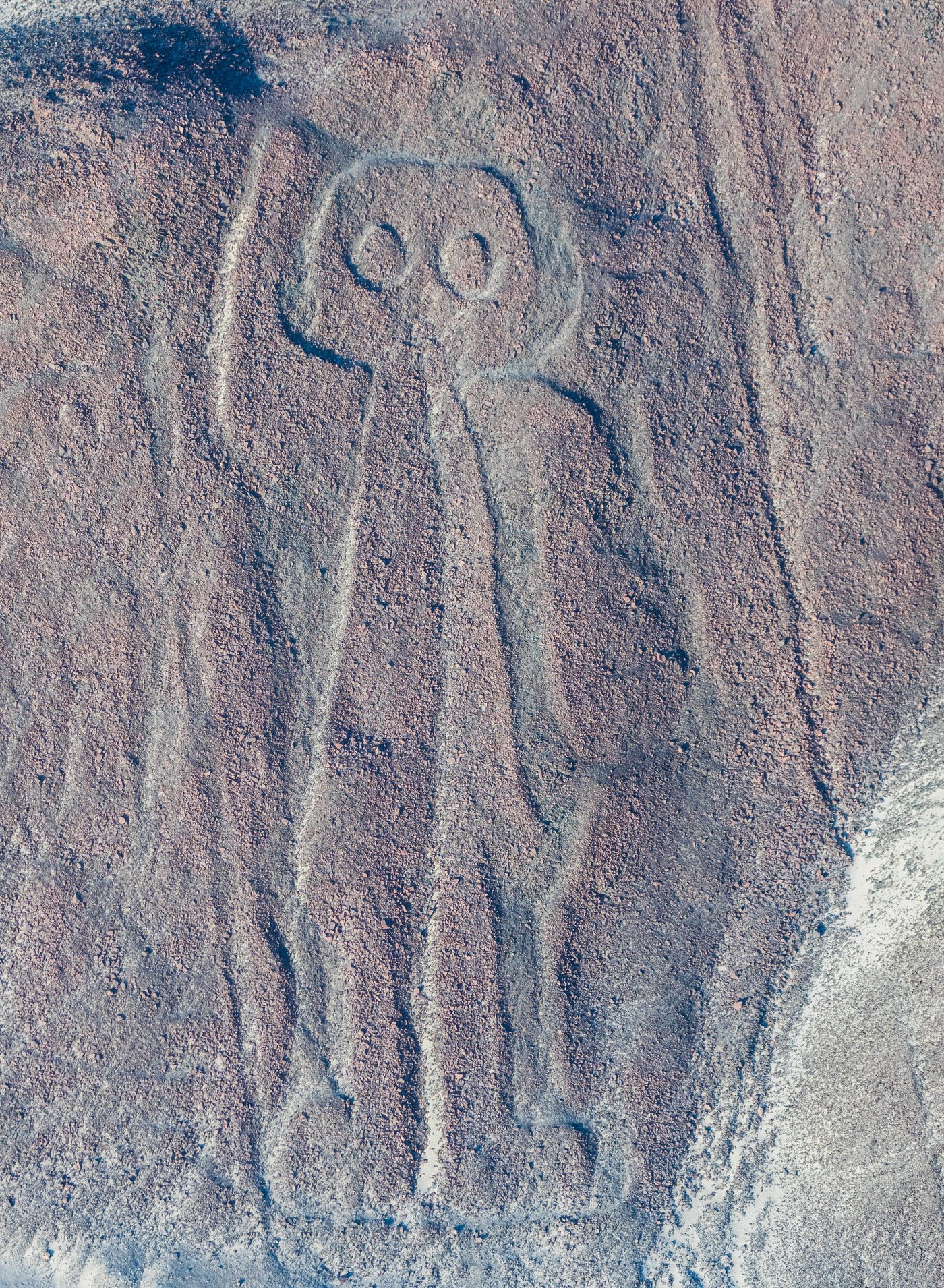
And then there is the other story, the one most people actually know. In 1968 the Swiss writer Erich von Däniken published Chariots of the Gods?, a runaway bestseller that claimed the wonders of the ancient world were really the work of visiting aliens. The Nazca Lines were among his star exhibits. The long trapezoids, he suggested, were runways for spacecraft, and the pampa an ancient alien airfield. A humanoid figure carved on a nearby hillside, with a round head and huge staring eyes, was rechristened "the Astronaut."
It is worth being blunt about why this is wrong, because the reasons matter. A runway needs a hard surface to bear the weight of a landing craft; the Nazca "runways" are soft cleared ground that would swallow any real aircraft. The figures are shallow scrapes a few centimetres deep: the exact thing you would make with stakes and string, and nothing like engineering for machines. Every technique the Nazca supposedly could not have used has been reproduced by modern researchers with Bronze Age tools. And the "astronaut," when you look at it in context, is one of many hillside figures the Nazca and Paracas drew of owl-headed humans and shamans, a local artistic tradition, not a portrait of a spaceman.
Beneath the harmless fun there is something worth naming. The alien theory only works if you assume the people of ancient Peru could not possibly have made these things themselves, and that skill and vision on this scale had to come from somewhere else, from the sky. That assumption has been aimed at non-European peoples again and again, and it is both wrong and insulting. The Nazca did this. It is more impressive, not less, for being entirely human.
"The Nazca Lines are alien runways and the 'astronaut' is a picture of a spaceman — proof that extraterrestrials visited ancient Peru, because no early people could have made drawings only visible from the air."
The figures are shallow surface scrapes, easily reproduced with stakes and cord; the "runways" are soft ground that could bear no aircraft. The "astronaut" belongs to a known tradition of owl-headed human figures. The Nazca made all of it themselves, using simple tools and hard-won skill.
When the machines started looking
For most of the twentieth century, finding a new geoglyph meant a human being spotting it: from a light aircraft, in an old photograph, or on the ground. That is slow, and the faint, weathered figures are easy to miss. In the last few years, that has changed completely.
Researchers led by Masato Sakai at Japan's Yamagata University, working in partnership with IBM, trained artificial-intelligence models to hunt for geoglyphs in high-resolution aerial and satellite imagery of the pampa. The AI does not "see" the way we do; it learns the visual fingerprint of a faint figure and then scans vast areas far faster than any person could, flagging candidates for archaeologists to check on the ground. In 2019 the approach found a single new figure. Then the pace exploded.
In September 2024 the team announced 303 newly confirmed figurative geoglyphs, found and verified over about six months of fieldwork guided by AI, nearly doubling the number of known figurative Nazca figures at a stroke. In the summer of 2025, at the Osaka World Expo, they reported a further 248 new geoglyphs. Many of the fresh finds are smaller, older relief-type figures, often set along winding footpaths rather than the great straight lines: figures of people, llamas, birds and scenes that may have been made to be seen up close by travellers on foot.
What the new figures are telling us
The flood of discoveries is doing more than padding a list. It is starting to change how researchers understand the whole site. The newly found relief figures cluster along old paths, which supports the idea that people were meant to walk among many of these images, encountering them one by one on a journey rather than viewing them from the air. And the subjects lean towards human activity: figures leading llamas, holding weapons or knives, scenes that seem to show ritual or even human sacrifice, echoing the themes on Nazca pottery.
By sorting the figures into types and mapping where each kind sits, the Yamagata team has argued that the older, smaller relief figures and the huge line-type figures may have served different purposes, the small ones for individual viewing along the trails, the giant ones for group ritual on the open plain. It is, in a real sense, the machines helping us read the desert: not by explaining what the images mean, but by finding enough of them, and mapping them precisely enough, that patterns invisible to any single human surveyor finally come into focus.
If artificial intelligence can now find geoglyphs faster than people can protect them, what happens next? The same tools that are doubling the catalogue are also raising hard questions: which figures deserve scarce conservation money, how to guard newly mapped sites from looters and developers who now know exactly where they are, and whether the rush to discover is outpacing the slow, careful archaeology needed to actually understand each find. Discovery and preservation have never sat entirely comfortably together, and on the Nazca pampa that tension is sharper than ever.
A fragile thing
For all their endurance, the lines are alarmingly easy to destroy. The very quality that preserved them, a surface so still that a footprint can last for years, means that damage lasts too. In 2014 activists from an environmental group tramped across the pampa near the hummingbird to lay out a banner, leaving fresh footprints that may never fully heal. Lorries have driven over figures. Illegal mining and squatter settlements press at the edges of the protected zone. Even changing weather is a threat: the region has seen freak heavy rains and flash floods that the ancient desert was never built to shed.
The Nazca Lines became a UNESCO World Heritage Site in 1994, and Peru guards them as best it can across a vast and thinly policed area. But every new geoglyph the AI reveals is one more fragile thing to look after, in a place where a single careless afternoon can undo two thousand years of survival.
The message we have not finished reading
Strip away the aliens and the calendars and what remains is, if anything, more moving. A people living at the edge of what the land could bear walked out into the harshest ground they knew and spent generations turning it into a work of art on a scale the human eye could not take in: enormous, patient, precise, and aimed, as far as we can tell, at their gods and their thirst for water rather than at us.
They could not have imagined the light aircraft that would first reveal their pictures whole, or the satellites and learning machines now finding the ones they had almost let the desert keep. We can measure the lines to the centimetre and map every figure, and still we cannot fully say what any single one meant to the person who raked it into being. That gap is not a failure. It is the reason the pampa still pulls at us. The Nazca left a message written large enough to last millennia, in a language of walked paths and broken pots and single unbroken lines, and we are, even now with our clever machines, only beginning to learn how to read it.
Read next: Tiwanaku: The Andean Temple a Satellite Found Under a Farmer's Field and Caral: A City as Old as the Pyramids, With No Sign of War.
Sources & further reading
- Sakai, M. et al., "AI-accelerated Nazca survey nearly doubles the number of known figurative geoglyphs and sheds light on their purpose," Proceedings of the National Academy of Sciences (2024).
- Reinhard, J., The Nazca Lines: A New Perspective on their Origin and Meaning (Editorial Los Pinos, Lima, 1996).
- Aveni, A. F. (ed.), The Lines of Nazca (American Philosophical Society, 1990).
- Nickell, J., "The Nazca Drawings Revisited: Creation of a Full-Sized Duplicate," Skeptical Inquirer (1983).
- Yamagata University & IBM, joint announcements on AI-assisted geoglyph surveys, 2019–2025.
Image credits (via Wikimedia Commons): Nazca hummingbird (featured), monkey, spider, "astronaut" hillside figure and condor — all Diego Delso, delso.photo (CC BY-SA 4.0).