In 1764 a Spanish officer picked his way down a ravine on Tenerife called the Barranco de Herques, squeezed through a gap in the rock, and stepped into a room full of the dead. They were not skeletons. They were bodies: brown, dry, feather-light, wrapped in stitched goatskins and laid out in long rows along the cave floor, some propped upright against the wall. The account that survives says there were close to a thousand of them. Nobody has ever found that cave again. But the officer had walked into the single strangest fact about the people who once owned these islands: their dead did not rot, and for a long time no one in Europe could say who they were.
The Guanches were the aboriginal people of the Canary Islands, the scatter of volcanic peaks in the Atlantic about a hundred kilometres off the coast of Morocco. Strictly the word belongs to the islanders of Tenerife alone; it has long been stretched to cover all seven islands, and it is used that way here. When Castilian ships arrived in the fifteenth century they met a Stone Age farming people who kept goats, painted caves, mummified their nobles, spoke in a language nobody could place, and, the detail that has never stopped nagging at people, could not sail. A people living on islands, surrounded by water they had crossed to get there, with no boats and no memory of the sea. That contradiction is the door into everything else about them.
Islanders with no boats
Start with the geography, because the geography is the mystery. The Canaries are true oceanic islands. They rose from the seabed as volcanoes and were never joined to Africa or to each other; the deep water between them runs to more than a kilometre in places. To reach them at all, someone had to build a boat, load it with people, goats, grain, pigs and dogs, and steer across open Atlantic swell out of sight of any coast. Somebody did exactly that, at least once, for every inhabited island in the group.
And then the boats vanished. By the time Europeans arrived the Guanches had no seagoing craft of any kind. They did not fish far offshore. They did not trade between islands. A person born on Tenerife would live and die without setting foot on Gran Canaria, a day's sail away and clearly visible on the horizon. The knowledge that had carried their ancestors across the sea was simply gone, and it had been gone so long that nothing in their stories reached back to it.
Because the islands were cut off from one another, each grew apart. The dialects drifted until they were barely mutually intelligible. Political systems differed: Tenerife was split between nine rival kings, Gran Canaria ran to two large chieftaincies, La Gomera to four districts. Even the mummy-making was uneven: elaborate on Tenerife, patchier elsewhere. When we say “the Guanches” we are really talking about several related peoples who had lost touch with each other so completely that they had become strangers on neighbouring rocks.
How do you lose the sea? The likeliest answer is unglamorous. The first settlers may have arrived in small numbers, perhaps only once or twice, on boats they did not need to rebuild once they had landed on good farming country. Timber suitable for real boats is scarce on the islands. Within a few generations the skill was not practised, then not remembered, then not imagined. It is a quiet kind of forgetting, and it left a farming people marooned on the peaks of drowned volcanoes, looking at islands they could see but never reach.
Where did they come from?
For four hundred years this was open season for cranks. The Canaries sit exactly where the old maps put Atlantis, out in the ocean beyond the Pillars of Hercules, so the islands were pressed into that story again and again: the Guanches as survivors of a sunken continent, the last of a drowned civilisation. Others made them relic Cro-Magnons, a lost white race stranded in the Atlantic, and pointed at the tall, fair-haired individuals among them as proof. Nineteenth-century collectors measured Guanche skulls by the crateful, trying to fit them into whatever racial scheme was fashionable that decade.
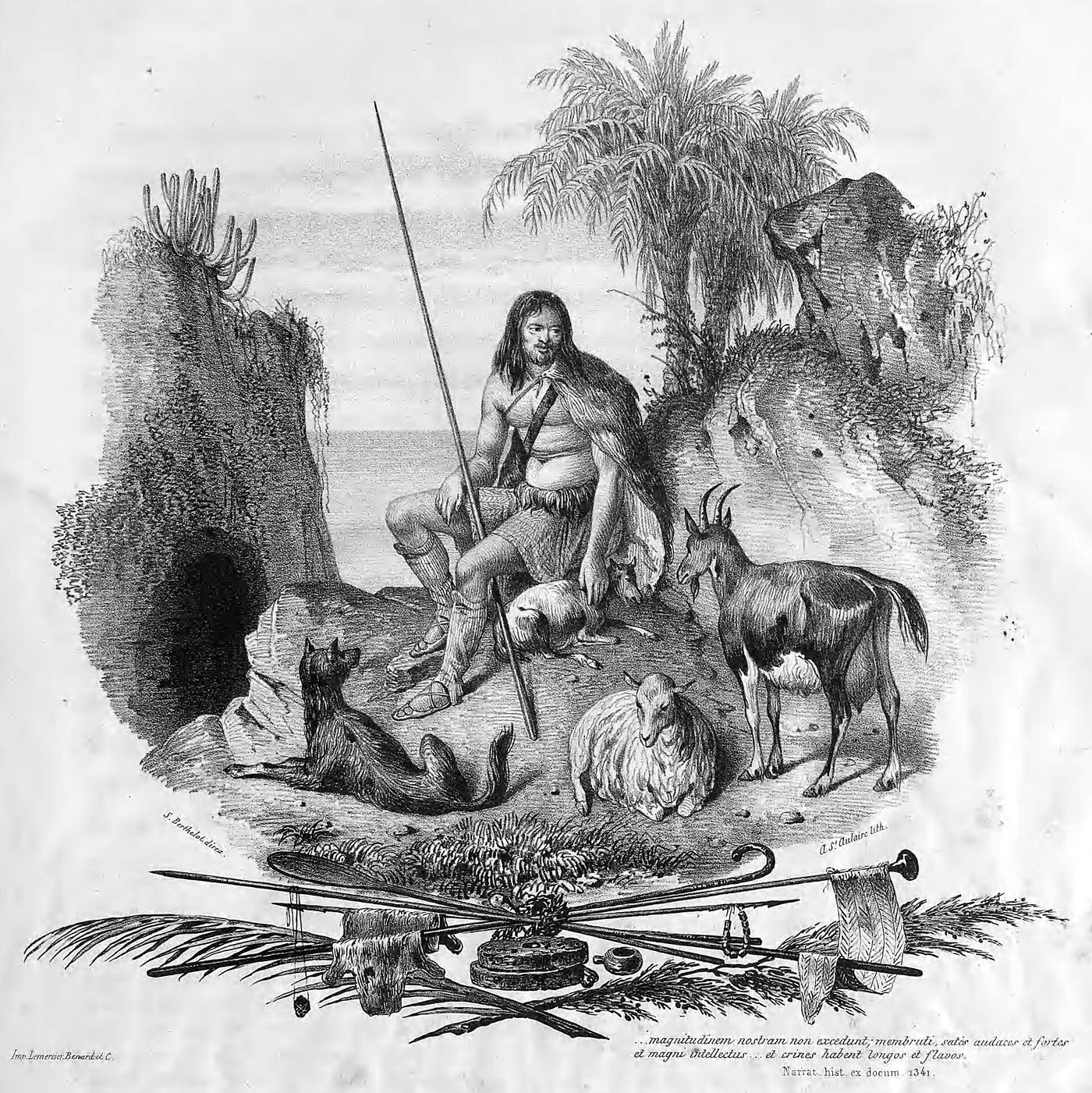
The plain answer, when it came, was North Africa. The tools, the pottery, the goat-and-barley economy, and above all the language all pointed east, to the Amazigh, the Berber peoples of the Maghreb. Guanche words for numbers and everyday things line up with Berber ones. Rock inscriptions on the islands are written in a script related to Libyco-Berber. None of this was proof on its own, but it all pointed the same way, and it pointed at the nearest mainland rather than at any lost continent.
Then genetics closed the case. When researchers sequenced DNA from Guanche remains, the results were not ambiguous: the islanders were closest, by a wide margin, to the Berber populations of North Africa. Individuals radiocarbon-dated across several centuries of the first millennium after Christ carried the maternal lineages you find in the Maghreb, not in Iberia and certainly not in some vanished Atlantic homeland. The Guanches were North Africans who had gone to sea, most likely in the first millennium before Christ, and then stayed.
The myth: the Guanches were the last of Atlantis, or a stranded remnant of an ancient European race, mysteriously marooned in the Atlantic and unrelated to anyone nearby.
The reality: they were an Amazigh (Berber) people from North Africa, tied to the mainland a hundred kilometres away by their language, their farming, their script and, decisively, their DNA. The fair hair and pale eyes that so excited nineteenth-century writers are found among Berbers too. There is nothing to explain that the coast of Morocco does not already explain. The only real mystery is not where they came from but why, once here, they stopped crossing water at all.
Dried in smoke and dragon's blood
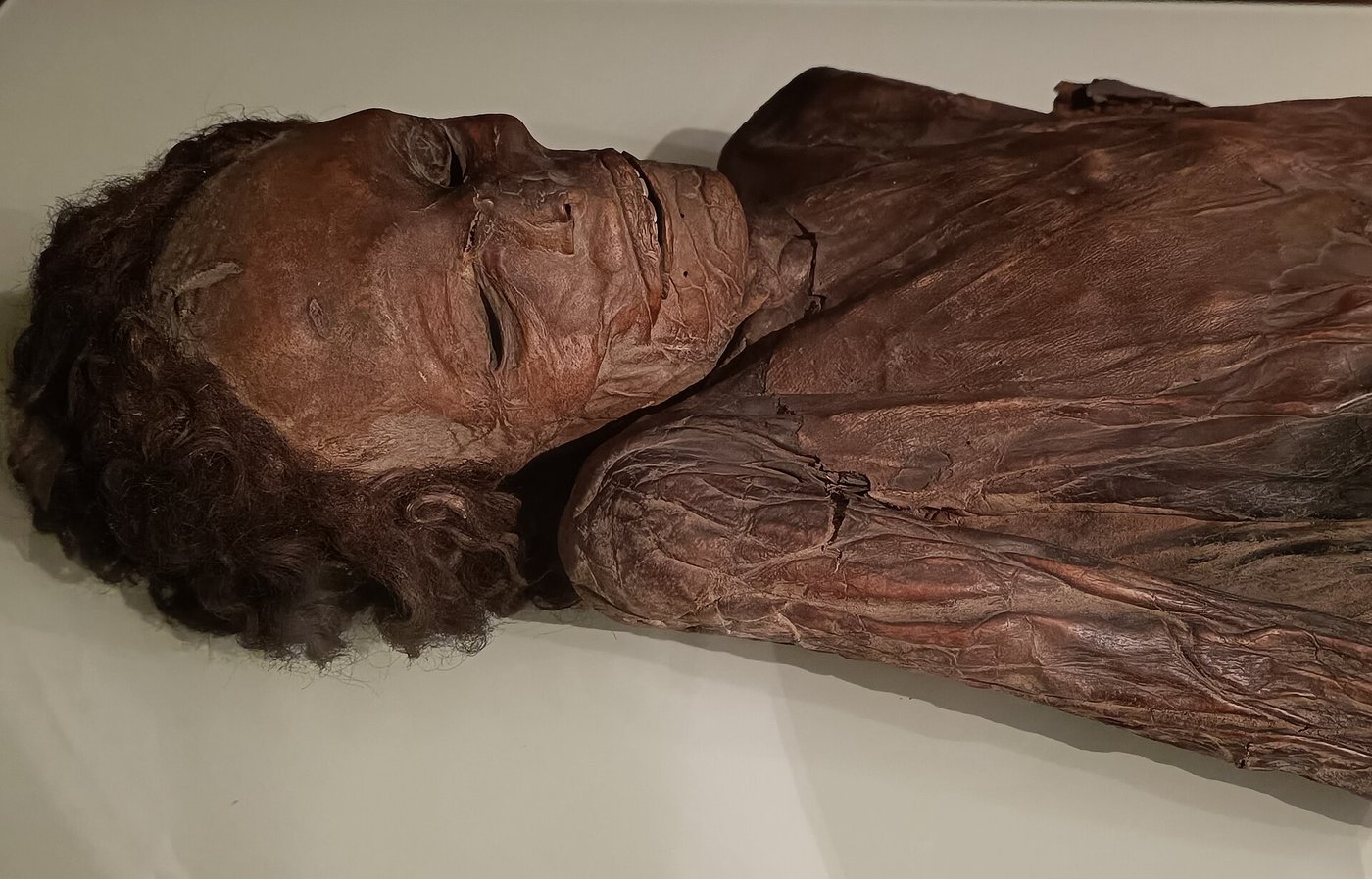
The dead in the Herques cave were not preserved by the dry air alone, though the islands' climate helped. They were made. On Tenerife especially, the body of a person of rank was worked on for a fortnight or more by specialists who, the early Spanish chroniclers noted with distaste, were kept apart from everyone else and treated as unclean. They opened the body, cleaned it, and dried it slowly in the sun and over smoke. Then they treated the skin with a paste of animal fat, ground pine bark, aromatic herbs and resin, including, on Tenerife, the deep red sap of the dragon tree, the strange umbrella-shaped tree found on the islands, whose sap goes by the name dragon's blood.
The finished body was sewn into carefully cut goatskins, the number of skins marking the person's importance, and carried to a burial cave high in the cliffs. Modern scans of the best-preserved survivors have turned up a detail that sets the Guanche method apart from Egypt's: the internal organs were often left in place. There was no elaborate removal of the viscera, no canopic jars. One famous mummy, taken from the Barranco de Herques on Tenerife in the eighteenth century and now in Madrid, still holds parts of its brain inside the skull. The islanders had arrived, by their own route, at a way of cheating decay that mostly worked.
Almost none of it survives. Once Europe took the islands, the burial caves were stripped. Missionaries burned some bodies as heathen relics, and collectors carted off many more, which, in the trade that consumed Egyptian mummies too, were ground into powder and sold as medicine called “mummy”. Of the many thousands the Guanches must have preserved, only a few dozen genuine mummies are left in the world's museums. The great cave the 1764 account described, with its rows of a thousand dead, was never relocated. It may still be sealed somewhere in a Tenerife ravine, or it may already have been emptied by people who did not write down what they took.
Caves, granaries and painted walls
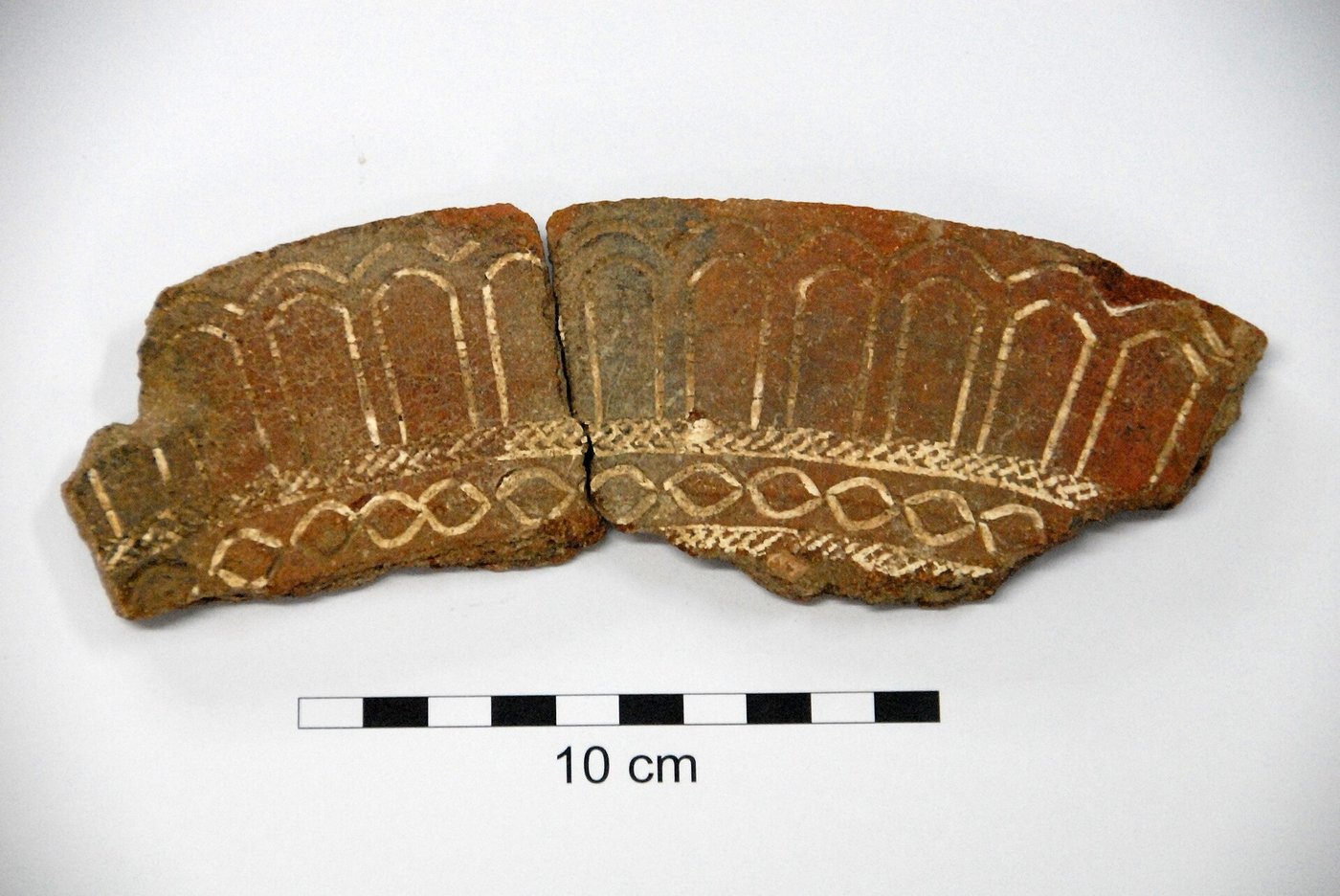
Living Guanches, not just dead ones, used the caves. Many people lived in them, natural or enlarged, cool in the Atlantic heat and easy to defend; others built low houses of dry stone. They grew barley and wheat, roasted and ground the grain into a toasted flour called gofio that Canarians still eat today, and ran large herds of goats, sheep and pigs across the high ground. They made pottery without a wheel, decorated with stamped and incised patterns, and carved small clay figures whose meaning we can only guess at.
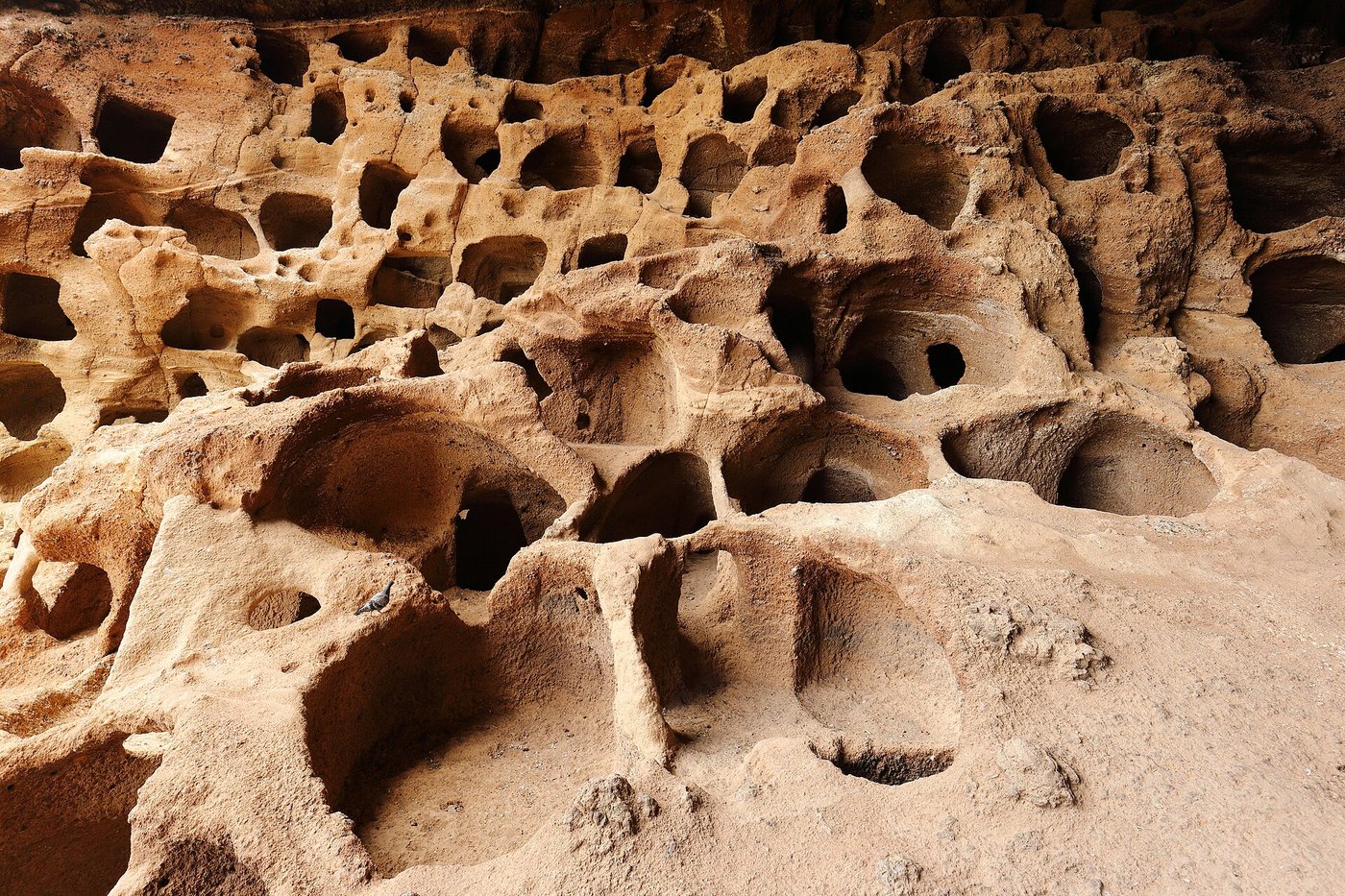
What they lacked in metal (there was none on the islands, so tools stayed stone, bone and wood right to the end) they made up for in organisation. The cliff at Valerón on Gran Canaria is honeycombed with hundreds of tiny stone-lined chambers, a communal granary tucked under an overhang where the harvest of a whole district could be locked away, dry and safe, above the reach of thieves. It is the work of a society that planned ahead, pooled its food, and trusted somebody to guard the store. That is not the mark of scattered cave-dwellers. It is the mark of a settled, governed people.
The pyramids that grew out of a field
Near the town of Güímar on Tenerife stand six stepped platforms of black volcanic stone, built in terraces with corners squared off and, some say, aligned to the summer solstice. In the 1990s the Norwegian adventurer Thor Heyerdahl, the man of the Kon-Tiki raft, declared them ancient pyramids, evidence of a lost people crossing the ocean, and had the site turned into a park to make the case. It is a seductive idea on an island already soaked in Atlantis stories.
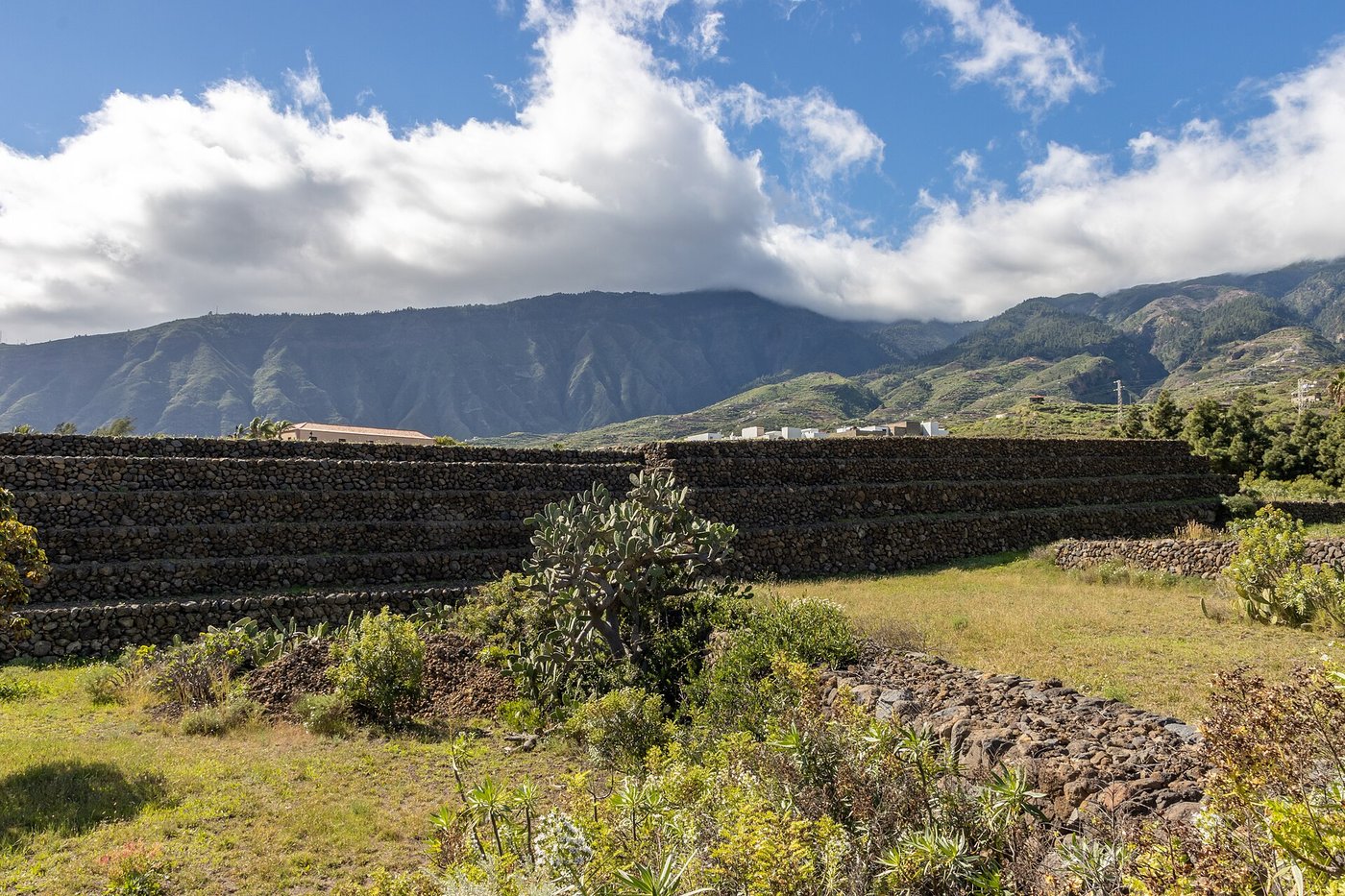
The trouble is the ground underneath. When archaeologists dug into the platforms they found nineteenth-century material, not ancient. The most sober reading is the least romantic one: these are the by-product of farming. Clearing a volcanic field means shifting endless loose black stone, and Canarian farmers stacked it in neat terraces at the field edge, as farmers do all over the islands. Some of the Güímar terraces may have been tidied into their present shape only in the 1800s. The solstice alignments, sceptics point out, are the kind of pattern you can find almost anywhere if you go looking with a compass and enough hope.
The honest position is that Güímar tells us more about us than about the Guanches. The real islanders left plenty behind that is theirs and strange in its own right: the mummies, the granaries, the painted caves, a whistled language. The pull towards the pyramids is the pull of the bigger, tidier story: an ocean-crossing mystery race, rather than farmers with a lot of loose rock and a slope to clear. Both can stand on the same terrace and see completely different pasts. The spade, so far, is on the side of the farmers.
The last kings of Tenerife
The conquest was not quick. It began in 1402, when a Norman adventurer, Jean de Béthencourt, landed on Lanzarote under the flag of Castile and started picking the islands off one by one. The flatter, drier eastern islands fell first. The high, wet, well-defended western ones held out for the better part of a century. Gran Canaria did not fall until 1483. Tenerife, the highest and most populous, held out longest of all.
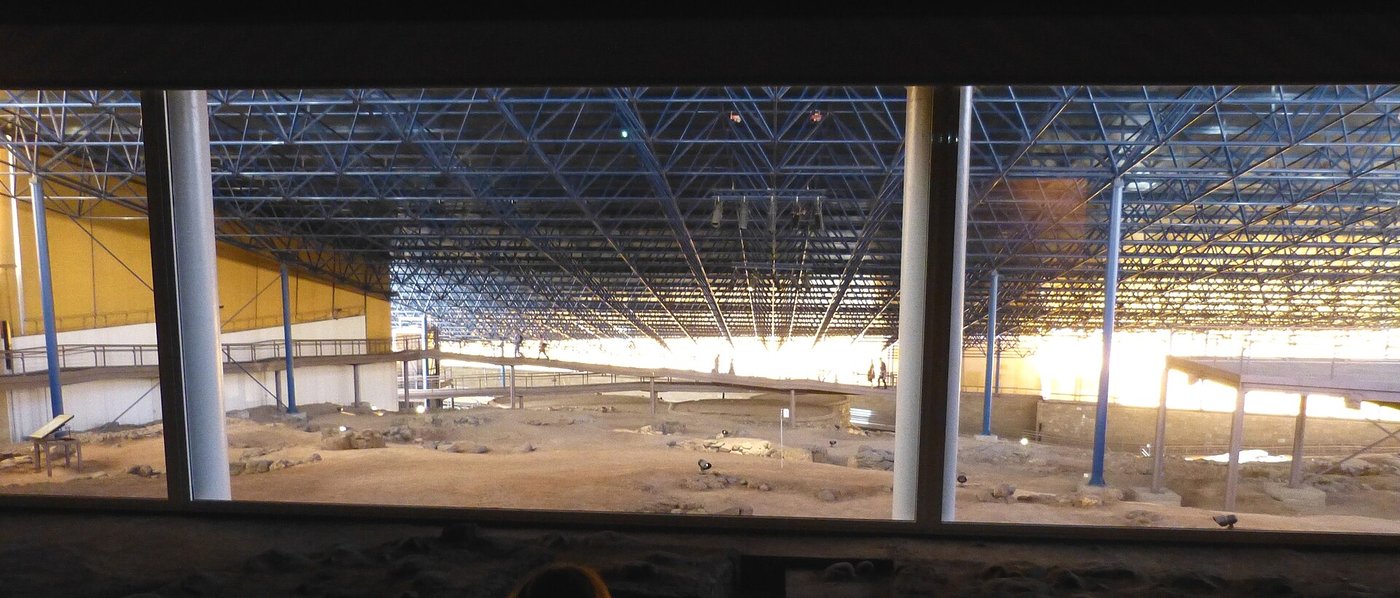
On Tenerife the invaders met a soldier's nightmare: nine kings, called menceyes, who could put thousands of fighters into steep, broken country they knew perfectly. In May 1494 the most powerful of them, Bencomo, mencey of Taoro, and his half-brother Tinguaro caught the Castilian force under Alonso Fernández de Lugo in a ravine at Acentejo and cut it to pieces. It was one of the worst defeats Castile suffered anywhere in its long century of conquest, and for a moment it looked as if Tenerife might simply refuse to be taken.
It did not last. De Lugo came back with more men and money, and this time the islanders had a second enemy inside their own ranks. A sickness the Spanish called the modorra (probably a disease brought from the mainland, against which the isolated islanders had no defence) swept through the Guanche population and gutted it. Weakened and dying, the menceyes lost the field at Aguere and again at Acentejo. On 25 July 1496 the last of them came down out of the mountains and submitted. The islands were Castilian, and would be the launch pad from which Spanish ships crossed to the Americas.
What did not die
The Guanches did not vanish so much as dissolve. Many were killed or shipped off and sold; many more were baptised, married into the settler population, and folded into the new Canarian society at the bottom of it. Their blood is still here: studies of modern islanders find a strong current of indigenous ancestry running through the population, carried down especially on the maternal line. The people of the Canaries today are, in real part, the Guanches' descendants.
Their fingerprints are on the map and in the mouth. The very name Tenerife is thought to come from their tongue; so do dozens of place names and the word gofio for that toasted flour. And on the small green island of La Gomera something even older survived: Silbo, a way of turning speech into loud, carrying whistles that can be heard across the deep ravines where a shout would die. The Guanches whistled their own language that way; after the conquest the islanders simply retooled the whistles for Spanish. It very nearly died out in the twentieth century. Then La Gomera put it back into the schools, and today its children are taught to whistle a language across a valley: the last living echo of a people who crossed an ocean and then let the boats rot on the beach.
That is the shape of the Guanches, in the end. Not a lost race and not a riddle from a sunken continent, but ordinary people who did an extraordinary thing, forgot they had done it, and were nearly erased before anyone thought to ask who they had been. The bodies in the caves outlasted the men who ground their neighbours into medicine. The whistles outlasted the kings. And somewhere in a Tenerife ravine, if the old account is true, a thousand of them may still be lying in the dark, waiting to be found a second time.
Read next: Chinchorro: Made by Fishermen, Older Than the Pharaohs and Lapita: The Dotted Pottery Behind Prehistory's Fastest Migration.
Sources & further reading
- Fregel, R. et al. “Genome-wide analysis of the aboriginal Canary Islanders reveals a Berber-like origin,” and related ancient-DNA work published in Current Biology and PNAS (2017–2019).
- Rodríguez-Varela, R. et al., genomic analyses of pre-European Canary Island remains, Current Biology (2017).
- “Guanche mummy of Madrid” and CT-imaging studies of the Barranco de Herques mummy, Museo Arqueológico Nacional, Madrid.
- Espinosa, Fr. Alonso de. The History of the Guanches (early Spanish chronicle of Tenerife), and later editions in English.
- UNESCO, listing for the whistled language of La Gomera (Silbo Gomero), Intangible Cultural Heritage (2009).
- Reporting on the conquest of Tenerife (1494–1496) and the Battles of Acentejo, with the Cenobio de Valerón and Gáldar excavations.
Image credits (via Wikimedia Commons): Guanche mummy from Tenerife, Museo Arqueológico Nacional — Carlos Teixidor Cadenas (CC BY 4.0); nineteenth-century Guanche shepherd lithograph — after Sabin Berthelot, lith. Auguste-Félix Saint-Aulaire (public domain); Cenobio de Valerón — Martin Falbisoner (CC BY-SA 4.0); Pyramids of Güímar — Mike Peel (CC BY-SA 4.0); Gáldar Cueva Pintada excavation — Wolfgang Sauber (CC BY-SA 4.0).