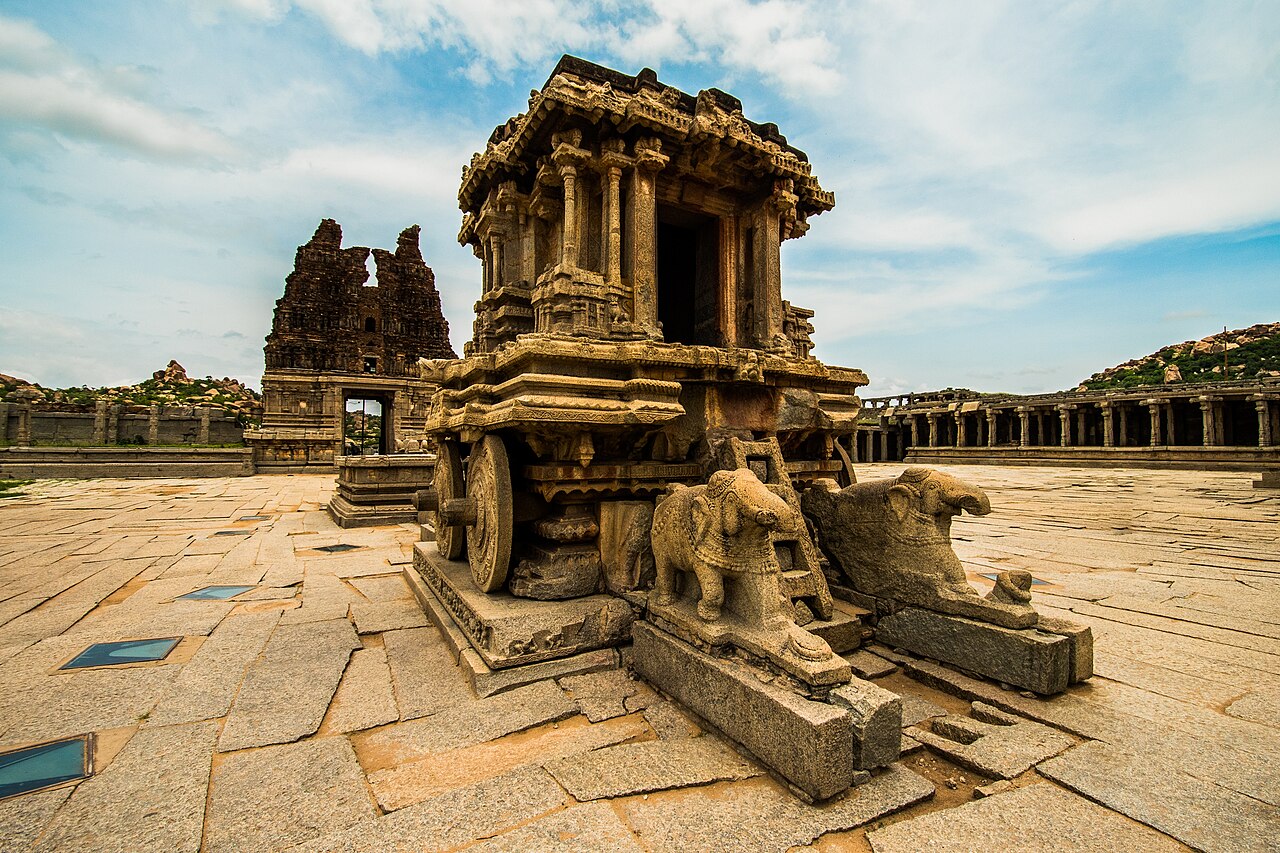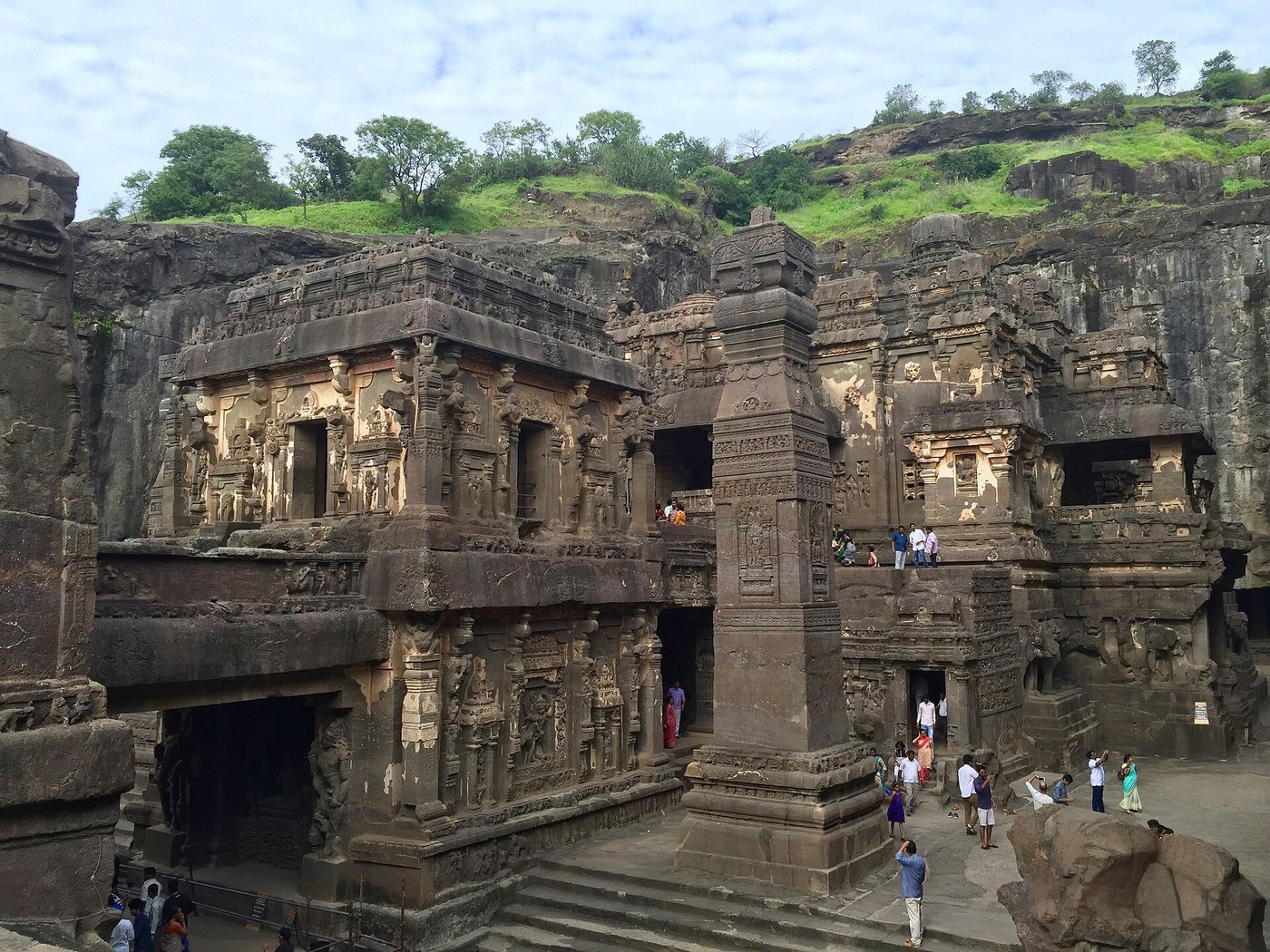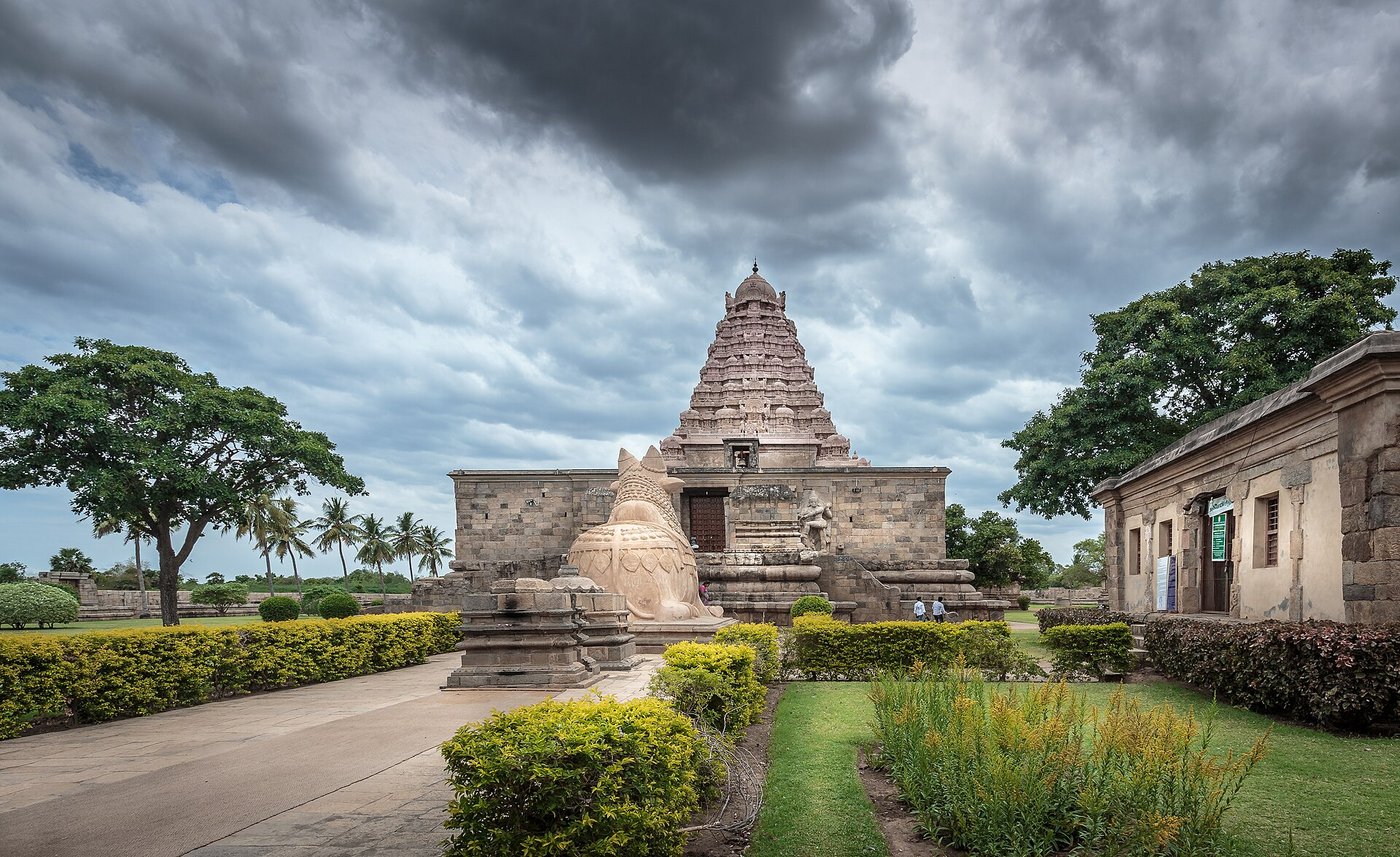
Sometime around 1030, on a slab of grey granite in the Tamil country, a stonecutter was working through the longest boast his king had ever handed him. He had already cut the northern wars: the rivers forded, the kings pulled down, the pot of Ganges water carried a thousand miles home. Then came a stranger passage. The chisel spelled out names nobody in the workshop had seen or could point to on any ground they knew: Sri Vijaya, Pannai, Malaiyur, Kadaram. Harbours on the far side of an ocean. The king, the stone said, had put an army onto ships, sent them across open water, taken those ports one after another, and dragged their ruler back in irons. It reads like somebody else's geography. Every place on the list was real.
The king was Rajendra Chola I, and the raid the stone describes is one of the oddest things in the whole history of the region. South India built no great fighting fleets. Its powers were land powers, settling their quarrels on river plains within marching distance of home. Yet in about 1025 a South Indian emperor sent a war fleet more than two thousand kilometres across the Bay of Bengal, fell on the richest trading empire in Southeast Asia, and sacked more than a dozen of its harbours in what looks like a single sailing season. It is the only long-range seaborne invasion launched from South Asia that the records remember. And the strange part is how little we can say about how it was done.
The king who ran out of land
Rajendra came to the Chola throne in 1014, taking over an empire his father Rajaraja had spent a lifetime enlarging. Rajaraja had beaten the Cheras and Pandyas at home, taken much of Sri Lanka, reached into the Deccan, and raised at Thanjavur the vast Brihadisvara temple, a mountain of stone with a shrine tower that still throws its shadow across the town. Rajendra inherited a full treasury, a hardened army, and a father's reputation he plainly meant to outdo.
He looked north first. Around 1019 his forces set out on a march that carried them up the eastern side of the subcontinent, through Odisha and into Bengal, where they broke the army of the Pala king Mahipala. What they brought back was less a province than a symbol: water from the Ganges, poured into a great tank at a brand-new capital Rajendra founded to mark the feat. He called both the city and himself Gangaikonda Chola, the Chola who took the Ganga. A king who names his capital after a river a thousand miles from his own is a king thinking about how history will read him.
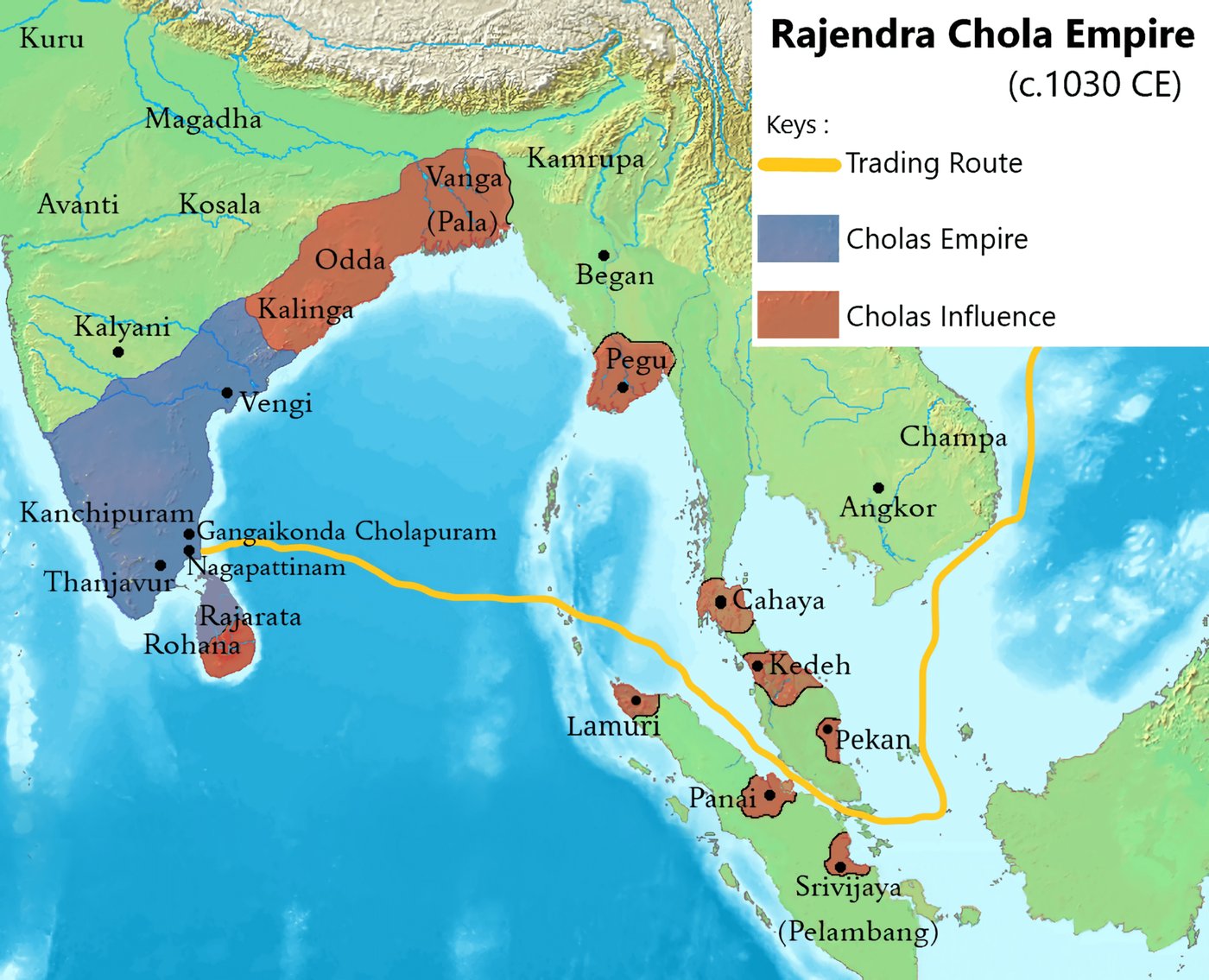
By the early 1020s Rajendra had a problem that only a very successful conqueror gets. On land, in any direction that mattered, he had already won. The obvious rivals were beaten or absorbed. A ruler raised on the idea of the digvijaya, the conquest of the quarters of the world, had run out of quarters he could reach on foot. What was left lay over the water, and over the water was where the money was.
A rival on the far shore
Everything the Chola ports traded eastward (and by the eleventh century that was a great deal, silks and spices and the long, lucrative business with Song China) had to pass through one narrow gate. The Strait of Malacca, the squeeze of water between Sumatra and the Malay Peninsula, was the hinge of all commerce between the Indian Ocean and the seas of China. Whoever held the strait held a hand on the throat of that trade. And for three centuries it had been held by Srivijaya.
Srivijaya is a name most readers have never met, which is itself part of the story. From a capital usually placed at Palembang on the Musi river in southern Sumatra, it ran a loose, wealthy maritime empire: less a solid block of territory than a web of ports, river-mouths and vassals strung along both sides of the strait. It grew fat on tolls and transhipment. Ships coming from the west waited out the monsoon in its harbours; goods changed hands, and a cut stayed behind. Chinese pilgrims broke their journeys there and wrote admiringly of a city of a thousand Buddhist monks. The Sailendra rulers who stood behind it were, in the same period, patrons of some of the greatest Buddhist building the world has seen.
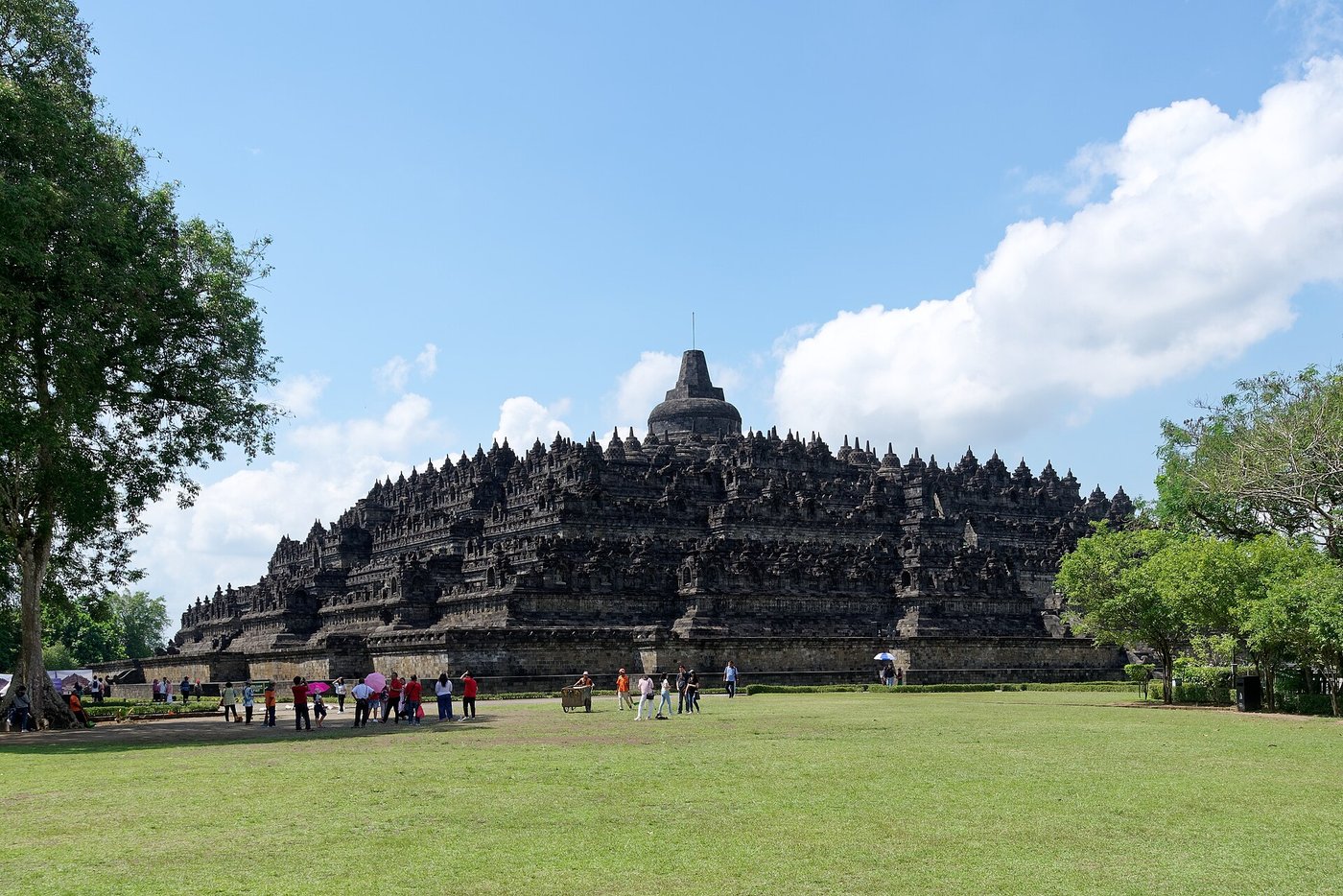
So the target was not some soft frontier town. It was a sophisticated sea power, richer per head than most of what Rajendra had conquered on land, and defended by the sheer awkwardness of reaching it. To get at Srivijaya you had to cross the Bay of Bengal. That, more than any wall or army, was its protection. It was a protection Rajendra decided to take away.
The quarrel that never got written down plainly
Why he decided it is the question that has kept historians arguing, because the one thing the sources are shy about is motive. The inscriptions crow about the result and say almost nothing about the cause. Into that silence several explanations have been poured, and the honest position is that more than one of them is probably true at once.
The simplest is trade. If Srivijaya controlled the strait, it could choke or tax the flow of Tamil merchants and goods heading for China, and there are hints it had begun to do exactly that. The Cholas were sending their own embassies to the Song court (one arrived in 1015, another would come in 1033), and a state that keeps opening a diplomatic and commercial line to China does not want a rival sitting astride the only road there. On this reading the raid was a hard shove to clear the route: break the gatekeeper, and the gate stands open.
One school reads the raid as cold commerce: a pre-emptive strike to stop Srivijaya strangling the Chola trade with China before it could grow, with the historian Tansen Sen among those who see a merchant's logic behind the swords. Another reads it as pure prestige, a king extending his digvijaya across the sea because conquest was the thing a great ruler did, and no one before him had done it over open water. There is a third thread too: a tangle in which the Khmer ruler Suryavarman I and the port-state of Tambralinga were pulling Srivijaya into their own fight. The raid can be made to fit any of these. It probably belonged, untidily, to all three.
What none of the explanations quite reaches is the boldness of it. Trade disputes are usually settled by trade. Prestige is usually chased where your armies can walk. To answer either by loading soldiers onto ships and pointing them at an ocean was a wild, expensive gamble, and the fact that Rajendra took it says something about the man that the polite inscriptions do not.
The fleet we can barely see
Here is the frustrating heart of the whole affair. We know the raid happened. We know roughly where it went and what it took. We do not really know how it sailed, because next to nothing survives about the ships that carried it.
The Chola navy was not a navy in the modern sense; there was no standing fleet of purpose-built warships kept ready in a harbour. It was, as far as anyone can tell, an army that could be put to sea: transports and merchantmen pressed into service, loaded with the same soldiers who fought on land, sailed to a coast and unloaded to do there what they did everywhere. The great Chola port was Nagapattinam, on the Coromandel coast, and from somewhere along that shore the expedition set out. Beyond that the record thins to almost nothing. Inscriptions name a handful of ship-types in passing; no hull has been dug up, no shipwright's account survives, no drawing made from life. The single most famous seaborne campaign in South Asian history left behind, of its ships, essentially a blank.
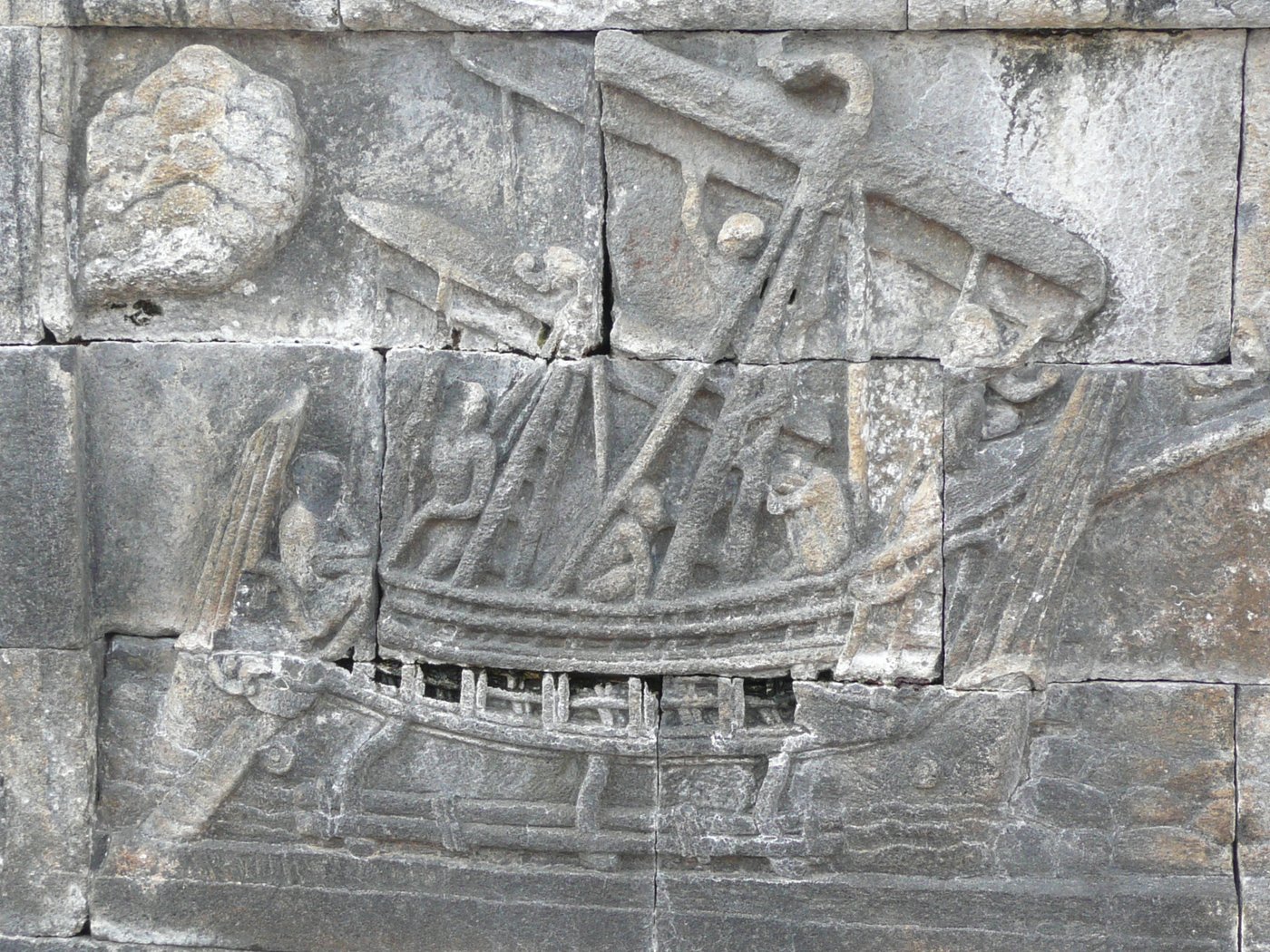
Almost everything we know about the raid comes from words cut into stone in Tamil, praising the king. Those meykkirti panels list conquests; they do not describe logistics. There is no chronicle written by a sailor, no wreck on the seabed yet tied to the campaign, no builder's record of a Chola hull. Later writers filled the gap with colour, such as war-elephants shipped across the bay and engines throwing fire, but that is embroidery added centuries downstream, not evidence. When you strip the story back to what can actually be shown, the fleet that changed the eastern seas is a rumour supported by its own results.
What made the crossing possible was the one thing the sailors of the Indian Ocean understood better than anyone: the monsoon. The winds of these seas reverse with the year, blowing steadily one way for months and then the other. A fleet that timed its departure right could ride the wind east across the bay and, with the season, ride it home again. The Cholas did not need a navy that could beat its way anywhere at will. They needed to leave on the correct week. It appears they did.
Fourteen harbours in a season
The blow, when it landed, seems to have been fast and thorough. Rather than grinding up the strait from the obvious northern end, the fleet apparently came at Srivijaya from an unexpected quarter, striking down the chain of ports before the defenders could gather. Srivijaya's strength was spread across many harbours; that was its wealth in peacetime and its weakness under a surprise attack. A raider who moved quickly could take them one at a time, and it looks as though that is what happened.
The royal inscription reels off the catch like a merchant counting stock: Sri Vijaya itself, and Pannai, and Malaiyur, and Mayirudingam, and Ilangasoka, and Mappappalam, and Talaittakkolam, and Madamalingam, and the island of Nakkavaram (the Nicobars), and, at the end of the list, Kadaram. These are ports scattered down Sumatra, along the Malay Peninsula, out into the islands: the whole spine of the strait, named as taken. Whatever the precise order and however much a court poet rounded up, the scale is the point. This was not a raid on one town. It was a sweep along an entire coastline.
At the far end of it stood the prize. The Cholas took Kadaram, in the Kedah region at the strait's northern mouth, and there they laid hands on the Srivijayan overlord himself, Sangrama Vijayottunggavarman of the Sailendra line, and carried him off a prisoner. A ruling emperor of the eastern seas, seized in his own capital by men who had sailed from the far side of the ocean: it is the kind of reversal that does not happen twice in a region's history.
Among the plunder the inscription singles out one object above the heaps of gold: the Vidyadhara-torana, the jewelled gateway of Srivijaya's capital, its "war gate," hauled down and taken as a trophy. A gate is a strange thing to carry off. You cannot spend it. But a gate is the face a city shows the world, the thing an approaching traveller sees first, and to strip a proud harbour of its own gate and bear it home across the sea was to take not just its treasure but its front door.
The wealth that sailed back
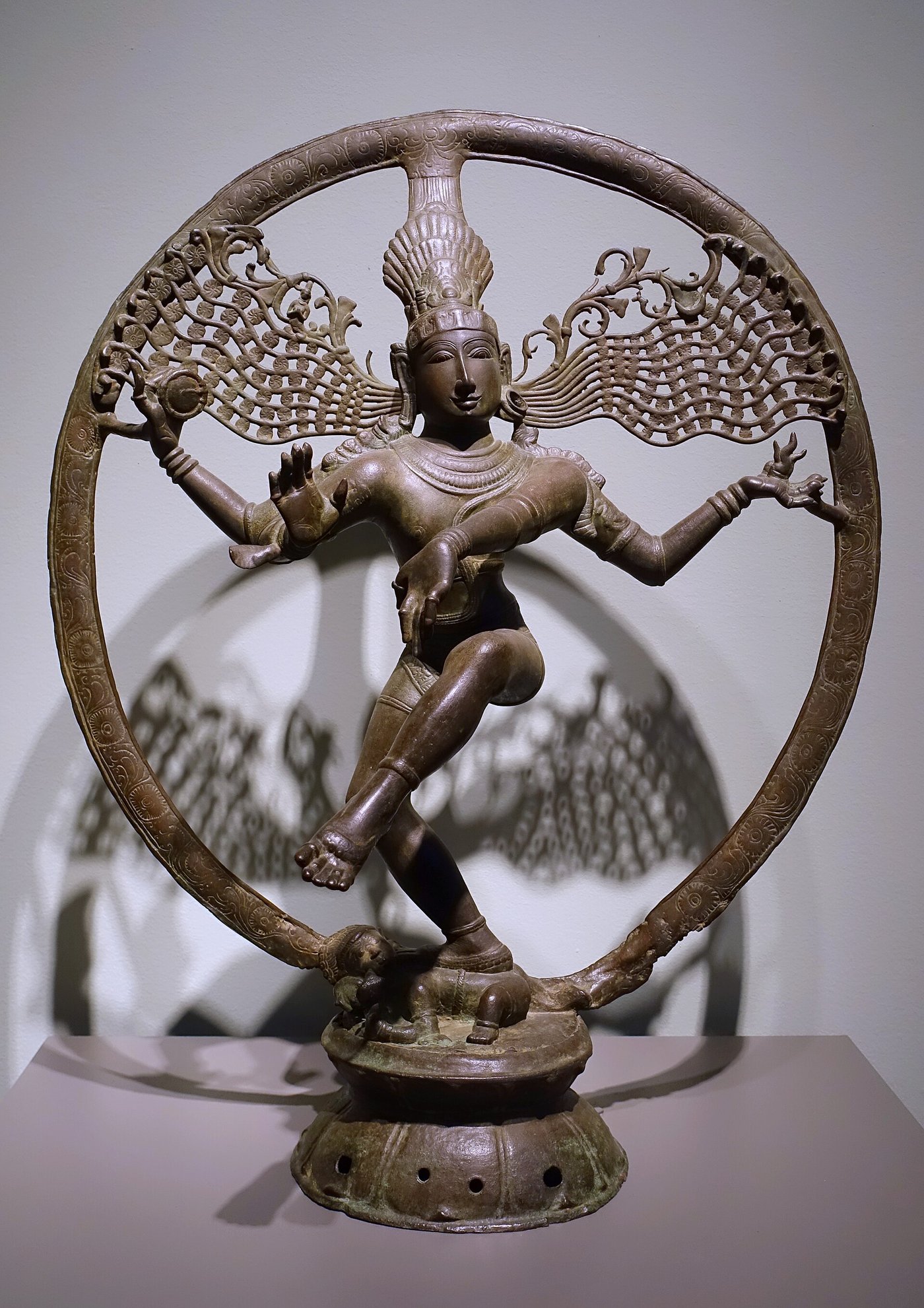
What Rajendra brought home turned into stone and bronze. The Chola century was the great age of Tamil temple building and of the lost-wax bronzes that are still, a thousand years on, among the most admired sculptures ever cast anywhere: supple, exact, alive at the shoulders and wrists. That art was paid for by an empire at the very top of its wealth, and the seaborne raid was part of what kept the treasury that full. When you stand in front of a Chola Nataraja, you are looking at the surplus of a state that could afford to send an army across an ocean and come back richer.
The boast on the temple wall belongs to the same impulse. The Cholas were among the most tireless record-keepers of the medieval world, cutting the deeds of their kings into granite where anyone could read them for as long as the stone lasted. That habit is the reason we have the campaign at all. The place-names on the wall are our chief witness: not a war diary, but a list of trophies, meant to make a farmer in the Kaveri delta understand that his king's arm now reached to islands he would never see.
Colony, or a season of plunder?
It is easy, reading the triumphant list, to imagine that Rajendra founded a Tamil empire in the southern seas, and that after 1025 the strait belonged to the Cholas the way Sri Lanka or the Kaveri delta did. That picture, popular as it is, does not survive contact with the evidence.
The raid turned Southeast Asia into a Chola colony, ruled from Tamil country for generations.
The Cholas took the ports, took the king, took the treasure, and then sailed home. They planted no lasting government along the strait, garrisoned no chain of forts. What followed was influence and intermittent tribute, not rule: a second expedition under a later Chola king around 1068, Tamil merchant guilds like the Ayyavole Five Hundred trading busily enough to leave their own inscription at Barus on Sumatra in 1088, and a memory of Chola power that lingered for perhaps a century before fading. It was the most spectacular raid of its age. It was not a conquest that stuck.
That distinction matters, because it changes what the whole episode was for. If the aim had been to plant an empire overseas, the raid failed; nothing permanent grew from it. If the aim was to smash a rival's grip on the trade route and open the road east for Chola ships and Chola merchants, it worked handsomely. Srivijaya never recovered the unquestioned command of the strait it had held before. The web of ports came loose. Power in the region began to drift, and over the next two centuries drifted for good, toward the Javanese kingdoms of Kediri and, later, Majapahit, while Srivijaya itself thinned into a name that even scholars had trouble recovering until the twentieth century.
What the crossing left behind
Rajendra reigned on until 1044, adding the taking of Kadaram to the long chain of titles carved after his name, and died the master of the widest empire any South Indian dynasty ever held. The fleet he sent east is not remembered with a single famous battle or a hero's name; it is remembered as a list of harbours on a wall, and as an absence: the ships that vanished from the record the moment they had done their work.
What it really opened was the sea itself. For a few generations after 1025 the Bay of Bengal was, in a way it had not quite been before, a Tamil sea as much as anyone's: crossed by Chola merchants, marked by Tamil inscriptions on Sumatran soil, held together by guilds that thought nothing of doing business a thousand miles from the Kaveri. The soldiers went home and the empire receded. The traders stayed, and the trade routes the raid had forced open outlasted the king who forced them. Rajendra wanted his name cut into stone next to a river he had reached and an ocean he had crossed. The river is still there on the wall. The ocean kept the better part of what he did.
Read next: Zheng He: The Treasure Fleet the Ming Tried to Erase.
Sources & further reading
- Nilakanta Sastri, K. A. The Cōḷas (University of Madras) — the standard narrative history of the dynasty and its inscriptions.
- Kulke, Hermann, K. Kesavapany & Vijay Sakhuja (eds), Nagapattinam to Suvarnadwipa: Reflections on the Chola Naval Expeditions to Southeast Asia (ISEAS, Singapore).
- Sen, Tansen, "The Military Campaigns of Rajendra Chola and the Chola-Srivijaya-China Triangle," in the volume above — the case for a commercial, pre-emptive reading.
- Spencer, George W. The Politics of Expansion: The Chola Conquest of Sri Lanka and Sri Vijaya.
- Coedès, George. The Indianized States of Southeast Asia — the classic account of Srivijaya and the Sailendras.
Image credits (via Wikimedia Commons): Gangaikonda Cholapuram temple — Mumbailensman (CC BY-SA 4.0); map of the Chola Empire — Levakpitam (CC0); Borobudur, Java — Jakub Hałun (CC BY-SA 4.0); Borobudur ship relief — Andreas Sihono (CC BY-SA 3.0); Chola bronze Nataraja, Portland Art Museum — Daderot (public domain).