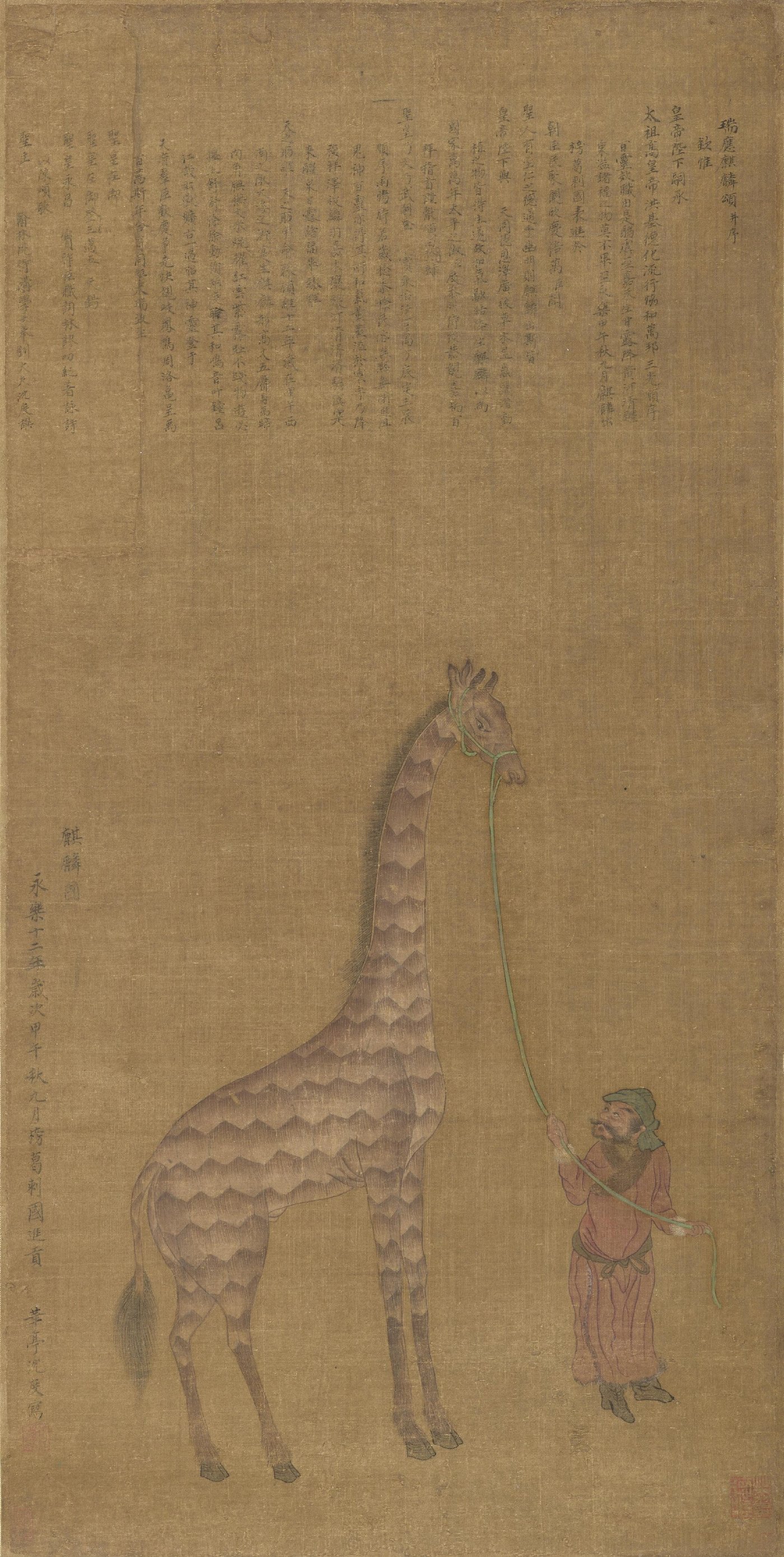
In the autumn of 1414 a giraffe walked through the gates of Nanjing. It had come the long way: born on the plains of East Africa, traded up the coast to the Sultan of Bengal, then handed to the officers of a Chinese fleet who carried it across the Indian Ocean and up the rivers of home. The court had no word for it. The scholars settled on qilin, the gentle horned creature of legend that was said to appear only when a virtuous ruler sat on the throne. Officials fell to their knees. A court painter, Shen Du, set the animal down in ink and colour, its neck bowed, a groom holding a thin rein as if such a rope could ever have held it. The message was plain to everyone in the hall: heaven approved of the Yongle emperor, and the proof had been fetched from the far side of the world by his ships.
The man who ran those ships was not in the painting, but he stood behind everything it meant. His name was Zheng He. Over twenty-eight years he led seven fleets down through Southeast Asia, across to India, on to Arabia and the coast of Africa: voyages so large that nothing to match them would put to sea for centuries. And then, within a lifetime of his death, the Ming state turned its back on the whole venture, let the great ships rot at their moorings, and did its best to see that the record of what they had done was never used again.
The boy taken in the mountains
He began life as Ma He, born around 1371 into a Muslim family in Yunnan, the far southwestern corner of China that still held out for the Mongols after the rest of the country had fallen to the new Ming dynasty. His father and grandfather had both made the pilgrimage to Mecca, and the boy grew up hearing about the sea and the lands beyond it. When the Ming armies finally took Yunnan in the early 1380s, that heritage counted for nothing. He was a captured child on the losing side. Soldiers castrated him, as was done to boys marked for palace service, and sent him north.
What could have been the end of him became the making of him. The young eunuch was assigned to the household of a prince, Zhu Di, and the two men suited each other. When Zhu Di rebelled against his own nephew and seized the throne in a brutal civil war, Ma He fought at his side and distinguished himself in the field. The new emperor, who took the reign name Yongle, rewarded him with a new surname, Zheng, and with a trust that few subjects ever earned. He handed this soldier-eunuch the largest fleet the world had yet seen and told him to sail it into oceans no Chinese official fleet had crossed on that scale before.
A fleet built to be seen
The first voyage sailed in 1405. The numbers, even at their most cautious, are difficult to hold in the head: more than three hundred vessels and some twenty-seven thousand men (sailors, soldiers, navigators, interpreters, doctors, clerks, cooks and craftsmen). This was not a scouting party. It was a floating town, a slice of the Ming state sent out to move under sail.
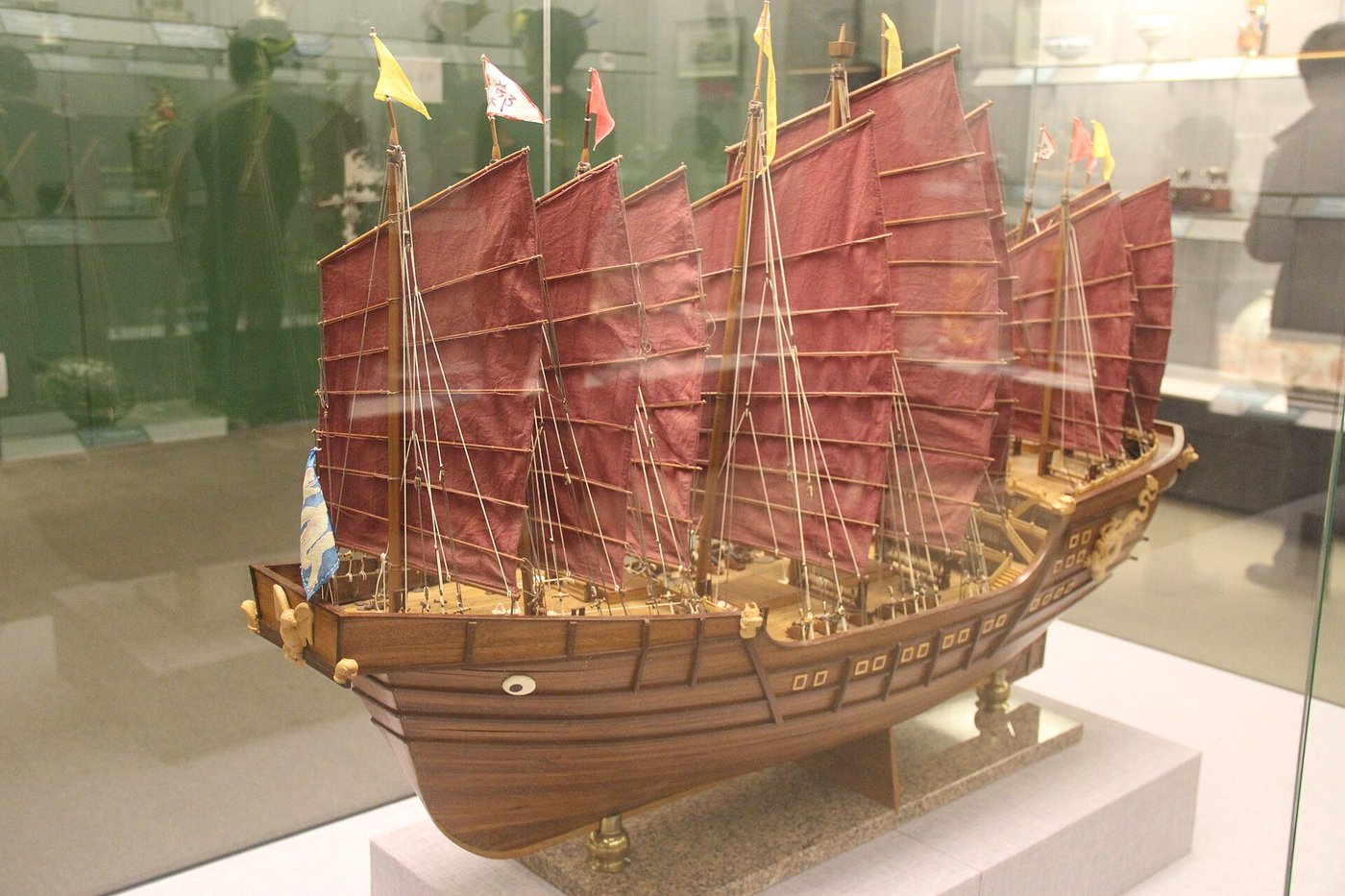
To build it, the dynasty turned the shipyards on the Qinhuai river near Nanjing into something close to an industry. Records speak of thousands of ships ordered across the provinces in the space of a few years. At the yard now remembered as the Treasure Ship shipyard, workers dug long tide-fed basins where hulls could be laid down side by side, floated out on the rising water, and sent downriver to the sea. The largest craft were called baochuan, treasure ships, and they carried the fleet’s name: nine-masted junks with watertight compartments in the hull, a technology Chinese builders had by then used for centuries and European ones would not adopt for hundreds of years more.
Two lengths that cannot both be true
How big were they, really? This is where the story tips from record into argument. The History of Ming, compiled long after the event, and a popular novel written in 1597, both give the largest treasure ships a length of forty-four zhang and a beam of eighteen. Run those figures through the measuring units of the day and you get a ship somewhere between about a hundred and seventeen and a hundred and thirty-five metres long: four hundred feet or more, wider than it has any business being, a wooden hull the size of a football pitch.
The grand claim: the biggest treasure ships were around 135 metres long and 55 metres in the beam, the largest wooden vessels ever built, dwarfing anything Europe put to sea. Nine masts, a crew of hundreds, a rudder as tall as a house.
The engineer’s objection: a wooden hull that long would flex and leak itself apart in any real sea. Timber has limits, and most historians of shipbuilding put the ceiling for a working wooden ship nearer 70 metres. On this reading the 44-zhang figure is a copyist’s error or a storyteller’s boast, and the real treasure ships, while still very large for their age, were something the physics allows.
Then there is a single, awkward object that neither side can wave away. In 1957, diggers at the old Nanjing shipyard pulled an eleven-metre rudder post out of the ground: a shaft of hardwood as long as a bus, cut for a rudder blade of enormous area. Chinese naval engineers looked at it and calculated the ship it must have hung on: something around a hundred and fifty metres, near the top of the wild-sounding claim. Sceptics counter that a rudder post proves the size of a rudder, not the length of a hull, and that the same timber could belong to a far shorter vessel. The post sits in a museum in Beijing, refusing to settle the case. What is not in doubt is that these were among the largest ships anyone had built, and that the exact figure has become a stand-in for a larger question about how much of the Zheng He story is history and how much is glory added later.
Where the ships went
The reach of the voyages grew with each one. The first three, between 1405 and 1411, worked the familiar trade route down to Calicut on the Malabar coast of India, the great pepper market of the age. The fourth, in 1413, pushed on to Hormuz at the mouth of the Persian Gulf. The last three reached further still: to Aden on the Arabian coast, to Mogadishu and Brava and Malindi on the shore of East Africa. Fleets, or squadrons split off from them, touched Java and Sumatra, Ceylon and Bengal, the Maldives and the Red Sea. Some Chinese sailors, sent inland from Arabia, are said to have reached Mecca itself.
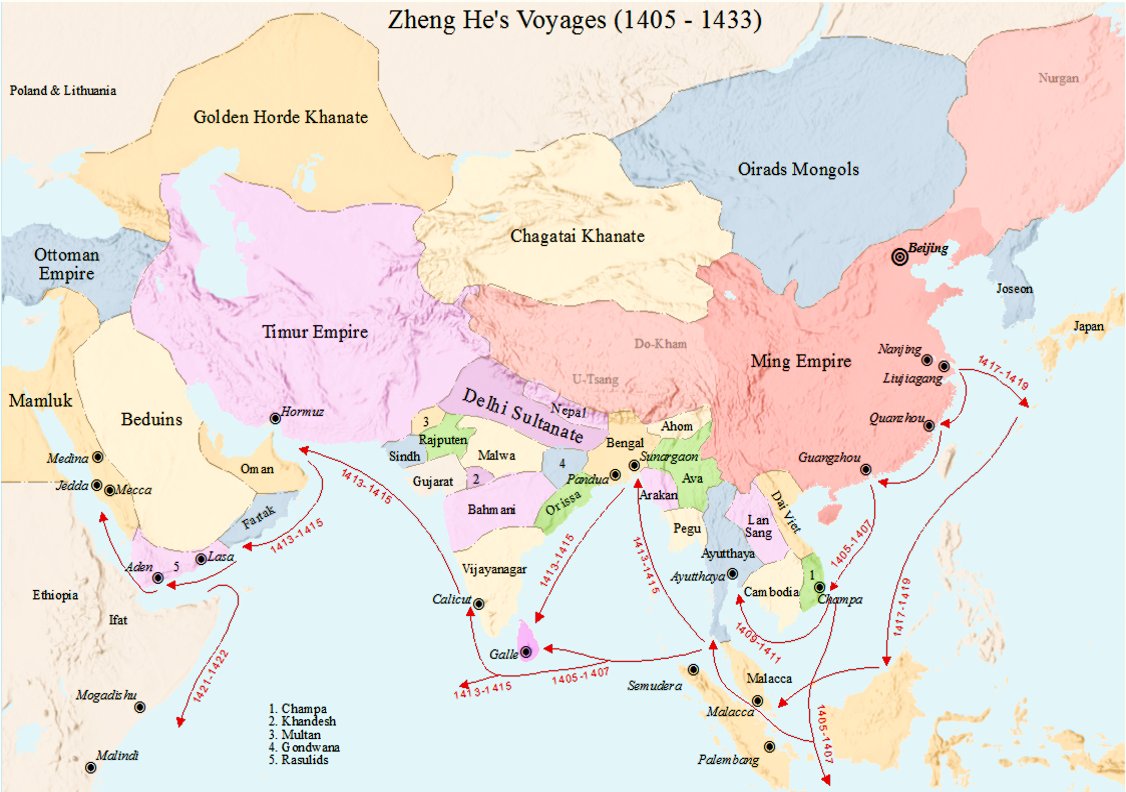
The point of all this was not to plant colonies or seize territory. The fleet came to trade, and to gather what the Ming called tribute: goods and envoys sent back to the emperor as a sign of respect. Silk and porcelain went out; pepper, gems, ivory, incense, exotic animals and foreign ambassadors came back. Rulers who acknowledged the emperor’s standing were confirmed on their thrones and sent home with gifts worth more than they had given. It was diplomacy carried out at a scale meant to leave no doubt about where the centre of the world lay.
Soft words, and decks full of soldiers
None of which made the fleet gentle. Behind the silk and the ceremony rode thousands of troops, and Zheng He used them when he judged it necessary. On the return leg of the first voyage, at Palembang on Sumatra, he crushed the fleet of a Chinese pirate named Chen Zuyi who had been preying on the strait. Thousands died in the fighting; Chen was taken back to Nanjing and executed. The lesson was not lost on the ports of Southeast Asia.
The sharpest episode came in Ceylon. In 1411 a local ruler, Alakeshvara, tried to trap and rob the fleet. Zheng He landed a force, marched inland while the king’s army was drawn off, and stormed the capital. He carried the king and his family back to China as prisoners, then let the emperor release them and set a friendlier ruler in place. It was a raid, not a conquest (the Ming took no land in Ceylon), but it showed that the velvet came off the fist when a host misbehaved.
Ceylon also holds one of the most remarkable things the fleet left behind. On an earlier visit Zheng He had set up a stone tablet, carved in three languages (Chinese, Tamil and Persian), recording offerings made at a shrine. The striking part is that each language addresses a different god: the Chinese honours the Buddha, the Tamil a Hindu deity, the Persian the light of Islam. One admiral, one stone, three faiths thanked at once. The slab lay lost until a road crew turned it up in the town of Galle in 1911.
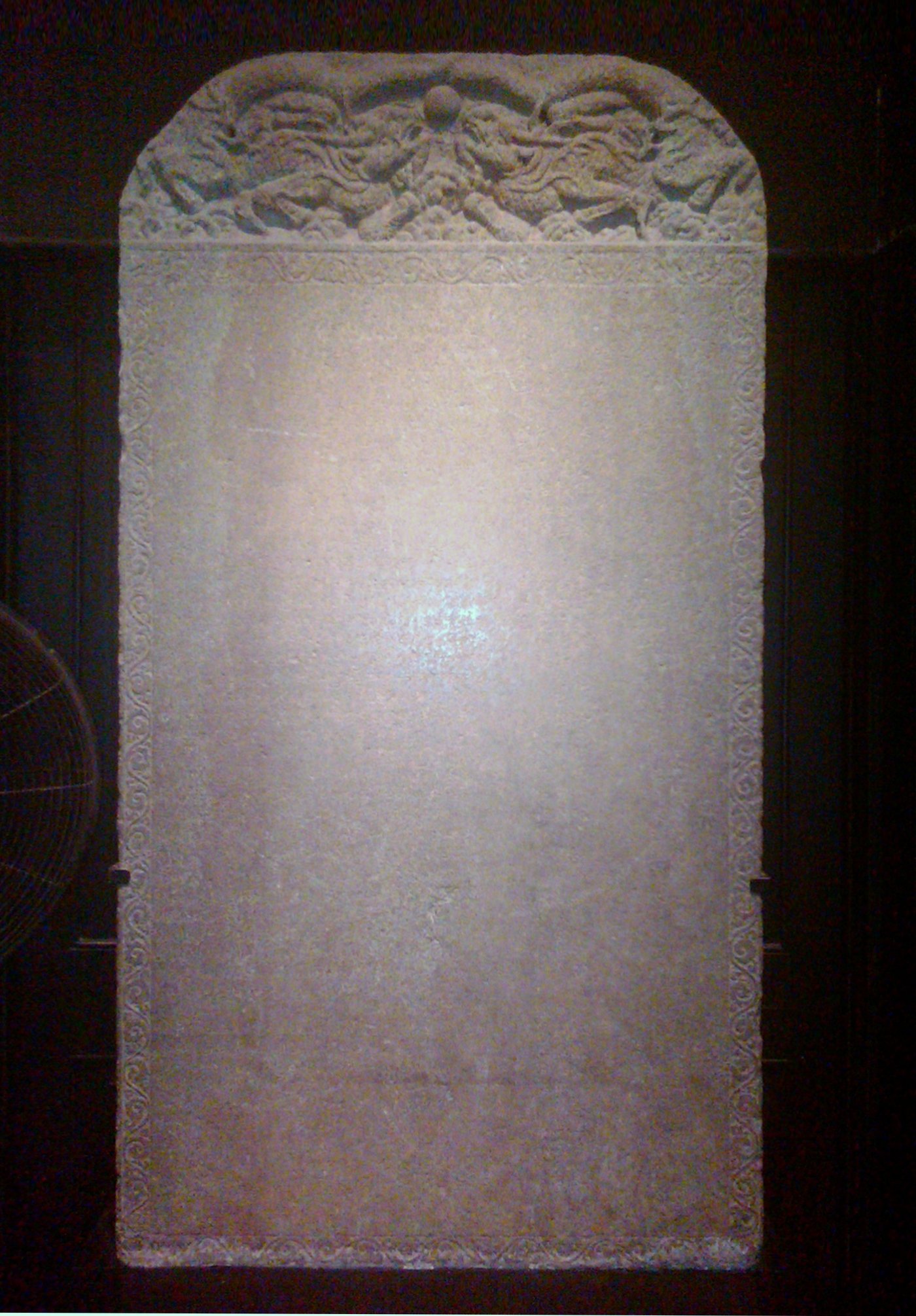
Before the seventh fleet sailed, Zheng He and his officers raised inscribed stones at Liujiagang and Changle, on the coast where the ships gathered, giving thanks to the sea goddess Tianfei for their safe returns. The tablets list the voyages and the far countries reached, and read like a man setting down his own account while he still can: places “beyond the horizon and at the ends of the earth,” the text says, had come to pay their respects. Those stones survived. They are, in a way, the memoir the state would later refuse to keep: Zheng He’s summary of his life, written in his own hand and left standing by the harbour.
A unicorn for the emperor
Return, for a moment, to the giraffe. Its arrival was not a happy accident. It was politics, and everyone at court understood the game. The Yongle emperor had taken the throne by force, over the body of his nephew, and a usurper is always hungry for signs that heaven is content with him. A living qilin, appearing in his reign, was exactly such a sign. That the creature had been fetched by his own fleet only doubled the point: the emperor’s virtue reached so far that the auspicious beasts of legend came to his door.
Yongle, to his credit, played it with a light hand. When his officials pressed him to accept the giraffe as proof of his greatness, he waved the flattery away and said the good government of the realm mattered more than any omen. It was a graceful move, and it lost nothing, because the painting had already been made and the story was already spreading. A second giraffe followed, sent directly from Malindi. For a few years, the strangest diplomacy in the world ran on the backs of animals no one in China had ever seen.
The turn inward
The Yongle emperor died in 1424, on campaign against the Mongols in the north, and the ground shifted at once. His son, the Hongxi emperor, had barely taken the throne before he ordered the treasure voyages stopped. He reigned less than a year, but the mood he spoke for outlasted him.
The Confucian scholar-officials who ran the day-to-day state had never liked the fleet. To them it was a eunuch’s project (and the eunuchs were their rivals for the emperor’s ear) that spent staggering sums to haul home giraffes and gemstones while the real dangers gathered on the northern frontier. The capital itself had just been moved from Nanjing up to Beijing, closer to the Mongol steppe, and the money and attention followed it: to the Great Wall, to the army, to the Grand Canal that fed the new capital with grain. There was a revival (the Xuande emperor sent Zheng He out one last time in 1430), but it was a farewell, not a fresh start.
After the seventh voyage the great ships were not sent out again. They sat, and aged, and were broken up or left to rot. The skills that built them scattered. Within a couple of generations the state made it a crime to go to sea in a multi-masted ship at all. A country that had reached the coast of Africa turned its back on the ocean and bolted the door.
Did anyone actually burn the logs?
The most dramatic part of the tale is also the shakiest. The story goes that around 1477, when a later emperor asked to see the records of the voyages, perhaps to consider sending fleets out again, the documents could not be found. A senior official in the war ministry, Liu Daxia, was said to have pulled them from the archive and either hidden or burned them, dismissing the whole record as “deceitful exaggerations of bizarre things far from the truth,” the sort of thing no official should want a young emperor to imitate.
It is a perfect ending (the bureaucrat as book-burner, killing the memory of a golden age), and perfect endings deserve a second look. The tale of Liu Daxia and the burning appears in later, second-hand accounts, and some historians now argue that what he actually suppressed were the files for a proposed campaign in Vietnam, not the sea-voyage records at all. On that reading, the logs were not dramatically destroyed in one act of spite. They simply mattered to no one for long enough that they rotted, scattered and were lost: a quieter and, if anything, sadder way for a great record to vanish. Either way the result was the same: for centuries, China’s own account of its greatest voyages was mostly gone.
What is certain is the silence that followed. The detailed logs, the charts, the ships’ manifests (the raw record that would let us settle the arguments about size and reach) are not in our hands. Much of what we know comes instead from a few crew members who wrote books, from the stones Zheng He raised himself, and from the archaeology of the shipyards. The state that built the fleet chose, in the end, not to remember it, and that choice did more damage than any storm.
The admiral who was almost forgotten
Zheng He did not come home from the last voyage. He died in 1433, most likely at sea on the return leg near Calicut, and was probably buried in the ocean he had spent his life crossing. A tomb was raised for him near Nanjing, but it is thought to hold his clothes and his queue rather than his body. He was in his early sixties, and had sailed further, with more men, than any commander of his age.
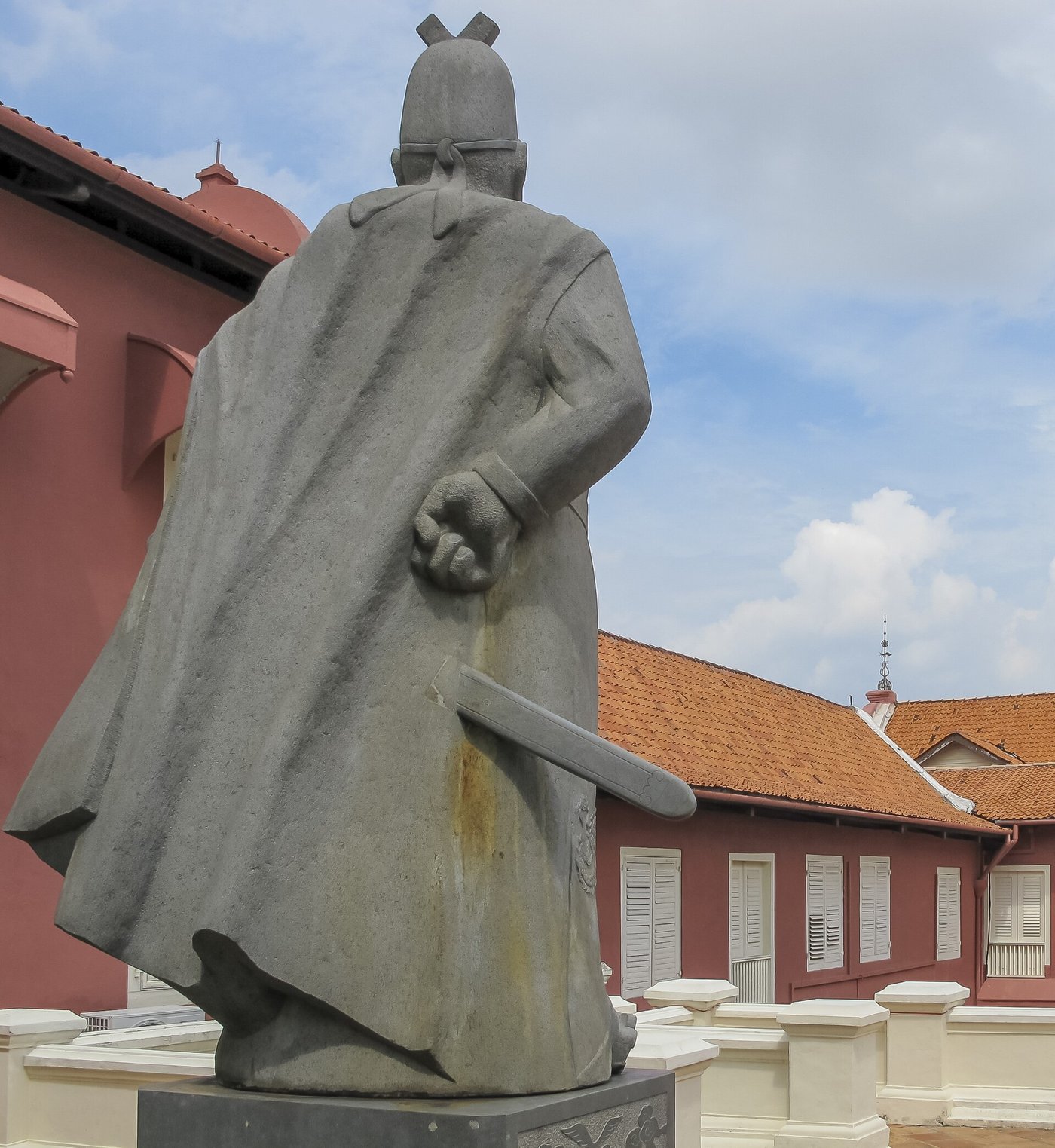
The strange thing is where his memory did survive. Not in the archives of the state that sent him, but in the port towns his fleet had visited. Along the coasts of Malaysia and Indonesia, Chinese communities kept his name alive, built temples to him, folded him into local legend as a protector and a founder. The state forgot; the harbours remembered. It was only in the twentieth century, as the stones were read and the shipyard was dug and the rudder post came out of the mud, that China gathered the pieces back and set Zheng He where he now stands: on statues, on stamps, at the centre of a national story about a time when its ships ruled the sea.
There is a habit of using him as a what-if: what if the fleets had kept sailing, met the Portuguese head-on, reached the Atlantic first? It is a thin game. The Ming did not want an empire of the sea; they wanted respect paid at the door and then quiet, and once the giraffes stopped arriving the whole thing looked to them like money poured into salt water. The lesson the voyages actually leave is smaller and harder. A country can build the most powerful fleet on earth, sail it to the ends of the known world, and then decide, deliberately, to stop, and to forget it ever did. Greatness is not only hard to achieve. It is easy to give away.
Read next: Rajendra Chola: The War Fleet India Sent Across the Bay of Bengal and Srivijaya: The Sea Empire That Left Almost No Ruins.
Sources & further reading
- Levathes, Louise, When China Ruled the Seas: The Treasure Fleet of the Dragon Throne, 1405–1433 — the standard popular account of the voyages and their end.
- Dreyer, Edward L., Zheng He: China and the Oceans in the Early Ming Dynasty, 1405–1433 — a careful, sceptical military and naval history.
- Needham, Joseph, Science and Civilisation in China, vol. 4 — on Chinese shipbuilding and the treasure-ship dimensions debate.
- Church, Sally K., “Zheng He: An Investigation into the Plausibility of 450-ft Treasure Ships” — the leading critique of the largest size claims.
- The Galle Trilingual Inscription and the Liujiagang and Changle stele texts — Zheng He’s own contemporary records.
- Ming treasure voyages, entries in the Ming shi and the Ming shilu (Veritable Records), and modern reports on the Nanjing Treasure Ship shipyard excavations.
Image credits (via Wikimedia Commons): tribute giraffe presented at the Ming court — attributed to Shen Du, c. 1414 (public domain); model of a treasure ship — Gary Todd (CC0); map of the seven voyages — SY (CC BY-SA 4.0); the Galle Trilingual Inscription — Kanatonian (CC BY-SA 3.0); monument to Zheng He at Melaka — CEphoto, Uwe Aranas (CC BY-SA 3.0).