The best diving is done in the dark. On the Musi River at Palembang, in the wet years after 2011, men would take small boats out over the brown water at night, weight themselves down, and go under with a torch and a hose to blow the silt away. They were not looking for fish. They were feeling along the river bed for gold. A ring here, a handful of beads, a coin stamped with a flower, once a Buddha of gold set with gems that came up out of the mud life-size and vanished into a dealer’s car before dawn. By the time anyone with a notebook arrived, most of it was gone: sold, melted, scattered across the private collections of three continents.
What those divers were pulling out of the river was the wreckage of an empire. For roughly six hundred years a kingdom called Srivijaya sat astride the sea lanes between India and China and grew rich on every ship that passed. It was one of the great powers of its age. And then it was forgotten so completely that in the early twentieth century a French scholar had to prove, from scratch, that it had ever existed at all. This is the strange thing about Srivijaya: not that it fell, but that it left so little behind that its own descendants lost the memory of it.
An empire that fit in a footnote
Think of the empires that leave a mark you can walk into. Rome has its forum and its aqueducts. Egypt has pyramids you can see from space. Angkor left a stone city the jungle could hide but never erase. Srivijaya left almost none of that. No great walls, no ruined capital with its name carved over the gate, no line of temples marching to the horizon. For centuries the only trace of it lived in other people’s writing: a word here in a Chinese pilgrim’s diary, a name there in an Arab sailor’s account of the eastern seas, a scatter of inscriptions in a language nobody had bothered to place.
The reason is not mysterious once you see the land. Srivijaya was built on the coast and the riverbank, in a climate that eats everything. Its houses, its halls, most likely its palaces, were made of wood and thatch and stood on stilts above the tidal mud. Wood rots. Thatch rots faster. The tropics take a timber town back into the soil within a lifetime or two, and the river shifts its course and buries what is left. Stone was used for the sacred and the official (a Buddha, a boundary marker, a temple of brick), but the living city was made of things that do not last. An empire that trades in silk and camphor and gold does not need to build in granite. Srivijaya spent its wealth on ships and tribute and monks, not on monuments to outlast it. So it did not outlast itself.
The paper that put it back on the map
For a long time the scattered clues sat unconnected. Chinese records spoke of a rich trading kingdom they called Shilifoshi, later Sanfoqi, that sent tribute and Buddhist pilgrims. Arab geographers wrote of a maritime king called the Maharaja of Zabag, whose lands were so productive that, one of them claimed, he threw a gold brick into the water each morning. Dutch surveyors in Sumatra kept turning up old stones cut with an unreadable script. Nobody had joined the dots.
The man who joined them was George Cœdès, a French epigrapher working in Southeast Asia. In 1918 he published a short, careful paper arguing that all these fragments (the Chinese Shilifoshi, the Arab Zabag, the Sumatran inscriptions in Old Malay) were pointing at one thing: a single Buddhist sea empire, centred somewhere around Palembang, that had dominated these waters from the seventh century onward. He gave it back its own name, the one written on its oldest stones. Srivijaya. It is a rare thing for a scholar to hand a nation an empire it did not know it had; Cœdès did exactly that, and modern Indonesia has claimed the memory ever since.
Proving it on the ground took much longer. For decades the awkward fact remained that the supposed heart of a wealthy empire had produced very little to dig. It was only from the 1980s onward, as archaeologists worked the low ground around Palembang and up the rivers of southern Sumatra, that enough turned up (foundations, ceramics by the tonne, workshops, religious sculpture) to show that a large and busy settlement really had stood there for centuries. The empire was real. It had simply kept its records in wood and water.
A kingdom made of water, not land
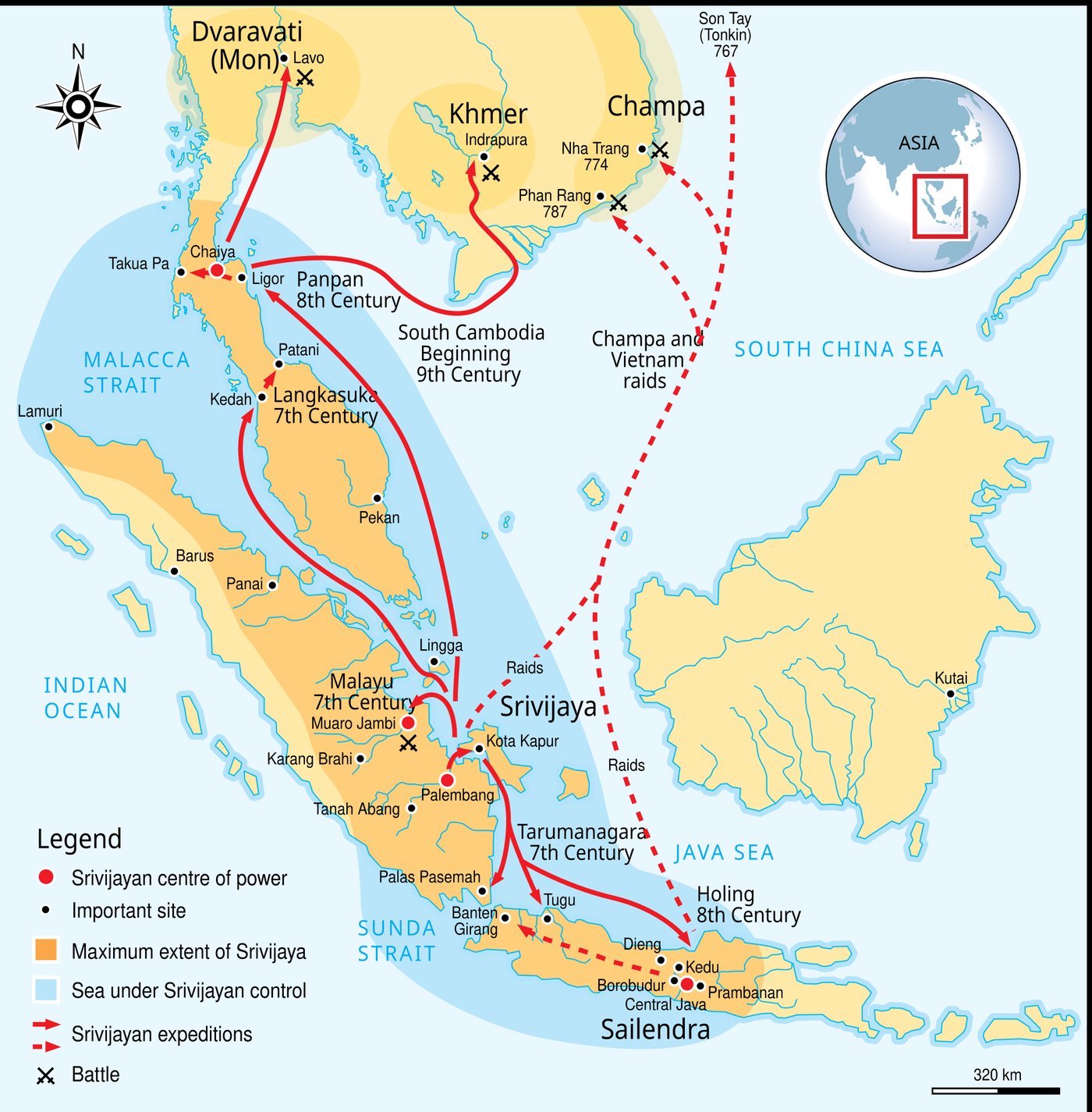
To understand Srivijaya you have to stop thinking like a mapmaker who colours in territory. Srivijaya did not rule much land in the way Rome or the Tang ruled land. What it ruled was movement. Everything sailing between the Indian Ocean and the South China Sea had to pass through a narrow gate (the Strait of Malacca, with the Sunda Strait as the back door), and the monsoon winds meant ships could only make the passage at certain times of year. Traders arriving from the west often had to wait months for the wind to turn before they could carry on to China. They needed somewhere safe to wait, to repair, to buy and sell. Srivijaya made itself that place.
Historians call this kind of state a thalassocracy: a power of the sea rather than the soil. Its strength was a network: a capital port, a string of lesser harbours that paid it loyalty, and the orang laut, the sea peoples who lived on their boats and knew every channel and hiding place in the maze of islands. Backed by the orang laut, Srivijaya could offer a merchant two things at once. It could keep the pirates off you if you came into its harbour and paid your dues. And it could unleash those same pirates on you if you tried to trade anywhere else. The result was a kind of protection racket run on an oceanic scale, and it worked for six hundred years.
The other half of the strategy was China. Srivijaya sent embassy after embassy to the Chinese court bearing tribute, and in return the emperors recognised its ruler as the legitimate master of these seas. That recognition was worth more than any fleet. It told every Chinese merchant which harbour was the safe and proper one to use, and it let Srivijaya speak to smaller ports with the borrowed weight of the largest empire on earth. The kingdom grew fat not by conquering its neighbours but by standing in the doorway and taking a cut of the world’s trade in spices, aromatic woods, tin, and gold.
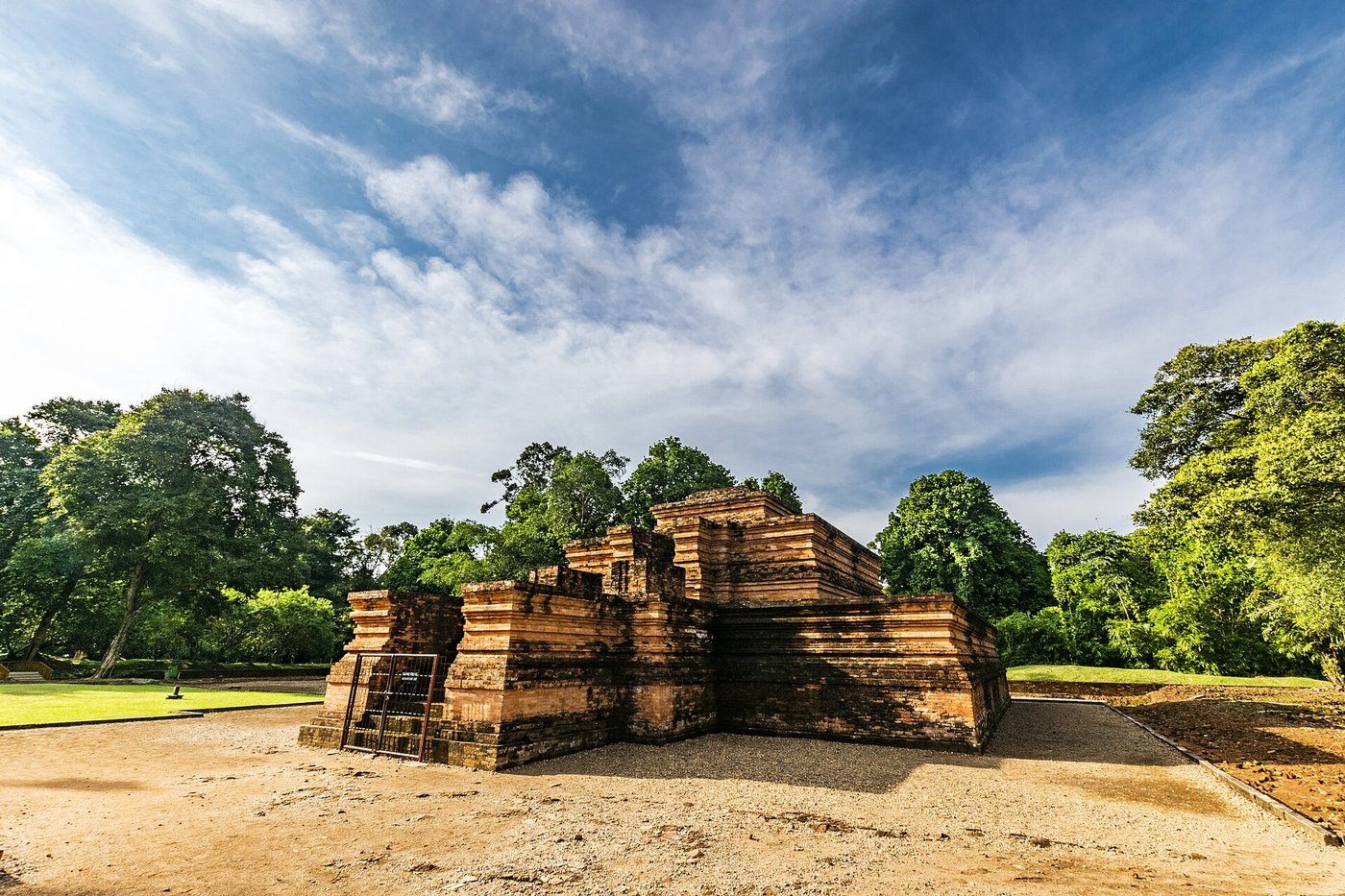
Most scholars place Srivijaya’s heart at Palembang, on the Musi, where the oldest inscriptions were found. But the ground there has been stubborn, and rival candidates keep their supporters, above all the brick temple city of Muara Jambi, upriver in Jambi, one of the largest ancient religious complexes in Southeast Asia. Some argue the centre of power shifted over the centuries, from Palembang to the Malayu country around Jambi and back. A thalassocracy may simply not have had one fixed capital in the way we expect. The question is not settled, and the silt is not helping.
The monk who stayed to learn the grammar
The clearest window we have into Srivijaya at its height was left by a visitor who never meant to write a guidebook. His name was Yijing, a Chinese Buddhist monk who set out by sea in 671 to reach the great monasteries of India. On the way he stopped at Srivijaya, and was so struck by it that he stayed about six months to study before sailing on.
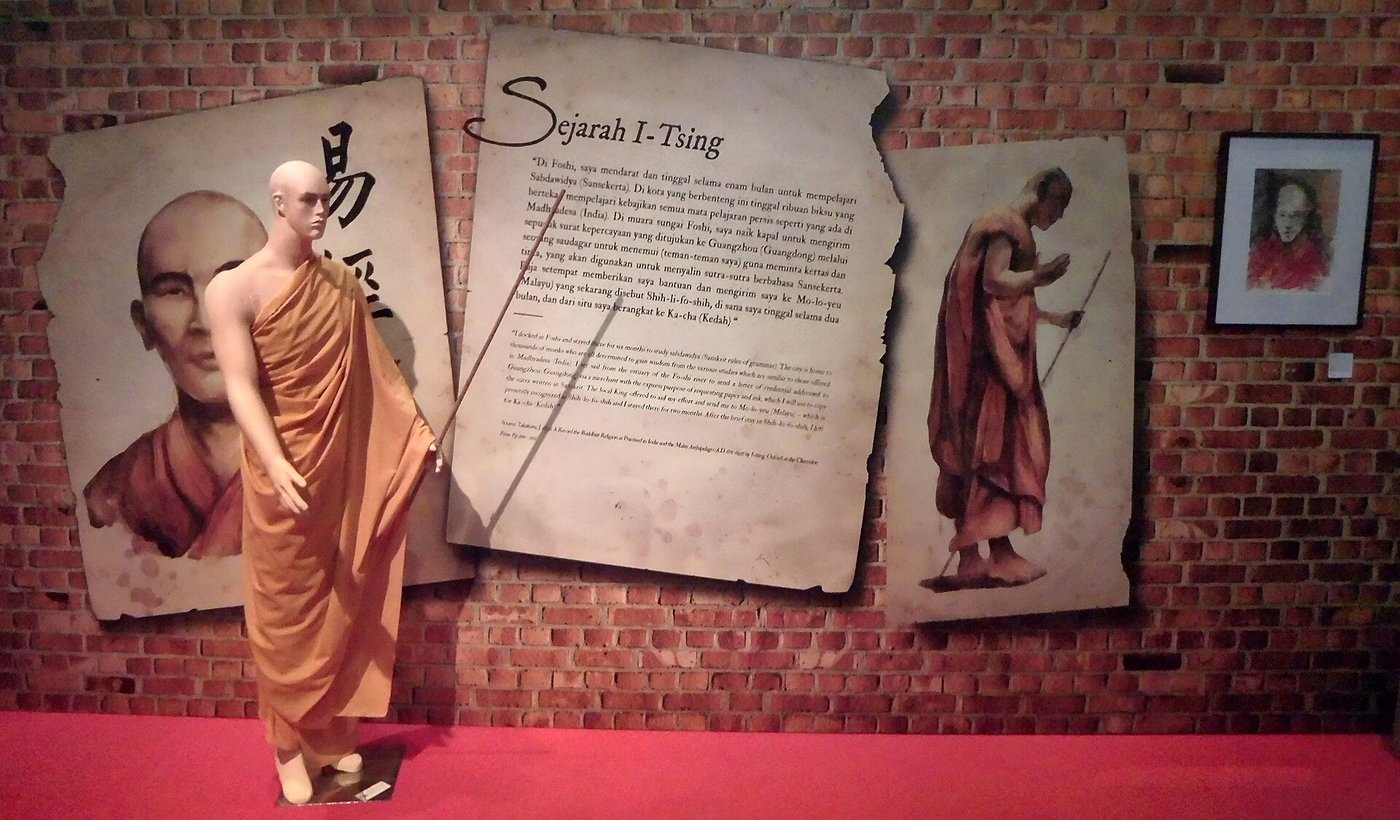
What he found was not a rough trading post but a centre of learning. By his account more than a thousand Buddhist monks lived and studied at the capital, following the same disciplines as the monasteries of India. The teaching was good enough that Yijing gave later pilgrims a piece of practical advice: if you are bound for India, he wrote, stop at Srivijaya first and spend a year or two getting your Sanskrit right, so you arrive fit to study. On his own way home, decades later, he stopped again (this time for years) and sat in the city translating scriptures and writing the accounts of Buddhist practice that survive under his name. Because of one traveller’s notes, we know that ships waiting for the monsoon shared their harbour with a university of the faith.
Words cut in stone by a fleet that won
If the wooden city is gone, a handful of stones are not. The oldest of them is small and easy to miss, a lump of rock found near Palembang and known by the place it turned up: the Kedukan Bukit inscription. It is dated with unusual precision to a day in the year 682, and it tells a compact story. A ruler (his title reads Dapunta Hyang) set out on a sacred journey, gathered an army and a fleet of ships, and won a victory that brought Srivijaya power and plenty. It reads like the founding notice of a kingdom announcing itself.
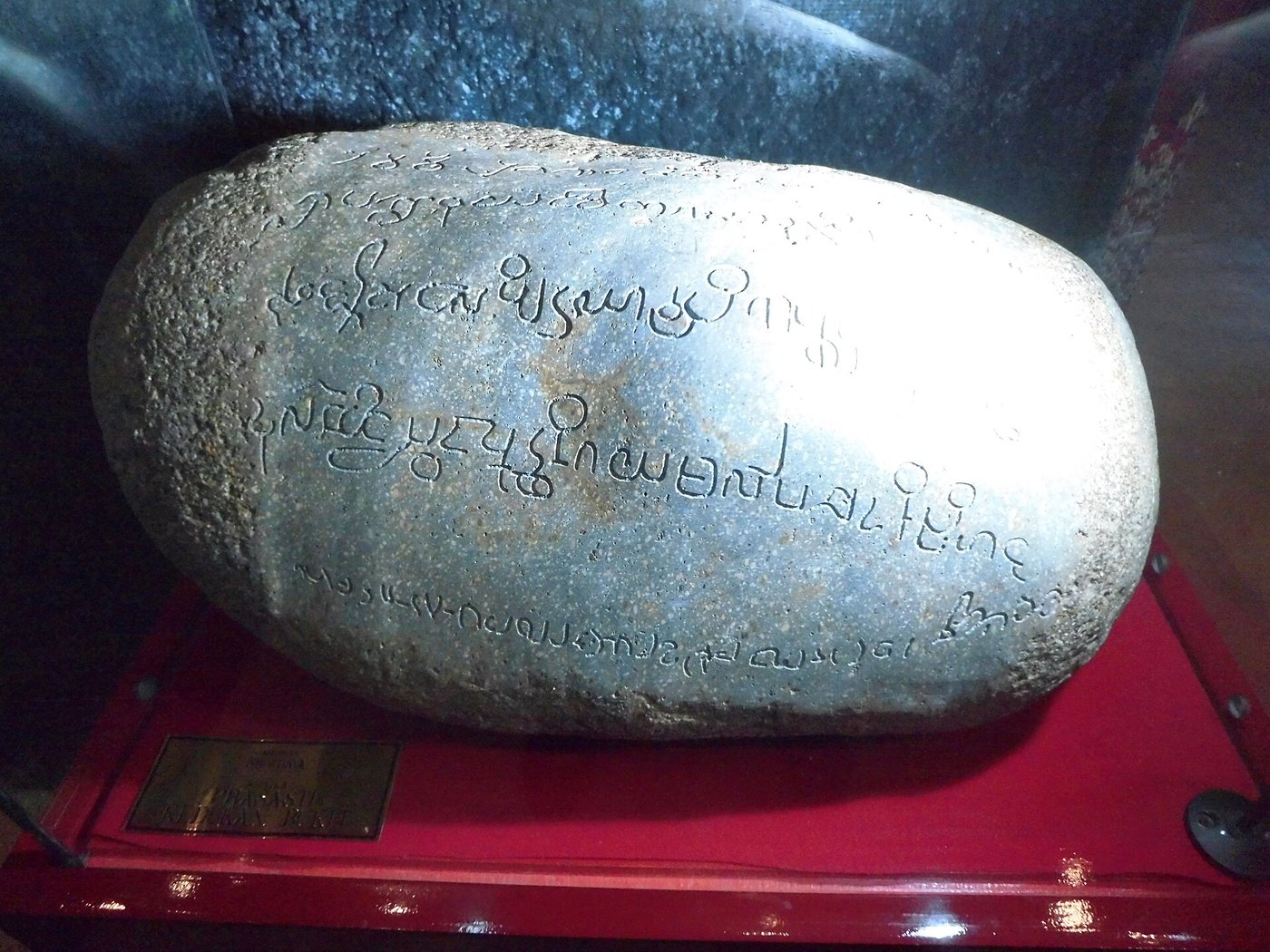
What makes the stone matter beyond Srivijaya is the language it is written in. The words are Old Malay, cut in a script borrowed from southern India, and this is the earliest dated example of that language anyone has found. Malay went on to become the trade tongue of the whole region, the language you used to do business from Sumatra to the Spice Islands, and from it descend the national languages of Indonesia and Malaysia today. The empire vanished; its language did the opposite.
The Old Malay of the Kedukan Bukit stone is the direct ancestor of modern Malay and Indonesian, which together are spoken by well over a quarter of a billion people across Southeast Asia. When you hear Indonesian on the news today, you are hearing the great-great-grandchild of the language a Srivijayan king used in 682 to boast about winning a war at sea.
A second stone, from 684, has a gentler voice. Set up by a king named Sri Jayanasa, it records the laying-out of a public park (fruit trees, water tanks, embankments) and asks that the good it does be shared with all living beings, in the plain language of Buddhist merit. Between the two inscriptions you get the whole shape of the place in a few lines: a state that won its wealth by force on the water, and spent part of it planting gardens and feeding monks.
The year the ships came from the west
An empire that lives by controlling the sea has one great weakness: someone with a bigger navy can come and take the doorway from you. In 1025 that is what happened. A fleet crossed the Bay of Bengal from southern India, sent by Rajendra Chola, the most powerful of the Chola kings, and fell on Srivijaya’s ports one after another. The Chola inscriptions list the harbours they struck by name and claim the capture of the Srivijayan ruler himself. It was a raid, not a conquest (the Cholas did not stay to govern), but it broke something. A kingdom whose whole authority rested on being the safe and unchallenged master of the straits had been shown, in a single season, to be neither safe nor unchallenged.
Srivijaya did not fall that year. It limped on, still sending embassies to China under the old name for two more centuries. But the spell was broken, and rivals had seen it break.
The long fade
What finished Srivijaya was not one blow but a slow loss of the thing it sold. Other ports learned the same trick and offered merchants a better deal. On Java, powerful kingdoms rose that had their own designs on the trade routes; a Javanese expedition pushed into Sumatra in the late thirteenth century, and the growing empire of Majapahit later claimed overlordship of the old Srivijayan lands. The Musi itself may have turned against the capital, silting up so that the biggest ships could no longer come far upriver. Trade drifted to newer harbours, and with the trade went the tribute, and with the tribute went the reason for anyone to obey a maharaja at Palembang.
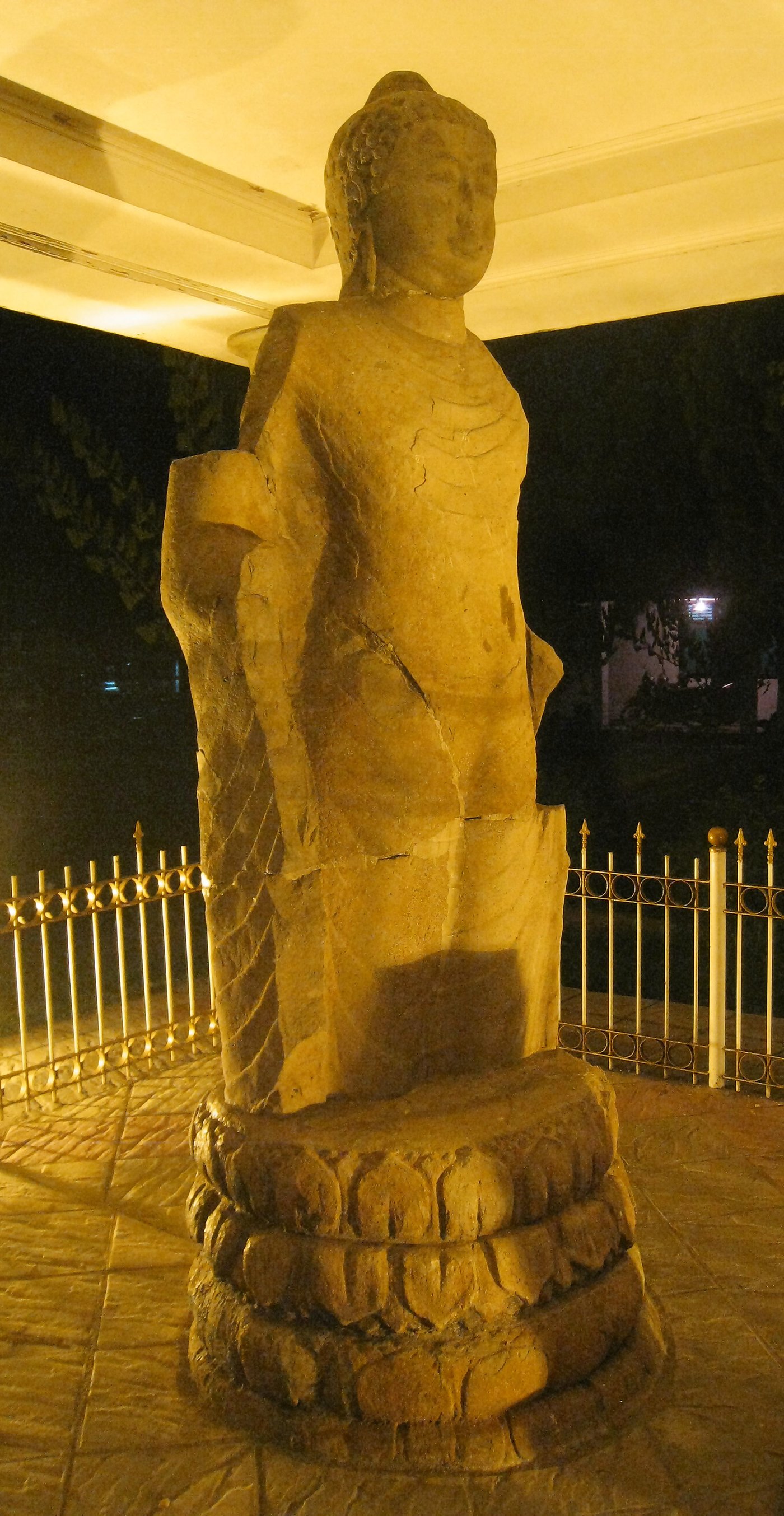
By the time a prince of the old line washed up at the far end of the Strait around 1400 and founded a new port called Malacca, Srivijaya was already a memory fading into legend. Palembang itself became known, for a while, as a nest of pirates: the sea peoples’ old muscle with nothing left to serve. The name Srivijaya slipped out of use so thoroughly that when Cœdès reconstructed the empire five hundred years later, he was telling the region something about itself it had entirely forgotten.
The romantic version, helped along by the old Sanskrit name for Sumatra, Suvarnadvipa, the “island of gold”, imagines a single sunken metropolis, an Atlantis of the East, that will one day be dug up whole and dazzling.
There is no buried golden city. Srivijaya was an empire, not a lost town, and its mystery is the opposite of Atlantis: not a place that sank in one night but a power that dissolved slowly and left almost nothing solid to find. The gold coming out of the Musi is real, but it is the everyday wealth of a trading capital scattered in the river mud, not the treasure vault of a fairy tale. The true marvel is how a state this large managed to leave so little to dig.
What the Musi keeps giving up
Which brings the story back to the river and the night divers. Since building work first stirred up artefacts around 2011, the Musi has been handing back pieces of the empire that grew up on its banks: gold rings and ornaments, coins, bronze mirrors, bells, ceramics from China, fragments of Buddhist statues. The British maritime archaeologist Sean Kingsley, who gathered the reports, described a haul that reads like the contents of a vanished city tipped into the water: temple wares, jewellery, the trappings of a court.
The heartbreak is what happened next. Almost none of it was recorded before it was sold. Indonesia has no easy legal path to reward a finder who hands treasure to the state, so the finds go instead to dealers and out into the private market, where an object without a findspot loses most of its meaning to history. Each ring that disappears takes with it whatever it could have told us about where the city stood, how it lived, when it thrived and when it failed. Kingsley put it bleakly: the evidence for Srivijaya’s rise and fall, he wrote, is dying anew without ever having been told.
There is a hard symmetry in it. Srivijaya was a power that chose the sea over the stone, that put its faith in ships and trade and the moving water rather than in walls built to be remembered. The water kept its secrets for six hundred years and then began, slowly, to give them up. And we are losing them a second time, not to rot or silt now, but to the same appetite for gold that filled the river with treasure in the first place. The empire that fed on the sea is being fished out of it, one torch-lit dive at a time, and slipping away before it can finish telling us who it was.
Sources & further reading
- George Cœdès, “Le royaume de Çrîvijaya” (1918) — the founding paper that reconstructed the empire, later expanded in his The Indianized States of Southeast Asia.
- O. W. Wolters, Early Indonesian Commerce: A Study of the Origins of Śrīvijaya and The Fall of Śrīvijaya in Malay History.
- Yijing (I-Ching), A Record of the Buddhist Religion as Practised in India and the Malay Archipelago, trans. J. Takakusu — the seventh-century monk’s own account.
- Pierre-Yves Manguin, papers on Srivijaya, Palembang and the archaeology of Southeast Asian port-cities.
- Sean Kingsley, reporting on the Musi River finds in Wreckwatch magazine (2021); and news coverage in Smithsonian and Live Science, 2021.
- British Museum and Museum Nasional Indonesia collection notes on Srivijayan gold, sculpture and inscriptions.
Image credits (via Wikimedia Commons): Muaro Jambi temple complex (featured) — Ryan Wijaya (CC BY-SA 4.0); map of the Srivijaya empire — Gunawan Kartapranata (CC BY-SA 3.0); commemorative statue of the monk Yijing — Gunawan Kartapranata (CC BY-SA 4.0); the Kedukan Bukit inscription — Gunawan Kartapranata (CC BY-SA 4.0); Buddha of Bukit Seguntang, Palembang — Gunawan Kartapranata (CC BY-SA 3.0).