Sometime around 24 BCE, in a small temple at Meroe on the middle Nile, workmen set a heavy bronze head into a pit at the foot of a staircase and covered it over with clean sand. The head was a portrait of Augustus, first emperor of Rome, torn from a full-sized statue somewhere far to the north. It was laid so that the stair to the sanctuary passed directly above it. From that day, every priest and worshipper who climbed to the altar walked over the emperor's face. That was the point. The woman who ordered it done was the queen of Kush, and she had just fought Rome on her own frontier and made it flinch.
Her name was Amanirenas. She ruled a kingdom that the Mediterranean world barely bothered to describe, in a stretch of desert that most people today could not place on a map. Yet for a few years at the end of the first century BCE she was the ruler who gave Augustus a border war he did not want and a peace he did not dictate. This is the story of that queen, the kingdom behind her, and the buried bronze head that turned up under a step nineteen centuries later, still staring, its glass eyes intact.
The kingdom Rome kept underestimating
South of Egypt, past the first rapids of the Nile, lay the land the Egyptians had long called Kush. By Amanirenas's day its heart was Meroe, a river city set among savannah rather than pure desert, ringed by grazing land and, crucially, by iron ore and the hardwood needed to smelt it. The slag heaps around the old city are still there, dark mounds of waste from furnaces that ran for centuries. Meroe made iron on a scale unusual for the ancient world, and it grew rich on the trade that moved gold, ivory, ebony and enslaved people down the river toward the Roman markets in the north.
This was not a young or borrowed civilisation. Three centuries earlier, Kushite kings had done something no one else ever managed: they conquered Egypt and ruled it as pharaohs. Piye marched north around 727 BCE, and his successor Taharqa held a realm stretching from the Nile delta deep into Sudan. Egyptians remember them, a little awkwardly, as the twenty-fifth dynasty: the so-called Black Pharaohs. The Assyrians eventually drove them out, and after the old northern capital at Napata was sacked, the court pulled south to Meroe, farther from any army that might come looking. By the time Rome swallowed Egypt in 30 BCE, Kush had been a going concern for the better part of two thousand years.
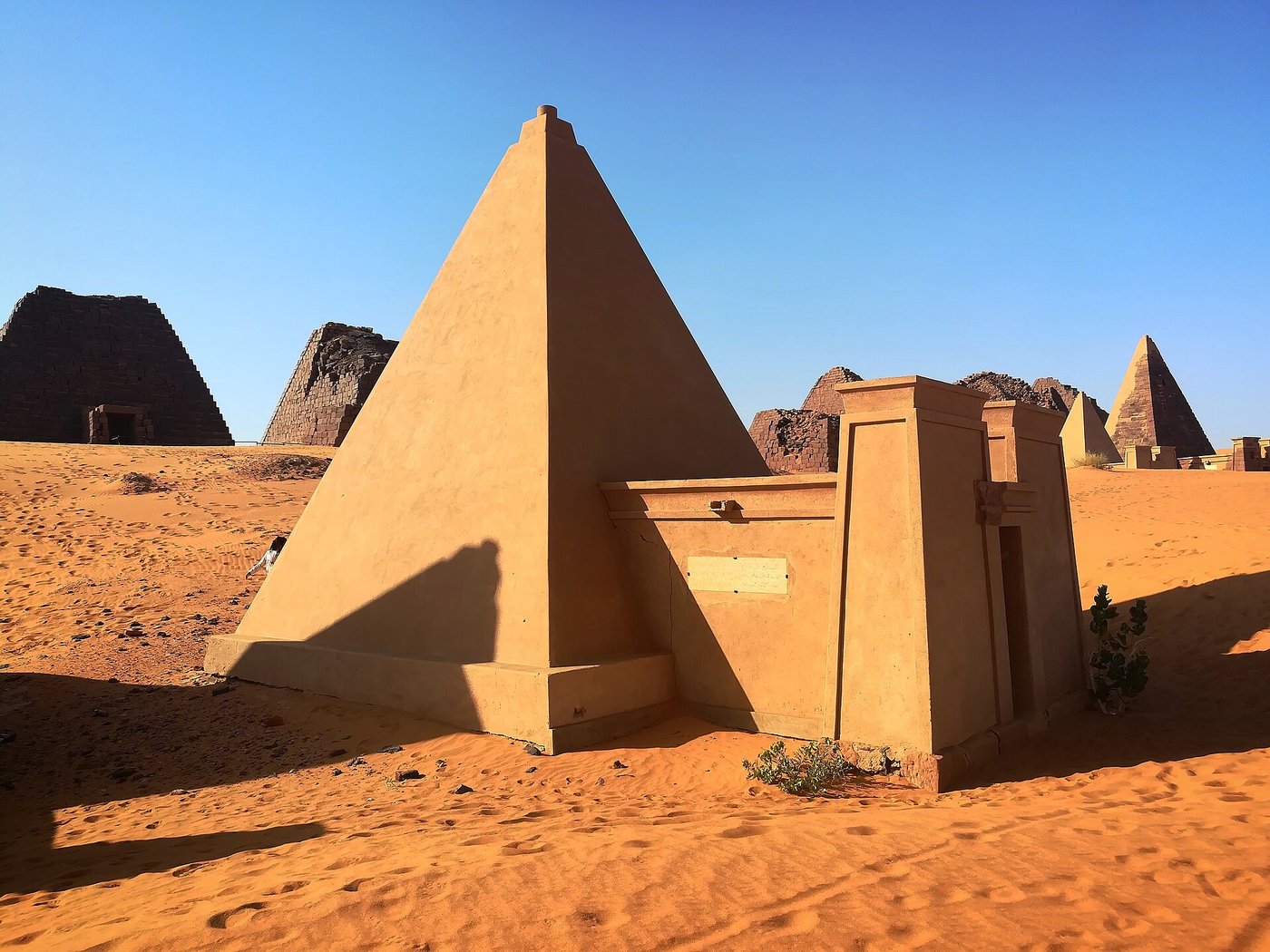
The most visible thing the kingdom left behind is a field of pyramids: hundreds of them, clustered at Meroe and at older sites upstream. They look wrong to anyone raised on postcards of Giza: narrow, sharply pitched, rarely more than thirty metres tall, with a little chapel tacked onto one side for offerings to the dead. They are unmistakably pyramids, and unmistakably not Egyptian. This is where the kings and queens of Kush were buried, Amanirenas's own generation among them.
There is a fact here that still surprises people: Sudan has more pyramids than Egypt, close to twice as many. Egypt built somewhere above a hundred across its whole history; the Kushites raised roughly twice that number along their reach of the Nile. They are smaller, poorer in gold, and far less visited, and for a long time European scholars simply refused to believe Africans south of Egypt had built them at all. The stones say otherwise, and there are a great many stones.
A queen the Kushites called kandake
Kush was one of the rare ancient states where women ruled in their own right, not merely as the mothers or widows of kings. The title was kandake, a word the Romans heard and mistook for a personal name, so that Greek and Latin writers keep referring to a Nubian queen called "Candace" as though it were her Christian name. It was nothing of the sort. It was an office, and a powerful one, and several women held it in succession around Amanirenas's time.
We know a little about her family. Her husband, Teriteqas, seems to have been king before her and to have died early in the conflict with Rome. Her son Akinidad fought at her side and appears with her on a monument that still survives. On her own inscriptions she is given two titles at once (qore, meaning ruler, and kandake), which is to say she was not a queen behind a king but the sovereign herself. That detail matters, because when the fighting started it was her decision to make.
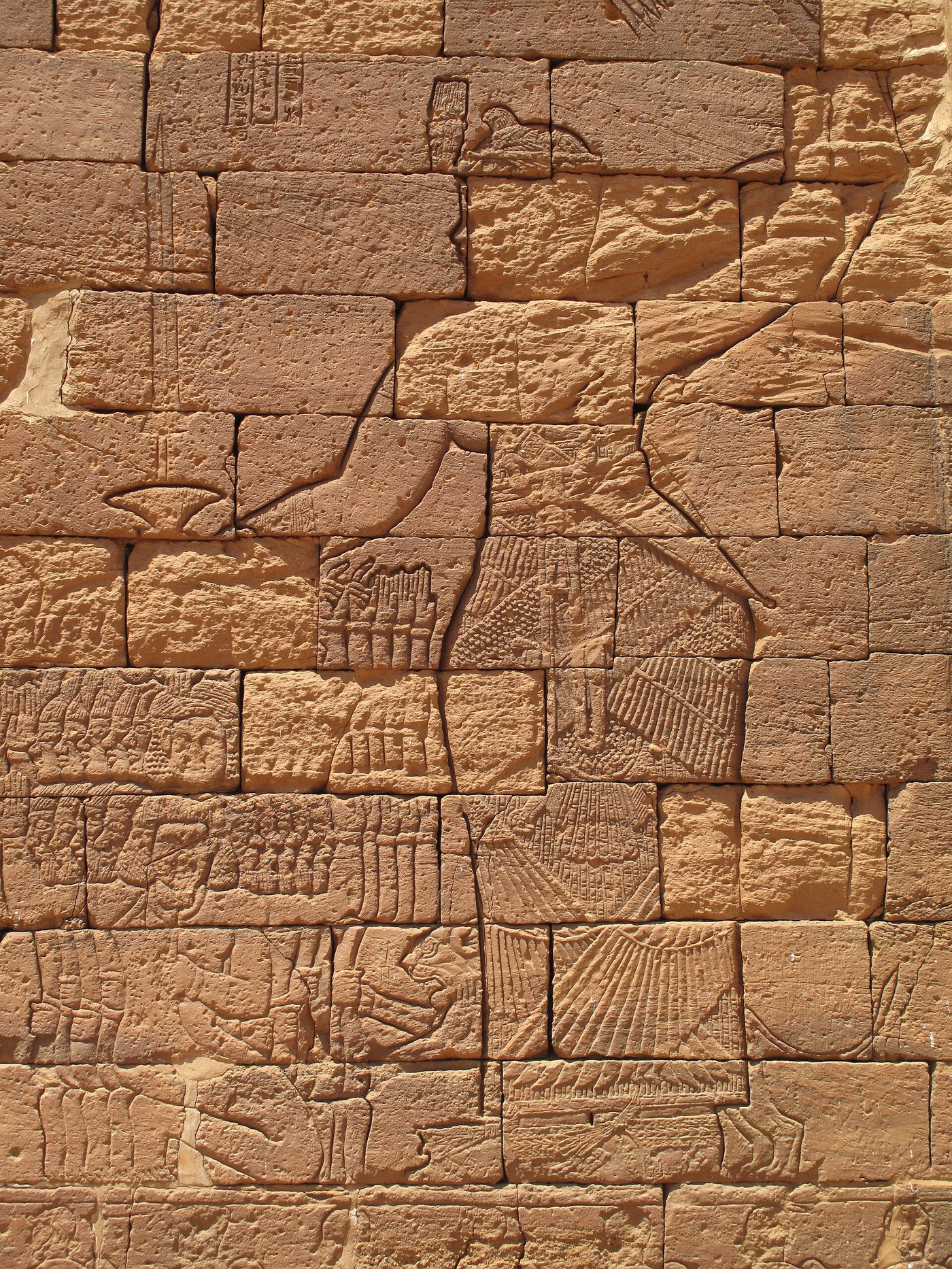
Popular writing likes to turn the kandakes into a line of "warrior queens", and some of them clearly did lead in war, but the title was broader than that. A kandake could rule alone, rule jointly with a king, or hold power as the senior royal woman of the realm. The Kushites carved their queens the way they carved their kings, heavy and powerful, one hand raised over a bundle of enemies. Whatever the day-to-day reality, they did not treat female rule as an emergency measure. It was simply how the kingdom sometimes worked.
The year the frontier caught fire
Rome had taken Egypt in 30 BCE, and its new southern border ran through the old debatable ground at the first cataract, around Syene, modern Aswan. For a while there was an uneasy quiet. Then, in 25 BCE, the Roman prefect Aelius Gallus took the bulk of his army off on an ill-judged expedition into Arabia, leaving the frontier thin. Amanirenas moved.
A Kushite army swept north and took the border towns: Syene, the island of Elephantine, and Philae with its great temple. They carried off prisoners to be enslaved, and they did something that was clearly meant as a message rather than mere looting: they pulled down the statues of Augustus that Rome had planted along the frontier, and they cut the heads from at least some of them. One of those heads went home to Meroe.
Almost everything we know about the war comes from Strabo, a Greek geographer who travelled up the Nile with his friend Aelius Gallus, the very prefect whose absence let the raid happen. Strabo describes the Kushite queen as "a masculine sort of woman, and blind in one eye". It is a hostile, second-hand line from the losing side's neighbour, and it is the single sentence that has followed Amanirenas down the centuries. Nearly every modern retelling that calls her "the one-eyed queen" is leaning on those few words of Strabo, and on nothing else.
Petronius comes south
Rome did not let the insult stand. The next prefect, Gaius Petronius, gathered a strike force (Strabo puts it at fewer than ten thousand foot and eight hundred horse) and drove south against a Kushite army he numbered at around thirty thousand. The Roman troops were better armed and better drilled, and the campaign went their way. Petronius retook the border, pushed on to Napata, the old religious capital, and burned it. Captives were shipped down to Alexandria; some were sold, some sent as a gift to Augustus.
But taking Napata was not the same as holding Kush. The land was vast, the supply lines impossible, and the heat murderous for men in armour. Petronius pulled back to a fortified point at Primis, near the modern site of Qasr Ibrim, and left a garrison. He had won the battles. He had not conquered the kingdom, and everyone involved seems to have understood that.
The head under the step
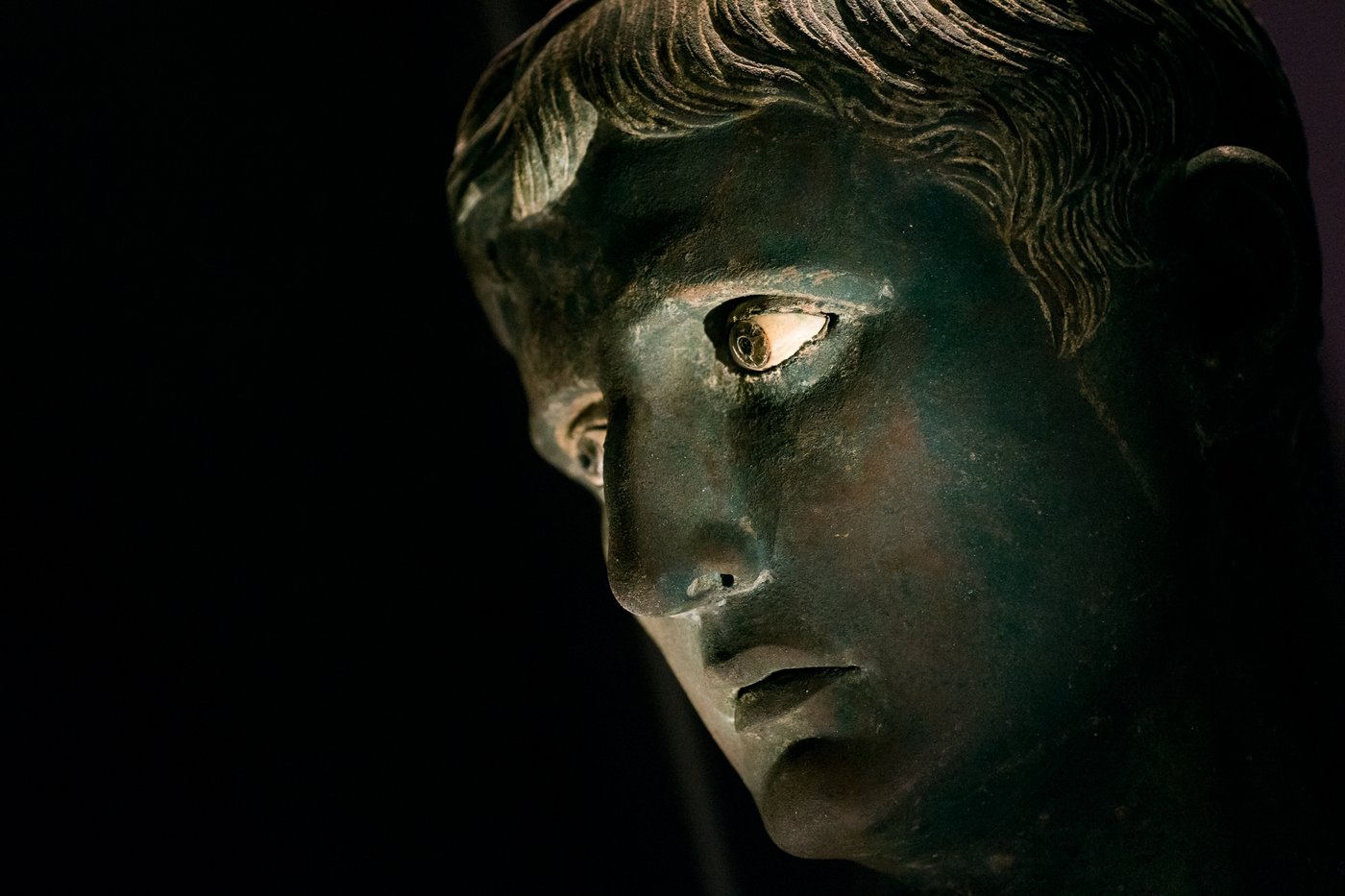
In December 1910 the British archaeologist John Garstang was digging at Meroe when his workmen, clearing the ground in front of a small temple, struck bronze about two and a half metres down. What came out of the sand was a life-and-a-half-sized head of a young man, the metal barely corroded, the eyes still fitted with rings of calcite around pupils of dark glass. It was a portrait of Augustus, made between 27 and 25 BCE in the confident early style Rome used to sell its new emperor to the provinces.
The place it was buried told the whole story without a word of text. The head had been set beneath the threshold of a small building linked to victory, laid at the foot of the steps that led up to the shrine. Anyone going in had to cross above it. In the Kushite mind, and the Egyptian one before it, to put an enemy under your feet (under a doorway, under a floor, under a stair) was to trample him forever. Amanirenas had taken the emperor's face home and arranged for her own people to walk on it, day after day, for as long as the temple stood.
The Meroe Head, as it is now known, stands 46.2 centimetres tall and once topped a full bronze statue. Its survival is freakish: bronze was almost always melted down and reused, so very few large Roman bronzes come down to us at all, and this one owes its life to being buried as a trophy in dry Sudanese sand. The inlaid eyes are the unsettling part: most ancient bronzes have lost theirs, but Augustus still looks straight out of the case. It has been in the British Museum since 1911.
The peace she actually won
With the fighting stalled, Amanirenas sent envoys north. Augustus was not in Rome; he was wintering on the Greek island of Samos, in 21 or 20 BCE, and the Kushite ambassadors were brought to him there. What they got was remarkable. Augustus pulled the Roman frontier back toward the first cataract, gave up the strip his troops had pushed into, and, most striking of all, cancelled the tribute that Rome had meant to squeeze from Kush.
Put plainly, the queen of a kingdom Rome regarded as a backwater negotiated a settlement with the most powerful man alive and came away owing him nothing. The border that peace drew held for roughly three centuries, one of the longest stretches of quiet on any Roman frontier. Augustus, who liked to record his conquests in stone, said very little about Kush. There was not much for him to boast about.
What is myth and what is not
Amanirenas has had a strange second life online, where she is often billed as the one-eyed African queen who defeated the Roman Empire. It is worth being careful here, because the real story is impressive enough without the varnish.
The myth: a one-eyed warrior queen led her armies to crush Rome and drove the legions out of Africa.
The reality: on the battlefield Rome had the upper hand; Petronius won his engagements and burned Napata. What Amanirenas won was the peace, and it was a real victory: no tribute, a frontier pulled back, terms settled directly with Augustus. The "one eye" comes from a single hostile line in Strabo, and even her name is uncertain in the sources, since Romans kept confusing the title kandake for a personal name. She did not defeat Rome in the field. She fought it to a draw and then out-negotiated it, which almost no one else managed.
There is a second confusion worth clearing up. Because so many kandakes ruled in a row, and because Greek and Latin writers lumped them all under "Candace", the deeds of Amanirenas, her son Akinidad, and later queens such as Amanishakheto and Amanitore get tangled together in the retellings. The smiting reliefs, the war with Rome, the buried head: sorting out exactly which queen did which is still work in progress, and some of it may never be settled.
The grave-robber and the gold
The kingdom outlived Amanirenas by centuries, fading only around 350 CE, perhaps under pressure from the rising power of Aksum to its east. Its pyramids stood more or less untouched until 1834, when an Italian doctor and treasure-hunter named Giuseppe Ferlini arrived with official permission to dig, and a taste for quick riches.
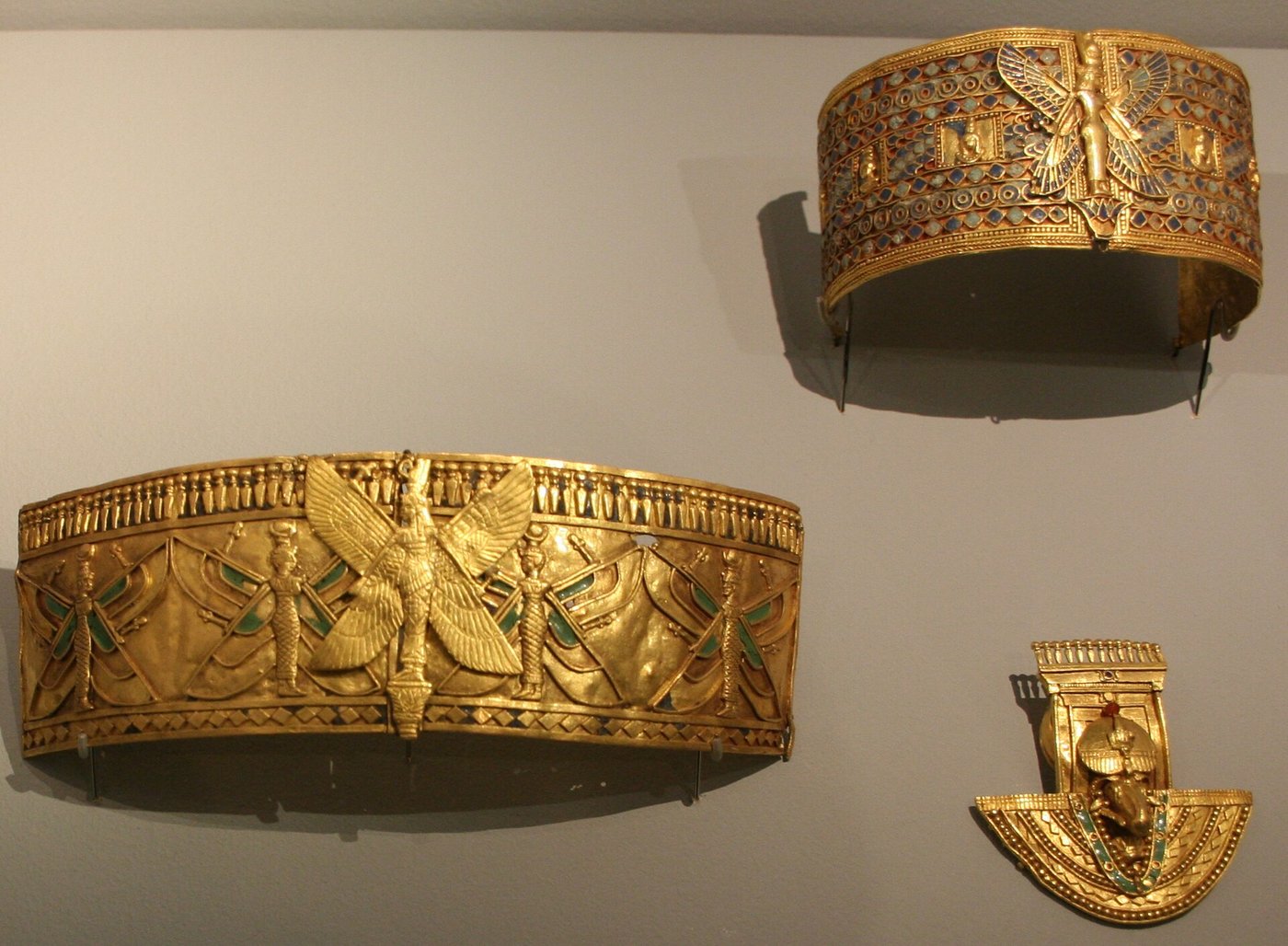
Ferlini's method was to knock the tops off pyramids and blast his way down, and in the process he wrecked more than forty of them. In one he hit a hoard of gold jewellery belonging to Queen Amanishakheto (fine bracelets, rings and amulets), the sort of goldwork that shows just how rich these "poor" pyramids had once been. Ferlini sold the treasure into Europe, where it ended up divided between Berlin and Munich, and where much of it remains. The damage he did to the cemeteries has never been undone.
The Kushites wrote in Meroitic, a script of their own that scholars can sound out but cannot translate: we can read the letters and not the meaning, because the language behind them has no living relatives we can match it to. Amanirenas left inscriptions, including a long monument that records her war. We can pick out her name and her son's, and see the bound captives carved beside them, but the sentences themselves stay locked. For all the retelling, we have never actually heard the queen describe her own war in her own tongue.
That silence sits oddly beside the head. The face of Augustus survives in perfect detail, glass eyes and all, curated and captioned in a museum in London. The queen who conquered him keeps her thoughts to herself, her words sounded out but unread, her pyramids battered, her kingdom's very location a blank for most of the world. She arranged for an emperor to be walked on. Two thousand years later, it is her side of the story that we cannot make out.
Meroe itself is at risk again. Since 2023, war in Sudan has emptied the archaeological camps, halted the slow work of conservation, and left the pyramids in the desert with no one to watch over them. The head is safe in its case. The kingdom that took it is not.
Read next: Meroë: The Treasure Hunter Who Blew the Tops Off Forty Pyramids.
Sources & further reading
- Strabo, Geography, Book 17 — the ancient account of the war, the queen and Petronius's campaign, written by a man who had travelled the Egyptian frontier.
- The British Museum, catalogue entry for the Meroe Head of Augustus (1911,0901.1) — the object, its dating and the circumstances of its burial and discovery.
- Derek A. Welsby, The Kingdom of Kush: The Napatan and Meroitic Empires — the standard modern survey of the kingdom, its rulers and its archaeology.
- László Török, The Kingdom of Kush: Handbook of the Napatan-Meroitic Civilization — a detailed reference on Meroitic history, kingship and the kandakes.
- John Garstang, Meroe: The City of the Ethiopians (1911) — the excavator's own report on the season that turned up the bronze head.
- UNESCO World Heritage Centre, "Archaeological Sites of the Island of Meroe" — on the pyramids, the site and its protected status since 2011.
Image credits (via Wikimedia Commons): the Meroe Head of Augustus — Paul Hudson (CC BY 2.0); the pyramids of Meroe — Ahmed Amir (CC BY-SA 4.0); the smiting relief at Naga — Ron Van Oers (CC BY-SA 3.0 IGO); the gold of Amanishakheto — Einsamer Schütze (CC BY-SA 3.0); the Apedemak temple at Naga — LassiHU (CC BY-SA 4.0).