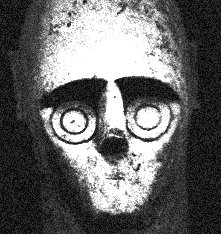
The first of the giants came up in pieces. In the spring of 1974, two men were ploughing a low field near the sea at Cabras, on the Sinis peninsula in western Sardinia, when the blade struck stone and turned over a lump of pale sandstone the size of a football. It was a face: a wide, flat face with a nose like a straight ridge and two circles cut where the eyes should be. Nobody had put a statue there. The men had driven their plough into the smashed remains of the oldest large stone figures anyone has ever found in the western Mediterranean, and for the next few years the field kept giving them back, a fragment at a time.
They are called the Giants of Mont’e Prama, after the low rise the field sits under. Stood upright and whole, the tallest reach about two and a half metres. They show boxers with shields raised over their heads, archers with a bow drawn across the chest, and helmeted warriors, all carved by a people who left no cities, no kings we can name, and not one line of writing. For a long time the accepted story of ancient sculpture ran straight from Egypt to Greece. These figures were standing in a Sardinian field, life-size and staring, perhaps two centuries before a Greek workshop cut its first free-standing man from marble.
A face in the furrow
What the plough hit that spring was a head. The landowner, Giovanni Corrias, saw it for what it was and told the authorities, and over four seasons of digging between 1975 and 1979 archaeologists lifted roughly five thousand fragments out of the ground. Later work at the site, on and off until 2022, pushed the count past ten thousand pieces. Almost none of it came up whole. The field held a scatter of broken limbs, shattered torsos, boxers’ shields snapped from their arms and heads parted from their necks, packed into the earth along a line of tombs.
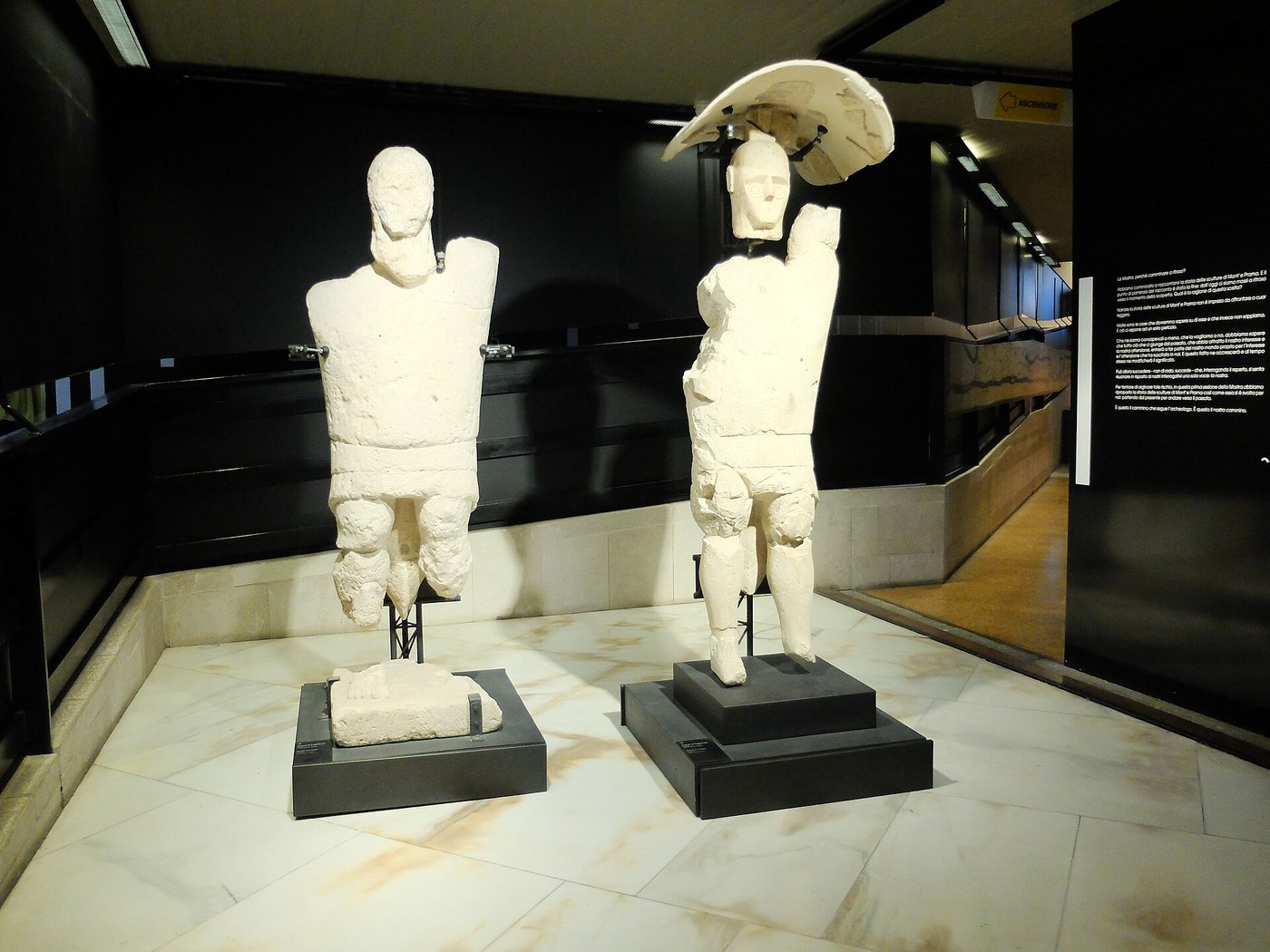
Then the pieces went into store, and there they sat. For close to thirty years the fragments filled shelves in the National Archaeological Museum in Cagliari while other work took priority. It was not until a long restoration campaign at a centre near Sassari, finished around 2011, that the jigsaw was seriously attempted: every fragment cleaned, catalogued, matched edge to edge, and the figures raised again on steel frames. From that mountain of rubble the restorers have so far rebuilt around two dozen statues, and they estimate the field once held perhaps forty or more. When the reassembled giants first went on public show in 2014, Sardinia was looking at monuments its own museums had owned, in bags and boxes, for a generation.
They are carved from a soft local sandstone, easy to cut and easy to break, quarried close to where they stood. That softness is part of the story. It let the sculptors work fast and in numbers, and it meant that when someone later decided the giants should come down, they came down easily.
The towers that came before them
To understand who carved them you have to look at what already covered the island. Sardinia in the Bronze Age belonged to the Nuragic civilisation, named for the nuraghe: a round tower of huge dry-stone blocks, built without mortar, tapering like a cooling tower or a beehive. They went up from roughly 1800 BC onward, and they are everywhere. More than seven thousand of them still stand or lie in ruin across an island smaller than Wales, and the true original number was higher still. Some are single towers; the grandest, like Su Nuraxi at Barumini, grew into clustered strongholds with a central keep and a village crowding around its feet.
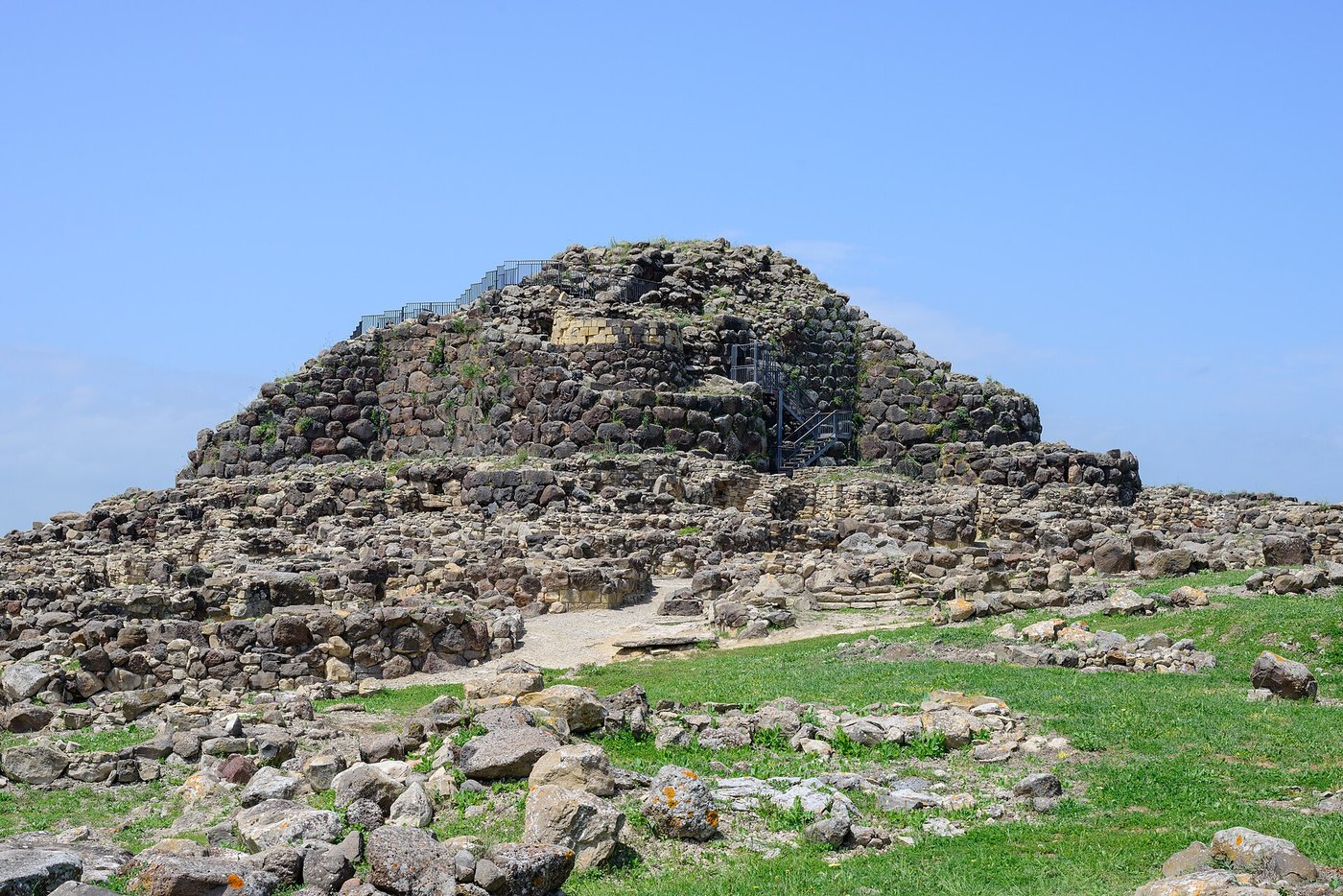
These were the same people. The builders of the towers and the sculptors of the giants shared a world, even if centuries separated the earliest nuraghi from the statues. They farmed, kept sheep and cattle, worked bronze with real skill, sailed and traded across the Tyrrhenian Sea, and dug sacred wells lined with beautifully fitted stone to reach the water table. And they did all of it without writing. No Nuragic script has ever been found, because there does not seem to have been one. Everything we can say about them is read off their buildings, their bronzes and their dead.
The scale is the thing that catches people out. A civilisation that never developed writing, on a single Mediterranean island, quarried and stacked more than seven thousand stone towers, some of them thirty metres across at the base and weighing thousands of tonnes. It also cast thousands of small bronze figures and, at the end, carved the Mont’e Prama giants. Literacy is often treated as the mark of a serious society. The Nuragic world is a standing argument that a people can be highly organised, wealthy and ambitious in stone and metal, and leave no words behind at all.
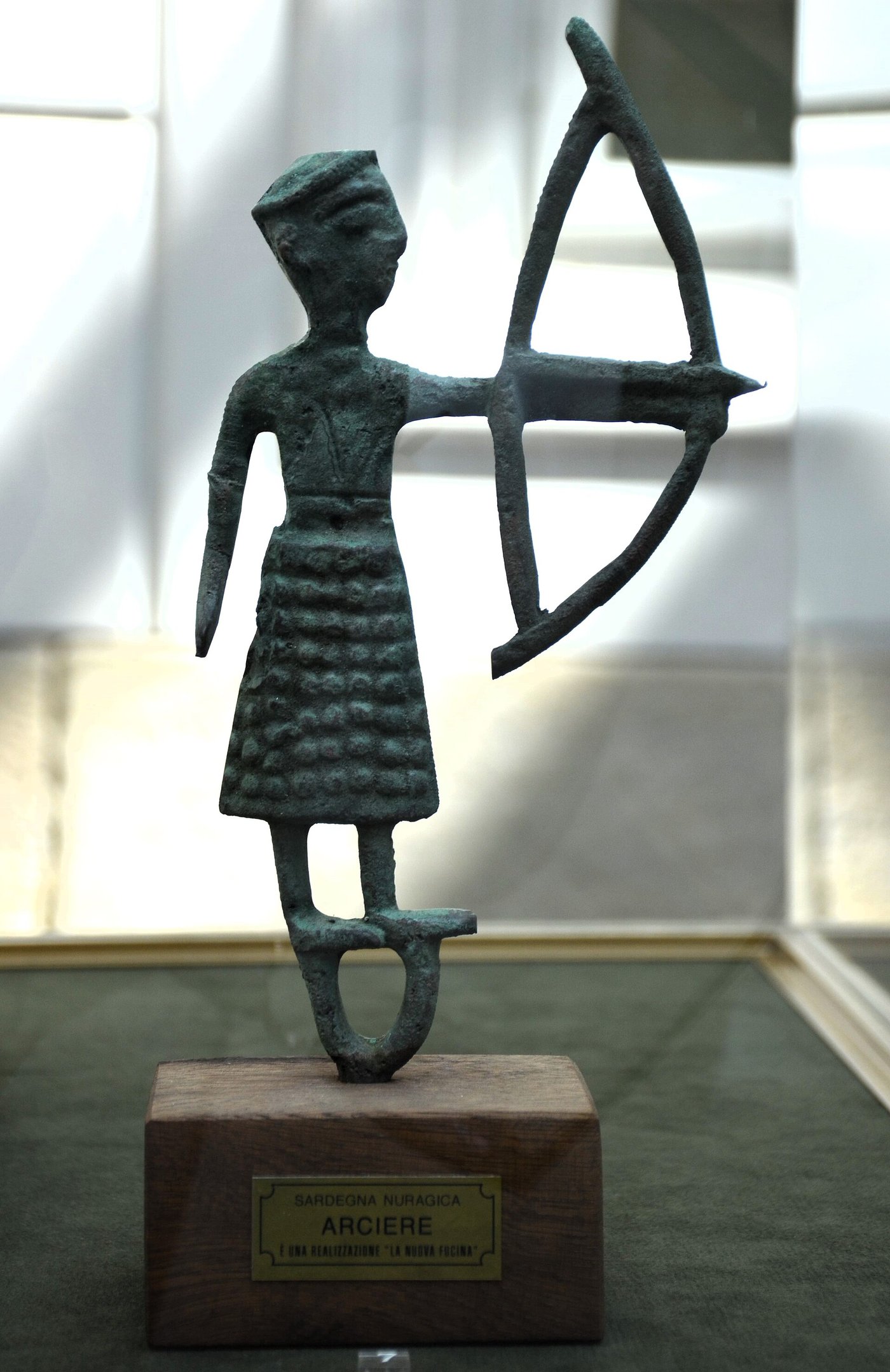
Long before the giants, the Nuragic people had been making the same figures in miniature. Their bronze statuettes (the bronzetti) show archers, boxers, warriors, chiefs with staffs, wrestlers with the same curved shields held up over the head. The giants look like those little bronzes blown up to human size and translated into stone. Whoever designed them was not inventing a new kind of image. They were taking figures the island already knew, ones that fit in a hand, and making them tall enough to stand over a grave and be seen from a distance.
Boxers, archers and men who look through you
Up close the giants divide into a small cast of characters. The boxers are the most numerous. Each holds a curved shield arched over the head with the left arm, guarding the face, the right arm dropped and bent: the pose of a fighter braced for a blow, or perhaps of a man performing a rite rather than a real fight. The archers stand with a bow held across the body, a quiver at the back, sometimes wearing a horned helmet and a chest-guard. The warriors carry round shields and wear crested helmets. Alongside the figures the diggers found stone models of nuraghi too, carved towers standing among the carved men, as if the statues and the buildings were meant to belong to one scene.
The strangest thing about them is the face, and it is the same on nearly all of them. The brow and nose form a single flat T. The mouth is a short straight line. And the eyes are not eyes at all in any lifelike sense but two circles, one set inside the other, cut cleanly into the stone. A whole crowd of them once stood together, every one gazing out through those doubled rings. It is a face built to be read at once and never mistaken: not a portrait of anybody, but a sign for a certain kind of being.
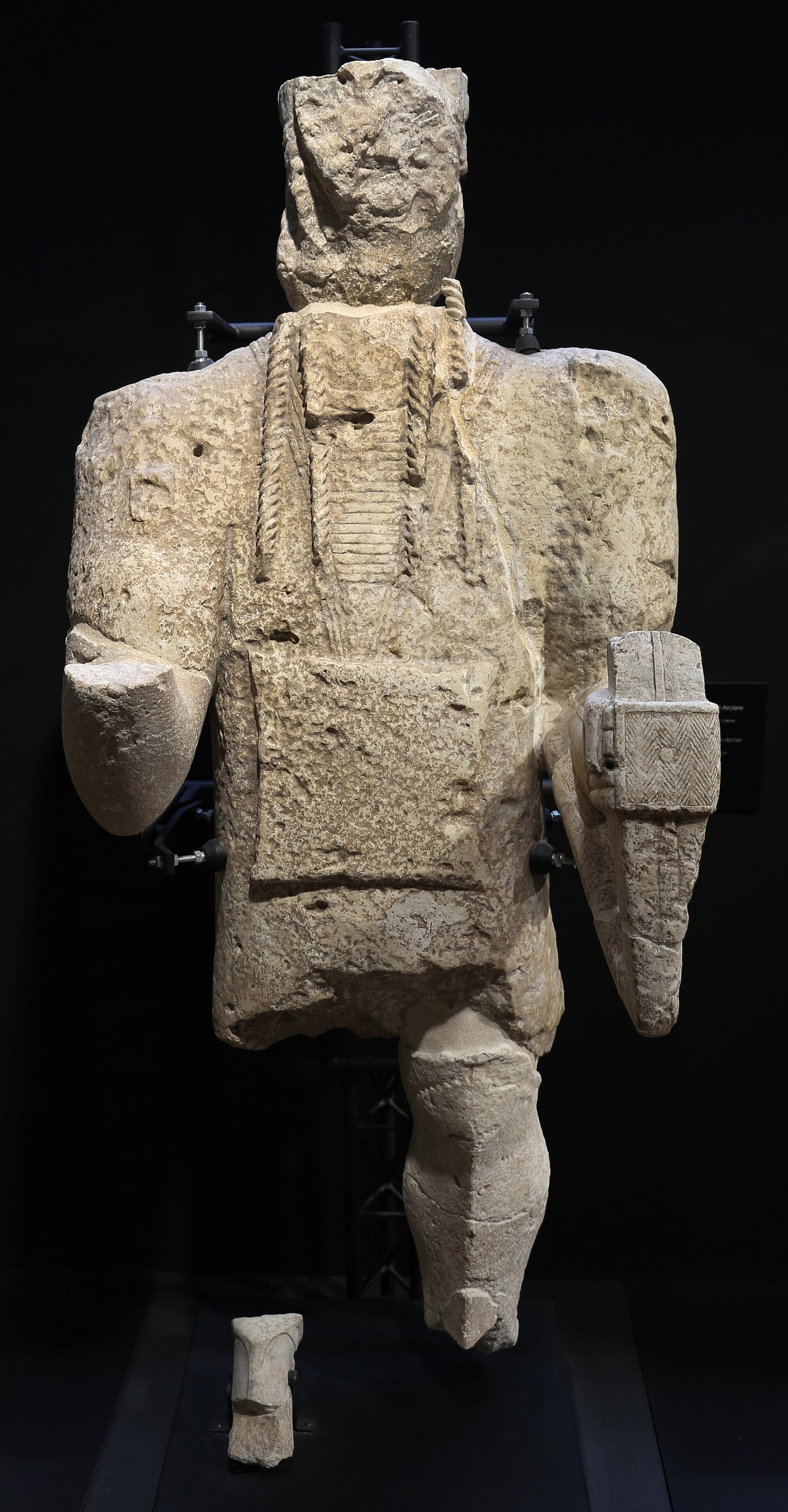
Whatever they were meant to be, they were not meant to be gentle. Grouped along the tombs, life-size, faces frozen and identical, they would have read as guardians: a standing company of stone men set to watch over the dead, or over whoever the dead had been. They are among the very few examples of monumental stone statuary the Nuragic world ever produced. Nothing on this scale has turned up anywhere else on the island. Mont’e Prama is, so far, unique.
How old is a broken statue?
Putting a date on them has been almost as hard as putting them back together. The giants themselves carry no inscription and sit in no neat layer; they were smashed, moved and buried, which scrambles the usual clues. What can be dated is the burial ground they were found with: a row of pit tombs, each a shaft cut into the rock, that the statues seem to have stood over. Radiocarbon dates from the bones in those tombs, and from the wider phase of the site, cluster in the early Iron Age, and most specialists now place the carving of the giants somewhere in the ninth or eighth century BC. Some readings of the burials reach back further, and the argument over exactly how far is not finished.
Because the statues cannot be dated directly, the numbers come from what was buried with and beneath them (charcoal, bone, the fill of the tombs), run through radiocarbon and read against the styles of pottery and bronze found alongside. Different samples have given different answers, and a handful reach back several centuries earlier than the rest, which is why you will see everything from the eleventh century to the eighth quoted for these figures. The careful version is a range, not a year: Iron Age, most likely the ninth to eighth century BC, with the earlier end still argued over.
Even the cautious dating carries a jolt. If the giants were carved around 800 BC, they were standing in that Sardinian field before the Greeks began making large free-standing stone figures of their own. The famous marble youths, the kouroi, belong to the seventh and sixth centuries BC. The story that puts Greece at the fountainhead of monumental sculpture in the Mediterranean has to make room for a smaller, older company of stone men on an island to the west, carved by people the Greeks would not have counted as sculptors at all.
Somebody took them down
The giants did not fall over. They were destroyed. The fragments in the field were not the wear of centuries but the result of blows (heads struck from bodies, torsos broken across, shields snapped away), and then the pieces were left scattered through and over the graves. That much the state of the stone makes clear. Who did it, and why, is where certainty stops.
One reading blames invaders. As Carthage tightened its grip on Sardinia from the sixth century BC, a foreign power may have pulled down the monuments of the people it was subduing, the way conquerors have always toppled the statues of the conquered. Another reading keeps it local: perhaps the giants were “killed” on purpose in a rite, broken by their own community when the burial ground went out of use, so that the guardians were retired along with the graves they watched. A third, flatter possibility is that centuries of ploughing and stone-robbing did much of the damage long after. The breaks are real; the hand behind them is not agreed.
There is a further twist in how the pieces lay. In places the broken fragments seem to have been arranged, even laid out along the tombs, rather than simply flung aside. That has fed the idea that the destruction was not vandalism but ritual: a deliberate unmaking, the statues taken to bits with something like the same care the Nuragic people gave to burying their dead. If so, the smashing is not the end of the giants’ story but the last chapter their makers wrote for them.
Giants, Atlantis and other tall tales
A find like this attracts stories, and Sardinia has always had them. The island’s folk tradition is full of giants; the great stone tombs of an earlier age are called tombe dei giganti, giants’ graves, and the Mont’e Prama figures slotted straight into that older habit of imagining a lost race of big men. More ambitious still is the claim, argued in recent decades by the journalist Sergio Frau and others, that Sardinia was the real Atlantis: Plato’s sunken island was a memory of the Nuragic world, laid low not by the sea but by a tidal wave and by Carthage. It makes a stirring documentary. It is not accepted by archaeologists, and it does not need to be true for the real thing to be remarkable.
The myth: the giants are the relic of a lost race of literal giants, or proof that Sardinia was Atlantis, a vanished super-civilisation wiped out in a single catastrophe.
The reality: they are human-scale statues, at most two and a half metres, carved by the same Nuragic islanders who raised the seven thousand towers and cast the little bronzes. No sunken continent is required. The surprising part needs no legend: a people with no writing produced the earliest monumental stone figures in the western Mediterranean, then broke every one of them and buried the fragments in a field.
The plainer truth is stranger than the folklore, because it is real and it is still only half-read. We do not know the name the Nuragic people gave themselves. We do not know what they called these figures, or the rite the boxers are frozen in, or whether the men who broke them were enemies or heirs. The giants stare out through their circled eyes and give nothing back.
What the field is still handing over
Mont’e Prama is not a closed case. Fresh digging in 2022 turned up two more statues, both boxers of the type with a shield wrapped round the body, still in the ground where they had lain for the best part of three thousand years. Around them the necropolis keeps yielding tombs, and the reassembly of fragments goes on, so the roll-call of giants slowly grows. The restored figures are now split between the museum at Cagliari and a museum in Cabras itself, a short walk from the field that produced them, where the head that a plough turned over in 1974 can be seen beside the company it belongs to.
Stand in front of one and the effect is not grandeur but attention. The giant is looking at something, steadily, through eyes that were never meant to look like eyes. For twenty-eight centuries a crowd of them did that in the dark of a Sardinian field, in pieces, waiting. A farmer’s plough found the first. The rest are still coming up.
Read next: Vix: The Celtic Grave That Held Antiquity's Largest Bronze Vessel and Sanxingdui: The Bronze Masks With Eyes on Stalks.
Sources & further reading
- Museo Civico Giovanni Marongiu, Cabras, and the Museo Archeologico Nazionale, Cagliari, on the Mont’e Prama statues and their restoration.
- Soprintendenza Archeologia della Sardegna, reports on the 1975–1979 excavations and the later campaigns at Mont’e Prama.
- “Two more Giants discovered at Mont’e Prama,” ANSA (2022), on the boxer statues found still buried at the site.
- The Metropolitan Museum of Art, “The Giants of Mont’e Prama,” on the figures, their types and their place in Nuragic art.
- General surveys of the Nuragic civilisation and the nuraghe towers, including the UNESCO listing for Su Nuraxi di Barumini.
Image credits (via Wikimedia Commons): boxer statues from Mont’e Prama, Cagliari (featured) — Ludovica Dal Molin (CC BY-SA 4.0); giant’s head with circular eyes — Xoil (CC BY-SA 3.0); nuraghe Su Nuraxi at Barumini — Norbert Nagel (CC BY-SA 3.0); reassembled archer statue — Sailko (CC BY 3.0); Nuragic bronze archer figurine — Silar (CC BY-SA 4.0).