In 1890 a photographer named Kassian Cephas spent the best part of a year on his knees at the foot of Borobudur, making pictures of carvings that were about to disappear. Workmen had prised a skirt of stone away from the base of the monument and found, hidden behind it, a whole buried gallery: one hundred and sixty carved panels that no visitor had set eyes on for perhaps a thousand years. Cephas photographed them one at a time in the flat light of the Javanese morning. Then, when he was done, the stone was heaved back into place and the panels were shut away once more. For most of that hidden gallery, his glass plates are still the only way anyone will ever see it.
It is a strange thing to do to a work of art. Someone carved these panels with great care, scene after scene, and then someone else (possibly the very same crew) built a wall of rock across the front of them and hid the lot before the temple was even finished. The panels were meant to be walked past and read. Instead they were entombed inside the building they belonged to.
Why would anyone do that? The answer has been argued over for more than a century, and it opens up almost everything worth knowing about Borobudur: how it was built, what it was for, how it came to be abandoned, and how a monument the size of a small hill managed to slip out of the world’s memory and then back into it.
A hill that turned out to be a building
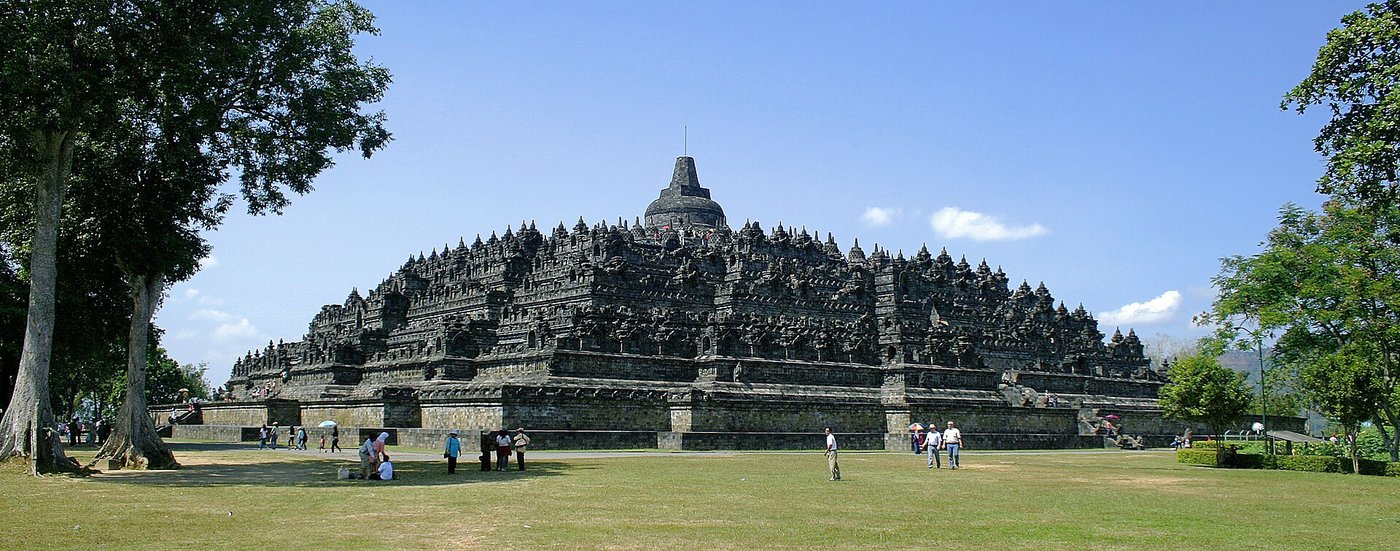
Borobudur stands on the Kedu Plain in central Java, a bowl of rich volcanic farmland ringed by mountains. Two live volcanoes, Merapi and Merbabu, close off the eastern horizon; Sumbing and Sundoro rise to the west. It is some of the best soil in Indonesia, and it grew enough rice to feed the kings who paid for the place.
Those kings belonged to the Sailendra dynasty, and they raised Borobudur across roughly sixty years around the year 800. What they built is hard to take in even now. Set out one square platform, then five more on top of it, each smaller than the last, then three round terraces above those, and crown the whole thing with a single great bell of stone. Face every wall with carved panels. The result used something close to two million blocks of grey andesite, cut to fit and locked together without a drop of mortar, the way a dry-stone wall holds.
This is what catches people out. Borobudur is not a temple you go inside. There are no rooms, no doorways, no dark sanctuary at the heart of it. It is solid all the way through: a hill of dressed stone wrapped around a natural knoll. You do not enter Borobudur. You climb it.
The path that climbs out of the world
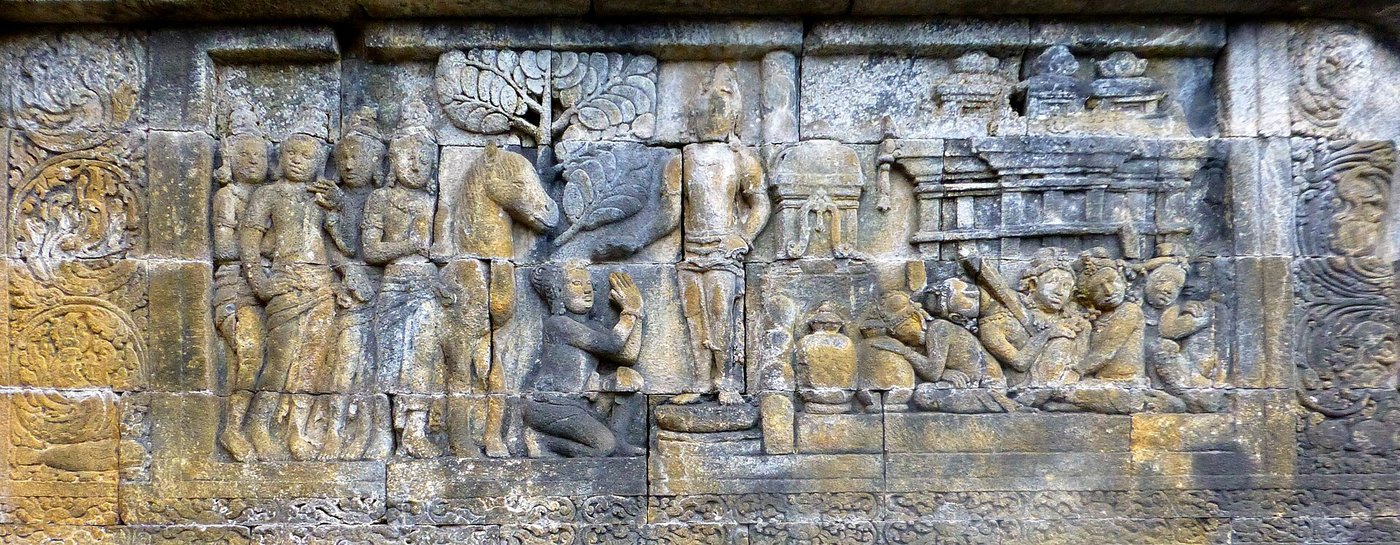
The climbing is the point. Borobudur was built to be read with the feet as much as the eyes. A pilgrim entered at the base, turned left so the monument stayed on the right hand, and began walking clockwise. Each full circuit of a gallery led to a stairway; each stairway led up to the next. To reach the top you walked several kilometres in tightening rings, and the carvings on the walls beside you told a continuous story as you went.
The story is a journey out of the ordinary world and towards enlightenment, and the building maps it onto three levels. Down at the bottom sits the sphere of desire, the world of wanting things. Above it come the square galleries, the sphere of form, their walls lined with more than a thousand narrative panels: the life of the Buddha carried across some hundred and twenty scenes, the moral fables of his earlier lives, and the long pilgrimage of a young seeker named Sudhana, who visits teacher after teacher in search of wisdom.
Then the walls fall away. At the summit the square galleries give onto three open circular terraces with no reliefs at all: the formless sphere, where there is nothing left to depict. Standing on them are seventy-two stupas, each one a stone bell pierced with a lattice of holes, and inside each lattice sits a Buddha, half seen, half hidden. Above them all rises one large central stupa, sealed and empty. In all, the monument carries more than five hundred Buddha figures and over two and a half thousand carved panels. A pilgrim who walked the whole route rose, quite literally step by step, from a world crowded with images to one with almost none.
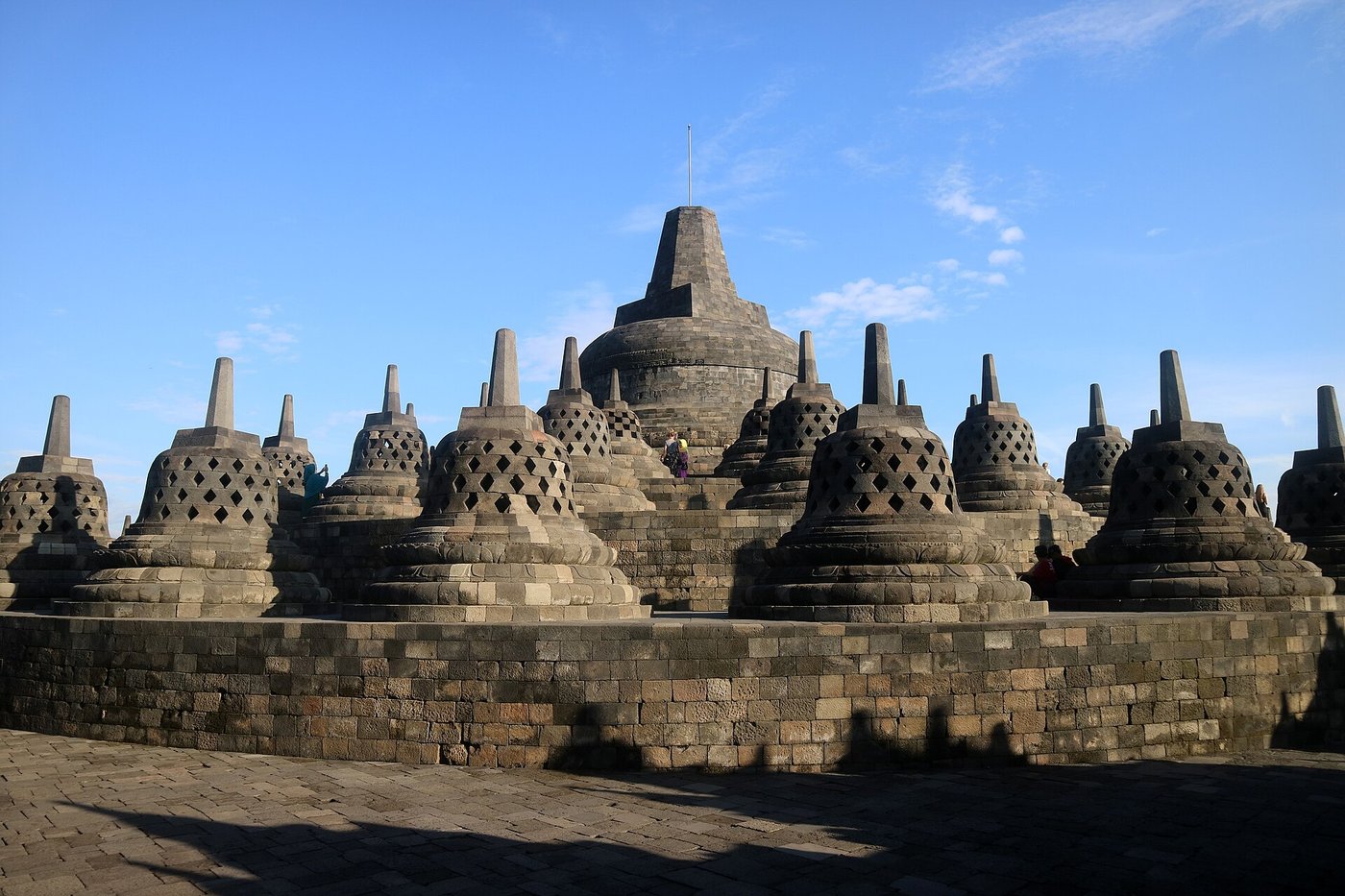
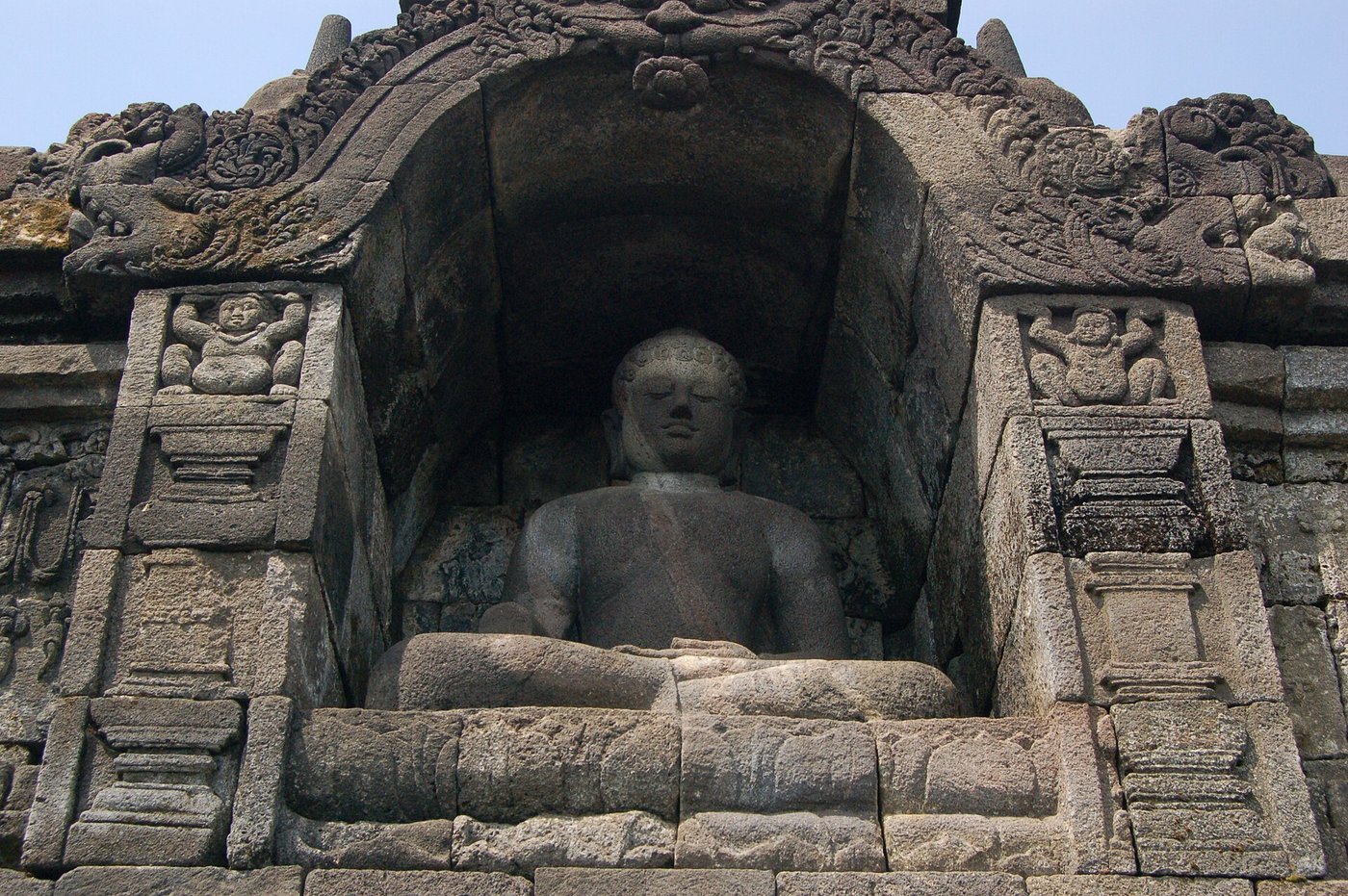
Reach into one of the latticed stupas and you can still touch the Buddha inside: a real figure, life-size, seated in stone, cool under your fingers even at noon. Generations of visitors have believed that touching one brings luck, and the reachable statues are worn smooth in patches. It is a quieter marvel than the great bell at the centre, and easy to miss, which is rather the idea.
The skirt of stone at the base
Now go back to the bottom, to the world of desire, because that is where the buried gallery lives.
When the monument was cleared and studied in the nineteenth century, the base looked odd. It was too broad and too plain, a wide processional terrace of bare stone wrapped around the foot of the building, out of keeping with the lavish carving everywhere above. In 1885 a Dutch engineer named J. W. IJzerman, the chairman of the local archaeological society, had the nerve to test what he suspected. He had a section of that plain terrace taken apart, and behind it, facing inward against the older stonework, were carvings.
There were one hundred and sixty of them, running right around the building: a hidden gallery walled up behind a later apron of stone. The panels tell a single subject, the law of cause and effect, of deeds and their consequences: the way good and bad actions ripple forward into future lives. Some scenes are gentle glimpses of Javanese life twelve centuries ago: markets, kitchens, boats, ploughing, a house on stilts, musicians and dancers. Others are grim. There are punishments in hells, bodies sawn and boiled, the wages of cruelty and greed spelled out in stone. It is the base of the whole moral ladder, the world the pilgrim is meant to be climbing away from.
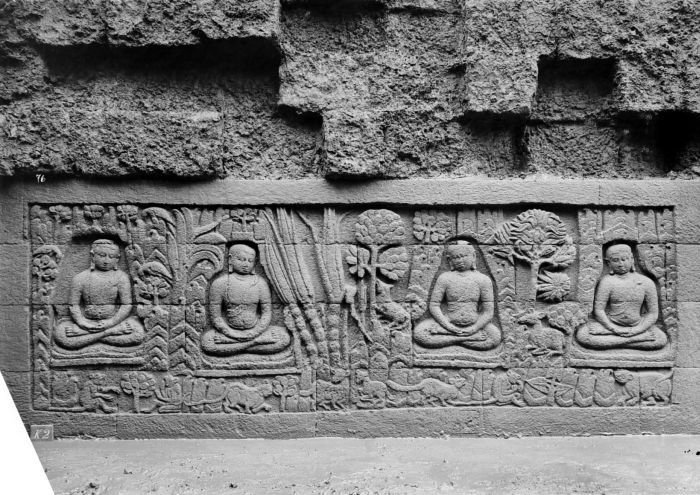
Scratched above many of the hidden panels are short lines of writing. They are not scripture. They read as working instructions to the carvers: brief labels naming the scene each panel was meant to show, the ninth-century equivalent of a builder’s pencilled note. The shapes of the letters can be dated on their own, and they point to about the year 800, the same span as the rest of the monument. That small detail matters: it means the panels were covered during the original building work, not walled up centuries afterwards by some later hand. Whoever hid them was there at the start.
Why wall up a masterpiece?
So the panels were carved, briefly seen, and buried on purpose, and it happened while the temple was still going up. That leaves the harder question of motive, and here the experts split.
The plain explanation is engineering. Borobudur is a colossal weight of stone piled on a natural hill, and a hill can move. There are signs the structure began to slump early, that the builders watched the lower courses start to spread and slide, and threw a broad, heavy apron of stone around the whole foot to hold it in, the way you might buttress a leaning wall. On that reading the hidden gallery was not hidden for its own sake at all. It simply got in the way of a rescue, and the quickest fix was to bury it.
The other explanation is about meaning. A monument built to lift the mind out of the world of desire might not want to greet every pilgrim, at eye level by the entrance, with carved scenes of sin and its punishments in hell. On this view the base was covered because it was thought unfitting to leave that lowest, most worldly register on open show. Decorum, not subsidence.
Most specialists lean towards the engineering case: the encasement really does behave like a retaining structure, and cracks and slippage in the lower monument are real. But the evidence does not force a single answer, and the two motives are not rivals. A crew that had to bury the base for structural reasons may have felt no great loss in hiding scenes they were half-minded to conceal anyway. The honest position is that we know the base was deliberately covered during construction, and we can argue about why, but the builders did not write down their reasons where we can read them.
The man who photographed what would vanish
The reason we know the hidden gallery at all in any detail comes down to one remarkable person. Kassian Cephas, born in Yogyakarta in 1845, was the first professional photographer of Javanese birth: court photographer to the sultan, and the man the archaeologists turned to when they needed the buried panels recorded before the stone went back.
Between 1890 and 1891 he worked his way round the exposed base and made a picture of every panel, one hundred and sixty in all, with a handful of extra corner shots to show how the gallery sat together. It was slow, awkward work with heavy glass plates in cramped light, and it was never fully funded. The grant he was given covered only a fraction of what the job really needed, so a fuller record (the hundreds of overlapping views that would have caught every detail) was never made. What he managed is what survives. When the base was sealed again, Cephas’s plates became the memory of a gallery that had gone back into the dark.
How a wonder gets forgotten
By then Borobudur had already been lost once, in a slower and stranger way. For roughly its first century and a half the monument was a living centre of pilgrimage. Then, some time after the year 900, the centre of power in Java shifted east, away from the Kedu Plain. Nobody is quite sure why. Volcanic eruptions may have driven people out; political change certainly did. Whatever the cause, the great temple lost its kingdom, and over the following centuries Java slowly turned to Islam. A vast Buddhist monument no longer had a community that needed it.
It was never wholly forgotten. The people of the surrounding villages always knew the great stone hill was there. It even keeps a faint, unlucky glow in old Javanese chronicles: one tale has a rebel prince visit the “mountain of a thousand statues” and die soon after, as if the place carried a warning. But knowing a hill is there is not the same as understanding what it is. Earth, ash and jungle crept over the terraces. The carvings filled with soil. What had been the largest Buddhist monument on earth became a green mound that farmers walked past.
The popular version has Borobudur utterly lost, swallowed whole by rainforest, its very existence forgotten, until a European stumbled on it by pure luck and revealed a wonder no living person knew about.
Local people never lost track of it; it appears in Javanese writing centuries before any European saw it. It was overgrown and neglected, not undiscovered. What happened in the nineteenth century was a clearing and a survey, not a first sighting: the difference between finding a thing and finally paying attention to it.
The paying of attention came in 1814. Java was under British rule for a few short years during the Napoleonic Wars, and its lieutenant-governor was Thomas Stamford Raffles, a man with a real hunger for the island’s past. Hearing reports of a huge ruin near the village of Bumisegoro, he sent a Dutch engineer, H. C. Cornelius, to look. Cornelius arrived with some two hundred labourers and spent about six weeks hacking back trees and shovelling out earth. He could not clear the whole thing (the lower galleries kept collapsing as he dug), but he uncovered enough for the world to grasp, for the first time in centuries, the sheer scale of what stood there.
Taking the mountain apart to save it
Uncovering Borobudur was one thing. Keeping it standing was another, and for a long time it was a losing fight. Exposed to tropical rain, the monument drank water into its core, and the swelling and slipping that had worried its original builders never really stopped. Souvenir hunters and, at one low point, official gifts of statues to visiting dignitaries stripped pieces away.
The first serious rescue came between 1907 and 1911, when a Dutch army engineer, Theodor van Erp, reset the top terraces and put the leaning upper works back in order. His repairs held for decades, but they treated the surface, not the sickness underneath. Water was still working its way through the hidden hill of stone, and by the middle of the twentieth century the reliefs were rotting and the whole structure was slowly failing.
What followed was one of the boldest pieces of conservation ever attempted. Through the 1970s and early 1980s, Indonesia and Unesco took the lower half of Borobudur completely to bits. Every stone in the square galleries (something like a million of them) was numbered, lifted out, cleaned, and treated, and a modern drainage and waterproofing system was laid inside the monument before the whole thing was rebuilt, block by numbered block, exactly as it had been. It cost a fortune and took years. When it was finished the world’s greatest Buddhist monument had, in effect, been dismantled and reassembled to save its life.
The Unesco-backed campaign of 1973–1983 lifted, catalogued and re-laid roughly a million blocks of the lower galleries, at a cost of around twenty-five million US dollars, a huge sum for the time, drawn from dozens of countries. It bought Borobudur a proper spine: buried drainage, waterproof layers, and clean, consolidated reliefs. In 1991 the monument was inscribed as a World Heritage Site. It has needed care since (a bomb attack in 1985 damaged several of the summit stupas, and the ash from Merapi’s 2010 eruption had to be cleaned off the stone by hand), but the great dismantling is why it is still here to protect.
The ship that sailed off the wall
Not everything at Borobudur points inward and upward. Among the thousands of panels in the upper galleries are ships: big ocean-going vessels with outriggers and full sails, carved by people who plainly knew what a real one looked like. They are the best picture we have of the boats that carried Javanese trade across the Indian Ocean twelve centuries ago, and for a long time they were treated as decoration and little else.
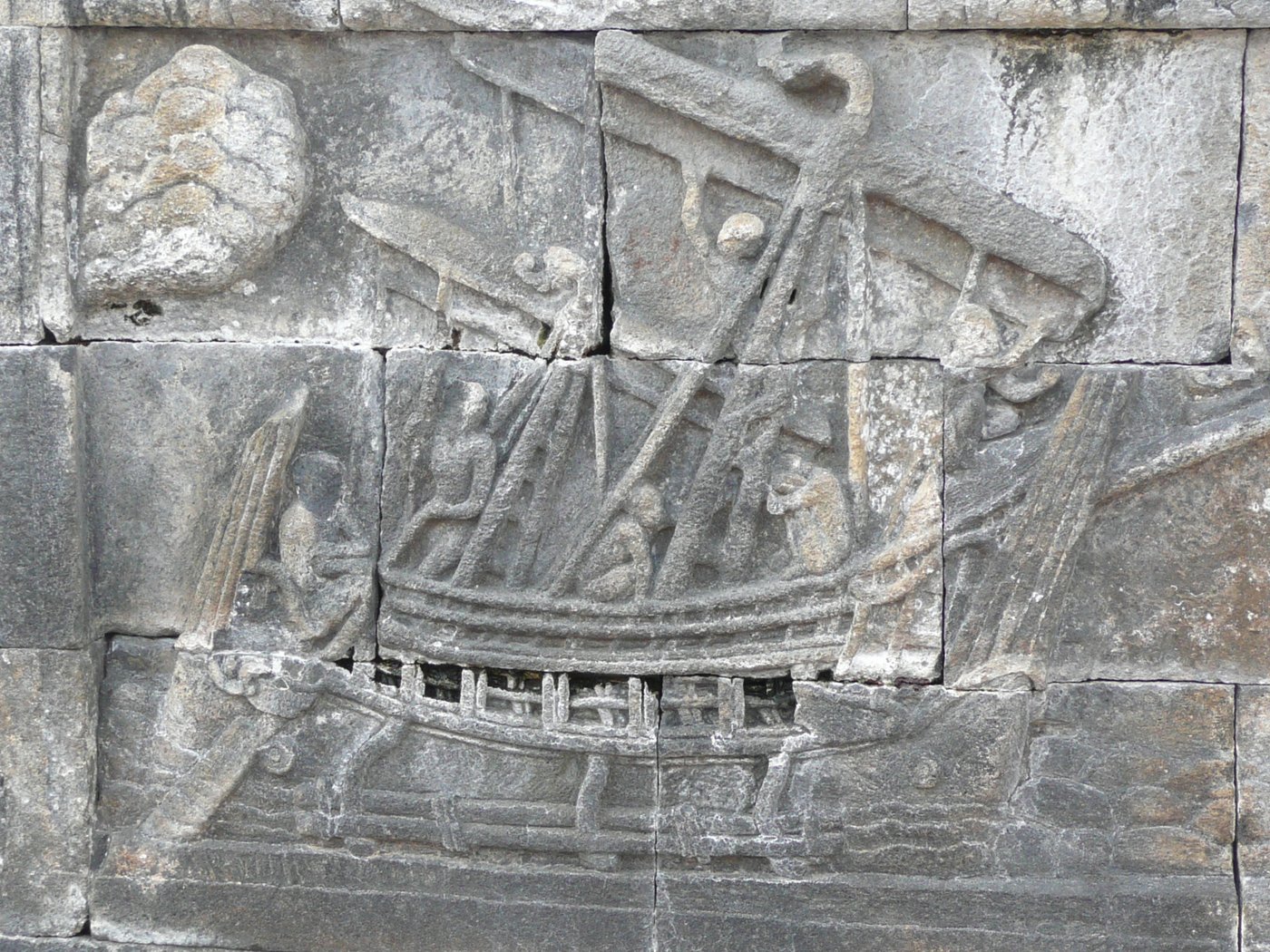
Then, in 2003, an English adventurer named Philip Beale decided to find out whether they would actually float. He had a full-size vessel built by traditional Indonesian boatwrights, working only from the carvings, and named her the Samudra Raksa (“defender of the seas”). Then he sailed her, with a mixed crew, from Java across the open Indian Ocean to Madagascar, round the Cape of Good Hope, and up to Ghana, retracing the old spice route that had linked the East Indies to Africa. A ship carved on a temple wall, hidden in plain sight among sacred scenes, turned out to be a working blueprint. She sits today in her own museum in the shadow of the monument that drew her.
What stays buried
Borobudur has been climbed, cleared, catalogued, taken apart and put back together. Very little about it is now hidden, except the thing at its foot. After Cephas finished his photographs the base was sealed again, and sealed it has stayed. All that a visitor can see of the buried gallery today is a single stretch at the south-eastern corner, deliberately left open, where a handful of the hidden panels stand exposed to the light. The rest are still there, all the way round the building, faces turned in against the stone, exactly where the ninth-century masons left them.
It is an odd thing to stand on. You are on top of one of the great sacred buildings of the world, and beneath your feet, out of sight, runs a whole gallery of carved life and death that was made to be seen and then hidden before it ever really was. The engineers were probably right; the base most likely had to be buried to keep the monument up. But the effect is stranger than the reason. Borobudur teaches, in stone, that the goal is to rise out of the crowded lower world. To do it, its builders took that lower world (the markets and the boats and the punishments in hell) and walled it into the foundations, so that everyone who climbs towards the empty summit is standing, without knowing it, on the world they are trying to leave behind.
Read next: The Kailasa Temple of Ellora: The Mountain Carved Into a Temple and Srivijaya: The Sea Empire That Left Almost No Ruins.
Sources & further reading
- John Miksic, Borobudur: Golden Tales of the Buddhas (Periplus / Tuttle, 1990).
- Luis O. Gómez and Hiram W. Woodward Jr (eds), Barabuḍur: History and Significance of a Buddhist Monument (University of California, 1981).
- Jacques Dumarçay, Borobudur, trans. and ed. Michael Smithies (Oxford University Press, 1978).
- N. J. Krom and T. van Erp, Beschrijving van Barabuḍur (The Hague, 1920–1931) — the great early survey, including the record of the hidden foot.
- Unesco World Heritage Centre, “Borobudur Temple Compounds” inscription file and the Borobudur restoration campaign reports (1973–1983).
- Philip Beale, accounts of the Borobudur Ship Expedition and the Samudra Raksa voyage of 2003–2004.
Image credits (via Wikimedia Commons): Borobudur seen from the north-west — Gunawan Kartapranata (CC BY-SA 3.0); Lalitavistara relief, the prince leaving the palace — Photo Dharma, Penang (CC BY 2.0); the perforated stupas on the summit — Gunawan Kartapranata (CC BY-SA 4.0); a Buddha inside a perforated stupa — Andrew Otto (CC BY-SA 2.0); a hidden-foot relief photographed in 1890 — Kassian Cephas (public domain); the Borobudur ship relief — Andreas Sihono (CC BY-SA 3.0).