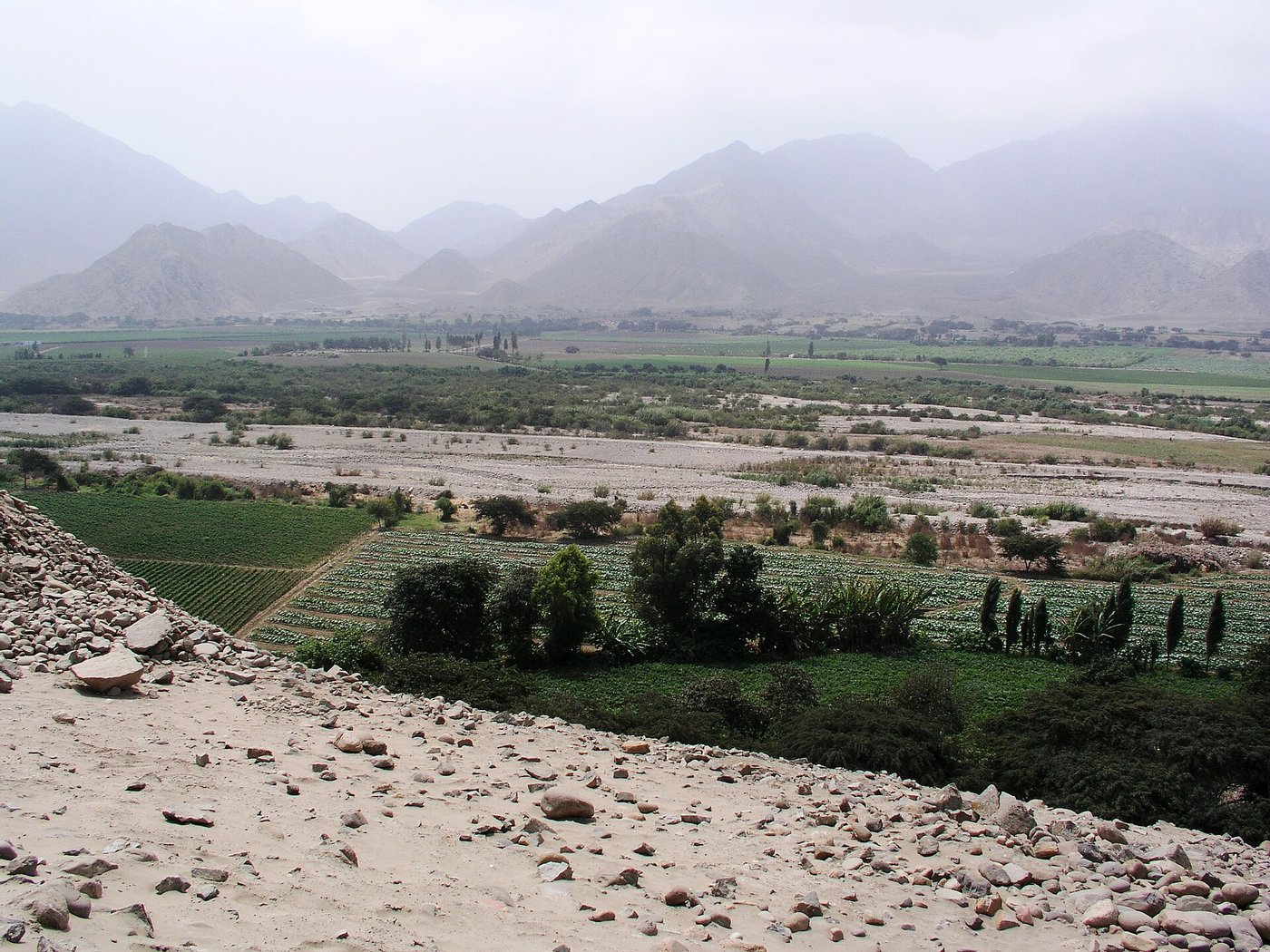
In the winter of 1994 Ruth Shady climbed a low hill in a dry Peruvian valley and did not, at first, think much of it. The Supe valley, a hundred and eighty kilometres north of Lima, is a thin green ribbon of cotton and fruit trees squeezed between desert and sea. The hill she was standing on was covered in sand and scrub, and looked like every other rise in that landscape. Then she noticed the shape under the sand was too regular. The slopes were too straight. She was not standing on a hill at all. She was standing on the top of a pyramid, and the whole valley around her, she would come to argue, was a city: one that had been raised while the pharaohs were still building at Giza, and then forgotten for four thousand years.
The place is called Caral. When Shady and her colleagues finally pinned down its age, the numbers were hard for anyone to accept. Caral was not a small settlement that grew slowly. It was a planned centre of monuments and plazas, built in the centuries around 2600 BC. That makes it the oldest known city in the Americas by more than a thousand years, and a contemporary of the first Egyptian pyramids, of the city-states of Sumer, and of the great towns of the Indus. Four of the world’s cradles of civilisation, it turned out, had been getting under way at more or less the same moment, on four separate parts of the planet, none of them able to send so much as a rumour to the others.
A hill that turned out to be a pyramid
Caral had been seen before. The German archaeologist Max Uhle noted mounds in the area in 1905. Paul Kosok walked the valley in 1948 and suspected the rises were man-made, but moved on. The reason nobody pressed further comes down to a single missing object: pottery. Almost every method archaeologists use to sort a site into early and late leans on the styles of broken pots. Caral had none. It was built and lived in before anyone in the region made ceramics at all. To the eye of a mid-century surveyor, a large site with no pots read as a poor site, or a young one. It was neither.
Caral belongs to what archaeologists call the pre-ceramic period. Its people built pyramids taller than a nine-storey building, planned plazas and drew up neighbourhoods, and did all of it without a single fired clay pot, without metal tools, and with no writing anyone has yet learned to read. For a long time that emptiness was read as backwardness. It was the opposite. Caral shows that monumental architecture and a complex, layered society can appear before the technologies we assume have to come first.
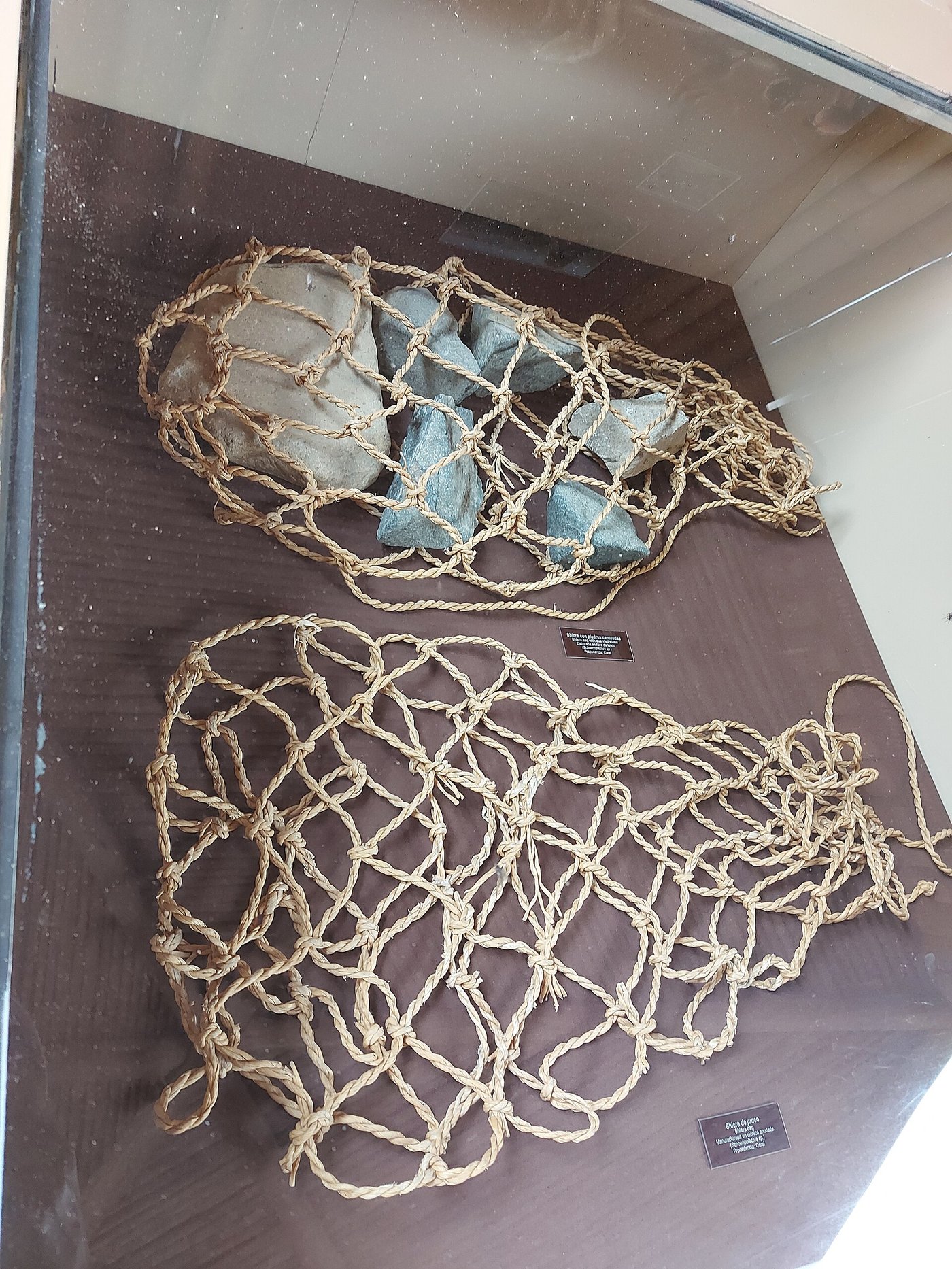
Shady solved the dating problem with rubbish, in a sense. Threaded all through the platforms were woven bags of reeds and grass, packed with stones, that the builders had used as fill. The plants had been cut, knotted and buried in a single season. That made them close to perfect for radiocarbon dating, because they recorded one short moment rather than centuries of reuse. In 2001 she and two American colleagues published the results in the journal Science: the fill dated to around 2627 BC. The desert had been keeping the receipts the whole time.
Walking the sacred city
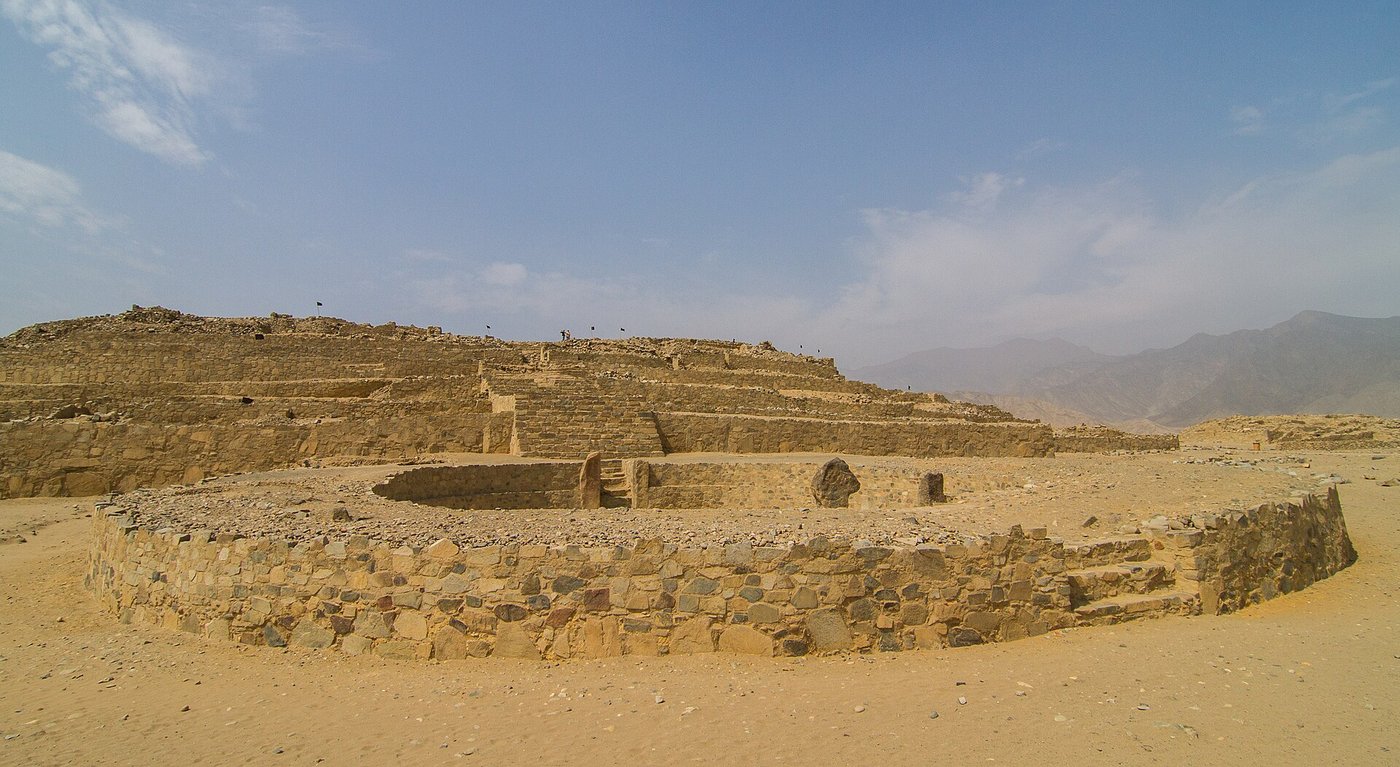
Stand in the middle of Caral today and the plan of it opens around you. Six large pyramid mounds are arranged across roughly sixty-six hectares, with smaller platforms, sunken round courts and rows of houses filling the space between. The largest, the Pirámide Mayor, runs about a hundred and fifty metres along one side and a hundred and ten along the other, and still stands some twenty-eight metres high after five thousand years of wind. In front of it sits a sunken circular plaza, a shallow stone amphitheatre cut into the ground, where people would have gathered below the great platform and looked up.
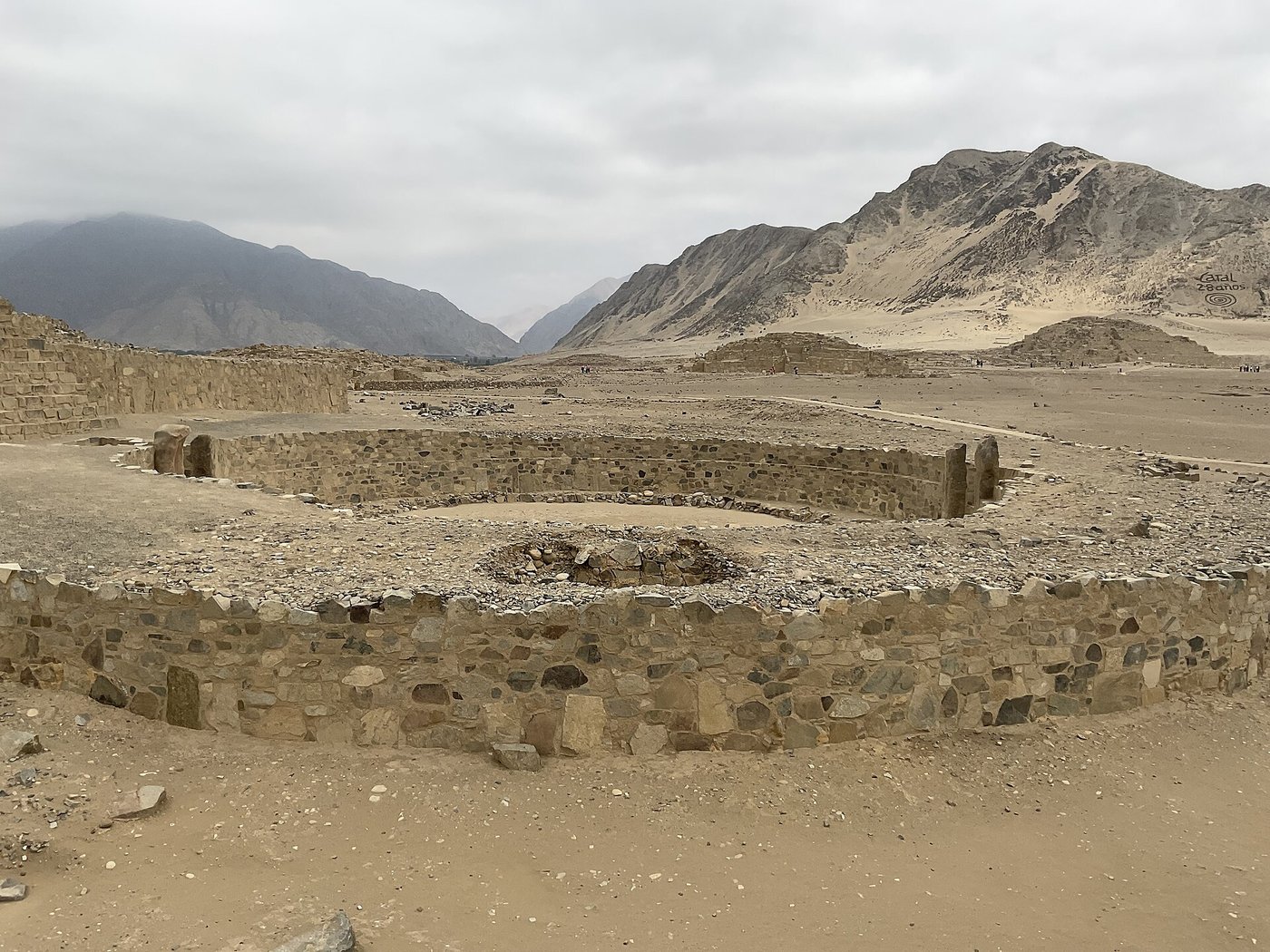
The city reads as a designed thing, not an accident of growth. Archaeologists divide it into an upper half of grand monuments and finer houses, and a lower half of smaller homes clustered around a single large platform. Bone from the dinner middens tells the same story of rank: the people in the upper half ate more sea lion and better fish. Perhaps three thousand people lived here at its height, which does not sound like much until you remember that every basket of stone in those pyramids was carried up by hand, by a population that had to be fed while it built.
What is missing is as striking as what stands. There is no defensive wall. There is no gate built to be held. Nothing about the layout suggests a place bracing to be attacked, and nothing suggests it was preparing to attack anyone else. For a first city, that is a real puzzle.
Bags of stone that ride out an earthquake
The reed bags that dated the city did something cleverer than record a year. This is one of the most earthquake-prone coastlines on Earth, where the Nazca plate grinds under South America and the ground can heave without warning. A pyramid built of loose rubble on that ground should have shaken itself apart long ago. Caral’s has not, and the reason seems to be those bags.
The builders filled woven fibre sacks, called shicras, with stones, and used them by the thousand as the core of their platforms, rather than laying the stone in solid packed layers. Loose stones held in a flexible net behave very differently from a rigid mass when the earth moves. They shift, roll and settle against one another, soaking up the energy of a tremor instead of transmitting it straight up into the walls.
Modern engineers have taken the idea seriously enough to test it. Researchers built scale models of shicra-filled foundations and ran them on shaking tables, the rigs used to trial earthquake-proof buildings today. The bagged stone behaved like a rough version of the base-isolation systems now bolted under hospitals and bridges: the fill rolled and absorbed the shaking rather than passing it on. A technology worked out five thousand years ago, with reeds and river cobbles, was doing in miniature what steel-and-rubber bearings do now.
A city that ate from a sea it could not see
Caral sits twenty-odd kilometres inland, out of sight of the Pacific, and yet the ocean fed it. The middens are thick with anchovies and sardines, small oily fish hauled from the cold, teeming waters of the Peruvian coast. The city could not have caught them itself. What it could do was grow cotton, and cotton is what you spin into the nets and lines that catch fish by the tonne.
So a trade took shape along the valley. Inland farmers at Caral grew cotton and squash and beans; coastal fishers at sites such as Aspero, down where the Supe meets the sea, supplied the catch. Nets went one way, dried fish came the other, and neither side seems to have needed an army to enforce the bargain. This was an economy running on cotton and fish, without coined money, without writing to keep the accounts, and, as far as anyone can find, without the threat of force holding it together.
Thirty-two flutes, and not one weapon
The objects that survive from Caral lean hard towards ceremony and away from war. In one building excavators found a cache of thirty-two flutes, cut from the wing bones of condors and pelicans and still able to sound a note. Elsewhere they turned up dozens of cornetts made from the bones of deer and llama. This was a city with an orchestra. There is also a knotted cord that Shady identified as an early quipu, the recording device of tied strings that the Inca would still be using four and a half thousand years later, which would push the whole Andean habit of keeping records in knots back to the very beginning.
Set against the flutes and the knots is a plain and repeated absence. No one has found a defensive wall, a weapon cache, or a body showing the wounds of battle. There are no trophy heads, no burned and slaughtered layers, none of the grim furniture that usually turns up when a society organises itself for violence. Over decades of digging across the whole Supe valley, the record of war at Caral has stayed stubbornly blank.
Caution is fair here. Absence of evidence is not the same as evidence of absence, and a peaceful reading can harden into wishful thinking. Raiding with wooden clubs might leave little trace; not every valley has been dug; not every grave has been read. But the case for Caral is not one lucky empty trench. It is the same silence, again and again, over a large area and a long span of time: no walls anyone had to build, no weapons anyone bothered to bury. At some point a consistent silence starts to count as a finding of its own.
The story that cities are born from war
Why does any of this unsettle people? Because there is a long-running idea about how the first states came to be, and Caral sits awkwardly across it.
The familiar story: complex societies are forged by conflict. War, or the fear of it, forces scattered villages to submit to a strongman, pool their labour and accept a ruler, so the earliest cities should bristle with walls, weapons and the marks of coercion.
What Caral suggests: at least one of the world’s founding cities grew the other way. The pull here looks like shared ritual, trade and the sheer draw of a religious centre, not the push of an enemy at the gate. It does not prove that early cities everywhere were peaceful; plenty were not. It proves that the warlike path was not the only one, and that people could raise pyramids and organise thousands of lives around a plaza and a set of flutes rather than around a threat.
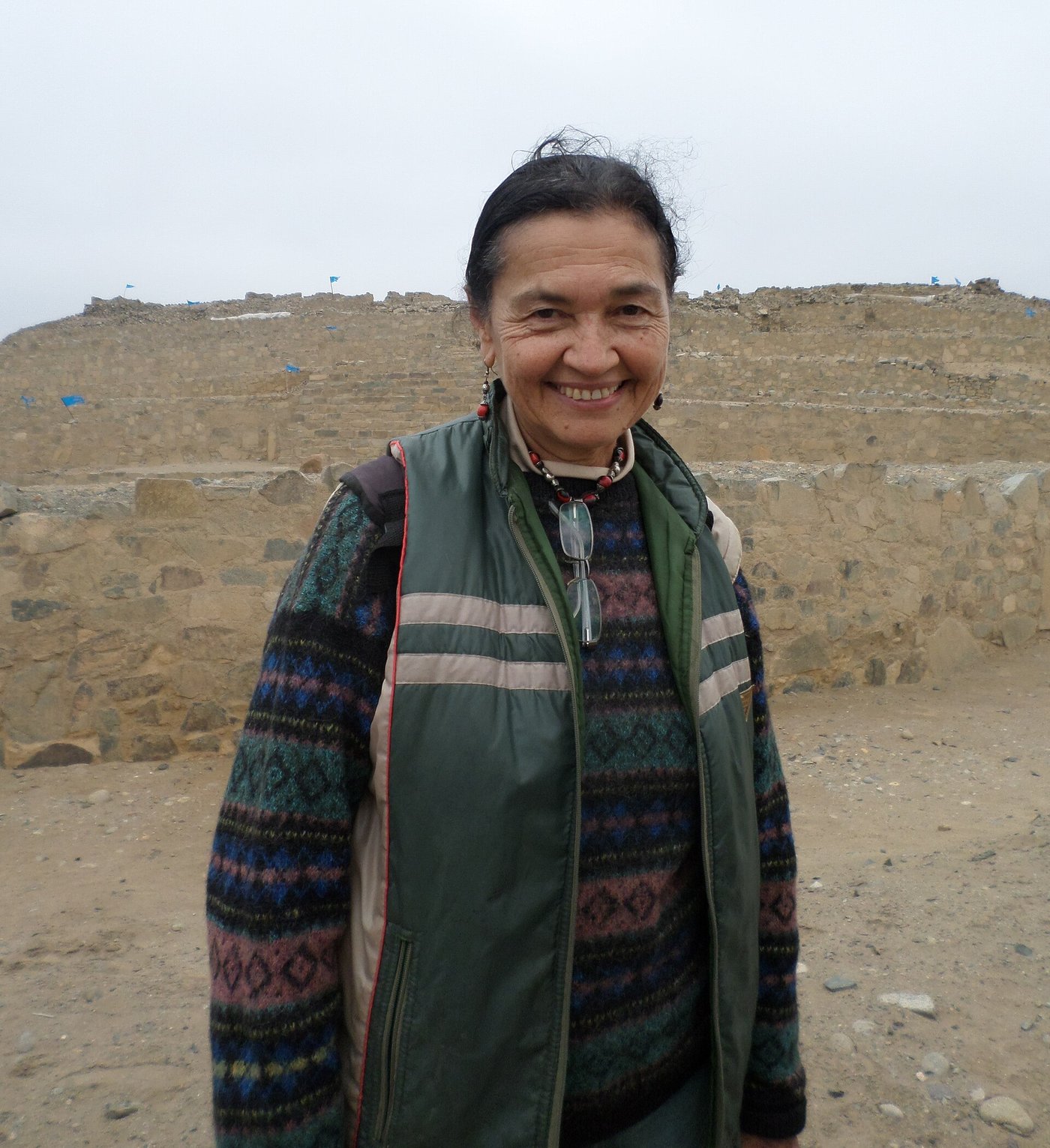
Ruth Shady has spent thirty years making that argument, largely on her own terms and often against the grain. She built the excavation up from almost nothing, kept it running through years of thin funding, and turned Caral into a UNESCO World Heritage site in 2009. It has not made her life easy. In 2003 she was shot in the chest during an attack at the site by people who wanted the land. Years later, squatters trying to seize parts of the protected zone sent her death threats down the telephone. The oldest city in the Americas is still, in a small way, being fought over, just not by the people who built it.
The drought that scattered them
Caral did not fall to an invader, which fits everything else about it. Around 2000 BC the city was gradually left empty, and the cause looks like the sky rather than a sword.
Roughly four thousand two hundred years ago the climate lurched. A long, severe drought spread across a wide band of the planet, drying rivers and ruining harvests. Historians know the same event from far away: it is tangled up with the collapse of the Akkadian empire in Mesopotamia, with hard times in Old Kingdom Egypt, and with upheaval in the cities of the Indus. The four cradles that had risen together were now, together, being shaken. In the Supe valley the rains that fed the cotton failed, and a city built on the exchange of cotton for fish had its main bargain cut from under it.
What the people did next is the most human part of the record. At the later site of Vichama, near the coast, archaeologists have uncovered clay friezes that seem to be a deliberate message about the crisis. Emaciated figures with their ribs showing. A pregnant woman. Two large fish. A frog-headed being reaching up towards a face wreathed in lightning, read by the excavators as the arrival of rain after famine. It is one of the oldest surviving attempts by a people to record a climate disaster and pass the warning on. And still, through the abandonment and the scattering, the pattern holds: the survivors moved to the coast and to inland valleys and built again, at Vichama and at Peñico, without the record showing them turning on one another.
What the quiet city leaves behind
Caral is easy to file under superlatives (oldest this, first that), and the superlatives are real. But the thing worth carrying away is quieter and stranger. Here is a city as old as the pyramids of Giza, raised without pottery, without metal, without writing, on ground that shakes, by a few thousand people who fed themselves by trading cotton for anchovies. And when you look for the war that is supposed to sit at the root of every early state, the trench comes up empty, over and over.
The flutes still play, when a museum lets someone breathe into a copy. The knotted cord may or may not be the first quipu. The drought that emptied the plazas is written in ice cores and lake beds on the far side of the world. What Caral leaves behind is not an answer but a standing question, sitting there in the desert for anyone who thinks they know how the first cities had to be made: it did not have to be by force. At least once, it was not.
Read next: Chan Chan: The Mud City Where Dead Kings Sealed Their Own Palaces and Tiwanaku: The Andean Temple a Satellite Found Under a Farmer's Field.
Sources & further reading
- Shady Solís, R., Haas, J. and Creamer, W., “Dating Caral, a Preceramic Site in the Supe Valley on the Central Coast of Peru,” Science, 2001 — the paper that fixed the city’s astonishing age.
- Shady Solís, Ruth, La ciudad sagrada de Caral-Supe and related monographs from the Proyecto Especial Arqueológico Caral-Supe — the excavator’s own account.
- Mann, Charles C., 1491: New Revelations of the Americas Before Columbus — a readable placing of Caral among the early Andean cultures.
- Sacred City of Caral-Supe, UNESCO World Heritage Centre listing — the site description and the case for inscription.
- Reports from the Vichama and Peñico excavations on the friezes, the 4,200-year drought and the peaceful resettlement of the Supe people.
- Engineering studies on shicra fill and the seismic behaviour of Caral’s platform foundations, including shaking-table experiments on bagged-stone models.
Image credits (via Wikimedia Commons): Pirámide Mayor and circular enclosure, Caral — Jon Gudorf Photography (CC BY-SA 2.0); sunken circular plaza at the main pyramid — Jose Morales (CC BY-SA 4.0); shicras exposed in a platform — Sandro Ruiz Peralta (CC BY-SA 4.0); Ruth Shady at Caral, 2014 — Ruth Madelen Luna Cruz (CC BY-SA 4.0); view of the Caral mounds in the Supe valley — Håkan Svensson (Xauxa) (CC BY 2.5).