In September 2026, five metres under the floor of a royal compound at Chan Chan, a narrow staircase ran down into the dark and ended at a chamber no one had opened for six hundred years. The diggers had expected another looted pit; every earlier tomb in the city had been emptied long ago. Instead they found the dead still lying where the Chimú had left them: thirty-eight people, gold ear ornaments, boxes of folded cloth, beads of shell carried up from warmer seas. The sand had sealed it, and the sand had kept it. For the first time an elite burial at the largest mud city ever built came out of the ground with its contents intact.
To understand why that stair mattered so much, you have to understand what Chan Chan was for. It was not only a place where kings lived. It was a place where they stayed after they died: where a ruler's whole life was walled up and looked after by the living, generation after generation, until the desert had swallowed a dozen palaces at once. The city grew the way it did because of a single, strange rule about death and property. Follow that rule and the ruins make sense.
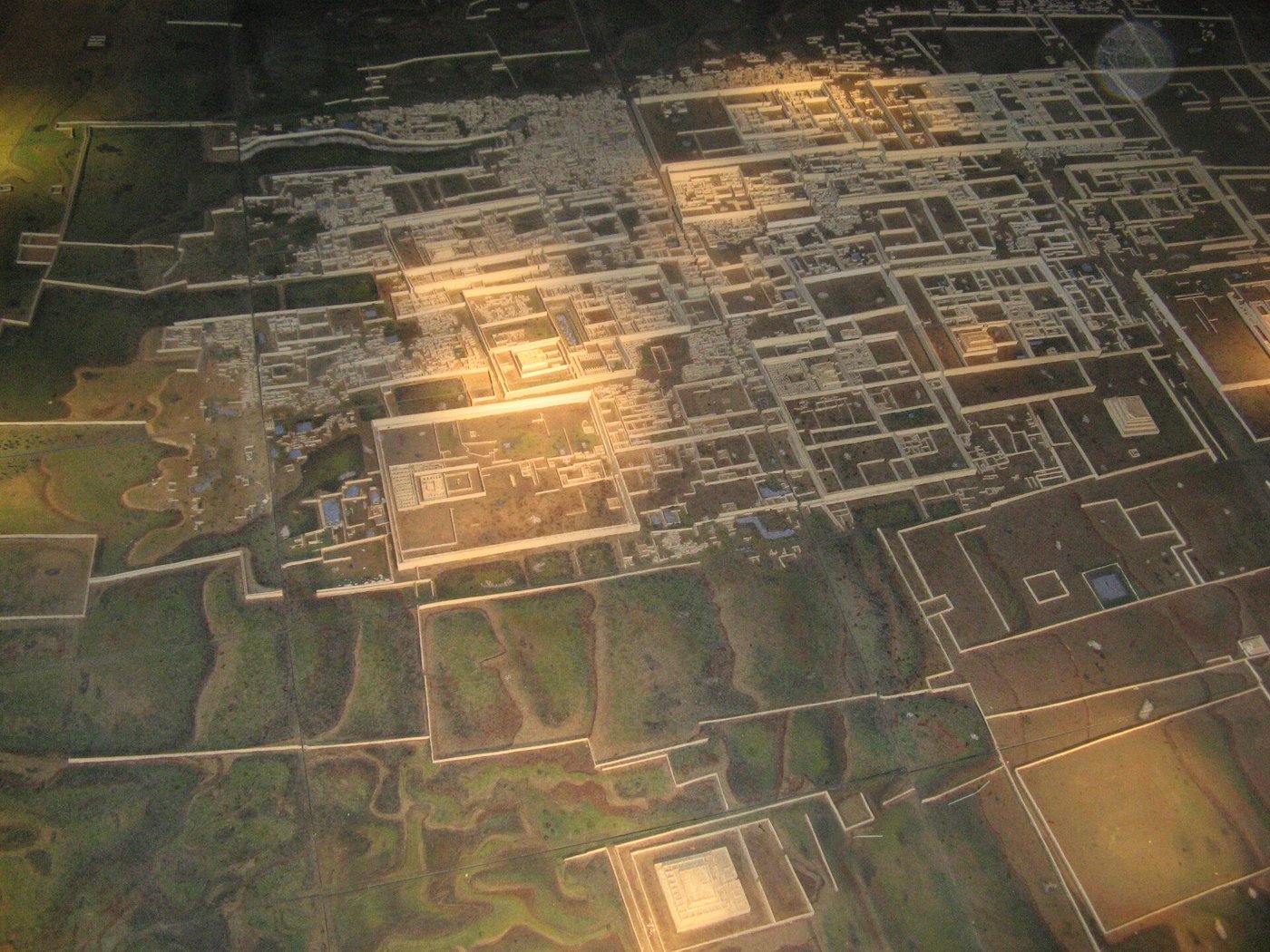
A capital raised in a place with no rain
Chan Chan sits on the north coast of Peru, in the flat valley of the Moche river a few kilometres from the sea. It is one of the driest inhabited coasts on earth. Rain, in an ordinary year, barely comes at all. Nothing about the setting suggests a great city, and yet from around 900 CE the Chimú built one here that eventually covered close to twenty square kilometres and, at its height, may have held thirty thousand people. It was the largest city in the ancient Americas, and the largest city built of mud anywhere in the world.
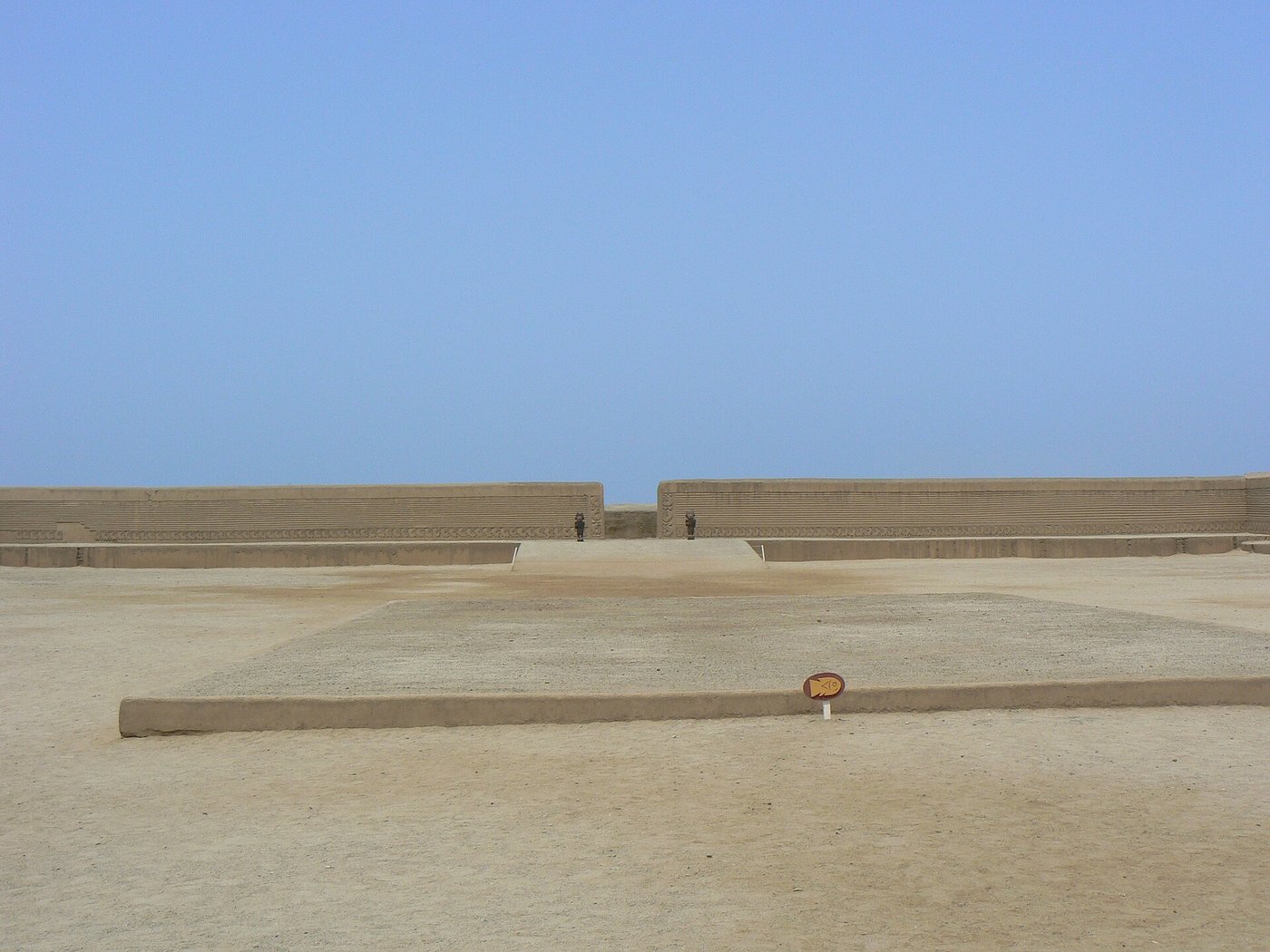
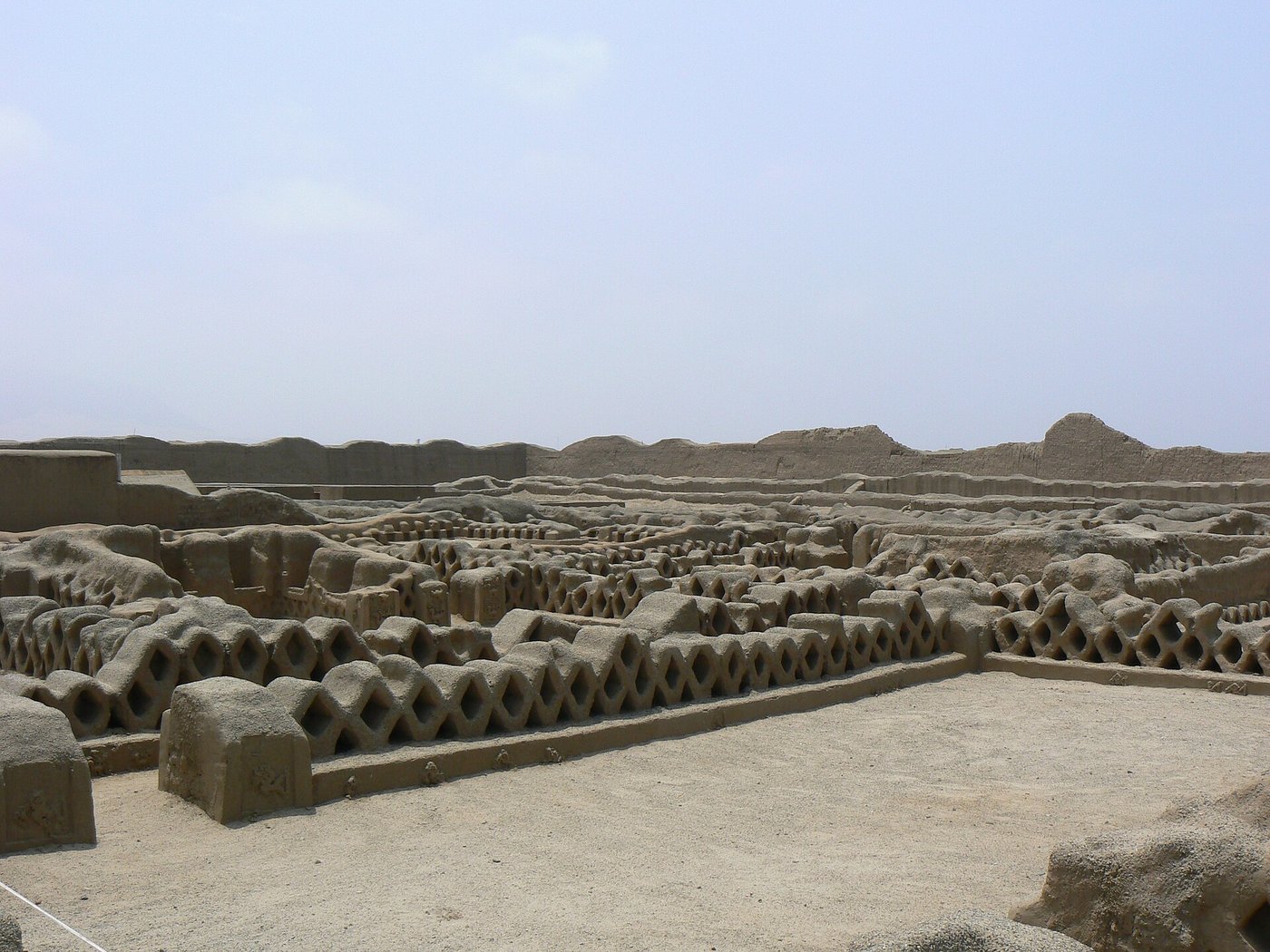
Everything standing was made of earth. The Chimú had no cheap stone and no interest in importing it, so they raised their walls from adobe: mud and sand pressed into moulds, dried in the sun, then stacked and plastered smooth. The tallest compound walls climbed to nine or ten metres and ran for hundreds of metres in a straight line. Wind and the rare cloudburst have rounded them since, but in their day they were sheer, pale and blank, a skyline of clay cliffs.
A city that size in a desert has one problem before all others: water. The rivers running down from the Andes were small and seasonal, so the Chimú became engineers of the first rank. They cut canals dozens of kilometres long, terraced the valley floor into irrigated fields, and dug sunken gardens down to the damp subsoil so crops could drink from the water table itself. Their most ambitious scheme, a canal meant to carry water clear across from the neighbouring Chicama valley, would have been one of the great engineering feats of the pre-Columbian world, though whether it ever fully worked is still argued over. When flash floods threatened the fields, they threw up long defensive walls to turn the water aside. The whole society was organised around moving water to where it was needed, and keeping it from where it was not.
The rule that built the skyline
Walk over Chan Chan today and the first thing that strikes you is the repetition. There is not one palace but nine or ten of them, each a vast walled rectangle, each with its own single guarded entrance, its own plazas, its own warren of rooms, its own tomb. They were not built all at once, and they were not built to house a growing court. They were built one after another because of a law of inheritance that sounds, to modern ears, almost unworkable.
When a Chimú king died, his heir took the throne, but not the wealth. The gold, the storerooms, the cloth, the land, the palace itself: all of it stayed with the dead man. His body was kept in the compound, tended as a kind of living presence, and his surviving relatives went on occupying the palace as caretakers of his estate and his memory. The new king inherited the office and almost nothing else. He had to start again: build his own compound, fill his own storehouses, win his own fortune.
Historians call this split inheritance, and it had a fierce logic. Because a king could not live off what his father had gathered, he was pushed to go and get more: to conquer new valleys, seize new fields, tax new subjects. Some scholars think this single rule was the engine behind the whole Chimú expansion, driving each ruler outward in search of the wealth the last one had locked up in his tomb. Every reign added a fresh palace to the city and a fresh conquest to the map. Chan Chan grew, in other words, not despite its dead kings but because of them. Each compound is a reign made solid.
Behind the one door
The compounds (archaeologists call them ciudadelas) are strange buildings to move through. A wall taller than a house, and along its enormous length a single narrow opening. Step inside and you do not reach anything directly. The passages bend and double back, funnelling anyone who enters through a sequence of courtyards and checkpoints before they can approach the heart of the place. Access was everything. Who got to stand where, and who could go no further, was written into the plan.
Deep inside sat the ruler's own quarters, with kitchens and private wells, and around them the machinery of an estate. Rows of storerooms held the tribute of a kingdom: cloth, food, metal, Spondylus shell. Guarding them were curious U-shaped roofed structures the Chimú built by the dozen, small control points where officials seem to have overseen what came in and went out. To reach fresh water the builders dug great walk-in wells, wide sunken courts with ramps that let a person walk down, year after year, to whatever level the water table had fallen to. A palace was a treasury, a temple and a household folded together behind one door.
Walls that speak only of the sea
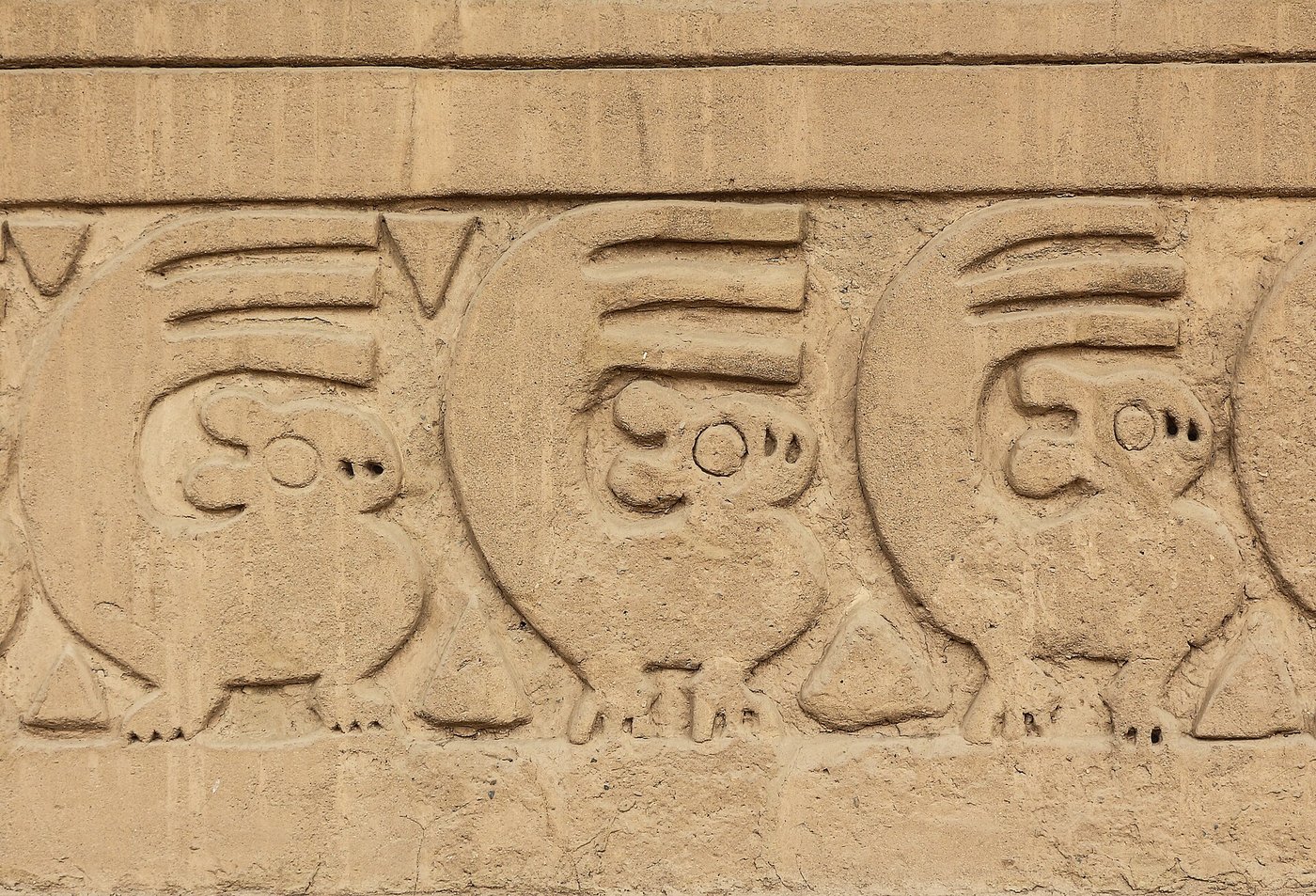
For a city stranded in a rainless desert, Chan Chan is decorated almost entirely with water. The Chimú pressed long friezes into the wet clay of their walls, and the images repeat with an almost hypnotic insistence: fish swimming in tidy rows, one line heading left and the next heading right, as if to catch the turn of the tide. Above them run seabirds: pelicans, cormorants, the birds that wheel over the cold Pacific current just offshore. There are nets, waves, sea otters, and small creatures that may be crabs or shellfish. Land almost never appears.
This was not decoration for its own sake. The sea fed the north coast (anchovies and shellfish in staggering quantity), and it sat at the centre of how the Chimú understood the world. The moon, not the sun, was their highest deity; a coastal people who fished by night and watched the tides had good reason to rank it first. To wall a king inside images of fish and seabirds and the moon's tides was to wrap him in the source of everything the kingdom ate and believed. The desert city dreamed of the ocean on every surface.
What a king took with him
At the southern end of most compounds stood the reason the whole thing existed: the burial platform. It was a solid mound of adobe, honeycombed inside with cells, and in the central cell lay the king. Around him, in the surrounding cells, went the things and the people that were meant to follow him: fine textiles, pottery, worked metal, and the bodies of retainers, many of them young women, buried with him at his death or added over the years that followed. The platform was not a full stop. It was the point where the compound turned from a palace into a shrine, a place his descendants would keep visiting long after his name had passed into ritual.
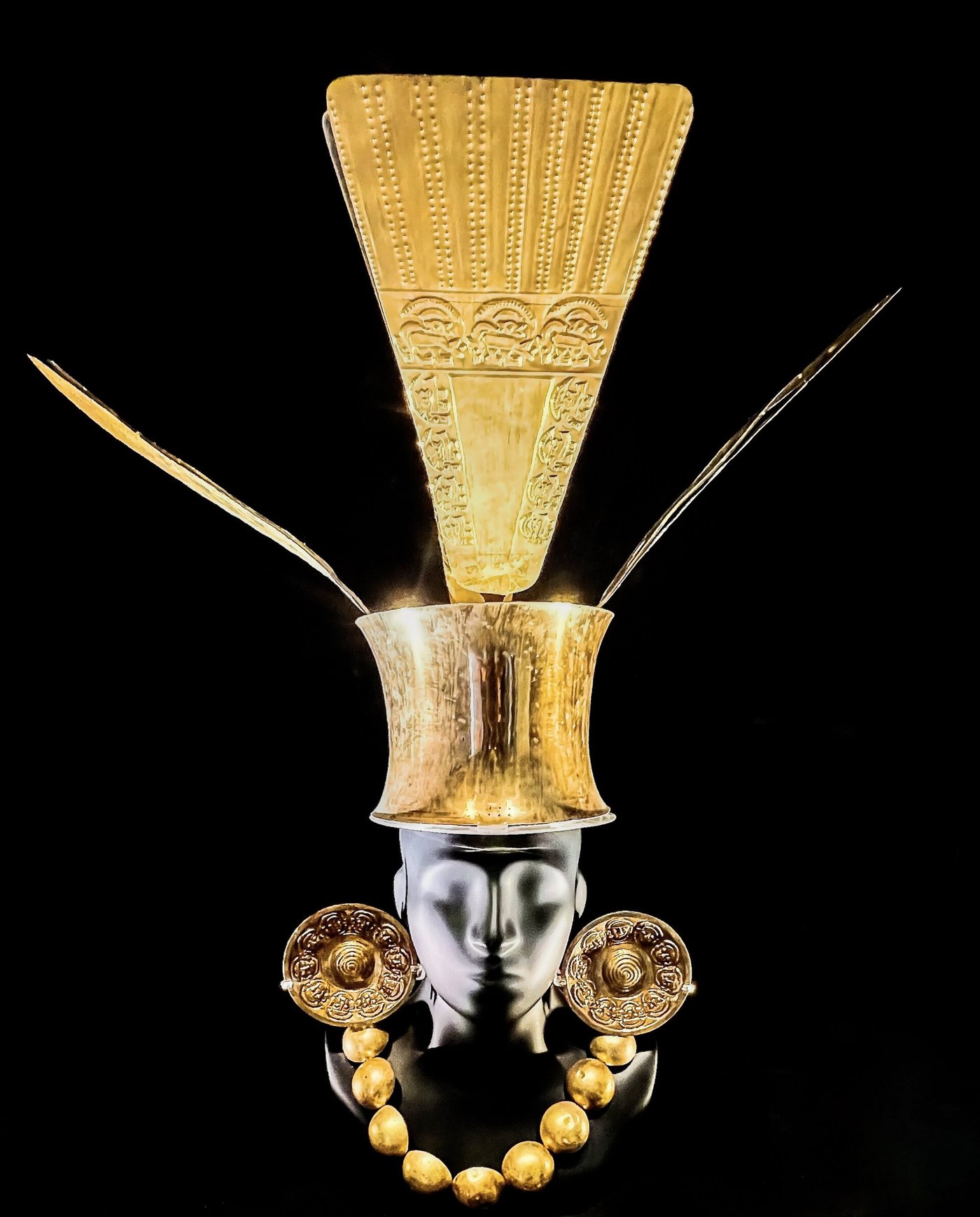
The Chimú were among the finest metalworkers the Americas ever produced, and a royal burial swallowed astonishing quantities of gold and silver: headdresses, ear spools, beakers, masks, ornaments sewn onto cloth by the hundred. That wealth is exactly why we know so little of it. From the first Spanish decades onward, Chan Chan's platforms were mined for treasure with the thoroughness of a quarry; colonial companies were formally registered simply to dig the mounds and melt what they found. By the time archaeologists arrived with trowels and notebooks, nearly every royal tomb in the city had been gutted. What the Chimú had sealed away to honour their kings, later hands had torn open for its metal.
The platform the looters missed
Which is what makes the 2026 discovery so unusual. In a compound on the northern side of the city (a complex the Chimú called Utzh An, long known to outsiders as the Gran Chimú), a Peruvian team led by the archaeologist Jorge Meneses came down onto a funerary platform the treasure-hunters had never reached. A staircase of some two and a half metres led to a narrow central chamber, five metres deep, where a single body lay with objects of shell and metal. Two long side chambers opened off it. All told, the platform held thirty-eight people.
The offerings were the kind that centuries of looting had otherwise scoured from Chan Chan: gold ear ornaments, necklaces and headdresses, carved wooden boxes fitted with metal plaques, beads of marine shell, worked quartz, and pottery placed for the dead. One wooden chest held twenty pieces of finely embroidered cloth, folded and preserved by the dry ground. On three of the bodies the excavators found the remains of red pigment, a colour the Andean world reserved for the dead of high rank. It is the first elite burial platform in the whole of Chan Chan to be found before the robbers did.
Peru's Ministry of Culture announced the find on 8 September 2026. The central chamber, roughly 1.2 metres wide and 5 metres deep, was reached by a stair of about 2.5 metres and held one individual with shell and metal offerings; two lateral chambers, each around 1.5 metres wide and 8 metres long, held the rest. In total thirty-eight people were laid there, together with gold ear ornaments, necklaces, headdresses, carved wooden boxes with metal appliqué, marine-shell beads, quartz, ceramics, and a wooden chest of twenty embroidered textiles. Excavators described it as the only elite funerary platform at Chan Chan known to have escaped looting.
Most of the thirty-eight were arranged in the flexed, seated posture the Chimú used for their dead, knees drawn up, wrapped and bundled. One was not. A single body lay fully extended, stretched out flat, a pose so far outside the usual practice that the team paused over it. In a culture that folded its dead, why lay one person straight?
The extended burial is a real puzzle, and the excavators have been careful not to force it. One reading is sacrifice: the north coast has yielded some of the largest ritual killings known anywhere. At nearby sites archaeologists have uncovered the graves of hundreds of children and young llamas offered together, most likely to placate the sea during years of ruinous flooding. A person killed to accompany a ruler might well be treated differently from the ruler's own kin. But an unusual posture is not proof of an unusual death, and nothing yet found settles it. For now the straight-laid body is a question the platform has asked and not answered.
The hands that made the wealth
A tomb like that did not fill itself. Behind every royal compound stood a small army of specialists, and Chan Chan set aside whole quarters for them: cramped, crowded neighbourhoods of cane-and-mud rooms where the artisans lived and worked, a world away from the silent plazas of the ciudadelas. Here the goldsmiths hammered and soldered, the weavers ran their looms, and the potters turned out vessel after vessel.
Chimú pottery is easy to recognise: a smoky grey-black ware, fired in a starved, low-oxygen kiln so the clay never reddened, and very often pressed from two-piece moulds rather than shaped one pot at a time. That is the mark of a state producing at scale, not a village potter working to order. The same instinct ran through their metalwork and cloth. The Chimú had turned craft into something close to an industry: standardised, organised, and pouring its output into the storerooms and the tombs of a ruling line.
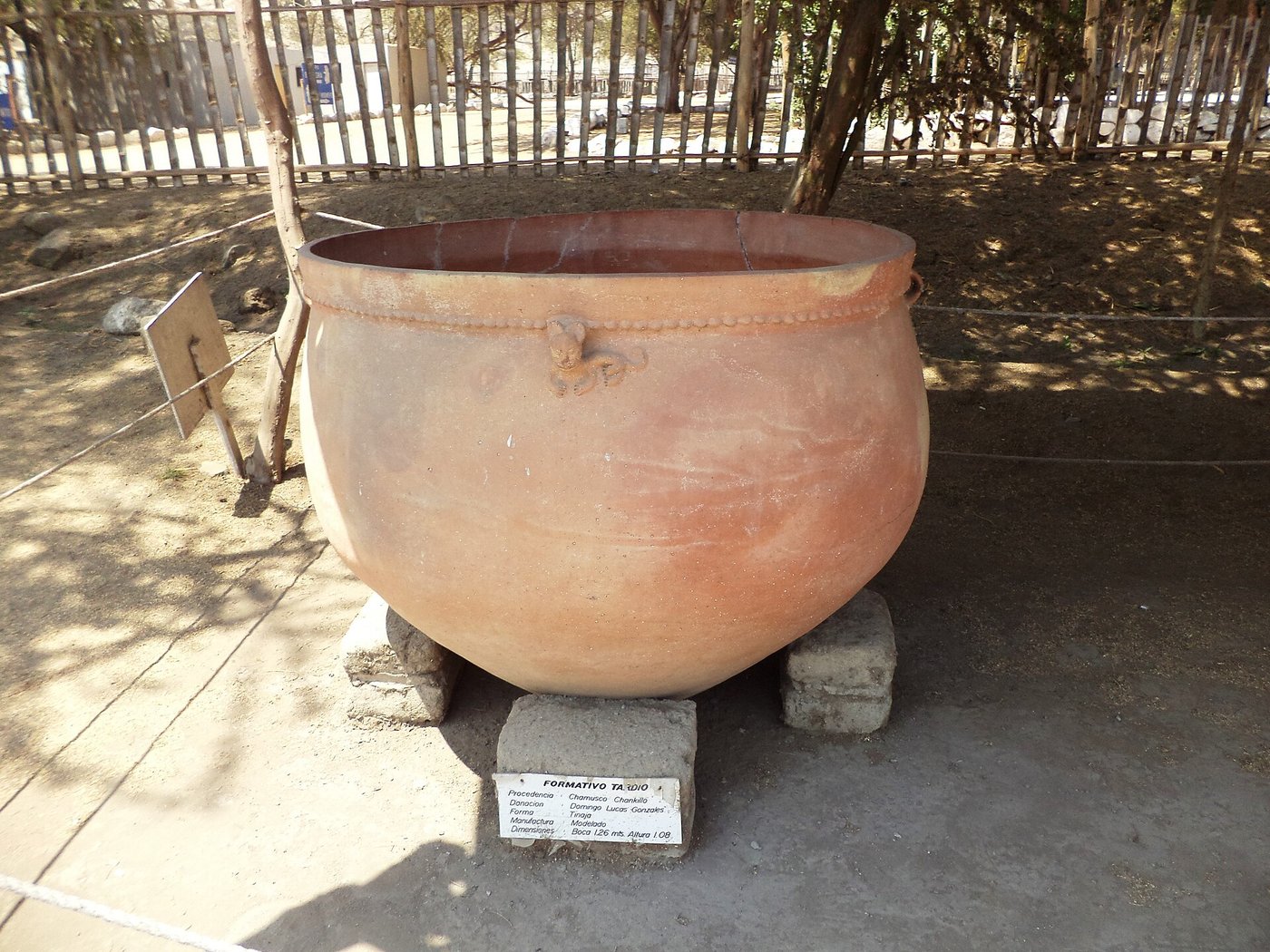
That skill would outlive the kingdom, though not in the way its makers would have wished. When the end came, it was the Chimú craftsmen the conquerors wanted most.
How the city fell quiet
Sometime around 1470, the Chimú met a power hungrier than themselves. The Inca, expanding north out of the highlands, reached the coast and forced the last great Chimú king (remembered as Minchançaman) to submit. He was carried off to Cuzco, honoured as a hostage and stripped of real power, while the Inca broke the kingdom's independence for good. The most valued spoils were not the gold but the people who made it: Chimú goldsmiths were resettled hundreds of kilometres away in Cuzco to work for their new masters, and the coastal style of fine metalwork was absorbed into the empire that had conquered it.
The myth: the Inca simply turned off the water. In the popular telling, they seized the canals feeding Chan Chan, threatened to leave the desert city to die of thirst, and the Chimú surrendered without a fight: a clean, bloodless conquest won by cutting a ditch.
The likelier truth: it was neither clean nor simple. The story of the severed water comes down through Inca-era accounts written after the fact, and control of the canals may well have been one lever among several. But the conquest was a drawn-out affair of alliance, threat and force against a large and organised state, not a single clever act of engineering. Cutting the water made a memorable tale precisely because it flattered the victors: the highland newcomers outwitting the coastal kingdom on its own ground. The city did not die of thirst. It was beaten, absorbed, and slowly emptied.
Chan Chan did not fall in a day or burn in a siege. Under Inca rule its reason for being drained away. The kings who had built compound after compound were gone, and with them the whole machinery of split inheritance that had kept the city growing. Within a couple of generations the Spanish arrived, and the mud metropolis passed from a living capital to a quarry and a ruin, its platforms mined, its walls softening in the sun.
The desert is not finished with it
What saved the 2026 tomb is also what now threatens the whole site. For centuries the near-total absence of rain preserved Chan Chan's earthen walls almost by neglect; mud that never gets wet does not wash away. But the coast's rare disasters come from the sea's own moods. Every so often the warm waters of an El Niño year drive real rain onto this coast, and rain is the one thing adobe cannot survive. Downpours have gnawed at the friezes and slumped the walls, and each severe year does damage that cannot be undone. Chan Chan has spent decades on the list of world heritage sites judged to be in danger, sheltered in places under modern roofs, its clay reliefs fighting a slow battle against the weather that its builders were lucky enough rarely to see.
Most of the city has never been dug. Under the rounded mounds and the wind-smoothed walls lie compounds barely touched, platforms whose contents no one has counted, and, somewhere, more chambers the looters happened to miss. The stair uncovered in 2026 is a reminder that the largest mud city ever built is still, six centuries on, only half read. The Chimú wrote nothing down. Everything they wanted remembered they moulded into clay and buried with their kings, and the desert, so far, has chosen what to keep.
Read next: Lord of Sipán: The Guard Buried With His Feet Cut Off and Caral: A City as Old as the Pyramids, With No Sign of War.
Sources & further reading
- UNESCO World Heritage Centre, Chan Chan Archaeological Zone — the official inscription, and its listing among sites in danger from erosion and El Niño rains.
- Moseley, M. E. & Kolata, A. L. (eds.), Chan Chan: Andean Desert City — the foundational study of the city's plan, compounds and burial platforms.
- Conrad, G. W. & Demarest, A. A., Religion and Empire: The Dynamics of Aztec and Inca Expansionism — the argument that split inheritance drove Chimú and Inca expansion alike.
- Rowe, J. H., “The Kingdom of Chimor,” Acta Americana (1948) — the reconstruction of the Chimú king list and the Inca conquest from colonial sources.
- Moore, J. D. & Mackey, C., “The Chimú Empire,” in Handbook of South American Archaeology — a modern overview of Chimor's rise, economy and craft.
- Peru Ministry of Culture / Archaeology magazine news reports, September 2026 — the announcement and details of the unlooted Utzh An funerary platform.
Image credits (via Wikimedia Commons): ceremonial plaza of a Chan Chan compound — Kevstan (CC BY-SA 3.0); scale model of the city — GilCahana (public domain); adobe reliefs of fish and seabirds — Bernard Gagnon (CC BY-SA 3.0); net-patterned storeroom walls — Kevstan (CC BY-SA 3.0); Chimú gold funerary ornaments — WMrapids (CC0); Chimú blackware vessel — Olidel13 (CC BY-SA 4.0).