Some time around 2015, conservators at the University of Tarapacá in Arica noticed that a few of the oldest mummies on Earth had begun to weep. The skin on certain bodies was going soft and dark, turning in places to a black, glistening ooze, as though something inside them had at last decided to let go. These were people who had lain in the driest desert in the world for as long as seven thousand years without rotting. Now, in air-conditioned museum cases, in a city where the humidity had crept up over the decades, they were dissolving. A team that included a Harvard microbiologist ran the samples and found the culprit: ordinary skin bacteria, harmless on a living body, feeding at last on collagen that the desert had kept out of their reach since the Stone Age.
The mummies going soft in Arica are Chinchorro mummies, and they are the oldest deliberately made mummies anywhere on the planet. The oldest of them was embalmed by human hands around 5050 BC. That is roughly two thousand years before anyone in Egypt thought to preserve a pharaoh, and it was done not by priests or god-kings but by a small band of fishermen on a strip of coast at the dead bottom of the map. They had no cities, no writing, no metal, no temples we can find. What they had was the sea, the driest desert on the planet at their backs, and a way of taking a dead person apart and building them again that they kept alive, and kept changing, for more than three thousand years.
To most people mummies mean Egypt: gold masks, canopic jars, the wrapped kings of the Valley. The truth runs the other way round the world and a great deal further back. Before the pyramids, before the wheel reached the Nile, before writing existed anywhere, the people of the Atacama coast were the first human beings we know of who looked at their dead and decided not to let them go.
A coast with no rain and a sea full of food
Draw a line down the Pacific edge of South America and stop where northern Chile meets southern Peru. This is the Atacama, the driest non-polar desert on Earth. Parts of it have gone centuries without measurable rain. Weather stations here have recorded nothing, year after year; some riverbeds run only when snowmelt comes down from the Andes far inland. Nothing much lives in the interior. It is a place that looks, from the hills, like a rehearsal for Mars.
And yet the coast itself is one of the richest larders in the world. Off this shore runs the Humboldt Current, a cold upwelling that carries nutrients to the surface and turns the water thick with fish. Anchovy, sea bass, shellfish, sea lions, seabirds, the odd stranded whale: a people who knew how to work the shore need never have gone hungry. Chemical study of Chinchorro bones shows a diet that was around nine-tenths from the sea. They fished with hooks of shell and cactus spine, with nets and with harpoons tipped in stone and bone, and they knew the reefs and the tide as well as any people ever have.
So the Chinchorro were not a great civilisation in the way we usually mean it. They were bands of hunter-gatherers who happened to sit still. The sea was reliable enough that they did not have to move, and a people who stay in one place begin to bury their dead in one place too. Their name is borrowed, like the Olmec's. It comes from Playa Chinchorro, a beach in modern Arica where their remains first turned up in numbers. We do not know what they called themselves. We know where they lived, what they ate, and, in extraordinary detail, what they did with the people they lost.
The child from Camarones
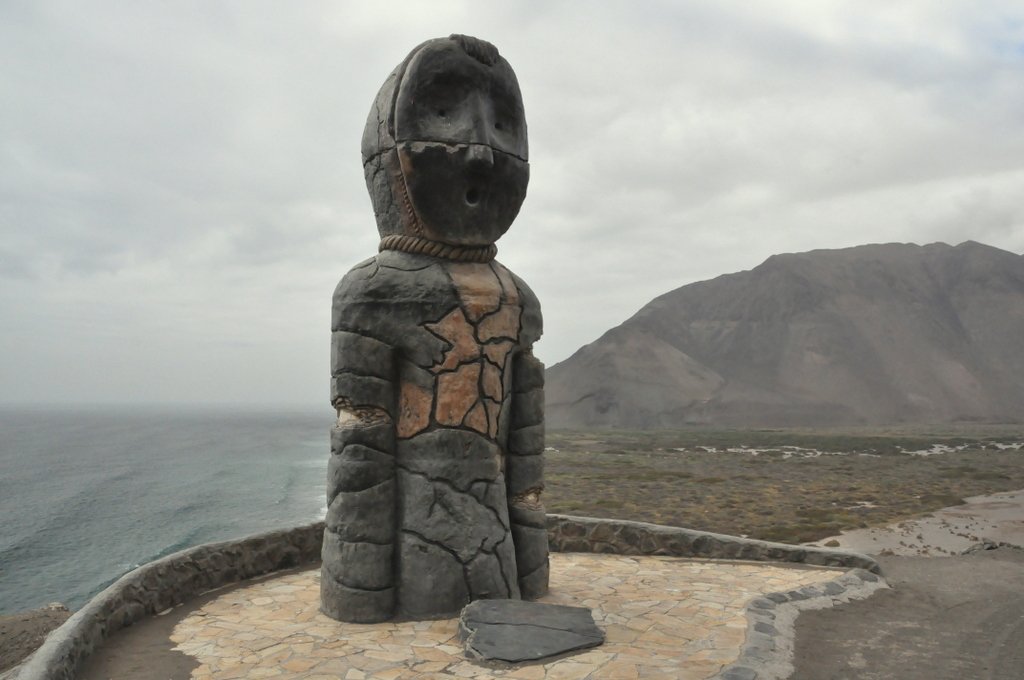
The oldest mummy that human hands prepared did not belong to a chief or an elder. It was a child, from the Camarones valley about sixty kilometres south of Arica, embalmed a little after 5050 BC. This is not an accident of what survived. Across the earliest Chinchorro burials, the very young are everywhere, and they are among the most carefully made. Foetuses lost before birth, newborns, small children: these were not buried quickly and forgotten. They were among the first people anywhere to be turned, by deliberate work, into something meant to last.
That single fact reorders everything you think you know about mummies. In Egypt, embalming began at the top and stayed there for centuries: it was for kings, then for nobles, and only slowly, over a very long time, for anyone who could pay. The Chinchorro did the opposite. They appear to have started with the people a harder society would count for least, the babies, and worked outward from there. Whatever drove them to it, it was not the vanity of rulers. It looks a great deal more like grief.
Before we ask why, it helps to see exactly what they did, because the how is astonishing on its own. This was not wrapping. It was reconstruction.
How to take a person apart and put them back
Start with the most elaborate style, the one archaeologists call the black mummies, made roughly between 5000 and 3000 BC. The process reads less like a burial and more like the building of a figure that happened to be built around a real person.
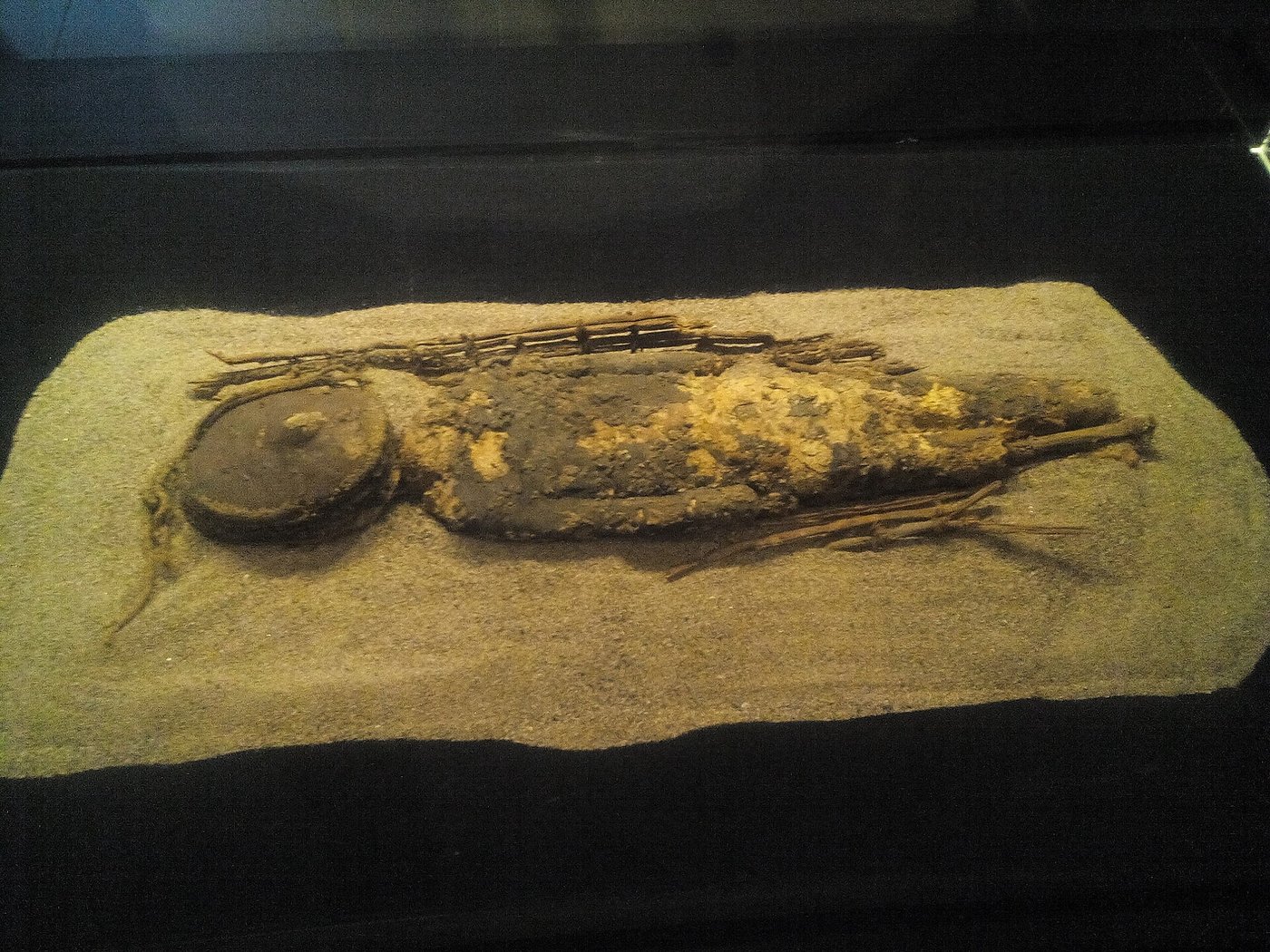
First the embalmers took the body completely apart. The head was removed, the limbs detached, the skin peeled away and set aside, the organs and the brain taken out, the flesh stripped from the bones. What was left was cleaned and dried, sometimes with hot ash or coals. Then they built the person back up. The skeleton was reassembled and reinforced with sticks and reeds lashed along the bones, so the finished figure could stand the handling to come. The empty body was packed out with grasses, ash, animal hair, clay and soil until it held a human shape again.
Over this frame they laid a skin. Sometimes it was the person's own, replaced piece by piece; sometimes it was patched out with sea lion hide where the human skin had not survived the taking-apart. The face was covered with a mask of grey ash paste, the features modelled into it: a calm, simplified face with a small open mouth and eyes, more a made thing than a portrait. A wig of short black human hair was fixed to the crown. Finally the whole figure was painted: for the black mummies, a shining coat of black manganese that gave the style its name. The result was not a preserved corpse in the Egyptian sense. It was a dark, solemn statue with a human being sealed inside it.
These figures were not hidden away at once. The wear on some of them, the repainting, the repaired masks, all suggest they were kept above ground for a time: propped up, carried, perhaps set among the living at whatever the Chinchorro did to mark a death, and touched up when the paint chipped or a limb worked loose. A mummy was not the end of a funeral. It was an object the family went on living with.
Black, then red, then a coat of mud
Three thousand years is a long time to do anything, and the Chinchorro did not do it the same way throughout. The styles changed, and the changes are clear enough that archaeologists use them almost like a calendar.
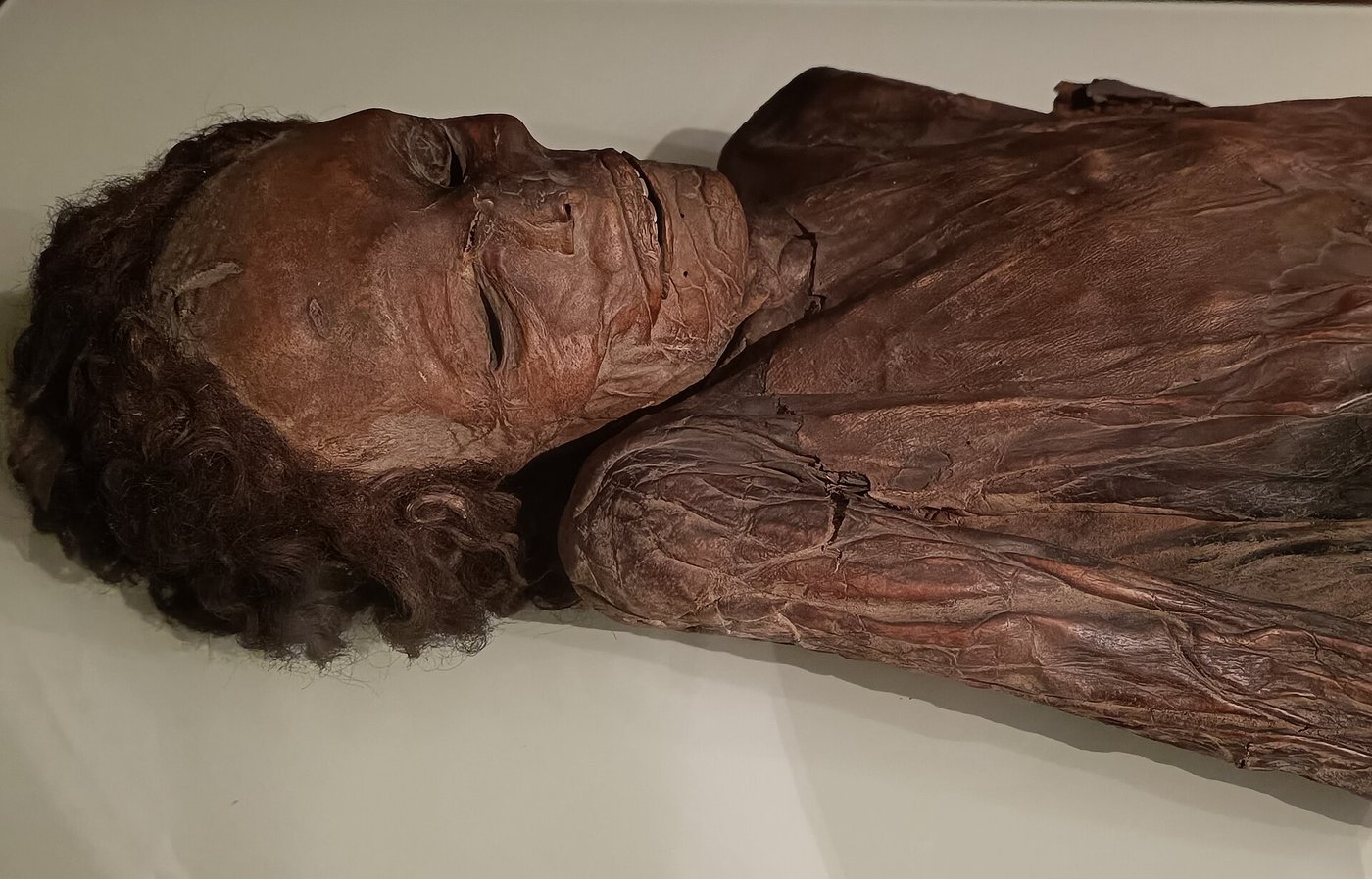
After the black mummies came the red, made roughly between 2500 and 2000 BC. The method grew less brutal on the body. Instead of taking the person wholly to pieces, the embalmers now made cuts to draw out the organs and dry the inside, then packed the cavities and set the body back into shape without the full disassembly of the older style. The skin was mostly left in place. The body was painted a deep red with ochre, the face often left black, and a long wig of black hair, sometimes hanging past the shoulders, was fixed to the head with a clay cap. Where the black mummies are grave and statue-like, the red ones can look almost asleep.
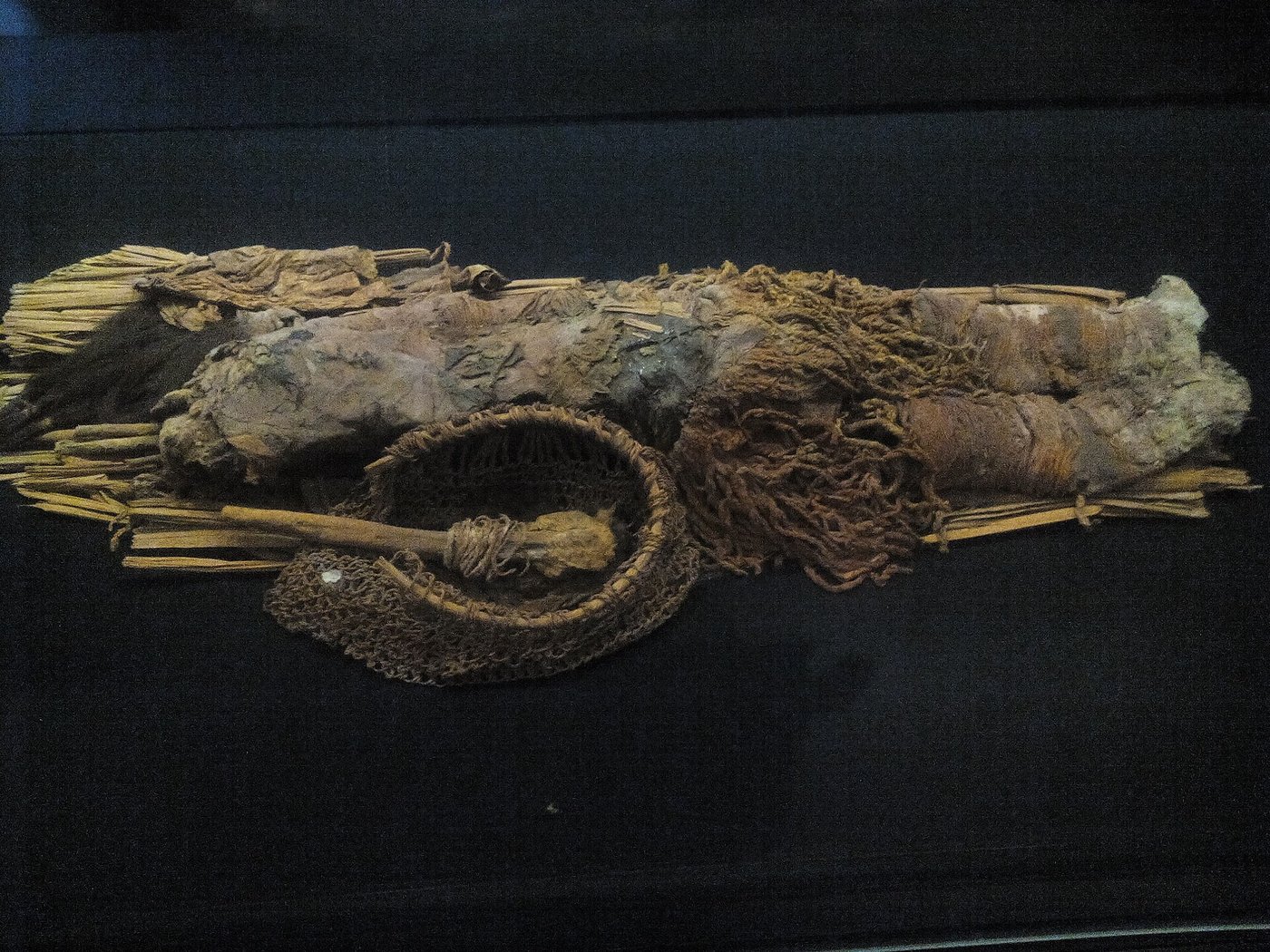
Alongside and after these ran simpler treatments. In the mud-coated style, a body was cemented into its grave under a thick paste of mud, sand and a binder that set almost like plaster, fixing it in place rather than lifting it out to be shown. There was a rare bandage style, known from only a handful of infants, that split the difference. Taken together, the sequence tells you this was never a single fixed rite handed down unchanged. It was a living tradition, argued over and revised across a hundred generations, the way any craft is.
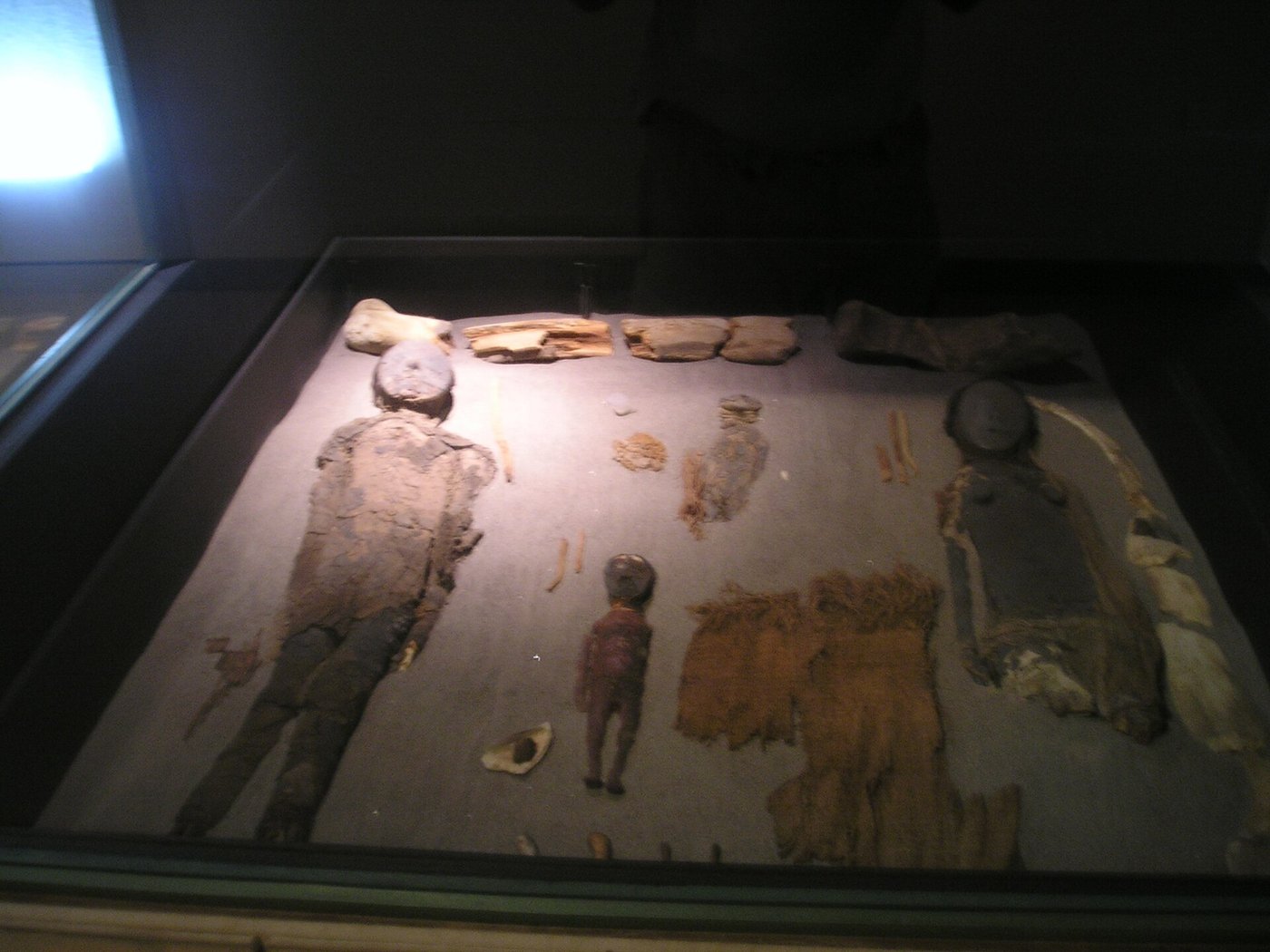
The scale of it only lands when you dig a single cemetery. At the site called Morro-1, on a hill above Arica, excavators lifted ninety-six individuals from the ground: fifty-four adults and forty-two children. Across all the known Chinchorro sites, something on the order of 280 prepared individuals have been recovered and studied. These are not the tombs of a ruling family. They are whole communities, the old and the newborn side by side, every one of them given the same patient, extraordinary work. No other people we know of mummified so widely across the whole of their society, and none did it so early.
Everyone was worth keeping
This is the thing that makes the Chinchorro strange even among the peoples who preserved their dead. Almost everywhere else that mummification appears (Egypt, the later Andes, dynastic China), it marks status. It is a thing done for the important, a way of saying this person outranked ordinary death. Among the Chinchorro there is no sign of that. Men and women, elders and infants, the whole and the stillborn all received the treatment, and the youngest often got the most care of all.
That points to a society without much of a ladder to climb: no kings whose deaths mattered more than a fisherman's, no priests guarding the rite as a privilege. The skill was real and specialised (someone in each band knew how to do this, and did it well), but the result was not rationed. If your child died, your child could be made to last, whoever you were. In a world that had not yet invented the pharaoh, death had not yet been sorted into ranks.
The popular picture of mummification is thoroughly Egyptian: a priestly craft, centuries in the making, reserved for kings and the very rich, wrapped up with an elaborate theology of the soul, the underworld and the weighing of the heart. On that picture, preserving the dead is a mark of a complex state, something only a society with rulers, scribes and temples could invent, a late and sophisticated achievement of high civilisation.
The Chinchorro break the picture in half. They were preserving their dead two thousand years before Egypt, with no state, no writing and no ruling class: small bands of fishers on a desert shore. And they did it for everyone, beginning with the babies, not for an elite. Whatever mummification is, it is not a thing that only kingdoms can produce. The oldest impulse to keep the dead close does not come out of power or theology at all. It comes from people standing over a body they were not ready to give up.
Poison in the water, grief in the work
Why here? Why these people, and why so many of their children? The most striking answer on the table has to do with the water itself. The rivers that feed the Camarones valley run over rock rich in arsenic, and the groundwater there carries some of the highest natural arsenic levels ever measured for a place where people lived, in parts far above what any modern authority would allow near a tap. Long-term arsenic poisoning does its worst to the unborn and the newly born: it raises the rates of miscarriage, stillbirth and infant death.
The archaeologist Bernardo Arriaza, who has spent much of his career with these mummies, has argued that this is no coincidence. A people losing an unusual number of babies, without any idea why, might respond by refusing to surrender those small bodies to the ground: by keeping them, working over them, making them beautiful and permanent. On that reading, the reason the oldest mummies are so often infants is the simplest and saddest one. They are the dead the living could least bear to lose.
In a study published at the end of 2025, Arriaza pushed the idea further, describing the practice as something close to grief work, even a kind of art therapy for whole communities. The prepared body, he suggested, became a canvas for feeling, a way to hold on, to make meaning, to find comfort in the shaping of a loss into an object you could keep. It is impossible to prove what a Stone Age fisherman felt over a dead child. But it is hard to look at the care in these figures (the modelled faces, the fitted wigs, the repainting years on) and not see something we would recognise.
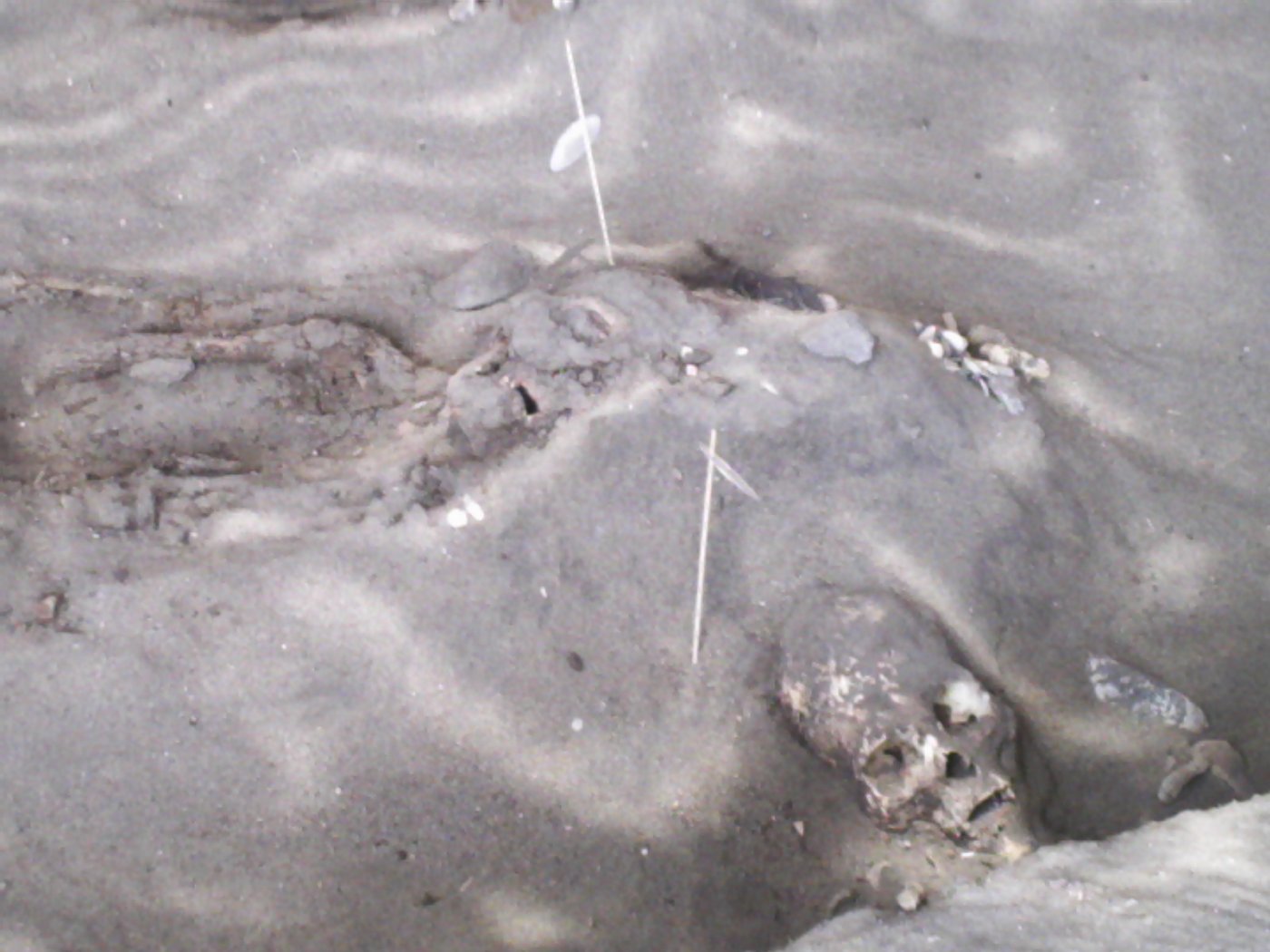
For decades the Chinchorro have held the title of the world's oldest artificial mummies, and for artificial mummies (bodies deliberately taken apart, treated and rebuilt) the claim still stands. But "oldest" is a slippery word. Natural mummies, dried by chance in the same desert, run older still; the so-called Acha Man from near Arica was preserved by the environment alone around 7000 BC, with no human hand involved. And in 2025 researchers argued that hunter-gatherers in southern China and Southeast Asia were smoke-drying their dead more than twelve thousand years ago, reading it from the crouched, scorched positions of the bones. If that holds, the idea of preserving the dead is older than the Chinchorro. What no one has matched is the sheer craft of what these fishermen did, and how early they did it.
How we know any of this
The Chinchorro left no records, so everything here is read off the bodies and the ground around them. Local people had long known the desert gave up the dead; a Chilean teacher noted them in a newspaper in 1910. But the science begins with the German archaeologist Max Uhle, who worked the Arica sites in the mid-1910s and was the first to recognise that these were not stray burials but a distinct and very ancient culture with a mummifying tradition all its own. He gave the Chinchorro their place in the record.
Everything since has sharpened the picture rather than overturned it. Radiocarbon dating fixed the sequence and pushed the earliest artificial mummy back past 5000 BC. CT scanning lets researchers look inside the figures without unmaking them, tracing the sticks, the packing and the reassembly the embalmers used. Chemical work on the bones gave up the sea-heavy diet and the arsenic. Genetics tied the Chinchorro into the wider peopling of the Pacific coast. Piece by piece, a people with no writing have been made to tell a remarkably full story.
Because there is no text, the mummies are the document. A single figure can be read on many levels at once: the style dates it, the radiocarbon pins the date, the CT scan shows the technique, the isotopes in the bone give the diet, the arsenic in the tissue points to the water, and the age at death (so often an infant's) hints at why the work was done at all. This is history without a single written word in it, assembled entirely from what a body can be made to say. It is also why the mummies matter so much as objects, and why losing them to damp and bacteria would mean losing the archive itself.
The slow unmaking
Which brings the story back to where it started, to the mummies going soft in their cases. For seven thousand years the Atacama did the preserving for free; the desert was the embalmer's silent partner, and as long as the air stayed dry the work held. That bargain is now breaking. Arica has grown, the sea air and rising humidity have reached the collections, and the bacteria that were always harmlessly present on the skin have finally been handed the moisture they needed to begin their own slow taking-apart of the bodies. The people who defeated decay for longer than any others on Earth are, at last, decaying.
In 2021 the Chinchorro sites and their mummification tradition were made a UNESCO World Heritage site, a recognition that arrived, as these things do, alongside the worry of losing them. Museums in Arica are learning to hold the humidity down, to keep the archive intact a while longer. But the deeper point is hard to shake. These figures were made by people who could not bear to let their dead disappear, and who found a way to keep them present for a span of time that beggars belief. Now it falls to strangers, seven thousand years on, to try to do the same thing for them: to hold off the ordinary rot of the world a little longer, for a child from Camarones whose name no one will ever know, and whose family made sure, against every odd, that we would still be looking at the shape of them today.
Read next: The Tarim Mummies: The Desert Dead Who Were Not Who Anyone Expected and Guanches: The Canary Islanders Who Lost the Sea That Brought Them.
Sources & further reading
- Bernardo T. Arriaza, Beyond Death: The Chinchorro Mummies of Ancient Chile (Smithsonian Institution Press, 1995) — the standard book-length account by the field's leading scholar.
- Bernardo T. Arriaza et al., Cambridge Archaeological Journal (2025), on Chinchorro mummification as an emotional response to grief and infant loss.
- Bernardo T. Arriaza et al., “Environmental arsenic exposure and its role in the Chinchorro mummification practice,” on the arsenic hypothesis in the Camarones valley.
- Marcela Sepulveda and colleagues, and R. Mitchell (Harvard), reporting on the microbial degradation of Chinchorro mummies as humidity rose in Arica.
- UNESCO World Heritage Centre, “Settlement and Artificial Mummification of the Chinchorro Culture in the Arica and Parinacota Region” (inscribed 2021).
- Max Uhle, early reports on the Arica burials (1910s), the first scientific description of the culture.
Image credits (via Wikimedia Commons): black Chinchorro mummy — WeHaKa (CC BY-SA 4.0); Caleta Camarones coast — Yastay (CC BY-SA 4.0); red Chinchorro mummy — WeHaKa (CC BY-SA 4.0); mummy heads, Arica — Zorka Ostojic Espinoza (CC BY 2.0); mummies at the San Miguel de Azapa museum — Heretiq (CC BY-SA 2.5).