Climb the low ridge east of Şanlıurfa on a bright morning in the summer of 2023, past the gazelle country and the outcrops of hard limestone, and you come to a pit cut down into the living rock. Stand at its edge and something looks back. Set into the wall, at head height, is a human face carved out of the bedrock: a long neck, a heavy chin, eyes turned toward a row of stone shafts that rise from the floor like a silent congregation. Nobody wrote down why it is there. Nobody could have. The face was cut into that rock roughly eleven and a half thousand years ago, by people who had no pottery, no metal, no writing, and, as far as anyone can tell, no farms. It has been watching that empty room since before the first field was ever sown.
The place is called Karahan Tepe, the “black hill”, and for most of the last century it was a scatter of stones that shepherds walked past without a second look. Today it is one of the most argued-over sites in the study of how human beings first came together in large numbers. It sits about forty-six kilometres from its more famous neighbour, Göbekli Tepe, and it is telling a stranger version of the same story. The short form of that story is this: the monuments came first, and the villages came after. That is the wrong way round from everything textbooks said for a hundred years, and Karahan Tepe is one of the reasons the textbooks are being rewritten.
A black hill in the Urfa country
The site lies in the Tektek Mountains of Şanlıurfa Province in south-eastern Turkey, a dry upland of thin soil and stone where summers are fierce and water is scarce. It was noticed formally in 1997, when a survey team led by Bahattin Çelik recorded the stones poking through the surface and the worked pillars lying about. For years it was known but not dug: a name on a map, a promise of something underneath. Systematic excavation only began in earnest in 2019, under the archaeologist Necmi Karul of Istanbul University, as part of a wider Turkish programme.
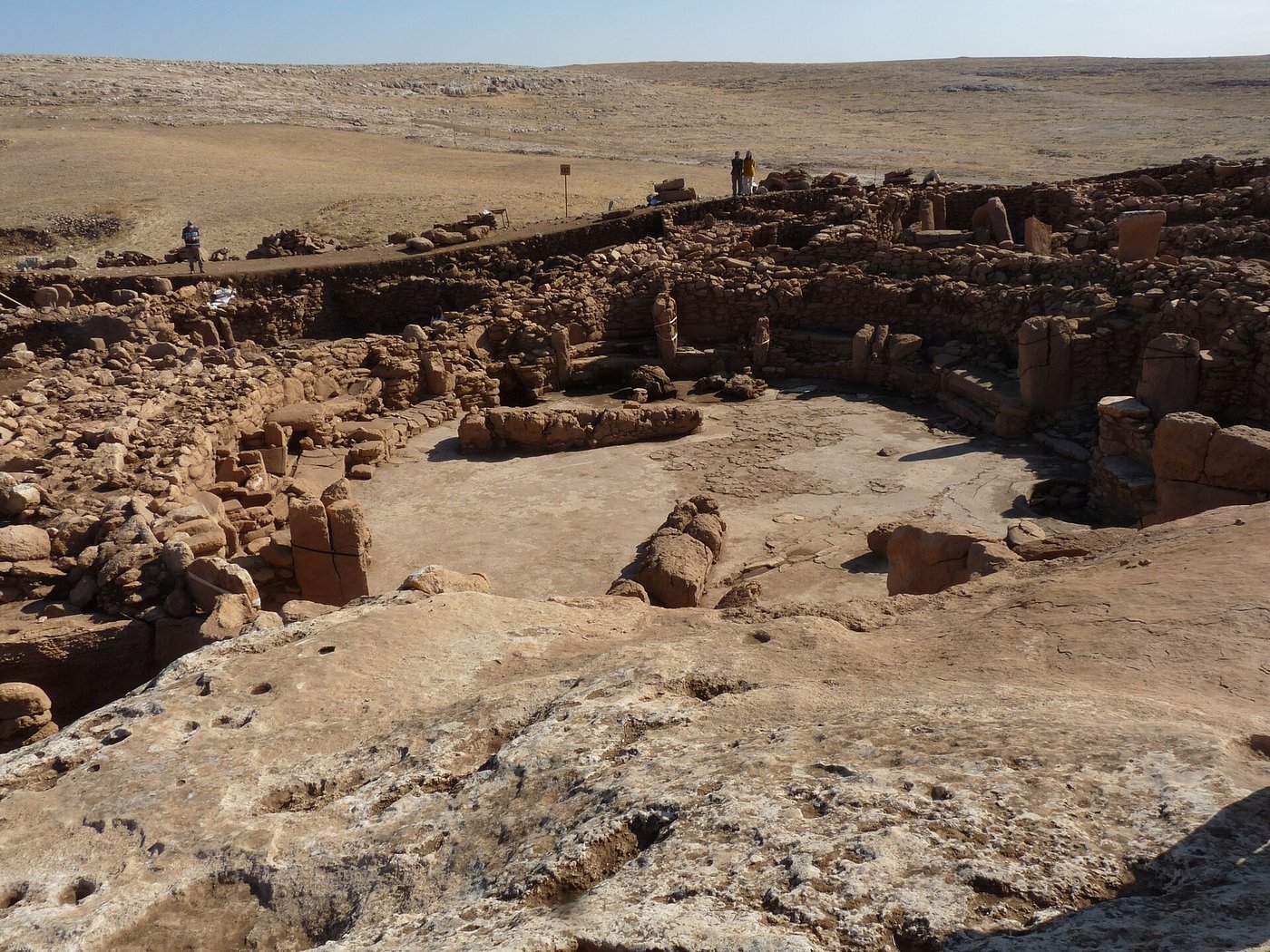
That programme has a name worth knowing: Taş Tepeler, the “Stone Hills”. It gathers together around a dozen related sites spread across the Urfa region, of which Göbekli Tepe was the first to be understood and Karahan Tepe is now the star of the second act. These were not isolated shrines dropped in the wilderness. They were a landscape of them, built by communities who shared a way of carving, a set of symbols, and a habit of raising heavy stone in a world that had not yet invented the wheel or the plough. Karahan Tepe covers close to ten hectares, and by some counts fifteen if you include the quarries where the stone was cut. As of the early excavations, only a small fraction of it had been touched.
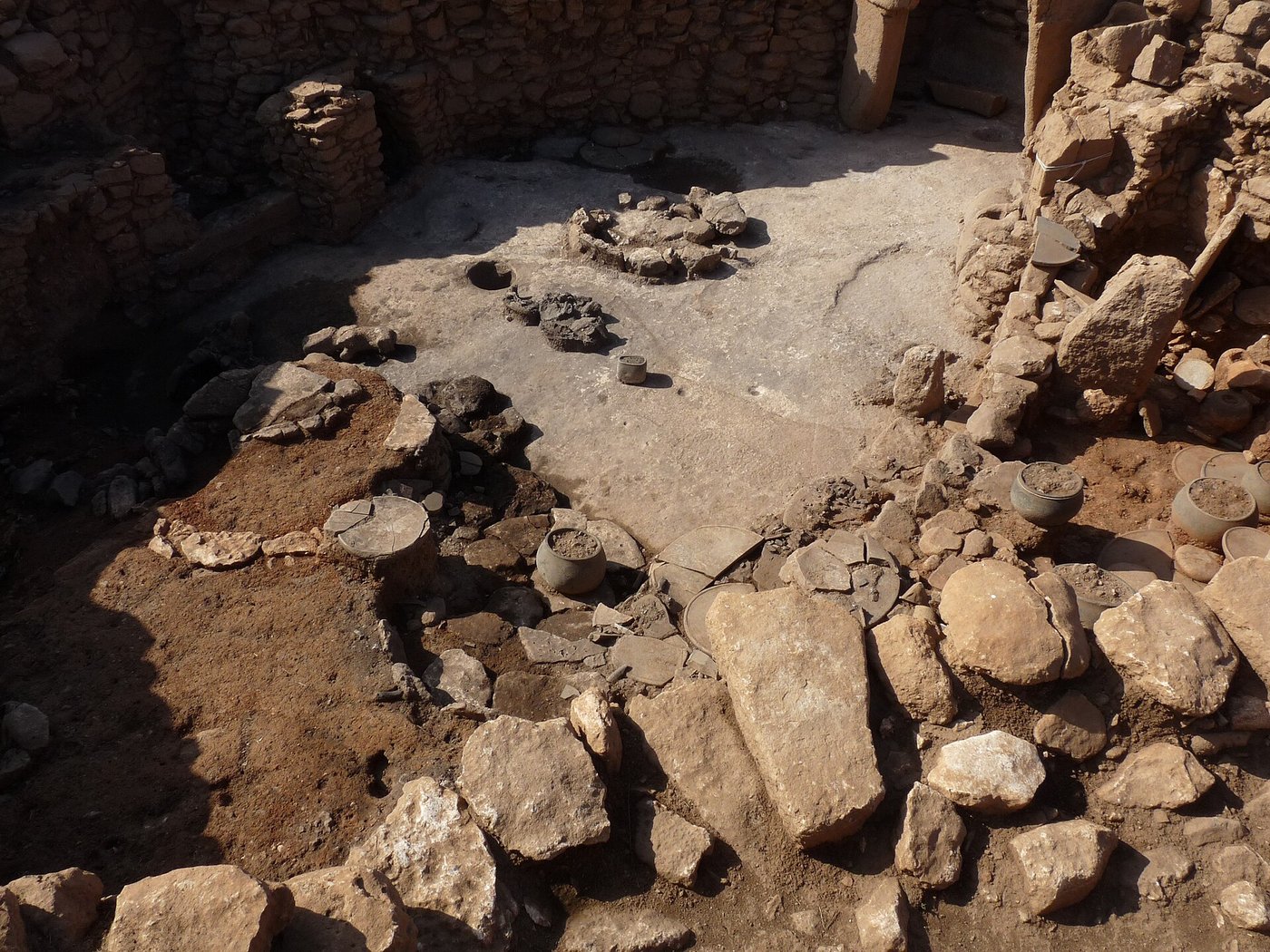
To understand why Karahan Tepe matters, you have to hold two dates in your head. The building here begins around 9500 BCE and the place is left quiet by about 9000 BCE. That is deep in the Pre-Pottery Neolithic, the long stretch before ceramics, before bronze, before anything most people picture when they hear the word “ancient”. The pyramids of Giza are closer in time to us than they were to the people of Karahan Tepe. Stonehenge would not be raised for another six thousand years. When the head was cut into that wall, the last ice age had only recently loosened its grip on the world.
Carved down, not built up
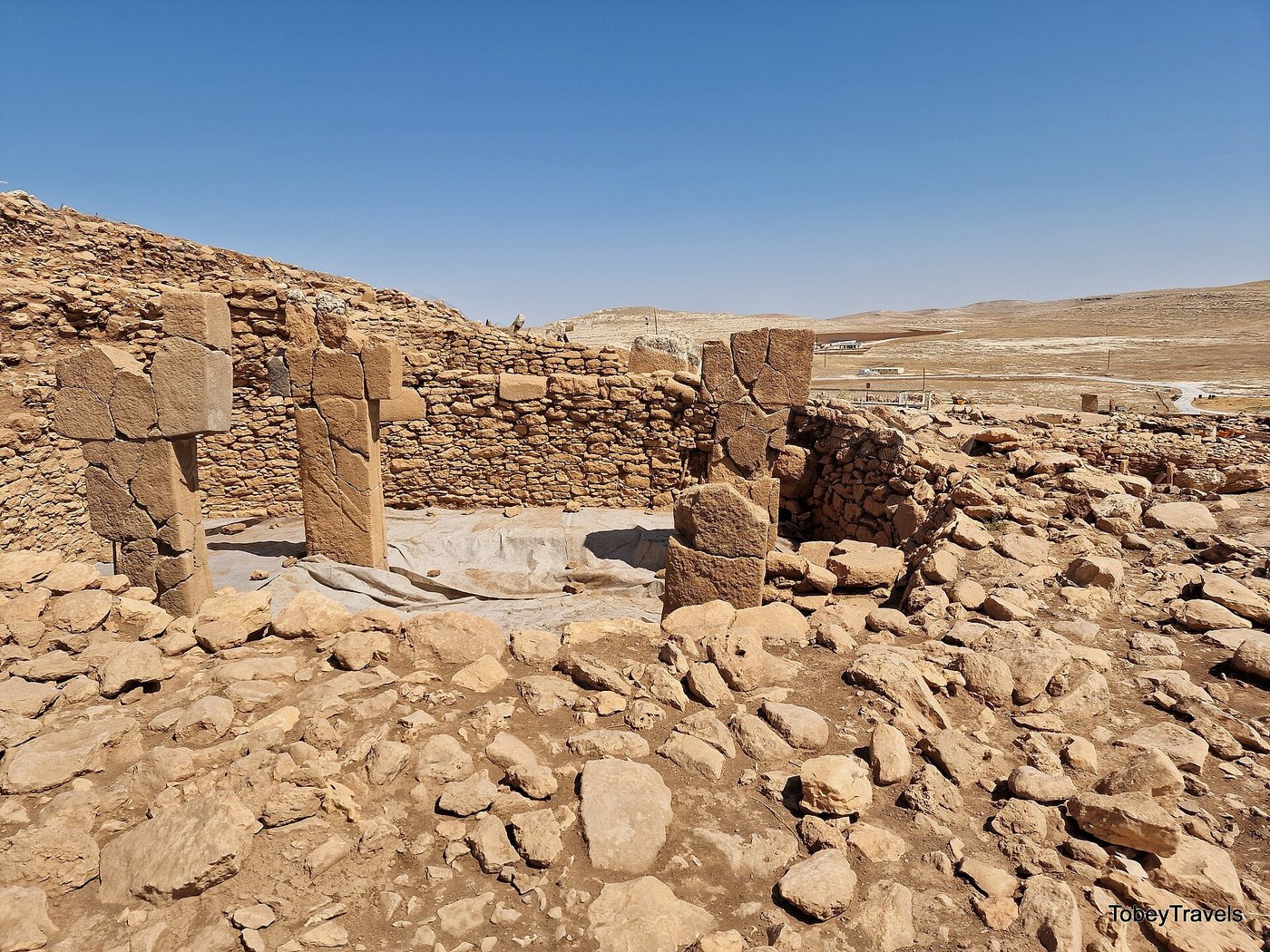
Most great buildings of the past were assembled, stone laid on stone, course by course, until a wall stood where there had been air. Karahan Tepe works the other way. Many of its most striking structures were cut down into the bedrock, hollowed out of the solid limestone of the hill like rooms scooped from a block. The pillars inside were not carried in and stood up. They were left standing when the rock around them was carved away, so that a shaft of stone rises straight out of the floor it belongs to, still joined at the root to the hill itself.
This is a punishing way to make a room. There is no undo. A builder stacking blocks can pull one down and try again; a carver cutting a pillar from bedrock has one attempt, and a slip of the flint takes off a piece that cannot be put back. That the people of Karahan Tepe chose this method, again and again, tells you the work mattered enormously to them. It also tells you they had organised labour on a serious scale, because hollowing rooms out of a hillside with stone tools is not a job for a family. It needs a crowd, fed and directed and kept at it across seasons.
The signature technique at Karahan Tepe is subtractive: the builders removed rock rather than adding it. Pillars stand where the surrounding stone was chiselled away, still rooted to the bedrock beneath. It is the opposite of masonry, and it leaves no margin for error: every shaft is a single, unrepeatable cut.
The pillars themselves are the family resemblance that ties Karahan Tepe to Göbekli Tepe. They are T-shaped: a tall upright with a broad slab across the top, and on many of them the crossbar reads unmistakably as a head above a body. Arms are carved down the sides, hands brought together at the front, sometimes a belt or a fox-pelt loincloth picked out in low relief. These are not columns holding up a roof. They are figures: stylised, faceless, gathered in rings and rows, standing in the rooms like an assembly frozen mid-rite. More than two hundred and sixty of these stelae have been counted at the site.
The room that watches back
The most haunting space at Karahan Tepe is the one the excavators labelled Structure AB. It is a pit building, round, cut into the rock, and its floor holds a crowd of tall shafts standing shoulder to shoulder: not the broad T-pillars of the other rooms but narrow, upright pillars, closely set, filling the chamber. There are around a dozen of them. And in the wall, emerging from the stone at the level where a standing person’s face would be, is a carved human head with its neck stretched forward into the room, as if leaning out to look at the pillars gathered in front of it.
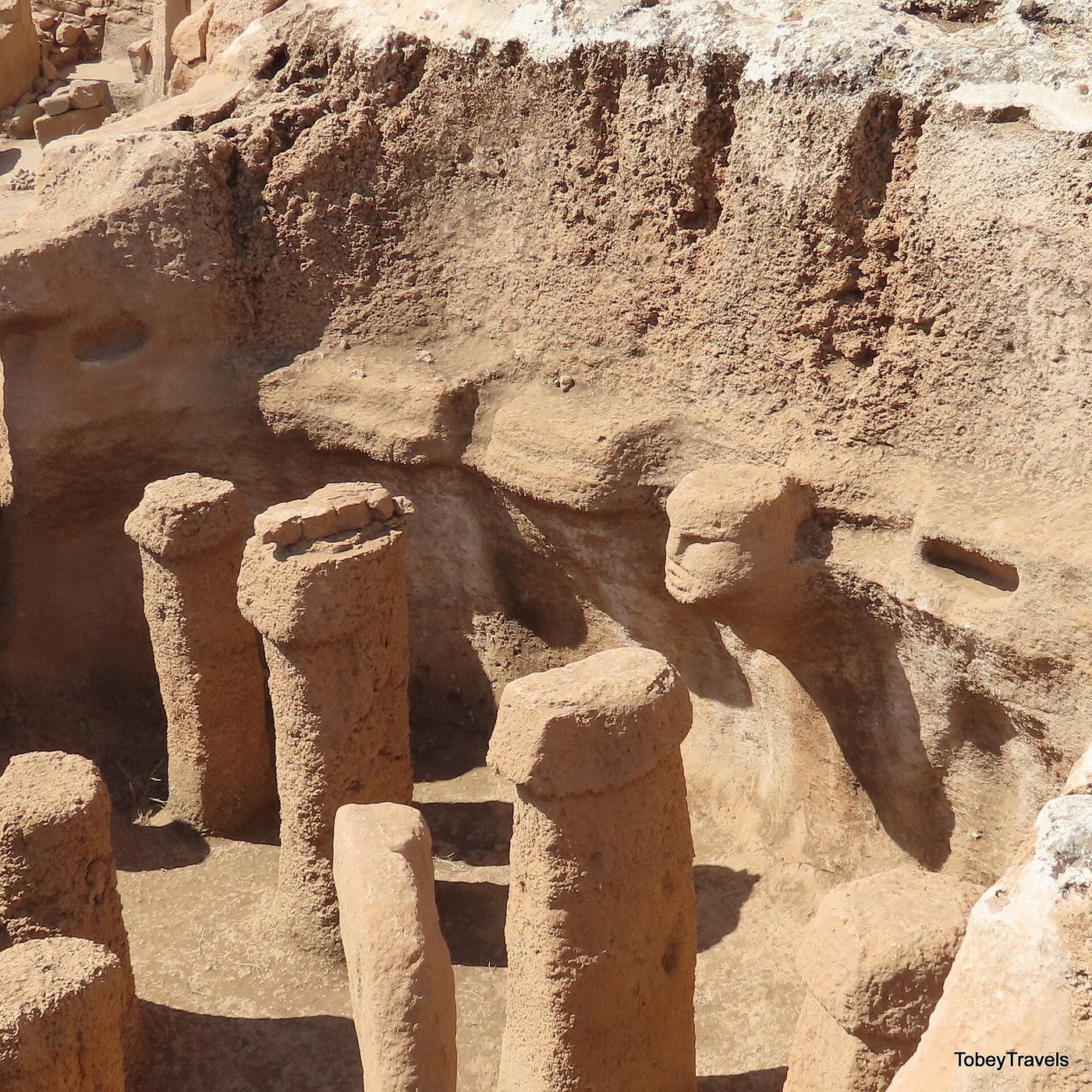
Next to the head is an opening, a kind of porthole cut through the wall into the neighbouring chamber. The arrangement has an unmistakable sense of choreography to it. Someone in the next room could pass through that opening, or reach through it, or be seen through it; the head watches the threshold as much as the pillars. What ceremony ran through this room is lost. But the design is deliberate to the last detail, and it was meant to do something to the people who came into it.
Read the tightly-packed pillars of Structure AB as figures (which the wider site invites) and the carved head becomes an audience of one, a face set to watch a standing crowd it will never join. Some researchers see the shafts as phallic, the room as a place of fertility or initiation; others read the whole scene as ancestors gathered before a watcher. The stone will not say. What is not in doubt is that the effect was arranged on purpose.
Here is the thing that unsettles people about that face. It is not a god on a throne or a king on a monument. It has no name we can recover and no story we can read. It is simply a human likeness, cut into a wall by human hands, placed to watch a room, and it has kept that watch for a hundred and fifteen centuries, through the invention of farming, of cities, of empires, of every religion now practised on earth, none of which existed when it opened its eyes. It is one of the oldest deliberate human faces we have that was made to look at us rather than to be looked at.
The man they lifted from the floor
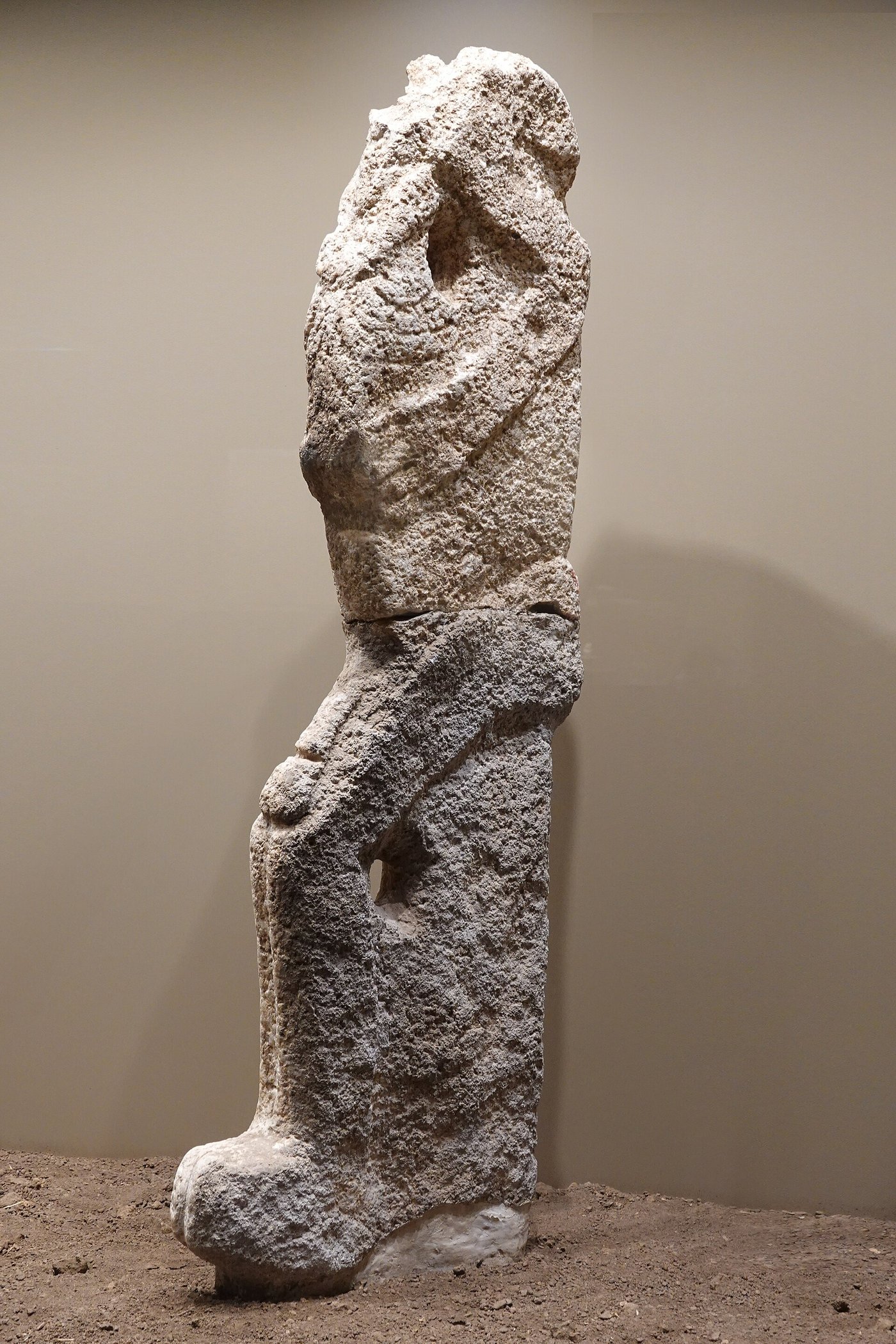
In 2023 the excavations at Karahan Tepe produced something that made the news far beyond archaeology. In one of the buildings, fixed upright as though seated, was a life-size statue of a man: about two and a third metres tall, cut from stone, naked, his hands brought to his front and his ribs marked in deep incised lines down his chest. A V-shaped collar was carved around his neck. The face is set in an expression that reads, to modern eyes, as strain or intensity; the ribs give it a gaunt, almost hungry look. It is one of the most realistic human figures known from the entire Pre-Pottery Neolithic, and it had been placed in the room deliberately, part of the furniture of whatever happened there.
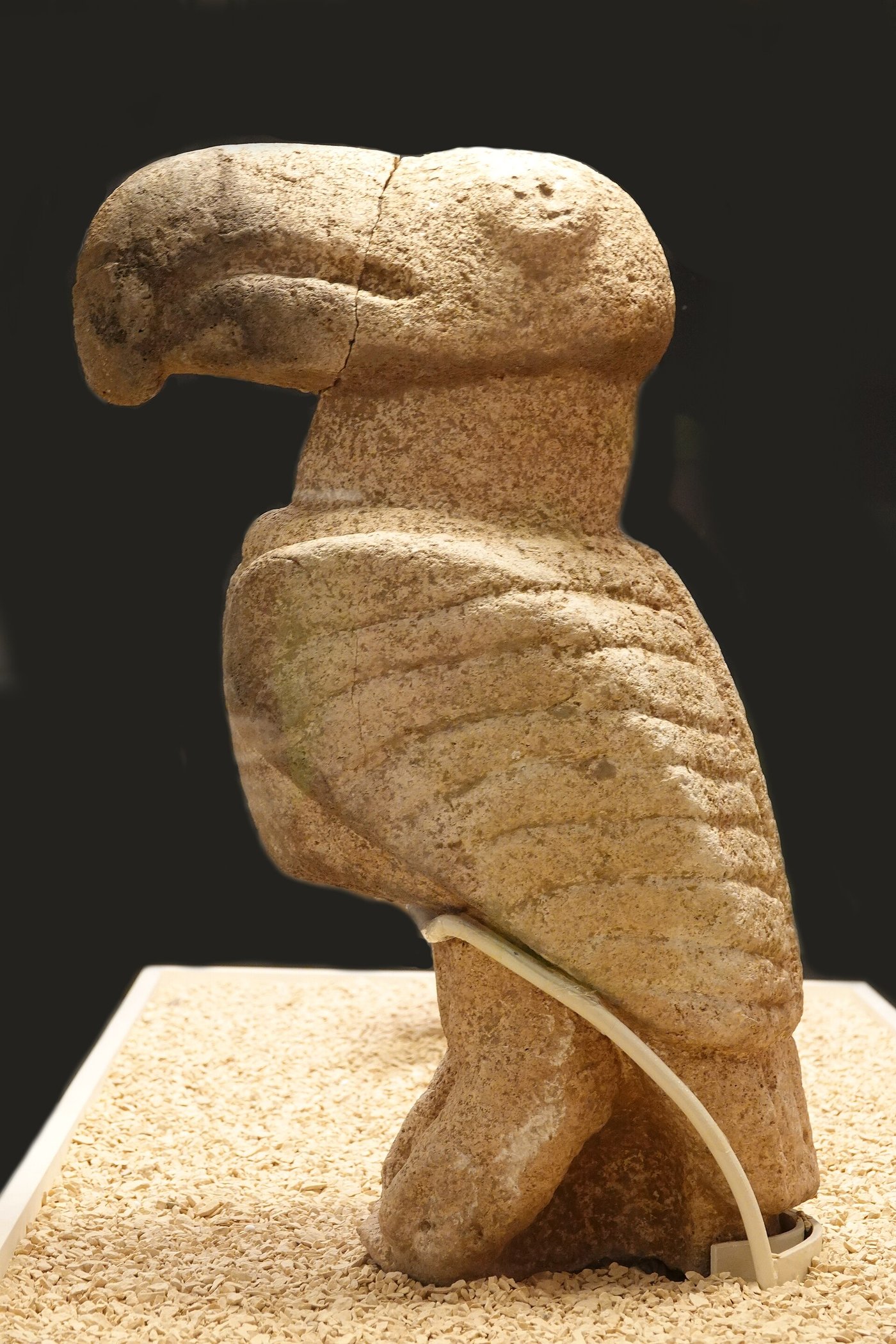
Beside the human figures came the animals. A vulture, carved in stone, its shape squat and heavy and immediately readable; birds of this kind carry weight all across the Taş Tepeler world, and at Göbekli Tepe vultures appear again and again in scenes that seem to touch on death and the treatment of the dead. There are leopards or big cats worked onto statues, snakes, and other creatures whose meanings we can only circle. What is clear is that the people here did not carve at random. They carved a fixed cast of characters (certain animals, certain postures, the human form itself) over and over, across sites separated by a day’s walk, which is what a shared belief looks like when it is written in stone instead of words.
Older than the first fields
For most of the twentieth century, the story of how civilisation began ran in a tidy order. First people learned to farm. Farming gave them surplus food. Surplus food let some of them stop foraging and specialise: as priests, as builders, as rulers. Out of that surplus grew towns, temples, hierarchy, everything we call complex society. Religion and monuments came at the end of the chain, as luxuries a full granary could finally afford. It was neat, it made sense, and Karahan Tepe helps take it apart.
The people who cut these rooms and raised these pillars were, on the evidence, still hunter-gatherers. Their bones and rubbish speak of gazelle, of wild plants and legumes, of a life lived off what the land gave rather than what a plough forced from it. Cereal farming as a settled way of life was not yet established here when the building began. And yet these foragers organised the labour, the planning and the sheer sustained effort to hollow monumental rooms out of bedrock and fill them with carved figures. The surplus theory has the order backwards. Here, the gathering and the building seem to have come first, and the pressure of feeding the crowds who gathered may itself have been one of the nudges toward farming, not the reward for it.
The myth: agriculture had to come first. People needed farms and food surpluses before they could ever spare the labour to build monuments or organise religion.
The reality: at Karahan Tepe, hunter-gatherers were carving monumental rooms out of solid rock centuries before settled farming took hold in the region. The building came first. The pull of large gatherings may have helped drive people toward farming, rather than farming making the gatherings possible.
None of this means Karahan Tepe was a “temple” in the way we would use the word, with a doctrine and a priesthood and a name for its god. That is reading our own furniture into a room eleven thousand years old. What the site shows is subtler and, in a way, larger: that the drive to gather, to mark a place as special, to make images of ourselves and the animals we feared and needed, runs deeper in us than farming does. It was there before the fields. It may even have helped make the fields necessary.
What the hill still holds
The honest headline about Karahan Tepe is how little of it has been dug. Only a small percentage of the site has been excavated; the great majority still lies under the soil, unread. Every season that changes the picture. The seated man, the vulture, the head in the wall: these are the finds from the first few years of serious work on a hill that may hold decades more. Anyone who tells you they know what Karahan Tepe meant is guessing ahead of the evidence, and the evidence is still coming out of the ground.
Excavation at Karahan Tepe began in 2019 and, after several seasons, only a small fraction of the roughly ten-hectare site has been opened. The Taş Tepeler survey has identified around a dozen related sites across the Urfa region, most of them barely touched. What has been found so far is, by any measure, the thin edge of the thing.
There are hard questions still open. How were these rooms roofed, if they were roofed at all? Were the pit buildings filled in deliberately when their use ended, the way Göbekli Tepe’s enclosures appear to have been buried? How many people did it take to feed a gathering large enough to carve a hillside, and where did they come from? Were the tightly-packed pillars of Structure AB ancestors, spirits, initiates, the dead, or something we have no word for? The dating itself, tied to the wider Pre-Pottery Neolithic sequence, is still being refined as more of the site is read.
What Karahan Tepe has already done is change the shape of a question. We used to ask what farming let people build. Now we have to ask what people were building before farming, and why the urge to raise stone and carve a face into it arrived so early, in a dry hill country, among foragers who had barely put down roots. The head in the wall does not answer. It only keeps looking: at an empty room, at the excavators, at the slow return of a place that spent eleven thousand years underground and is only now, room by room, coming back into the light.
Read next: Trypillia: The 6,000-Year-Old Cities That Burned Themselves Down and Poverty Point: The Colossal Mounds Nobody Was Ordered to Build.
Sources & further reading
- Necmi Karul, “Buried Buildings at Pre-Pottery Neolithic Karahantepe,” Türk Arkeoloji ve Etnografya Dergisi (reports on the Taş Tepeler excavations).
- Karul, N., et al., excavation reports of the Taş Tepeler Project, Turkish Ministry of Culture and Tourism.
- Klaus Schmidt, Göbekli Tepe: A Stone Age Sanctuary in South-Eastern Anatolia — background on the wider “Stone Hills” culture and the T-shaped pillar tradition.
- Şanlıurfa Archaeology Museum, exhibits and catalogue entries for the Karahan Tepe statue and vulture sculpture.
- Reports on the 2023 discovery of the life-size seated statue at Karahan Tepe, Anadolu Agency and Turkish Ministry of Culture and Tourism announcements.
Image credits (via Wikimedia Commons): Karahan Tepe site overview and excavated structures — Frantisek Trampota (public domain); T-shaped pillar enclosure and Structure AB carved head — tobeytravels (CC BY-SA 4.0); seated statue and stone vulture, Şanlıurfa Archaeology Museum — Marco Restano (CC BY-SA 4.0).