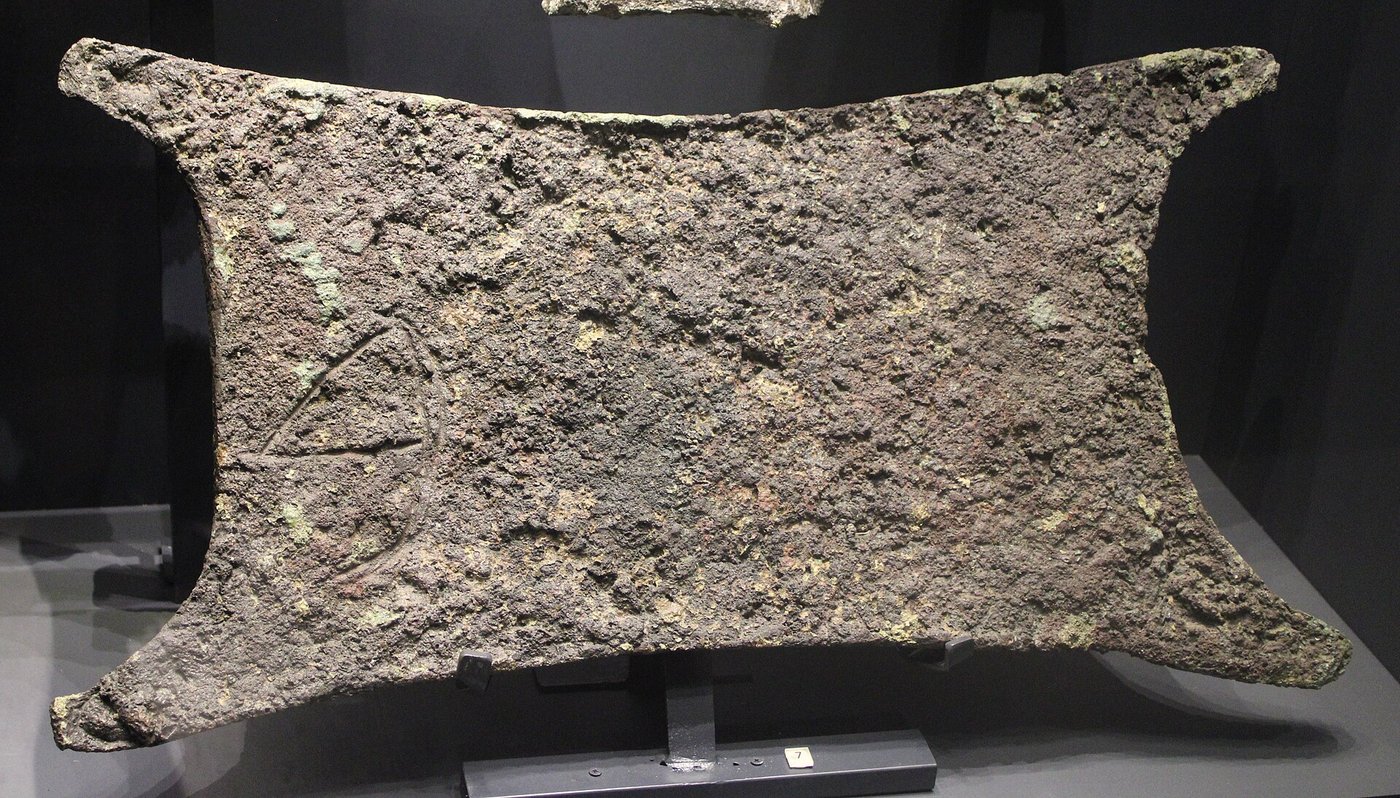
In the summer of 1982 a young sponge diver named Mehmed Çakır surfaced off the Turkish coast near Bodrum and told his captain he had seen “metal biscuits with ears” lying on the seabed. He drew them in the air with his hands: flat slabs, pinched at the four corners, the size of a hearthstone. The captain had been briefed. For years the Institute of Nautical Archaeology had asked local divers to report anything odd on the bottom, and this was exactly the shape they had described. The biscuits with ears were copper ingots. They had been sitting at the foot of a rocky cliff called Uluburun, sixty metres down, for roughly three thousand two hundred years.
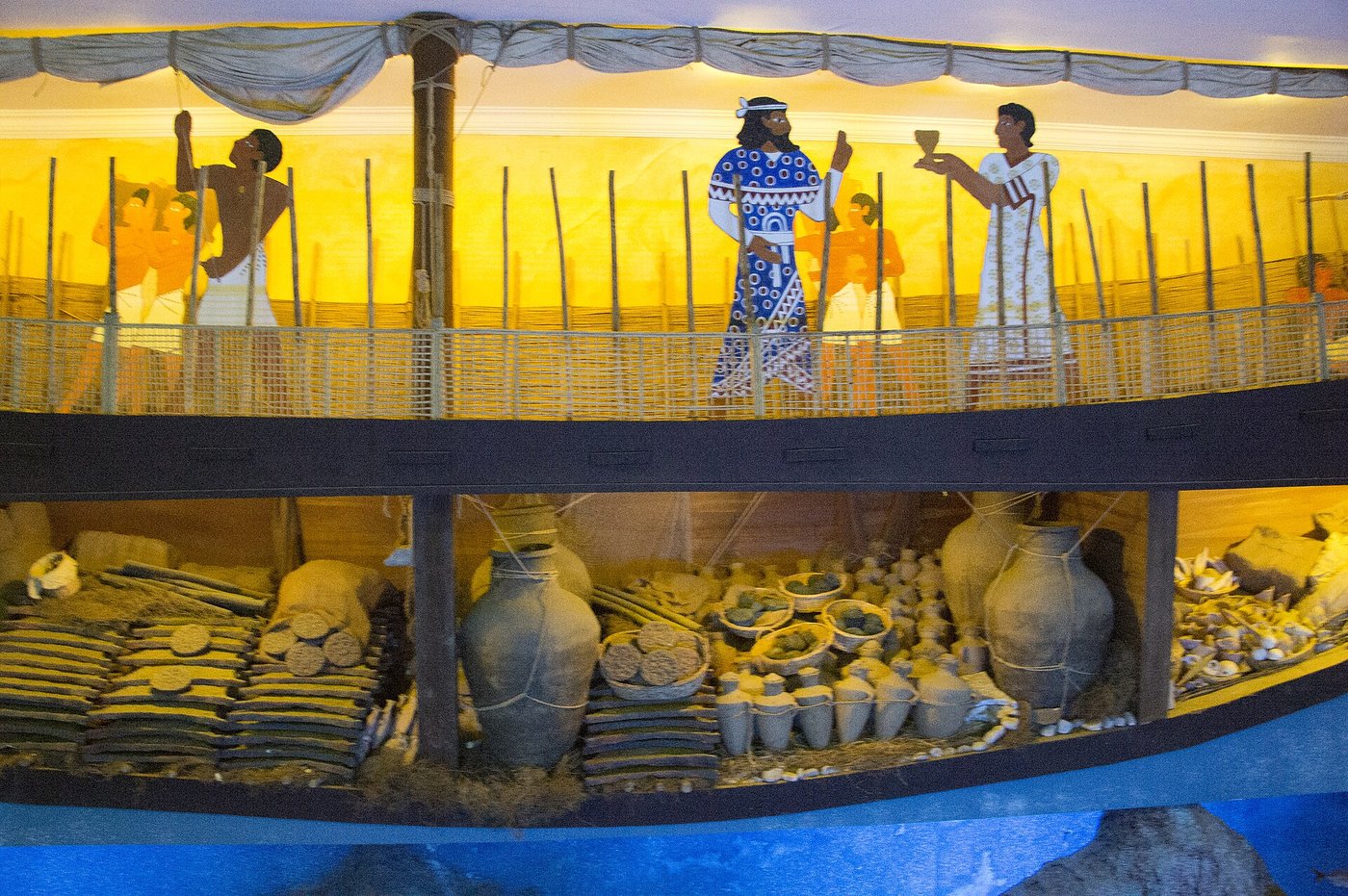
What Çakır had found was a ship. Not much of the wood was left, but the cargo was almost all there, tipped down the slope in the order it had spilled when the hull broke apart. Over the next eleven years divers would bring up glass the colour of a deep sky, ivory from two kinds of animal, a gold beetle old enough to be an heirloom when it sank, and amber that had begun its life as resin on a pine tree beside a cold northern sea. One small merchant ship, going down in one bad moment, had gathered goods from three continents into a single hold.
The biscuits with ears
To understand why an experienced diver would bother mentioning a few lumps of metal, you have to know what an oxhide ingot is. In the Late Bronze Age, copper was cast into flat slabs with a handle-like point at each corner, so that the finished shape looked like the stretched hide of an ox pegged out to dry. The corners were not decoration. They were grips. A man could get a hand around each one and heave the slab, which weighed about the same as a large sack of cement, onto his shoulder or a pack animal.
These ingots turn up all over the eastern Mediterranean, painted on Egyptian tomb walls, stamped with marks, dropped in shrines. But nobody had ever found a whole shipload of them still stowed where the crew had placed it. When word reached George Bass, the American archaeologist who had spent his career arguing that shipwrecks should be dug as carefully as any tomb on land, he understood at once what a single undisturbed cargo could be worth. He ran the first survey dives in 1984. Then he handed the long job to a younger colleague, Cemal Pulak, who would live with the wreck for the next decade.
Eleven summers on a slope
The wreck was not in an easy place. It lay against a cliff that fell away underwater, with the shallowest finds at forty-four metres and the deepest scattered past sixty. At that depth a diver can work for only a few minutes before the clock on the air, and on the body, forces them up again. Pulak’s teams made the crossing over and over. By the end they had logged more than twenty-two thousand dives across eleven diving seasons, each one a short, cold, careful shift in the blue dark, fanning sand off objects that had not been touched since the reign of the pharaohs.
Nothing could be rushed. Every ingot, bead and bone was drawn in place before it was lifted, because the position of an object is half of what it can tell you. A gold cup on its own is treasure. A gold cup lying beside a set of merchant’s weights, under a layer of copper, above a scatter of figs, is evidence. Slowly the plan of the ship came back: the metal stowed low as ballast, the jars packed around it, the fine things tucked wherever there was room.
Roughly ten tonnes of copper in about three hundred and fifty-four oxhide ingots, plus a tonne of tin: together enough metal to cast some eleven tonnes of bronze, the raw material for an army’s worth of tools and weapons. Around it: about a hundred and seventy-five glass ingots, at least a hundred and forty-nine storage jars, ebony-like African logs, hippopotamus and elephant ivory, ostrich eggshells, Baltic amber, Cypriot pottery, a full carpenter’s tool kit, weapons from three cultures, and jewellery of gold, silver and electrum. It remains the richest single cargo of the Bronze Age ever recovered.
A ship built the old way
The vessel itself was modest: a merchantman about fifteen metres long, not a warship or a royal barge. What survived of it changed how we picture ancient boatbuilding. The keel and planks were cut from Lebanese cedar, and the planks were locked together edge to edge with hundreds of little joints: a tongue of oak, the tenon, slotted into a mortise cut in each plank and pinned with pegs. This is “shell-first” construction. The builders raised the skin of the hull first and fitted the frames inside afterwards, the opposite of how a modern wooden boat is made.
For a long time that technique was thought to be a Greek and Roman invention. The Uluburun ship pushed its history back by a thousand years. Under the cargo lay brushwood and thorny branches, packed in as dunnage so the sharp metal would not gouge the planking. And ranged along the wreck were twenty-four stone anchors, far more than one ship needs to moor. Anchors of that exact type are unknown in the Aegean but common in the temples of the Syrian and Cypriot coast, a quiet clue to where the ship belonged.
Ten tonnes of metal, and where it began
Bronze is copper mixed with a little tin, usually about nine parts to one, and the mixture is far harder than either metal alone. That is the whole reason the age is named for it. A civilisation that wanted bronze needed both ores, and the two rarely come out of the same ground. Copper was the easier problem. Chemical fingerprinting of the Uluburun ingots (matching trace elements and lead isotopes to ore bodies) points almost all of it to the mines of Cyprus, an island so tied to the metal that its name and the word copper share a root.
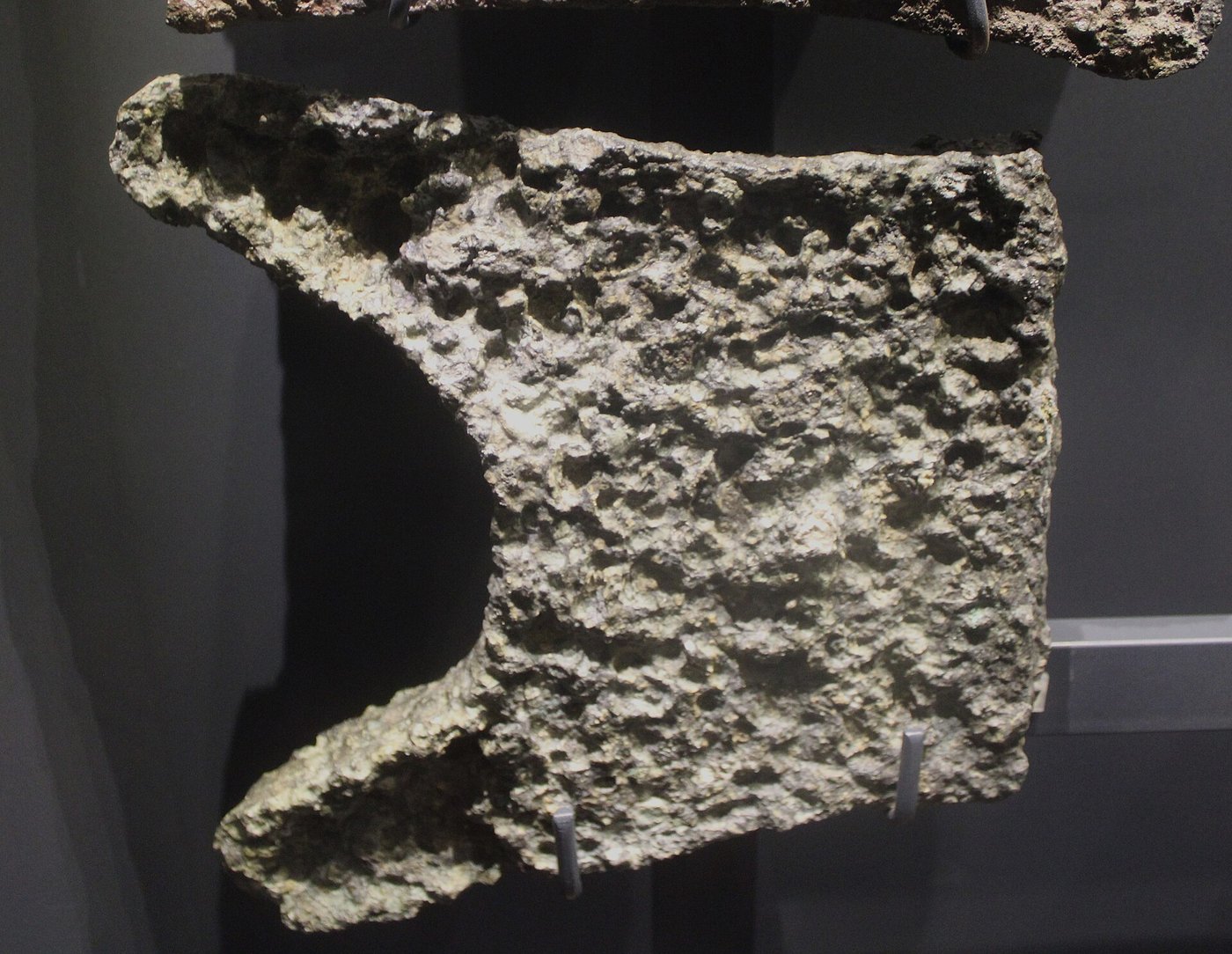
Tin was the hard problem, and it still is. There was about a tonne of it on board, cast in the same oxhide shape as the copper but in smaller slabs, some broken into halves and quarters for easier trade. Tin is scarce in the Mediterranean. To get it, the Bronze Age world had to reach a very long way, and reconstructing that reach has turned the Uluburun tin into one of the liveliest arguments in archaeology.
The tin that two teams place a world apart
In 2022 a group led by the geologist Wayne Powell published a confident answer. Working from tin isotopes and trace chemistry, they matched roughly a third of the Uluburun tin to a single mine called Mušiston, high in the mountains of what is now Uzbekistan, in Central Asia. The rest they traced to the Taurus range of southern Turkey. If they were right, a tin ingot in that hold had crossed some two thousand kilometres of mountain and steppe, changing hands through many traders who had no idea where it started or where it would end, before it was loaded onto a ship bound the other way.
Within a year another team pushed back hard. Daniel Berger and his colleagues re-read the same isotope numbers and argued they fit a very different source: the tin fields of Cornwall, in south-west Britain, whose ore was already moving into the Mediterranean by this date. The disagreement is not a small one. One reading sends you east to the roof of Asia; the other sends you north-west to a rainy corner of Europe. Both cannot be right, and the science that was supposed to settle the question has instead sharpened it.
The honest position today is that we do not know where most of the Uluburun tin was mined. Isotope studies can rule places in and out, but the ore bodies overlap in their chemistry and many of them were worked out and forgotten long ago, leaving nothing to compare against. What everyone agrees on is the important part: the metal came from very far away, through a chain of hands no single person could have seen from end to end. Whether the far end was Uzbekistan or Cornwall, the ship is proof that Bronze Age tin travelled across a continent to reach the sea.
The rest of the hold
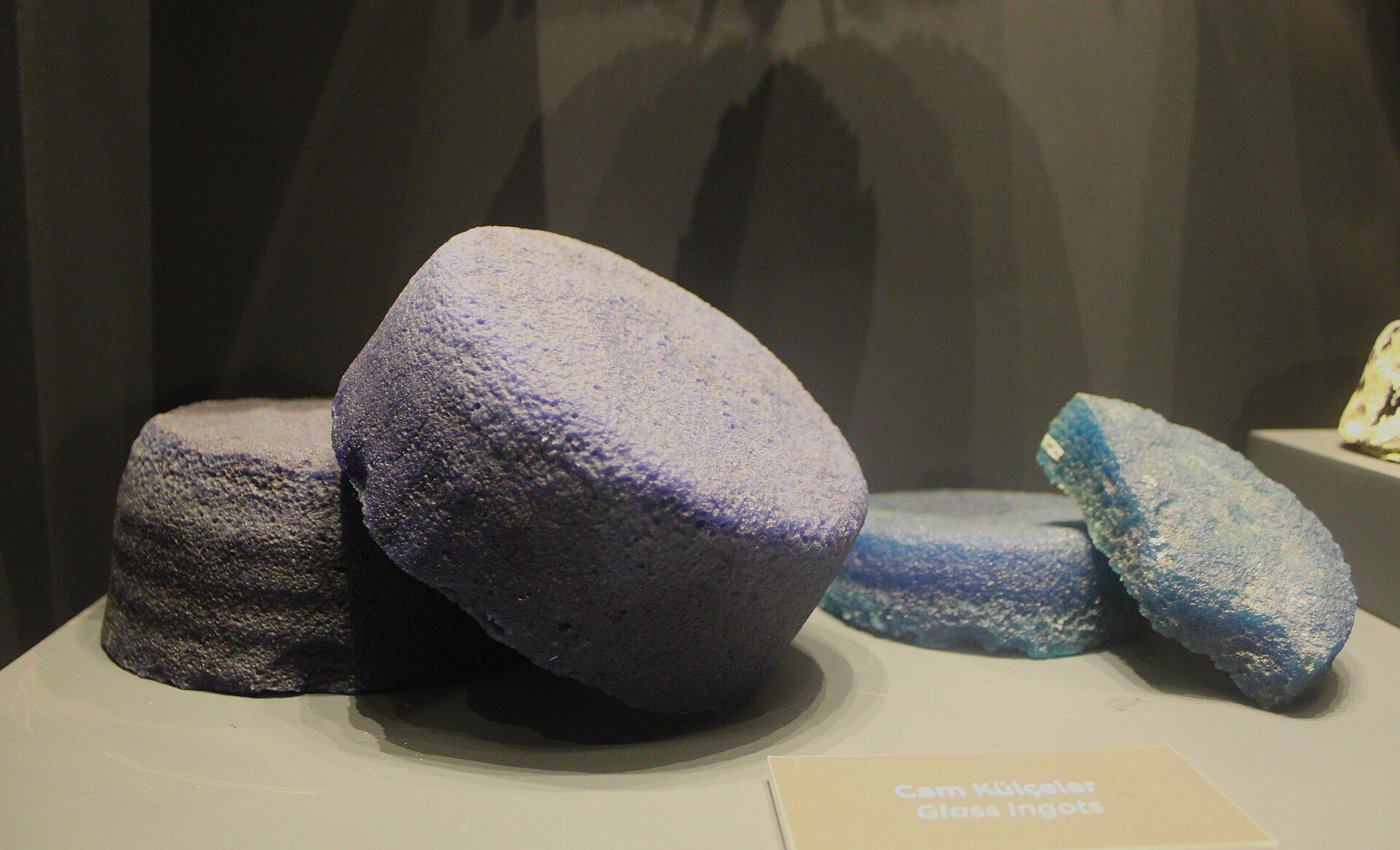
Below and around the metal lay the things that make the cargo feel less like a mine shipment and more like the contents of a whole world. There were about a hundred and seventy-five ingots of raw glass, discs the size of a hockey puck in cobalt blue, turquoise and pale lavender. They are the earliest intact glass ingots ever found, and their cobalt colouring links them to Egyptian workshops. Glass at this date was a luxury made by a handful of palaces and traded like a gem.
Then there were the jars: at least a hundred and forty-nine of them, of a type made along the Canaanite coast, in the land that is now Israel and Lebanon. Most held a sticky yellow substance that turned out to be terebinth resin, the sap of the pistachio’s wild cousin, burned as incense and used in perfume. One jar was packed with glass beads. Others held olives. Scattered through the wreck were logs of a dark African wood the Egyptians called hbny, the root of our word ebony; whole hippopotamus tusks and more than a dozen elephant teeth for the ivory carvers; tortoise shells; ostrich eggshells, prized as ready-made cups and containers; and the operculum of the murex sea snail, the little trapdoor of a shell, probably burned for its scent.
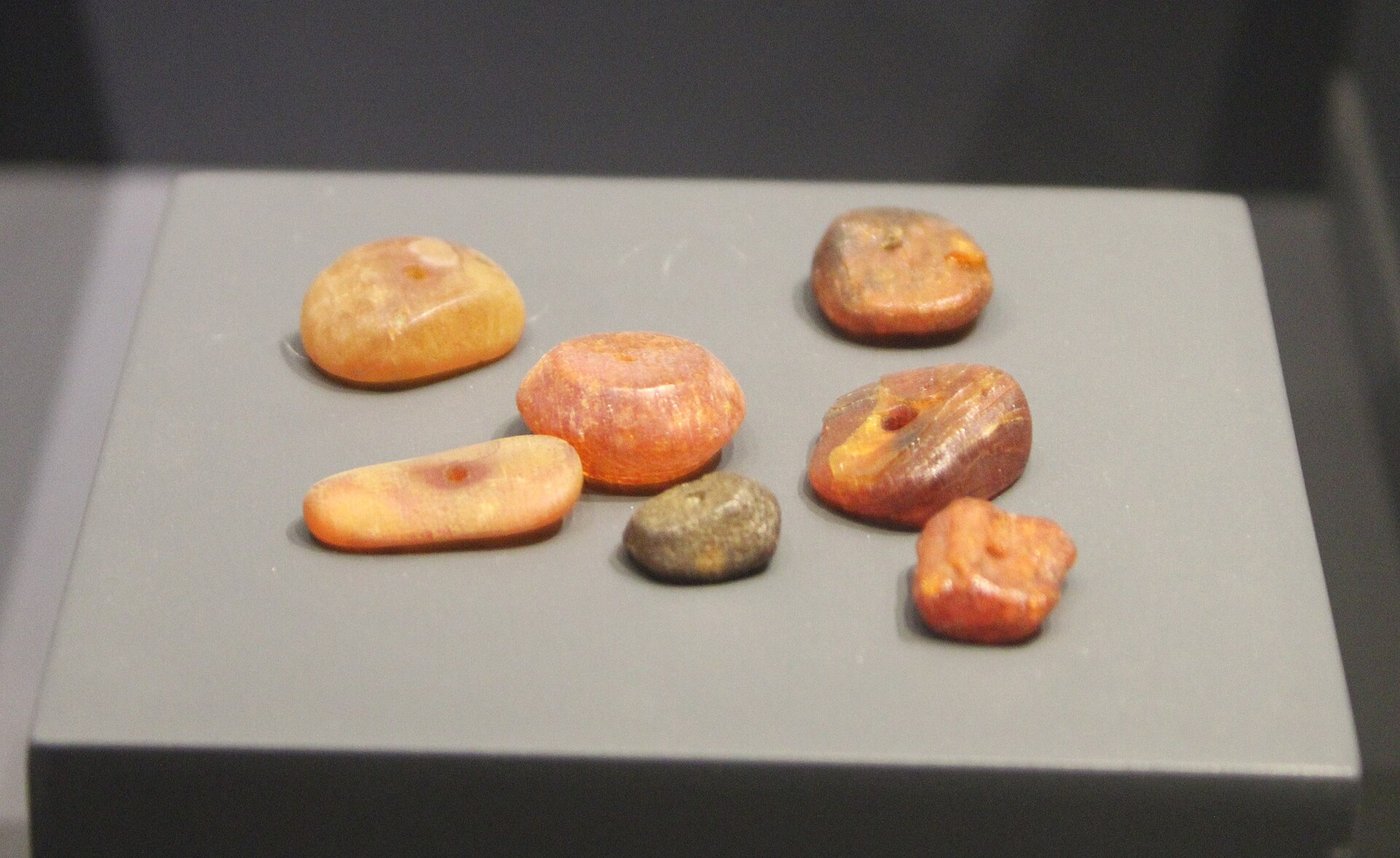
And there was amber. Small golden beads of it, worn smooth, of the kind that forms only around the Baltic. To reach a ship off Turkey it had come overland down the length of Europe, hand to hand, from a shore two thousand kilometres to the north. Egyptian ivory, Cypriot copper, Canaanite resin, Baltic amber, tin from somewhere past the edge of the map: a single hull holding Africa, Asia and Europe at once.
Gold, and a beetle centuries too old
The fine goods came up in ones and twos over the years, and each was its own small event. There were thirty-seven pieces of gold: pectorals to hang on the chest, medallions, pendants, beads, and a heavy biconical cup that is the largest single gold object from the wreck. There was a bronze figure of a goddess, her head, hands and feet sheathed in thin gold, the sort of protective idol a ship might carry for luck. There were rings and seals of silver and electrum, the pale gold-silver alloy.
Two objects mattered more than their weight. The first was a gold scarab (a beetle-shaped seal) carved with the name of Queen Nefertiti of Egypt. It is the only object of its kind known anywhere, and it gave the excavators a firm floor for the date: the ship cannot have sunk before Nefertiti’s time in the fourteenth century BCE. The second lesson came from other scarabs on board that were far older still, some made centuries before the voyage. These were heirlooms, antiques already when they were loaded, a reminder that old and valuable things circulated for generations before ending up, by chance, in the same doomed hull.
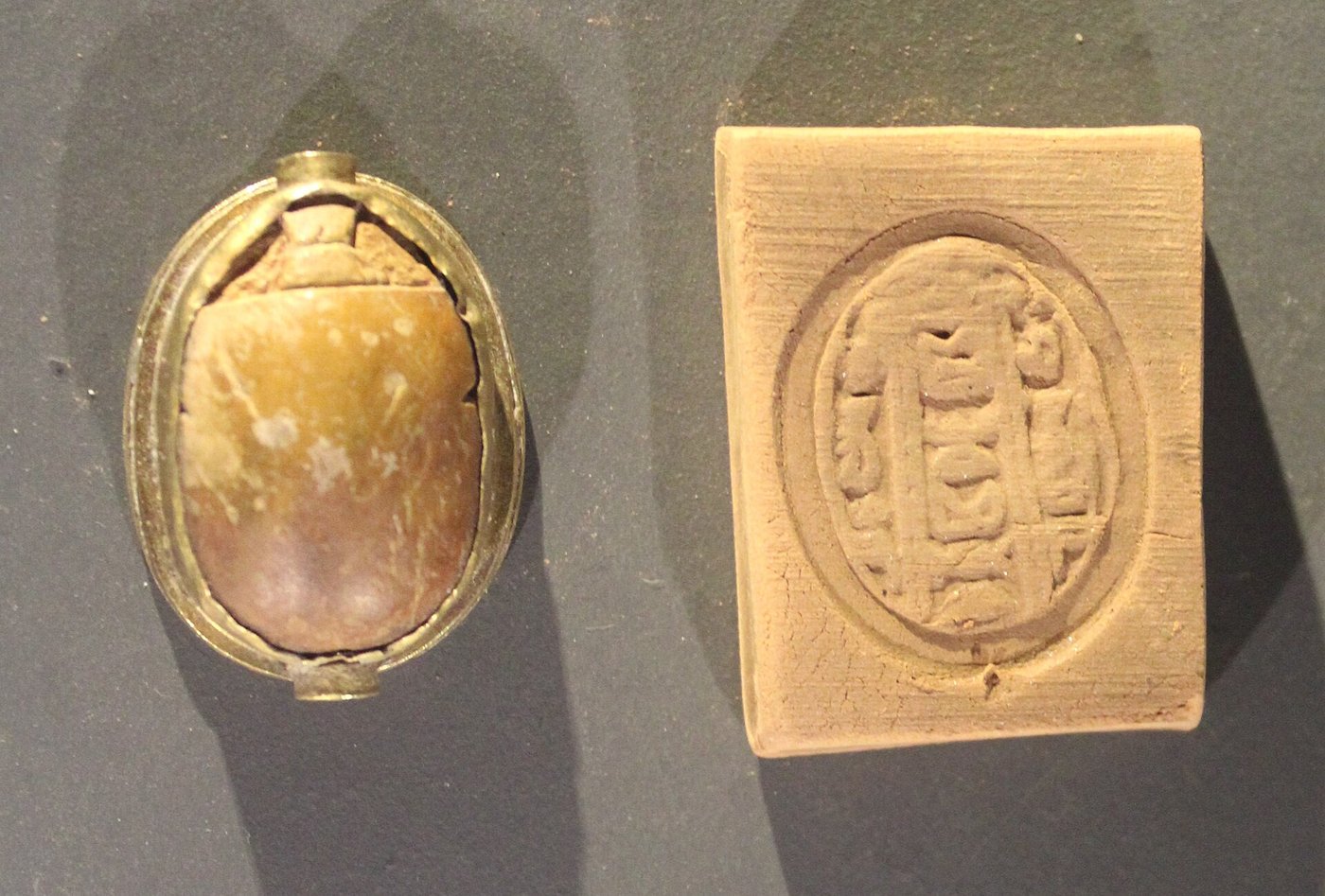
We are not guessing about what this kind of cargo meant. Clay letters found at Amarna in Egypt, written between the pharaoh and the kings of the day, list exactly these goods (copper, tin, glass, ebony, ivory, gold, fine cloth) sent between courts as royal gifts and greetings. The Uluburun ship also carried a small folding writing-board of boxwood, its inner faces hollowed for a coat of wax that a scribe could write on and smooth flat again. It is one of the oldest such notebooks in the world. The wax, and whatever tally it held, dissolved in the sea long ago.
How to weigh the world
If you want to know whether a ship carried a merchant rather than just a king’s messengers, look for the weights. Uluburun had them in quantity: around a hundred and twenty small geometric weights and about nineteen charming ones cast as animals (a lion, a bull, a fly, a frog, a duck curled with its bill on its back). Together they are one of the largest sets of balance weights from the whole Bronze Age.
They are also revealing. The weights follow more than one standard, the systems used in different lands, which is what a trader needs if he is going to buy by the reckoning of one port and sell by the reckoning of another. Add the nine cylinder seals from Mesopotamia and the Levant, used to sign and secure goods, and a picture forms of someone aboard whose job was to measure, record and deal: not a courtier carrying presents, but a working man of business on a busy sea.
It was once natural to imagine the ancient world as a scatter of separate kingdoms that mostly kept to themselves, swapping the odd luxury between neighbouring courts. Trade over great distances, the thinking went, belonged to later ages: to Greece, to Rome, to the medieval merchant. The deep past was local, and what moved between distant lands moved only as the occasional gift between rulers.
One wreck undid that. The Uluburun cargo binds together mines in Cyprus, tin from the far side of a continent, glass from Egyptian furnaces, resin and jars from the Levant, timber from Lebanon, amber from the Baltic and pottery and swords from Mycenaean Greece, all in transit at once, weighed on merchant scales against several standards. This was not a handful of gifts. It was a working economy that already stretched from northern Europe to Central Asia, three centuries before the Trojan War was even a story. The connected world is much older than we used to allow.
Who was aboard, and where were they going
The personal belongings hint at the crew’s mixture. Most of the everyday gear (the cooking pots, the oil lamps, the stone anchors) is Syrian or Cypriot, which is why the excavators believe the ship set out from a port on the Levantine or Cypriot coast. But two sets of belongings stand apart: a pair of swords and seals of Mycenaean Greek type, along with other bits of Aegean kit, which suggests that one or two Mycenaeans were travelling with the ship, perhaps as agents accompanying the goods to a Greek destination.
That fits the likeliest route. The ship was working its way westward, hugging the southern coast of Anatolia with the land on its right, when it struck the rocks at Uluburun and went down. Where it was heading no one can prove. The best guesses are the island of Rhodes, a great clearing-house for goods entering the Aegean, or one of the Mycenaean palaces on the Greek mainland, whose kings had an appetite for exactly this kind of copper, gold and glass. Somewhere a court was waiting for a cargo that never came.
The moment it ended
We cannot know the last hour. A ship of this size, low in the water with ten tonnes of metal in her belly, would have had little margin. A squall off a rocky headland, a shift in the load, a wrong reading of the coast at night: any of these could have driven her against the cliff. The hull broke, the heavy ingots pinned the wreck to the slope, and the sea closed over a working day like any other.
What makes the loss so valuable to us is precisely that it was ordinary. This was not a grave arranged to be seen, not treasure chosen to impress. It was a snapshot of trade caught in the act, everything in it exactly as it had been packed and weighed and stowed. And there is a shadow over it that the ship’s people could not have felt. Within a century and a half of this voyage, the whole bright network the cargo represents (the palaces, the courts, the long roads that carried tin and amber and gold) would come apart in the wave of collapse that ended the Bronze Age. The Uluburun ship sailed at the height of a connected world, and sank while it still seemed it would last forever.
Three thousand years later a sponge diver saw some biscuits with ears on the bottom and mentioned them to his captain. Everything we now know about the reach of that world came from one sunken merchantman and eleven summers of divers going down into the cold to bring it back, piece by numbered piece.
Read next: The Bronze Age Collapse: When the First Connected World Fell Apart and The Mentor: The Shipwreck That Sank the Parthenon Marbles in 1802.
Sources & further reading
- George F. Bass, “A Bronze Age Shipwreck at Ulu Burun (Kaş): 1984 Campaign,” American Journal of Archaeology — the first published account of the wreck by its original director.
- Cemal Pulak, “The Uluburun Shipwreck: An Overview,” International Journal of Nautical Archaeology — the excavator’s full survey of the ship, its cargo and its date.
- Cemal Pulak, “The Uluburun Shipwreck and Late Bronze Age Trade,” in Beyond Babylon: Art, Trade, and Diplomacy in the Second Millennium B.C. (Metropolitan Museum of Art) — the cargo set against the diplomacy of the age.
- Wayne Powell et al., “Tin from Uluburun shipwreck shows small-scale commodity exchange fuelled continental tin supply across Late Bronze Age Eurasia,” Science Advances (2022) — the Central Asian and Anatolian sourcing argument.
- Daniel Berger et al. (2023), the published rebuttal proposing a Cornish origin for part of the tin — the other side of the tin debate.
- Bodrum Museum of Underwater Archaeology, Turkey — where the reconstructed ship and the finds are displayed.
Image credits (via Wikimedia Commons): reconstruction of the Uluburun ship and cargo, Bodrum Museum of Underwater Archaeology (featured) — Dosseman (CC BY-SA 4.0); copper oxhide ingot — Zunkir (CC BY-SA 4.0); tin ingot — Zunkir (CC BY-SA 4.0); raw glass ingots — Zunkir (CC BY-SA 4.0); gold-and-faience scarab — Zunkir (CC BY-SA 4.0); Baltic amber beads — Zunkir (CC BY-SA 4.0).