In the spring of 2004, in a windowless room under the presidential bank in Kabul, a team of jittery officials stood watching a locksmith work on a safe that had not been opened in more than a decade. Nobody in the room was certain what was inside. For years the rumour on the street had been that Afghanistan's greatest treasure, some twenty thousand pieces of ancient gold, had long since been carried off, sold to smugglers, or melted into anonymous bars. The Taliban had ruled the country and gone. Two wars had rolled over Kabul. When the last lock finally gave and the boxes were lifted out and unwrapped, the gold was there. Crowns, clasps, coins, a wafer-thin diadem folded flat for burial two thousand years ago. Every piece accounted for. The story of how it got into that safe, and how it survived, is one of the strangest in modern archaeology, and it begins with a low brown hill in the north of the country that nobody expected to be worth digging.
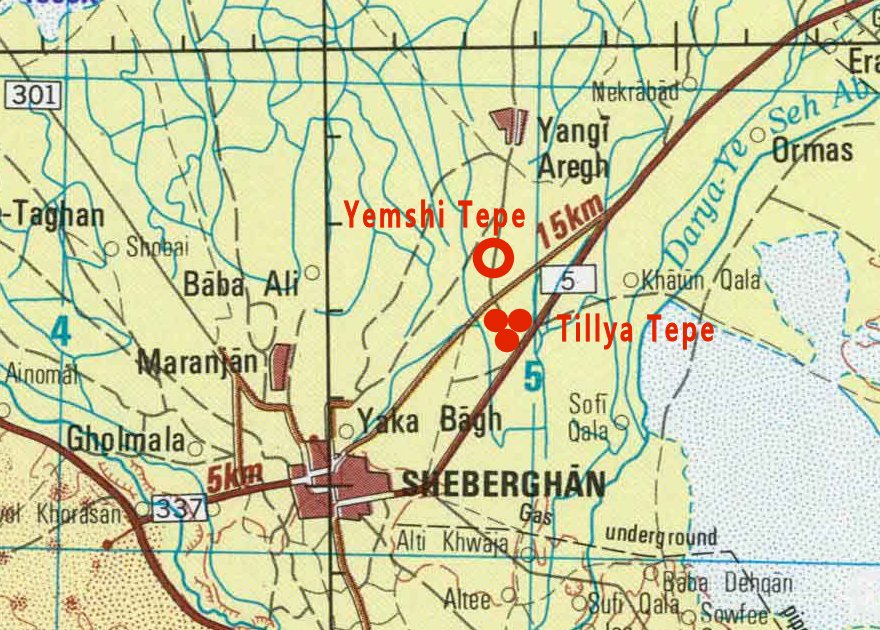
The hill was called Tillya Tepe, which in the local Persian means “golden hill” or “hill of gold.” It sits on the dusty plain of Jowzjan province, near the town of Sheberghan, a long way from anywhere famous. The name was old and, as it turned out, exactly right, though the people who first used it can only have been guessing. For most of its life the mound was just a rise in the fields, the buried stump of a much older mudbrick temple. What lay in the soil above that temple, a small cluster of graves dug in quietly and forgotten, would not be found until a Soviet archaeologist came looking for something else entirely.
A dig that was looking for the wrong thing
Viktor Sarianidi was not hunting for gold. He was a Greek-Russian archaeologist with a long career in Soviet Central Asia, and his real love was the Bronze Age: the mudbrick towns and fire temples of the second millennium BC. In 1978 his Soviet-Afghan team was working through the ancient sites of northern Afghanistan, and Tillya Tepe was on the list because of that buried temple, a place of ritual more than a thousand years older than anything anyone was about to find.
Late in the season, almost by accident, the diggers came down onto a grave. Then another. In the end there were six, cut into the top of the old mound, shallow and unmarked, easy to have missed by a spade's width. Five held women. One held a man. And packed in around the bodies, sewn onto clothes that had long since rotted away, pressed into the soil in their thousands, were objects of gold.
Sarianidi and his team counted as they lifted. Small discs by the thousand, once stitched to robes so that the dead had shimmered as they moved. Rings, pendants, clasps, buckles, appliqués shaped like flowers and hearts and animals. Bracelets, hair ornaments, a scatter of coins. When the counting was done the tally ran to roughly twenty thousand separate pieces (the figure most often quoted is 20,600), making it one of the richest single finds of ancient gold ever recovered anywhere. People began to call it the Bactrian Hoard, after the old name for the land it came from.
The digging did not get to run its course. Sarianidi opened the sixth grave and knew there might be a seventh nearby, still in the ground. He never reached it. In the winter of 1979 the Soviet Union invaded Afghanistan, the country slid into war, and the excavation stopped where it stood. The seventh grave, if it exists, is out there still. What had already come out of the ground was crated up, taken to the National Museum of Afghanistan in Kabul, and put on display. Then, before long, it disappeared from public view for a generation.
What six graves were wearing
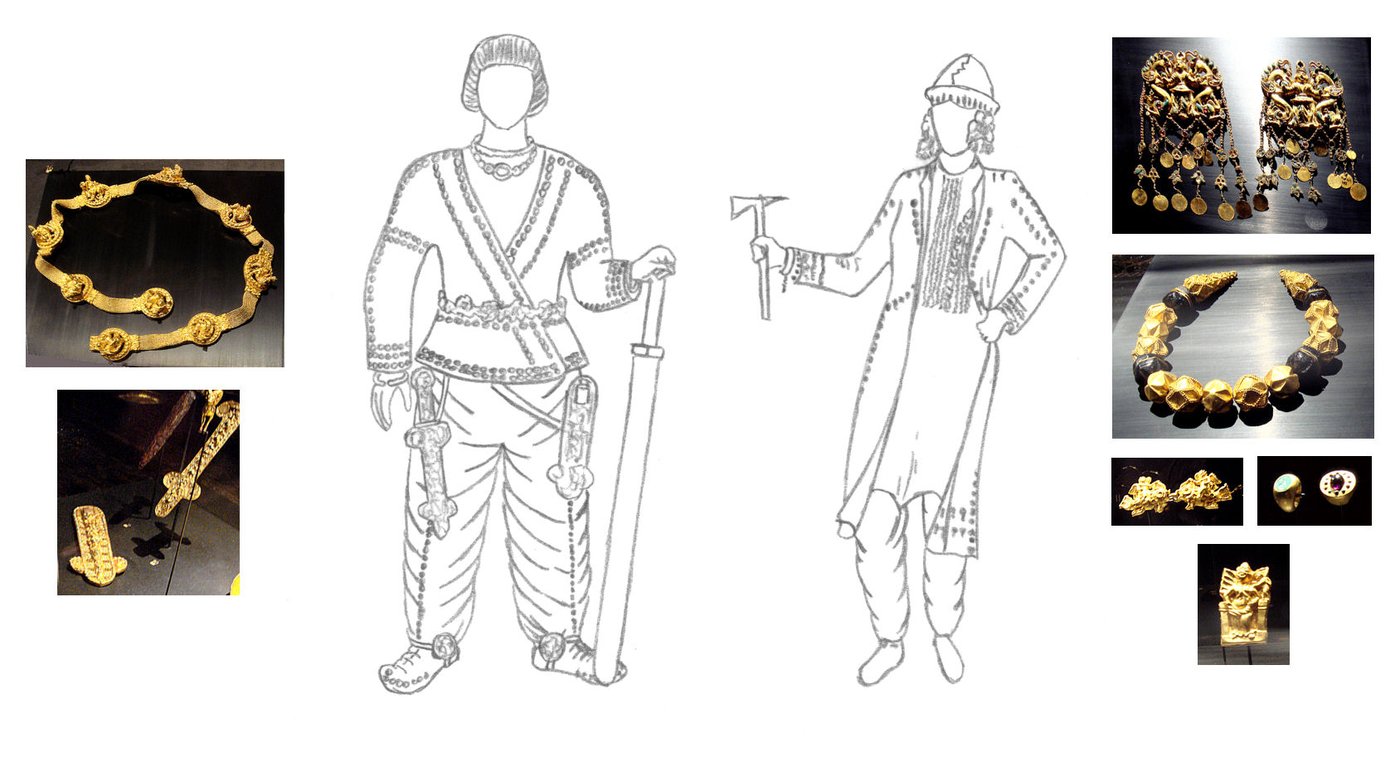
Take the finds on their own, without the survival story wrapped around them, and they are still astonishing. These were not the goods of a settled kingdom with palaces and treasuries. They were the burial wealth of nomads: a mounted, herding people who had ridden down out of the steppe and settled on the edge of the old Greek world of Bactria in the first century, around the time of the Roman emperor Augustus and his heirs.
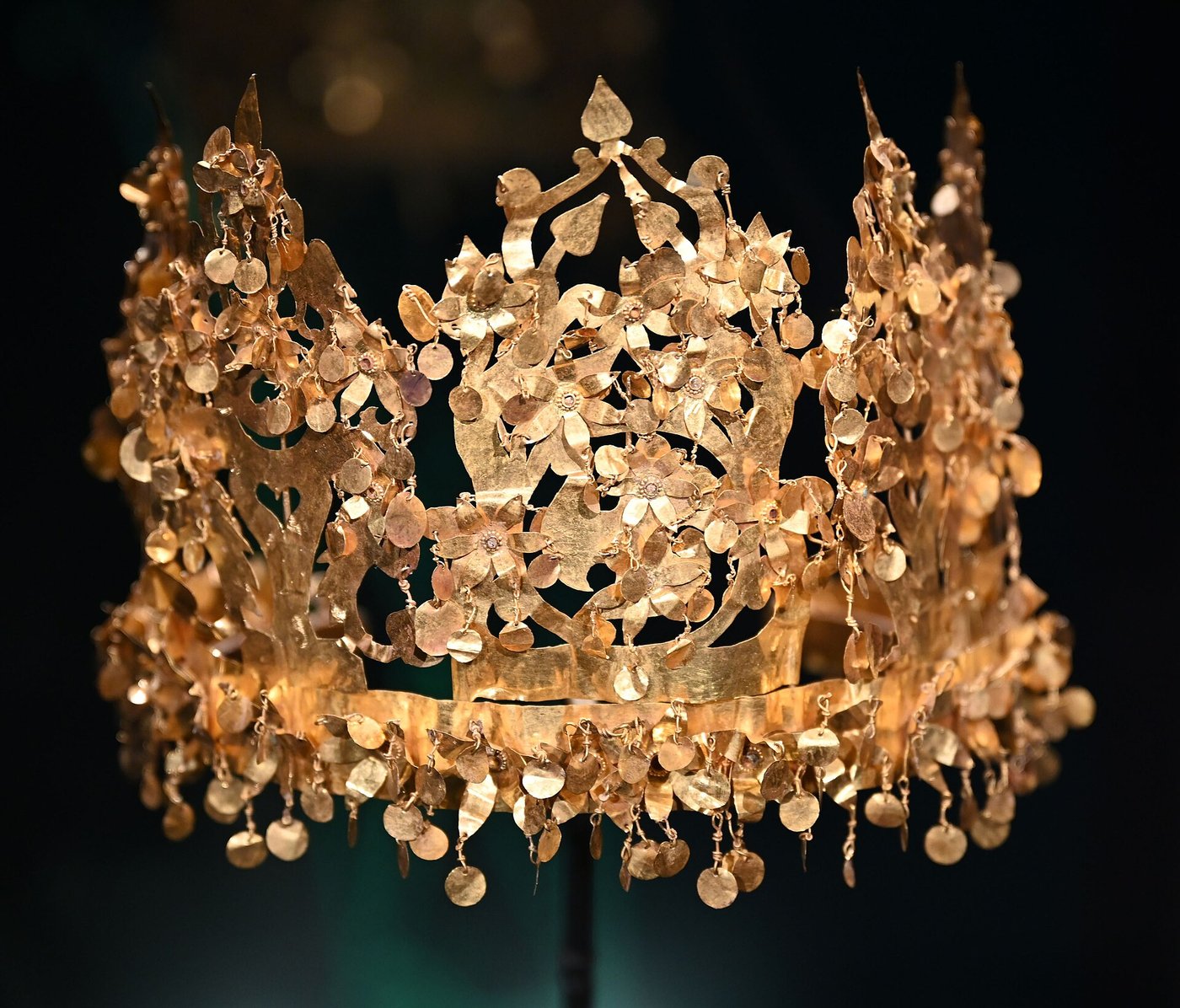
The woman in the sixth grave was buried in a crown. It is a thin band of gold with five detachable trees rising from it, hung with hundreds of tiny discs that would have trembled and flashed at the slightest movement. It was made to be taken apart: the trees lift off, and the whole thing folds down flat, small enough to pack in a saddlebag. A crown for people who did not stay in one place. It is the single most famous object from the hoard, and the one that put a face to the whole find.
The gold crown from Tomb VI is built for a life on the move. Its five ornamental trees pull free of the headband, and the band itself collapses flat, so the whole thing packs down into something a rider could carry across country. It is a piece of settled, palace-style regalia (the kind of crown a Persian or Greek queen might wear) redesigned by a people who measured their wealth in horses and had no fixed capital to keep it in. Everything about the hoard sits in that tension: the tastes of the city, made portable for the saddle.
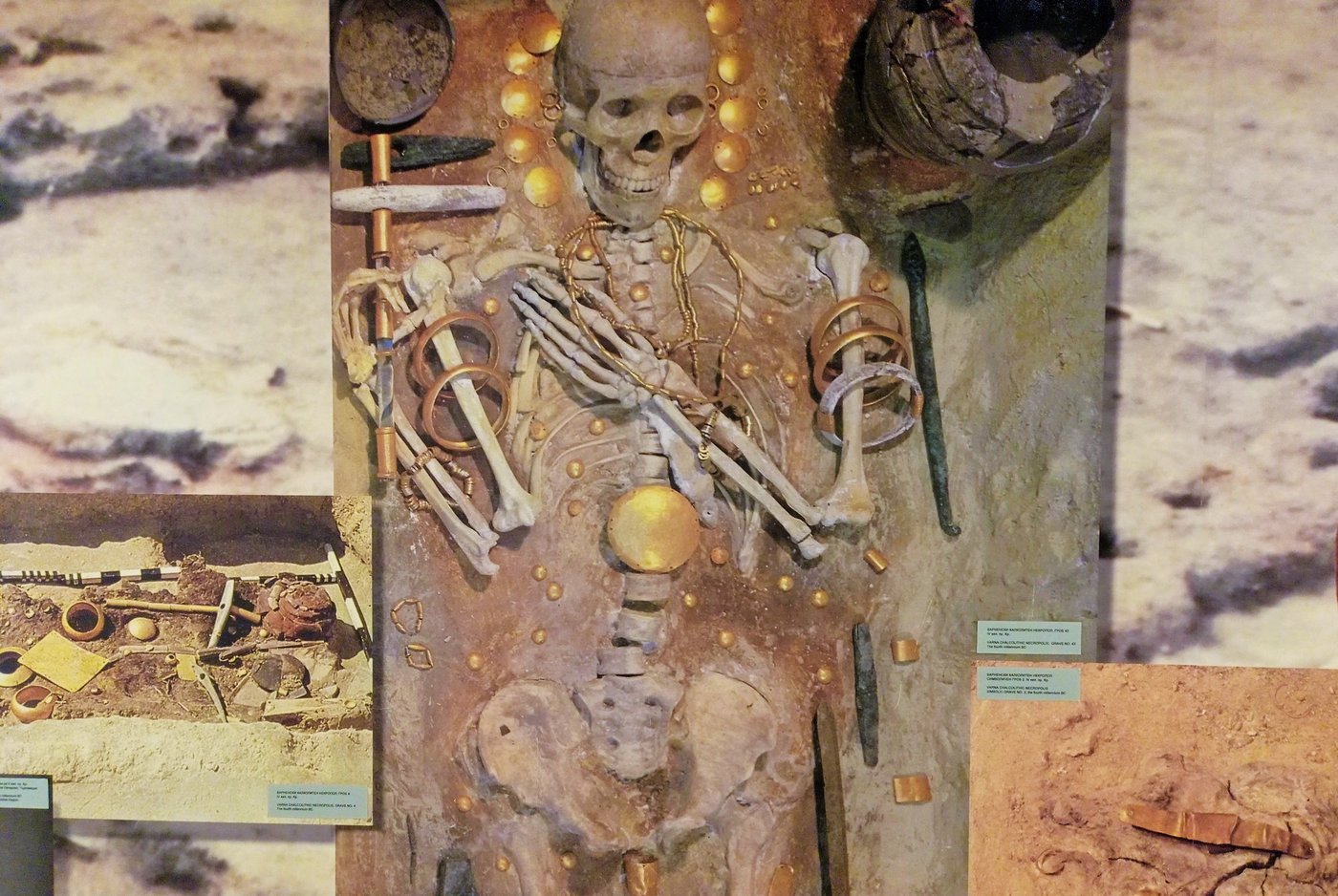
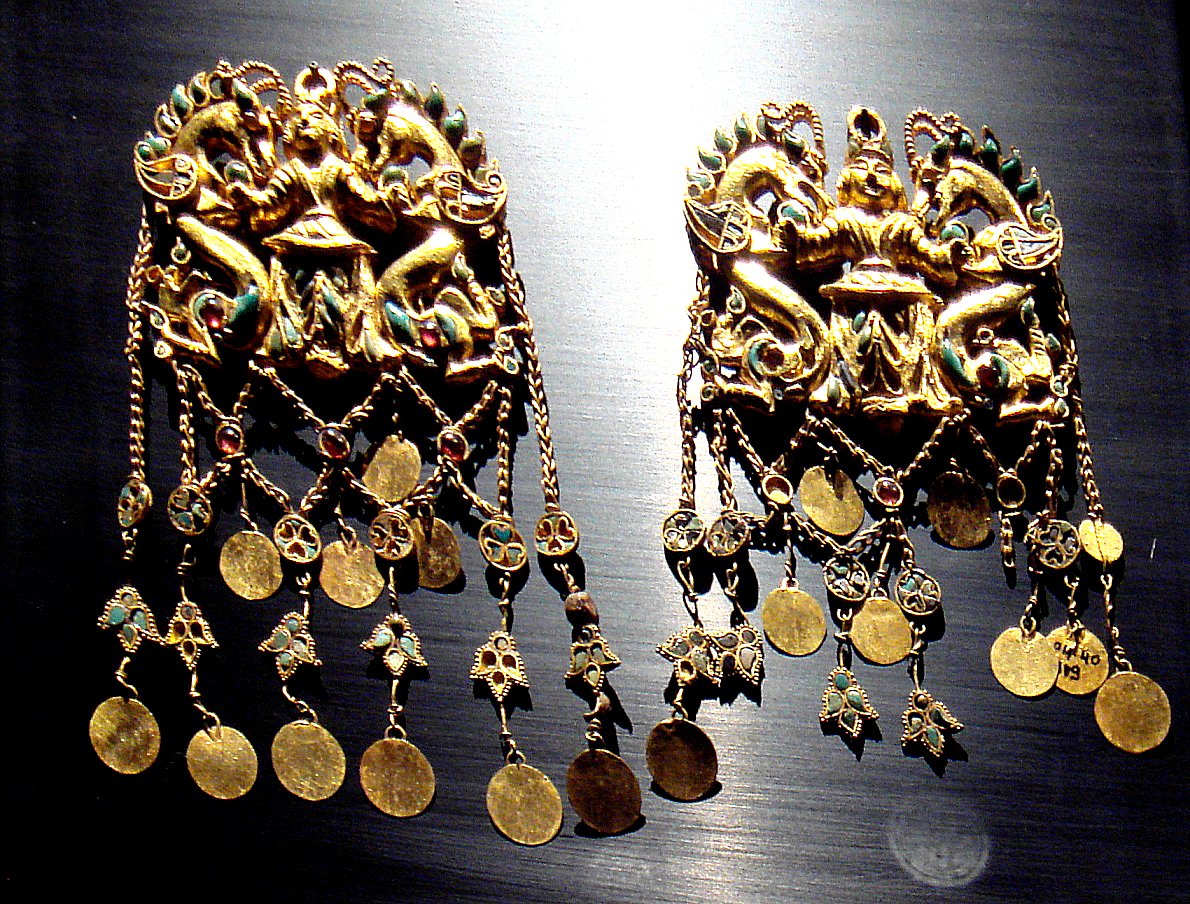
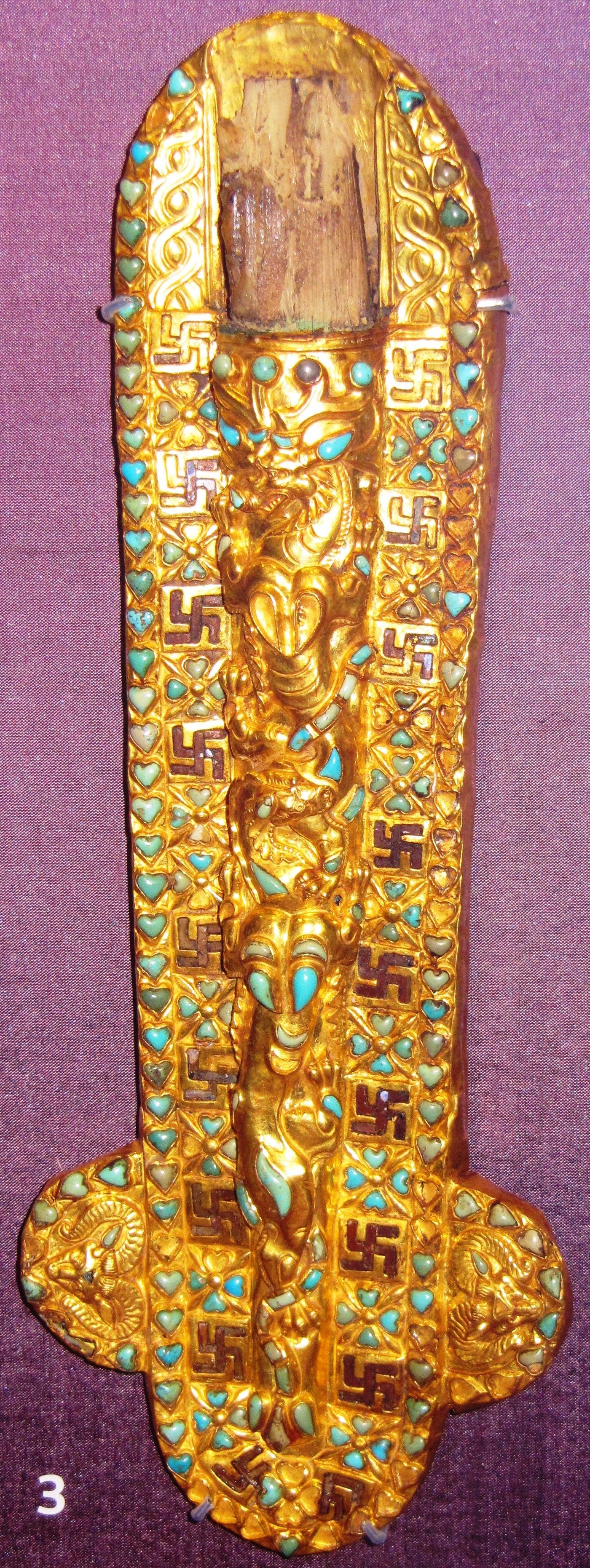
The rest of the graves matched it. There were golden clasps showing a man gripping two rearing, serpentine dragons, one on each side: a “master of animals” motif that runs back through Persian and steppe art for centuries. There were belt plaques of a warrior riding a lion, appliqués of winged goddesses, a golden ram, boot buckles worked with chariots, a dagger and its sheath covered in a writhing parade of beasts locked in combat. The man in the fourth grave had been buried with weapons; the women with jewellery, mirrors, and vessels. Almost every body wore gold from head to foot.
A crossroads worn as jewellery
What makes Tillya Tepe more than a big pile of treasure is what the pieces are copying. Look closely and you are looking at half of Eurasia at once. There is the Greek world, in figures of Aphrodite and winged Eros, in the shapes of the vessels, in the dolphins and vines. There is the steppe, in the animal-combat scenes and the stylised beasts that Scythian and Saka riders had worn for centuries. There is India, in a coin and in certain forms. There is China, in the jade and in imported bronze mirrors laid beside the dead. All of it, gathered into six graves on a single hill.
This was Bactria, and Bactria sat at the hinge of the ancient world. Alexander the Great had marched through it three centuries before and left Greek-speaking cities behind him. The Silk Road ran across it. Caravans carrying Chinese silk, Indian ivory and Mediterranean glass all passed within reach of this plain. The people buried at Tillya Tepe were newcomers, almost certainly the Yuezhi, a nomad confederation pushed west out of the borderlands of China, whose descendants would go on to found the vast Kushan Empire. When they buried their dead, they buried them in the styles of every neighbour they had, all at the same time. The gold is not one culture. It is a photograph of a crossroads.
The coins fix the date better than anything. Among the finds were a gold aureus of the Roman emperor Tiberius, who ruled from AD 14, a local imitation of a Parthian coin, a silver piece of the earlier Parthian king Mithradates II, and a gold coin of uncertain Indian origin. Roman, Parthian, Indian money, in one nomad's grave on the Afghan plain. The latest of them points to a burial in the first century AD, a single moment, caught and sealed, when four empires' coinage could end up in the same handful of soil.
The Bactrian Gold is the lost treasury of the Greek kings of Bactria: the leftover riches of Alexander's successors, a hoard of pure Hellenistic art that happened to be dug up in Afghanistan.
The people buried at Tillya Tepe were not Greeks. They were nomads, most likely the Yuezhi, who had ridden in from the steppe and settled on the ruins of the old Greek kingdom a century or more after it fell. The Greek touches in the gold sit beside Scythian animal art, Indian and Chinese imports and Parthian coins. It is not a Greek treasure that survived in Bactria. It is the burial wealth of newcomers who borrowed from everyone at once, and it belongs to them.
Into the vault
Through the 1980s the gold sat in the National Museum in Kabul, a low building on the southern edge of the city. As the Soviet war ground on and it became clear the country was heading somewhere worse, a small number of officials made a quiet decision. In 1988 and 1989, with the Soviets pulling out and the government of President Mohammad Najibullah bracing for what came next, the most precious things in the museum, the Bactrian Gold among them, were packed up and moved into the vaults of the Central Bank, deep underneath the presidential palace complex in the centre of Kabul.
The boxes were locked away, and the keys were split among a handful of trusted men. These were the tawildars, the traditional keyholders of the bank, and the arrangement was old and deliberate: no single person could open the vault alone, and the names of the keyholders were not written down where anyone could find them. Then the men went home, kept their mouths shut, and waited for the country to become safe enough to open the door again. It would be a very long wait.
The museum they had emptied did not fare well. In the civil war of the 1990s a rocket hit the building and burned much of what was left. Looters worked their way through the galleries. When the Taliban took Kabul, they went further: in 2001 they smashed statues and reliefs they judged idolatrous, the same campaign that destroyed the giant Buddhas of Bamiyan. Anyone who assumed the museum's greatest treasure had gone the same way had good reason. For years, the gold was spoken of in the past tense.
The men who held the keys could not be summoned by name when the time came, because their names had been kept secret on purpose. The system was designed so that no list existed to be tortured or bribed out of anyone. One bank employee, Askarzada, is remembered for standing guard over the vaults across the worst years, refusing to give up their contents even when the Taliban leaned on him to open them. The gold survived not because it was well hidden from a distance, but because a few ordinary men decided, at real risk to themselves, that it was not theirs to hand over.
The gold that came back
After the Taliban government fell at the end of 2001, rumours about the vault started up again. Some said it had been emptied. Some said the boxes were still down there, untouched, if only the right people could be found to open them. The trouble was exactly the thing that had kept the gold safe: nobody official knew who the keyholders were.
It took time to track them down and bring them together. In 2003 and 2004, with President Hamid Karzai's government behind the effort and the keyholders finally assembled, the vault was opened. Where a key was missing, a locksmith drilled. Box by box, the contents were lifted out into the light and checked against Sarianidi's old excavation records from a quarter-century before. The count came out whole. The National Geographic Society sent a team to help inventory and conserve the collection, and the number they arrived at, around twenty-two thousand catalogued objects, matched what had gone into the ground and then into the vault. Nothing of significance had been lost.
What followed was a second life for the hoard. From 2006 the Bactrian Gold went on tour (Paris, then major museums across Europe, North America, Asia and Australia) under the title Afghanistan: Hidden Treasures. Millions of people saw the folding crown and the dragon clasps. The tours raised real money for Afghanistan's cultural institutions and, for a while, the gold became a rare piece of good news out of a country short of it: proof that something precious had been kept safe by people who had every reason and opportunity to sell it.
When the Taliban returned to power in August 2021, the Bactrian Gold dropped out of sight once more. Officials said it remained locked in the Central Bank vault, under government control and untouched; others feared it would be sold or scattered. As of the middle of the 2020s there has been no public, independent inventory of the collection since the takeover. The likeliest reading is that the gold is still in its vault, kept the way it has been kept for more than thirty years, but the honest answer is that the wider world has not been allowed to look, and so, once again, cannot be sure.
What the hill still holds
The Bactrian Gold has now outlived a Soviet invasion, a civil war, the destruction of its own museum, one Taliban government and the arrival of another. It has been declared lost more than once and turned out, each time, not to be. That is a strange thing for a set of grave goods to do. The people who made it measured wealth in horses and buried it in the ground; the people who saved it measured something else, and hid it behind a door whose keys they would not name.
And the hill is not finished. Sarianidi always believed there was a seventh grave at Tillya Tepe, left in the soil when the war shut his dig down in 1979. It has never been excavated. Somewhere under the plain near Sheberghan, if he was right, another body lies dressed in gold, waiting for a country quiet enough to let an archaeologist finish the job that was started nearly half a century ago. The golden hill has given up a fortune and kept, so far, at least one more secret.
Read next: Gonur Depe: The Lost Capital That Brewed the Drink of the Gods and Oxus Treasure: The Achaemenid Gold Rescued From Robbers Near Kabul.
Sources & further reading
- V. Sarianidi, The Golden Hoard of Bactria: From the Tillya-tepe Excavations in Northern Afghanistan (Harry N. Abrams / Aurora, 1985).
- F. Hiebert and P. Cambon (eds.), Afghanistan: Hidden Treasures from the National Museum, Kabul (National Geographic, 2008).
- “Inside the Quest to Save Afghanistan's Bactrian Gold,” National Geographic (History Magazine).
- “Tillya Tepe,” Wikipedia, with catalogue references to the six tombs and their contents.
- Reporting on the 2003–2004 opening of the Central Bank vault and the 2021 status of the collection (Live Science; Task & Purpose).
Image credits (via Wikimedia Commons): the folding gold crown from Tomb VI — H Sinica (CC BY-SA 2.0); dragon-master clasp from Tomb II — World Imaging (CC BY-SA 3.0); reconstruction of a grave's regalia — PHGCOM (CC BY-SA 3.0); gold dagger sheath — Artacoana (CC BY-SA 3.0); location map — US Government (public domain). Featured image: the Tillya Tepe crown — H Sinica (CC BY-SA 2.0).