On a spring morning in 1891, two men cutting peat in a small bog called Rævemosen, in the flat farm country of Himmerland in northern Jutland, drove their spades into something that rang. It was not a root and it was not a stone. Working the wet peat away, they uncovered curved sheets of blackened metal, folded and stacked, and then the deep bowl they had been packed inside. Cleaned, the metal came up bright: silver, worked all over with faces, beasts and gods that no one in Denmark had a name for. The men fell out almost at once over who should be paid for it. That was the first argument the Rævemose find started. More than a century later the biggest one (where it was made, and by whom) is still going.
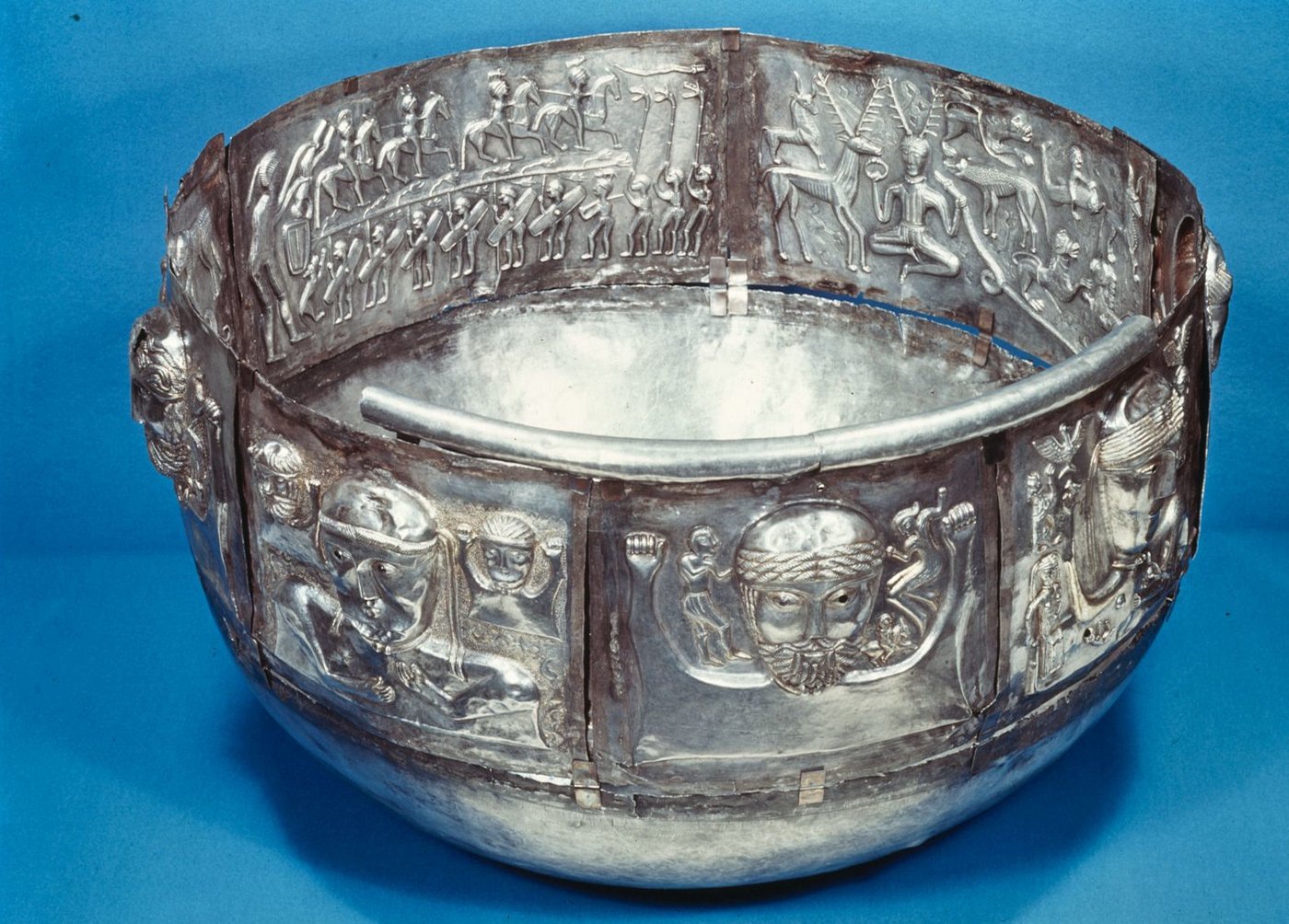
The object is the Gundestrup cauldron, named for the nearest hamlet, and it is the largest and finest piece of worked silver to survive from Iron Age Europe. It is also one of the strangest. Everything about it points somewhere else. The gods on it are not Danish gods. The animals include creatures no one in Jutland had ever seen. The way the silver is raised and gilded belongs to a craft tradition from more than a thousand miles to the south-east. And the silver itself, when chemists finally read it, seems to have been dug out of the ground somewhere else again. A single bowl, pulled from a Danish bog, that argues with itself about its own birthplace.
What came out of the bog
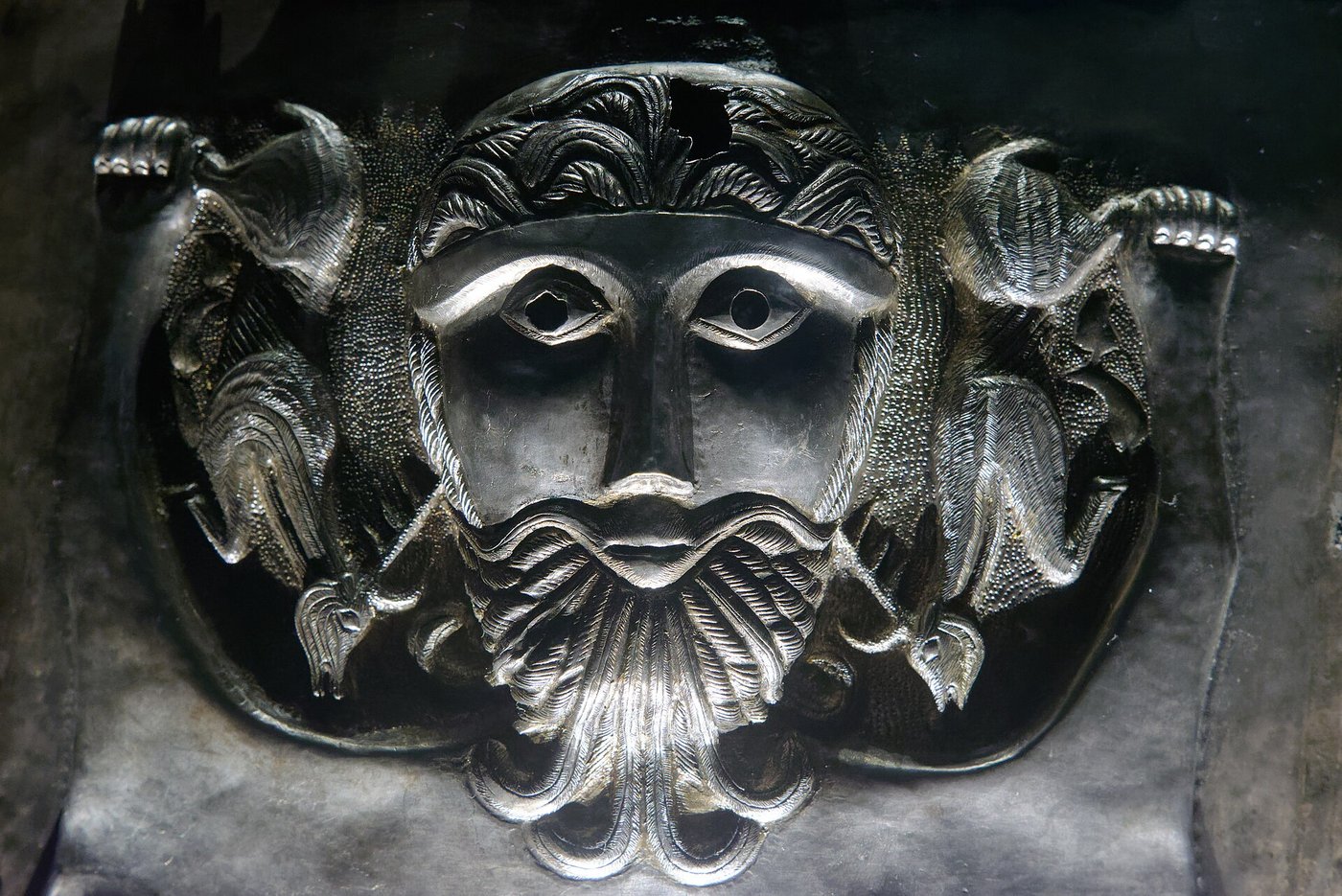
Start with the thing itself, because the thing is extraordinary. The cauldron stands about 42 centimetres tall and is roughly 69 centimetres across the mouth: big enough to bath a small child in. It weighs just under nine kilograms, close to twenty pounds, almost all of it silver. There is gold too, brushed into the raised figures as gilding, and tin in the solder that once held it together, and small beads of coloured glass set in as eyes so the faces would seem to look back at you across a firelit hall.
It did not come out of the bog as a bowl. It came out as a kit. Before it was buried someone had taken it apart: the round base and the tall side panels had been unfastened, the curved plates laid flat, and the whole set stacked neatly inside the base like plates in a cupboard. Thirteen silver plates survive: a rounded base plate, five long inner panels and seven shorter outer ones, with an eighth outer panel missing and never found. Whoever dismantled it knew exactly how it went together. This was not smashing. It was careful undoing.
Silver on this scale was staggering wealth in the last century before Christ. Nine kilograms of it, beaten into sheet and raised into high relief, stands for the melted-down value of a great deal of coin or plunder, plus the labour of skilled smiths working for a long time. The gilding was added selectively, to lift certain figures out of the crowd, and the eyes of several faces were once filled with glass or enamel. The cauldron was built to catch light and hold a room: an object for the very top of a society, not for a farmhouse.
A god with antlers and a snake
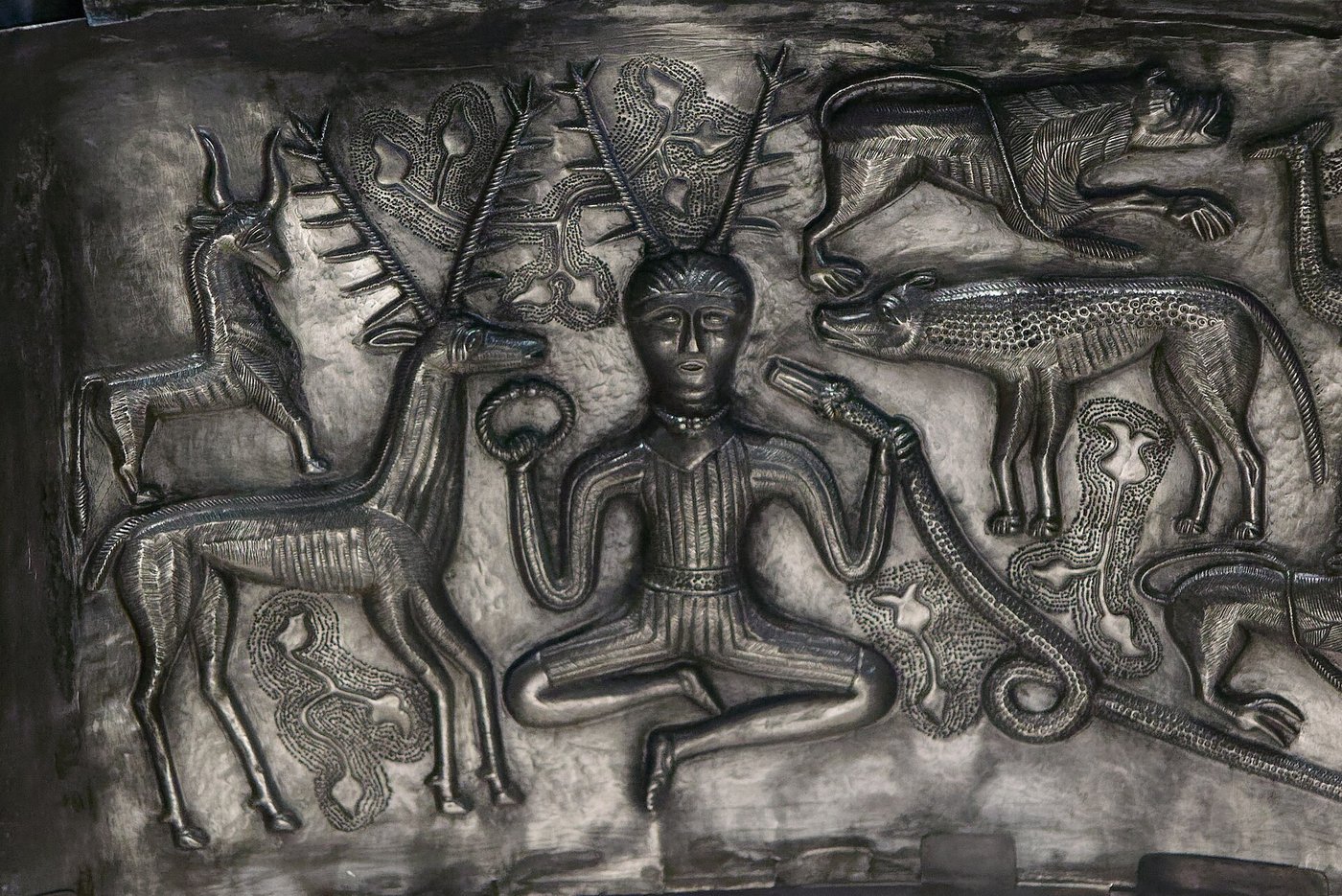
The most famous panel shows a figure that has become a poster for the whole Iron Age. He sits cross-legged and calm, antlers rising from his head like a stag’s. In one hand he holds a twisted neck-ring, a torc, the kind of collar that marked out high rank across the Celtic world. In the other he grips a serpent with the horns of a ram. Around him the silver is crowded with animals: a great stag whose antlers match his own, a hound, a lion, and a small boy riding what looks like a dolphin.
Scholars usually call him Cernunnos, the antlered one, a Gaulish god of animals and wild places. The name is real but thin. It survives from a single carved inscription on a stone pillar found under Notre-Dame in Paris, put up by boatmen in the first century. Nobody can prove the seated man on the cauldron is that god, or that the people who made him used that name. What is not in doubt is the idea behind him: a lord of beasts, sitting quietly at the centre of a wild kingdom that obeys him. Whoever cut this plate had met that idea before and knew how to render it in silver.
Elephants in a Danish bog
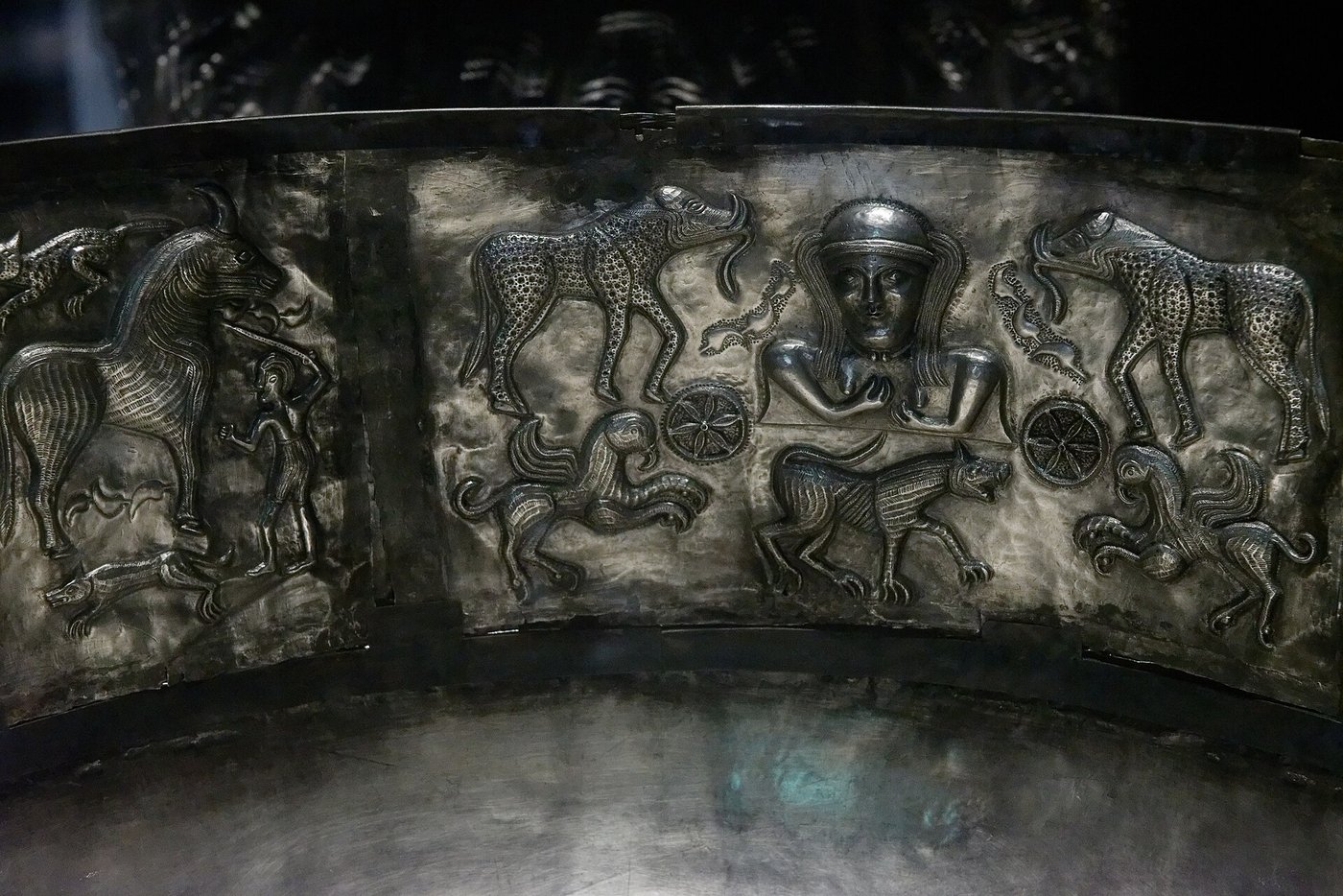
Then the bowl stops being local at all. On one inner plate a woman’s calm face fills the centre, flanked by spoked wheels. Above her shoulders stand two heavy, big-eared beasts that are hard to read as anything but elephants. There are griffins too, and rows of long-bodied lions padding along the silver. None of these animals lived in Iron Age Denmark. None of them lived in Iron Age Gaul either. They belong to the art of the eastern Mediterranean and the lands beyond it, the shared picture-book of a world that ran from Greece through Thrace and on towards Persia and India.
This is the crack that lets everything else in. A silversmith working in Jutland does not put elephants on a bowl by accident. Elephants come from somewhere the maker had at least heard described, in a style the maker had been trained in. The animals are not clumsy copies; they are confident, part of a visual language the artist plainly knew well. The cauldron was carrying images from the far south-east up into the cold north, and it was doing it in the hand of someone fluent in them.
The silversmith’s fingerprints
The clearest evidence for where the cauldron was made is not in what it shows but in how it was built. The figures are raised in very high relief, hammered out from behind so far that some faces stand almost free of the background. The detail was then chased in from the front with fine punches and tracing tools, and parts were picked out in gold. That whole tool-kit (deep repoussé, punchwork, selective gilding) belongs to the silver tradition of the Thracians, the peoples of the lower Danube and the Balkans, who were famous across the ancient world for exactly this kind of work. It is not how Celtic metalworkers of the same period worked. They were superb smiths, but they did not make silver like this.
Look closely and the object breaks into more than one hand. Study of the metal has found at least three separate batches of silver with different amounts of copper mixed in, matched to different sets of tools. The plates were not all made by one person at one sitting. A workshop, several smiths, different toolboxes: a production line for a single grand commission, which is itself a clue to the scale of whoever ordered it.
Dating the cauldron has been almost as slippery as placing it. Traces of beeswax survive on the backs of the plates, left over from the making, and beeswax can be radiocarbon-dated. One study read those dates and put the cauldron in the Roman Iron Age, in the first centuries after Christ. Then a second laboratory ran the same beeswax and came back with dates some four hundred years earlier. Both cannot stand. Most estimates still settle in the last two centuries before Christ, but the honest span runs from about 200 BC to 300 AD, a window wide enough to swallow whole arguments.
Warriors, a war-trumpet, and a man over a vat
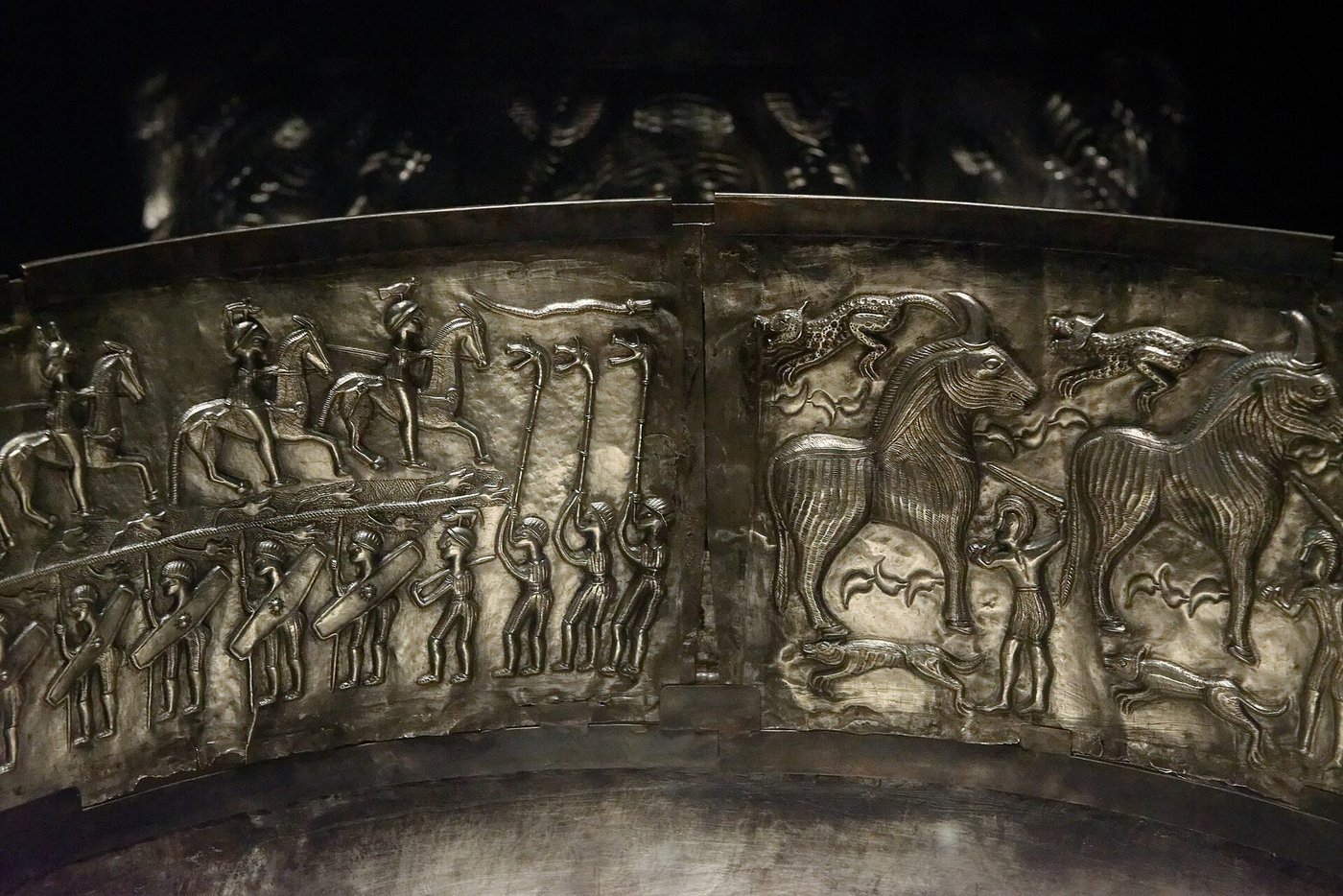
One plate turns from gods to an army. A line of foot-soldiers marches along the bottom, carrying spears and long oval shields, while horsemen ride above them the other way. A leafy branch runs between the two ranks, splitting the scene. Three tall men blow strange upright trumpets that end in animal heads: carnyces, the boar-mouthed war-horns whose eerie braying Roman writers said unnerved their legions. And at the head of the marching men stands a giant figure who has taken hold of a much smaller one and is lowering him head-first into a vat.
It is the most quoted image on the cauldron and the least agreed upon. For a long time it was read as human sacrifice, the drowning of a captive to feed a god. Others see the opposite: not a killing but a making, warriors dipped into a cauldron and brought back to life, an old idea that echoes in later Celtic story where a cauldron restores the dead. The silver does not say. That doubleness (a scene that reads as both death and rebirth depending on how you tilt it) is part of why the bowl has never let go of the imagination.
Whose hands, whose gods?
So the pieces will not sit still. The gods and the torcs are Celtic. The elephants and lions are eastern. The silversmithing is Thracian. And when researchers measured the lead isotopes locked into the metal (a kind of geological signature that can point back towards the ore it came from), some readings matched the silver used for coins struck by Celtic peoples in what is now northern France, hundreds of miles from the Balkans. Every strand of evidence seems to pull towards a different corner of Europe.
The theory that holds most of it together is a story of a commission. In the last centuries BC the lower Danube was a border zone where Celtic tribes and Thracian ones lived shoulder to shoulder. One Celtic people there, the Scordisci, had both the wealth to order a masterpiece and the Thracian silversmiths next door to make it. On this reading the cauldron was Celtic in idea and patron but Thracian in hand: Celtic gods rendered by foreign masters, using a picture-book that already carried elephants and lions in it. How it then travelled a thousand miles north to a Danish bog is a separate puzzle. One popular guess ties it to the Cimbri, a northern people who raided deep into that Danube region before their wars with Rome and may have carried the great bowl home as plunder. It is a guess, and it is admitted to be one.
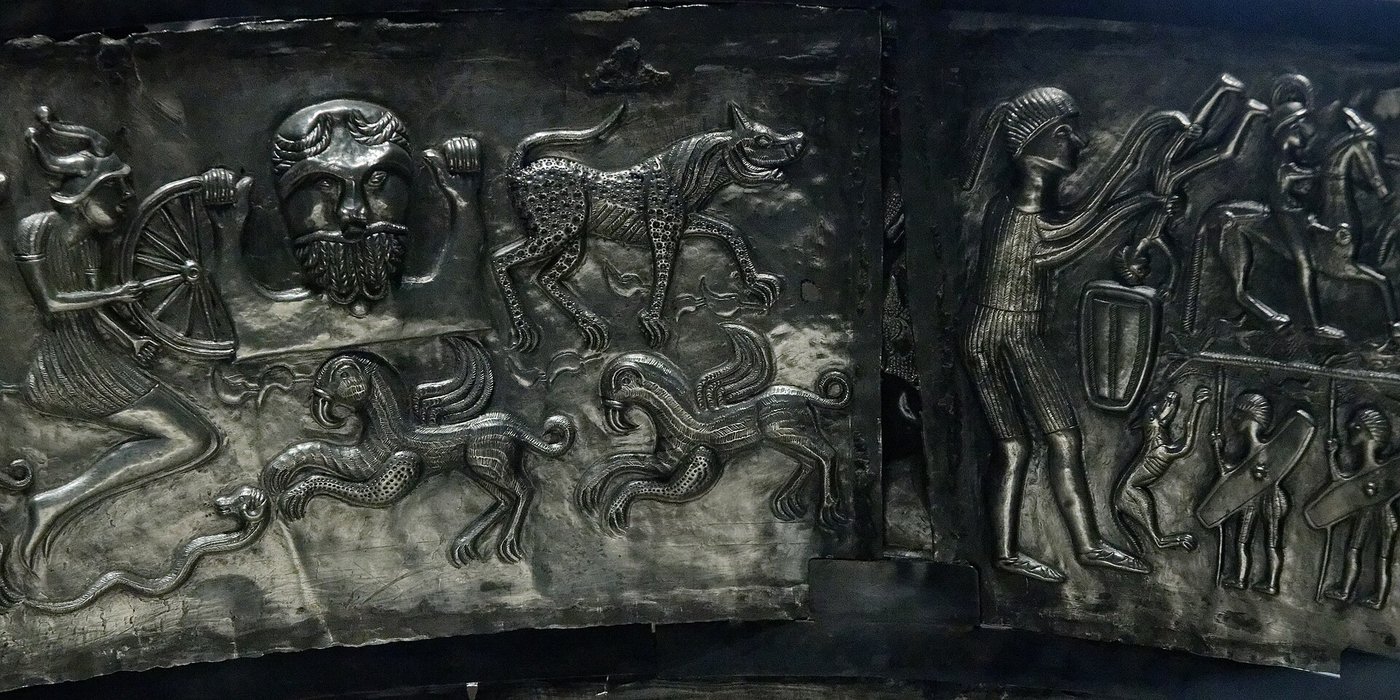
The plates were found loose, so the bowl had to be put back together by guesswork. The first curator to tackle it, Sophus Müller, worked out an order from faint traces of old solder along the rim, and his arrangement became the standard one. Later scholars have pushed back: strip away one or two firm joins and the solder marks do not actually fix the sequence, which means the “correct” order of scenes, and any story you might read across them, rests partly on a century-old best guess. We are not even sure we are looking at the cauldron in the order its makers intended.
The myth: the Gundestrup cauldron is a Celtic treasure, made by the northern people who buried it, a window straight onto the gods of Iron Age Denmark.
The reality: almost nothing about it is local. The craft is Thracian, from the Balkans; some of the animals come from further east still; the silver may have been mined and coined in Gaul; and the northern bog where it ended up was probably its last stop, not its first. It is an authentic Celtic religious object, and an imported one, assembled from a Europe far more connected than the word “barbarian” ever allowed.
Laid down on dry ground
The last act was deliberate. The cauldron was not lost, dropped or hidden in a hurry. It was taken apart with care and set down on ground that was dry at the time, in a spot that only later filled in and became the bog that kept it. Across northern Europe, prized things (weapons, wagons, gold, and now and then something like this) were given to watery and boggy places as offerings, put beyond human use on purpose. The most valuable silver bowl in the north was handed over the same way, dismantled so it could never simply be picked up and carried off again.
That is where the trail ends and where the arguments begin. A bowl that shows Celtic gods, carries eastern beasts, was raised by Thracian hands from silver that may have come from Gaul, then crossed a continent to be buried in Denmark, and was reassembled two thousand years later from marks a curator could only half-read. The Gundestrup cauldron is usually labelled the masterpiece of Celtic art. It might be closer to the truth to call it the opposite of one culture’s work: a record of how far people, metal and gods already moved across Iron Age Europe, pressed into a single sheet of silver that still will not tell us plainly where it began.
Read next: The Carnyx: The Screaming Boar-Headed War Trumpet of the Celts and Vix: The Celtic Grave That Held Antiquity's Largest Bronze Vessel.
Sources & further reading
- The National Museum of Denmark, Copenhagen, curatorial pages on the Gundestrup cauldron and its discovery at Rævemosen.
- Klavs Randsborg, Gundestrupkedelen / The Gundestrup Cauldron, and related studies of its imagery and origin.
- Timothy Taylor, “The Gundestrup Cauldron,” Scientific American (1992), on Thracian workmanship and the Scordisci commission theory.
- A. K. Nielsen and colleagues, accelerator radiocarbon dating of beeswax residues from the cauldron plates, and the conflicting laboratory results that followed.
- G. S. Olmsted and later lead-isotope analyses linking the plates’ silver to Celtic coinage of northern France.
Image credits (via Wikimedia Commons): Gundestrup cauldron, full view, National Museum of Denmark — Nationalmuseet / Lennart Larsen (CC BY-SA 3.0); outer bearded face, antlered figure, goddess with wheels, warrior procession and broken-wheel plates — Marie-Lan Nguyen (public domain).