They lie on their backs with their eyes shut and their mouths open, and for the better part of a hundred years people looked at them and saw dancers. There are more than three hundred of them, cut into flat grey stone, set into a wall at the edge of a plaza high above the valley of Oaxaca in southern Mexico. When Mexican writers of the nineteenth century first described the carved wall they reached for the gentlest word they had. The figures seemed to twist and float, so they became los danzantes, the dancers. The name stuck for so long that it is still on the signs. It is also almost certainly wrong. Look again, without the word, and the loose limbs stop reading as movement. The eyes are closed because they are dead. The mouths are open because they are screaming, or past screaming. Many of the bodies are cut and bleeding in the one place a victorious enemy would choose.
This is Monte Albán, the mountain city of the Zapotecs, and its most famous carvings are a war memorial with the sign turned the wrong way round. The story of how the dancers stopped dancing is really the story of the place: a capital built on a hilltop that had no reason to hold a city, raised by people who wanted the world to know exactly what they had done to their neighbours.
A mountain cut flat
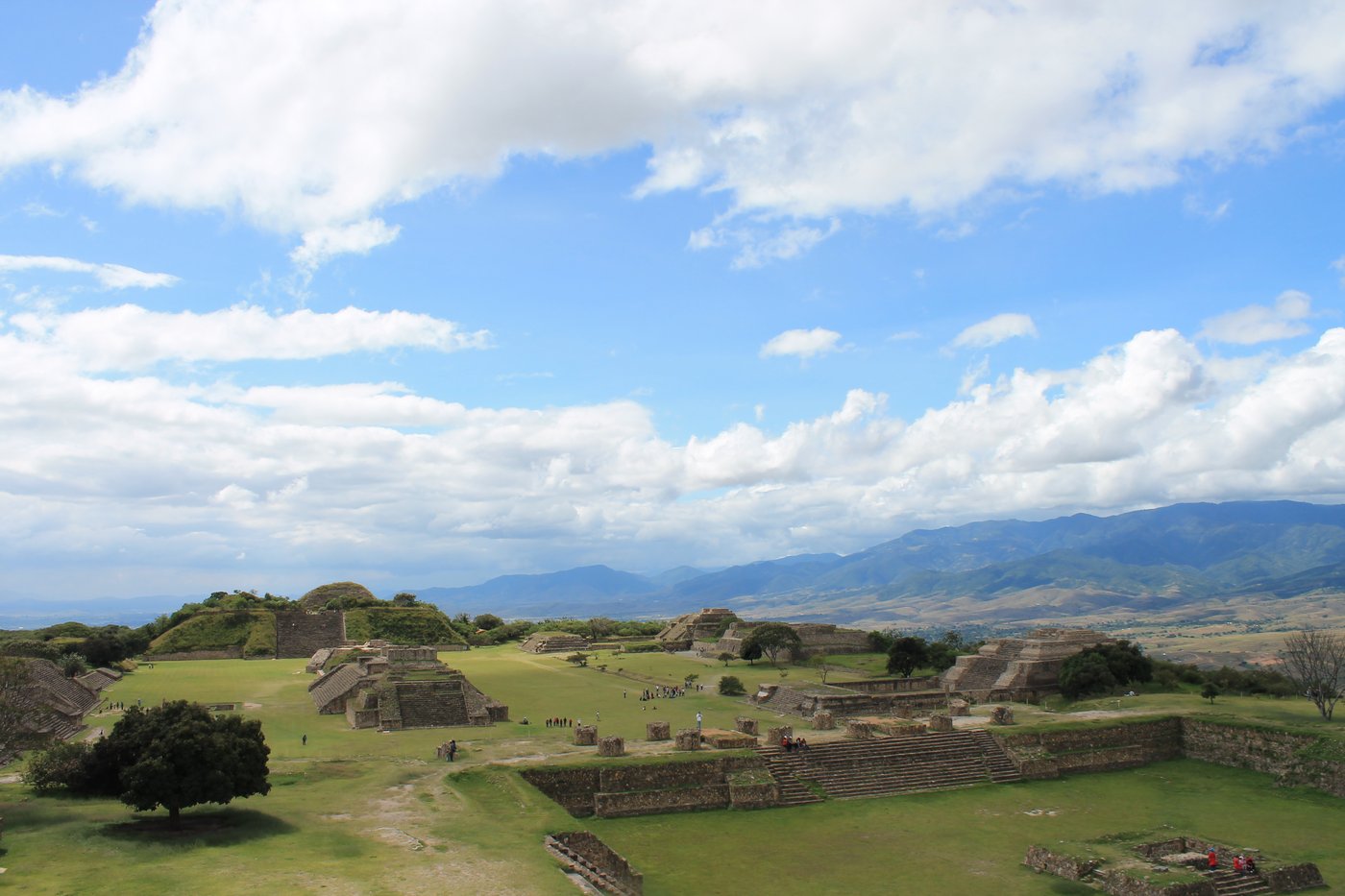
Start with the ground, because the ground is the first strange thing. Monte Albán sits on a ridge about four hundred metres above the floor of the Valley of Oaxaca, where three arms of flat farmland meet like the spokes of a rough Y. The hill is a natural fortress with one enormous drawback: nothing grows on bare rock, and there is almost no water up there. Nobody would choose it to farm. Nobody would choose it to trade. And yet, around 500 BCE, people climbed it and began to build.
First they made room. The top of the ridge was uneven, so the builders sheared it off, cutting and filling until they had a level artificial platform roughly two thousand feet long. On that platform they laid out a vast rectangular plaza and lined it with stone pyramids, courts and terraces. The scale is hard to take in from a photograph. The main plaza alone could hold tens of thousands of people, and every stone in it was carried up a mountain that offered its builders nothing but a view.
That is the puzzle archaeologists have chewed on for decades. Why put your capital where the land actively fights you?
The city nobody's valley owned
The best answer came from the archaeologist Richard Blanton, who surveyed the whole hill in the 1970s and walked away with an idea that has shaped every argument since. Before Monte Albán, the Valley of Oaxaca held several rival chiefdoms, each with its own patch of good land, each watching the others. The biggest early centre, San José Mogote, sat in the northern arm. What the valley did not have was a neutral place, owned by no single faction, where the whole region could act as one.
Blanton argued that the hill was chosen precisely because it belonged to nobody. It sat near the meeting point of the three valley arms, on land too poor to be anyone's prize. Rival groups could pool their people there to build a shared capital without any one of them being seen to move onto a neighbour's turf. He called it a "disembedded capital": a seat of power deliberately lifted out of the local rivalries, the way some countries plant a brand-new capital in an empty spot rather than crown an existing city. It is a tidy explanation for an untidy choice, and it fits what the diggers found: a city that appears fast, fully planned, on a site with no earlier town beneath it.
Whether the founding was really a peaceful league or a takeover dressed up as one is still argued. What is not in doubt is that it worked. Within a few centuries Monte Albán ruled the valley and reached well beyond it, and the population on and around the hill grew into the tens of thousands. A place that grew no food had become the centre of everything.
The figures on the wall
The oldest large building on the site is also the one that gives the city away. Down at the south-western corner of the plaza stands a low platform, Building L, and along its base runs the wall of the danzantes. The carvings on it are among the earliest monuments at Monte Albán, made not long after the city was founded, and there are a great many of them: well over three hundred figures in all, once spread across the building in long rows.
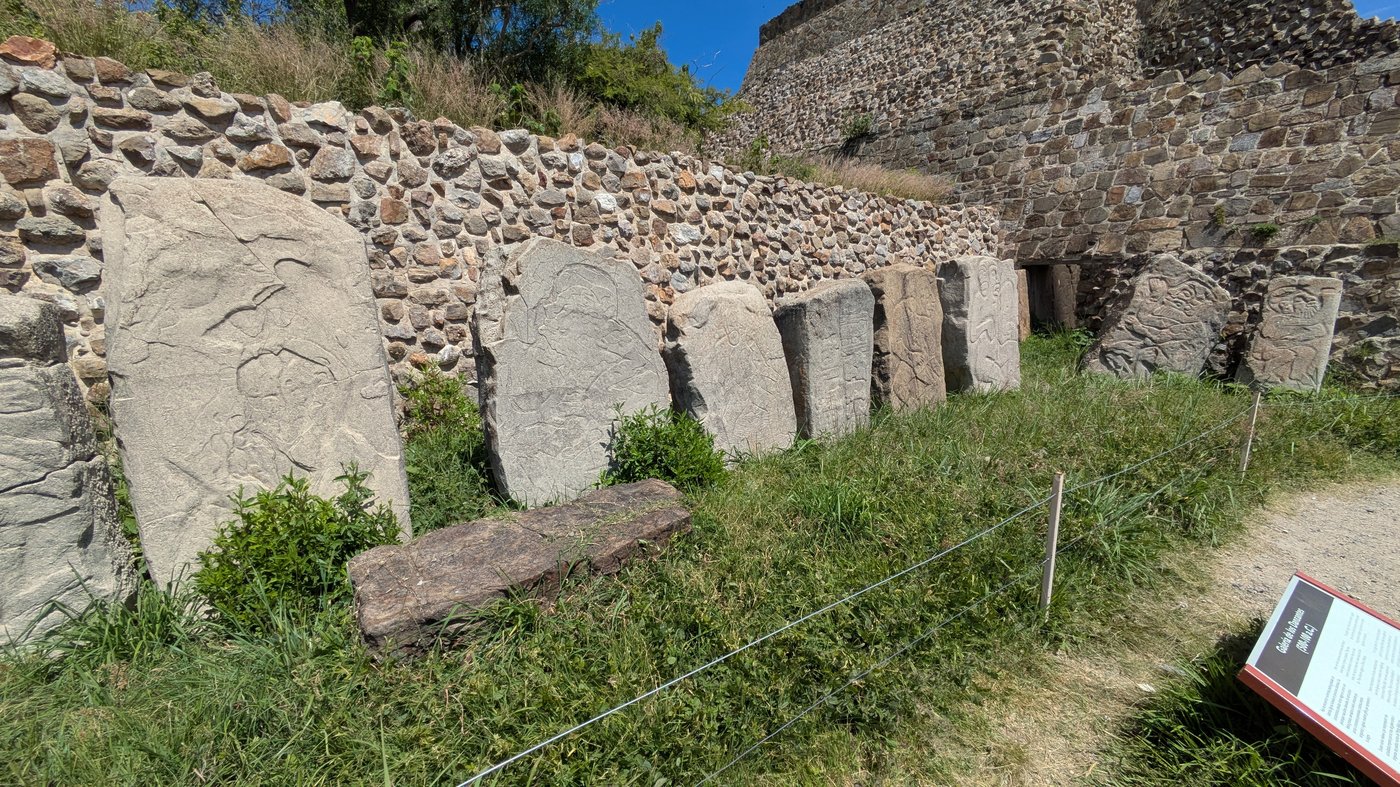
For generations the friendly reading held. The bodies bend and sprawl; surely they are dancing, or swimming, or perhaps they are patients in some medical text, or priests lost in a trance. The trouble is that once you stop expecting dancers, the details are hard to explain away. The eyes are closed in the manner Mesoamerican art used for the dead. Bodies are shown from odd angles, limp, as if dropped rather than posed. On many of the slabs the figure is naked (a deep humiliation in this world), and a scroll or flower of blood curls from the groin, marking men who had been castrated. Some carry name-glyphs, the way a modern memorial lists names, except that here the names are those of the defeated.
The claim: the figures on Building L are dancers, acrobats or swimmers, caught mid-movement, a frieze celebrating ritual performance.
The likelier truth: they are slain and mutilated enemies. The closed eyes, slack limbs, nakedness and genital wounds are the vocabulary of conquest, not choreography. The wall is a roll-call of the people Monte Albán's rulers broke: a monument built to be walked past and understood as a threat.
Read that way, the wall changes the whole mood of the young city. This was not a quiet religious retreat on a peaceful hill. Almost the first thing its rulers chose to advertise, in stone, at the front of their plaza, was violence done to the people around them. The message to any visitor from the valley below was blunt: look what happens to those who stand against us.
Names, numbers and a screaming mouth
The danzantes matter for a second reason, one that has nothing to do with cruelty. Many of the slabs carry small clusters of signs beside the bodies, and those signs are among the earliest writing anywhere in the Americas. Alongside them, at Monte Albán and nearby sites, are some of the oldest dates recorded in the Mesoamerican calendar, notched out in bars and dots. Before the Maya cut a single glyph, the Zapotecs on this hill were already keeping a written account of who they were and what they had done.
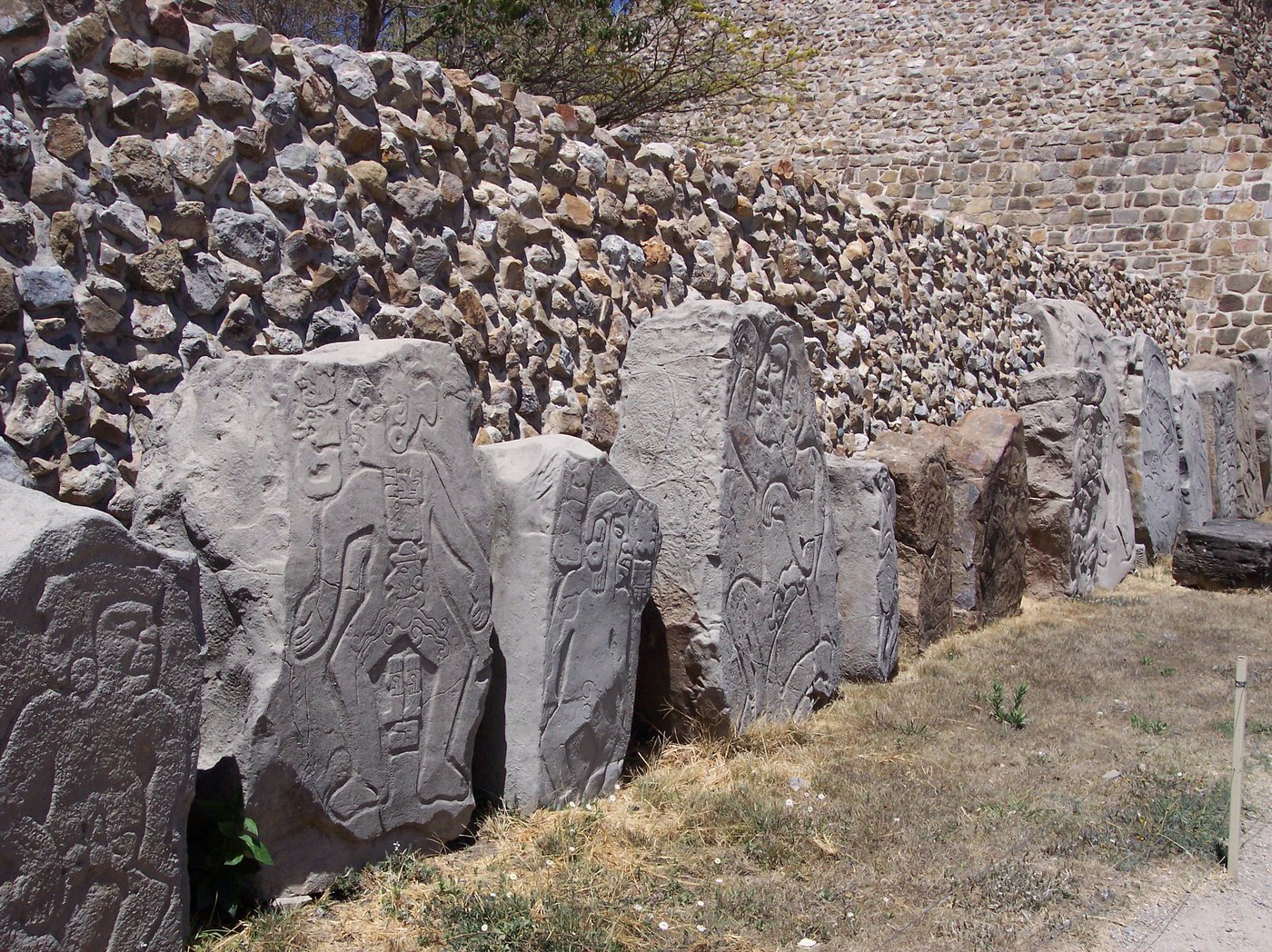
Their script is only partly cracked. We can read some calendar signs and a handful of names, enough to know the carvings record specific people and specific days, but the grammar behind the rest stays out of reach. It is a frustrating kind of half-silence: a civilisation that learned to write, wrote for more than a thousand years, and left us letters we can sound out without quite understanding the words.
New work keeps pushing at that edge. In 2025 researchers proposed that some of the early Zapotec inscriptions track a running count of lunar days, which would tie the loose scatter of texts into a firmer timeline and sharpen the dates behind the danzantes themselves. The wall, in other words, is not finished talking. Every few years someone reads a little more of it.
The name-signs and calendar dates carved beside the Monte Albán figures are among the earliest writing known in the Americas, cut centuries before the Classic Maya inscriptions that usually get the credit. The Zapotec system was never fully deciphered, and much of what the slabs say is still, quite literally, unreadable.
The arrowhead in the plaza
Walk out into the centre of the great plaza and you meet the site's other riddle. Almost every building at Monte Albán is squared to the same tidy grid. One is not. Building J sits at a sharp angle to everything around it, and instead of the usual rectangle it is shaped like a blunt arrowhead, its point aimed off to the south-west. Its shape, its odd twist and a dark internal passage have convinced many archaeologists that it was built partly to watch the sky: an observatory as much as a temple, lined up on the rising of certain bright stars.
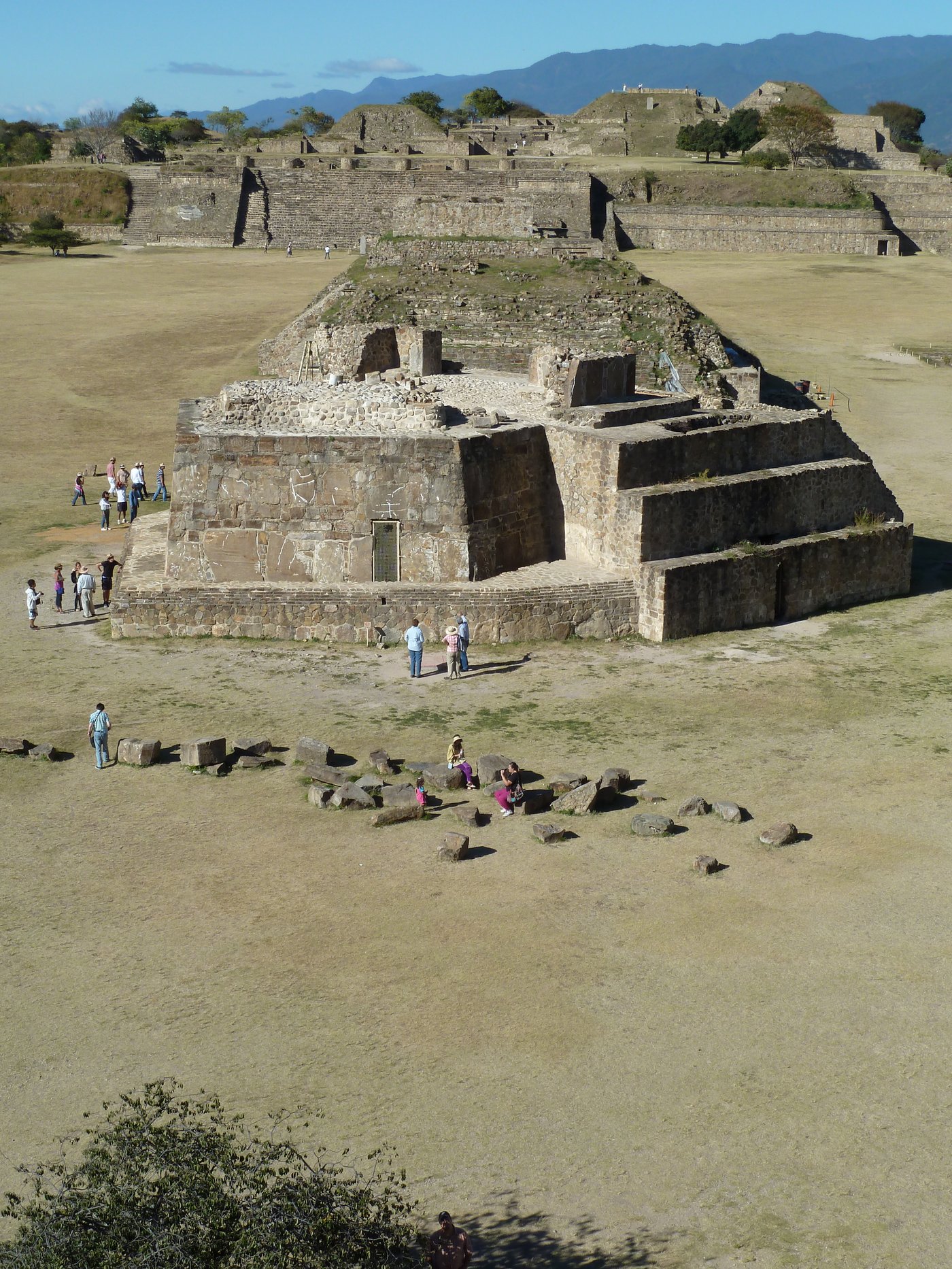
The stranger content is on its walls. Set into Building J are roughly forty carved slabs, each showing an upside-down head above a hill-sign and a cluster of glyphs. The archaeologist Alfonso Caso, who dug here in the 1930s, read them as conquest slabs: each one a place the armies of Monte Albán claimed to have beaten, the inverted head the standard Mesoamerican shorthand for a town brought down. It is a stone map of an empire's reach, carved in the language of the danzantes but scaled up from bodies to whole towns.
The forty-odd slabs plainly boast of conquered places. What is harder is knowing which boasts were true. For one named region, the Cañada de Cuicatlán north of the valley, archaeological survey has turned up the burned villages and shifted populations you would expect after a Zapotec takeover. For most of the others there is no such check. The wall may record real campaigns, wishful propaganda, or a mix of both, and short of digging every named town, we may never sort one from the other.
That gap between the claim and the proof runs through the whole site. Monte Albán's rulers were skilled at saying, in stone, that they were powerful and feared. Whether every boast matched the ground beneath it is a separate question, and one the carvings were never meant to answer honestly.
Nine jaguars of gold
For all its early menace, Monte Albán's most famous single discovery came from its long, calmer afterlife. In January 1932 Alfonso Caso's team, clearing tombs on the northern slope, broke into a chamber that had been reused long after the city's peak. Inside was the richest single burial ever found in the Americas up to then: Tomb 7, packed with more than five hundred objects, including gold and silver jewellery, jade, turquoise mosaics, pearls, and finely carved jaguar and eagle bones. The gold alone was staggering, delicate breastplates and ear ornaments and a mask, the work of some of the finest metalsmiths of the ancient New World.
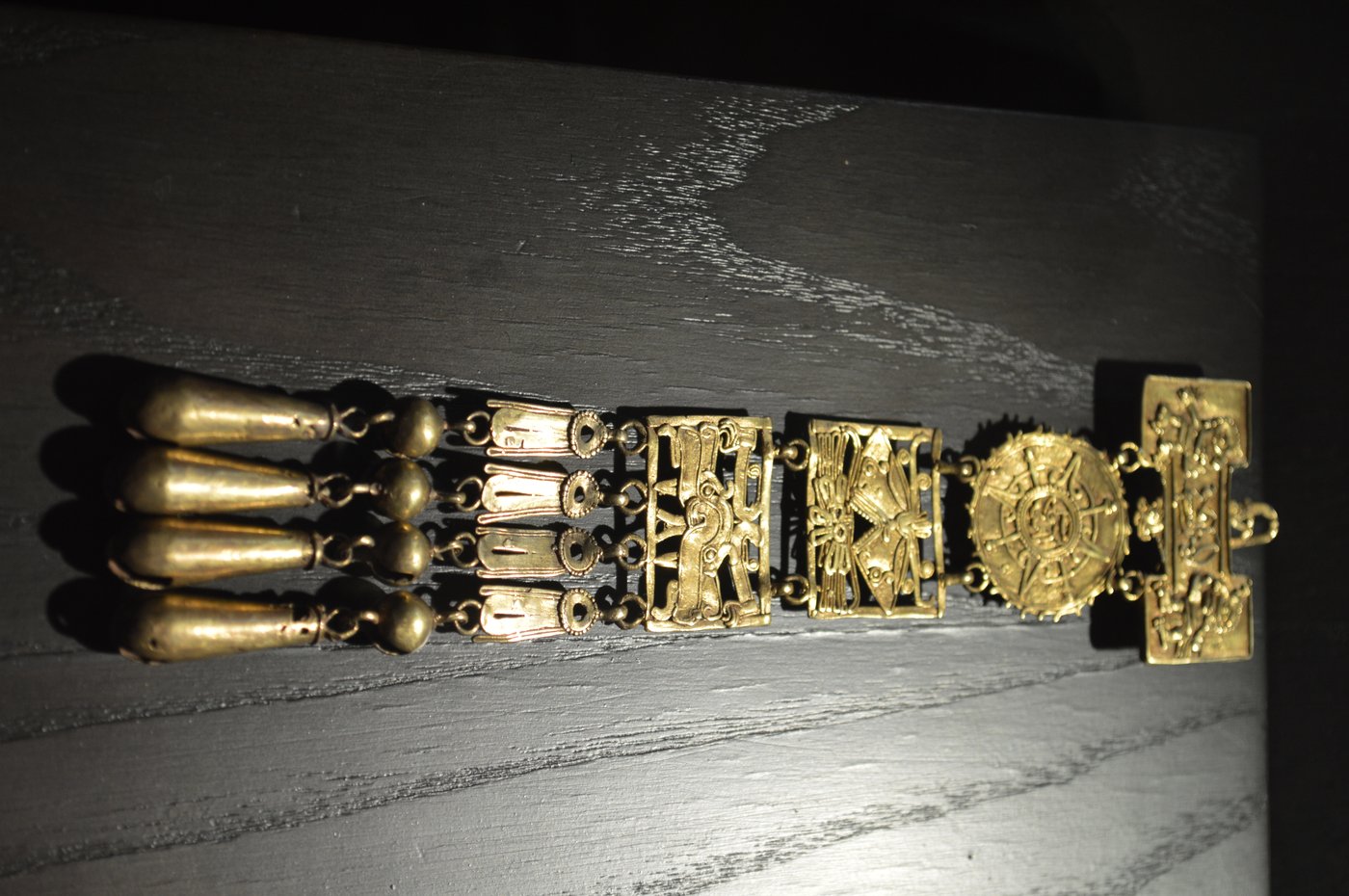
The twist is that the treasure is not really Zapotec. By the time it was buried, around the fourteenth century, Monte Albán had faded as a living capital, and the newcomers who left the gold were Mixtecs from the surrounding highlands. They had found a grand old Zapotec tomb, emptied or honoured its first occupants, and turned it into a resting place for their own elite dead, wrapped in the prestige of the ancient hill. Tomb 7 is two cultures stacked in one hole in the ground: a Zapotec chamber refurnished by Mixtec hands.
"We had never seen anything like it," Caso wrote of Tomb 7, describing gold that gleamed as the lamplight reached it after six centuries in the dark. The find made headlines around the world and turned a regional dig into national news; the treasure has stayed in Oaxaca ever since, one of the few great hauls of ancient American gold never melted down or shipped abroad.
The slow emptying
Cities of this size rarely end with a bang, and Monte Albán did not. After holding the valley for the best part of a thousand years, the hill began to lose its people from around 800 CE. The plaza fell quiet. The great platforms were no longer patched and rebuilt. Power did not vanish from Oaxaca. It scattered, into a patchwork of smaller Zapotec and later Mixtec centres down in the valley, closer to the fields and the water the mountain never had.
Why the centre could not hold is the familiar open question of collapse. No single disaster is written in the ground: no sacking, no plague, no drought that neatly does the job. The likelier story is slower and duller: a capital whose whole purpose had been to bind rival groups together gradually lost its grip on them, until the reasons to haul food and water up a barren hill no longer outweighed the effort. The disembedded capital came apart along the same seams it had once stitched shut.
What the hill still keeps
Go up there now and the plaza is calm, the grass short, the view enormous. It is easy to take the calm for the whole story, to see a serene ceremonial centre floating above the fields. The danzantes are the correction. Set into the oldest wall on the site, they are a reminder that this beautiful place opened its account with a record of the dead: the first thing its founders wanted carved in stone was proof of what they could do to anyone who resisted them.
The gentle name has outlived the people who earned the correction. There is something fitting in that. A civilisation that learned to write, and used its writing to name its enemies, has been remembered instead for a word its enemies would never have chosen. The stones are still there, eyes shut, mouths open. We are only now learning to read them as they were meant to be read.
Read next: Teotihuacan: The City Whose Builders Left No Name and Tiwanaku: The Andean Temple a Satellite Found Under a Farmer's Field.
Sources & further reading
- Richard E. Blanton, Monte Albán: Settlement Patterns at the Ancient Zapotec Capital (Academic Press).
- Joyce Marcus & Kent V. Flannery, Zapotec Civilization: How Urban Society Evolved in Mexico's Oaxaca Valley (Thames & Hudson).
- Alfonso Caso, reports on the excavation of Tomb 7 at Monte Albán (Instituto Nacional de Antropología e Historia).
- Javier Urcid, Zapotec Hieroglyphic Writing (Dumbarton Oaks).
- "A Lunar Day Count at Monte Albán," Latin American Antiquity (Cambridge University Press, 2025).
Image credits (via Wikimedia Commons): Main Plaza panorama — DavidConFran (CC BY-SA 3.0); gallery of the danzantes — MAHC-oaxaca (CC BY 4.0); single danzante slab — Gengiskanhg (CC BY-SA 3.0); Building J, the observatory — Rob Young (CC BY 2.0); gold ornament from Tomb 7 — AlejandroLinaresGarcia (CC BY-SA 4.0).