Sometime in the fourteenth century, a band of Nahua-speaking newcomers walked north from the lakes of the Valley of Mexico and came upon a dead city. Grass grew on its avenues. Two hills of dressed stone, each the size of a small mountain, stood at the north end of a broad, straight road that ran for kilometres through a field of ruined temples. Whoever built the place had been gone for seven or eight hundred years, longer than the gap between us and the Norman Conquest. The newcomers had no idea who they were. So they did what people do with a wonder they cannot explain: they gave it a story. This, they decided, was where the gods had gathered in the dark to make the sun and the moon and set the present age in motion. They called it Teotihuacan: in their language, something close to “the place where the gods were born.”
That name is the one we still use, and it is a confession. The Aztecs did not build Teotihuacan and never met the people who did. The word is theirs, coined centuries after the fact, for a city they found already ancient and empty. We do not know what the builders called their own home. We do not know what language they spoke, what they called their gods, or the name of a single one of their kings. And this is not some minor lost tribe. At its height, around 500 CE, Teotihuacan held well over a hundred thousand people and ranked among the half-dozen largest cities on the planet, the equal of anything in China or the Mediterranean. It is one of the best-excavated ancient cities in the Americas. We have measured its pyramids to the centimetre and dug through its rubbish for a century. The one thing it will not give up is who lived there.
Old before the Aztecs were born
Start with the timeline, because it is the part people get wrong. Teotihuacan is routinely called an Aztec city in captions and on postcards. It is nothing of the kind. The Aztecs (more properly the Mexica) rose to power in central Mexico in the fourteenth and fifteenth centuries. Teotihuacan was founded around the time of Christ, grew explosively over the next few hundred years, and was a burnt-out ruin by roughly 550 CE. By the time the Mexica arrived to marvel at it, the city had been dead for the better part of a millennium. The relationship is the other way round from how it is usually told: Teotihuacan was the deep past that the Aztecs looked back on with awe, the way medieval Europe looked back on Rome.
Its beginnings may owe something to a disaster. In the last centuries BCE, the volcano Popocatépetl and its neighbours were violently active, and eruptions seem to have driven farming communities off the land to the south and east. Some of those refugees appear to have gathered on the plain to the north-east of the lakes, at a spot with good springs and obsidian nearby. Within a few generations that gathering had become something without precedent in the region: a true city, planned from the top down, pulling in people faster than any place in Mesoamerica ever had.
A city laid out like an argument
What strikes you first, standing in the ruins, is how deliberate it all is. Teotihuacan was not a town that grew by accident and sprawled. It was drawn. The whole city is built on a grid, and the grid is tilted: oriented about 15 and a half degrees east of true north, a slant that shows up again and again in the alignment of walls and temples and even in the direction of a canalised river that was forced to bend to fit the plan. Nobody is quite sure what the angle points at. Guesses range from the setting of the Pleiades to sunrise on particular days of the year to a calendar written into the ground itself. Whatever the reason, the builders cared enough to make a river obey it.
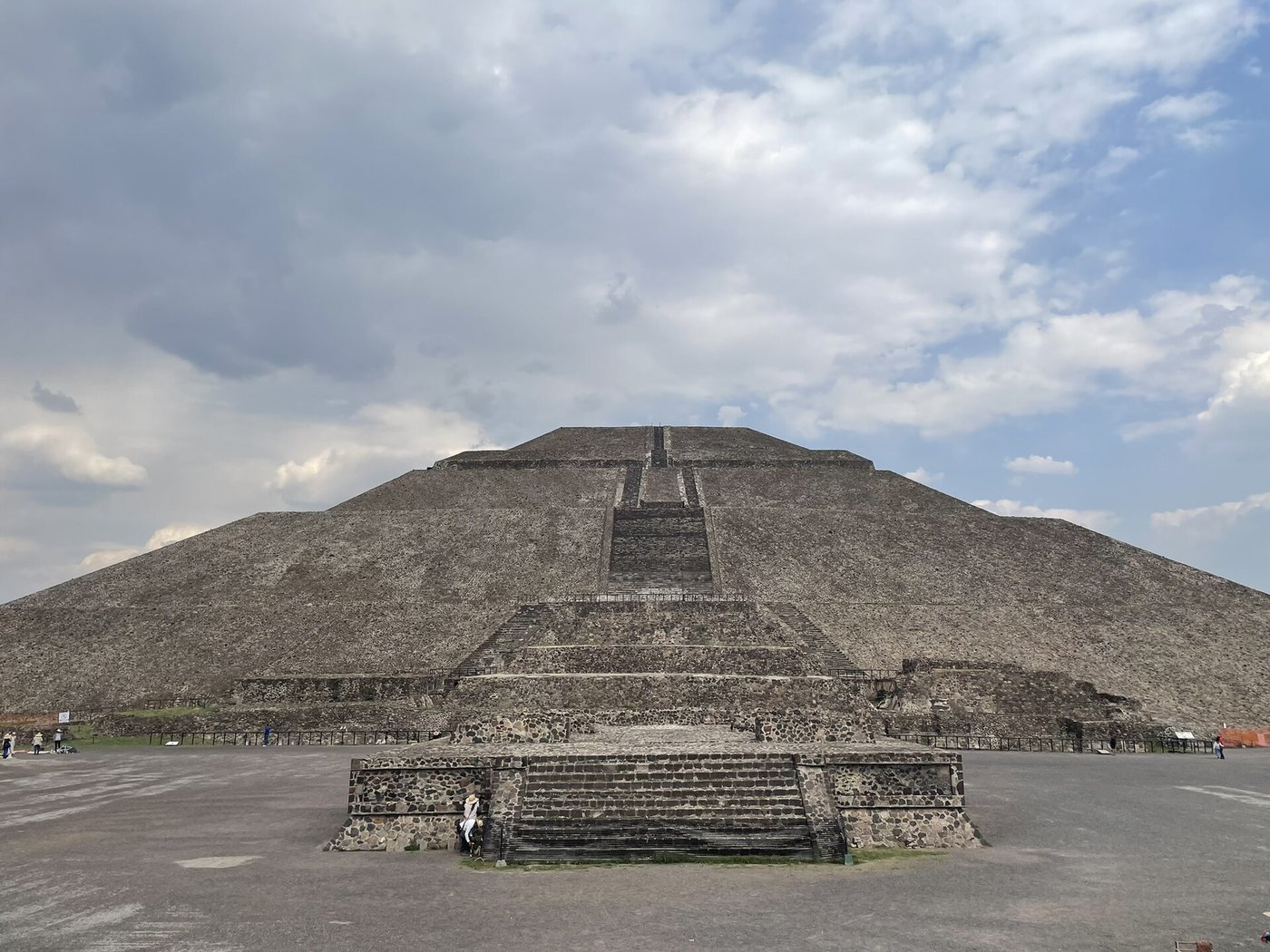
Running north to south through the heart of the city is the great processional road the Aztecs later named the Avenue of the Dead, because they took the platforms lining it for tombs. They were wrong about that, but the name stuck. At the northern end sits the Pyramid of the Moon, backed by the real mountain of Cerro Gordo, so that architecture and landscape rhyme. Halfway down looms the Pyramid of the Sun, one of the largest structures ever raised in the ancient world: around 65 metres tall and, by volume, the third-biggest pyramid on Earth, behind only the two great pyramids of Giza and Cholula. Further south stands the walled compound the Aztecs called the Ciudadela, the “citadel,” with a smaller, stranger pyramid at its centre that we will come back to.
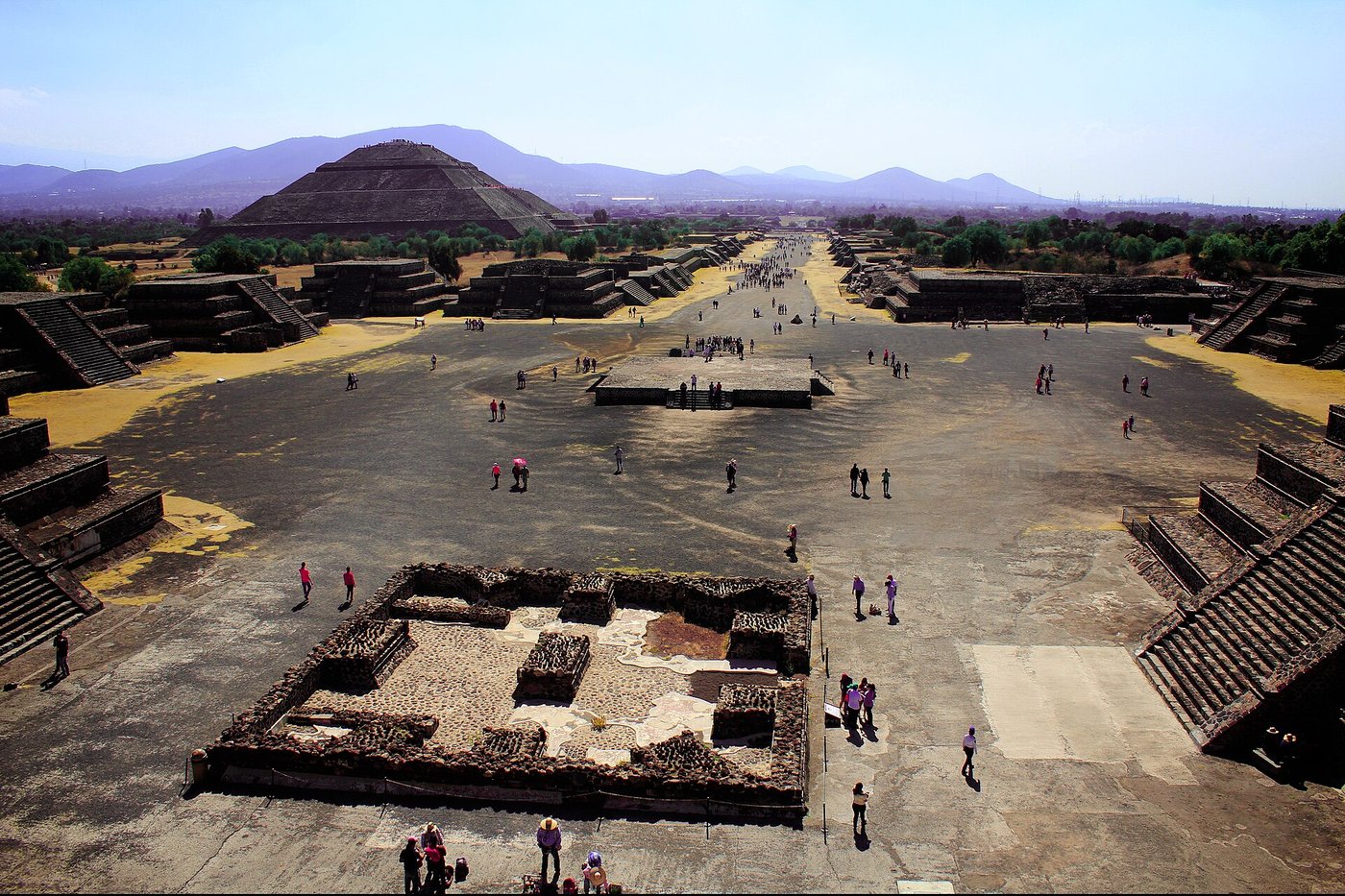
Under the Pyramid of the Sun there is a further oddity. In 1971 archaeologists found the mouth of a tunnel at its foot and followed it in. It led to a natural lava tube, widened and shaped by hand, that ran beneath the pyramid to a chamber split into four lobes like the petals of a flower. Caves, in Mesoamerican thought, were mouths of the earth, places of emergence and origin. It looks very much as though the greatest pyramid in the city was planted directly over a doorway to the underworld, and that the builders chose the spot for what lay beneath it, not the other way round.
At its peak around 500 CE, Teotihuacan covered roughly 20 square kilometres and housed somewhere between 100,000 and 200,000 people: larger than contemporary Rome had become, and among the five or six biggest cities anywhere on Earth. It supplied obsidian tools across hundreds of kilometres and its art turns up in Maya courts a thousand kilometres away. Yet the city produced no readable writing of its own that names a king, a dynasty, or the place itself. Everything we call it (Teotihuacan, the Sun, the Moon, the Avenue of the Dead) is a word the Aztecs supplied, long after the last resident had gone.
A hundred thousand strangers under one roof
Where the city becomes unusual is in how ordinary people lived. Most ancient cities housed their poor in mud and thatch that has long since dissolved. Teotihuacan rehoused a huge share of its population, at some point around 250 CE, in solid stone apartment blocks: more than two thousand of them, spread across the whole urban area. Each compound held a cluster of rooms, courtyards and shrines behind a plain outer wall, home to perhaps sixty or a hundred people who worked and worshipped together. It is one of the earliest experiments anywhere in housing a mass population in durable, standardised, multi-family blocks. Walk the excavated compounds today and you are walking through something that feels startlingly like public housing built seventeen centuries too early.
And the people in those blocks did not all come from the same place. The bones and the pottery tell a story of a city that pulled in migrants from across Mesoamerica and kept them in recognisable communities. On the western edge sat a whole neighbourhood of people from Oaxaca, hundreds of kilometres to the south, who went on making Zapotec-style pottery and burying their dead in Zapotec-style tombs for generations while living in Teotihuacan apartments. Elsewhere there were people from the Gulf coast and from the Maya lowlands. Chemical signatures locked into tooth enamel show individuals who grew up far away and moved to the city as adults. Teotihuacan was, in the fullest sense, a city of strangers: a cosmopolitan capital that drew people the way a great port does, and let them keep a good deal of who they were.
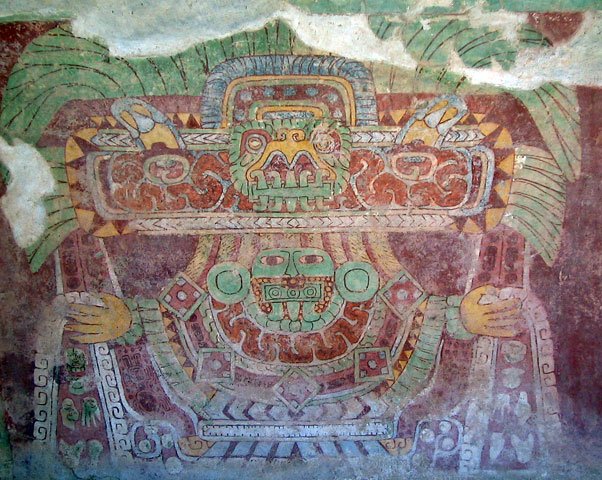
This is what still unsettles specialists. For all its size and organisation, Teotihuacan produced almost no images of a personal ruler. The Maya cities of the same era are wallpapered with kings: their portraits, their names in glyphs, their birthdays and conquests and the dates they let their own blood. Teotihuacan has next to none of that. Its art overflows with gods, priests, warriors, animals and abstract signs, but the swaggering individual monarch, so normal everywhere else, is simply missing. Some archaeologists now argue that this is not an accident of survival but a fact about how the city was run: that after an early phase of strongman rule, Teotihuacan may have governed itself through some kind of collective or council arrangement, a sharing of power that deliberately kept any one face off the walls. If they are right, the anonymity that frustrates us was, to the people who built the place, the point.
The serpent and the two hundred dead
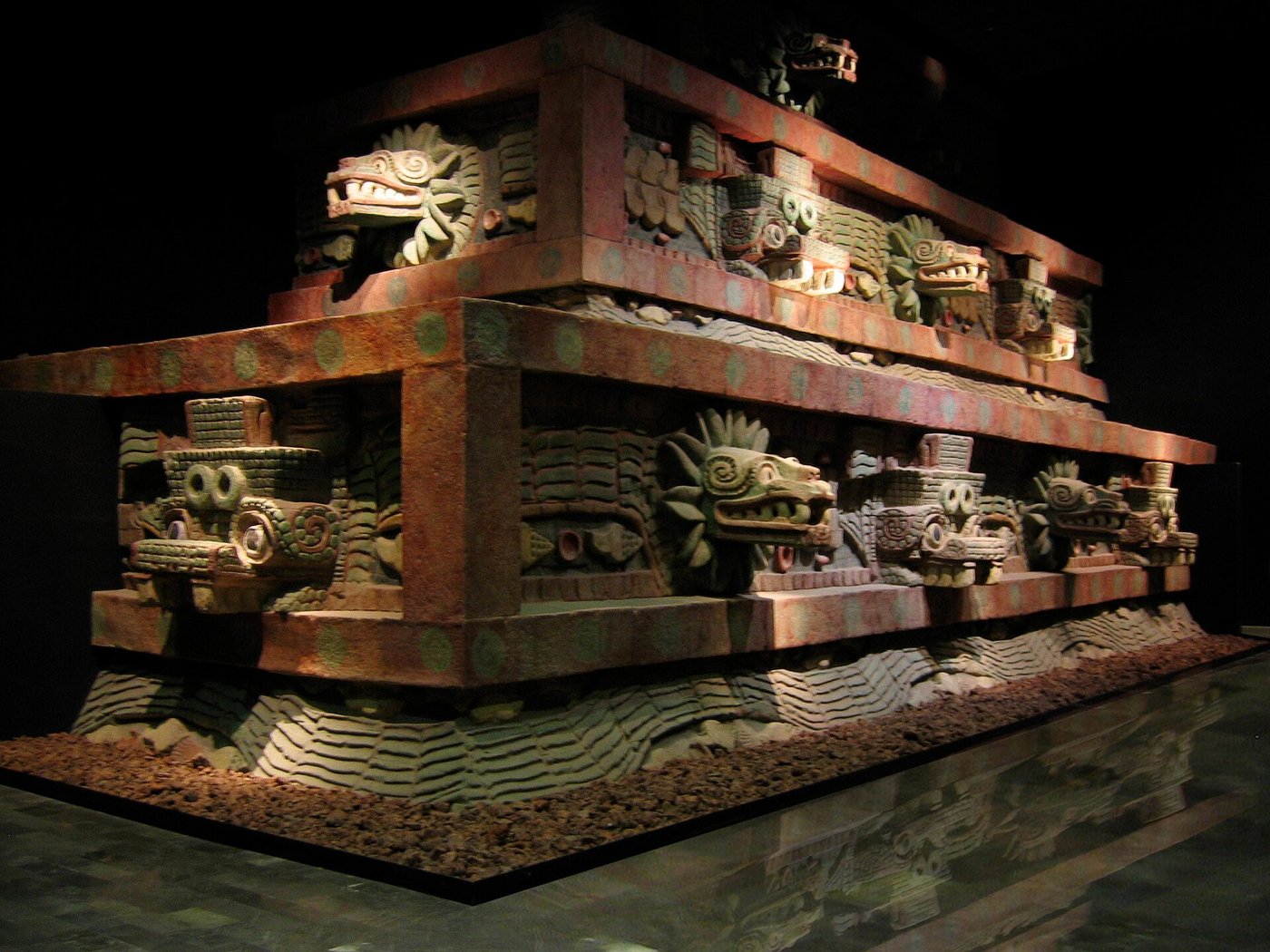
The smaller pyramid inside the Ciudadela is where the city shows its teeth. It is the Temple of the Feathered Serpent, and its facade is the most spectacular sculpture in Teotihuacan: rank upon rank of great stone serpent heads, fanged and ringed with carved feathers, thrusting out of the stonework beside a blockier head usually read as a war or storm emblem. The feathered serpent here is the earliest monumental version of a being who would haunt Mesoamerica for the next thousand years, resurfacing among the Maya as Kukulkan and among the Aztecs as Quetzalcoatl. Painted and complete, with the serpents perhaps trailing real feathers and the eyes filled with shining obsidian, it must have been overwhelming.
In the 1980s and 90s, archaeologists led by Saburo Sugiyama and Rubén Cabrera dug into and around the temple, and found what the beauty was sitting on. Buried in the pyramid, in careful rows, were the skeletons of around two hundred people. Many had their hands tied behind their backs. They were dressed as warriors, some with collars strung from imitation human jawbones carved in shell, and they had been laid in the foundations in numbers that seem to answer to the calendar: groups of nine, eighteen, twenty, the counting units of the Mesoamerican year. This was not a graveyard. It was a mass dedication: scores of captives, quite possibly foreign soldiers, killed and arranged to consecrate the monument and, some think, to advertise the military reach of whoever ordered it. The Feathered Serpent temple is beautiful the way a loaded threat is beautiful. It tells you exactly what the city could do.
The river under the pyramid
For all the digging, the tomb of a Teotihuacan ruler had never been found: not one confirmed royal burial in a city of a hundred thousand. Then the ground offered a clue on its own. In 2003, heavy rain opened a sinkhole near the foot of the Feathered Serpent temple, and the hole turned out to be the top of a shaft dropping into a long, sealed tunnel. An archaeologist named Sergio Gómez Chávez spent more than a decade clearing it, working by hand and later with a small remote-controlled robot sent ahead into the dark.
What he found was a designed underworld. The tunnel ran about 103 metres, roughly the length of the pyramid above it, and descended some 18 metres below the surface before opening into chambers directly beneath the temple. Its walls and ceiling had been dusted with powdered pyrite and other minerals so that, under a torch, they would have glittered like a night sky underground. The floor was strewn with offerings by the tens of thousands: jade figurines, greenstone, thousands of shells, rubber balls, the bones of big cats, carved wooden objects preserved in the damp. And in the deepest chambers, pooled and scattered on the ground, was liquid mercury: quicksilver, painstakingly extracted from cinnabar ore, most likely poured to stand for the still, shining rivers and lakes of the world below.
Gómez believed the tunnel might lead, at its end, to the burial of one of the city's rulers, the find that would finally put a body and perhaps a face to Teotihuacan's missing kings. The chambers held rich offerings, and arrangements that looked as though they had been staged around something important. But no undisturbed royal tomb has been confirmed. The kings of Teotihuacan, if kings is even the right word, remain exactly as anonymous as before. The city built a jewelled road to the underworld and left us standing at the end of it, holding a torch, with no name to read.
The faces that keep their secret
If you want to feel the anonymity directly, look at the masks. Teotihuacan sculptors made hundreds of them: broad, calm human faces cut from greenstone, serpentine and other hard stones, with drilled eyes that once held inlays of shell and obsidian and a stillness that is almost unnerving. They are among the most admired objects the ancient Americas produced. Aztec kings prized them as heirlooms; they sit now in the great museums of the world. And not one of them is a portrait of a person we can name.
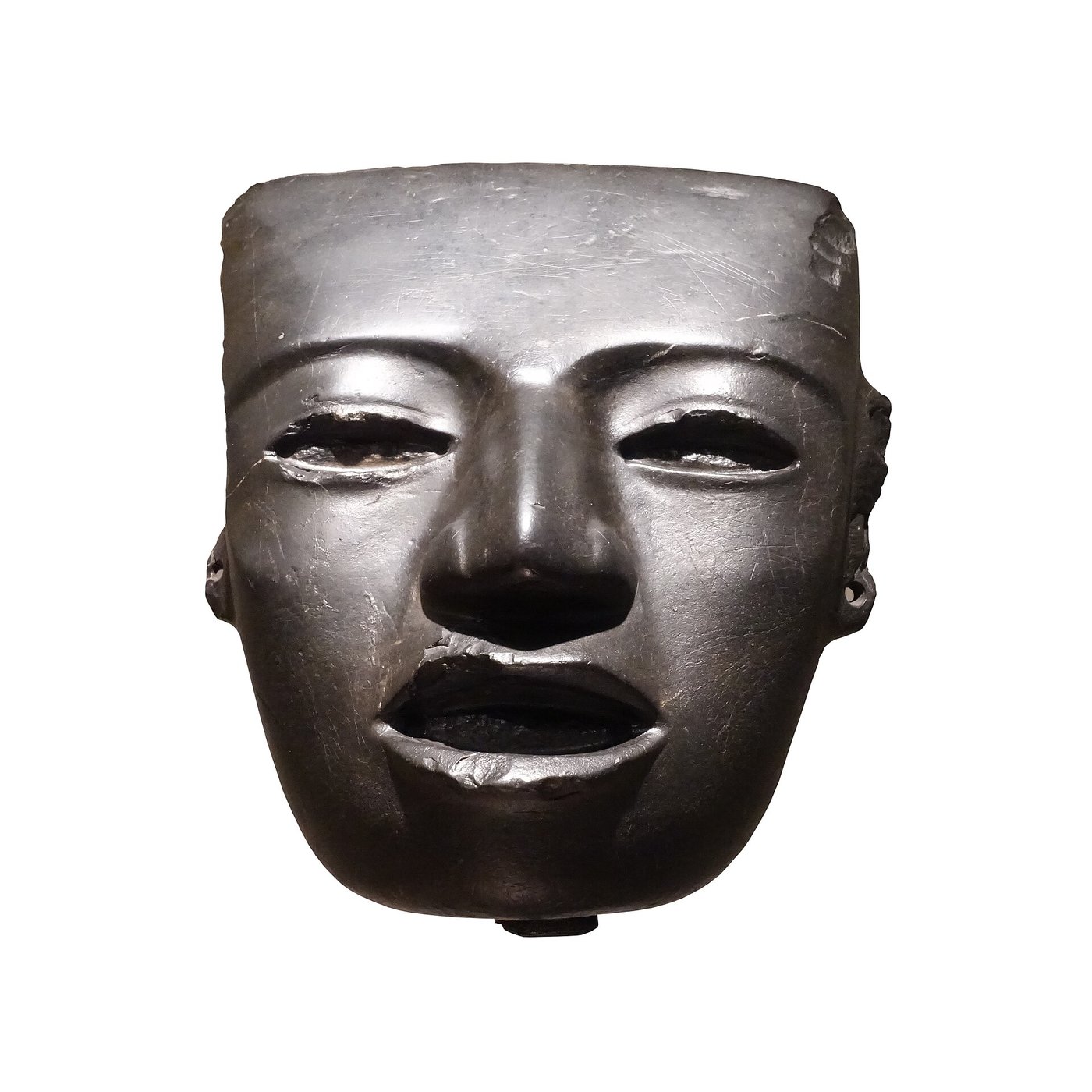
This is the strangeness at the centre of the whole subject. Most great early civilisations are noisy about themselves. Egypt filled its walls with the names and deeds of pharaohs. The Maya carved their kings' genealogies into stone. Mesopotamian rulers had scribes list their conquests. Teotihuacan, at least as large and as powerful as any of them, went silent about individuals. It had a system of signs (there are glyph-like marks in the murals, and scholars are slowly teasing out how they worked), but it never developed, or never chose to use, a full writing that spelled out royal names and dates the way the Maya did next door. So the city speaks to us fluently in stone and paint and plan, and says nothing at all about the men and women who ran it.
Because Teotihuacan has “no known builders,” a whole genre of television and online video reaches for the obvious punchline: that a city this vast, this precisely aligned, this early, must have had help from a lost super-civilisation, or from somewhere off the Earth entirely.
“No known builders” is a statement about names, not hands. We know a great deal about who built Teotihuacan: farming peoples of central Mexico, joined by migrants from Oaxaca, the Gulf and the Maya lands, working in obsidian, lime plaster and cut stone with techniques we can trace step by step through the archaeology. Their pottery, their diet, their gods, their tools and their remains are all thoroughly Mesoamerican and thoroughly human. What is missing is not the makers but their language and their written names: a gap in the record, not a gap in the story of who did the work.
Its shadow fell as far as Guatemala
A city that keeps its own name secret can still leave fingerprints on its neighbours, and Teotihuacan left them a very long way off. The clearest case is written down, not by Teotihuacan, but by the Maya, who did keep dated royal records. On a date that converts to 16 January 378 CE, Maya inscriptions at the great city of Tikal, in the forests of present-day Guatemala, mark the arrival of an outsider named Sihyaj K'ahk', “Fire Is Born.” That same day, the reigning king of Tikal died. Within a year a new king sat on the throne: a boy, Yax Nuun Ahiin, whose father the inscriptions link to a distant lord tied to Teotihuacan. Read plainly, the glyphs describe something like a coup with foreign backing: a ruling house removed and replaced, on a single day, by agents from central Mexico more than a thousand kilometres to the west. Maya scholars call it, drily, the Entrada.
The evidence for that reach has kept growing. In 2025, archaeologists working at Tikal announced a painted altar, built around the late 300s, decorated in an unmistakably central-Mexican style (the colours, the frontal figure, the feathered headdress all reading as Teotihuacan rather than Maya) and surrounded by the buried remains of children. The excavators argue it was made by, or under the hand of, someone trained in Teotihuacan's own artistic tradition, dropped into the middle of a Maya city. It is the kind of find that turns a line of glyphs into a physical presence. Teotihuacan did not just trade with the Maya world; for a time it reached in and rearranged its politics, and left its own temple furniture behind on the floor as proof.
The day the palaces burned
Great cities usually decline slowly, thinning out as trade shifts and land tires. Teotihuacan did not fade. It burned. Sometime around the middle of the sixth century, the monumental core of the city (the temples and elite compounds strung along the Avenue of the Dead) was set on fire and torn apart in a single sustained episode of destruction. Sculptures were smashed, sacred images broken, staircases and shrines pulled down. The city did not empty and then crumble; its own heart was attacked while it still stood.
Who did it is the great argument, and the clue is in what burned. The fire and the smashing fell overwhelmingly on the grand public and elite buildings, not on the ordinary apartment blocks, which were largely left alone. That pattern points away from a foreign army sacking everything in reach and towards something more pointed: an uprising from inside, aimed squarely at the rulers, the priests and the monuments of their power. The picture that many now favour is of a population that had had enough (of demands, of shortages, of an elite that took more than it gave), turning on the institutions above them and burning the symbols of authority while sparing their own streets.
Three explanations for the burning still compete. Some read it as invasion by outsiders: northern peoples pressing in as the city weakened. Others see an internal revolt, on the strength of a fire that targeted temples and palaces while leaving the residential blocks standing. A third view widens the lens: skeletons from the city's last generations show rising signs of poor nutrition, and the wider region was turning drier, so drought and strain may have hollowed the city out from within until a revolt, when it came, only finished a job that hunger had started. The three are not neatly separable, and the honest answer is that we are still reading the ashes.
Whatever the trigger, the recovery never came. Teotihuacan's population fell away over the following century until, by around 650 CE, the greatest city the Americas had yet produced was a scattering of villages among enormous ruins. The obsidian trade moved elsewhere. The gods it had exported kept travelling (the feathered serpent would outlive the city that carved him first by a thousand years), but the place that made them was finished as a power. When the Mexica walked in seven or eight centuries later and named it for the birth of the gods, they were naming a grave.
What the stone keeps
We can do remarkable things with Teotihuacan now. We can date its building phases, map its neighbourhoods block by block, read the diet and the birthplaces out of its dead, trace its obsidian across half of Mexico and follow its influence into the courtrooms of the Maya. We can stand in the tunnel under the Feathered Serpent and see the mercury the builders poured to make an underground sea. For a city with no history in the ordinary sense, it is astonishingly well known.
And still the middle of it is empty. Not the streets, which are crowded with evidence, but the space where the names should be. No royal list. No founder. No word in the builders' own language for the road, the pyramids, the gods, or the city itself. Every label we hang on Teotihuacan is a loan from people who came later and guessed. It is a peculiar kind of silence: not the silence of a place we have failed to dig, but of one we have dug thoroughly and found deliberately mute. The builders raised the third-largest pyramid on Earth, housed a hundred thousand people in stone, reached across a subcontinent, and arranged, whether by accident or design, to leave without telling us who they were. The city kept everything. It just would not keep its name.
Read next: Monte Albán: The Stone ‘Dancers’ That Are Really the Slain and The Calakmul Mural: The Oldest Known Portrait of a Maya Hero Twin.
Sources & further reading
- George L. Cowgill, Ancient Teotihuacan: Early Urbanism in Central Mexico (Cambridge University Press, 2015) — a leading synthesis of the city's rise, organisation and fall.
- David M. Carballo, Collision of Worlds: A Deep History of the Fall of Aztec Mexico (Oxford University Press, 2020), and his work on collective governance at Teotihuacan.
- Saburo Sugiyama, Human Sacrifice, Militarism, and Rulership: Materialization of State Ideology at the Feathered Serpent Pyramid, Teotihuacan (Cambridge University Press, 2005).
- Matthew H. Robb (ed.), Teotihuacan: City of Water, City of Fire (de Young Museum / University of California Press, 2017) — catalogue of the major exhibition, including the tunnel discoveries.
- Stephen Houston, Andrew Scherer and colleagues, “A Teotihuacan altar at Tikal, Guatemala,” Antiquity (2025) — the painted altar and the central-Mexican presence in the Maya lowlands.
- David Stuart, “The Arrival of Strangers: Teotihuacan and Tollan in Classic Maya History,” in Mesoamerica's Classic Heritage (University Press of Colorado, 2000) — on the 378 CE Entrada at Tikal.
Image credits (via Wikimedia Commons): Pyramid of the Sun — Peachseltzer (CC BY-SA 4.0); Avenue of the Dead — AnbyG (CC BY-SA 4.0); facade of the Temple of the Feathered Serpent — rosemania / Flickr (CC BY 2.0); Teotihuacan stone mask — Rama (CC BY-SA 3.0 FR); Tetitla “Great Goddess” mural — Abracapocus / Flickr (CC BY 2.0).