Sometime around the year 637, a Chinese Buddhist monk named Xuanzang arrived at a walled complex in the kingdom of Magadha, in what is now the Indian state of Bihar, having walked, ridden and very nearly died across thousands of miles of desert and mountain to get there. He had not crossed half of Asia for a temple or a relic. He had come for a school: the most famous centre of learning in the Buddhist world, a place whose reputation had travelled all the way to the Tang court in China. He would stay for years, studying under its greatest master, and carry hundreds of its manuscripts home on the backs of pack animals. The place was called Nalanda, and centuries before Europe built Oxford or Bologna, it was already the closest thing the world had to a true university.
What stops you short is that Nalanda was not a handful of monks in a quiet cloister. At its height it was a residential university of thousands, with students and teachers living, eating and arguing on a single vast campus, drawn from across the whole of Asia. And then, after some seven centuries, it was destroyed so completely that for hundreds of years people forgot exactly where it had stood.
A university before the word existed
Nalanda was founded in the fifth century CE, around 427, under the patronage of the Gupta emperor Kumaragupta I, during the era often called the golden age of classical India. It began as a Buddhist mahavihara, a "great monastery", but it grew into something far more ambitious: a residential community of scholarship that ran for roughly 750 years. What made it a university, and not just a monastery, was that students lived on site, in monasteries arranged around open courtyards, and pursued a structured, years-long education under resident masters.
The scale, by the accounts that survive, was staggering. Tradition speaks of as many as ten thousand students and well over a thousand teachers in residence at its peak. They came not only from across India but from China, Tibet, Korea, Japan, Central Asia, Sumatra and Sri Lanka: an international student body more than a thousand years before that phrase meant anything. They were housed and largely fed by the revenues of villages granted to the university by a long line of royal patrons, which freed students and teachers alike to do nothing but study. It is one of the earliest examples anywhere on earth of organised higher education on a large scale.
Getting in was the hard part
For all its size, Nalanda was no diploma mill. By every account it was fiercely selective. Prospective students arriving at the gates had to face the dvarapandita, the "scholar at the gate", and submit to a rigorous oral examination on the spot. According to the Chinese pilgrims who studied there, a large fraction of applicants simply failed to get past this first interrogation and were turned away. To win a place was itself a mark of distinction across the Buddhist world.
And what those who got in studied went far beyond religion. Nalanda's curriculum was famously broad: Buddhist philosophy of every school, certainly, but also logic and debate, Sanskrit grammar, medicine, mathematics, astronomy, and metaphysics, alongside the study of the Vedas and rival philosophical systems. The intellectual life centred on rigorous public debate, where a scholar's reputation could be made or destroyed in argument. This was a place built not for memorising doctrine but for sharpening the mind against other minds.
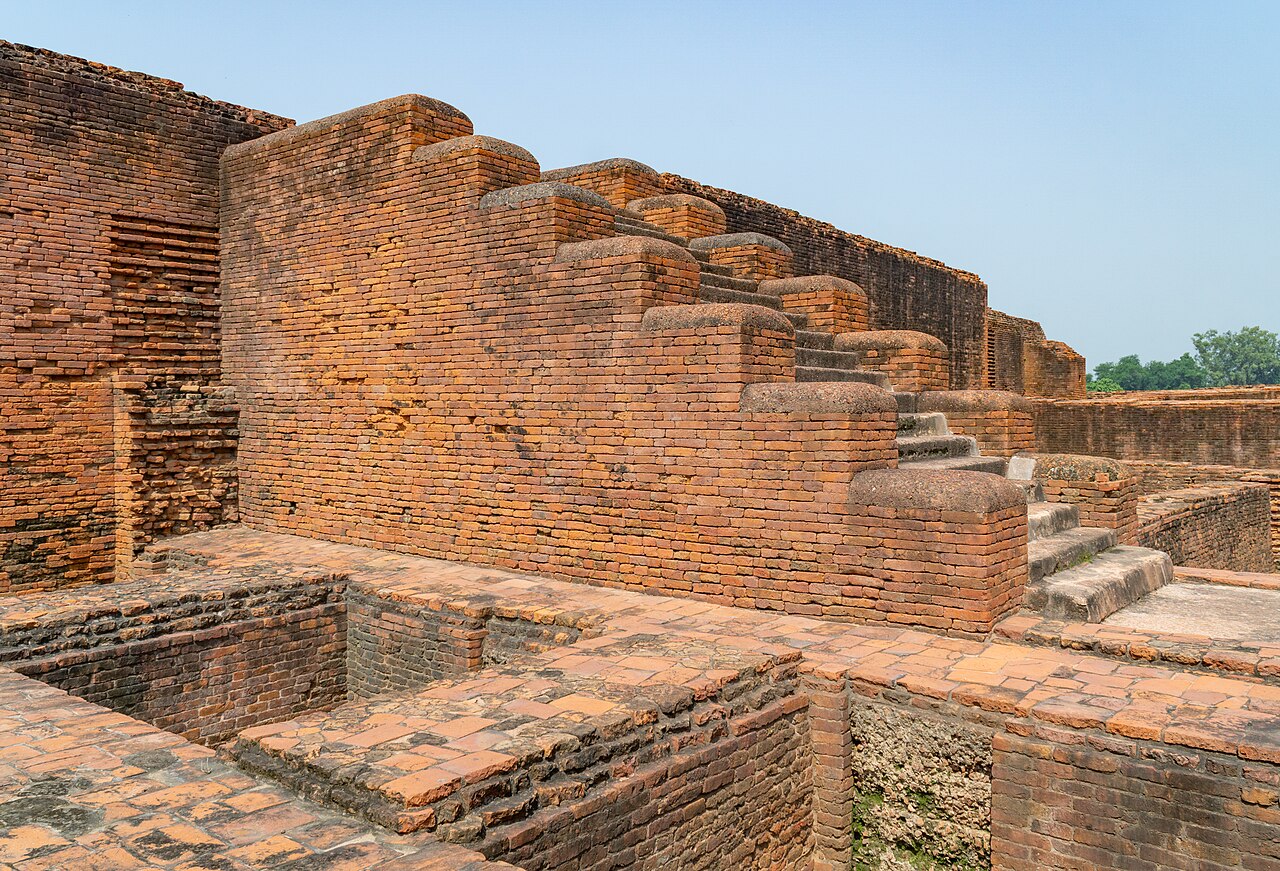
Almost everything we know about daily life at Nalanda comes from two Chinese monks who travelled there in the seventh century: Xuanzang and, a little later, Yijing. They recorded the numbers of students, the strict admissions debates, the daily timetable signalled by a water clock, the lectures, even the menu. Xuanzang studied at Nalanda for years and hauled hundreds of manuscripts back to China, where their translation reshaped East Asian Buddhism. In a real sense, two foreign students became the most important historians of the university that taught them.
The library called the Treasury of Truth
At the heart of Nalanda stood its library, and it is the library that haunts the imagination most. According to accounts preserved in the Tibetan tradition, the library complex was known as the Dharmaganja, the "Treasury of Truth", and consisted of three great buildings, one of which, the Ratnodadhi or "Ocean of Jewels," was said to rise nine storeys high. Together they were said to hold a collection of manuscripts so vast that scholars came from across Asia simply to copy texts that existed nowhere else.
Some of those details, the nine storeys and the poetic names, come from sources written centuries later and should be held a little loosely. But the core fact is not in doubt: Nalanda housed one of the greatest collections of written knowledge in the pre-modern world, an irreplaceable archive of Buddhist philosophy, science, medicine and literature accumulated over seven hundred years. That is what makes its end so painful to contemplate.
"The priests, to the number of several thousand, are men of the highest ability and talent... The day is not sufficient for asking and answering profound questions. From morning till night they engage in discussion."— Xuanzang (Hiuen Tsiang), 7th-century Chinese pilgrim, describing Nalanda (trans. Samuel Beal)
The scholars who changed Asian thought
Nalanda was not famous merely for its size; it was famous for the minds it produced and housed. Over the centuries it was associated with some of the towering figures of Buddhist philosophy: the logicians Dignaga and Dharmakirti, whose work on epistemology and reasoning influenced Indian thought far beyond Buddhism; the great abbot Shilabhadra, under whom Xuanzang studied; the philosopher Dharmapala; and Shantarakshita, who, together with Padmasambhava, carried Nalanda's learning north into Tibet and helped plant Buddhism there.
That last point is the key to Nalanda's true importance. This was not an isolated Indian institution; it was the beating heart of a vast intellectual network that stretched across Asia. The forms of Buddhism that took root in Tibet, China, Korea and Japan were shaped, directly and indirectly, by the texts, teachers and debates of Nalanda. When students returned home to Lhasa or Chang'an carrying manuscripts and ideas, they carried Nalanda with them. For centuries, to study the cutting edge of Buddhist philosophy meant, in one way or another, to study Nalanda.
1193: the fire
The end came at the close of the twelfth century. Around 1193, a Turkic military commander named Bakhtiyar Khilji, campaigning in eastern India in the service of the new Muslim powers pushing in from the northwest, stormed and sacked the great monastic complexes of Bihar. The Persian chronicler Minhaj-i-Siraj, writing several decades later in his history the Tabaqat-i-Nasiri, describes the storming of a fortified Buddhist centre in the region, the killing of its shaven-headed monks, and the discovery of a great library of books.
The image that has come down to us is unforgettable: the libraries of Nalanda set ablaze, and so vast was the collection, the tradition holds, that the manuscripts smouldered for days, or by some later tellings for months. Whether or not that specific detail is literally true, the essential catastrophe is real. A monastic university that had gathered and generated knowledge for seven centuries, with a community of monks and scholars and an irreplaceable library, was destroyed in a single brutal campaign. Centuries of accumulated learning went up in smoke, and what survived did so mainly because earlier students like Xuanzang had carried copies abroad.
The popular story of Bakhtiyar Khilji burning Nalanda's library for months is dramatic but needs care. Minhaj-i-Siraj's account does not name Nalanda explicitly, and some historians argue the fortified site he describes may have been the nearby monastery of Odantapuri rather than Nalanda itself, though Nalanda was certainly devastated in the same period. The "burned for months" detail comes from later tradition, not the contemporary chronicle. And Nalanda was already weakening: as the Buddhist Pala dynasty gave way to Hindu rulers, royal patronage dried up and Buddhism in India was in long decline. The 1193 sack was a brutal death blow, but to an institution that was already fading, not a flourishing one cut down at its peak.
Rediscovery and revival
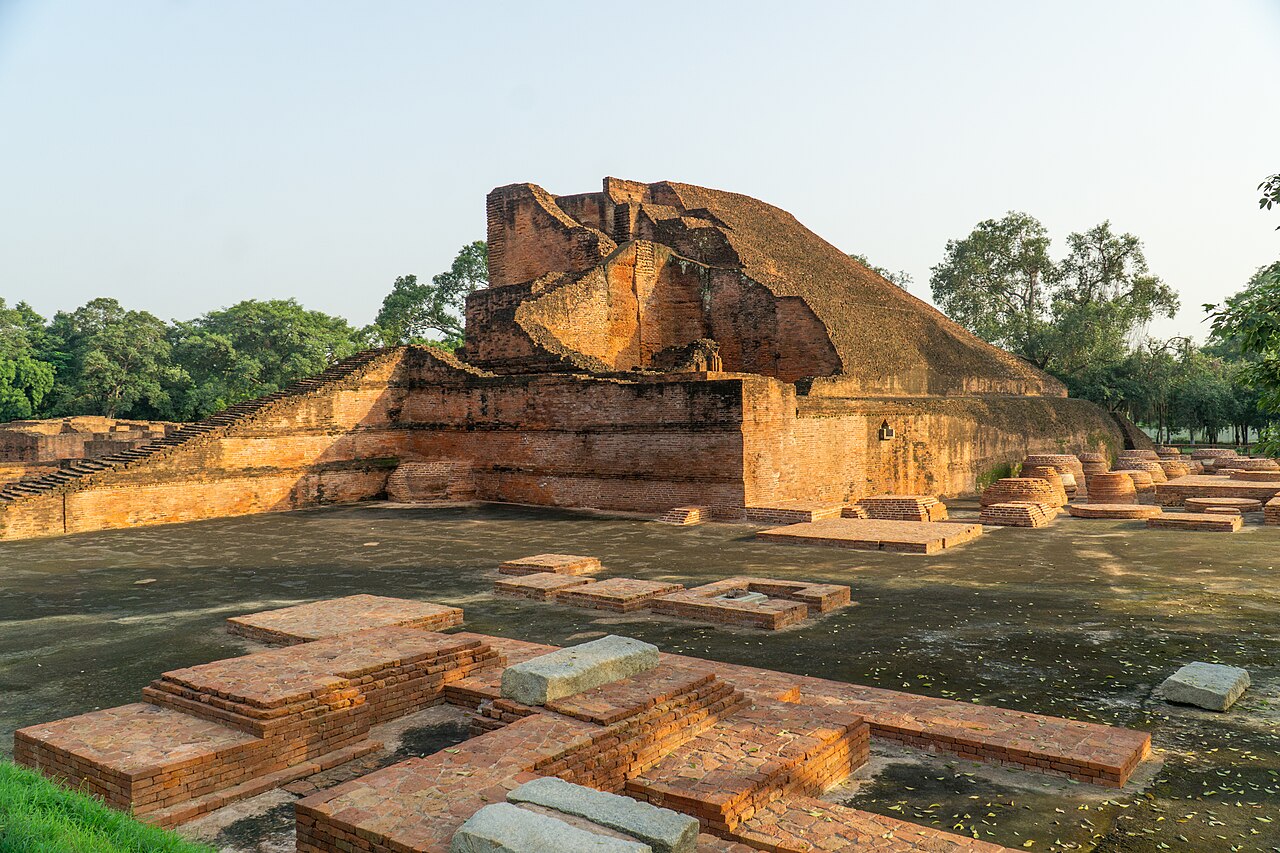
After its destruction, Nalanda faded so completely from living memory that its very location was lost. For centuries it survived only as a name in old Tibetan and Chinese texts and as a field of overgrown mounds in Bihar. It was not until the nineteenth century that archaeologists, guided in part by the centuries-old travel writings of Xuanzang, identified the site and began to dig. What they uncovered was extraordinary: row upon row of monastery cells, lecture halls, temples and the great stupa, sprawling across a huge area, exactly as the Chinese pilgrim had described it more than a thousand years before. In 2016 the Archaeological Site of Nalanda Mahavihara was inscribed as a UNESCO World Heritage Site.
And the name has been deliberately revived. In 2014 a new Nalanda University opened nearby at Rajgir, established by the Indian government with international backing as a conscious attempt to resurrect the spirit of the ancient institution: a modern university carrying a fifteen-hundred-year-old name. It is a striking gesture: an acknowledgement that what was lost in 1193 was worth trying, however imperfectly, to recover.
A day inside the great monastery
What did life at Nalanda actually feel like? Thanks again to the Chinese pilgrims, we have a surprisingly vivid picture. The day was regulated with almost clockwork precision: time was measured by a water clock, and the hours of study, worship, debate and rest were announced to the whole community by drums and bells. Xuanzang describes a campus humming with intellectual activity from morning to night, with something on the order of a hundred lecture platforms in daily use, so that a student could move from teacher to teacher and subject to subject across the day.
The intellectual centre of gravity was public debate. A scholar's standing rose or fell on his ability to defend a position against all comers, and visiting challengers would arrive hoping to make their name by defeating Nalanda's masters, though more often they left humbled. Daily life was communal and disciplined: shared meals, shared worship, strict rules of conduct, and a largely self-governing community of monks and students who policed their own standards. It was, in every sense that matters, campus life, fifteen hundred years ago.
All of this was paid for in a way that might make a modern university envious. According to the Chinese accounts, successive kings endowed Nalanda with the revenues of a large number of surrounding villages (by some reports around a hundred, by others as many as two hundred) whose grain and income supported the whole community. Students paid no fees; the monastery housed, fed and taught them for free, sustained entirely by this standing endowment of land. It was precisely that secure, long-term patronage that let Nalanda think in centuries rather than seasons, maintaining an enormous library and teaching staff, and admitting gifted students regardless of their means. And it was the slow erosion of exactly that royal support, as much as any single act of violence, that would in the end leave the great university dangerously exposed.
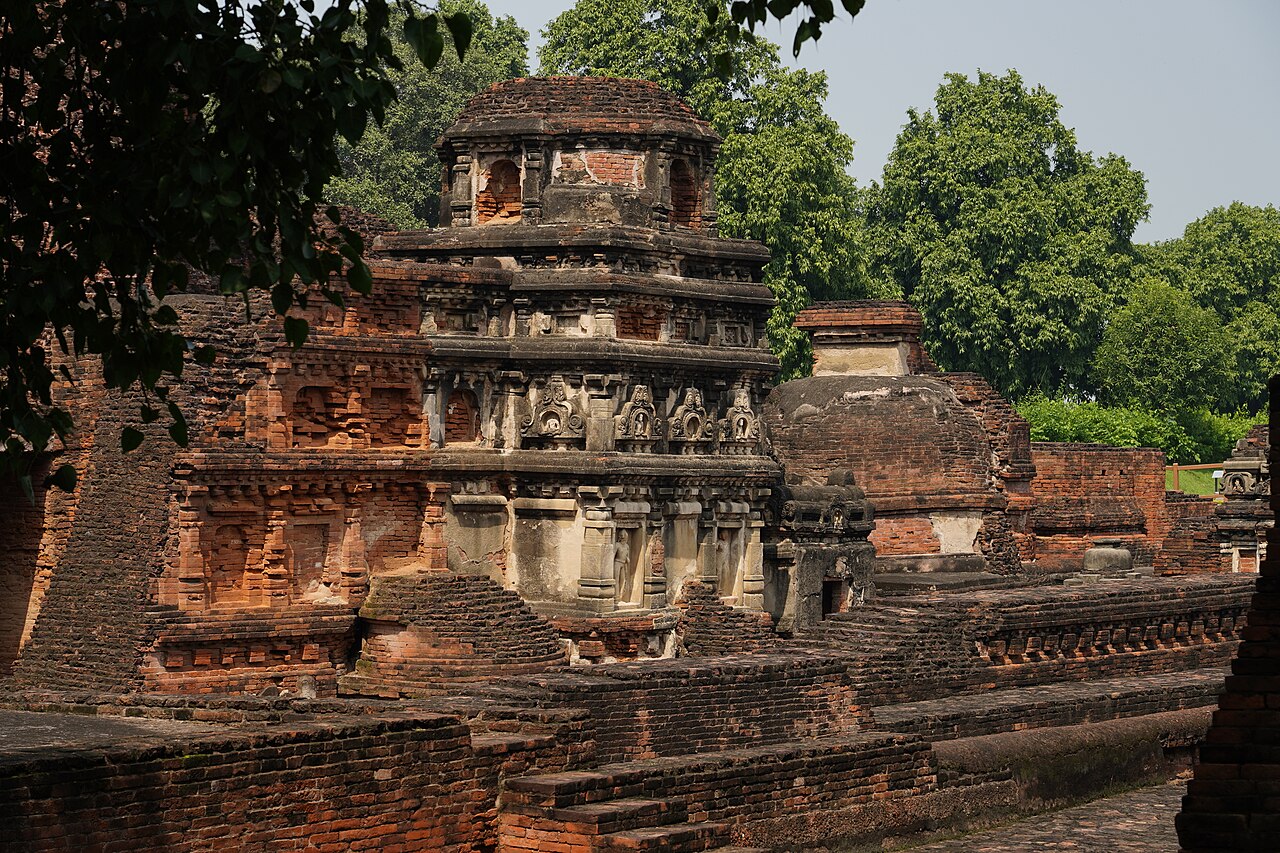
More than a Buddhist school
It is tempting to imagine Nalanda as a purely religious seminary, but that badly understates it. Its curriculum embraced what Indian tradition called the great branches of knowledge: not only Buddhist and rival philosophies, but logic, Sanskrit grammar, medicine, the fine arts and crafts, mathematics and astronomy. Students could train as physicians or logicians as readily as monks. This breadth is exactly why scholars travelled from across Asia. Nalanda was a place to learn the most advanced thought of the age in a dozen fields at once.
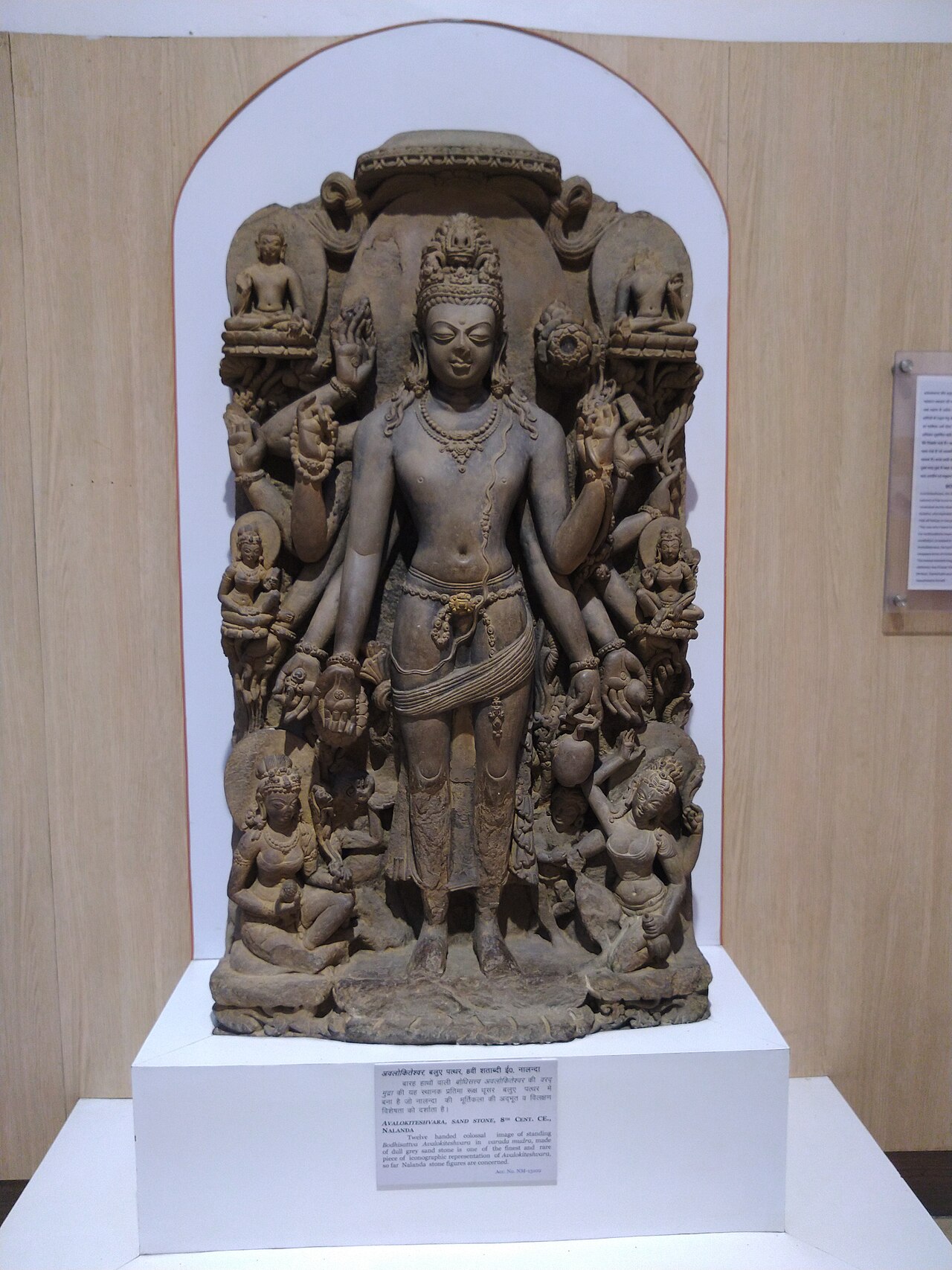
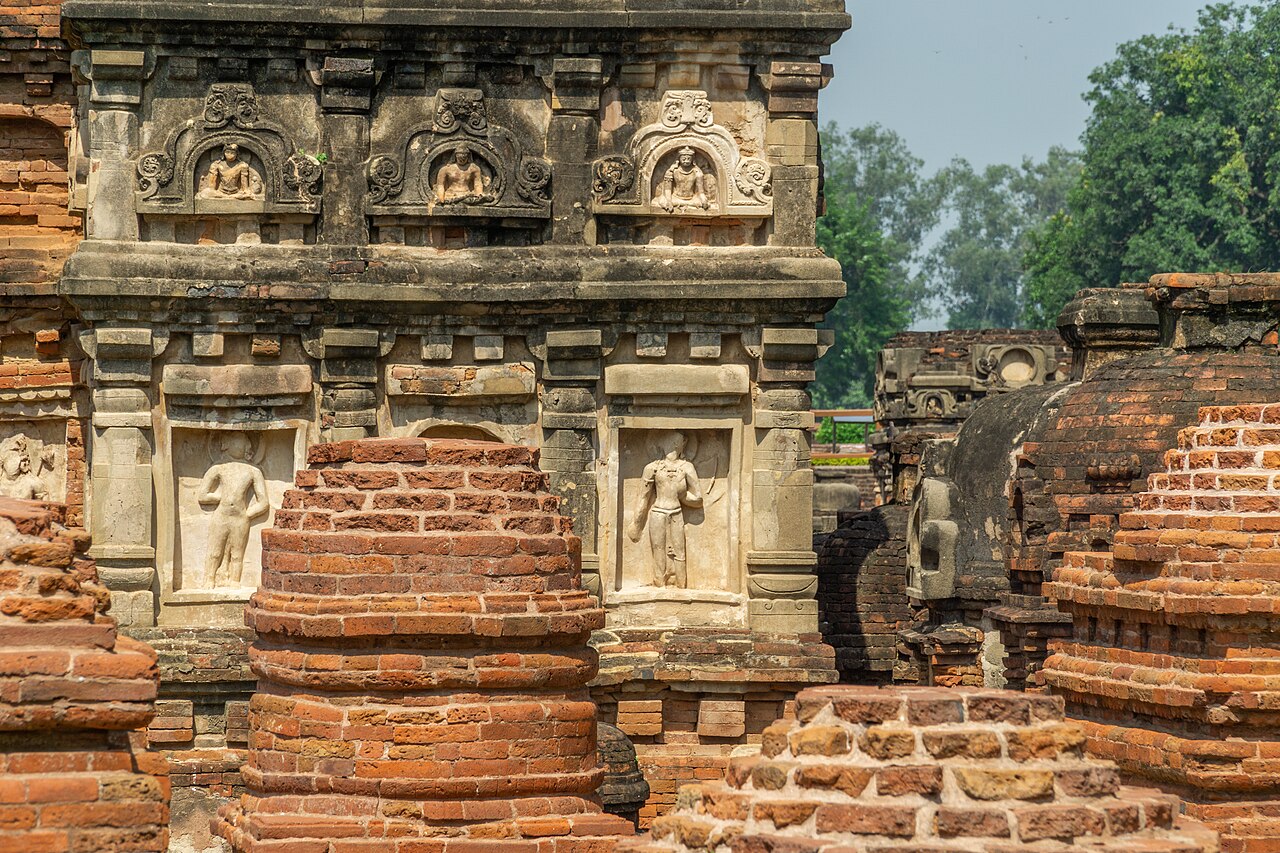
Nor did Nalanda stand alone. Under the Pala dynasty it was the most famous node in a whole network of great monastic universities across eastern India (Vikramashila, Odantapuri, Somapura and others) between which teachers and texts moved freely. Together they formed something like an interconnected university system, an academic world with Nalanda at its centre. Pilgrims and patrons endowed the site with countless small votive stupas and shrines, layering centuries of devotion onto the campus.
The university was not a Western invention
Nalanda matters because it forces us to revise a lazy assumption: that organised higher education, the residential university with its faculties and libraries and international students, is a modern, Western invention. It is not. Here was a campus in eastern India, more than a thousand years before the modern university, where thousands of students from across a continent lived together and studied philosophy, logic, medicine and mathematics under resident masters, admitted only after passing tough oral examinations. The idea is far older and far more global than we usually credit.
And its ruin is a lesson in how fragile knowledge really is. A library that took seven hundred years to build could be destroyed in a matter of days, and an institution that shaped the thought of half a continent could be erased so thoroughly that the world forgot where it stood. What survived of Nalanda survived almost by accident, scattered in copies carried abroad by foreign students who loved it. Standing among the silent brick courtyards today, you are looking at both the height of an ancient civilisation's learning and the ease with which such things can be lost. Nalanda is a monument to human curiosity at its most ambitious, and a warning about how much depends on protecting what we know.
Images: the Sariputra Stupa (Temple 3) and the excavated monastery ruins at Nalanda, Bihar (via Wikimedia Commons).
Read next: The Library of Alexandria: Not One Great Fire but Centuries of Neglect and Bagan: The Temple Boom That Helped Bankrupt a Kingdom.
Sources & further reading
- Xuanzang, Records of the Western Regions (Da Tang Xiyu Ji) — the 7th-century pilgrim's firsthand account; and the writings of Yijing.
- Minhaj-i-Siraj, Tabaqat-i-Nasiri (c. 1260) — the Persian chronicle describing the sack of the Buddhist monasteries of Bihar.
- Sukumar Dutt, Buddhist Monks and Monasteries of India — on the mahaviharas and Nalanda's organisation.
- D. G. Apte and later ASI excavation reports on Nalanda; Hartmut Scharfe, Education in Ancient India.
- UNESCO World Heritage Centre, "Archaeological Site of Nalanda Mahavihara"; Encyclopaedia Britannica, "Nalanda."