The lid of the log coffin came free in the summer of 1993, and the water inside it was still ice. Natalia Polosmak and her team had spent days melting that ice with warm water, cup by careful cup, on a windswept plateau near the point where Russia, China, Kazakhstan and Mongolia almost touch. When the last of it drained away, a bare shoulder rose into the light. On the skin, drawn in blue-black lines that two and a half thousand years had not erased, was a deer with the beak of a bird and antlers that ended in flowers. The woman under the ice had been lying there since the fifth century before Christ, and she had been waiting, though nobody yet knew it, to start an argument that is still going on.
She is usually called the Siberian Ice Maiden, or the Princess of Ukok, after the high, treeless plateau where she was found. Neither name is quite right, as we will see. What is certain is that she is one of the best-preserved human beings to survive from the ancient world, and that her survival was an accident twice over: once when she was buried, and once when grave robbers, of all people, sealed her fate.
A grave that should have been empty
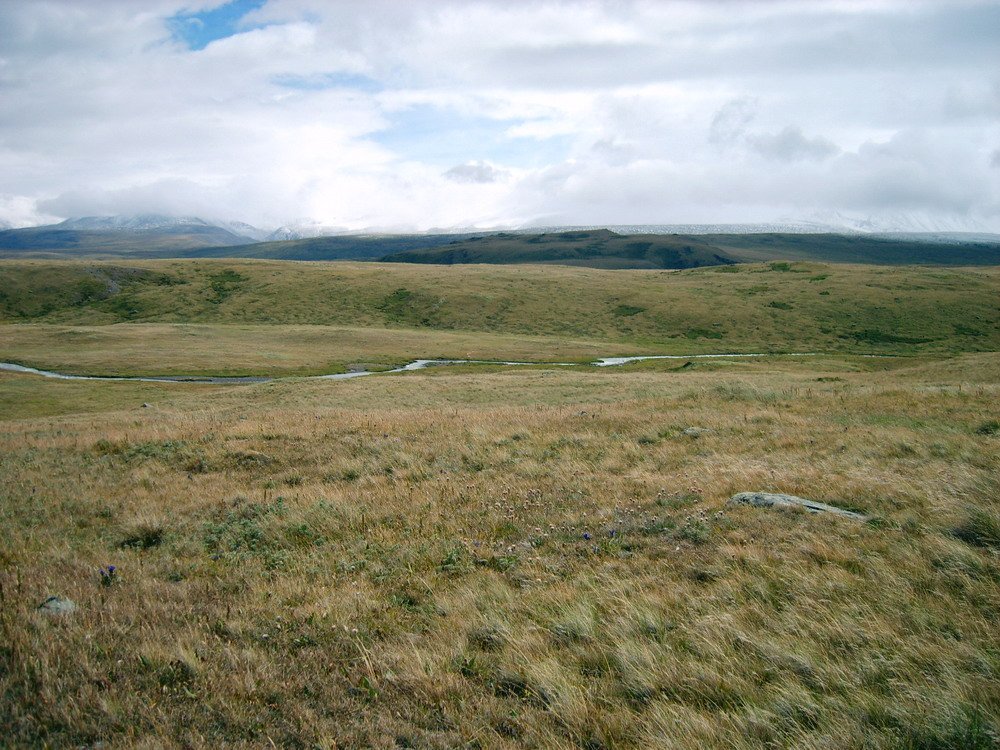
The Ukok Plateau sits at around two and a half thousand metres, a cold shelf of grass and marsh under enormous skies. Herders cross it; almost nobody lives on it. Scattered across the plateau are kurgans: low mounds of stone and earth heaped over burial shafts by the people archaeologists call the Pazyryk culture, a branch of the wider Scythian world that spread across the Eurasian steppe in the Iron Age. Most of these mounds were robbed in antiquity, sometimes within a generation of the funeral, and the diggers took what glittered and left the rest.
The mound that held the Ice Maiden had been robbed too. That is why she is here. When the ancient thieves cut their shaft down into the chamber, they broke the seal the builders had made. Rain and meltwater followed the shaft down, pooled in the timber-lined pit, and froze. Above it the mound acted like a lens for the cold, holding the ice through every short summer that followed. The robbers had ruined an upper burial and, without meaning to, refrigerated the one below for the next twenty-four centuries.
Polosmak, an archaeologist from Novosibirsk, was working the plateau because these frozen tombs are among the few places on earth where the soft, perishable things of the ancient steppe survive: wood, felt, leather, hair, skin. Bronze and gold turn up everywhere. A tattooed body does not. When her team reached the lower chamber and found the ice intact, they understood they had something that could not be dug in a hurry.
The woman in the ice
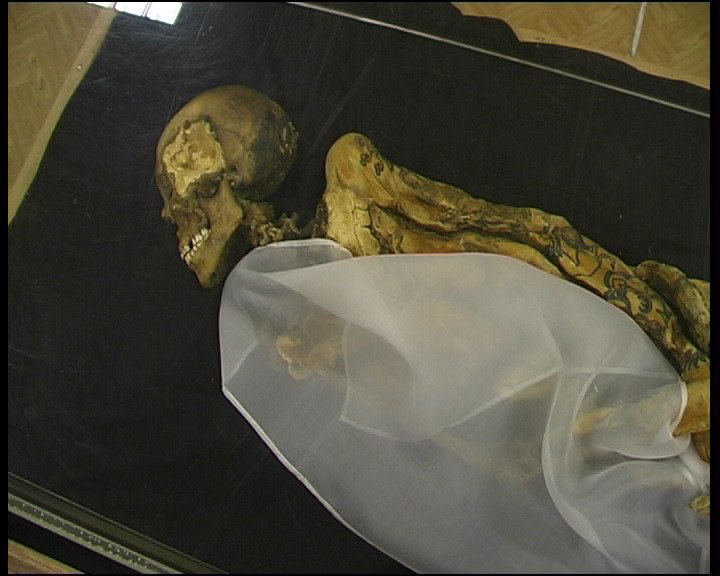
Inside the larch coffin, pinned shut with bronze nails, lay a woman on her side with her knees slightly drawn up, as if asleep. She had died young; the anatomists put her in her twenties. She was tall for the time. And she had been prepared for burial with a care that had nothing to do with luck.
Her people had embalmed her. The internal organs were removed, the body cavities cleaned and packed with plant matter and wool, and the skin treated so that it would keep. This was deliberate mummification, done because the funeral could not happen at once: a death in the warm months on the steppe often meant a wait until the ground and the season allowed the rites. Only after that human work did the accident of the ice take over and finish the job.
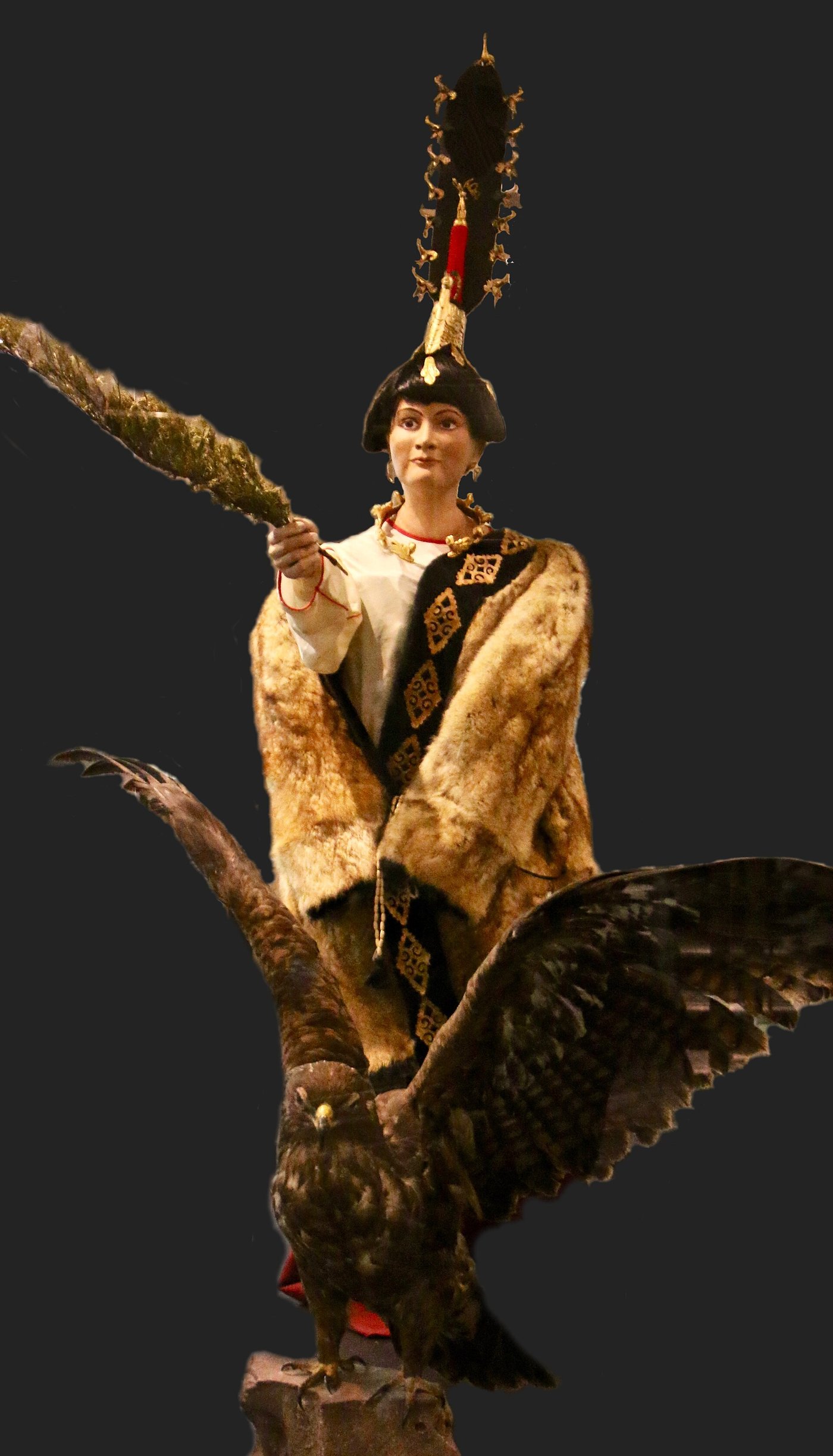
She was dressed as no ordinary herder would be. She wore a long shirt of Chinese silk, a thick wool skirt in maroon and white, tall felt stockings, and a marten-fur wrap. On her head had been placed a rigid headdress almost a metre tall, built over a wooden frame and dressed with felt and gold, so top-heavy that it could only have been worn seated or lying down. Around her were the things a traveller needs: a hand mirror, a small dish, food set out for a journey. And outside the coffin, in the same pit, lay six horses, saddled and bridled and killed to go with her, their stomachs still holding the last grass they had eaten. It was spring grass, which is how we know the season she went into the ground.
From a single frozen grave: a whole human body with skin and tattoos intact; a silk shirt and a dyed wool skirt; felt stockings; a marten-fur garment; a metre-tall gilded headdress on a wooden frame; a hand mirror; a stone dish of seeds; and six horses with their saddles, bridles and stomach contents. In an ordinary dry grave, almost none of this would have lasted a century. Here it lasted twenty-five.
The drawings under her skin
The tattoos are what made her famous, and they are extraordinary. On her left shoulder runs a fantastical deer: the body of a stag, the antlers curling forward and terminating in the heads of birds, the muzzle drawn out into a beak. The design follows the curve of her arm, using the muscle beneath it to give the animal a sense of movement. There are marks on her wrist and thumb as well. These were not scratched-in dots. They were the work of someone who could compose an image on the living, three-dimensional surface of a body.
To read them, you have to look past her to the rest of her culture. In the 1920s and 1940s, in a valley called Pazyryk lower down in the Altai, the Russian archaeologist Sergei Rudenko dug a series of these frozen mounds and found more tattooed bodies, including a powerful man, well past middle age, whose arms, chest and legs were covered in the same animal style: deer, rams, and creatures that never existed, coiled nose to tail. His face was left bare. It was Rudenko's finds that gave the culture its name, and that first showed the world that these steppe riders wrote their myths on their own skin.
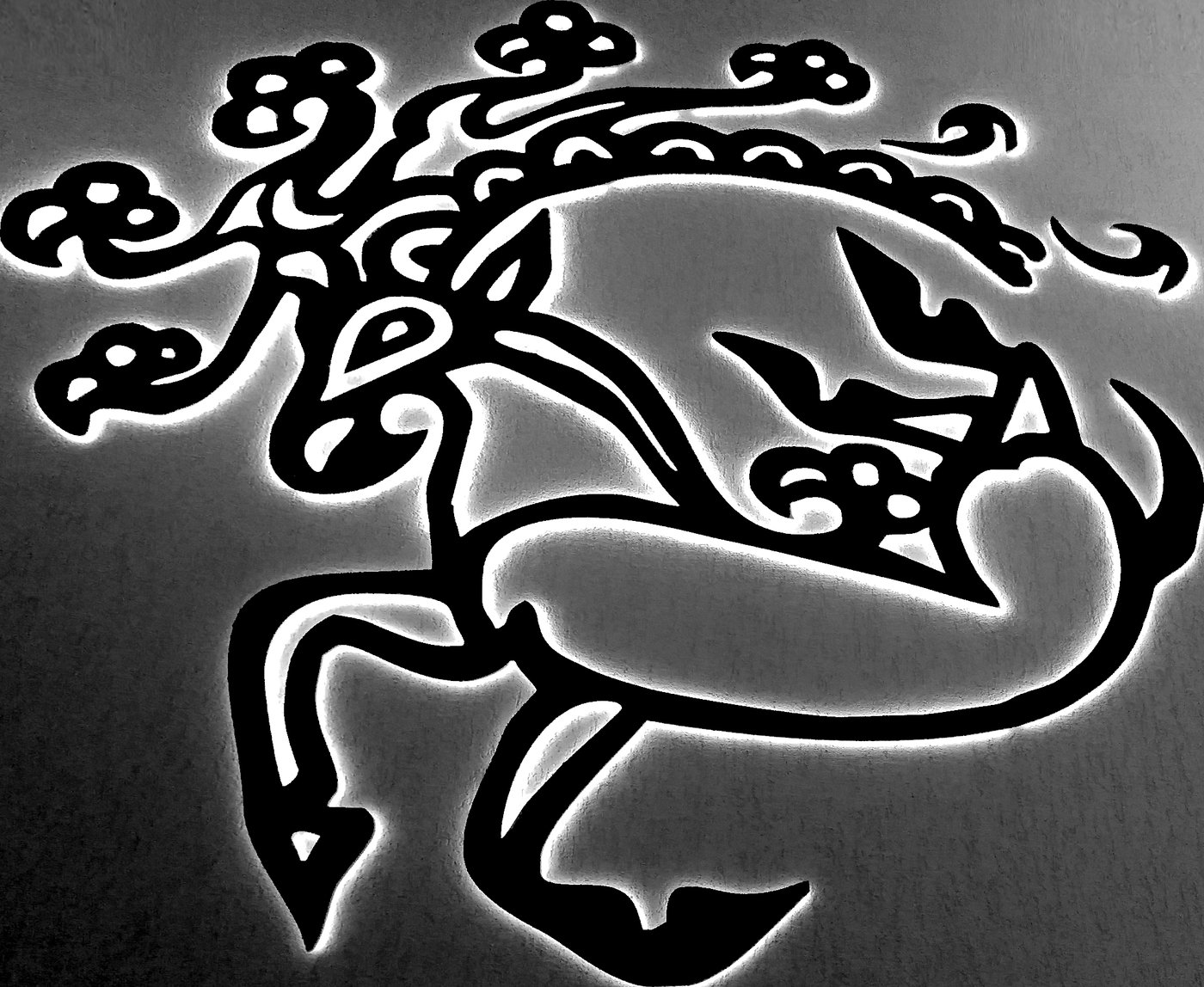
The story did not end with her. In 2025 a team led by the archaeologist Gino Caspari, working with high-resolution near-infrared imaging, went back to another Pazyryk mummy: not the Ice Maiden, but a woman from the same culture whose tattoos had faded into skin darkened almost to black. The infrared brought them back. Her right arm carried leopards and deer; her left arm carried a stag locked in combat with a griffin, the lion-bodied, eagle-headed monster of the steppe imagination. The imaging was sharp enough to show how the lines had been made: puncture by puncture, with a tool of bone or horn, the pigment most likely soot.
It also showed something human. The quality of the work was not even. One arm had been done by a confident, practised hand; the other was a little clumsier, as though a second, less experienced artist had taken over. Two and a half thousand years later, you can still see where the master handed the needle to the apprentice.
The 2025 study in the journal Antiquity concluded that a single Pazyryk body had probably been tattooed by more than one person. The design on one arm is assured and anatomically clever; the design on the other is drawn with a shakier line and weaker sense of the form beneath. The likeliest reading is a skilled tattooist and a learner working the same body: the oldest surviving trace of someone being taught this craft.
The people who froze their dead
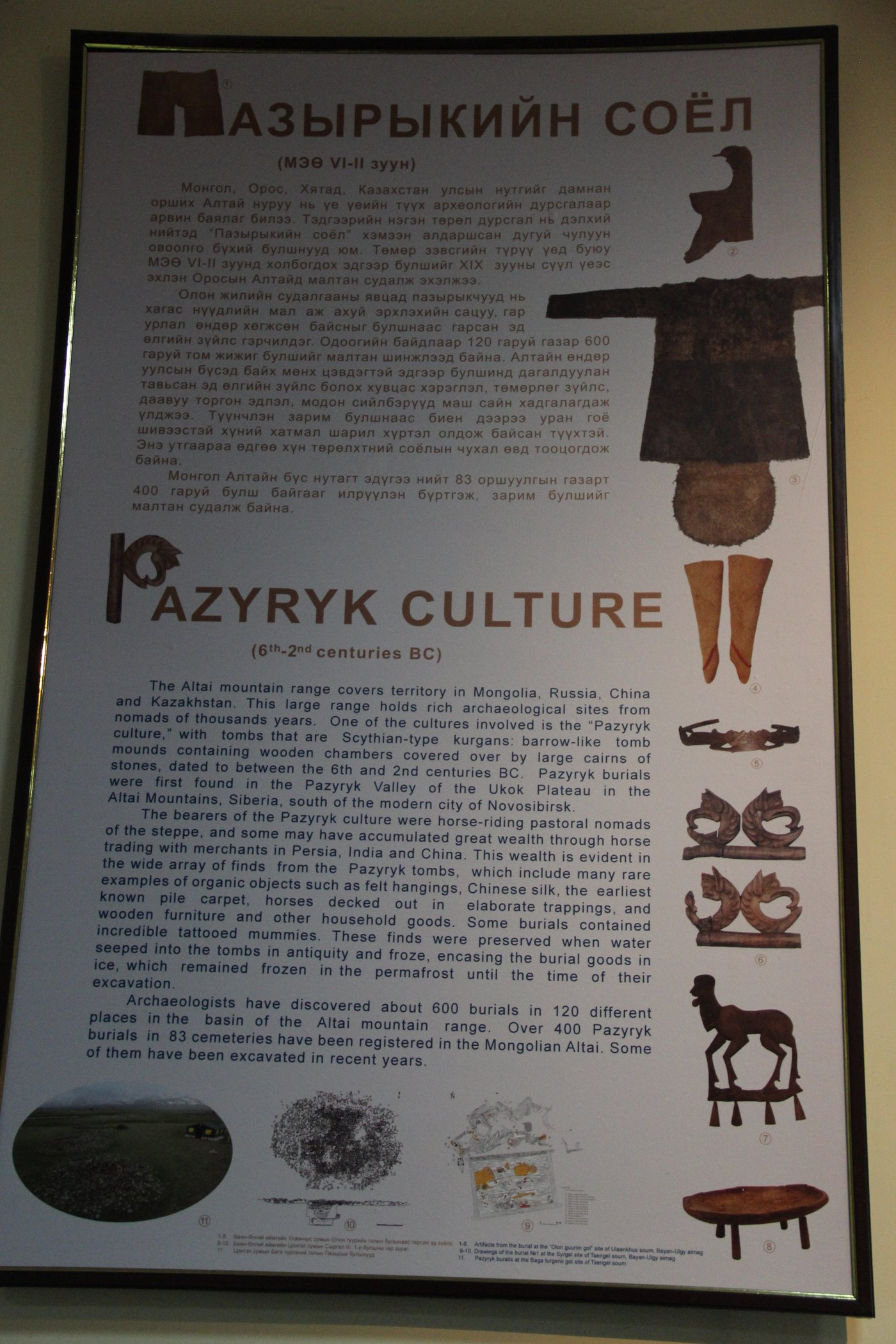
The Pazyryk were not a lost tribe of exotic strangers. They were horse people of the Altai, part of the vast Scytho-Siberian world that stretched from the edge of China to the Black Sea. They bred and rode horses, herded sheep, worked gold, and traded far enough to end up wearing Chinese silk and, in at least one tomb, sitting on Persian-style textiles. They left no writing. Almost everything we know about them, we know because they buried their dead in the cold and the cold kept its promises.
What Rudenko's frozen tombs gave up is a catalogue of things that normally rot to nothing. Felt wall hangings the size of a room, worked with appliqué figures. A four-wheeled wooden wagon, taken apart and laid in the grave. Saddles and elaborate horse masks, some turning the animals into imaginary beasts with antlers and wings for the funeral. And, most famous of all, the Pazyryk Carpet: a knotted woollen pile carpet, its border marching with horsemen and grazing deer, that is the oldest such carpet known anywhere in the world. It now hangs in the Hermitage in St Petersburg. It exists for one reason only: water got into the tomb and froze.
The dish that was not cannabis
Two stories grew up around the Ice Maiden almost as soon as she surfaced, and both need pruning. The first is the word "princess." It is a good headline and probably wrong. Her grave was rich by the standards of an ordinary person, but it was modest beside the great chieftains' mounds like Rudenko's, with their wagons and their room-sized hangings. She had no weapons and no throng of sacrificed retainers. The current reading is that she was a woman of standing but not royalty: perhaps a healer or a figure of some ritual importance, someone whose community thought her worth the silk and the six horses, but not a queen.
The second story is the drugs. Early reports had her buried with a container of cannabis, and the image of a stoned steppe priestess spread quickly. The seeds in her little stone dish were, on closer study, more consistent with coriander, a kitchen and medicinal herb, useful for masking the smell of a body that had waited weeks for burial. Cannabis did matter to the Scythian world; the Greek writer Herodotus describes them throwing it on hot stones and howling with pleasure at the smoke, and charred hemp has turned up in Pazyryk tombs. But the specific dish beside this specific woman was most likely something far more ordinary.
The popular picture: a Scythian princess of high blood, buried in narcotic splendour with a stash of cannabis to carry her into the next world, her tattoos the badges of royalty.
Her grave is well-appointed but middling, not royal. She carried no weapons and no royal regalia. The seeds in her dish read as coriander, a herb for scent and medicine, not a drug hoard. She mattered to her people, but "princess" is our word, not theirs.
What the scans found
Because she is so complete, she can be examined the way a living patient is. Magnetic resonance imaging of her body, published in 2014, suggested she had not been well. The researchers described changes consistent with advanced breast cancer, alongside signs of an old injury, the kind you might get from a fall from a horse. If that reading holds, the last years of a woman in her twenties were spent in real pain, which puts the herbs and any medicinal use of hemp in a gentler light: not decadence, but relief.
Her face, long collapsed, has been reconstructed more than once from the skull and the preserved tissue. The results show a strong-featured young woman, and the reconstructions travel the world in photographs while the body itself lies in the dark. She has become, in a way her people could never have imagined, a portrait: a named individual from a culture that left us no names at all.
Whose ancestor is she?
Here the story turns, because the Ice Maiden did not come out of an empty land. The Altai Republic has its own people, the Altaians, and many of them never accepted that a body could be cut from their soil and flown to a laboratory in Novosibirsk to be studied and displayed. To them she is not a specimen. Some call her Ochy-Bala, after a heroine of Altai epic, and describe her as a guardian: a sentinel set at the border between this world and the world below, whose task was to keep evil from rising. Digging her up, in this understanding, unbarred a door that was meant to stay shut.
Then things began to go wrong on the plateau. In 2003 a powerful earthquake struck the Altai, close to the Ukok region. Floods followed in later years. Many Altaians linked the disturbances directly to the removal of the woman from her grave, and the demand to bring her back grew into a political movement. The republic's council of elders voted for reburial. There have been court cases. There have been calls to close the Ukok Plateau to archaeology altogether, and excavation there has largely stopped.
To the archaeologists she is evidence: a unique, fragile record of a vanished culture that only careful science can read, and that reburial would surrender forever. To many Altaians she is a living ancestor and a spiritual guardian whose grave should never have been opened, and whose continued display, and the misfortunes since, are proof enough. Both sides are arguing in good faith. There is no reading of the facts that satisfies both.
The compromise, for now, is a strange one. In 2012 she was returned to the Altai and installed in a purpose-built room at the national museum in the capital, Gorno-Altaisk, laid in a climate-controlled glass case modelled on a Buddhist reliquary. She is shown to the public only on certain days, at certain times, and for parts of the year not at all. She is home, in the sense that she is back in the republic. She is not home, in the sense her people mean: back under the plateau, under the mound, under the ice.
The cost of knowing
She has told us a great deal. Because she was studied, we know what a Pazyryk woman of the fifth century BC wore against the cold, what she ate, what she rode, how her people prepared a body and mourned it, and how they turned their myths into images on skin with a bone needle and a little soot. None of that could have been read from an unopened grave. The knowledge is real, and it is not going back.
And yet the last word on the Ice Maiden may not belong to the people who read her. It may belong to the people who never wanted her read at all, standing over a glass case in a museum they did not ask for, waiting for a woman to be allowed to go back to sleep. The permafrost that kept her is thawing now, all across the Altai. Whatever is decided, the cold that held its promise for two and a half thousand years will not hold it for many more.
Read next: Silla Gold Crowns: The Korean Regalia Too Fragile to Wear and Ötzi the Iceman: The Alpine Murder That Took 5,300 Years to Solve.
Sources & further reading
- Natalia Polosmak, “A Mummy Unearthed from the Pastures of Heaven,” National Geographic (1994) — the excavator’s own account of the Ukok discovery.
- Natalia Polosmak and Ludmila Barkova, Costume and Textiles of the Pazyryk of Altai — the detailed study of the clothing, headdress and grave goods.
- Sergei I. Rudenko, Frozen Tombs of Siberia: The Pazyryk Burials of Iron Age Horsemen — the classic account of the frozen kurgans, the tattooed chieftain and the Pazyryk Carpet.
- Gino Caspari et al., “Reconstructing the tattoos of a Pazyryk mummy,” Antiquity (2025) — the near-infrared study revealing the designs and the two-artist reading.
- Andrey Letyagin et al., “Magnetic resonance imaging of the Ukok mummy” (2014) — the medical study proposing advanced breast cancer.
- A. V. Anokhin National Museum of the Altai Republic, Gorno-Altaisk — where the mummy is now kept and shown.
Image credits (via Wikimedia Commons): facial reconstruction of the Siberian Ice Maiden, Anokhin Museum (featured) — Sue Fleckney (CC BY-SA 4.0); the Ukok Plateau — Kobsev (CC BY 2.5); mummy of the Ukok Princess — Kobsev (public domain); tattoo motif from the Ice Maiden’s arm — Agilight (CC BY 2.5); Pazyryk culture artefacts — Gary Todd (CC0).