On the morning of 30 April 1907 the German administrator of Pohnpei, Viktor Berg, was found dead. The day before he had gone out to the ruined stone city that lies in the reef off the island's eastern shore, and there, against the plain warnings of the islanders around him, he had ordered a royal tomb dug open and lifted out a set of unusually large human bones. That night a storm broke over the lagoon. By first light Berg was gone. The official cause was sunstroke. The people of Pohnpei never accepted it. They knew what the place was, and they knew what happened to men who disturbed it.
The place is Nan Madol. It sits on the reef off Temwen Island, a short way from the coast of Pohnpei in the Federated States of Micronesia, roughly in the middle of the Pacific and a very long way from anywhere. It is a city built out into the sea: not beside the water but in it, on ninety-two artificial islands raised from the reef and threaded by tidal canals. There is nothing else quite like it on Earth. And for a long time the questions people asked about it were the wrong ones.
They asked whether it could be older than history, whether some vanished race had raised it, whether the stones had been floated into place by magic. The real answers, when they finally came, were harder and more interesting than any of that. This is the story of who built Nan Madol, and how, and why the how still keeps a corner of the mystery to itself.
A death the island had a word for
Berg was not the first outsider to underestimate the place, and he would not be the last. The islanders had told him, before he lifted a single stone, that the tomb he meant to open belonged to the old god-kings and that the dead there were not to be handled. He dug anyway. When he died the next morning his own officials wrote down heat and exhaustion, which may well be true. But the coincidence was total, and on Pohnpei coincidence of that kind is not treated as nothing.
That reaction tells you something the archaeology later confirmed: Nan Madol was never a forgotten ruin waiting to be rediscovered. Local families knew exactly what it was. They kept its stories, its names, and its rules. What they did not do was live in it. By Berg's time the city had stood empty for the better part of three centuries, and the reasons it emptied are as much a part of its history as the reasons it was built.
Ninety-two islands nobody needed to lose
Come at it from the water, which is the only honest way to come at it, and the first thing you notice is that the walls rise straight out of the sea. Reef-flat and shallow lagoon give way to black basalt, stacked in long horizontal courses, with dark canals running between the islets like flooded streets. Somebody in the nineteenth century called it the Venice of the Pacific and the name stuck, though it undersells how strange the engineering is. Venice grew on mudflats. Nan Madol was built on a coral reef, in open salt water, by people working with stone that had to be brought from somewhere else entirely.
The name itself is a description. Nan Madol means, more or less, "within the intervals", the intervals being the canals that divide the ninety-two platforms from one another. The older name was gentler and grander: Soun Nan-leng, the Reef of Heaven. The built core runs about one and a half kilometres long and half a kilometre wide, and the islets are not natural. Each is a stone-and-coral platform raised on the reef by hand, some barely bigger than a house floor, others large enough to carry a temple and its outbuildings.
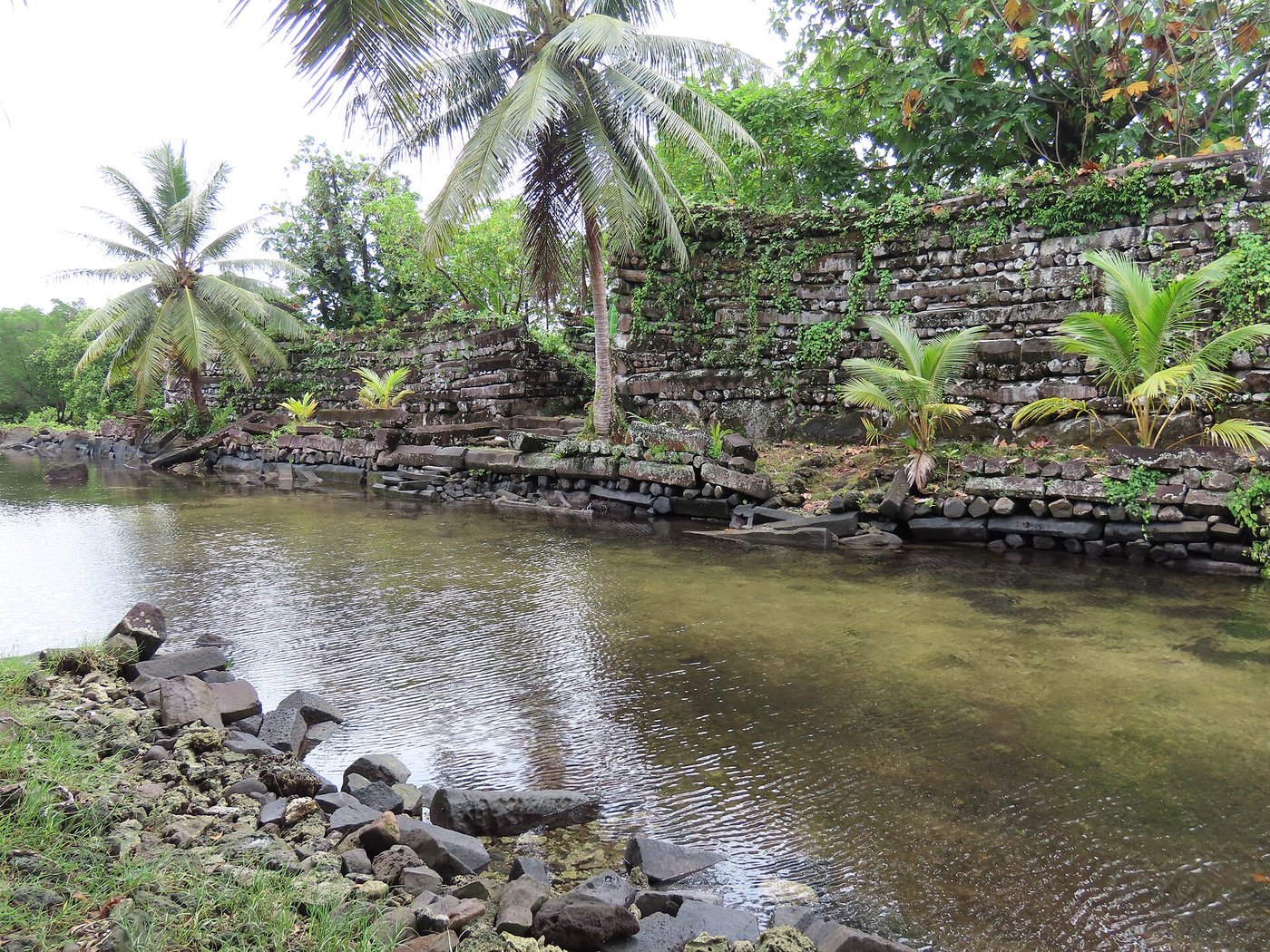
The layout was not random. The city split into two halves with two jobs. One sector, Madol Pah to the south-west, held the living business of the state: the dwellings of the ruling class, the administrative islets, the space where power was exercised. The other, Madol Powe to the north-east, was given over to priests and the dead. This was the district that earned Nan Madol its darker nickname, the City of the Dead: an entire quarter of a city built for tombs, ritual, and the tending of ancestors. Berg had gone digging in exactly the wrong half.
How you build a city on the sea
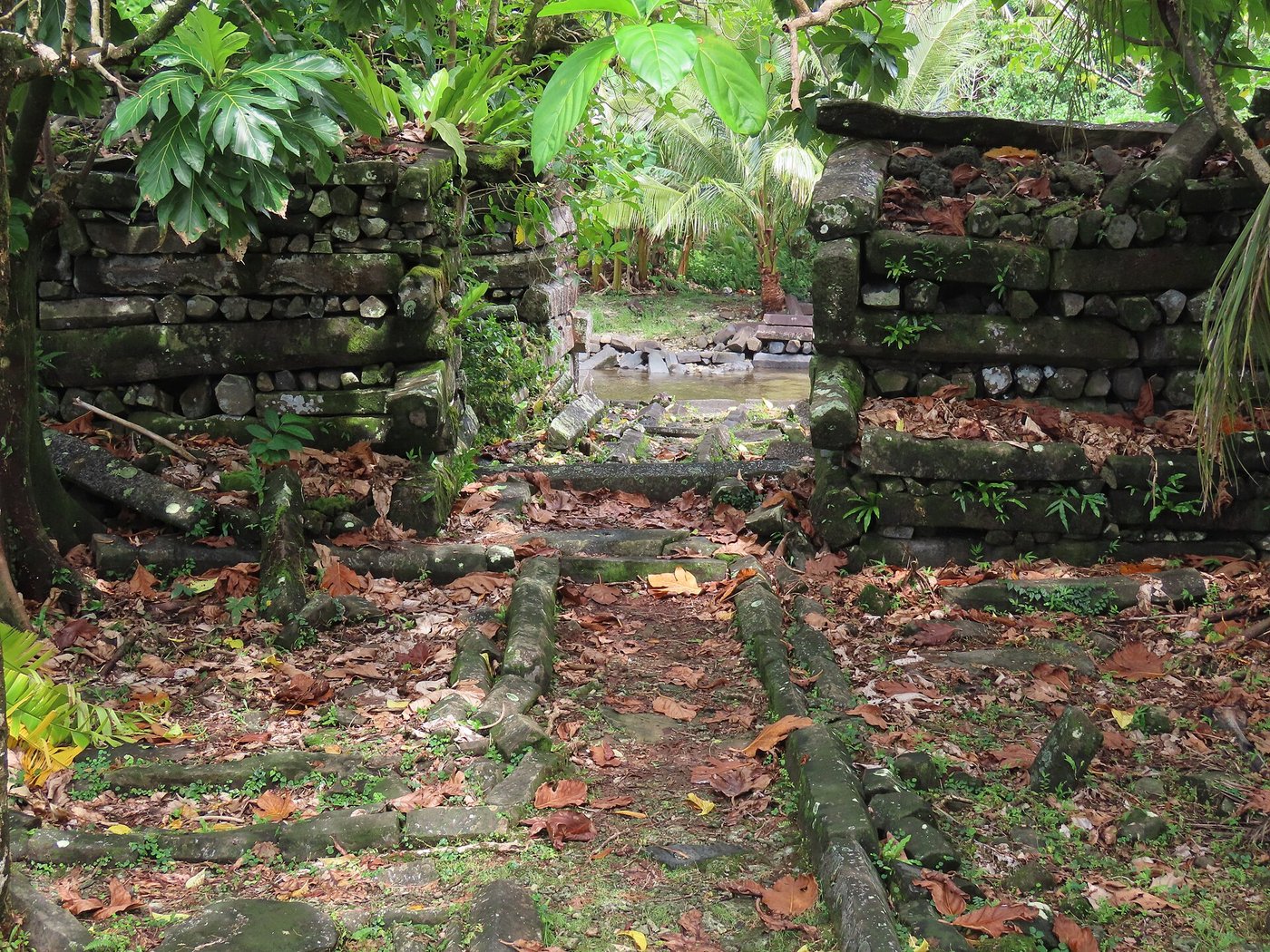
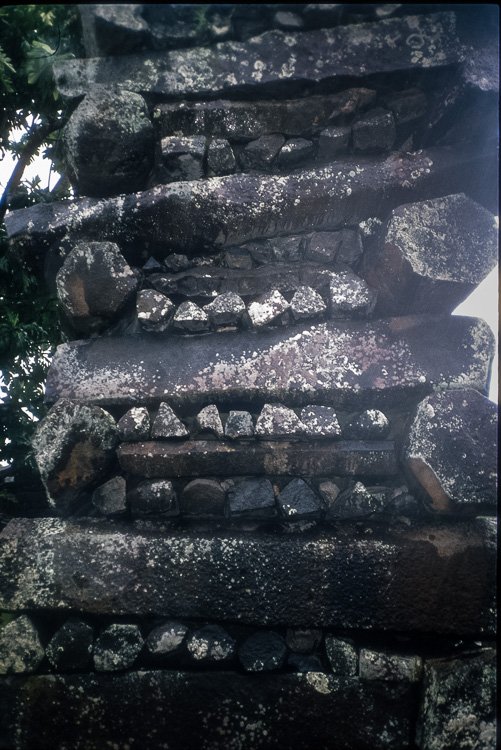
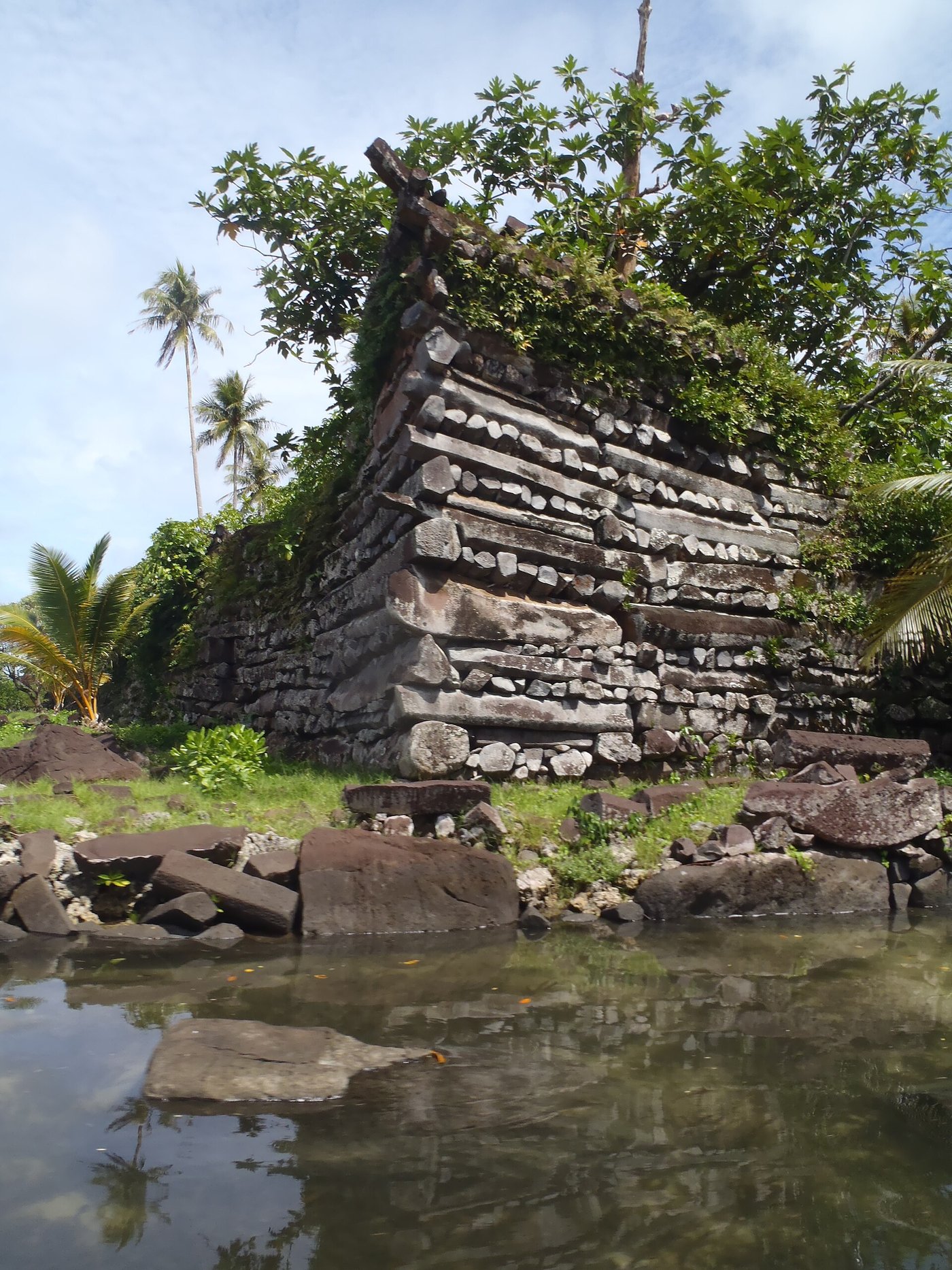
Strip away the legends and the raw achievement is still staggering. To make each islet, the builders first laid down a foundation of huge basalt boulders on the reef, then raised walls around and above them using long columns of a particular kind of stone. That stone is columnar basalt: lava that, as it cooled, cracked into natural prisms, long, straight, five- and six-sided shafts, some of them six metres from end to end. Nature had, in effect, pre-cut the beams. The Pohnpeians only had to work out how to move and stack them.
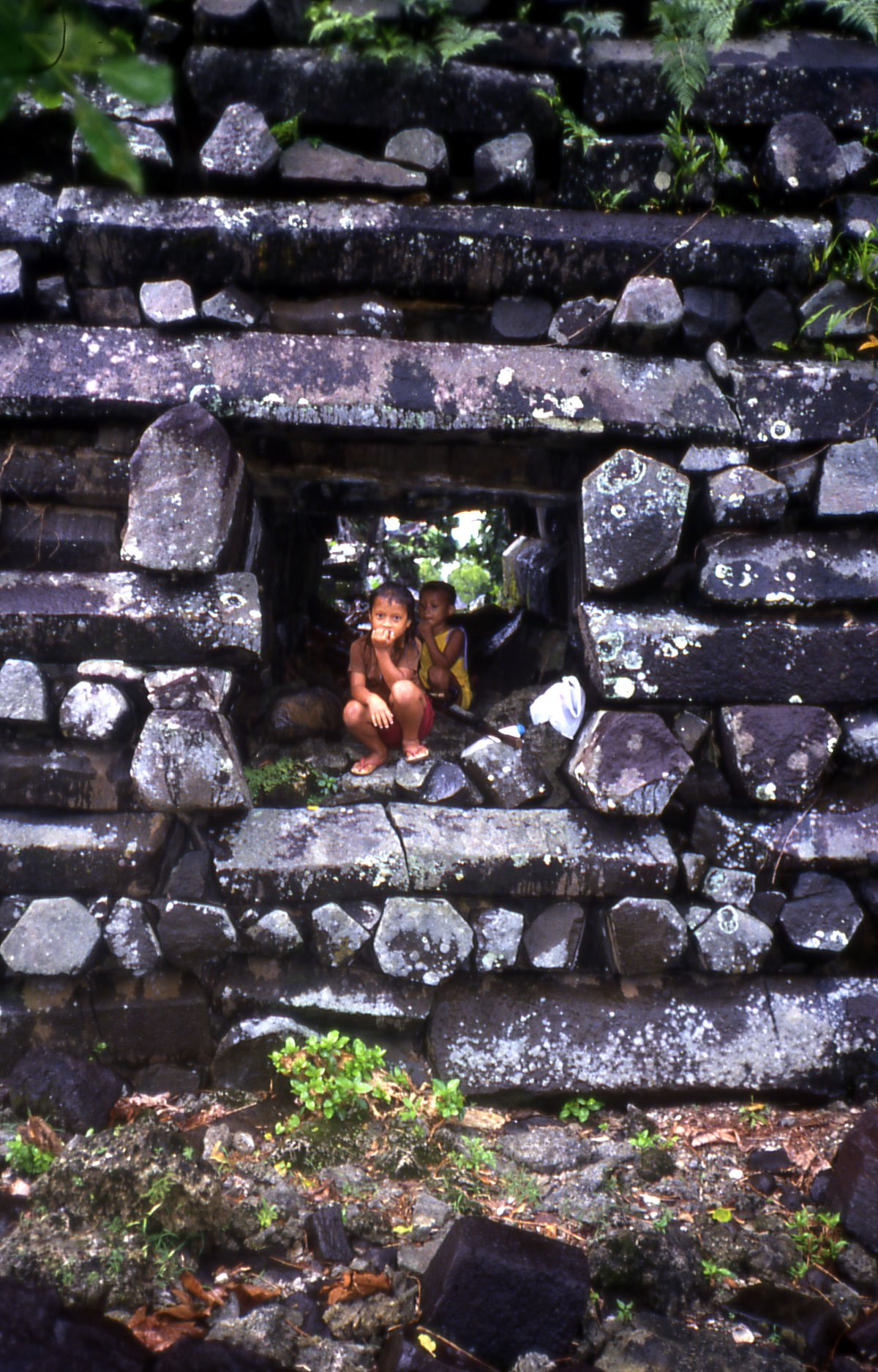
They stacked them the way a child builds with logs. A course of columns would be laid pointing one way, the next course laid crosswise on top, then the next back the other way (header and stretcher, header and stretcher), each layer locking the one below. Between and behind the walls they packed coral rubble to make solid, level platforms. No mortar was used anywhere. The whole city is dry-stacked, held up by nothing but weight, angle, and the patience of the people who fitted it.
At the heart of Madol Powe stands the piece everyone remembers, a royal mortuary islet called Nandauwas. Its outer walls run between five and a half and seven and a half metres high (picture a two-storey house and then add a bit), and they enclose a courtyard and a central tomb. Standing inside it, with the black columns rising over your head and the sea sounding through the canals, you understand why the islanders kept it at arm's length. It was built to hold the bones of rulers who were treated, in life and after it, as something close to gods.
Estimates put the total stone in Nan Madol at around 750,000 tonnes of basalt and coral, spread across ninety-two islets. Most of the columns weigh a few tonnes each; the largest are reckoned at several times that. Every piece was quarried on the main island, carried to the coast, floated out across the lagoon, and lifted into place by a population that never numbered much above a thousand at the site, and had no wheel, no pulley, no draft animal, and no metal tool of any kind.
The stones that came from the far side of the island
This is where the wonder sharpens into a real puzzle. The columnar basalt did not come from the reef, and it did not come from nearby. The outcrops that produce this stone lie inland and around the coast of Pohnpei, some of them on the far northern side of the island, kilometres of open water and rough ground away from Temwen. Geochemists have matched the fingerprints of the building stone to specific source outcrops, and the sources are scattered. The builders were not using whatever lay to hand. They were selecting stone and hauling it across the island and around it, again and again, until they had moved three-quarters of a million tonnes.
How? No one has fully cracked it. The columns, being long and roughly log-shaped, would float or half-float when lashed to rafts, and the obvious idea is that they were rafted round the coast at high tide and then levered up ramps of earth and rubble onto the growing walls. It is a reasonable guess and it fits what the islanders themselves once said. It is also unproven at the top end. The heaviest columns are enormous, and moving that much stone across reef and current, then raising it several metres by muscle alone, remains something scholars can describe in outline but not yet demonstrate in full. The city works. The method that built it is still partly a reconstruction.
Rafts floated at high tide, log rollers over the reef flat, inclined ramps of earth and coral tipped away once a wall was finished: every proposed method is plausible and none has been convincingly reproduced with the largest stones. The transport of Nan Madol's basalt is one of the few things about the city that archaeology can bound but not yet close. We know where the stone came from. We know it arrived. Exactly how the biggest pieces made the crossing is still open.
Two sorcerers and a flying dragon
The Pohnpeians had their own account, and it is worth taking seriously as history of a kind, because it preserves real memory under the marvels. In the tradition, the city was founded by twin sorcerers, Olisihpa and Olosohpa, who came by canoe from a land to the west called Katau, looking for a place to raise an altar to Nahnisohn Sahpw, the god of agriculture. They tried several sites before the reef off Temwen let them build. And to move the great stones, the story says, they did not haul at all. They summoned a flying dragon, which carried the columns through the air and set them down where the brothers pointed.
Myth: two sorcerers raised Nan Madol with the help of a flying dragon that lifted the basalt columns through the air, which is why no ordinary people could have built something so heavy so far out on the reef.
Reality: the dragon is a memory dressed as a marvel. Behind it sits a real feat of organised human labour: quarrying, rafting and dry-stacking basalt over roughly four centuries under rulers who could command the work of a whole island. The story keeps the scale of the achievement and forgets the thousands of hands.
Read it plainly and the legend is doing what legends do. It remembers that the founders came from elsewhere, that the site was chosen after false starts, that the enterprise was tied to religion, and that the stones were impossibly heavy. It packs all of that into a dragon because a dragon is easier to carry down the generations than an account of tribute labour and tidal rafting. When Olisihpa died, the story goes, Olosohpa became the first ruler of the line, and the marvel gives way to something that reads much more like ordinary dynastic history.
The weight of a god-king
That line was the Saudeleur dynasty, and it ruled Pohnpei for something like five hundred years, from around the twelfth century to the early seventeenth. The Saudeleur were the first power to bring the whole island under a single authority, and Nan Madol was the engine room of that authority: the seat where the ruler lived, where the priesthood served, and where the ancestors were kept close so their power stayed in the family.
Holding it together took a great deal from everyone else. The city sat on a reef and grew nothing. Fresh water had to be fetched, food had to be brought, and the chiefs of the island were required to come and live at Nan Madol where the ruler could watch them, and to keep the place supplied out of their own districts. It was, in modern terms, a capital that ran on tribute and hostage-keeping. The later Saudeleur, the tradition remembers, grew harsh, leaning ever harder on the people who fed them.
The religion at the centre of it was strange and specific. On the islet of Idehd the priests kept a sacred eel, an embodiment of the sea, and honoured it with a ritual that ended in the offering of a turtle, the animal cooked, its insides fed to the eel while the god was called to attend. Around this ran a web of observances that only the ruler and his priests could perform, which is much of the point. The Saudeleur did not merely govern Pohnpei. They stood between the island and its gods, and Nan Madol was the stone proof that they alone could do it.
The man who came from Kosrae
Every arrangement like that carries the seed of its own ending, and Nan Madol's ending has a name. In the tradition he is Isokelekel, a half-divine warrior born of the thunder god, who sailed to Pohnpei from the island of Kosrae to the south-east with a war party remembered, precisely, as three hundred and thirty-three. He had come to end the last Saudeleur, and after a fight fought partly in the canals of the city, he did.
What Isokelekel built in place of the old order mattered as much as the man he overthrew. He broke the single crushing kingship into a system of paramount chiefs, the Nahnmwarki, sharing authority across the island's districts, a structure that survives on Pohnpei in recognisable form to this day. For a while he and his people went on living at Nan Madol. But the reasons the city had always been a burden did not go away. It still grew nothing; it still had to be supplied; and once the god-king it was built to glorify was gone, the case for keeping a court out on the reef grew thin.
So the islanders left. Not in a night, and not because of any disaster anyone recorded, but steadily, as the reason for the place drained out of it. By the time European ships began calling in the nineteenth century, Nan Madol stood empty: walls, tombs and canals intact, the population long since moved back to dry land, and only the stories, and the rules about the dead, still keeping watch over it.
What the coral finally said
For most of the twentieth century the city's age was guesswork, and guesswork attracts invention. Because Nan Madol is so far out at sea and so heavy, and because Pacific islanders were routinely underestimated by the people writing about them, the fringe filled the gap. Nan Madol got folded into stories of sunken continents, of Lemuria and Mu, of a lost super-civilisation tens of thousands of years old. None of it had any evidence behind it. All of it depended on the same assumption Berg had made: that the people living around the ruins could not have been the ones who raised them.
The breakthrough came from dating the coral built into the structures rather than the basalt, which carries no such clock. High-precision uranium-thorium dates on coral from the royal mortuary, paired with geochemical sourcing of the basalt itself, placed the start of the great columnar building at Nandauwas at around AD 1180 to 1200. The islets themselves were being raised earlier still, from about AD 900, on a reef that people had used since the first centuries after Christ. The city is medieval, and it is Pohnpeian.
That result did two things at once. It killed the lost-continent fantasy stone dead (a monument begun around AD 1180 cannot belong to a civilisation drowned tens of millennia earlier), and it fixed Nan Madol firmly in the hands of the ancestors of the people who had always claimed it. The columnar city rose in the same broad span that gave Europe its cathedrals. It was not older than history. It was history, kept in oral tradition until science caught up and agreed with it.
What the dating cannot yet do is settle the mechanics. Knowing the city was built between about AD 1180 and 1600 tells us who and roughly when. It does not tell us how a community of a few hundred moved and lifted three-quarters of a million tonnes of stone onto a reef. That question is not a mystery in the way the lost-continent tale pretended. It is a normal, hard problem in the archaeology of engineering, and it is still being worked.
The city keeps its own counsel
Nan Madol was made a UNESCO World Heritage Site in 2016, and placed on the list of sites in danger the same day. The threats are quiet ones: mangroves prising the walls apart with their roots, silt filling the canals, the sea and the storms doing slowly what no army ever managed. The city that outlasted its own dynasty by four hundred years is now in a slow argument with the reef that carries it.
Viktor Berg has been dead for well over a century, and the bones he lifted are long lost. What he ran into that night was not a curse in the way he would have understood the word. It was a place that its people had never stopped owning, whatever the official records said: a city they built, buried their kings in, walked away from, and went on guarding from the shore. The dragon never came. The stones were carried by hand, out over the water, by a society we are still learning to credit. That, in the end, is the harder marvel, and Nan Madol is still sitting on its reef insisting that we take it seriously.
Read next: Chaco Canyon: The Desert City Built From 240,000 Trees Carried on Foot and Guanches: The Canary Islanders Who Lost the Sea That Brought Them.
Sources & further reading
- Mark D. McCoy et al., "Earliest direct evidence of monument building at the archaeological site of Nan Madol (Pohnpei, Micronesia)," Quaternary Research (2016) — the uranium-thorium coral dating and geochemical sourcing that fixed the construction sequence.
- Mark D. McCoy and Helen A. Alderson, "Sourcing the Megalithic Stones of Nan Madol: an XRF Study of Architectural Basalt Stone from Pohnpei," Journal of Archaeological Science — on matching the building stone to its quarry outcrops.
- Rufino Mauricio, Nan Madol from the Perspective of Archaeology and Oral Tradition — a Pohnpeian scholar's reading of the site against its own traditions.
- Paul Rainbird, The Archaeology of Micronesia (Cambridge University Press, 2004) — the wider Pacific context for the site and the Saudeleur state.
- UNESCO World Heritage Centre, "Nan Madol: Ceremonial Centre of Eastern Micronesia" (inscribed 2016) — the official description and the reasons for its endangered listing.
Image credits (via Wikimedia Commons): stone islets of Nan Madol — Uhooep (CC BY-SA 4.0); canal between the islets — Uhooep (CC BY-SA 4.0); towering basalt walls — Patrick Nunn (CC BY-SA 4.0); columnar-basalt wall detail — Jebrennan (CC BY-SA 4.0); passage between the walls — Jebrennan (CC BY-SA 4.0).