Just before nine on the morning of 21 December 1967, Michael O'Kelly stood alone at the end of a stone passage, in the dark, waiting to find out whether a piece of local gossip was true. The archaeologist had been digging into the great mound at Newgrange for five years. Farmers in the Boyne valley had long said that at midwinter the sun somehow reached the tomb's inner room. O'Kelly did not much believe it (the doorway faces an unpromising patch of hillside, and the chamber sits buried in the heart of the mound), but the shortest day had come round again, and he decided to see for himself. At 8:58 a thin blade of light appeared on the floor at his feet. It widened, climbed the passage, and filled the chamber six metres to the roof, bright enough to read by. Then it narrowed and went out. The whole thing had lasted about seventeen minutes.
What he had watched was a machine for catching the sunrise, built by people who left no writing, five thousand years ago. Newgrange is older than Stonehenge and older than the pyramids at Giza: a green dome on a ridge above the River Boyne, north of Dublin, raised by some of the first farmers to reach Ireland. They quarried with no metal, because they had none. They set down no records. And yet they arranged a slab, a passage and a small stone box above the door with enough care that, five thousand winters later, the light still keeps its appointment. This is the story of that hill: how it was built, what it was for, who was found inside it, and the arguments (some of them settled only in the last few years) over almost every one of those questions.
The mound on the bend of the Boyne
The River Boyne swings north in a long loop a few miles inland from the Irish Sea, and on the ridge cradled inside that loop stand three enormous mounds: Newgrange, Knowth and Dowth. With dozens of smaller monuments around them they make up Brú na Bóinne, the richest gathering of prehistoric building in Ireland and one of the densest anywhere in Europe. Newgrange is the most famous of the three, and the most theatrical. It is a flattened dome about eighty-five metres across and twelve metres high, roughly two hundred thousand tonnes of stone and earth, heaped and shaped entirely by hand.
Fix a date on it and the scale of the thing changes. The mound went up around 3200 BC. That is some five centuries before the first great stones were raised at Stonehenge, and a similar margin before the earliest Egyptian pyramid. Its builders were not a kingdom with a treasury and a standing army of workers. They were farmers: growing grain, keeping cattle and pigs, living in timber houses that have long since rotted into stains in the soil. To pile up a monument on this scale, and to line it up on the sky, hundreds of them had to agree to spend years of labour on something that fed no one and sheltered no one. That agreement, more than the lifting of the stones, is the real mystery of Newgrange.
The stone across the door
Anyone who walks up to the entrance meets the tomb's masterpiece before reaching the door. Lying across the threshold is a single long slab, about three metres of grey stone, its whole face worked over with spirals, diamonds and arcs. It is known plainly as the entrance stone, or K1, and it is probably the most copied piece of prehistoric art in Europe: a triple spiral on the left, a run of lozenges down the middle, coils that seem to turn as you move past them. Nobody knows what any of it meant. The carvers drew no person, no animal, no plant. If the marks were a language, it was a language of pure pattern, and it has kept its silence.
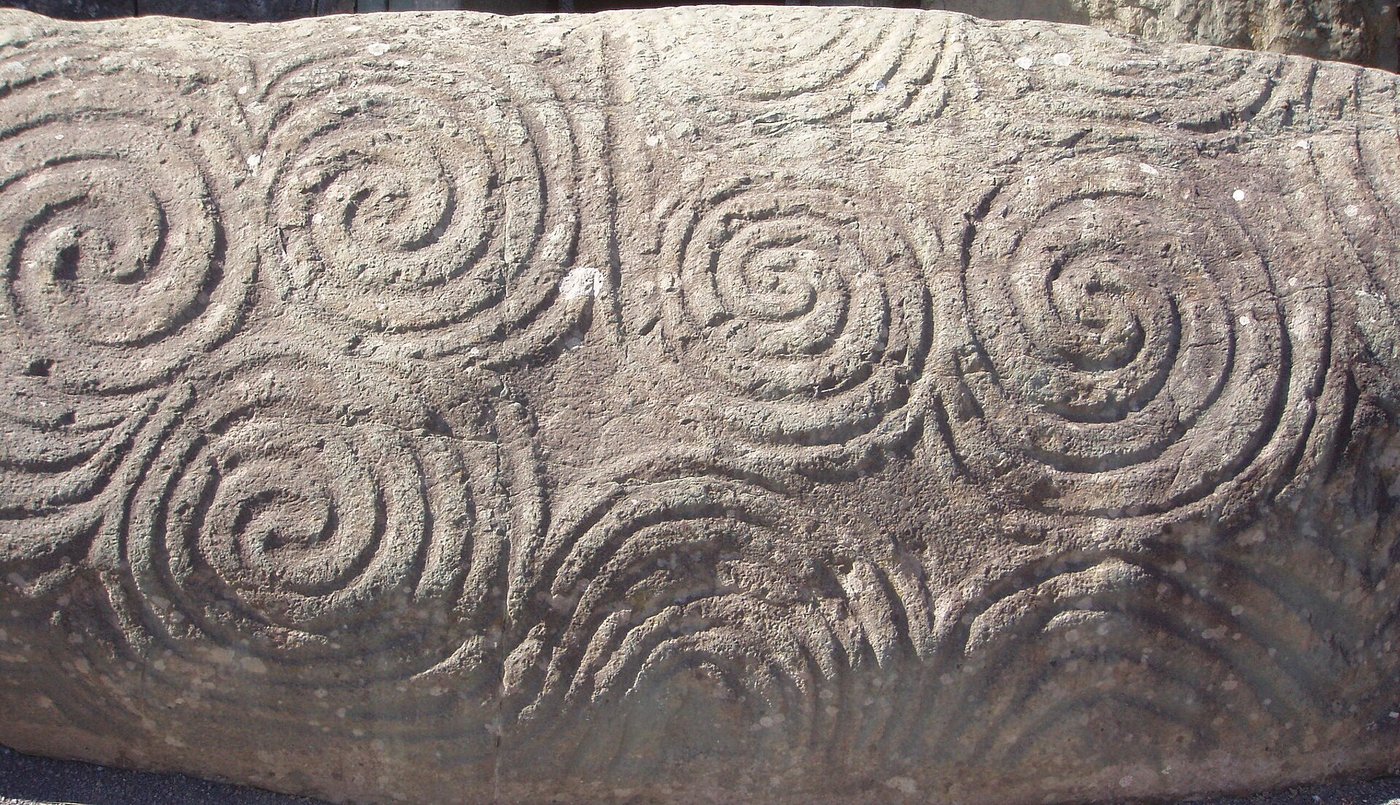
K1 is one of ninety-seven great kerbstones that ring the foot of the mound, set end to end like a stone hem holding the whole hill in. Several of the others carry carvings too, though none as crowded as the one at the door. The kerbstones were hauled here from the riverbanks and the coast, some weighing several tonnes each, and laid in a near-perfect circle. Before a single basket of earth was tipped onto the mound, its outline had already been drawn on the ground in stone.
Nineteen metres into the dark
Behind the entrance stone the passage begins, and it was not built for comfort. Nineteen metres long, walled and roofed with standing slabs, it narrows in places until a grown adult has to turn sideways and stoop. It rises very slightly as it runs inward, so the chamber at the end sits a little higher than the doorway. At the far end it opens into a cross-shaped room with three recesses: a small central space with a bay to the left, the right and straight ahead. Above it climbs a corbelled roof: flat stones laid in rings, each course pushed a little further in than the one beneath, until a single capstone seals the top six metres up.
That roof is the quiet marvel of the place. It has stood for five thousand years without a scrap of mortar, and the chamber under it is still essentially dry. The builders cut shallow channels into the upper faces of the roof slabs to lead rainwater sideways and out, and caulked the joints with a paste of burnt soil and sea sand. Water that soaks into a two-hundred-thousand-tonne hill has been draining off those stones and out through the mound, one carved groove at a time, since before writing existed. Set into the recesses were heavy stone basins, and in and around them the excavators found the burnt and unburnt bones of only a handful of people. Newgrange was a tomb, among other things, but a peculiar one, holding not a community's dead so much as a chosen few.
The aim is precise enough to feel deliberate down to the minute. For about a week around the winter solstice (the shortest mornings of the year, in the third week of December), the rising sun clears the ridge across the valley and throws a beam straight down the passage. On the solstice itself the light reaches furthest, running the whole nineteen metres to the back of the chamber and holding there for roughly seventeen minutes before it slides away. Every other morning of the year the passage stays black. The tomb was engineered around a single sunrise, the hinge of the year, and it has gone on working for millennia after the last person who understood why was carried out of it.
The box above the lintel
The trick that makes it possible is easy to miss. Above the doorway, and a little behind it, the builders left a second opening: a rectangular slot roughly a metre wide, framed by slabs and once fronted by a decorated block of white quartz. This is the roof-box. Its floor sits about two metres higher than the floor of the passage, and that difference is what makes it work. At sunrise on the solstice the sun is low; its light passes over the blocked lower doorway and pours in through the raised slot instead, and because the passage climbs to meet it, the beam can travel all the way to the chamber. The doorway is for people. The box is for the sun.
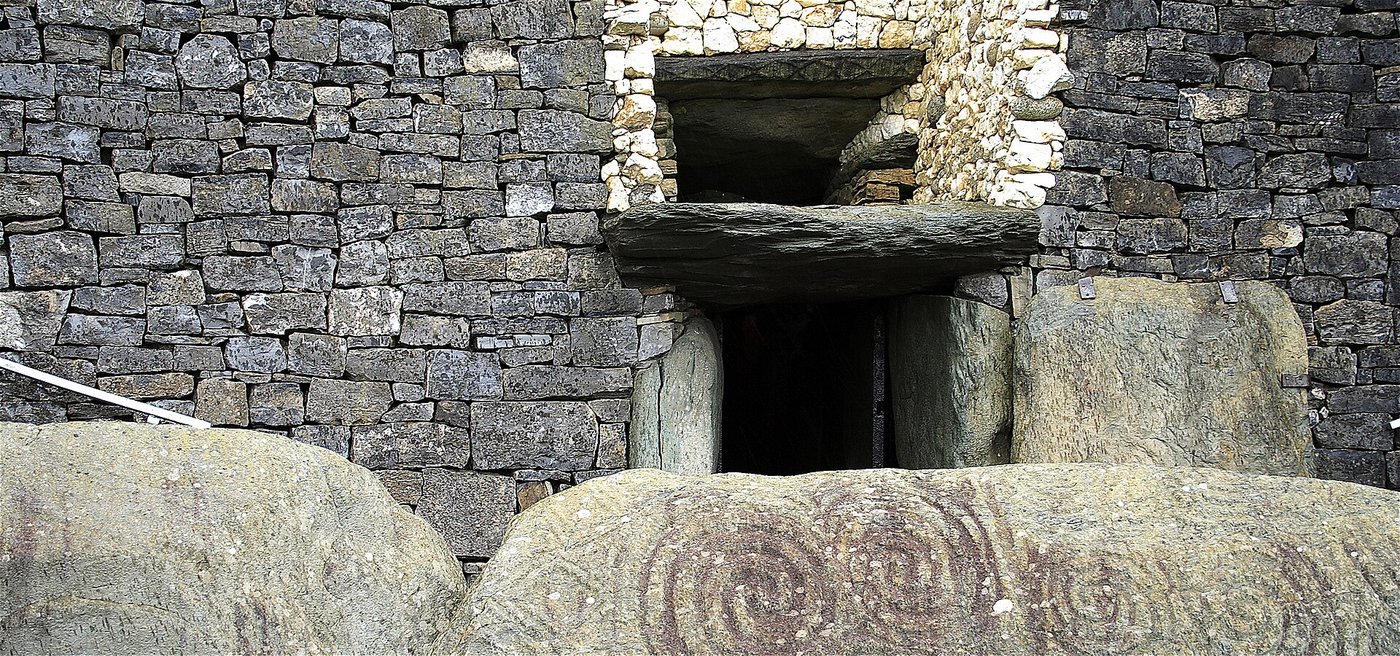
O'Kelly was the first person in modern times to grasp what the box was for, and the first known to stand in the chamber and watch it work. His experiment in December 1967 turned a country tale into a documented fact, and it changed how the whole monument is understood: not as a burial mound that happens to carry art, but as a carefully sighted instrument for marking the death and return of the sun. There has been later argument over how much of the roof-box in its present form is prehistoric and how much was tidied during restoration: a sill re-set here, a slab reseated there. But the feature itself, and the alignment it serves, are the builders' own. They cut it for exactly this.
The white wall that may never have stood
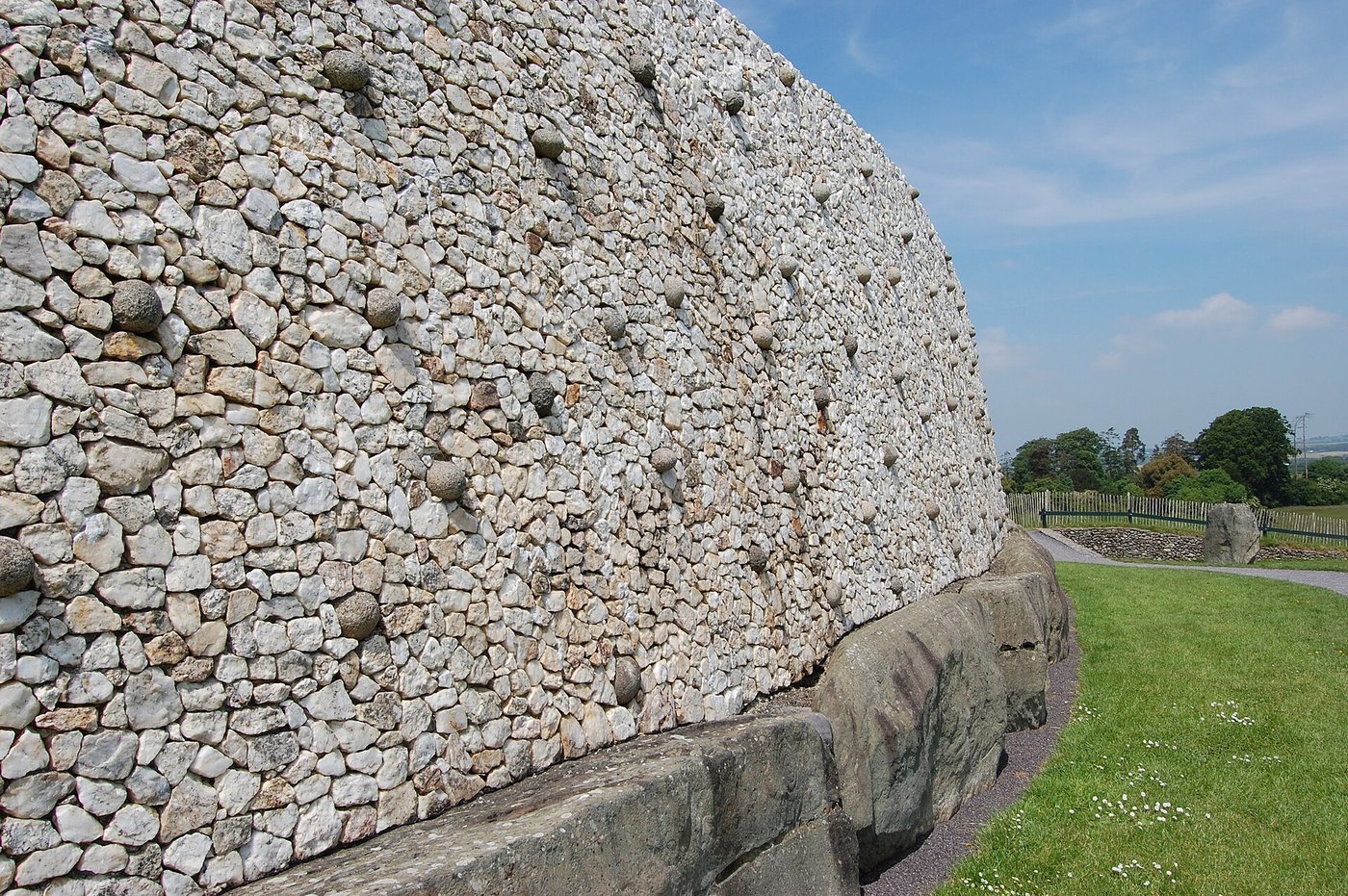
The face most people picture when they think of Newgrange (a gleaming, near-vertical drum of white quartz, studded with dark round stones, rising above the kerb) is the part of the monument we can be least sure about. When O'Kelly dug at the front of the mound he found a thick spread of white quartz and rounded granite cobbles lying on the ground before the kerbstones. He decided this had once been a steep retaining wall that faced the mound and had since collapsed forward. In the 1970s he had it rebuilt to that theory: a wall four metres high, the ancient quartz and granite cemented onto a hidden core of modern concrete, without which it would not stand at all.
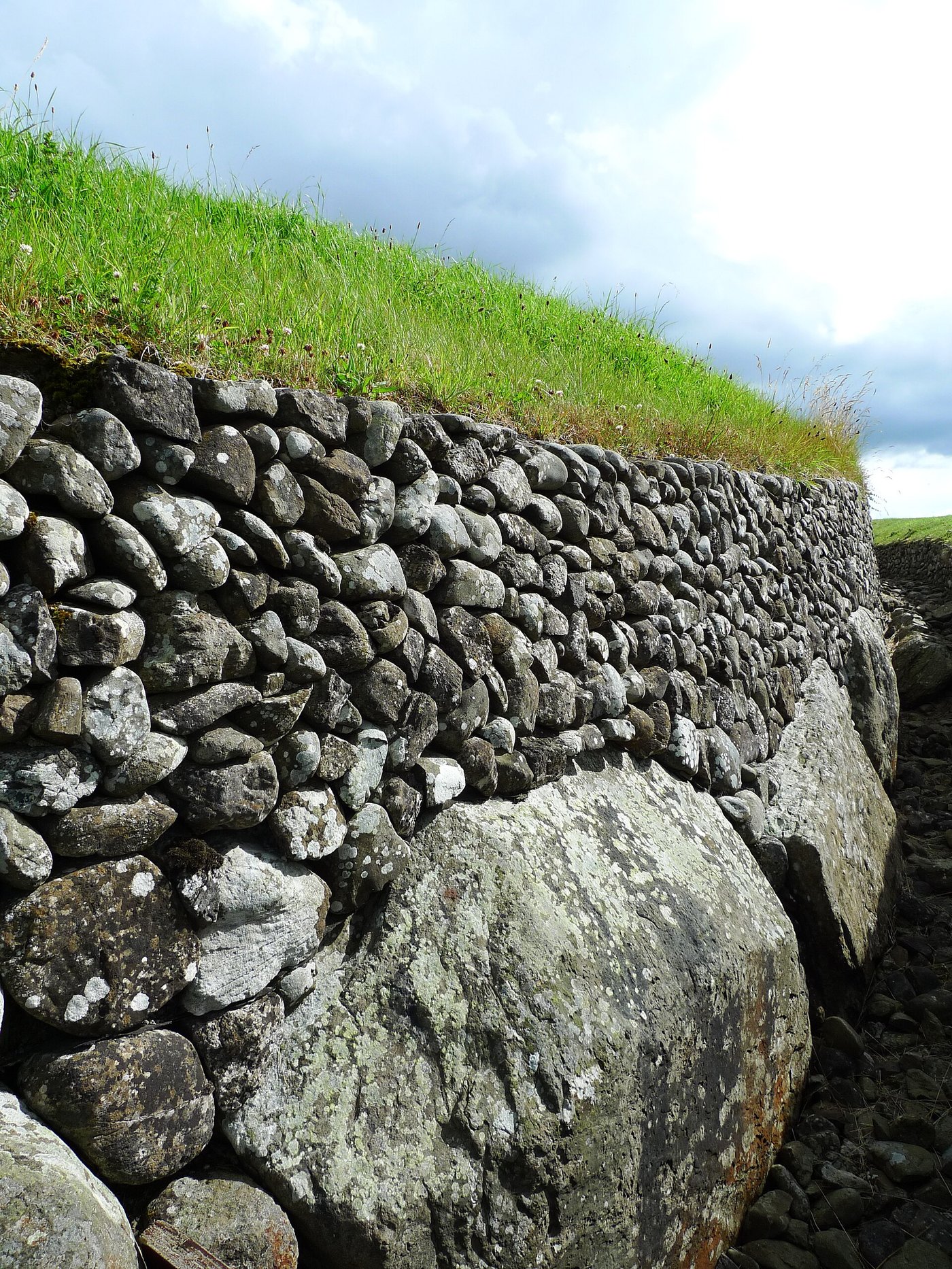
Not everyone was convinced, and the doubts have only grown. George Eogan, who dug the neighbouring mound at Knowth for decades, pointed out that no prehistoric wall of loose quartz could have held itself upright the way the concrete one does. Others, among them the Danish archaeologist Palle Eriksen, have argued that the quartz was never a wall at all: it lay flat, as a bright apron spread on the ground before the tomb to catch the light, or was banked against a gently sloping mound rather than a sheer one. If they are right, then the single most photographed image of Newgrange is a mid-twentieth-century guess in stone and concrete, and the real monument was lower, rounder and stranger than the postcard suggests. The passage and the roof-box belong to the builders. The dazzling white front may belong to us.
The myth: Newgrange was raised by the Druids as a temple, or thrown up by the Danes (the Vikings) who once raided this coast; a monument of the Celtic or early medieval world.
The reality: it is far older than either. Newgrange was built around 3200 BC, some two and a half thousand years before Celtic-speaking peoples and their druids appear in Ireland, and well over three thousand before the first Viking longship. For centuries antiquarians reached for the most recent people they could name to explain a mound they could not date. Radiocarbon dating settled it and forced the true age on everyone: the builders were Stone Age farmers, anonymous, with a command of stone and sky that later ages simply refused to credit them with.
The three spirals in the back
Deep in the chamber, on a standing stone in the end recess, is the carving that has become the emblem of the whole site: three linked spirals cut into the rock, winding out and back so that the eye never quite settles. The triple spiral of Newgrange has been borrowed for jewellery, book covers, tattoos and tourist logos, until it can be hard to see it as what it is: a five-thousand-year-old design, in a room that spends all but a few minutes of the year in total darkness, made by someone whose meaning we have completely lost.
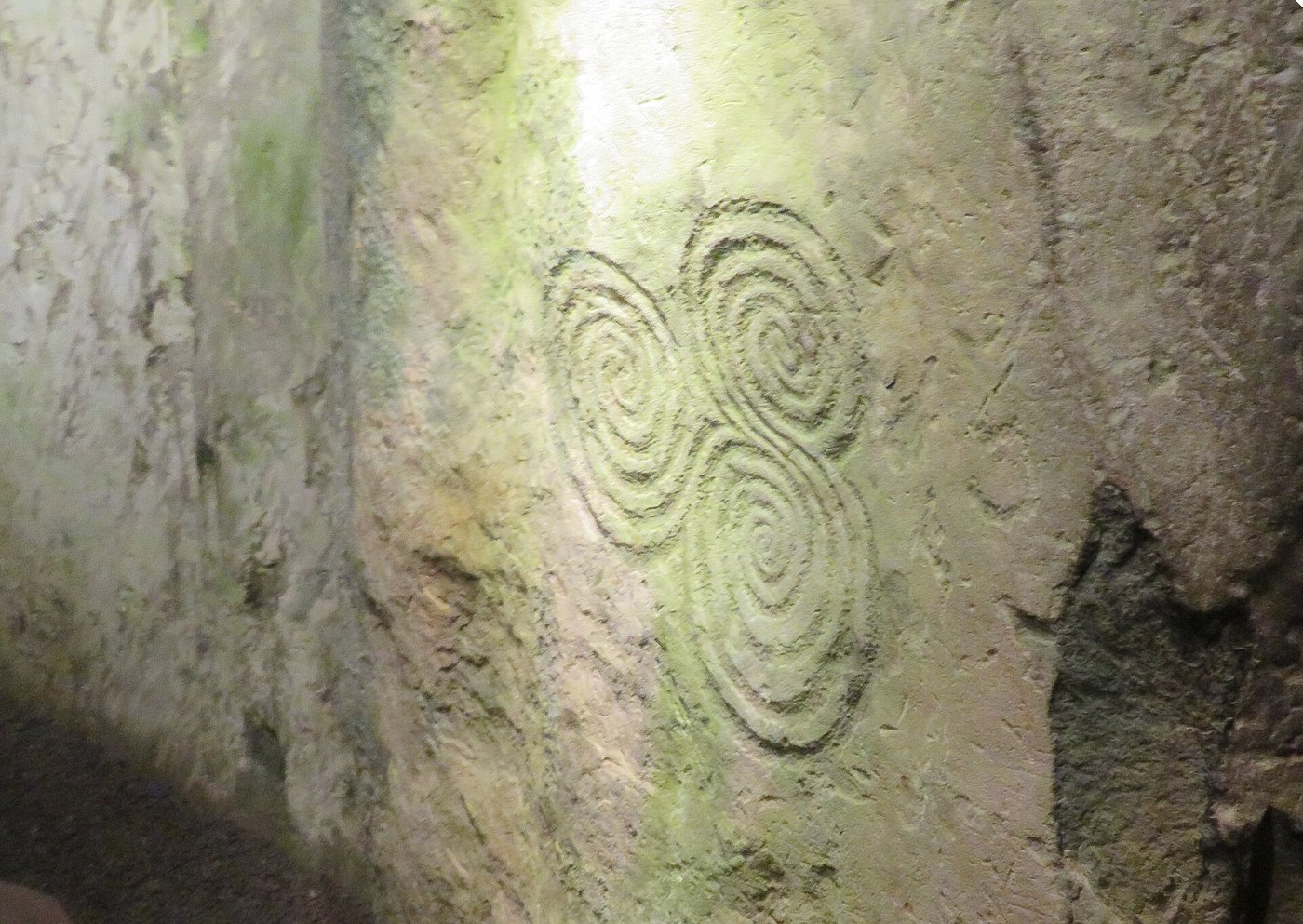
Guesses there have been in plenty. The spirals have been read as the sun and moon, as a diagram of the year, as flowing water, as a sign of death and rebirth to match the returning solstice light. Some see the whole repertoire of Newgrange art (spirals, zigzags, nested arcs) as shapes seen behind closed eyes in trance, the visual static of ritual and altered states. Each reading is plausible and none can be proved. The honest position is the uncomfortable one: the people of the Boyne had something urgent to say in stone, said it with great skill, and the message did not outlive them.
The man in the recess
For a long time the human remains from Newgrange were treated as a footnote: scorched fragments, a few unburnt bones, too little to say much about. Then genetics caught up with them. Among the bones the excavators had lifted from the right-hand recess was the petrous part of a skull, the dense nub behind the ear where ancient DNA survives best, belonging to an adult man who lived around the time the tomb was built. In a study published in 2020, a team led by the geneticist Lara Cassidy read his genome, and found something startling. His parents had been first-degree relatives: a brother and sister, or a parent and child.
Unions that close are among the deepest taboos in almost every human society, and they tend to be tolerated in only one setting: a ruling house so sure of its own difference that it will breed within itself to keep the bloodline pure. It happened among the pharaohs of Egypt, the Inca, and the royal line of ancient Hawaii. Finding the same signature in a man laid in the most elaborate chamber in Neolithic Ireland, the researchers drew the obvious parallel: perhaps Newgrange had been built for, and by, a hereditary elite, a dynasty of god-kings who married their own to set themselves above everyone else, and who commanded the labour that raised the mound.
It made headlines around the world, and a growing number of archaeologists think the story ran far ahead of the bone. In a 2025 paper in the journal Antiquity, Jessica Smyth, Neil Carlin and their colleagues pushed back hard. The incestuous birth is a single case, they note, unlike anything else in the genetic record for Neolithic Ireland, and there is nothing else to support a ruling class: no palaces, no rich houses set apart from poor ones, no sign of the trade, hoards or craft workshops that prop up a royal court elsewhere. The dwellings of these people were modest and much alike; their diets were much alike. It is not even certain the man was laid here as a person of rank; his bones may have been brought to the tomb long after death, by people who no longer knew who he had been. The counter-reading points the other way entirely: towards a society more collective and more equal than a dynasty, one that built its great monument together. One skull cannot decide it, and the argument is very much alive.
The people the stories gave it to
Long before archaeologists arrived, Ireland had its own account of who owned the mound. In the medieval tales, Newgrange is Brú na Bóinne, the dwelling of the Tuatha Dé Danann, the old gods driven underground when mortals took the land. It belonged first to the Dagda, the father-god, and then to his son Aengus, god of youth and love, who won it from his father by a riddle about time. The Boyne itself was a goddess, Boann. The mound was a síd, a doorway into the otherworld, and country people kept a careful distance from it for centuries. They were not wrong about its importance. They were only wrong about its age, by a margin of several thousand years.
Even the name is a latecomer. "Newgrange" has nothing to do with the Stone Age. In the Middle Ages the land here belonged to the Cistercian abbey of Mellifont, and this was one of its outlying farms: a grange. The "new grange" kept its plain farmyard name while the hill sat forgotten under grass, taken for a natural rise or a rabbit warren. Only in 1699 did workmen carting stone away for a local landowner break through to the entrance, and a passing Welsh scholar, Edward Lhwyd, record what lay inside. The tomb that had swallowed the solstice for four thousand years was rediscovered by men hunting for building rubble.
What still comes through
Every December the light comes back. The Irish state now runs a lottery for the handful of places inside the chamber on the solstice mornings; tens of thousands of people enter each year for a few dozen seats, and most who win stand in the dark under a clouded Irish sky and see nothing but grey. On the mornings the weather relents, the same beam O'Kelly watched in 1967 climbs the same passage and fills the same room, and for seventeen minutes the people crowded inside are standing where the dead were laid, in a light aimed at them from across five thousand years.
That is the strange gift of the place. Nearly everything about Newgrange is contested: whether a king lies in it, whether the white wall ever stood, what the spirals were trying to say. The one thing beyond argument is the light. The farmers who built the mound could not write their names, and we will most likely never learn them. But they left a message that needs no translation and keeps no secret. Once a year, on the morning the sun turns back towards summer, the hill still speaks the single sentence it was built to say, and anyone standing in the dark can understand it.
Read next: The Bluestones of Stonehenge: How a Century-Old Argument Was Finally Settled and Trypillia: The 6,000-Year-Old Cities That Burned Themselves Down.
Sources & further reading
- O'Kelly, Michael J., Newgrange: Archaeology, Art and Legend (Thames & Hudson) — the excavator's own account of the digs of 1962–1975 and of the roof-box and solstice discovery.
- Cassidy, Lara M., and others, "A dynastic elite in monumental Neolithic society," Nature (2020) — the genome of the man from the chamber and the incest finding.
- Smyth, Jessica, Neil Carlin, and others, on complexity and collectivity in Neolithic Ireland, Antiquity (2025) — the case against a god-king and a hereditary elite at Newgrange.
- Eogan, George, Knowth and the Passage-Tombs of Ireland — the wider Brú na Bóinne complex and the doubts over the reconstructed quartz facade.
- Stout, Geraldine and Matthew, Newgrange (Cork University Press) — a concise modern survey of the monument, its landscape and its long afterlife in myth.
- Brú na Bóinne Visitor Centre / Office of Public Works — the official account of the site, the solstice lottery and continuing research.
Image credits (via Wikimedia Commons): the reconstructed white quartz facade — fhwrdh (CC BY 2.0); the entrance stone K1 — John37309 (CC BY-SA 4.0); the entrance and roof-box — Allen Karsina (public domain); the triple spiral in the chamber — O'Dea (CC BY-SA 4.0); a kerbstone at the base of the mound — Chad K (CC BY 2.0).