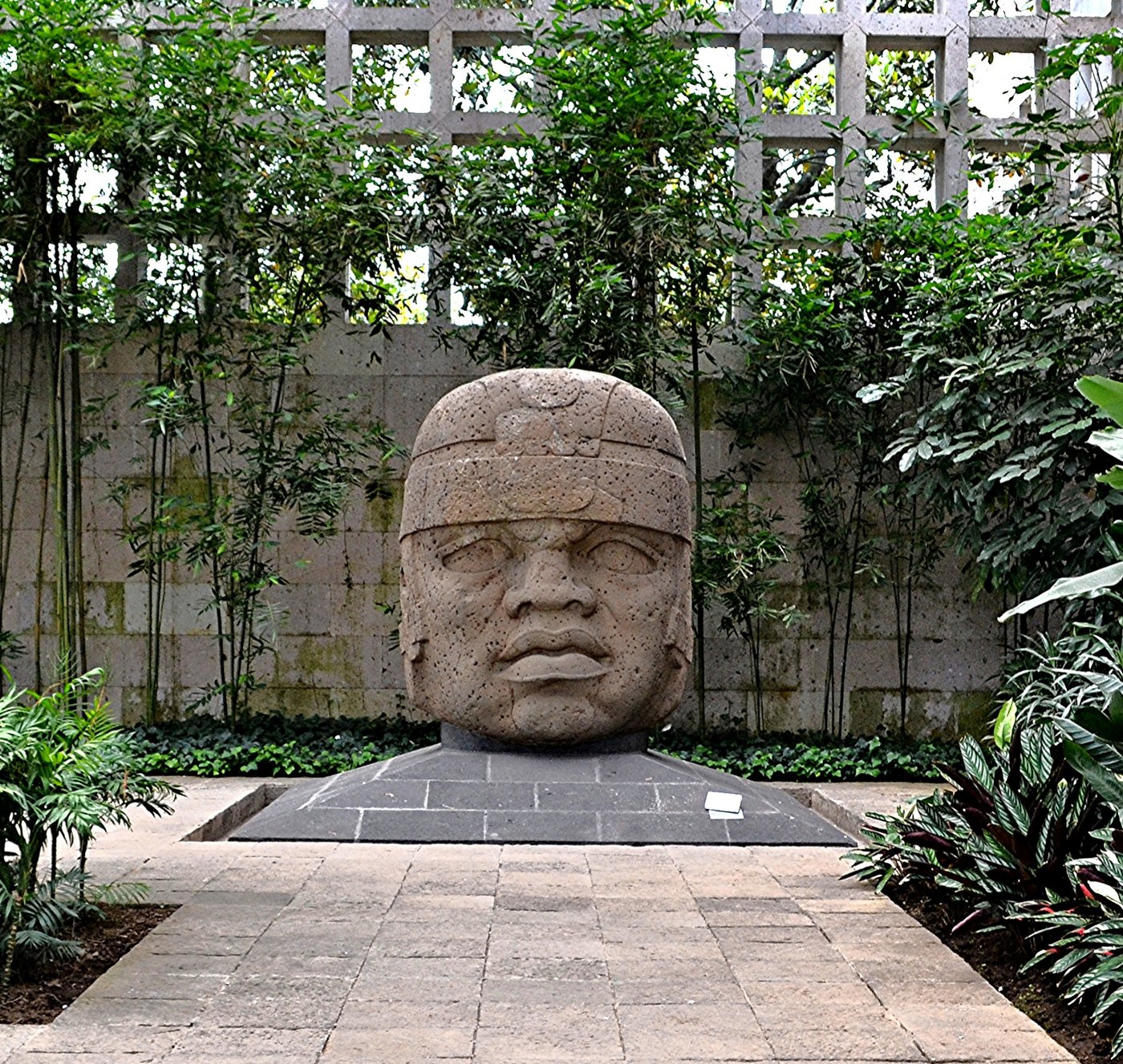
In the winter of 1862, in the cane and forest near the village of Hueyapan in southern Veracruz, a labourer clearing ground for a new field struck the top of something buried and hard. He took it for the base of a great iron kettle turned upside down in the earth and left it alone. Word reached a travelling engineer named José María Melgar y Serrano, who went out to look. What he dug clear of the soil was not a pot. It was a face: a human head carved from dark stone, wider than a man is tall, with heavy lids, a broad nose and a full mouth, staring up out of the ground as if it had been waiting there a very long time. Melgar published a short notice about it, wondered aloud whether it looked African, and moved on. It would be the better part of a century before anyone understood what he had found.
He had found the first of the Olmec colossal heads: seventeen of them now, the oldest monumental portraits ever carved in the Americas. They come from the marshy lowlands along the Gulf of Mexico, from a people who left no writing that we can read and whose real name we do not know. “Olmec” is a borrowed word, Aztec, from many centuries later, and it means something like “rubber people”: a name for a region, not a memory of who lived there. What these people left instead of a history is a set of enormous stone faces, each one different, each one apparently a real man who once had a name. And the closer you look at how they were made, the stranger the story gets. Some of them, it turns out, are not first drafts at all. They were cut down out of something else.
Stone that had no business being there
Begin with the material, because the material is the first shock. The heads are basalt, a coarse, dark, grey-black volcanic rock, and there is none of it where the heads were found. The Gulf lowlands are a country of mud and water: river silt, swamp, sandbars, not a boulder in sight. The nearest source of the right stone is the Tuxtla Mountains, a cluster of old volcanoes rising out of the plain, and in particular a flow of coarse basalt from around Cerro Cintepec. From there to the great Olmec centre at San Lorenzo is more than 150 kilometres in a straight line, and nobody moving forty tonnes of rock gets to travel in a straight line.
So the first thing every head announces, before you have read a single feature of its face, is effort on a civic scale. Someone chose a block of stone the weight of a loaded lorry, and someone organised the moving of it across a hundred and fifty kilometres of forest and floodplain, and someone fed and directed the crews who did it, and all of this happened more than three thousand years ago, in a society with no wheels that carried loads, no horses, no oxen, no iron tools. The head is the visible end of an invisible machine: a whole society bent, for a while, to the task of dragging a mountain to a king.
Seventeen faces, and no two the same
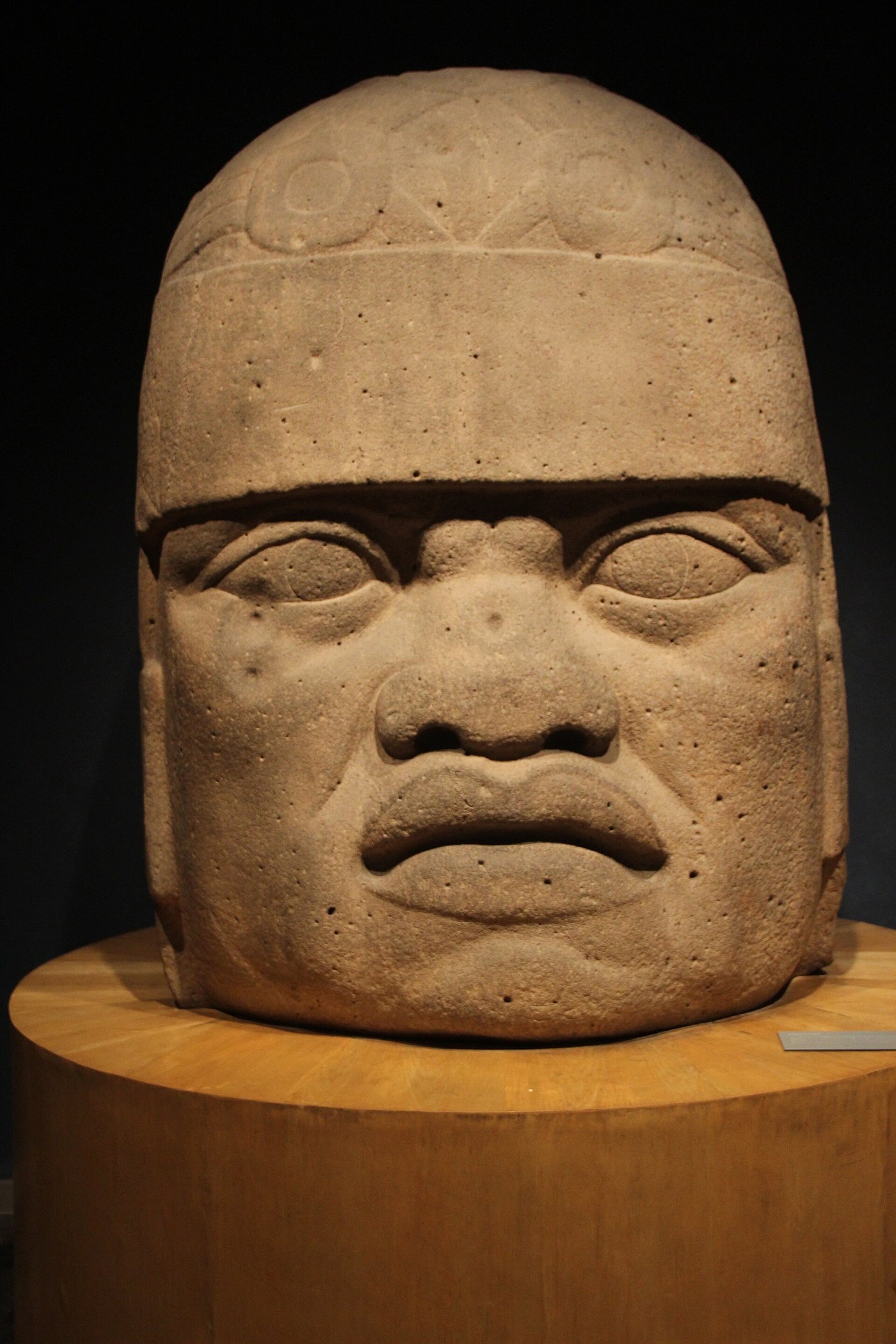
They are not a set in the way statues on a temple are a set. Line up photographs of all seventeen and the first thing you notice is how individual they are. One has a long, sad face and downturned mouth; another is round-cheeked and almost cheerful; a third is lean, hard, tight-lipped, the face of a man you would not argue with. The eyes differ, the noses differ, the way the lips sit differs. These are not a god repeated to a formula. They read as portraits (frank, unflattering, particular) of specific people the sculptors had actually seen.
The best guess, and it has held up well, is that each head is a ruler. Every one wears a close-fitting headdress, something like a leather or cloth helmet, often with straps under the chin and a band or ornament across the brow, and no two headdresses are decorated alike. The markings on them may have worked like emblems or names, a way of saying which king this was. For a long time people thought the helmets meant the heads showed players of the Mesoamerican ballgame, that brutal ritual sport played with a heavy rubber ball. That idea has faded. The likelier reading now is that these are the rulers themselves, sometimes dressed for the ballgame because the game was a royal and sacred act, not a pastime. To carve a man this size, in this stone, at this cost, you had to be the person who ran the world.
The seventeen are spread across four places. Ten come from San Lorenzo, the earliest of the great Olmec centres, at its height around 1200 to 900 BC. Four come from La Venta, the centre that rose as San Lorenzo declined. Two come from Tres Zapotes, where Melgar's kettle turned out to be a face. And one, the giant of the family, comes from a ranch called La Cobata: it stands about 3.4 metres tall and weighs something near forty tonnes, its features only half-finished, as though the carvers stopped partway and it was raised anyway.
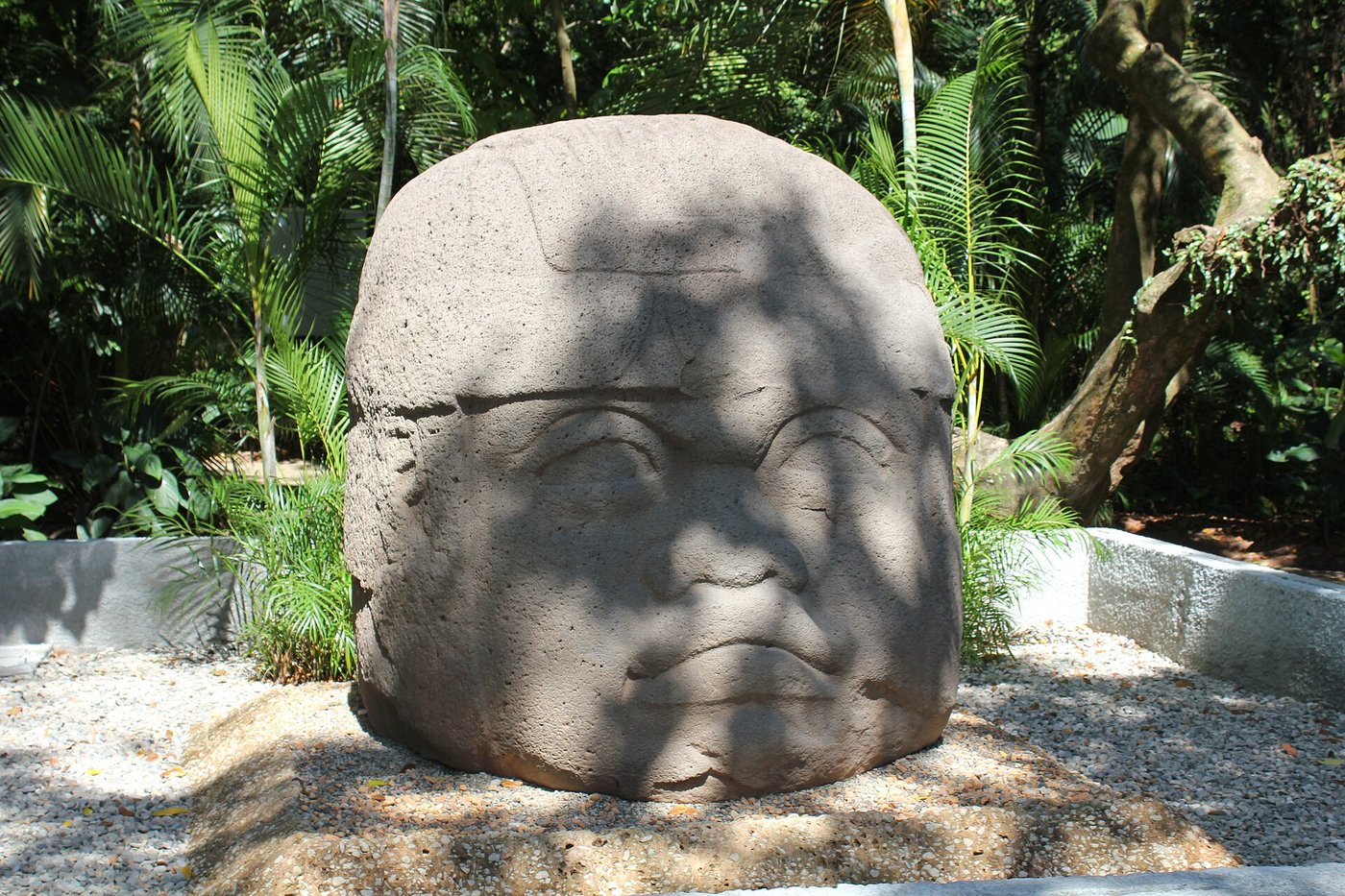
The heads run from about 1.5 metres to 3.4 metres tall and from roughly six to forty-five tonnes in weight. The smallest, San Lorenzo Head 4, still weighs six tonnes, the mass of a large elephant. Every one was cut from a single block of basalt quarried in the Tuxtla Mountains and moved more than 150 kilometres to where it was set up. There is no local stone. Each head is, in effect, a piece of a distant volcano, carried by hand across a landscape with no hard rock in it at all.
How you move a mountain with no wheel
Nobody watched the Olmec do it, so the moving has to be reconstructed from clues, and the clues are good. The favoured picture goes like this. A block was quarried in the mountains, probably roughed out on the spot to shed weight before the journey. It was then dragged, most likely on wooden sledges over rollers, down to a navigable river. From there it went by water (on rafts, or lashed between canoes) for as much of the trip as the rivers allowed, because water does the heavy lifting that muscle cannot. Only at the end, hauling the block up from the riverbank to the ceremonial ground, did it come back onto land, onto ramps and causeways built for the purpose.
Two small Olmec carvings seem to show exactly this: a figure seated on a great rectangular block, riding it, a person of rank overseeing the move. Moving the stone was not a job you handed to a work gang and forgot. It was an event, and the ruler, or his image, went with the stone. That fits the scale of the thing. A single head could take hundreds of people weeks or months to bring home, and the bringing was as much a part of its meaning as the carving. The head did not only show a king. Fetching it proved one.
The carving itself was done with stone. The Olmec had no metal tools. They shaped the basalt by battering and grinding it with harder hand-held stones, then smoothed and polished the surface, working the deep-set eyes, the drilled corners of the mouth, the raised bands of the headdress, all of it by abrasion. On some heads you can still see the faint pitting of the pounding under the polish. It is slow, patient, unforgiving work, and a single wrong blow on a face this size cannot be undone. Which makes the next discovery all the more surprising, because it turns out that at least some of these faces are corrections, carved over the top of something that was there before.
Recarved from a throne
Look at the back and sides of one or two of the San Lorenzo heads and you find something that should not be there: flat panels, and the ghosts of a rectangular niche, the kind of recessed opening that belongs not on a head at all but on an Olmec throne. The Olmec built massive stone thrones: low, table-like blocks, often carved on the front with a niche in which a seated ruler was shown emerging, as if from a cave or the mouth of the earth. These were the seats of living power. And the evidence on the stone says that certain colossal heads were carved out of old thrones: the throne was taken down, turned on its side, and reworked into the portrait of a face.
The clearest reading of this belongs to the scholar James Porter, who pointed out that the traces are unmistakable. A throne with a niche on its front, tipped and recut, leaves exactly the kind of scarring these heads carry. If he is right (and the physical evidence is hard to argue with), then the sequence is heavy with meaning. A ruler sat on his throne and ruled. When he died, or when his line fell, the throne itself was pulled down and remade into his likeness, or into the likeness of the man who replaced him. The monument that meant “this is where power sits” became the monument that meant “this is the man himself.” Nothing about that is casual. In a world where a single block of basalt cost a hundred and fifty kilometres of labour, you did not waste stone, and you certainly did not destroy the throne of a king unless the destroying was the purpose.
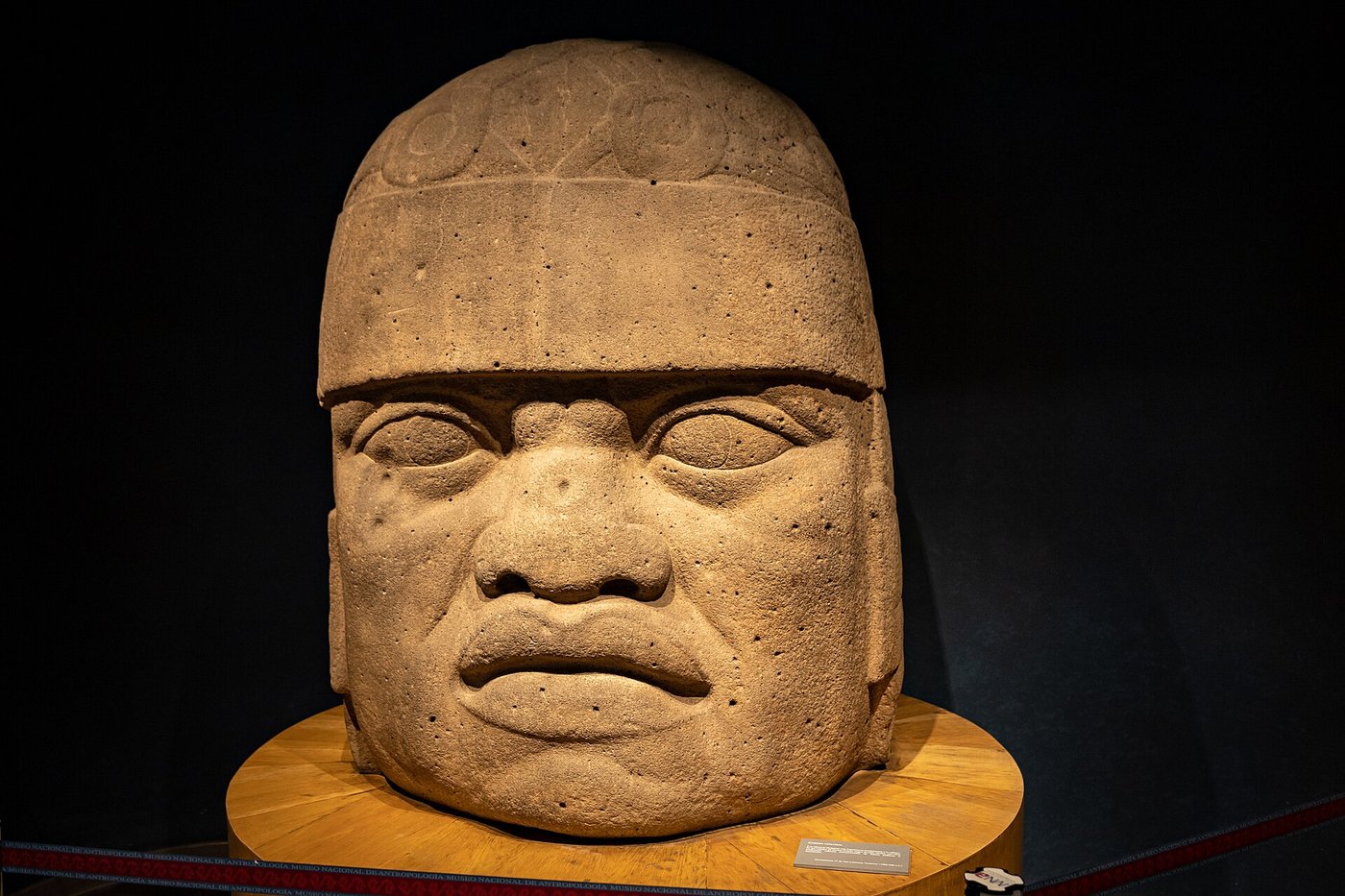
Not everyone agrees on how common the recarving was, or on the order of events. Some see clear proof that particular heads were made from thrones and take it as a rule of thumb for the rest; others caution that only a couple of heads carry unambiguous traces, and that most may have been carved straight from fresh blocks. The dating is too coarse to settle it: the whole run of heads was made within a window of perhaps a century or two, and telling which monument came first from style alone is treacherous. What is agreed is the direction of the change where it can be seen: throne into head, seat of power into portrait, and never the other way round. Whatever the exact numbers, the Olmec were willing to un-make one kind of monument to make another.
The heads that were attacked
If the recarving hints that these objects had a life and could be remade, the state some of them were found in says the same thing louder. Several heads are damaged in ways that are plainly deliberate. San Lorenzo Head 2 has more than sixty small hollows and a couple of larger holes cut into it. Head 9 has nine pits gouged into the face and headdress. One of the La Venta heads had its upper lip and part of its nose knocked away on purpose. These are not the random chips of a fall or the erosion of weather. Someone took the trouble to attack the stone.
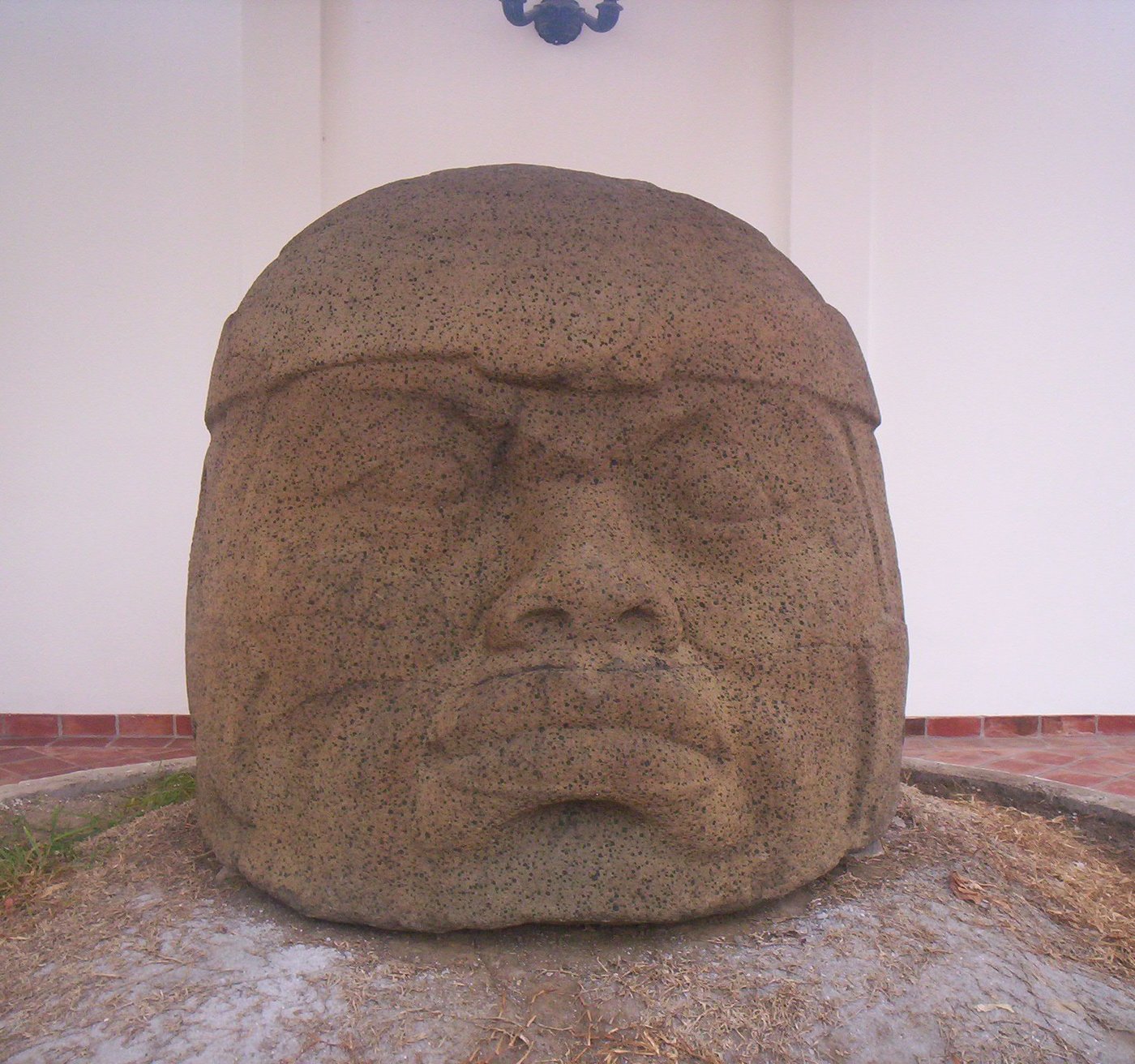
And many of the heads were buried: laid down and covered over in antiquity, sometimes in lines, alongside other broken monuments. At San Lorenzo a whole run of sculpture was defaced and interred around 900 BC, roughly when the centre lost its dominance. There are two broad ways to read this. One is desecration: a new order, or an enemy, striking down the images of the old rulers, killing them a second time in stone. The other is ritual: the Olmec themselves “retiring” a monument when its ruler died or his time ended, wounding it and putting it to rest with proper care, as you might a body. The pitting on some pieces may even have been an attempt to reclaim the precious basalt, drilling out cores of workable stone. Most likely all three things happened, at different heads and different times. What is clear is that these faces were not simply set up and admired. They were used, honoured, remade, attacked and buried, treated, from start to finish, as if they were alive.
The colossal heads have African faces, the argument goes, with broad noses and full lips, and so they prove that Africans crossed the Atlantic in ancient times and founded, or taught, the first civilisation of Mexico. Melgar said as much in 1862, and the claim was revived in the twentieth century and still circulates online.
They are portraits of local rulers, and the features are simply the features of the people who lived there, the same range of faces you can see in the region today. Broad noses and full lips are not the property of one continent. There is no African material culture anywhere in the Olmec world: no African crops, tools, pottery, burials or writing, nothing that a transatlantic founding population would have brought and left. And the genetics are decisive. The first peoples of the Americas descend from populations related to ancient North Asians who came by way of the far north, not from Africa across the Atlantic. Mainstream archaeologists, among them Richard Diehl and Ann Cyphers, who have spent careers in the Olmec heartland, do not take the idea seriously. The heads are magnificent, and they are entirely, locally, Mexican.
The men in the stone
Push past the puzzles (how the stone got there, whether a throne came first, who broke the noses) and you are left standing in front of the thing itself: a face. That is what unsettles people about the colossal heads, more than their size. A pyramid is architecture; you can admire it without feeling watched. These are individuals. Somebody with real cheeks and a real jaw sat, or was remembered clearly enough to sit, while a sculptor read his face and cut it into a rock that would outlast every soft thing about him by three thousand years. We have his portrait and not his name. We have the exact set of his mouth and no idea what language it spoke.
The archaeologist Ann Cyphers, who has worked the ground at San Lorenzo for decades, has argued that the heads were not fixed idols but part of a living landscape of power, set up, moved, re-carved and taken down as the fortunes of rulers rose and fell. That is the truest thing to hold on to. The Olmec did not make these faces to be timeless. They made them to do a job in their own present: to say who ruled, at a scale no one could miss, out of a stone no one else could get. That the job is over, and the names are gone, and the faces remain, is not the story the Olmec meant to tell. It is only the one the basalt was able to keep.
Seventeen men, then, staring up out of the mud of the Gulf coast, most of them found by accident, one of them first mistaken for a cooking pot. We know the weight of them to the tonne and the source of their stone to the hillside. We know they were carved, some of them, over the wreck of a throne, and buried, some of them, with their faces smashed. The one thing the Olmec could tell us plainly, who these people were, is the one thing they never wrote down, and the one thing the stone cannot say.
Read next: Teotihuacan: The City Whose Builders Left No Name and Mont'e Prama: Sardinia's Stone Giants, Smashed and Buried for 2,800 Years.
Sources & further reading
- Richard A. Diehl, The Olmecs: America's First Civilization (Thames & Hudson, 2004) — the standard general account of Olmec culture and its monuments.
- Ann Cyphers, published excavation reports and studies on San Lorenzo Tenochtitlán and its colossal sculpture.
- James A. Porter, “Olmec Colossal Heads as Recarved Thrones,” RES: Anthropology and Aesthetics (1989), on the evidence for reworking thrones into heads.
- Beatriz de la Fuente, Los hombres de piedra: escultura olmeca (Universidad Nacional Autónoma de México), a catalogue and analysis of Olmec stone sculpture.
- Matthew W. Stirling, reports in National Geographic and Smithsonian bulletins on the 1938–1946 expeditions that opened Olmec archaeology.
Image credits (via Wikimedia Commons): Olmec head No. 1, Xalapa — Mesoamerican (CC BY-SA 4.0); colossal head from San Lorenzo — Gary Todd (CC0); La Venta colossal head, Villahermosa — Arian Zwegers (CC BY 2.0); San Lorenzo Head 6 — Oren Rozen (CC BY-SA 4.0); colossal head in museum — ST-Historia (CC BY-SA 4.0).